

Zinc Supplement with or Without Food: A Practical Guide
You're standing in the kitchen with a zinc capsule in one hand and breakfast in the other, wondering whether taking it now will help or just leave your stomach complaining. The practical answer isn't “always with food” or “always without.” It depends on whether you tolerate zinc fasting, what's on your plate, and whether you're taking anything that needs to be spaced from it.
My recommendation is straightforward: try zinc with water before breakfast if your stomach handles it. If it causes nausea, take it with a low-phytate meal instead. Then check the supplement form, the elemental zinc amount, and medication timing before settling into a routine.
Table of Contents
- Why the Food Question Is the Wrong Starting Point
- Fasting vs. Fed Absorption and What the Numbers Actually Mean
- Which Food You Eat Matters More Than You Think
- Matching Zinc Form to Your Schedule and Tolerance
- Building Your Daily Zinc Routine Step by Step
- Two Real Weekly Routines You Can Copy
- Quick Checklist and the Disclaimer You Should See
Why the Food Question Is the Wrong Starting Point
Use this quick decision snapshot before you take a dose:
- Do you tolerate zinc on an empty stomach? If yes, try it before breakfast. If it makes you nauseated or unsettles your stomach, take it with food.
- What's in your meal? A light mixed meal isn't the same as a bowl built around whole grains, beans, nuts, or seeds.
- What else are you taking? Iron supplements and some medications need separation from zinc.
That's a better starting point than arguing over whether food is universally good or bad for absorption. Fasting can favor absorption, but it isn't useful if it makes you feel sick or turns a daily routine into something you keep skipping. Tolerability matters because the routine you can repeat is more useful than an idealized schedule you abandon.
The supplement label also deserves a close look. Compare the elemental zinc amount, not the total weight of zinc gluconate, citrate, or another zinc salt. And consider your total intake from supplements, multivitamins, and fortified foods, rather than treating one bottle as the whole picture.
There's a reason supplement language often says that an ingredient “supports” a normal function or “plays a role” in it. In the United States, those are structure/function claims, and the FDA requires them to be truthful, not misleading, and supported by substantiation. Manufacturers also have to use a standard disclaimer and notify the FDA after first marketing a product with such a claim, as explained in the FDA's structure/function claim guidance.
Ignore blanket rules. Start with your stomach, your meal, and your other supplements or medications. That decision stack gives you a routine built around real trade-offs, not a slogan.
Fasting vs. Fed Absorption and What the Numbers Actually Mean
If your only goal is to maximize absorption, fasting is the stronger starting point. In a 10-person kinetic study of 45 mg oral zinc gluconate, taking zinc with a standardized light meal delayed absorption, lowered peak serum exposure by about 31%, and reduced total exposure, measured by area under the curve, by about 28%. The investigators described the overall bioavailability reduction as moderate, and measurements taken later were closer to baseline kinetics (study details).
Those percentages describe measured exposure in a small study using a particular dose and form. They don't tell you exactly what you'll feel, and they don't mean a fed dose is wasted. Someone taking a lower dose or a different zinc form shouldn't treat these figures as a precise prediction of their own response. The useful takeaway is narrower: a meal can slow and reduce measured zinc exposure, so fasting is a reasonable choice when you tolerate it and absorption is your priority.
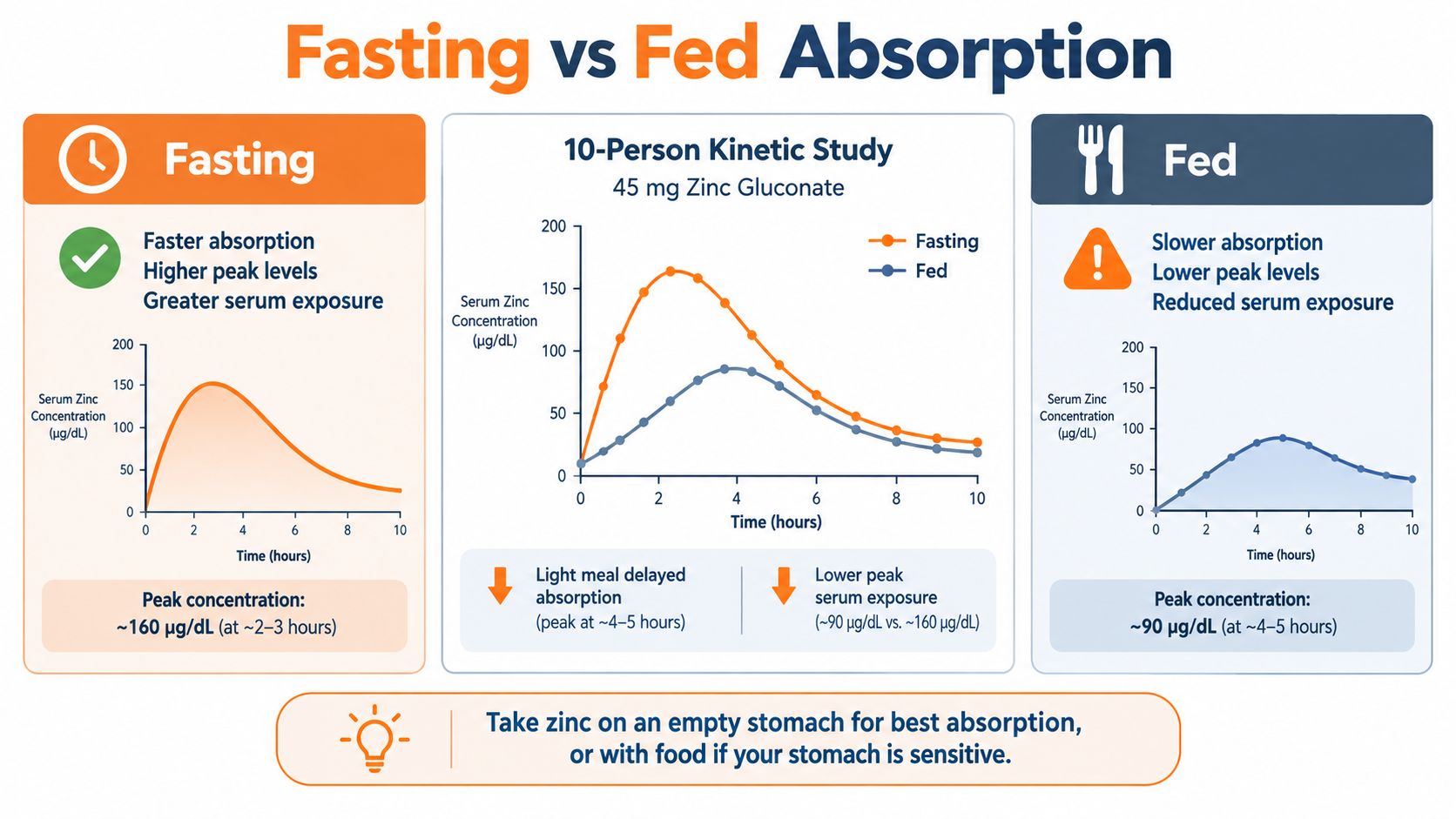
But serum peaks aren't the same thing as every downstream biological effect. An NIH review discusses a comparison in healthy men taking 25 mg zinc gluconate fasted or with breakfast. The fed dose produced a greater effect on essential-fatty-acid desaturation than the fasted dose. That finding doesn't prove that taking zinc with food is better overall; it shows why a higher peak absorption measurement shouldn't be treated as a universal measure of biological impact.
Practical rule: Choose fasting for the absorption advantage if your stomach tolerates it. Choose food if fasting causes discomfort, and don't confuse a lower measured peak with a dose that has no effect.
In short, fasting generally wins on raw absorption, but it doesn't automatically win on comfort, consistency, or every measure of function. For more on how the food and supplement context can shape uptake, see this guide to supplement bioavailability.
Which Food You Eat Matters More Than You Think
“Take zinc with food” is incomplete advice. The meal matters. Phytate, found in foods such as whole grains, legumes, nuts, and seeds, can bind zinc in the gut and make it less available for absorption. A meal that eases nausea may therefore be a poor pairing if it's dominated by high-phytate ingredients.
A review of studies involving phytic-acid-rich foods found compromised zinc bioavailability in 13 of 17 studies. A 2025 review also describes zinc absorption as dependent on the food matrix: phytates can reduce availability, while proteins, peptides, and amino acids can increase it (review of food effects and zinc absorption).
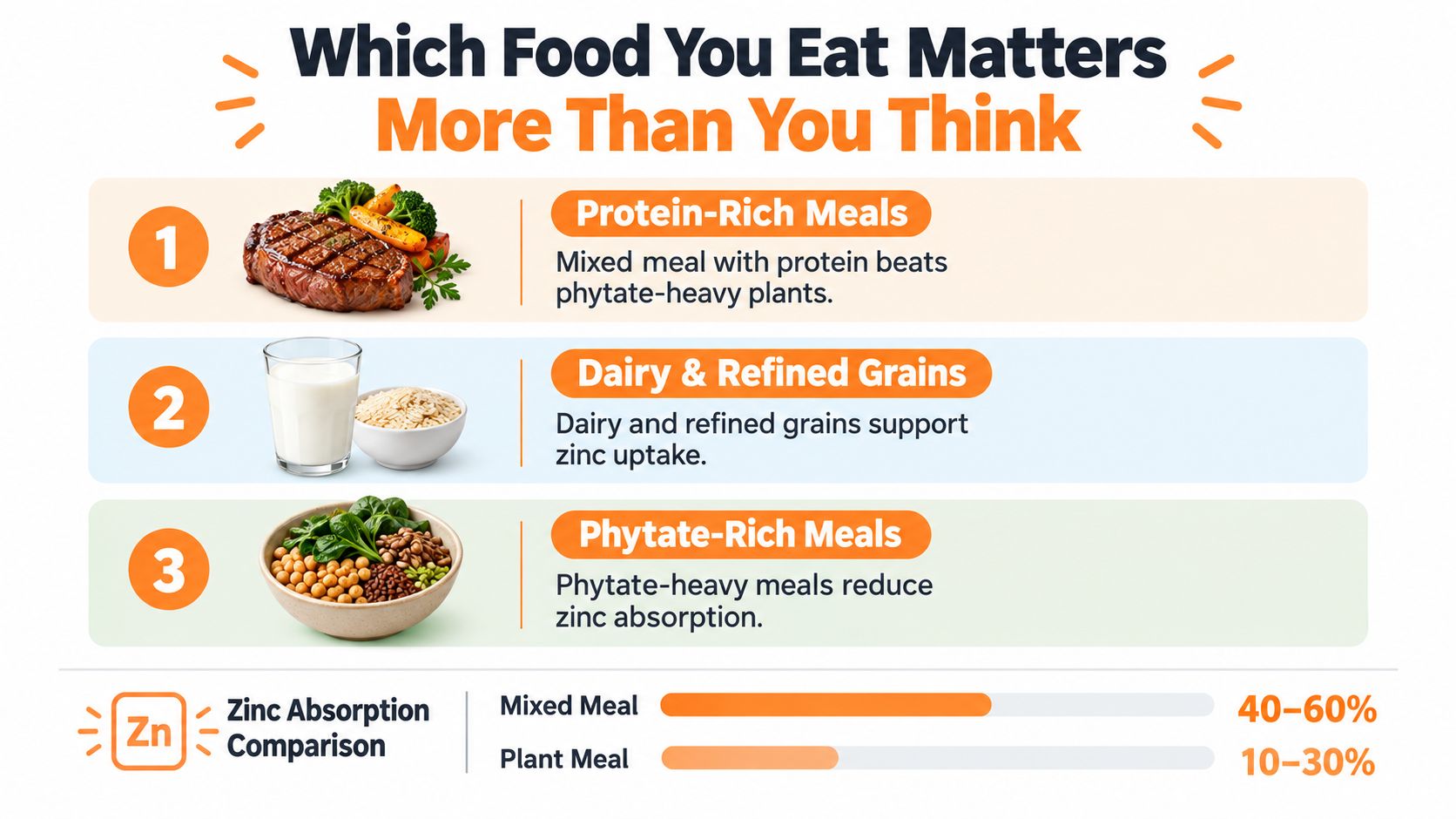
The practical distinction is between using a modest meal to improve comfort and taking zinc alongside the most phytate-heavy meal of your day. These patterns can make poor companions for a zinc dose:
- Whole-grain or bran breakfast: Cereal or whole-grain bread can bring a substantial amount of phytate with it.
- Bean-and-lentil bowl: Legumes are nutritious, but a meal centered on them may be a less suitable time for a zinc supplement.
- Trail-mix-style snack: Nuts and seeds can turn a quick snack into a high-phytate pairing.
- High-fiber grain bowl: Whole grains, seeds, and legumes together make this a meal to separate from zinc when practical.
If you need food to tolerate zinc, choose a light mixed meal rather than automatically taking it with a plant-heavy bowl. If your lunch is built around legumes or whole grains, take zinc at another time, such as before breakfast if that works for you. A roughly two-hour gap from a major phytate-rich meal is a conservative practical approach, not a guarantee of a specific absorption result.
For plant-forward eating ideas and zinc-rich foods, see this guide to foods that contain zinc. The point isn't to avoid nutritious plant foods. It's to place the supplement where your meal composition and tolerance aren't working against each other.
Matching Zinc Form to Your Schedule and Tolerance
Zinc form can influence absorption, but don't buy a form based on a promise that it will solve every timing problem. A small comparison in 15 adults reported absorption of about 61.3% for zinc citrate, 60.9% for zinc gluconate, and 40.9% for zinc oxide, as summarized in the review above. Those figures are a limited comparison, not a guarantee of how a particular person will respond.
| Form | Approx. absorption | Tolerability | Best use |
|---|---|---|---|
| Citrate | About 61.3% in a small adult comparison | Often used as a practical option; individual tolerance varies | A straightforward choice for a fasting trial or a light mixed meal |
| Gluconate | About 60.9% in a small adult comparison | Commonly used; food may help if it unsettles your stomach | A workhorse option, including with a light meal |
| Oxide | About 40.9% in a small adult comparison | May suit some people better with food | Consider the form and label carefully rather than choosing by salt weight |
| Picolinate | No percentage established here | Tolerance varies by person | A fasting protocol if the label and your experience suit it |
| Bisglycinate | No percentage established here | Often chosen by people looking for a gentler-feeling option, but individual results vary | A fasting trial or meal-time dose based on personal tolerance |
Don't read the table as proof that picolinate or bisglycinate absorbs better, or that either is always gentler. The cited comparison provides figures for citrate, gluconate, and oxide, not a head-to-head absorption result for every form listed. Picolinate is popular among people who prefer fasting protocols, and some choose bisglycinate when they're sensitive, but those preferences don't replace your own response.
Label check: Compare the amount of elemental zinc per serving, not the total weight of the compound. Salt weight isn't the amount of zinc your label is declaring as elemental zinc.
If nausea is the main problem, consider gluconate or citrate with a light mixed meal before concluding that you need an entirely different product. If you tolerate fasting well, citrate, gluconate, picolinate, or bisglycinate may fit a before-breakfast routine according to the product label and your experience. For a closer look at how forms are commonly compared, see this guide to zinc options for men.
Building Your Daily Zinc Routine Step by Step
A repeatable routine starts with the label, not the clock. Read the elemental zinc amount per serving and add zinc from your other supplements and fortified foods. The adult tolerable upper intake level is 40 mg per day from all sources; clinical references also flag doses above 50 mg per day as a gastrointestinal-risk range (clinical reference on zinc dosing and safety).
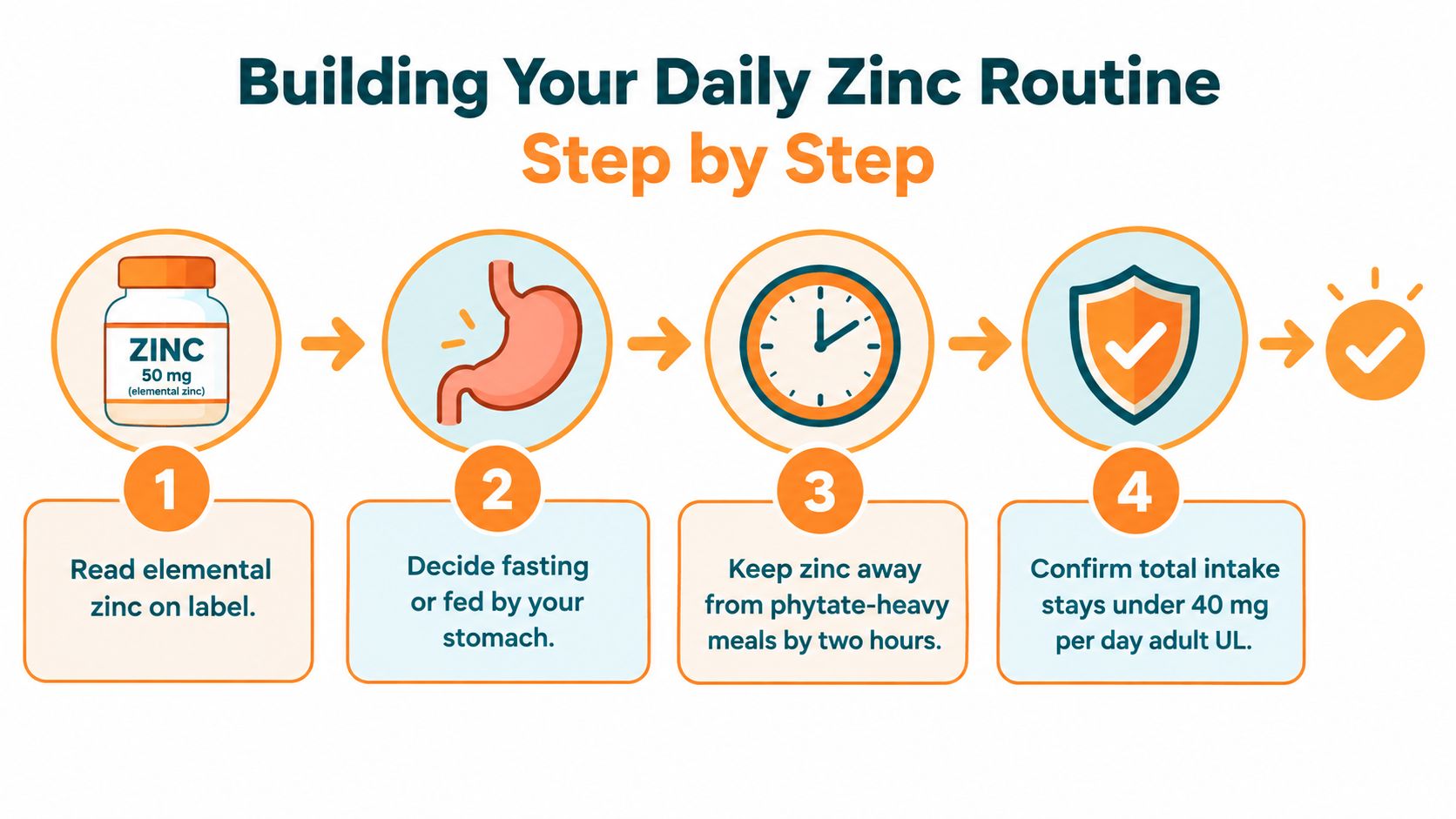
Set the timing around your stomach
- Start with water, about 30 minutes before breakfast, for several days if fasting seems comfortable.
- If nausea or stomach discomfort appears, move the dose to the middle of a low-phytate meal or take it immediately afterward.
- If symptoms continue even with a low dose and food, stop experimenting and ask a clinician or pharmacist whether the product and dose make sense for you.
Build in medication and mineral spacing
Keep zinc separate from iron supplements and major phytate-rich meals by at least two hours when practical. Zinc can also interact with quinolone and tetracycline antibiotics and with penicillamine. For those antibiotics, official U.S. guidance recommends taking zinc at least two hours before or four to six hours after the antibiotic; separate zinc from penicillamine by at least one hour. Check the specific medication instructions with a pharmacist, especially if your schedule makes those windows difficult.
Don't force all capsules into a fasting window just to chase a theoretical peak. For a three-capsule product, the useful benchmark is a schedule you can repeat that respects the labeled elemental-zinc dose and your stomach. If you're assessing a product that contains zinc among its ingredients, SEMEX is one example to check against its own label and your total daily intake.
Pick a consistent time and meal context, then keep it steady for 30 days before judging how well the routine fits your habits. That's a consistency checkpoint, not a promise of a particular result.
Two Real Weekly Routines You Can Copy
The following schedules are examples, not reports of specific people or case studies. Keep the same labeled elemental dose and product form throughout, and adapt the timing to your meals and any medication instructions.
Routine A for someone who tolerates fasting
- Monday through Friday: Take the dose with water 30 minutes before breakfast.
- Saturday: Take it before a protein-forward brunch if breakfast is later than usual.
- Sunday: Keep it away from a low-phytate lunch with a two-hour buffer if that timing suits your day.
This routine is simple because the user tolerates zinc before eating. It also avoids taking the dose alongside a large whole-grain, legume, nut, or seed meal. If fasting starts causing nausea, there's no prize for sticking with the schedule: move to a light mixed meal and see whether that resolves the problem.
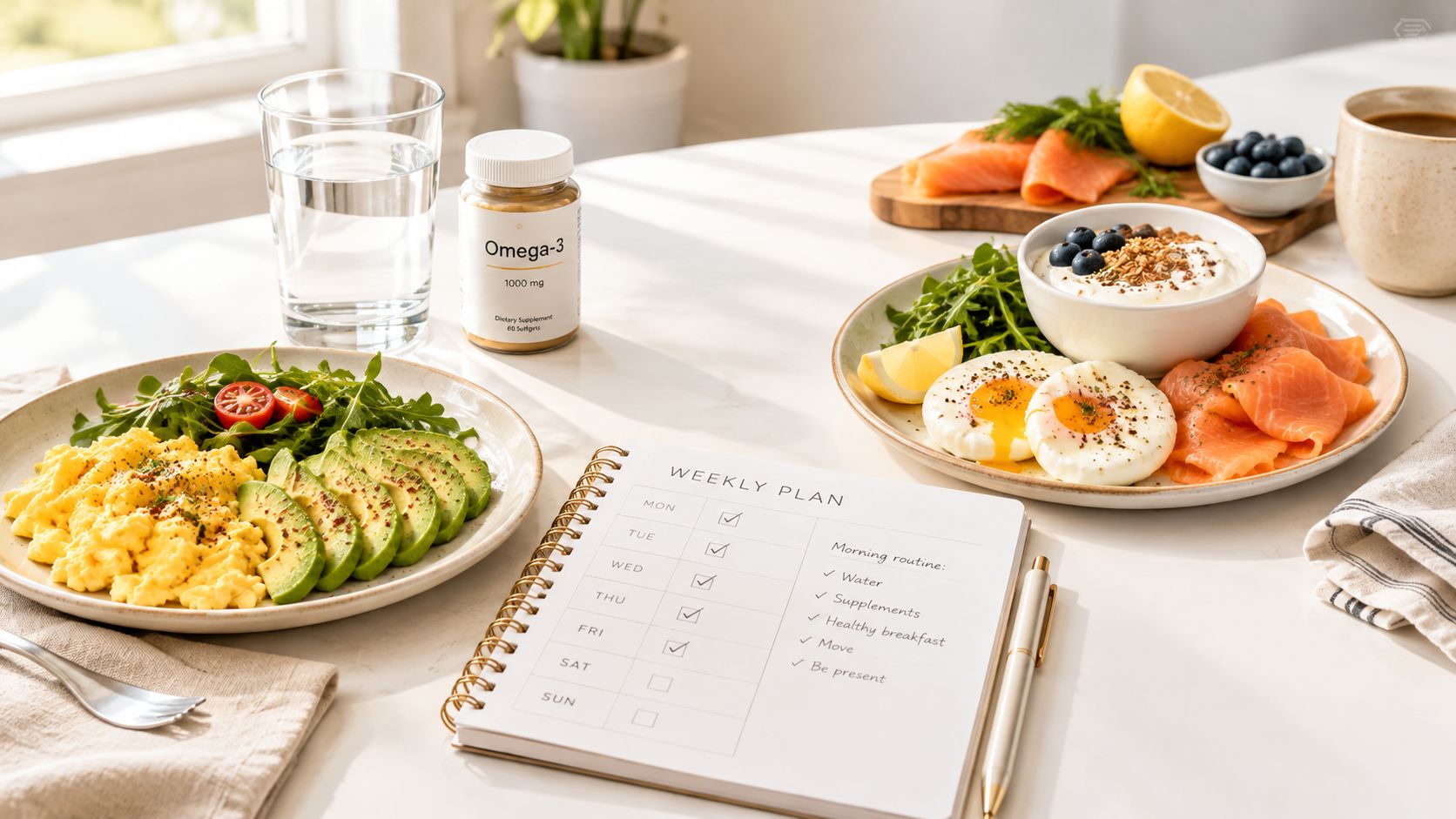
Routine B for someone prone to nausea
Take the dose while seated in the middle of a light mixed meal on weekdays. If dinner is protein-forward and lower in phytate, a post-dinner slot may be more comfortable. On a legume-and-rice night, don't force the supplement into that meal; use a separate time that respects the spacing guidance, or check with a clinician or pharmacist about how to handle a missed dose rather than doubling up.
The two schedules can use the same product and labeled elemental dose while fitting different stomachs and daily routines. Neither requires chasing a perfect window at the cost of missed doses.
Watch for nausea, abdominal discomfort, or diarrhea, and review your full intake if you're combining zinc with a multivitamin or other supplements. If you take medication that may interact with zinc, have a health condition affecting absorption, or are considering a high dose, ask a clinician or pharmacist to help set the schedule.
Quick Checklist and the Disclaimer You Should See
Before you take zinc, check the whole setup:
- Read the label: Compare elemental zinc per serving, not the weight of the zinc compound.
- Choose fasting or fed by tolerance: Try water before breakfast if it feels fine; use a low-phytate meal if fasting causes discomfort.
- Check the meal: Keep zinc away from phytate-heavy meals by about two hours when practical.
- Space other supplements and medication: Separate zinc from iron and follow clinician or pharmacist guidance for antibiotics and penicillamine.
- Check the total: Keep daily zinc under the adult upper intake level of 40 mg from all sources, unless a clinician is supervising a different plan.
For more on symptoms that can matter when adjusting a routine, read about zinc supplement side effects.
These statements have not been evaluated by the Food and Drug Administration. This product is not intended to diagnose, treat, cure, or prevent any disease.
The best zinc routine is the one you can repeat without nausea or a stacking mistake, not the one with the highest theoretical peak.
SEMEX is a daily supplement for men that combines zinc and other ingredients in a capsule formula. If you're comparing supplements while refining your zinc routine, visit SEMEX and review the product details and label.