

Zinc Supplement with Copper: A Practical Guide to Balance
You're standing at the kitchen counter with three bottles open, trying to do simple math that shouldn't be this hard. Your multivitamin has zinc. Your zinc capsule has more zinc. Your men's blend has zinc and, in smaller print, copper. You're not wondering whether zinc matters. You're wondering whether that copper line is doing real work, or whether it's just there to make you feel better about taking zinc every day.
That question has a clear answer, but it's not the one printed on most labels. A zinc supplement with copper makes sense for a specific reason, and it stops making sense when the total zinc dose gets out of hand. Judge the whole stack, not one bottle.
Table of Contents
- Why Pairing Zinc With Copper Even Comes Up
- How Zinc and Copper Compete Inside the Body
- Upper Limits and Reference Doses Explained
- Common Zinc-to-Copper Ratios in Commercial Formulas
- Why a Single Ideal Ratio Does Not Exist for Everyone
- How to Read a Zinc-Copper Supplement Label
- Practical Recommendations by Reader Situation
Why Pairing Zinc With Copper Even Comes Up
Most men don't go looking for copper. They go looking for zinc because zinc supports normal male reproductive function, immune function, and testosterone metabolism, then they notice copper sitting next to it on the label and start asking why. If you want the background first, read about what zinc actually does in the body before you judge any formula built around it.
The pairing exists because zinc and copper are physiologically linked minerals. They don't operate in separate lanes. When zinc intake stays modest, that link rarely becomes a practical problem. When zinc intake climbs and stays high for weeks or months, copper absorption can suffer, and that's when a formula that only adds more zinc starts to look incomplete.
The Cabinet Problem Nobody Adds Up
Your real exposure rarely comes from one product. It comes from a stack you built one purchase at a time, often for different reasons.
- A daily multivitamin: You take it for general coverage, and it already contributes zinc.
- A standalone zinc capsule: You added it for reproductive or immune support, sometimes without checking the multivitamin.
- A men's fertility or performance blend: It may add a third dose of zinc on the same day.
- Cold lozenges and fortified drinks: You use them seasonally, but they still count toward daily intake while you're using them.
None of those choices is unreasonable on its own. The problem is that nobody totaled them. Men building fertility, performance, or immune stacks are exactly the readers most likely to search for a zinc supplement with copper, because they're the ones layering products. Long-term zinc users search for it too, usually after reading that high zinc intake can interfere with copper status.
The question to ask: Not "does this bottle contain copper," but "how much elemental zinc am I getting from everything, and for how long?"
The U.S. National Institutes of Health's Office of Dietary Supplements reports that zinc can inhibit copper absorption in the intestine, with changes in a copper status marker observed at intakes around 60 mg per day for as little as 10 weeks. That finding is why copper shows up in zinc formulas at all. It's also why copper on a label shouldn't end your evaluation. It should start it.
You'll get more value from a framework than from a promised perfect ratio. By the end of this guide, you should be able to pick up any bottle in your cabinet, read the elemental zinc and copper amounts, add up your other sources, and decide whether the formula fits routine use or needs a closer look.
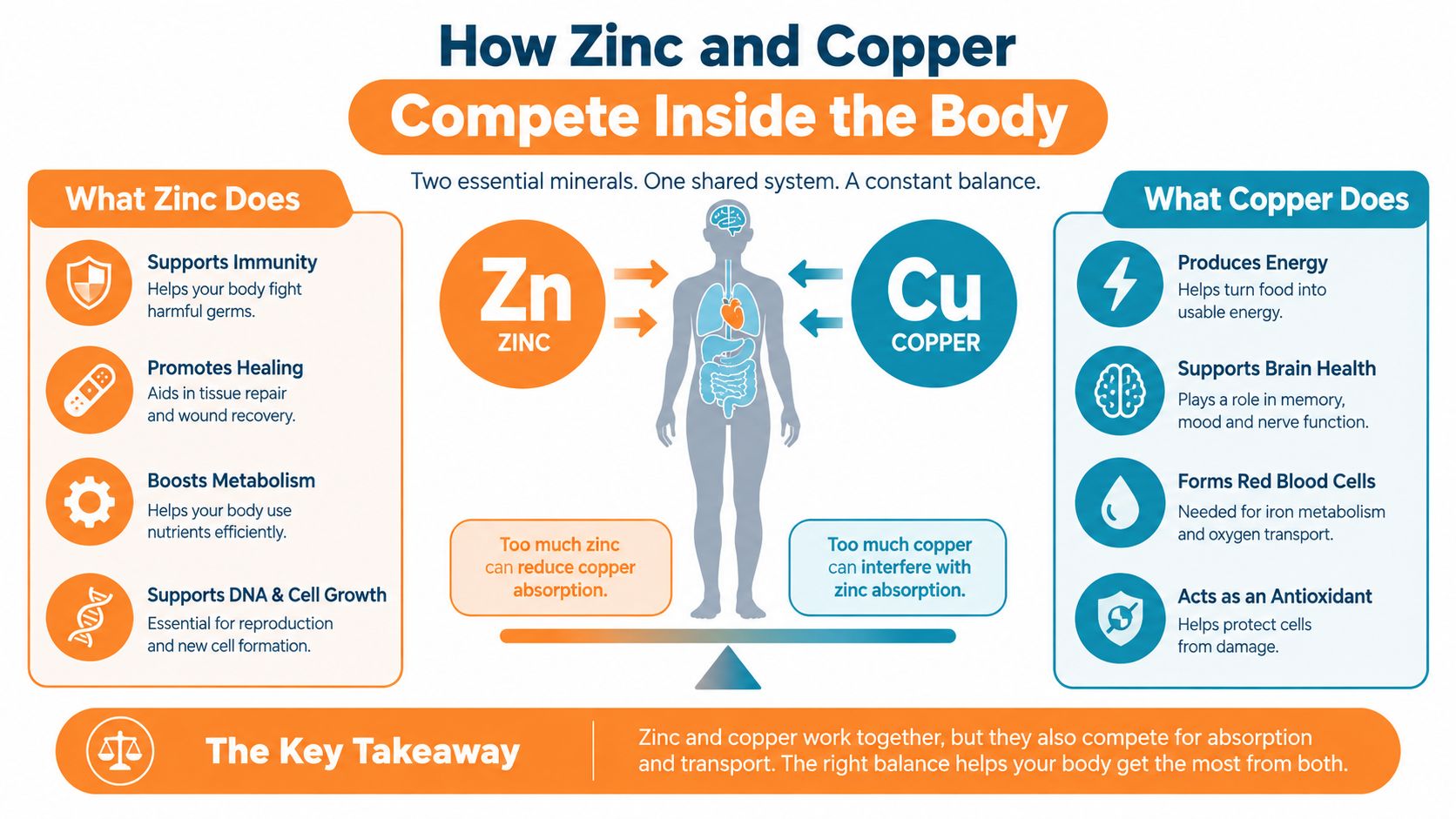
How Zinc and Copper Compete Inside the Body
Most explanations stop at "zinc blocks copper." That's true enough to repeat and too vague to use. The actual bottleneck happens in your intestine, before either mineral reaches your bloodstream in meaningful amounts.
When you swallow a zinc capsule, zinc arrives in the intestinal lumen and enters cells lining the gut wall, called enterocytes. At high zinc exposure, those cells produce more of a protein called metallothionein. That protein is the key actor in this whole interaction, and understanding it explains why dose and duration matter more than slogans.
What Metallothionein Does to Copper
Metallothionein binds copper with greater affinity than zinc, meaning it grabs copper more tightly when both minerals are present in the same intestinal cell. Copper that gets trapped inside an enterocyte doesn't move efficiently into systemic circulation. When those gut cells are shed as part of normal turnover, the trapped copper leaves with them instead of supporting copper status.
The NIH describes this mechanism directly in its copper guidance on metallothionein trapping copper in intestinal cells. The practical consequence is important. Persistent high zinc exposure can produce low copper status even when your dietary copper intake looks adequate on paper. You're eating enough copper, but less of it gets through.
That corrects a common misconception. Zinc and copper aren't primarily fighting in your bloodstream after absorption. They're competing at the absorption step, which is why taking more zinc every day can gradually change copper status even if you never changed your diet.
Why Adding Copper Is Not a Free Pass
Including copper in a formula addresses the absorption concern at the formulation level. It doesn't cancel the effect of an excessive zinc dose, and copper has its own ceiling. The adult upper limit for copper is 10 mg per day from all sources, as noted in the same NIH copper guidance linked above, so indiscriminate high-dose balancing is a bad idea.
If you're evaluating side effects more broadly, this overview of zinc supplement side effects worth knowing puts the copper issue in context with other tolerability concerns. My view is simple. Copper inclusion is a thoughtful formulation choice, especially for daily zinc use, but the zinc dose remains the primary variable you control.
Copper in the capsule helps address a known interaction. It doesn't make unlimited zinc intake safe.
For product evaluation, check four things: declared elemental zinc, declared elemental copper, total intake from all supplements, and duration of use. The word "copper" on the front of the bottle tells you almost nothing without those numbers.
Upper Limits and Reference Doses Explained
Numbers on supplement labels only help if you know what you're comparing them against. Two reference values matter here, and shoppers constantly confuse them. The recommended dietary allowance (RDA) estimates the daily amount generally sufficient for healthy people. The tolerable upper intake level (UL) is a ceiling for routine intake, not a target to aim for.
For adult men, the zinc RDA is 11 mg per day, while the adult zinc UL is 40 mg per day from all sources, according to the NIH summary of zinc intake recommendations and upper limits. That gap is your practical operating zone. A supplement doesn't need to push you near the ceiling to support normal nutritional intake, and a formula that gets you close to the ceiling before food deserves scrutiny.
Total Intake Means Everything Counts
The UL applies to food, beverages, supplements, and medications combined. It doesn't reset for each bottle. If your multivitamin, zinc capsule, and fortified products all contribute zinc on the same day, you add them together, then remember that food contributes zinc too.
- Food and drinks: Your baseline intake before any capsule.
- Multivitamins: Often the hidden first dose people forget.
- Standalone zinc and men's blends: The obvious doses, and the easiest to double-count.
- Lozenges and immune products: Short-term additions that still raise daily exposure while you use them.
The NIH also warns that sustained supplemental doses of 50 mg per day or more for several weeks can inhibit intestinal copper absorption, reduce immune function, and lower HDL cholesterol, based on its health professional guidance on high zinc intakes. Medical zinc regimens may exceed the UL, but that kind of use belongs under clinician supervision. It isn't a model for routine wellness supplementation.
Copper Has a Ceiling Too
On the copper side, the adult UL is 10,000 micrograms, or 10 mg, per day from all sources, according to the NIH consumer guidance on copper upper limits. Copper toxicity is uncommon in healthy people, but excessive exposure can be hazardous, and people with Wilson's disease are particularly vulnerable because their bodies handle copper differently.
That gives you the mental model I recommend. Zinc is the mineral with the narrower practical margin in supplement stacks, because men often stack several zinc sources without realizing it. Copper is easier to overlook, but it isn't harmless at any dose. If you want help translating the ceiling into a daily serving decision, see this guide to zinc dosage considerations for men.
Keep routine zinc exposure below the adult UL unless a qualified clinician is supervising you. That's the benchmark. Everything else, including whether copper is included and in what amount, sits underneath that rule.
Common Zinc-to-Copper Ratios in Commercial Formulas
Ratios look scientific, which is exactly why brands like them. A ratio can help you compare formulas, but only if you also know the actual zinc dose behind it. A modest daily formula and a high-dose clinical protocol can share a similar looking ratio while creating very different total exposure.
Common Zinc-to-Copper Ratios and Where They Show Up
| Ratio (Zn:Cu) | Typical Product Profile | Likely Intended User | Watch-Out |
|---|---|---|---|
| 8:1 to 15:1 | Bariatric nutrition guidance and some balanced daily formulas | People with altered gastrointestinal anatomy, or shoppers choosing a modest daily product | The bariatric figures were developed for a specific clinical context, not as a universal target |
| Around 15:1 | Multivitamin style and routine reproductive health formulas, as an illustrative label example | Men taking one daily product for nutritional support | Still add zinc from other products before assuming your total is modest |
| 40:1 | High-dose research style formulation | Participants in a controlled clinical study, not routine wellness users | The zinc dose can exceed the adult UL even when copper is included |
The 8:1 to 15:1 zone needs the most context. A University of Virginia clinical review reports an ASMBS recommendation of 1 mg copper for every 8 to 15 mg zinc in certain bariatric contexts, while noting those specific amounts have not been studied, in its clinical review of copper deficiency and mineral competition. People with altered gastrointestinal anatomy absorb nutrients differently. Don't copy a post-surgical framework and assume it's been validated as the ideal ratio for every healthy adult.
The 40:1 example comes from a major five-year randomized study in 3,640 adults aged 55 to 80 with age-related macular degeneration. Participants received 80 mg of zinc as zinc oxide and 2 mg of copper as cupric oxide daily, and researchers reported no significant differences over five years in serum copper, hematocrit, or blood lipids, with a median copper change of a 1% decrease in the zinc group versus a 1% increase in the no-zinc group, according to the five-year trial report on zinc plus copper supplementation.
That study explains why researchers paired copper with high-dose zinc in a controlled protocol. It doesn't prove that 80 mg of zinc a day is appropriate for routine use. The participants were a specific older clinical population, the formulation was administered in a trial, and the dose exceeded the general adult zinc UL discussed earlier.
If you take only one modest daily product, a clearly disclosed zinc and copper amount is usually enough to evaluate. If you stack products, the ratio on one label can mislead you, because your other bottles may add zinc without adding copper. Always calculate your combined exposure before you praise a ratio.
Why a Single Ideal Ratio Does Not Exist for Everyone
I'll be direct. If a brand tells you it found the one perfect zinc-to-copper ratio for every healthy adult, it's overselling certainty. Authoritative clinical guidance doesn't establish one universal ratio for every diet, dose, gastrointestinal situation, and duration of use.
That's not a gap in your research. It reflects biology. A man taking a low-dose daily formula with meals doesn't present the same exposure picture as a man taking high-dose zinc for months, and neither resembles a bariatric patient with altered absorption. One number can't cover all three.
The Variables That Change the Answer
Start with total daily zinc dose, because copper concerns rise when zinc exposure is high and sustained. Then consider duration. A short stretch of higher intake during cold season isn't the same decision as the same intake continued indefinitely without reassessment.
Diet matters too, because food contributes both minerals before supplements enter the picture. Gastrointestinal health matters because absorption happens in the gut, and conditions or surgeries that change absorption can change what a sensible intake looks like. Clinician supervision matters most at the high end, where laboratory monitoring may be appropriate and where routine consumer rules no longer apply cleanly.
The NIH identifies high-dose zinc users as a group at risk for copper deficiency, a point reinforced in its consumer fact sheet on zinc, copper absorption, and high intakes. The same source notes associations between excessive zinc use and impaired immunity, altered HDL cholesterol, and at more severe levels, anemia or neurologic complications. Those are reasons to respect dose and duration, not reasons to panic about a modest daily formula.
Stop asking for the perfect ratio. Ask how much elemental zinc you're taking from everything, and for how long.
That reframing protects you from the most common mistake I see. Men copy high-dose regimens from forums, notice copper was included somewhere in the protocol, and assume the combination automatically transfers to unsupervised daily use. It doesn't. Clinical protocols come with defined populations, defined formulations, and monitoring that a shopping cart doesn't provide.
Use ratios as a screening signal, not a verdict. A disclosed amount of copper alongside a moderate zinc dose suggests the formulator thought about the interaction. A high zinc dose with a token copper mention, or copper buried without an amount, tells a different story. The ratio starts the conversation. Your total exposure finishes it.
How to Read a Zinc-Copper Supplement Label
You can judge most bottles in two minutes if you read the Supplement Facts panel in the right order. Ignore the front of the label until you've done this. Front labels sell. Supplement Facts disclose.
Step One Find Elemental Zinc and Copper
Look for the amount per serving and the number of servings you take each day. The relevant figure is elemental zinc, meaning the amount of zinc itself, not just the weight of a zinc compound. Do the same for copper, and note the form listed in parentheses or in the ingredient details, such as cupric oxide or a chelated copper form.
Be suspicious when copper appears only inside a vague mineral blend without a disclosed amount. You can't evaluate balance if the company won't tell you how much copper is present. A product can truthfully say it contains copper while giving you no usable information about exposure.
For a broader walkthrough, this primer on how to read supplement labels with confidence covers the panel structure in more detail. For zinc and copper specifically, undisclosed amounts are my fastest reason to put a bottle back.
Step Two Build Your Daily Total
Write down zinc from every product you took today, not just the bottle you're evaluating. Include your multivitamin, men's blend, standalone zinc, lozenges, and fortified products. Then do the same for copper, because multivitamins and mineral blends can add copper you weren't counting.
- Zinc total: Add every serving, then compare your routine exposure with the adult UL covered earlier.
- Copper total: Confirm the amount is disclosed and remember copper has its own adult ceiling.
- Duration: Ask whether you've taken this amount for weeks, months, or indefinitely without reviewing it.
- Other minerals: Separate zinc and iron doses when you take both, because these minerals can interfere with each other's absorption.
- Medical context: Treat malabsorption, bariatric surgery, prescription zinc, and Wilson's disease as reasons to get individualized advice.
Step Three Check Manufacturing Signals
Mineral balance only matters if the product reliably contains what the label claims. Look for cGMP-registered manufacturing, third-party testing, and published testing thresholds for heavy metals, microbials, and adulterants. For men who care about formulation standards, vegan and non-GMO status may also matter, but those claims don't substitute for testing.
SEMEX, for example, is a daily men's supplement formulated with zinc and copper alongside ingredients such as L-Arginine, Sunflower Lecithin, and Bromelain to support semen volume, taste, and overall vitality. It's vegan, non-GMO, made in the USA in a cGMP-registered facility, and third-party tested by Eurofins. Evaluate it the same way you'd evaluate any other bottle. Check the elemental amounts, add them to your stack, and decide based on your total.
That discipline is the point. Once you can read elemental amounts, spot undisclosed blends, and total your daily exposure, you don't need a brand to tell you whether its ratio is balanced. You can see it yourself.
Practical Recommendations by Reader Situation
If you're adding one daily product to a clean routine, choose a formula with clearly disclosed elemental zinc and copper, keep your total routine zinc below the adult UL, and don't add a standalone zinc capsule on top without recalculating. Simplicity is your advantage. Protect it.
If you've taken the same zinc product for a year, audit the dose now. Long duration is exactly when copper interaction stops being theoretical. Check whether copper is included and disclosed, review your other zinc sources, and talk with a clinician about monitoring if your zinc intake has been near or above the UL.
If you're stacking multiple mineral products, assume you're the reader most likely to overshoot. Add every serving across your multivitamin, men's blend, immune products, and fortified drinks before you buy anything else. Remove duplication first. A zinc supplement with copper won't fix a stack that delivers excessive zinc from three directions.
If a clinician is supervising high-dose zinc, follow that clinician's monitoring plan rather than consumer ratio advice. Medical use can exceed general limits for specific reasons, but supervision and follow-up are part of the protocol, not optional extras.
My stance is straightforward. A zinc supplement with copper is a sensible formulation choice for routine nutritional support, because it acknowledges a real mineral interaction. It is not a license to ignore zinc dose, stacking, or duration. Respect the total, and the pairing can do its job.
These statements have not been evaluated by the Food and Drug Administration. This product is not intended to diagnose, treat, cure, or prevent any disease.
If you're auditing your own stack and want one daily men's formula that includes zinc and copper alongside ingredients selected to support semen volume, taste, and overall vitality, visit SEMEX to review the full label, testing information, and formula details before you decide. Read the elemental amounts, add them to everything else you take, and choose based on your total daily exposure, not a front-label promise.