

Saw Palmetto Zinc for Men: What the Evidence Actually Shows
The popular advice is simple: combine saw palmetto and zinc for more semen, stronger sperm production, and better sexual performance. The evidence isn't that simple. Zinc has a legitimate role in normal male reproductive biology, while saw palmetto has been studied mainly in connection with prostate-related urinary symptoms, not semen volume or fertility outcomes. A formula can contain both ingredients without proving that they work together, or that either one delivers the result a marketing claim promises.
For men comparing supplements, the useful question isn't whether a label includes saw palmetto zinc. It's whether the product identifies each ingredient clearly, uses an appropriate amount, and makes claims that match human research. That distinction helps separate reasonable structure/function language from unsupported promises.
Table of Contents
- Why the Saw Palmetto and Zinc Claim Needs Scrutiny
- What Saw Palmetto Research Actually Shows
- Zinc's Role in Male Reproductive Function
- Comparing Saw Palmetto and Zinc Side by Side
- How These Ingredients Appear in Multi-Ingredient Formulas
- Practical Dosing and Safety Guidelines
- Key Takeaways and Research Checklist
Why the Saw Palmetto and Zinc Claim Needs Scrutiny
Many men encounter saw palmetto and zinc in formulas promoted as a “powerhouse” combination for semen volume, sperm production, libido, or sexual performance. That positioning creates a problem: it merges two ingredients with different evidence bases and treats their presence together as proof of an additive effect.
Available clinical evidence doesn't establish that saw palmetto increases semen volume, sperm production, or fertility. The Merck Manual's discussion of saw palmetto states that claims involving increased sperm production or sexual vigor are unsupported. Reviews of aphrodisiac ingredients also describe the evidence for erectile-function effects as sparse and in need of further human research.
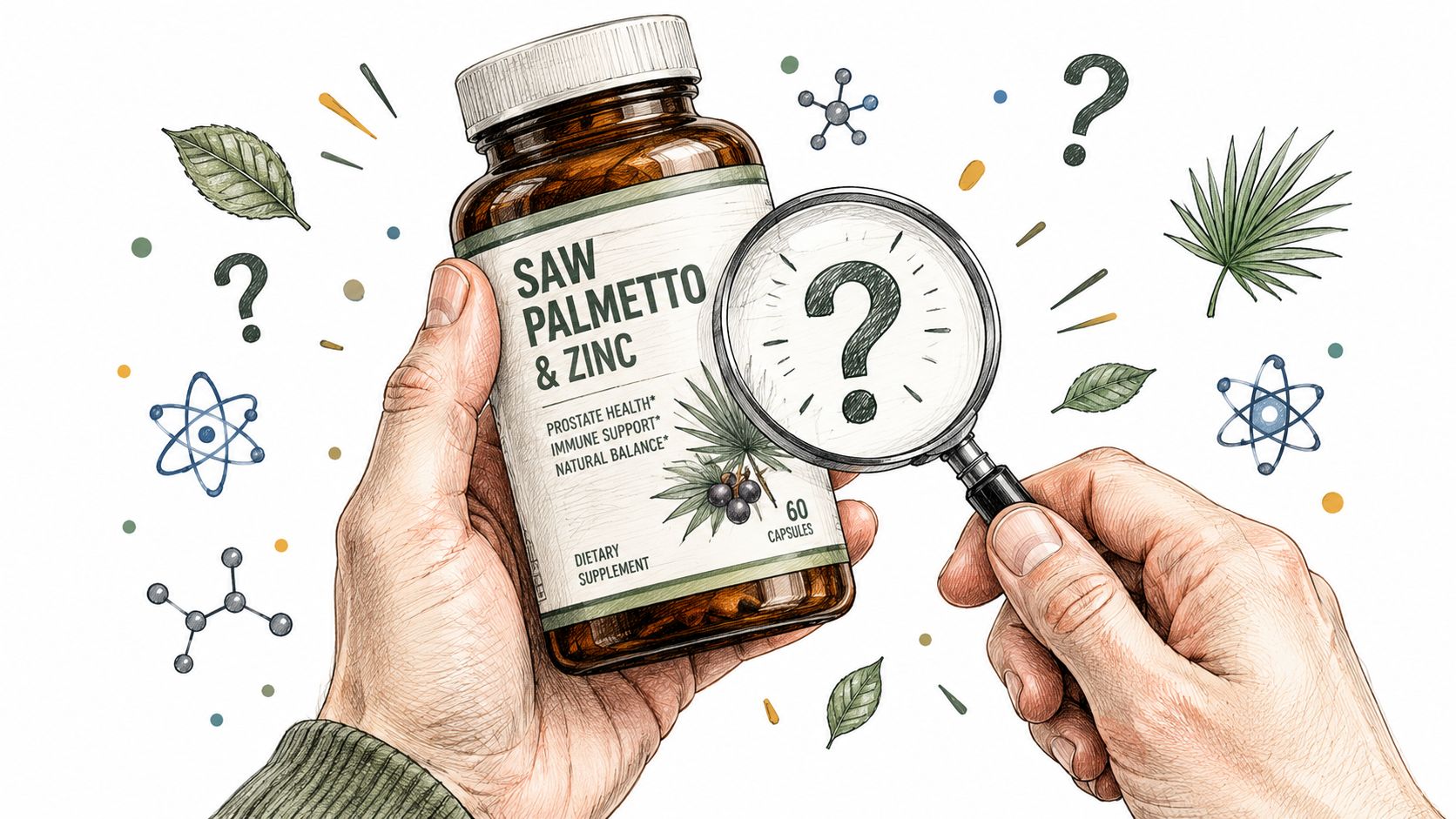
Different ingredients, different questions
Zinc deserves a more direct reproductive discussion because it participates in normal biological processes related to the male reproductive system. Adequate zinc status supports functions connected with sperm structure and activity, but that doesn't mean every zinc product improves fertility metrics or guarantees a particular outcome.
Saw palmetto is different. Researchers have examined it primarily in relation to urinary symptoms associated with prostate enlargement. That research history doesn't turn it into a semen-volume ingredient. A supplement label that places saw palmetto beside zinc may reflect a broad men's wellness formula, but the combination alone doesn't demonstrate that the ingredients produce additive reproductive benefits.
Practical rule: An ingredient's biological relevance isn't the same as proof that a finished supplement delivers a specific sexual or fertility outcome.
This distinction matters for men who want honest expectations. A structure/function statement such as supports men's wellness stays closer to the evidence for saw palmetto. A statement that it raises sperm count, increases semen volume, or treats infertility goes beyond what the available clinical evidence establishes.
Men evaluating the phrase “saw palmetto zinc” should therefore ask three questions:
- What outcome was studied? Prostate-related urinary symptoms, sperm parameters, semen volume, and sexual performance aren't interchangeable endpoints.
- Which ingredient supports the claim? Zinc's reproductive role doesn't validate a separate claim for saw palmetto.
- Did researchers test the combination? Evidence for one ingredient doesn't prove that a formula containing both has an additive effect.
That approach keeps supplement decisions grounded in what the research measured rather than what a product name implies.
What Saw Palmetto Research Actually Shows
Saw palmetto, or Serenoa repens, has a substantial research history. The strongest evidence, however, doesn't support presenting it as a treatment for prostate-related urinary symptoms.
A 2012 Cochrane review assessed 32 randomized controlled trials involving 5,666 men with benign prostatic hyperplasia, or BPH. The review found that saw palmetto didn't improve urinary-flow measurements or reduce prostate size compared with placebo, even when researchers used two or three times the usual dose. These findings place a clear limit on claims about prostate symptom relief. They also provide no basis for presenting saw palmetto as a fertility or semen-volume ingredient. The NCCIH review of saw palmetto research summarizes this evidence.
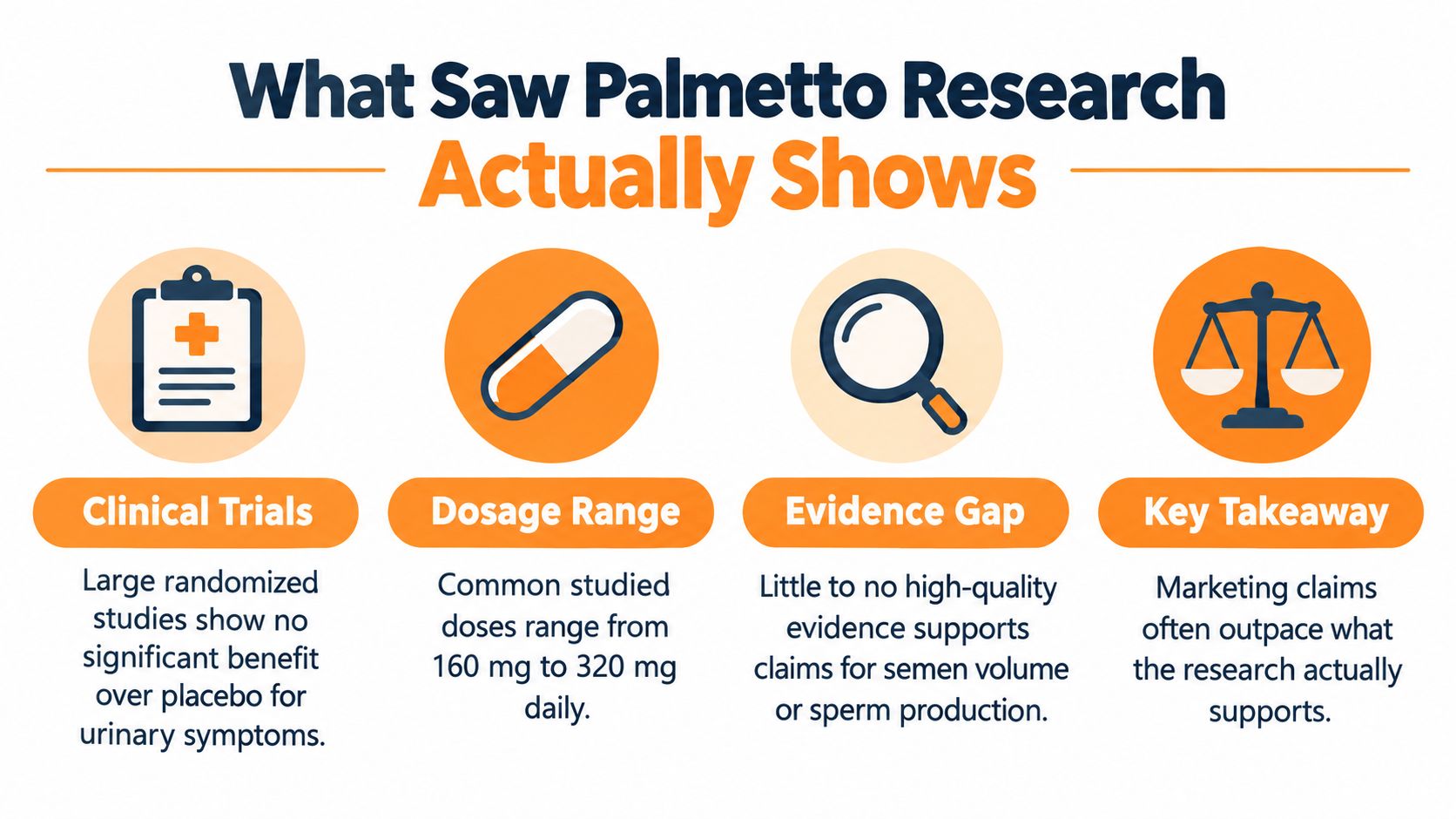
What the larger trial found
A separate double-blind, placebo-controlled trial randomized 369 older men to saw palmetto or placebo. Researchers increased the extract progressively from 320 mg daily to 640 mg, then 960 mg daily, across 72 weeks. Saw palmetto didn't outperform placebo on the primary American Urological Association Symptom Index or on secondary outcomes. Approximately half of participants in both groups reported meaningful symptom improvement.
The dose escalation is important because it challenges the assumption that more saw palmetto automatically produces more benefit. The trial also illustrates why a plausible mechanism or a familiar dose doesn't replace a controlled clinical result.
A measured communication position
NCCIH reports that there's not enough evidence to determine whether saw palmetto is useful for health purposes beyond the areas studied. It also states that saw palmetto doesn't appear to change prostate-specific antigen readings, even at higher-than-usual amounts, as described in its consumer overview of saw palmetto.
That doesn't make saw palmetto irrelevant. It means the ingredient should be positioned carefully, such as supporting men's wellness, rather than implying that it treats prostate enlargement, urinary disease, infertility, or low sperm count.
Safety findings are comparatively reassuring, though “generally tolerated” isn't the same as “risk-free.” Research has described mild digestive symptoms, dizziness, and headache. In one clinical safety assessment, serious adverse events occurred in 5.4% of the saw-palmetto group and 9.7% of the placebo group, a difference that wasn't statistically significant. Non-serious symptomatic adverse events occurred in 34.8% and 30.1%, respectively. The published safety assessment found no evidence of serious toxicity in that trial, while noting that its size and duration couldn't exclude rare adverse effects.
Men looking for a deeper explanation of the ingredient can review how saw palmetto is discussed in relation to semen volume, while keeping the central evidence boundary in view: research interest isn't proof of a reproductive benefit.
Zinc's Role in Male Reproductive Function
Zinc has a clearer link to male reproductive biology than saw palmetto, but that still leaves an important distinction in place. A nutrient can matter for normal function without acting like a treatment. That difference gets blurred in supplement marketing, especially when formulas group ingredients together and imply one broad men's-health effect.
A 2020 review reported measured zinc concentrations of approximately 14.08 ± 2.01 mg/100 mL in a fertile group compared with 10.32 ± 2.98 mg/100 mL in an infertile group. That finding suggests a meaningful difference in zinc status between the groups studied. It does not show that every man will get the same result by adding a zinc supplement, and it does not establish zinc as a treatment for infertility.
Zinc is involved in several parts of sperm biology. Research links it with antioxidant defense, sperm chromatin integrity, motility, concentration, and morphology. In practical terms, zinc helps support the conditions sperm cells depend on, including protection against oxidative stress and support for DNA and chromatin stability. The NIH Office of Dietary Supplements zinc information gives useful background on those biological roles and on safety.
Adequacy is the key distinction
The most responsible way to read this evidence is through adequacy. If zinc intake is low, correcting that shortfall may support normal reproductive-system function. That is a narrower and more defensible claim than saying a zinc product will raise semen volume, improve sperm count, or reliably change fertility outcomes.
The same review also noted that more recent clinical studies of supplements containing zinc have not consistently improved pregnancy rates, sperm counts, or sperm function. This is a common point of confusion. Observational differences can show that zinc status is relevant, much like finding that oil matters to engine performance, but they do not prove that pouring in more oil improves every engine. Men who want a practical overview can read what zinc does for men, with that evidence boundary kept firmly in mind.
Zinc can support normal reproductive biology, but it should not be presented as a guaranteed fertility solution.
Safety depends on total intake
Dose still matters. The U.S. adult tolerable upper intake level is 40 mg per day of elemental zinc from all sources, including food, beverages, supplements, and medications, according to the NIH zinc fact sheet for consumers. That number is a ceiling, not a target.
Excess intake can cause nausea, dizziness, headaches, gastric distress, vomiting, and loss of appetite. Longer-term excess may also impair copper status. For that reason, label reading should focus on elemental zinc, not just the total weight of a zinc compound.
Comparing Saw Palmetto and Zinc Side by Side
Saw palmetto and zinc appear together because both fit within broad men's wellness positioning. Their scientific roles aren't interchangeable. Zinc has a more direct connection to reproductive biology, while saw palmetto has been investigated mainly around prostate-related questions.
| Dimension | Saw Palmetto | Zinc |
|---|---|---|
| Primary research context | Men's wellness and prostate-related urinary symptoms | Normal reproductive-system function and broader biological processes |
| Reproductive evidence | No established benefit for semen volume, sperm production, or fertility outcomes | Participates in antioxidant defense, sperm chromatin integrity, motility, concentration, and morphology |
| Clinical certainty | Stronger trials haven't established meaningful benefit for BPH urinary outcomes | Biological relevance is clearer, but supplementation hasn't consistently improved pregnancy rates, sperm counts, or sperm function |
| Formulation issue | Extracts can differ by fatty-acid composition, extraction method, dose, and standardization | Elemental zinc amount must be assessed against total intake |
| Safety focus | Mild digestive symptoms, dizziness, and headache can occur | Excess intake can cause gastrointestinal effects and impair copper status |
| Responsible wording | Supports men's wellness | Supports normal biological and reproductive functions |
The NIH-hosted review of zinc and male reproductive function describes zinc's relationship with oxidative defense, sperm DNA and chromatin structure, motility, concentration, and morphology. It also emphasizes that those findings don't establish that every zinc-containing supplement improves reproductive outcomes.
Why the distinction matters
A formula may use saw palmetto to broaden its men's wellness profile and zinc to contribute nutritional support for normal reproductive function. That combination can be understandable from a formulation perspective, but it doesn't prove that the product increases semen volume or produces additive fertility effects.
Saw-palmetto extracts also aren't interchangeable. Fatty-acid composition, extraction method, dose, and standardization can vary substantially. “Saw palmetto” alone is therefore an incomplete description for anyone trying to compare products.
Zinc labels require a different inspection. The important figure is the elemental zinc amount, followed by a review of other supplements, fortified products, and medications that may contribute to the daily total.
A useful comparison doesn't ask which ingredient is “stronger.” It asks which ingredient has been connected to the desired outcome, how directly, and under what conditions.
How These Ingredients Appear in Multi-Ingredient Formulas
More ingredients can make a formula look more convincing, but labels often combine substances that serve very different purposes. Saw palmetto is usually included for its prostate and men's wellness positioning. Zinc is a nutrient with established roles in normal reproductive biology. Putting them in the same capsule does not merge their evidence into one stronger claim.
Combining ingredients doesn't automatically create additive benefits for semen volume, sperm production, fertility, or sexual performance. To show that a finished blend works for a specific outcome, researchers would need to test that exact combination in people. A formula can be rational on paper and still remain unproven for the headline claim on the bottle.
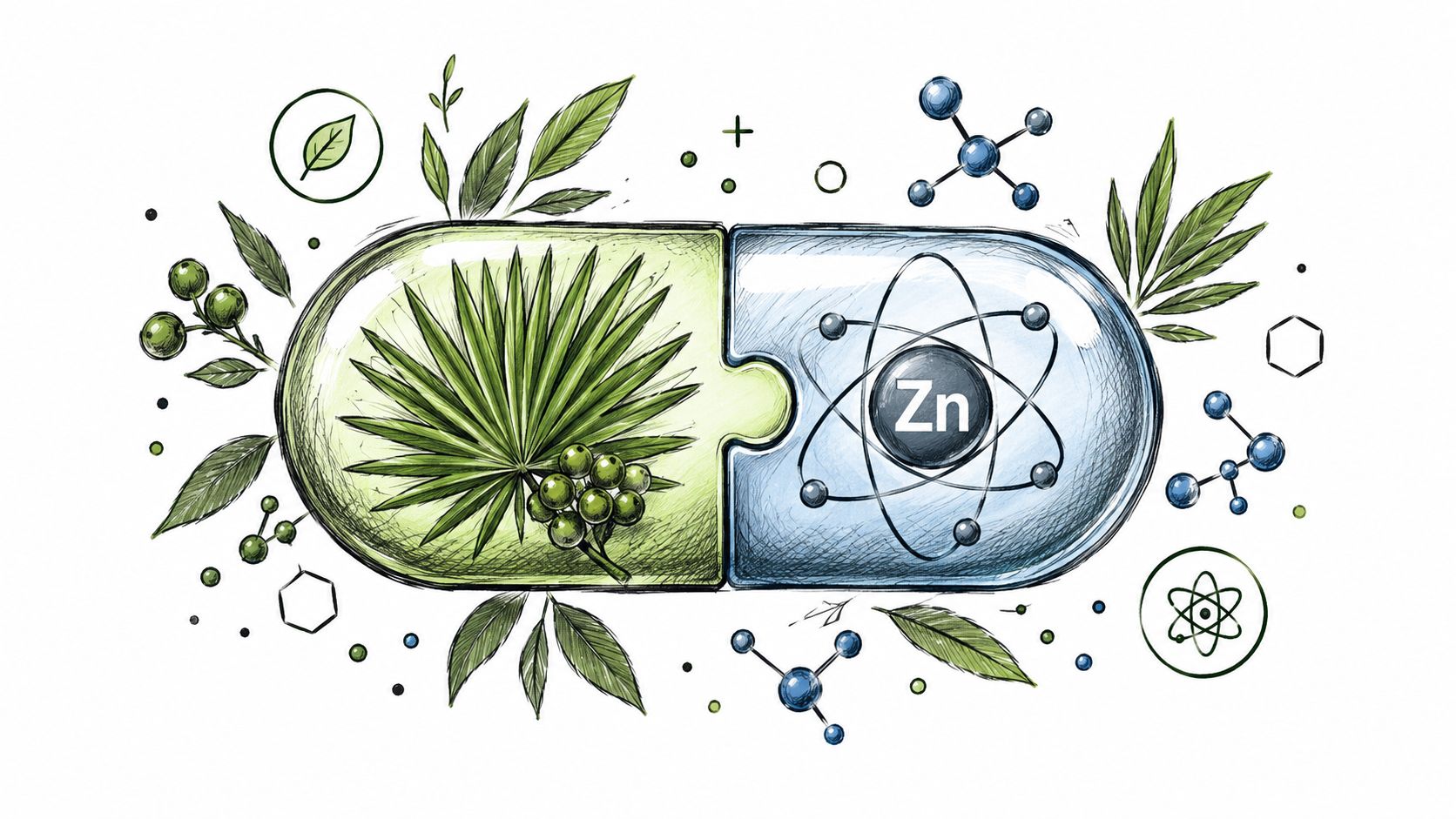
What transparent formulas reveal
A transparent label gives enough detail to judge each ingredient on its own merits. For saw palmetto, that means more than the plant name. The extraction method, fatty-acid profile, standardization, and actual amount all shape what the ingredient really is in practice. Two products can both say "saw palmetto" and still be quite different, much like two olive oils can come from the same fruit but vary in composition and processing.
Zinc requires a different kind of label reading. The key figure is the elemental amount, plus the zinc form. Then total the zinc you already get elsewhere. A common real-world problem is overlap: a multivitamin, a men's formula, and a cold-season product may all contribute zinc on the same day. As noted earlier, the upper boundary matters most when several sources stack together, not just when one label is viewed in isolation.
Multi-ingredient products may also add arginine, pygeum, or lecithin. A comparison of arginine, zinc, pygeum, and lecithin is useful because it separates what each ingredient is supposed to do instead of treating a longer ingredient list as better evidence.
The strongest formulas are usually the clearest ones. Readers should look for what form it uses, how much it provides, and which outcome the evidence assessed. Terms like "male enhancement blend" sound broad, but they do not answer those practical questions.
Practical Dosing and Safety Guidelines
Dose decisions should start with the formula details, because these two ingredients are judged differently.
For saw palmetto, the amount used in research is often 320 mg per day of a lipid-extracted extract, according to the NIH Bookshelf overview of saw palmetto. That figure is a reference point, not a shortcut to a men's health claim. A dose can be common in studies and still fail to show the specific outcome a shopper expects. That matters here, because reproductive claims and prostate-related research are not the same category.
A useful way to read the label is to treat saw palmetto and zinc as separate questions.
- Identify the extract: Look for Serenoa repens, plus the extraction method, fatty-acid profile, standardization, and listed amount.
- Find elemental zinc: The zinc compound and the actual elemental zinc delivered are not the same thing.
- Add total exposure: Count zinc from fortified foods, multivitamins, single-ingredient products, and medicines before judging whether the daily amount is reasonable.
- Match the claim to the endpoint: A study on urinary symptoms does not establish a semen-volume result. Zinc's role in male biology also does not prove that any blend improves fertility.
- Check your context: Men using medication, planning a procedure, or dealing with an ongoing condition should review supplement use with a qualified healthcare professional.
That checklist matters because labels often create a false sense of precision. A bottle can list both ingredients clearly and still leave the important questions unanswered.
Saw palmetto's safety record is relatively reassuring. NIH-funded work reported no serious toxicity over 18 months at doses approaching 960 mg per day, though mild gastrointestinal symptoms, dizziness, and headache can occur. In healthy young men, 320 mg daily for one week did not change serum dihydrotestosterone, or DHT. So a conventional amount should not be treated as automatic evidence of a meaningful systemic androgen effect.
Label lesson: Ask “How much elemental zinc is present?” and “What exactly is the saw-palmetto extract?” Those questions are more useful than asking whether the bottle simply contains both.
For zinc, the ceiling discussed earlier still applies. Chronic excess can raise safety concerns, including gastrointestinal problems and effects on copper status. More is not automatically better. A careful total daily intake is usually the smarter standard.
Key Takeaways and Research Checklist
A good closing takeaway is simple: zinc and saw palmetto belong in different evidence buckets. Zinc has a recognized role in normal male reproductive biology. Saw palmetto is studied much more often for prostate and urinary questions. Put together, they may appear in the same formula, but that does not turn them into a proven fertility pair. A label can combine ingredients faster than research can connect outcomes.
That distinction matters when you compare products in real-world settings. Men often shop by headline claims, then assume every ingredient supports the same result. Supplement evidence rarely works that neatly. A better approach is to review a formula the way you would review a toolbox. Each item may have a different job, and the presence of several tools does not mean they all solve the same problem.
Use this shorter checklist when comparing options:
- Define the outcome before reading the label. Urinary support, sexual function, semen measures, and general wellness are different endpoints, and formulas often blur them together.
- Check the research population. Findings from older men with urinary symptoms should not be stretched to younger men looking for reproductive support.
- Separate ingredient evidence from formula evidence. Support for one ingredient does not prove the full blend delivers the same result.
- Read the claim language carefully. “Supports men's wellness” is a broader and weaker claim than “improves sperm” or “treats infertility.”
- Record the label details before you compare products. Screenshot the Supplement Facts panel and ingredient list, then compare serving size, other actives, and non-active additions side by side.
- Re-check the formula after a period of use. If your goal, medications, symptoms, or clinician guidance changes, reassess whether the product still fits.
- Get personal advice when the context is complicated. That matters most for men with ongoing symptoms, fertility concerns, or multiple supplements in the routine.
Applying that checklist to a real formula shows how these distinctions work in practice.
SEMEX offers a daily men's wellness supplement that includes zinc and saw palmetto alongside ingredients such as L-arginine, sunflower lecithin, bromelain, maca root, Panax ginseng, ashwagandha, tongkat ali, and horny goat weed. Men considering it should judge the formula by each ingredient's role, the total design of the blend, and the exact claims being made, not by assuming that saw palmetto plus zinc automatically predicts a specific reproductive outcome.
These statements have not been evaluated by the Food and Drug Administration. This product is not intended to diagnose, treat, cure, or prevent any disease.