

How Does Saw Palmetto Work Mechanisms Explained
Why does saw palmetto get described as a natural DHT blocker when world results often look much less dramatic than the marketing?
That gap usually comes from a simple mistake. Many people talk about saw palmetto as if it were one active chemical doing one job. It isn't. Saw palmetto is better understood as a lipid-rich botanical extract with several proposed actions that may touch hormone signaling, receptor activity, and local inflammation. That makes the science more interesting, but it also makes the ingredient harder to judge.
A reader searching how does Saw Palmetto work usually wants one clean answer. The honest answer is more layered. In lab models, saw palmetto has been linked to 5-alpha-reductase inhibition, interference with dihydrotestosterone binding, anti-inflammatory activity, and antiproliferative effects in prostate tissue, according to a review hosted on PMC. In human studies, though, those mechanisms haven't consistently translated into strong symptom changes.
That doesn't make the ingredient meaningless. It means the ingredient has to be interpreted correctly.
A helpful comparison is this. A prescription drug is usually built around one defined molecule and one tightly characterized action. Saw palmetto is more like a blended extract where the overall effect may depend on the fatty acids, phytosterols, extraction method, and standardization. Two products can both say "saw palmetto" on the label and still behave differently.
Practical rule: Saw palmetto makes more sense as a formulation question than a simple yes-or-no ingredient question.
That point matters in men's wellness. Some formulas include saw palmetto not as a cure-all, but as one ingredient in a broader support stack aimed at hormone-related balance and vitality. Used that way, it fits the evidence better than exaggerated claims do.
Table of Contents
- Introduction to How Saw Palmetto Is Thought to Work
- What Saw Palmetto Extract Actually Contains
- Proposed Mechanisms Behind Saw Palmetto Activity
- What Human Studies Show Versus Lab Findings
- Dosing Forms and Why Standardization Matters
- Safety Considerations and Potential Interactions
- Key Takeaways on How Saw Palmetto Works and Next Steps
Introduction to How Saw Palmetto Is Thought to Work
Why do so many articles reduce saw palmetto to "it blocks DHT" when the actual story is much less tidy?
That shortcut is easy to remember, but it sets readers up for confusion. Saw palmetto research usually looks at a lipophilic extract from the fruit of Serenoa repens, not the raw berry itself. In plain terms, researchers concentrate the fat-soluble portion of the plant, then study how that mixed extract behaves. A review in Nutrients describes saw palmetto as a preparation rich in lipids and phytosterols, which helps explain why product composition matters so much.
A better starting point is this. Saw palmetto acts less like a single-purpose switch and more like a mixed tool kit. One part of the extract may interact with hormone-related pathways. Another part may affect inflammatory signaling. That does not guarantee a strong real-world effect, but it does explain why the mechanism discussion is broader than one enzyme.
The enzyme that gets the most attention is 5-alpha-reductase, which helps convert testosterone into dihydrotestosterone, or DHT. That pathway matters, especially in conversations about prostate and hair-related biology. But focusing only on DHT can flatten the picture too much. Researchers have also proposed effects involving androgen signaling, inflammatory pathways, and cell-growth regulation.
Here is the key point many readers miss. A lab finding answers one question. A human trial answers another.
A cell study can show that compounds in an extract interact with a pathway under controlled conditions. A human study asks whether a specific product, at a specific dose, in a specific group of people, leads to a noticeable outcome. Those results often fail to line up neatly. The gap does not mean the lab work was meaningless. It often means the extract is chemically variable, the formulation differs from study to study, or the pathway effect is too modest to produce a clear clinical change on its own.
That is why saw palmetto is easier to understand as a multi-pathway lipid extract than as a plant version of a single-target drug.
Readers also get tripped up when three evidence levels blur together:
- What is in the extract
- What the extract appears to do in cells or tissues
- What people experience in clinical studies
Keeping those levels separate makes the rest of the evidence much easier to read. It also explains why standardization keeps coming up. If two products both say "saw palmetto" on the label but differ in extraction method or lipid profile, they may not behave the same way.
What Saw Palmetto Extract Actually Contains
What is the extract made of, and why does that matter so much for understanding how it may work?
The short answer is that saw palmetto extract is usually a lipid-rich mixture, not a single standout compound. A composition review describes commercial extracts as being made up largely of fatty acids, with laurate and myristate often prominent, alongside beta-sitosterol, other fatty acids such as capric, caprylic, oleic, linoleic, myristic, and palmitic acids, plus related ethyl esters and glycerides, as summarized in this PMC review of saw palmetto composition.
That matters because a mixture behaves differently from a one-molecule ingredient.
An orchestra is a useful comparison here. The overall sound depends on which instruments are present, how strong each one is, and how they work together. Saw palmetto extracts are similar. Researchers are usually studying the combined behavior of a fatty, plant-sterol-rich profile rather than one “active ingredient” doing all the work.
That framing helps explain a common point of confusion. Two bottles can both say saw palmetto on the front and still deliver meaningfully different chemical profiles if the extraction process, fatty-acid concentration, or standardization target differs.
Why extraction method matters
Research papers often focus on the lipophilic, or fat-soluble, fraction of saw palmetto. In plain terms, that is the oily portion where many of the compounds of interest are concentrated.
This is one reason raw berry powder and a standardized extract should not be treated as interchangeable forms. If the berry is the whole fruit, the extract is more like a concentrated fraction pulled from it. That difference can shape what ends up in the capsule and how closely a product matches the material used in lab or human research.
A product label can still leave big gaps. “Saw palmetto” by itself says very little about extract type, lipid content, or how the ingredient was prepared. For readers comparing formulas, this guide to saw palmetto extract and what labels often leave out gives a useful plain-language overview.
What to look for conceptually on a label
A label will not give a full lab report, but it can tell you whether the manufacturer is describing the extract in a way that resembles the research.
- Extract form: Studies usually discuss a lipid-rich extract, not plain ground berry powder.
- Standardization clues: Listing fatty-acid content gives more context than a bare plant name alone.
- Ingredient transparency: Clearer labeling makes it easier to compare one product with another.
Useful filter: If the label does not identify the extract form or any standardization target, it becomes much harder to judge whether that product resembles the saw palmetto used in published studies.
Proposed Mechanisms Behind Saw Palmetto Activity
How could one plant extract be linked to hormone signaling, inflammation, and even cell-growth pathways at the same time?
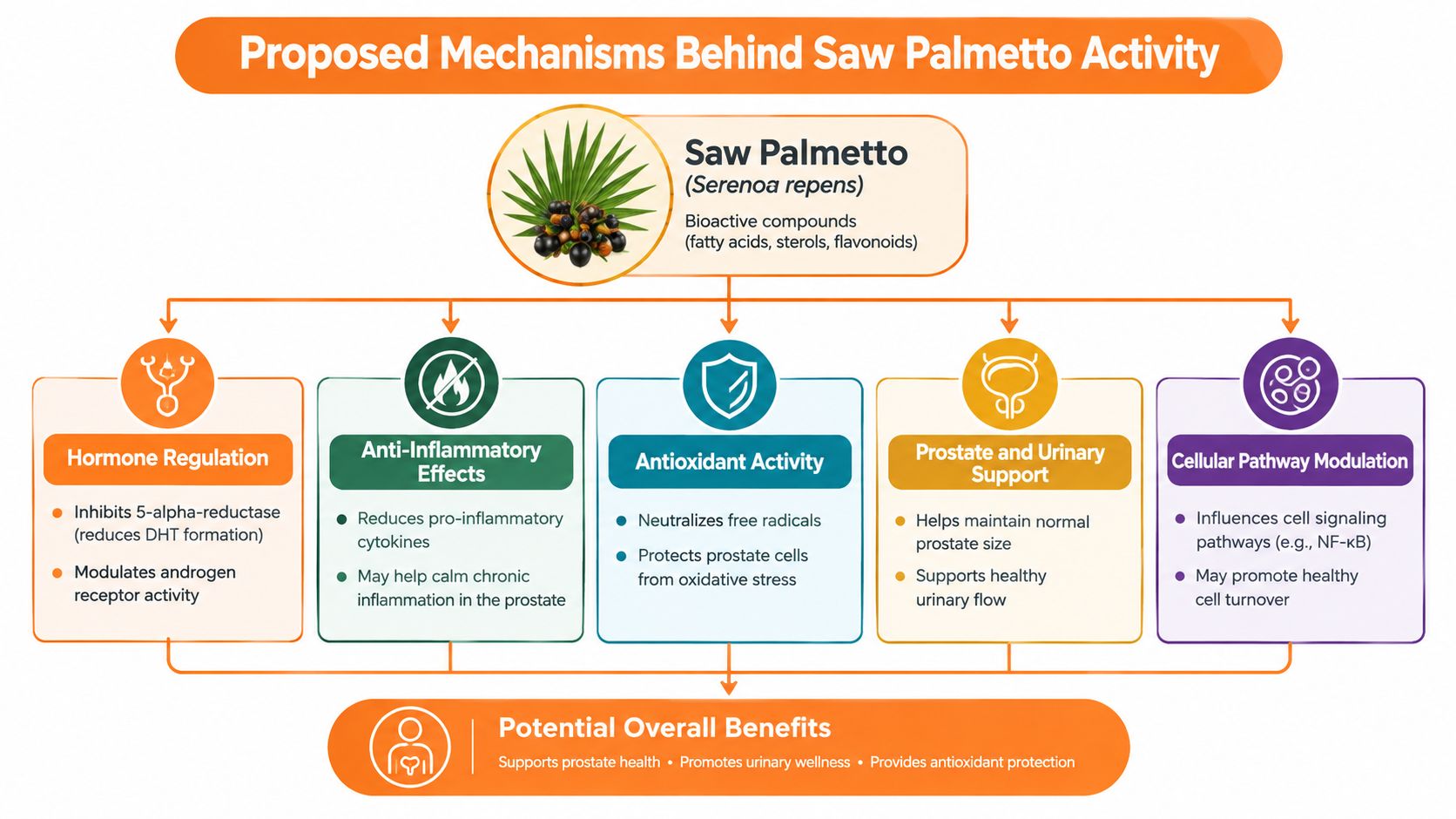
The short answer is that saw palmetto is studied as a lipid extract with several active components, not a single isolated molecule with one clean target. That matters. A multi-compound extract can nudge more than one pathway in lab models, while still producing modest or inconsistent results in real people.
5-alpha-reductase inhibition
This is the mechanism people usually hear first.
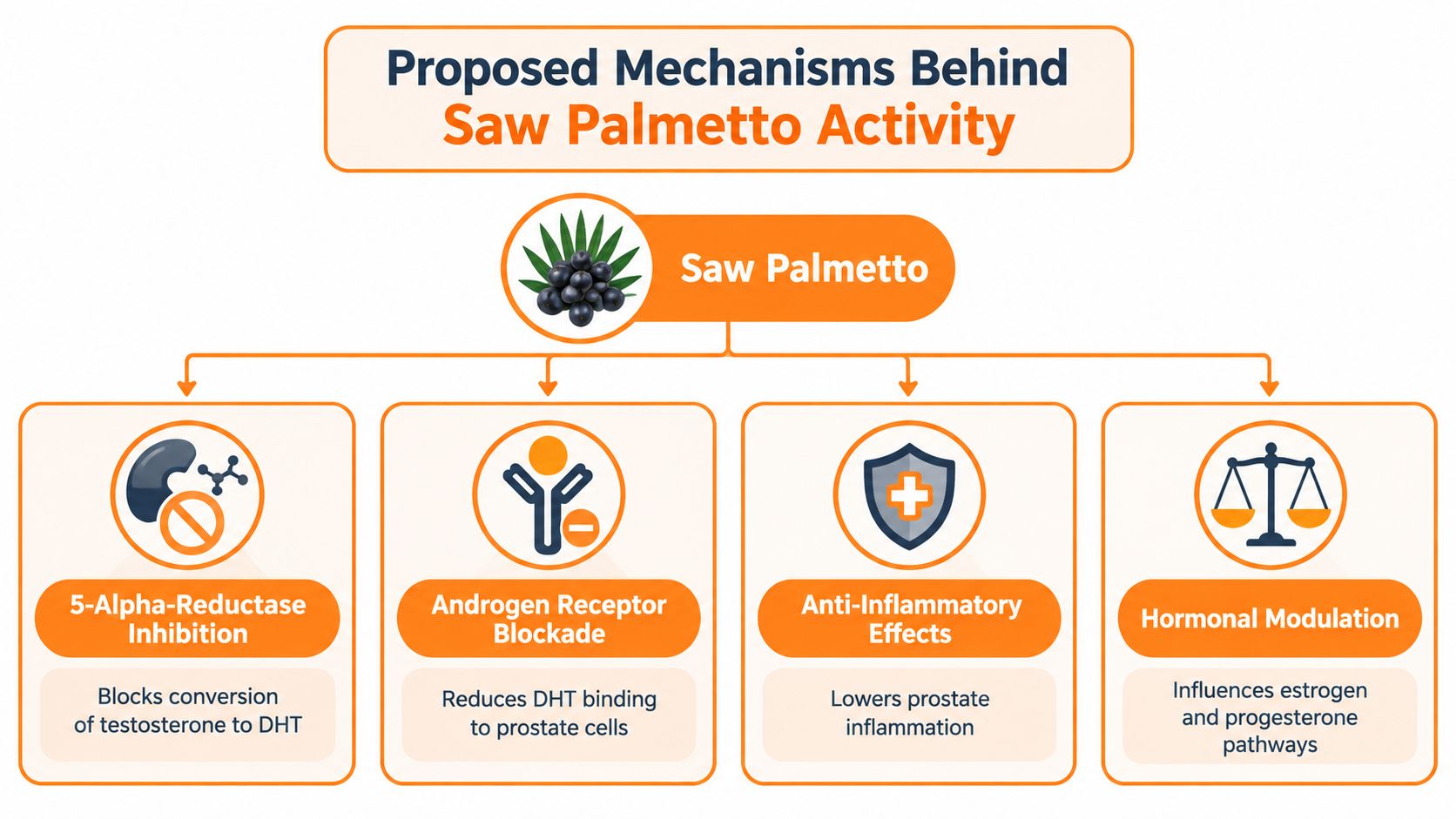
5α-reductase converts testosterone into DHT, and saw palmetto has been studied for slowing that conversion. Experimental work summarized in a NIH-hosted review found inhibitory effects on both type I and type II 5α-reductase in vitro. That gives a plausible reason the extract is often discussed in men's hormone-related wellness conversations.
The catch is easy to miss. Enzyme inhibition in a dish does not automatically tell you how much inhibition occurs in human tissue after someone swallows a capsule. The fatty-acid profile, extraction method, and dose can all change how strongly this pathway is affected.
Reduced DHT signaling at the receptor level
DHT production is only one part of the story. Researchers have also explored whether saw palmetto compounds may weaken how strongly DHT interacts with androgen receptors.
In plain language, the question is not only, "How much DHT is present?" It is also, "How much of that signal is getting through?" Some experimental findings suggest fatty-acid fractions may interfere with receptor binding, which helps explain why the ingredient is often described as more than a simple DHT blocker.
This is a useful place to slow down. If one formula contains a different mix of fatty acids and sterols than another, receptor-related effects may not be the same from product to product.
Anti-inflammatory activity
A second lane of research looks at inflammation.
Some investigators propose that saw palmetto may influence local inflammatory signaling in prostate tissue. That idea matters because symptoms are not always driven by androgen pathways alone. Tissue irritation, immune signaling, and local swelling can all shape how a person feels, even when hormone markers do not shift much.
This broader view helps correct a common oversimplification. Saw palmetto is often marketed as if its whole identity rests on 5α-reductase. The mechanistic literature suggests a wider set of possible actions, even if their real-world importance is still debated.
Effects on cell growth and turnover
Researchers have also examined whether saw palmetto extracts affect how prostate-related cells grow, divide, or undergo programmed cell death.
That sounds dramatic, so it helps to keep the claim narrow. These are proposed laboratory mechanisms, not proof that a supplement will create meaningful clinical changes in men using over-the-counter products. The practical takeaway is that saw palmetto has been studied across several biological pathways, which fits better with its identity as a complex lipid extract than with the one-note "natural finasteride" label.
A clearer summary looks like this:
- One proposed pathway involves less conversion of testosterone to DHT.
- Another involves weaker androgen-receptor signaling.
- Another involves modulation of inflammatory activity.
- Another involves effects on cell-growth behavior in lab settings.
So, how does saw palmetto work? The most honest answer is that it may work through several overlapping mechanisms, and the exact mix probably depends on the extract itself. That is one reason promising lab mechanisms and disappointing large trials can both be true at the same time.
What Human Studies Show Versus Lab Findings
Why can an extract look busy in a lab, then look almost quiet in a clinical trial?
That tension sits at the center of saw palmetto research. Test-tube and cell studies suggest activity across several pathways. Human studies ask a tougher question. Do those pathway effects add up to symptom changes men can feel or measurements clinicians can track?
Early positive signal and later disappointment
One early study gave saw palmetto momentum. A randomized, double-blind, placebo-controlled trial published in 2001 followed 369 men taking 320 mg/day and found statistically significant symptom improvement versus placebo, but urinary flow rates did not measurably improve, according to the PubMed record for the 2001 trial.
That result matters because it hints at a pattern that shows up often with saw palmetto. Some men may report modest subjective improvement, while harder endpoints stay mostly unchanged.
A later NIH-funded trial tested that pattern more rigorously. In a 2006 randomized trial of 225 men, saw palmetto showed no significant difference versus placebo in AUASI score change, maximal urinary flow rate, prostate size, residual urine, quality of life, or PSA levels over one year, based on the 2006 PubMed trial.
The observed effect was very small.
Lab mechanisms versus clinical outcomes
| Evidence Type | What Was Observed | Practical Meaning |
|---|---|---|
| In vitro mechanism studies | Saw palmetto affected 5α-reductase activity and other androgen-related pathways in experimental settings | The extract has plausible biological activity, but pathway activity alone does not predict a noticeable clinical effect |
| 2001 randomized trial | 369 men took 320 mg/day and symptom scores improved versus placebo, while urinary flow rates did not measurably change | Some men may notice subjective improvement, but objective urinary performance did not clearly improve |
| 2006 NIH trial | 225 men showed no significant differences versus placebo across major urinary and prostate-related outcomes | Under stricter testing, benefits were hard to distinguish from placebo |
| Broader evidence summaries | NCCIH says small studies sometimes suggested modest benefit, but a large high-dose study and a Cochrane review found saw palmetto was not more effective than placebo in a NCCIH science summary | The overall clinical picture remains weak even though mechanistic theories are easy to find |
Why this mismatch happens
A pathway study is a bit like testing one gear on a workbench. A human trial tests the whole machine under load. Absorption, tissue exposure, extract composition, study duration, placebo effects, and endpoint choice can all change the outcome.
That is also why the simple "natural DHT blocker" story often misleads readers. Saw palmetto is better understood as a multi-pathway lipid extract, not a single-purpose molecule. If one product is richer in certain fatty acids or sterols than another, the biological behavior may differ even when the front label says the same plant name.
This helps explain how two ideas can both be true. Lab studies can show enzyme or receptor effects. Large controlled trials can still find little clinical advantage.
Readers who want more context on how this fits into broader saw palmetto and prostate support claims should pay close attention to the type of extract used, not just the ingredient name.
Mechanism is not outcome. With saw palmetto, formulation details may help explain why promising lab activity has rarely translated into strong, consistent trial results.
Dosing Forms and Why Standardization Matters
If saw palmetto is a multi-component extract, then the next practical question is straightforward. What exactly was used in research, and how can a reader compare that to a supplement label?
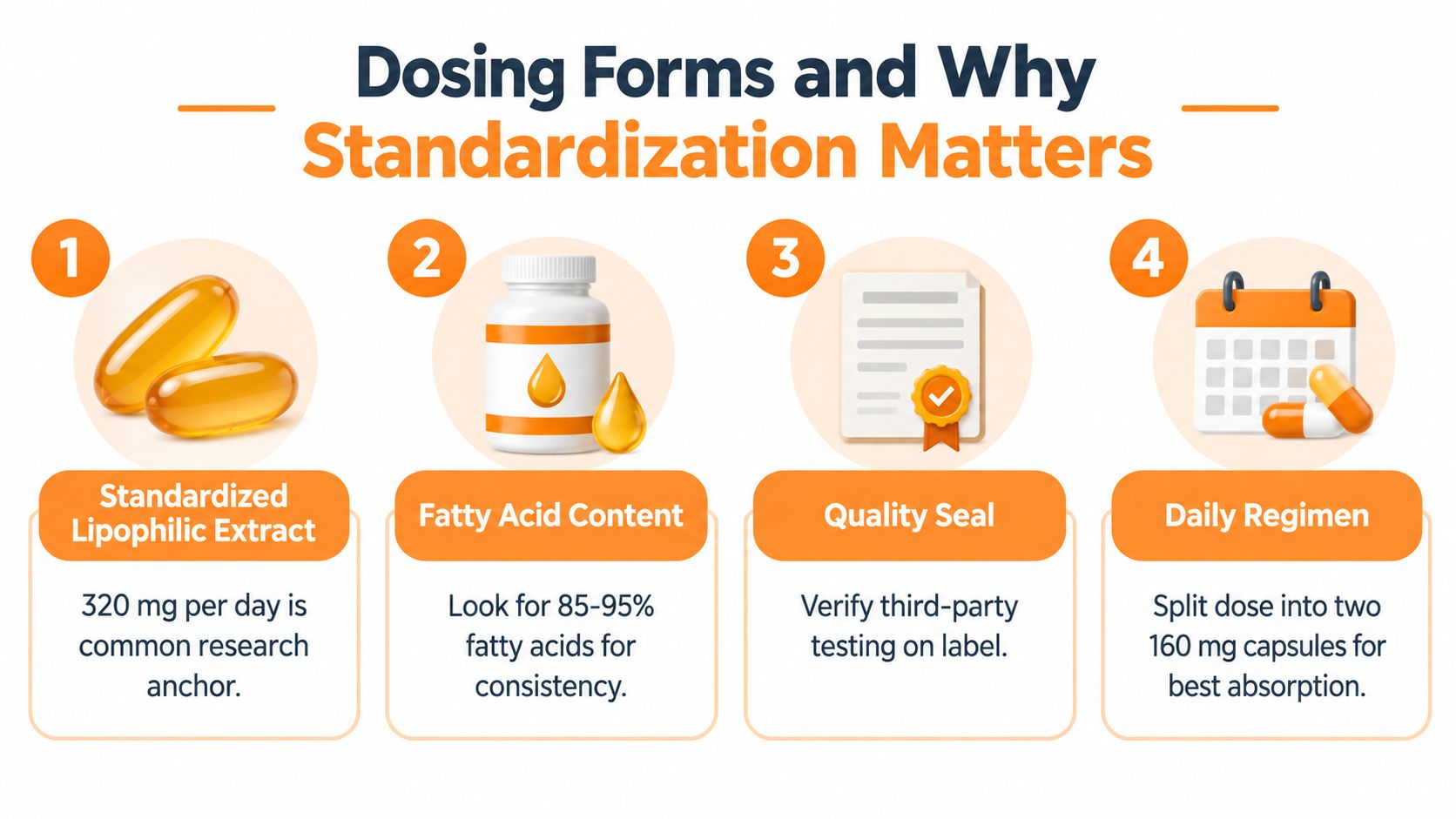
The most common research anchor is 320 mg per day of lipophilic extract, a dose repeatedly used in clinical discussion, including the earlier positive trial and later large trials summarized in the literature linked above. That doesn't mean every 320 mg product is equivalent. It means the dose only has context when the extract type is also known.
Why equal milligrams don't always mean equal products
A label can match the milligram amount used in research and still differ in composition. That's because extraction methods can shift the balance of fatty acids and phytosterols, and those are the constituents most often tied to proposed activity.
Recent coverage has started separating older generic saw palmetto products from newer fatty-acid-focused extracts. A 2026 consumer-facing summary describes reports of a proprietary extract standardized to four free fatty acids with stronger 5-alpha-reductase inhibition and sustained hair-related benefits over 90 to 180 days, while also noting that the broader evidence base remains variable and unsettled in clinical terms, according to the Satthwa review article. That doesn't prove all newer extracts outperform older ones. It does support the bigger point that formulation specificity matters.
A practical label-reading checklist
- Match the form first: Look for a lipophilic or lipid-rich extract rather than assuming any berry powder reflects the research.
- Check standardization language: If a label mentions fatty-acid or phytosterol standardization, the product gives more useful formulation detail.
- Separate ingredient from formula: In men's wellness products, saw palmetto is often included as one component among several supportive ingredients.
One example is SEMEX, which includes saw palmetto as part of a broader men's wellness blend rather than presenting it as a stand-alone treatment. In that context, the ingredient is positioned within a formula designed to support vitality and related male wellness goals, not to act like a drug.
Safety Considerations and Potential Interactions
Efficacy and safety are different questions. Even when an ingredient shows modest or inconsistent benefit, it still deserves careful use.
Where caution makes sense
Saw palmetto is generally discussed as well tolerated, but readers should still use common sense around interactions and existing care plans.
Two situations deserve extra caution:
- Hormone-related strategies: Because saw palmetto is studied around androgen pathways, combining it with other hormone-related approaches is something a healthcare professional should review.
- Blood-thinning considerations: Anyone using blood-thinning approaches should check before adding it, especially when stacking multiple supplements or medications.
A practical side-effect and use overview appears in this guide to saw palmetto for prostate health side effects.
The PSA point that often surprises people
A useful technical detail from the clinical literature is that saw palmetto does not appear to materially alter PSA readings, even at higher-than-usual amounts, according to a PMC summary of the NIH-funded trial evidence. That matters because some people assume any ingredient discussed for the prostate must also strongly move PSA. The available evidence doesn't support that assumption.
This fits the broader theme of the article. Saw palmetto may have plausible pathway activity, but its measurable downstream effects in large human studies often look limited.
A cautious reader doesn't just ask, "Can this ingredient do something?" The better question is, "How strong is that effect in people, and does the product match the extract that was actually studied?"
Product variability changes the user experience
Because extracts differ in composition, one person's experience may not tell another person much. Product-to-product variability is one reason internet anecdotes can be so misleading. Two users may both say they took saw palmetto, but they may not have taken remotely similar extracts.
Key Takeaways on How Saw Palmetto Works and Next Steps
The shortest accurate answer to how does Saw Palmetto work is this. It's a lipid-rich botanical extract that may interact with several biological pathways, especially 5-alpha-reductase activity, DHT receptor binding, and local inflammatory signaling.
That is more precise than calling it a simple natural DHT blocker. It also fits the evidence better.
The other half of the story matters just as much. Large controlled trials haven't shown strong or consistent real-world benefit for common prostate-related outcomes, even when the ingredient looked promising in mechanism research. That doesn't erase the lab data. It means the ingredient should be viewed with measured expectations.
A reasonable decision framework looks like this:
- If the goal is understanding mechanism, saw palmetto is interesting because its activity appears multi-pathway.
- If the goal is evaluating a product, extract form and standardization matter more than the plant name alone.
- If the goal is making a wellness decision, it makes sense to discuss the ingredient in the context of overall formulation, consistency, and personal health history.
For men exploring supplements, the most grounded approach is to look for transparent labeling, avoid exaggerated claims, and treat saw palmetto as one possible supportive ingredient rather than a guaranteed answer.
These statements have not been evaluated by the Food and Drug Administration. This product is not intended to diagnose, treat, cure, or prevent any disease.
SEMEX offers a daily men's supplement that includes saw palmetto within a broader formula alongside ingredients such as Zinc, L-Arginine, Sunflower Lecithin, Bromelain, Maca Root, Panax Ginseng, Ashwagandha, Tongkat Ali, and Horny Goat Weed. For readers who want to evaluate how saw palmetto fits into a more complete men's wellness stack, SEMEX provides product details, ingredient context, and testing information in one place.