

Saw Palmetto Extract: What It Is and What It Does
The most popular advice about saw palmetto extract is also the most misleading: because it's natural, it must be gentle, effective, and capable of “shrinking the prostate.” The evidence doesn't support that simple conclusion. Saw palmetto is widely used and extensively studied, but its results differ by extract, study design, outcome, and the question being asked.
A careful evaluation separates urinary symptoms from prostate size, proposed biological mechanisms from proven clinical outcomes, and general tolerability from medication-specific safety. The plant has a credible research history, but credibility isn't the same as a guarantee.
Table of Contents
- What Saw Palmetto Extract Really Is
- How the Extract Is Made and What's in It
- How Saw Palmetto Is Believed to Work
- What the Research Actually Shows for Prostate Health
- Does Saw Palmetto Shrink the Prostate or Just Ease Symptoms
- Dosing Forms and What to Look For on a Label
- Safety, Side Effects, and Medication Interactions
- Putting It All Together Before You Buy
What Saw Palmetto Extract Really Is
Natural does not mean that every saw palmetto product works the same way, or that it can change the prostate's structure. Saw palmetto extract comes from the ripe berries of Serenoa repens, a small American palm. Manufacturers concentrate the berries' oily compounds into supplements, usually softgels or capsules. That product differs from eating the whole berry or taking a simple powder.
The extract is generally lipophilic, meaning its main fractions dissolve in fat rather than water. Extraction therefore focuses on fatty acids and related compounds. Depending on its composition and production method, the finished product may be called a liposterolic extract, fatty-acid extract, or standardized berry extract.
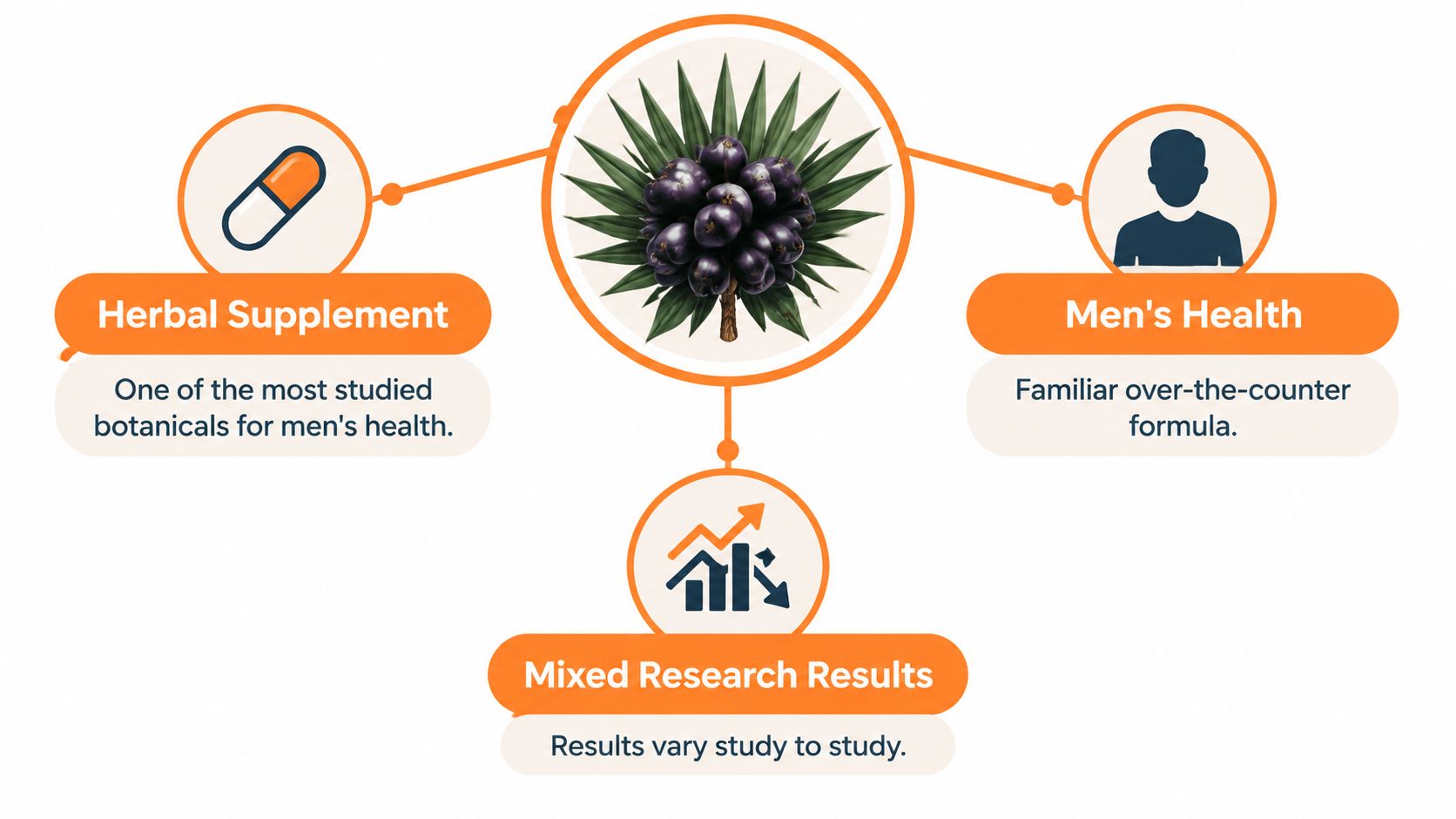
Why men take it
Men usually consider saw palmetto for two separate goals:
- Prostate comfort: Use often centers on urinary frequency, nighttime urination, weak flow, and other symptoms associated with benign prostatic hyperplasia, commonly called BPH.
- Hair support: The proposed connection involves dihydrotestosterone, or DHT, which also appears in discussions of androgenetic hair loss.
These claims address different outcomes. A product studied for urinary symptoms may not have the same evidence as one marketed for hair support, especially if the hair product is topical rather than oral. Relief of a symptom also does not establish that the prostate has become smaller or structurally different.
The plant's reputation reflects a long research history. The National Center for Complementary and Integrative Health overview of saw palmetto describes modern evidence finding little or no benefit for BPH symptoms when saw palmetto is used alone, despite more favorable early studies.
The historical shift helps explain the uncertainty. A plausible ingredient can attract encouraging initial results, then show weak or inconsistent practical effects in later trials. The berry, the extraction method, and the clinical endpoint all shape what a study can tell us.
How the Extract Is Made and What's in It
Saw palmetto extract is a selected portion of the berry, not just dried fruit in a capsule. Ripe berries are processed to concentrate the fat-soluble fraction, which contains many of the compounds used to describe and standardize the finished extract.
Manufacturing usually starts with drying and milling the berries into coarse plant material. Manufacturers then use solvent extraction or supercritical carbon dioxide extraction. Ethanol and carbon dioxide can draw out oily constituents, while water-soluble sugars and other non-lipophilic material play a smaller role in the final product.
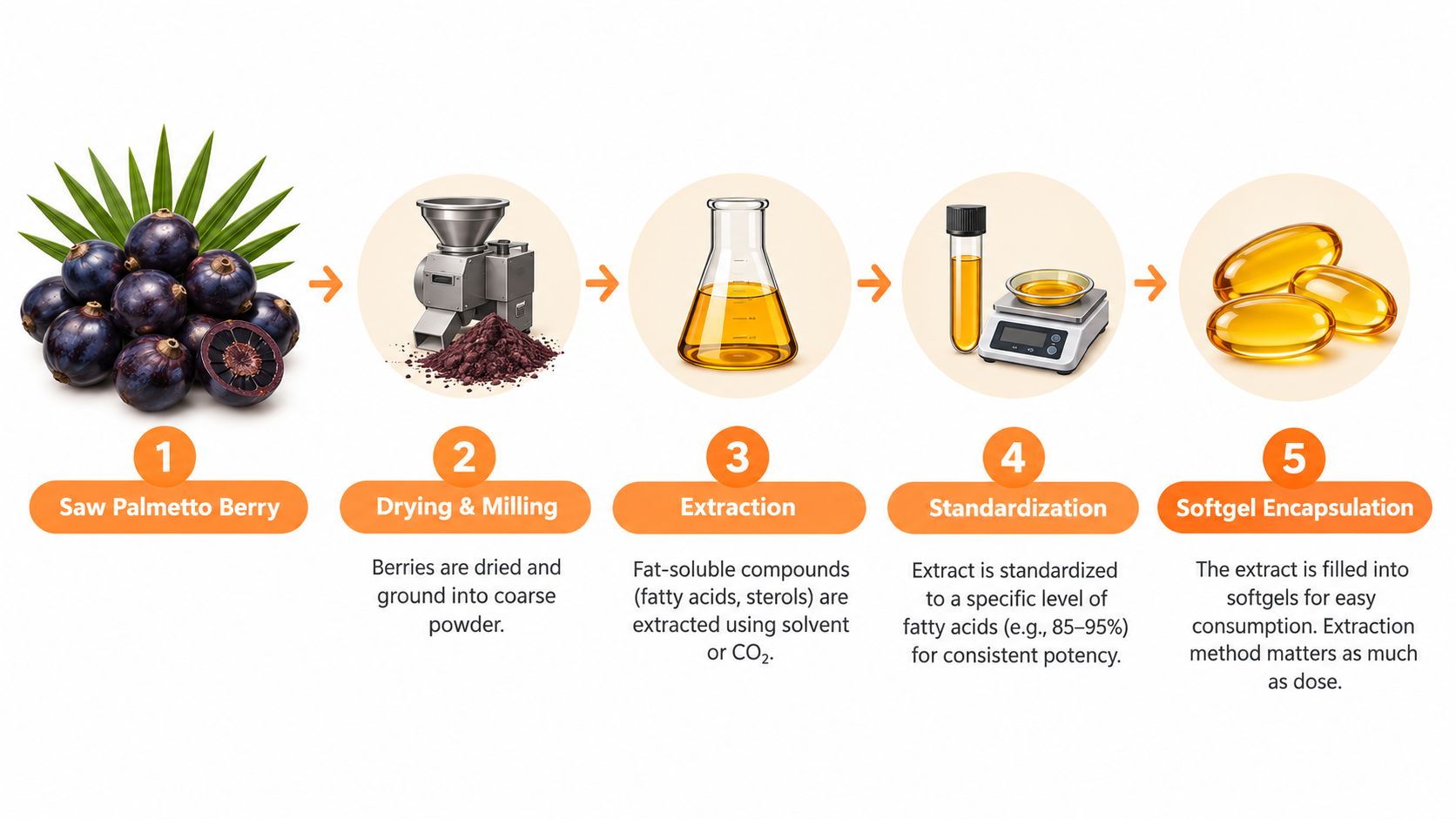
The fractions that matter
Research commonly discusses three groups of constituents:
- Fatty acids, including lauric, oleic, and myristic acids.
- Phytosterols, including beta-sitosterol.
- Minor plant compounds, such as flavonoids.
The difference is similar to concentrated juice. Whole fruit contains water, fiber, sugars, and other material. Concentration removes much of the water and produces a more defined mixture. A standardized saw palmetto extract aims to provide a predictable fatty-acid content, rather than relying only on the weight of berry material.
Commercial products may be standardized to about 85% to 95% fatty acids, while some dry extracts contain around 25% fatty acids, according to the Drugs.com saw palmetto monograph. These figures describe different preparations. A label number therefore needs to be read alongside the extraction type and analytical method.
Hexane-extracted products also occur in research and commerce. Clinical analyses have not shown a meaningful difference between hexane-extracted products and other preparations for BPH outcomes. The method can still affect the extract's composition, purity, and consistency, even without a demonstrated clinical advantage for one method.
How Saw Palmetto Is Believed to Work
A plausible mechanism is not proof of a useful treatment. Saw palmetto's proposed effects begin with 5-alpha-reductase, the enzyme that converts testosterone into dihydrotestosterone, or DHT. DHT acts like a stronger signal for some androgen-sensitive tissues, including the prostate and hair follicles.
Laboratory studies have associated saw palmetto's fatty-acid fraction, especially lauric acid, with reduced activity of this enzyme. Experimental models have also linked phytosterols such as beta-sitosterol with changes in inflammatory activity. A National Library of Medicine review of saw palmetto mechanisms describes these proposed actions, while also helping distinguish laboratory findings from clinical proof.
The theory has three connected parts:
- Hormone modulation: The extract may affect the enzyme involved in DHT production. Most support for this idea comes from laboratory research.
- Inflammatory signaling: Fatty acids and plant sterols may alter inflammatory pathways in cells.
- Tissue signaling: Experiments have examined whether the extract influences growth-related signals and cellular behavior.
These pathways explain why saw palmetto attracted research interest. They do not show that a capsule will reduce prostate size, improve urinary flow, or increase hair density.
Evidence rule: A mechanism makes an ingredient reasonable to study. Well-controlled human outcomes determine whether it helps people in practice.
Some clinical trials have reported symptom improvement, while findings for urinary flow and other outcomes have varied. That difference matters. A compound can appear active in cells yet produce little measurable benefit for people. Saw palmetto's debated status comes from this gap between biological plausibility and human results.
What the Research Actually Shows for Prostate Health
Saw palmetto's research history is less straightforward than its early reputation suggests. Earlier European studies and reviews reported improvements in urinary symptom scores, creating enthusiasm. One systematic review of 21 studies found a weighted mean difference of -1.41 points on a 0 to 19 scale for urinary symptoms, along with a nocturia improvement of -0.76 times per night, as summarized by NCCIH.
Those results came from studies that differed in size, extract composition, comparison groups, and methodological quality. Some compared saw palmetto with placebo, while others used an active medicine such as tamsulosin. These differences affect how confidently researchers can compare results across trials.
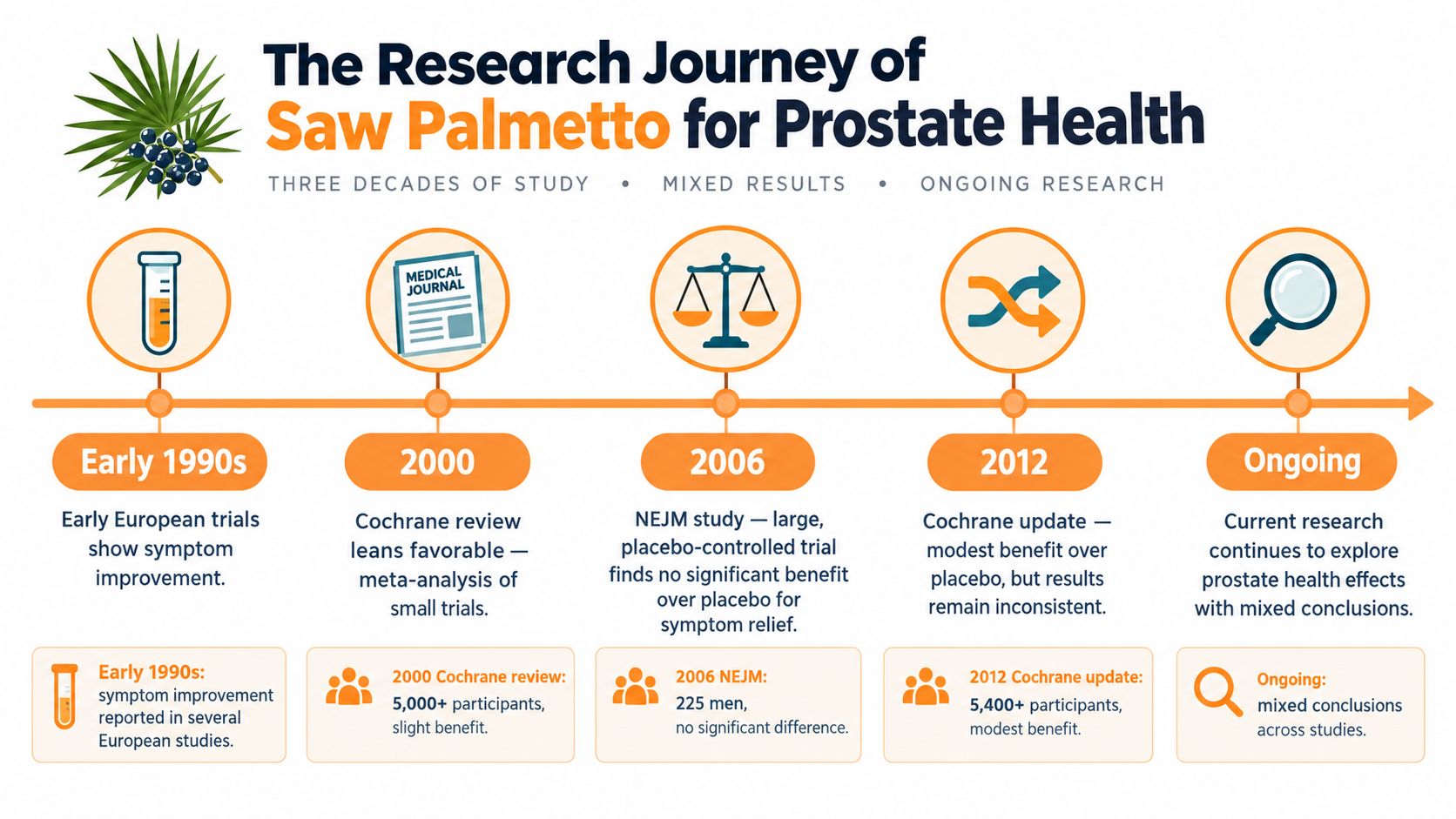
The evidence became less favorable
A major turning point was a 2006 randomized study that used 160 mg twice daily for one year. It did not show improved lower urinary tract symptoms caused by BPH.
Researchers tested the dose question again in the 2011 JAMA dose-escalation trial, evaluating amounts that reached three times the standard dose. Saw palmetto still did not provide greater relief than placebo for lower urinary symptoms or related outcomes, according to the JAMA trial.
The broader modern picture remains cautious. A 2023 review of 27 studies, summarized by NCCIH, concluded that saw palmetto used alone provides little or no benefit for BPH symptoms. Another analysis found no meaningful difference between hexane-extracted products and other preparation methods.
The early positive findings were not necessarily meaningless. They may reflect differences in study design, extracts, participants, or outcome measures. However, larger and better-controlled research did not consistently confirm the initial optimism. Study quality, extract standardization, dose, and the chosen endpoint all matter. A small questionnaire change may also fail to become a noticeable or lasting improvement in daily urinary function.
Does Saw Palmetto Shrink the Prostate or Just Ease Symptoms
Saw palmetto may be discussed as a prostate supplement, but that does not mean it makes an enlarged prostate smaller. There is no strong scientific evidence that saw palmetto shrinks the prostate. The Merck Manual reference on saw palmetto notes that imaging studies have not shown reversal of benign prostatic hyperplasia, or BPH.
The confusion comes from treating two different outcomes as one. Symptom relief concerns how a person urinates and feels. A structural claim concerns whether the prostate itself has changed.
Symptoms and structure are different measurements
Clinical trials can measure symptoms with questionnaires such as the International Prostate Symptom Score or the American Urological Association Symptom Index. These ask about urgency, weak stream, incomplete emptying, and nighttime urination.
Imaging measures something else: prostate volume. Medicines such as finasteride are assessed partly by structural effects, including reduced prostate volume. Studies of saw palmetto that examine volume generally have not shown meaningful shrinkage, even when some reports describe symptom improvement.
That leaves several possibilities:
- Someone may notice easier urination without a measurable change in prostate tissue.
- A product may fail to improve symptoms even if a proposed laboratory mechanism seems plausible.
- Symptom relief does not show that enlargement has reversed or that the condition's progression has changed.
Practical distinction: “Feels easier to urinate” and “the prostate is smaller” are separate claims. Each requires its own evidence.
Modern evidence is also less encouraging about symptoms than early reports suggested. Reviews describe little or no benefit for BPH symptoms when saw palmetto is used alone. If symptom improvement is uncertain, a claim of structural reversal has an even weaker foundation.
Why hair-loss discussions keep appearing
The proposed DHT pathway has also drawn interest in dermatology because it overlaps with biology involved in androgenetic alopecia. A small 2002 pilot trial involving men with mild-to-moderate hair loss reported a 60% improvement rating. That finding came from a limited early study, so it does not prove that oral saw palmetto reliably regrows hair.
Later research examined topical combinations and other preparations, including a 2012 topical combination study. Those results cannot be transferred automatically to a standardized oral capsule. Topical and oral products differ in delivery, concentration at the target tissue, and overall exposure.
Hair-loss research remains much smaller than the prostate evidence. It may help explain consumer interest, but it does not establish saw palmetto as an equivalent substitute for prescription treatment or a proven way to change hair growth.
Dosing Forms and What to Look For on a Label
A higher capsule count does not automatically mean a stronger product. Clinical studies often used 320 mg per day, commonly split into 160 mg twice daily, but labels may recommend one daily serving or a lower amount. Compare the total daily dose and the extract specification, not just the number of capsules. A saw palmetto prostate dosage guide can help explain how serving sizes and product formats differ.
Because saw palmetto extract is fat-soluble, taking it with food is a practical option. Food may support the handling and absorption of lipid-based ingredients, and it can make a softgel easier for some people to tolerate.
Read the label as a description of the ingredient, not as proof that the product will improve symptoms. Look for three details:
- What kind of extract is it? A standardized lipophilic extract gives more useful information than an unspecified berry weight alone.
- How is it standardized? Commercial products may list about 85% to 95% fatty acids, while some dry extracts list around 25% fatty acids. These figures can differ because testing methods differ.
- Has quality been independently checked? USP, NSF, or ConsumerLab seals may add verification. Check what the specific certification covers.
| Label Feature | What to Look For | Why It Matters |
|---|---|---|
| Extract type | Lipophilic or liposterolic berry extract | Identifies the fat-soluble fraction |
| Fatty-acid standardization | A clearly stated fatty-acid level | Helps compare product composition |
| Testing | USP, NSF, or ConsumerLab verification | Adds an independent quality check |
| Delivery form | Softgel, capsule, tincture, or dry extract | Tinctures often do not provide fatty-acid standardization |
Form matters because two products can list the same herb while providing different fractions and different label information. Interpret the serving size and extract type with a clinician, particularly if other medicines or an upcoming procedure are part of the picture.
Safety, Side Effects, and Medication Interactions
“Is saw palmetto safe?” is too broad to answer on its own. The practical question is safe for whom, at what dose, and alongside which medicines or procedures?
Available evidence generally describes saw palmetto as well tolerated, with reported effects such as stomach discomfort, digestive symptoms, dizziness, and headache. Clinical studies have followed participants using it for up to three years, and the extract does not appear to change PSA readings, including at higher-than-usual amounts, according to the NCCIH provider science summary.
A one-year safety assessment used 160 mg twice daily and found no evidence of serious toxicity or clinically important adverse effects, as reported in the published clinical safety assessment. The NIH saw palmetto monograph also finds no clear safety signal for men taking recommended doses, while noting that isolated serious-event reports have uncertain causality.
These findings describe tolerability, not suitability for every person. A product can be easy for one user to tolerate and still deserve review when another medicine, health condition, or procedure changes the risk.
Situations that need extra caution
- Bleeding risk: Anticoagulants and antiplatelet medicines warrant a clinician's review because bleeding concerns have been reported. The same caution applies before surgery or another invasive procedure.
- Hormone-related medicines: People using finasteride, dutasteride, testosterone replacement, or hormone-containing medicines should ask a prescriber or pharmacist about possible additive or opposing effects.
- Pregnancy and childhood: Safety information is limited, and a supplement marketed mainly to adult men is not automatically appropriate for everyone.
- New or persistent symptoms: Urinary symptoms need medical assessment, especially when their cause has not been established. Saw palmetto should not stand in for evaluation of a potentially significant prostate or urinary problem.
Randomized trials reviewed in a systematic review database reported no drug interactions, yet the wider record still includes bleeding-related events and later case-based cautions. The correct conclusion is neither blanket reassurance nor blanket alarm. Personal medicines and medical plans determine the relevant question.
Before a procedure: Tell the clinician managing bleeding risk about saw palmetto, even if the product was purchased without a prescription.
The FDA requires a specific structure/function disclaimer for supplement claims. The FDA dietary supplement labeling guide states that its wording may not be modified.
For a plain-language review of tolerability and interaction concerns, see this saw palmetto side-effects guide. Anyone overseeing blood thinners, hormone therapy, or an upcoming procedure should receive the complete supplement list.
Putting It All Together Before You Buy
The right decision starts with the intended outcome. Prostate symptom relief has a mixed and generally weak modern evidence base. Hair-support evidence is thinner, while broad wellness claims aren't well established by the clinical record.
Three checkpoints can make the choice more disciplined:
- Review personal risk. A doctor or pharmacist should assess saw palmetto before use when blood thinners, antiplatelet medicines, hormone-related medicines, or an upcoming procedure are involved.
- Read the full label. A product should identify the extract type, fatty-acid standardization, total daily amount, and any independent quality verification. Major trials commonly used a standardized lipophilic extract totaling 320 mg daily, as described in the prostate health supplement guide.
- Track the chosen outcome. Someone considering a trial can record urinary symptoms, nighttime bathroom trips, or perceived hair shedding rather than relying on memory. A planned 8 to 12 week observation period is often discussed in consumer guidance, but any worsening symptom should prompt medical care rather than extended self-experimentation.
Saw palmetto is a structure/function supplement, not an approved drug for BPH or androgenetic alopecia. A plausible mechanism and a long research history don't change that limitation.
SEMEX offers a daily men's wellness supplement that includes saw palmetto alongside zinc, L-arginine, sunflower lecithin, bromelain, maca root, Panax ginseng, ashwagandha, tongkat ali, and horny goat weed. Men evaluating ingredient transparency and third-party testing can visit SEMEX to review the formula and product details.
These statements have not been evaluated by the Food and Drug Administration. This product is not intended to diagnose, treat, cure, or prevent any disease.