

Origins of Bukkake: History and Cultural Context
The most popular explanation for the origins of bukkake is probably the least reliable one. Online retellings often place the practice in medieval Japan, describing it as a samurai punishment for adultery or a formal feudal ritual. That story is dramatic, memorable, and unsupported by reliable documentary evidence.
The documented record points somewhere else: Japan's commercial adult-video industry in the mid-to-late 1980s. The term itself comes from an ordinary Japanese verb meaning to splash, dash, or pour liquid over something. Its transformation into a fixed adult-film label appears to have taken place through production practices, censorship constraints, and the growth of Japanese AV rather than through an ancient ceremony.
Tracing that history requires keeping three things separate: what surviving accounts document, what media conditions make plausible, and what folklore merely repeats.
Table of Contents
- The Samurai Punishment Story That History Doesn't Support
- The Japanese Verb Behind a Modern Genre Label
- How 1980s Japanese Censorship Shaped the Genre
- Early Documented Examples and the 1980s AV Industry
- How the Genre Traveled Beyond Japan
- A Unified Explanation of the Genre's Form
- Why the Punishment Myth Keeps Circulating
The Samurai Punishment Story That History Doesn't Support
The samurai punishment story is a modern explanation, not a documented account of the genre's beginnings. It describes a woman accused of adultery, feudal authorities imposing punishment, and a group of men taking part in a ritualized act of humiliation. Versions vary, but they all present contemporary pornography as a survival from medieval Japan.
Its appeal is easy to understand. Samurai, public punishment, sexual shame, and ritual are familiar elements in popular images of feudal Japan. The story also turns a complicated media history into a single dramatic origin. Readers comparing folklore across terms can see the same pattern in the meaning of busting a nut: a memorable explanation can spread even when its historical basis remains unclear.
The documentary problem is more decisive. Available accounts connect the modern sexual meaning of bukkake with Japanese adult-video production in the 1980s. The feudal-punishment account lacks reliable documentary support and is widely treated as an urban legend. The documented history of the term and genre does not establish a medieval ritual as its source.
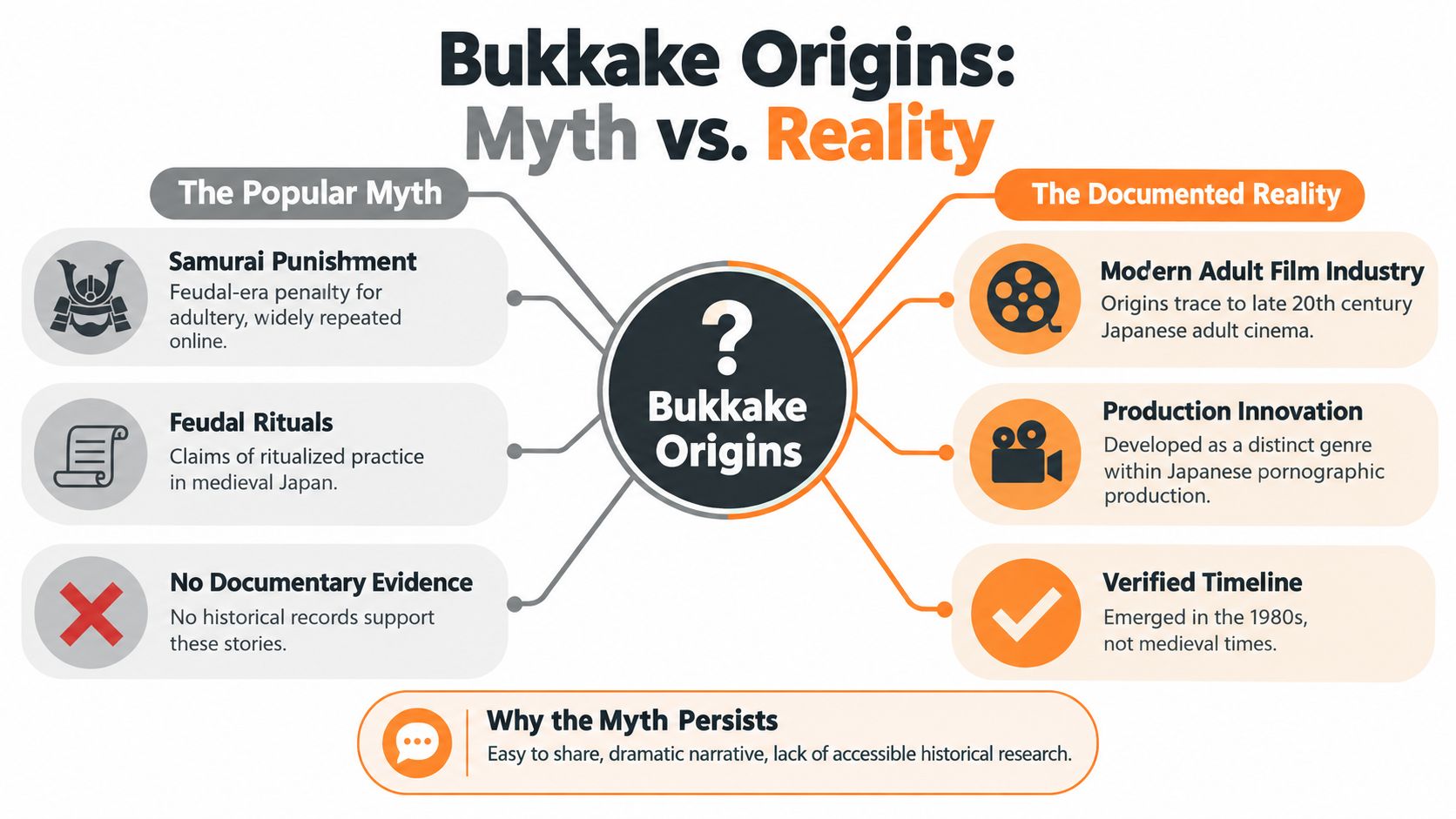
Why the story persists
Folklore survives correction when it supplies a complete narrative. The punishment account gives the act an apparent historical pedigree, associates it with a famous warrior culture, and recasts a commercial media product as an inherited custom. Short online explanations often preserve that structure while dropping the uncertainty.
A vivid story still needs evidence. Claims about medieval practice require period records, contemporary descriptions, or a traceable chain of documentation. Repetition across websites provides none of these.
The better-supported explanation places the genre within modern Japanese pornography. Producers worked within the technical and legal conditions of the 1980s, and those conditions helped make a recognizable format commercially viable. The surviving record may not identify the first use of the label or every early production, but it offers a more defensible starting point than the samurai story.
The Japanese Verb Behind a Modern Genre Label
Before bukkake became associated with adult media, its linguistic source had a much broader meaning. The Japanese verb bukkakeru refers to splashing, dashing, or pouring liquid over something. In ordinary use, a verb of this kind can describe an action involving water or another liquid without carrying a sexual meaning.
That distinction matters. Words frequently move from everyday language into specialized industries. A term may begin as a general description, then acquire a narrower sense when producers, advertisers, performers, or audiences use it repeatedly for a particular format. The adult-media meaning of bukkake appears to follow that path.
From action word to category name
The shift wasn't a sudden discovery of an ancient sexual vocabulary. It was a process of commercial labeling. As Japan's adult-video market expanded during the 1980s and 1990s, production companies developed recognizable categories that helped distinguish one visual formula from another. A general verb could become a genre label when it was repeatedly attached to scenes organized around splashing or covering the body with liquid.
That doesn't mean every use of the verb became sexual. It means the adult industry gave the word a specialized context that later became familiar outside Japan. The linguistic history therefore complicates the punishment myth. A word with an ordinary meaning was narrowed by modern media usage, rather than preserved from a documented medieval ritual.
The same pattern appears across adult-media vocabulary. Terms can retain their original dictionary sense while developing a separate commercial meaning. Readers encountering SEMEX, for example, should distinguish a product name from the historical vocabulary discussed here. The similarity of subject matter doesn't make the terms linguistically related.
Why the distinction matters
Etymology can't prove exactly when a genre began, but it can rule out weak assumptions. The verb's nonsexual origin shows that the word itself doesn't encode an ancient ritual. The specialized meaning had to develop through later usage, and the available historical account places that development within Japan's modern adult-video culture.
The result is a more cautious conclusion. The name reflects a description of an action, then a repeated production formula, and finally an internationally recognized adult category. Each stage belongs to a different historical context.
How 1980s Japanese Censorship Shaped the Genre
Censorship can influence a genre without inventing it by itself. In Japan's adult-video environment, explicit depictions of genitalia were subject to mosaic concealment. External ejaculation could be shown without depicting penetration or uncensored genital anatomy in the same way, creating an important difference between what had to be obscured and what could remain visually legible.
The consequence was a production problem with a practical solution. If producers couldn't display certain anatomical details clearly, they could emphasize other visible signs of climax, including fluid, reaction, positioning, and sequence. This is a media-technical explanation, not proof that one regulation single-handedly created the genre.
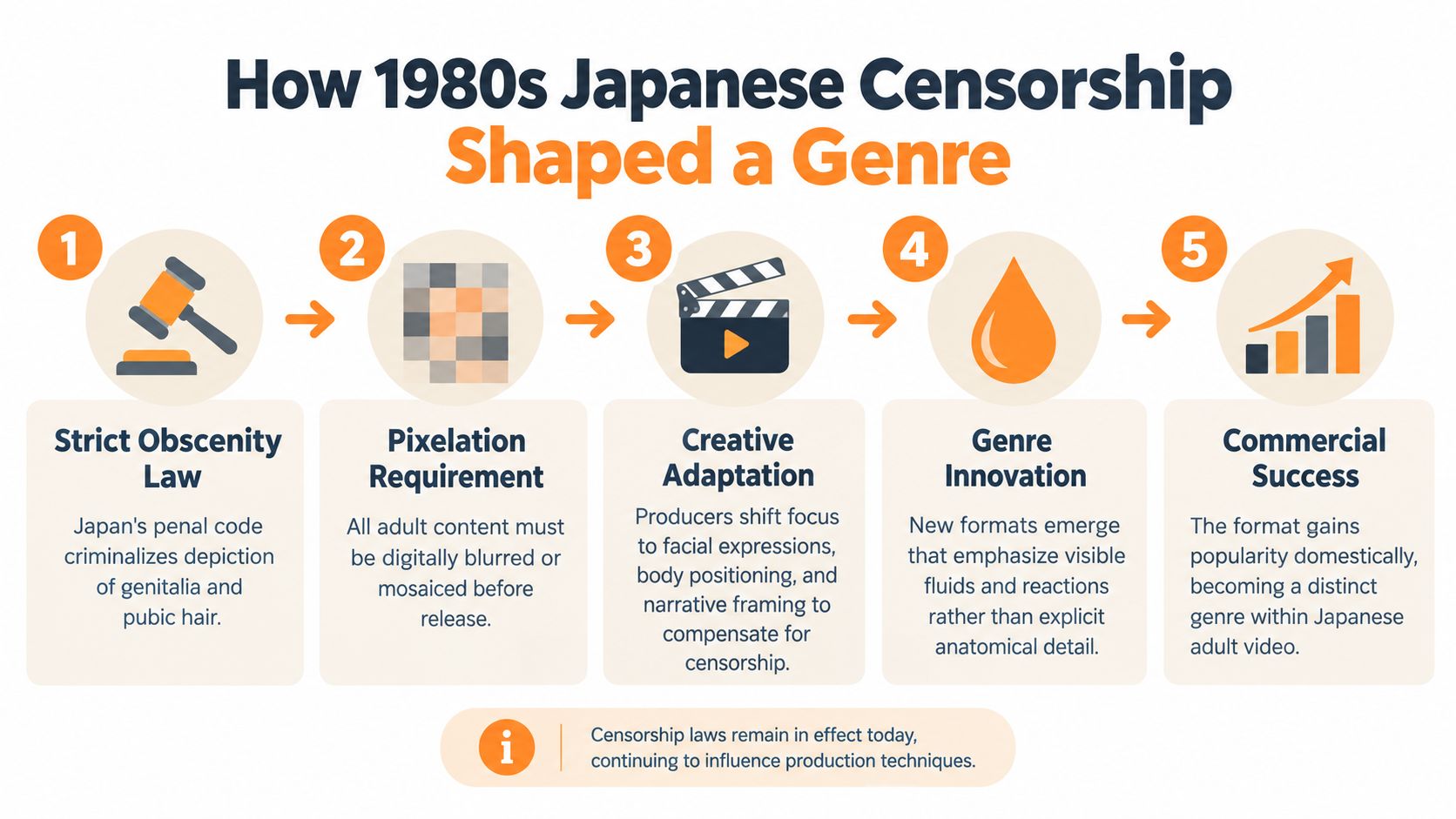
What the production logic made possible
The account of Japanese censorship and bukkake's visual form describes a production environment in which visible ejaculation could function as a distinguishable sign of sexual climax while censored anatomy remained concealed. That likely helped shape the genre's emphasis on quantity, sequencing, and group participation.
The logic can be broken down into several connected choices:
- Conceal restricted anatomy. Mosaic censorship limited what viewers could see directly.
- Emphasize permitted visual signs. Producers could give greater attention to fluid, facial reaction, body position, and editing.
- Build repeatable sequences. A scene organized around successive participants or visible outcomes could become a recognizable formula.
- Create a marketable category. Once audiences understood the format, labels could separate it from other adult-video conventions.
The final step remains an interpretation of industrial behavior. Censorship created constraints, but producers still made choices about style, narrative, and marketing. The evidence supports a likely influence, not a single-cause origin story.
Regulation and creativity are not opposites
Censorship often narrows a filmmaker's options, yet it can also encourage formal adaptation. In this case, concealment may have made external visual signs more important. Producers could turn a limitation into a recurring set piece that was legible to audiences even when other forms of explicit display were obscured.
That doesn't make the result uniquely Japanese or culturally inevitable. It shows how law, technology, audience expectation, and commercial repetition can interact. The genre's form becomes easier to understand when viewed as a response to a specific media environment rather than as evidence of an ancient social custom.
Early Documented Examples and the 1980s AV Industry
A useful chronology begins with a media artifact rather than a legend. The Japanese adult film Mascot Note, released in 1986, is frequently identified as the first known screen appearance of the format. That identification should be treated carefully. “First known” describes the limits of the surviving record, not an absolute guarantee that no earlier example existed.
The film matters because it anchors the discussion in modern production. Instead of relying on an alleged samurai custom, researchers can point to a named work from Japan's commercial adult-video industry and ask how its format was presented, repeated, and labeled.
A documentary timeline
| Year | Milestone | Significance |
|---|---|---|
| 1986 | Japanese adult film Mascot Note is frequently identified as the first known screen appearance of the format | Provides an early documented media reference for the modern genre |
| Late 1980s | Similar production practices appear within Japan's commercial adult-video market | Shows the format developing inside modern pornography rather than an ancient ritual |
| 1990s | The term becomes more standardized and commercially visible | Marks the movement from a scene formula toward a recognizable genre label |
The timeline is short, but it changes the question. The issue isn't whether medieval Japan possessed a hidden version of a modern pornographic category. The issue is how a production formula became recognizable within a modern industry.
What the record can and can't establish
The early film reference supports a modern origin, but it doesn't provide a complete industrial history. It doesn't tell us every producer involved, how audiences first responded, or precisely when the term became standard across catalogs. Those details require access to surviving films, trade materials, advertisements, and contemporaneous Japanese-language sources.
The available account does support a broader conclusion. The format emerged in the mid-to-late 1980s, then became more commercially visible during the 1990s, when Japanese AV categories became increasingly standardized. That chronology conflicts with claims that the practice originated as a medieval punishment.
Evidence threshold: A named film can anchor a timeline. It can't, by itself, explain every cause or erase every uncertainty.
How the Genre Traveled Beyond Japan
A regional production formula becomes international through circulation. Japanese adult video reached viewers outside Japan through imported physical media, distributor catalogs, translation, and later online sharing. As the material crossed borders, the Japanese label often traveled with it, because retaining the original term helped distributors distinguish the category from familiar Western labels.
That transmission changed the word's cultural setting. In Japan, the term had a linguistic history tied to a general verb and an adult-media classification. In English-language online spaces, many viewers encountered it primarily as a foreign genre name. The original verb became less visible, while the specialized pornographic meaning became dominant.
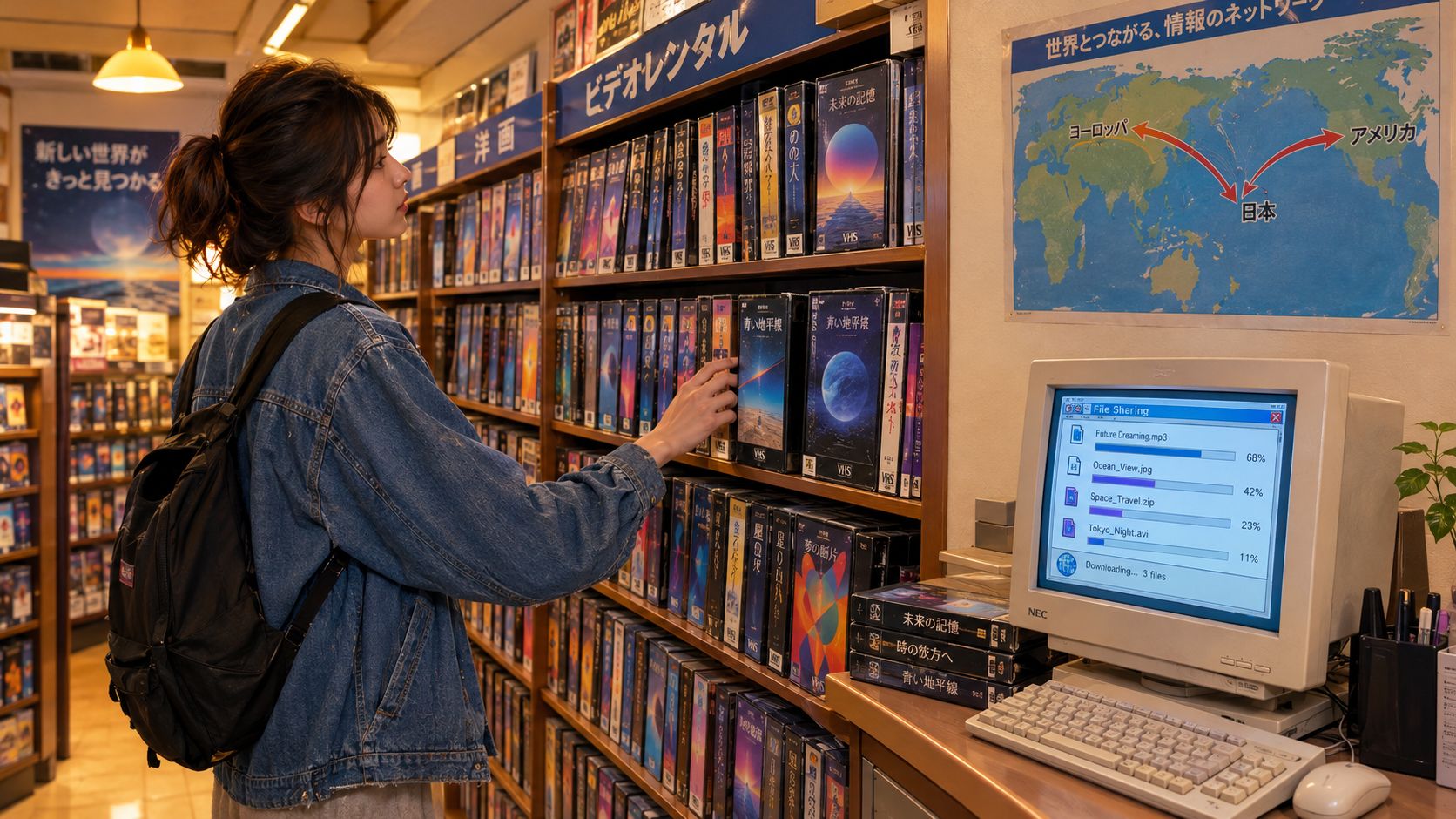
Translation preserves some things and distorts others
Import markets and online communities helped preserve the Japanese label, but they didn't necessarily preserve its history. A translated description might explain the visual format while omitting the ordinary meaning of bukkakeru. Another might add colorful backstory to make an unfamiliar term more memorable.
That's one possible route by which the punishment myth gained traction outside Japan, though the available evidence doesn't establish a single point of origin for that story. Western audiences often received the term detached from Japanese linguistic records and from the production conditions that shaped it. The empty historical space invited speculation.
The same problem affects other imported adult terms. A reader comparing vocabulary through this discussion of another semen-related term should be wary of treating online glossaries as historical archives. A definition can explain current usage without proving where a practice began.
The internet amplified category thinking
Online distribution made specialized labels searchable and repeatable. Users could encounter a term, copy an explanation, and circulate it without checking Japanese-language sources or early media documentation. That process helped fix bukkake in English-language vocabulary, but it also encouraged simplified origin stories.
The international history is therefore partly documented and partly inferential. The movement of Japanese adult media through imported video and online networks is a reasonable explanation for global recognition. The exact moment when the punishment narrative attached itself to the term remains less certain.
A Unified Explanation of the Genre's Form
The strongest explanation combines three developments without pretending they prove more than they do. First, bukkakeru supplied a general word associated with splashing or pouring liquid. Second, Japanese adult-video producers worked under censorship rules that concealed genital anatomy. Third, commercial production rewarded recognizable formats that could be repeated, labeled, and sold to an existing audience.
Together, these conditions explain why the modern genre carries its name and why its visual structure emphasizes external effects. The word supplied a flexible description. The regulatory environment made certain visual signs more useful. The industry turned those signs into a recurring format.
Three pressures, one recognizable category
The linguistic pressure was semantic narrowing. A neutral verb acquired a specialized adult meaning through repeated use.
The regulatory pressure was representational. Mosaic concealment limited explicit anatomical display, while visible ejaculation could remain a distinguishable sign of climax. The historical discussion of creampie terminology illustrates why adult categories often depend on precise distinctions between visual actions, labels, and audience expectations, although the terms describe different formats.
The industrial pressure was repetition. Producers could organize scenes around quantity, order, reaction, and group participation. Those elements made the format recognizable without requiring a medieval backstory.
Why this explanation is stronger than folklore
The model fits the evidence because each part belongs to a documented modern context. It doesn't require an undocumented ritual, a hidden feudal custom, or a continuous tradition linking medieval punishment to commercial pornography.
It also leaves room for uncertainty. Censorship likely influenced the genre, but the evidence doesn't prove that it caused its invention alone. Commercial incentives clearly mattered, but surviving accounts don't provide a complete record of every business decision. A good historical explanation can be persuasive without pretending to be complete.
Why the Punishment Myth Keeps Circulating
The feudal-punishment story persists because it provides narrative drama where the documented record offers industrial detail. “A genre emerged inside Japanese adult cinema under censorship constraints” is historically useful but less sensational than “samurai authorities used it to punish adulterous women.” Folklore often wins the first encounter because it is easier to visualize and retell.
The recurring versions usually make several claims:
- Adulterous women were punished publicly. This turns an adult-media format into a legal or social penalty.
- Samurai customs preserved the practice. This gives the story an association with a highly recognizable historical class.
- Medieval rituals anticipated the modern genre. This creates a false line of continuity from feudal Japan to commercial pornography.
- Humiliation was the original purpose. This presents a modern category as an inherited social institution.
None of those claims should be presented as established history without documentary evidence. Available historical accounts instead place the modern genre in Japan's adult-video industry during the 1980s, and they treat the punishment narrative as an urban legend.
Why repetition feels like evidence
A story repeated across forums, glossaries, and social posts can look well established even when each version traces back to another unsourced retelling. The effect is cumulative familiarity, not cumulative proof. Readers may also mistake the seriousness of the tone for the reliability of the account.
The broader lesson applies beyond this subject. When a contested origin story includes precise social roles, moral punishment, and an exotic historical setting, ask who first recorded it, when they recorded it, and whether independent evidence survives. A discussion of dominant and submissive scenarios may describe modern media conventions, but contemporary labels shouldn't automatically be projected backward into earlier societies.
What remains uncertain
The documentary record doesn't answer every question about early naming, distribution, or audience response. It does, however, support a clear distinction between modern evidence and medieval folklore. The most defensible conclusion is that bukkake developed as a recognizable adult-video genre in modern Japan, with censorship and commercial production shaping its form, while the samurai-punishment account remains unverified.
That conclusion may feel less satisfying than a legend. Historical honesty often is.
SEMEX offers a supplement positioned around semen volume and taste, making it relevant to readers interested in the contemporary wellness context surrounding this topic rather than its disputed history. Visit SEMEX to review the product information and decide whether it fits your personal goals.
These statements have not been evaluated by the Food and Drug Administration. This product is not intended to diagnose, treat, cure, or prevent any disease.