

Meaning of Creampie Explained Clearly and Safely
Creampie most commonly means ejaculation into a partner's vagina or anus, with semen remaining inside rather than being ejaculated externally. The term is explicit sexual slang, and its meaning depends heavily on context, consent, and the safety choices involved.
Why does a phrase that resembles a dessert carry a completely different meaning online? People may encounter it in pornography, a private message, an adult-content label, or an unfamiliar search result, then wonder whether it refers to food, slang, or a specific sexual practice. A clear explanation can answer that question without judgment or unnecessary graphic detail.
Table of Contents
- Introduction to the Meaning of Creampie
- What the Term Actually Means in Plain Language
- Where the Term Came From and How It Spread
- How the Term Is Used in Different Contexts
- Consent Communication and Safety Considerations
- Key Takeaways and Responsible Next Steps
Introduction to the Meaning of Creampie
In sexual slang, creampie refers to internal ejaculation. The central distinction is where ejaculation occurs and whether semen remains inside the partner, rather than being released externally. This definition is documented in Wiktionary's entry for creampie.
Plain definition: “Creampie” is an explicit adult term for ejaculation inside a partner's vagina or anus.
The word is not interchangeable with cream pie, written as two words, which normally refers to a dessert. Spelling and setting therefore matter. A recipe, bakery menu, or cooking conversation points toward food, while an adult-content tag or sexual conversation points toward the slang meaning.
People often search for the meaning of creampie because they've seen the term without enough context. Some encounter it in pornography or online categories. Others see it in a text, joke, or private conversation and need to understand the tone before responding. The term is generally explicit, so it may feel inappropriate in school, workplace, family, or other public settings.
Understanding the word is different from endorsing the activity. A responsible explanation should distinguish the slang definition from real-life decisions involving consent, pregnancy risk, sexually transmitted infections, and personal boundaries. The sections below move from the term's basic meaning to its metaphorical origin, changing contexts, and practical communication.
What the Term Actually Means in Plain Language
The simplest way to understand the term is to compare internal ejaculation with external ejaculation. In the usage documented by slang and glossary sources, the word points to semen being released inside a partner's vagina or anus. It doesn't describe every form of ejaculation, and it isn't a general synonym for sex.
The term functions as adult slang rather than neutral health language. In pornography, it may appear as a category or search label. In a private conversation, a speaker might use it as a noun to name a sexual preference or as a verb to describe an action. The exact tone can range from descriptive to provocative, depending on who says it and why.
The dessert comparison explains the word's imagery, but it shouldn't be treated as a medical description. A cream pie contains filling inside a pastry, and the slang expression draws on the visual idea of filling that later spills out. That metaphor is the linguistic bridge between the ordinary food phrase and the explicit adult term.
The key distinction is location: the slang refers to semen remaining inside rather than ejaculation occurring externally.
Readers may also confuse the term with related expressions that describe different ideas. A phrase about semen volume, for example, focuses on quantity, while creampie focuses on the location of ejaculation. A phrase about pregnancy or conception introduces another layer of meaning that may or may not be intended by the speaker.
A useful interpretation rule is to avoid guessing from the word alone. The surrounding sentence, the relationship between the speakers, and whether the discussion is about media or real-life sex all affect meaning. If the context is unclear, a neutral clarification is safer than assuming the speaker wants an explicit exchange.
Where the Term Came From and How It Spread
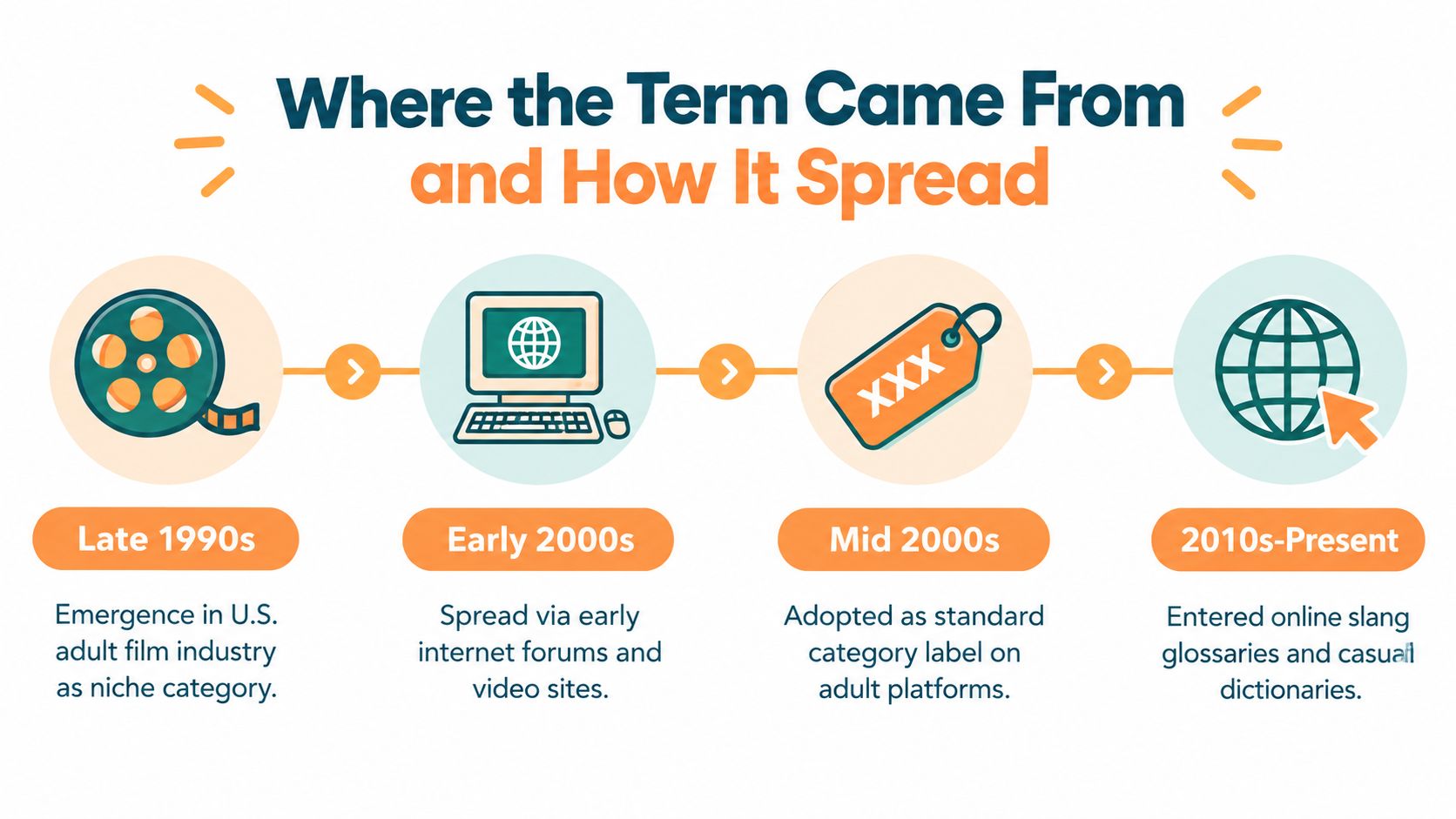
The sexual slang expression is documented as emerging in U.S. pornography in the late 1990s to early 2000s. Usage is attested as early as 1999, followed by broader industry adoption in the early 2000s, according to the documented history of the sexual term).
The word's origin is linked to the visual image of a cream pie's filling spilling out after the pastry has been filled. Adult pornography adopted that metaphor as a label for a particular depiction of internal ejaculation. The comparison is intentionally visual, which helps explain why the term feels more like a media category than a formal sexual-health phrase.
As adult media and online communities expanded, the expression moved beyond a narrow industry setting. It appeared in search labels, informal discussions, and slang references, which made it recognizable to people who had never encountered the original pornography context. That spread also created confusion, since many readers first notice the word without knowing whether it is literal, joking, or sexual.
The phrase can sit near broader conversations about ejaculation, semen, and sexual expectations. For readers looking for a separate explanation of another adult expression, this guide to “busting nuts” covers a different slang phrase and shouldn't be treated as a synonym for creampie.
Historical origin doesn't determine whether a person should use the term. It only clarifies why the word exists and why its spelling resembles a dessert. In current usage, the expression remains explicit and should be treated as adult language, especially when it appears outside clearly marked mature content.
How the Term Is Used in Different Contexts
Context changes the function of the word even when the underlying slang meaning remains similar. In pornography, creampie commonly operates as a category, title word, or search tag. It tells the viewer what kind of explicit depiction appears in the material, but it doesn't establish that the same activity was consensual, safe, or desirable in a viewer's real life.
In online slang, the term may appear in a glossary, meme, joke, or private message. A glossary uses it to define language. A joke may use it for shock value. A private message may carry sexual intent, but it could also be an unwanted escalation. The recipient's comfort matters more than the sender's assumption.
In partner communication, the word can be too vague to support meaningful consent. One person may use it to refer only to internal ejaculation, while another may attach ideas about pregnancy, exclusivity, intimacy, or pornography. A conversation becomes clearer when partners replace the slang with direct language about what is and isn't being discussed.
Several common misunderstandings deserve attention:
| Context | What the term usually does | What it doesn't establish |
|---|---|---|
| Adult media | Labels explicit content | Real-life safety or consent |
| Slang glossary | Defines an adult expression | Approval of the activity |
| Private text | May signal sexual intent | Permission to continue |
| Partner discussion | Names a sexual topic | Agreement about boundaries or protection |
A person who receives the term unexpectedly can respond without matching its explicitness. “What do you mean by that?” asks for context. “That subject isn't welcome here” sets a boundary. “Please keep the conversation non-sexual” makes the preferred direction unmistakable.
Discussions involving anal sex require especially precise wording because anatomy, comfort, and protection considerations differ from vaginal sex. A separate explanation of ejaculation in the anus addresses that context directly. The broader lesson remains the same: a pornography label is not a script for a real-life encounter.
Consent Communication and Safety Considerations
Knowing the meaning of creampie doesn't tell partners whether an activity is appropriate for them. That decision requires freely given, informed, specific, and reversible consent. Consent should be discussed before sexual activity, not inferred from flirting, prior behavior, pornography, or a partner's willingness to use explicit language.
The conversation should cover the practical issues that the slang can conceal. Partners may need to discuss whether vaginal or anal sex is involved, whether a condom will be used, how pregnancy prevention is handled when relevant, whether STI testing has been discussed, and what each person can stop at any time.
Practical rule: A sexual term can start a conversation, but it cannot replace consent.
A short script can make the discussion less awkward:
- Clarify the meaning: “When that word comes up, what specific activity are you referring to?”
- State a boundary: “That isn't something this partner agrees to.”
- Confirm protection: “A condom is required, and the plan won't change during sex.”
- Keep consent active: “Either person can stop, and stopping won't lead to pressure or punishment.”
- Separate fantasy from intent: “Erotic language isn't permission for the real-life act.”
Condoms can reduce exposure to semen and some infectious fluids, although no method eliminates every sexual-health risk. Testing and honest disclosure help partners make informed decisions, while contraception deserves separate attention whenever semen could enter a vagina. A person should consult a qualified clinician or sexual-health service for individualized advice about contraception, emergency contraception, STI testing, or symptoms.
Pornography can create unrealistic expectations because performers, editing, production choices, and negotiated scenes aren't visible to the viewer. It should never be used as evidence that a partner wants the same activity or that a particular practice carries no consequences.
For people researching related questions about sexual fluids, this article about swallowing sperm concerns a different exposure and should not be treated as guidance for vaginal or anal sex. Each activity has its own considerations, and a clinician can provide the most relevant advice.
A safety check can remain simple:
- Agreement: Has every participant clearly said yes to the specific activity?
- Boundaries: Has each person stated what is off-limits?
- Protection: Has the barrier and contraception plan been agreed in advance?
- Testing: Have partners discussed recent testing and relevant sexual-health history?
- Exit plan: Can anyone stop immediately without pressure?
- Follow-up: Is there a plan to seek care if concern, exposure, or symptoms arise?
If someone sends the term without invitation, the recipient doesn't owe an explicit reply. Blocking, ending the conversation, or seeking support from a trusted person can be appropriate responses to harassment or pressure.
Key Takeaways and Responsible Next Steps
The meaning of creampie is direct but context-sensitive. In sexual slang, it most commonly refers to ejaculation inside a partner's vagina or anus, with semen remaining inside. Its wording comes from a cream-pie metaphor, and its documented use emerged in U.S. pornography from the late 1990s into the early 2000s.
The term can function as a pornography label, an online slang expression, or a subject in private partner communication. Those settings aren't interchangeable. A media category doesn't prove consent in a real-life situation, and a message containing explicit slang doesn't grant permission for further sexual conversation.
Responsible communication uses plain words rather than relying on assumptions. Partners should discuss boundaries, barriers, pregnancy prevention where relevant, STI testing, and the right to stop. Anyone who feels pressured can decline, change the subject, end the interaction, or seek professional support.
For readers also comparing men's wellness products, SEMEX is listed as a daily dietary supplement. Product information should be evaluated separately from sexual consent and sexual-health decisions, and supplement language should remain limited to structure/function descriptions rather than disease claims.
The FDA explains that structure/function claims require a specific disclaimer because the agency hasn't evaluated those claims, and supplement products can't legally imply diagnosis, treatment, cure, or prevention of disease. The required wording is:
“These statements have not been evaluated by the Food and Drug Administration. This product is not intended to diagnose, treat, cure, or prevent any disease.”
Readers who encounter this term should first identify the context, then ask for clarification if needed. When the topic concerns a real partner, an honest conversation and qualified sexual-health guidance are more reliable than pornography, slang, or assumptions.
SEMEX offers a daily men's wellness supplement for readers researching semen-related topics, but it doesn't replace condoms, contraception, STI testing, or consent. Visit SEMEX to review the product information and keep supplement decisions separate from responsible sexual-health planning.