

Male Libido and Age What Changes and What Helps
Could age alone explain a change in sexual desire, or is it the easiest explanation to reach for? Male libido and age are related, but age doesn't tell the whole story. What changed for you, and what else changed around the same time, are often more useful questions.
Sexual interest can shift over adulthood, and those changes don't follow one universal timetable. Desire, erections, ejaculation, and satisfaction are related parts of sexual health, but they're not interchangeable. Understanding which part has changed can help you decide whether to make a practical adjustment, talk with a partner, or seek medical advice.
Table of Contents
- What Changes With Male Libido and Age
- How Hormones and Blood Flow Shape Desire
- What Research Says About Desire Across the Lifespan
- Why Health, Mood, Medication, and Relationships Matter
- Everyday Habits That Support Sexual Wellness
- Nutrition and Targeted Supplement Research
- When Persistent Changes Need Medical Care
- Putting Male Libido and Age Into Perspective
What Changes With Male Libido and Age
Is a dip in desire after 40 caused by age itself, or by the things that tend to change around the same time? Two men of the same age can have very different experiences. One notices less spontaneous interest while still enjoying sex once it begins. Another feels plenty of desire yet struggles to get or keep an erection. Same number of birthdays, different problem, different next step.
Seeing why requires separating the parts of sexual health that often get lumped together. Libido means sexual desire or interest. Erectile function is about blood flow and the ability to achieve or maintain an erection. Ejaculatory function covers ejaculation and orgasm, and sexual satisfaction reflects how you feel about your experiences overall. Each responds to different influences, so each calls for a different line of questioning.
The European Male Ageing Study used that kind of framework, tracking 3,369 community-dwelling men aged 40–79 across eight European centers and measuring each domain separately instead of collapsing sexual function into a single score. That design lets researchers, and you, ask which specific piece changed rather than settling for a vague sense that things aren't what they were. (European Male Ageing Study findings)
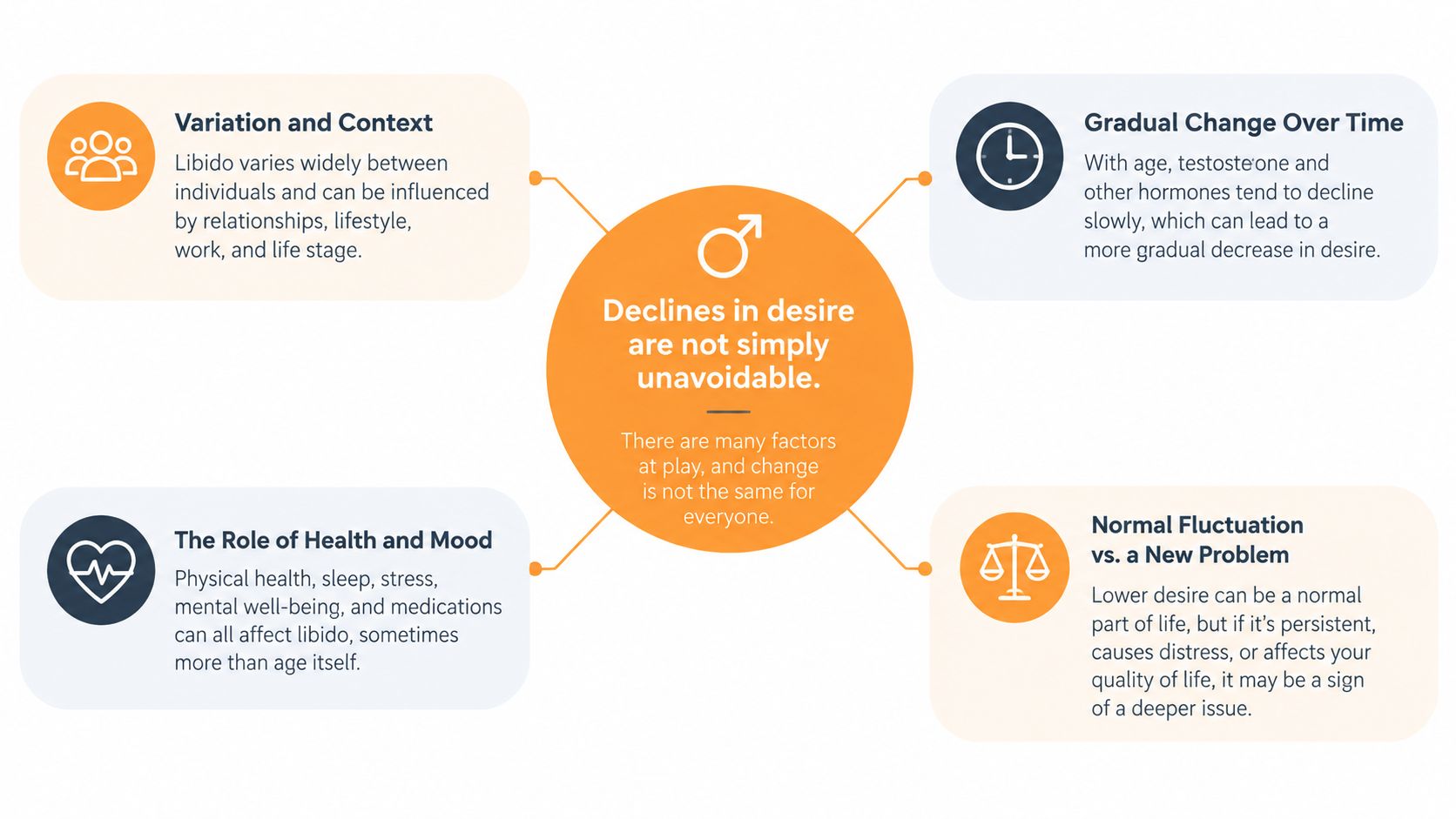
A useful distinction: Desire, erections, ejaculation, and satisfaction are separate domains. A shift in one can leave the others untouched, so start by naming what you've actually noticed.
Sexual interest responds to hormones, general health, mood, sleep, relationship context, and daily habits. Erection-related performance leans more heavily on blood vessel and metabolic health. Age rarely travels alone: new medications, poorer sleep, added weight, stress, and relationship strain often arrive in the same stretch of life, and each can lower desire on its own. Matching what you've noticed to the right domain helps you spot the factors most likely to be involved.
Sexual Health Domains and What They Measure
| Domain | What it reflects | Why it differs |
|---|---|---|
| Libido | Interest in or desire for sex | Can shift with mood, health, hormones, or relationship context |
| Erectile function | Ability to achieve or maintain an erection | Strongly influenced by vascular and metabolic health |
| Ejaculatory function | Ejaculation and orgasm | Doesn't necessarily change in step with desire or erections |
| Sexual satisfaction | Personal experience and contentment | May reflect intimacy, expectations, health, and relationship quality |
| Overall sexual activity | How often sexual activity occurs | Depends on desire, opportunity, health, and partnership |
How Hormones and Blood Flow Shape Desire
Think of sexual function as a dashboard with several gauges. Testosterone is one gauge, but circulation, nerves, mood, sleep, medications, and relationship context matter too. A change in one reading may help explain a symptom, but it doesn't tell the whole story.
Testosterone exists in total and free forms. Total testosterone measures testosterone in the blood, while free testosterone refers to the portion not bound to proteins. In the European Male Ageing Study, total and free testosterone were associated with overall sexual function. Free testosterone was also associated with more frequent masturbation and less erectile dysfunction after adjustment for other factors. These are associations, not a way to diagnose an individual from a symptom alone.
The relationship between testosterone and sexual function wasn't a simple “lower is worse” line. Sexual functioning was worse at concentrations at or below 8 nmol/L, or approximately 231 ng/dL, and appeared to plateau above that level. Symptoms and biochemical findings need to be interpreted together. (European Male Ageing Study hormone findings)
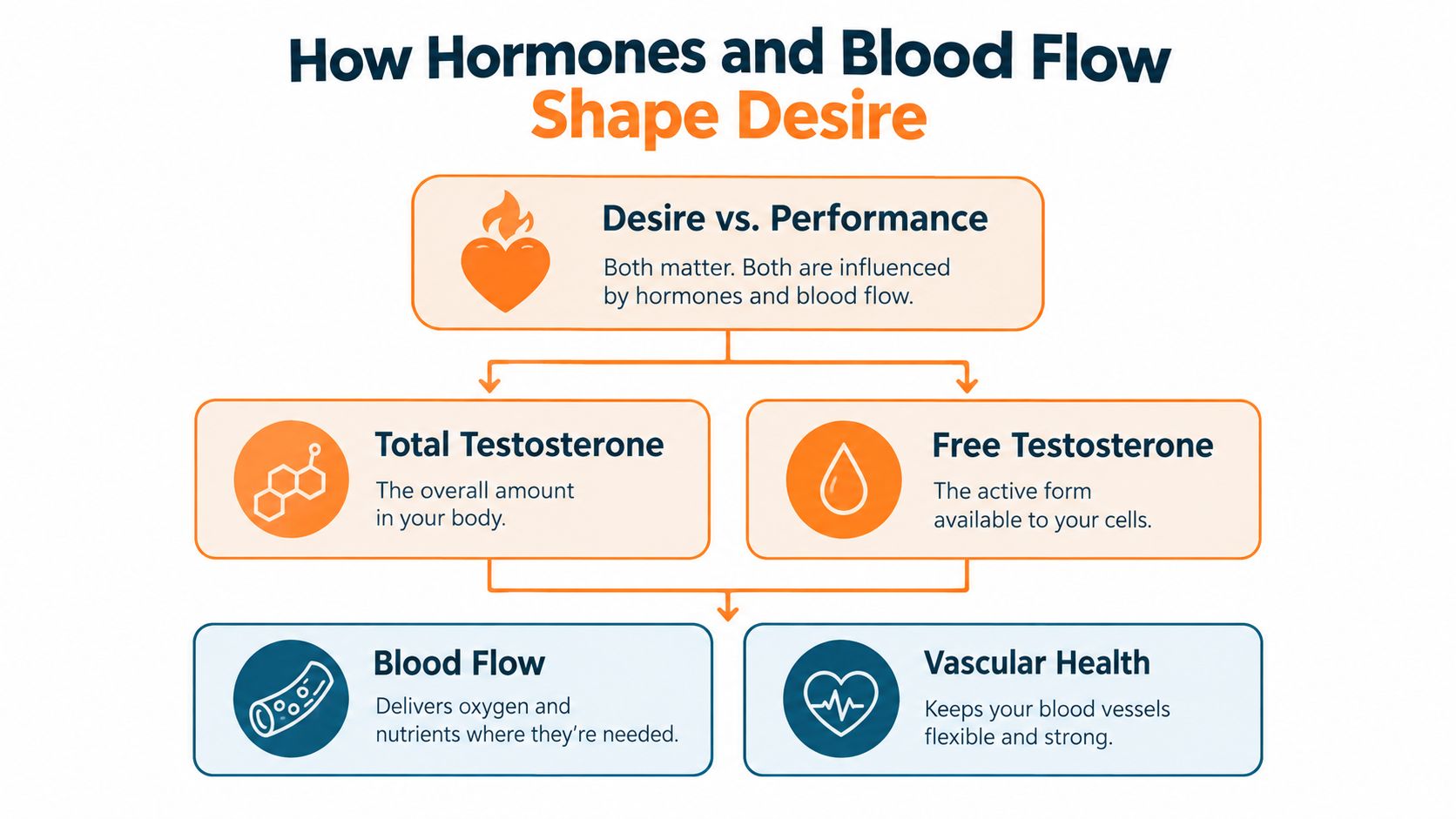
Desire and performance use overlapping systems
Nitric oxide helps blood vessels relax, a process relevant to blood flow and erections. That connection doesn't mean an ingredient or mechanism that affects blood flow automatically increases sexual desire. Desire and performance can overlap, but they're not the same gauge.
| Signal | Relevant role | Important boundary |
|---|---|---|
| Total testosterone | One measure of circulating testosterone | A single result doesn't explain every symptom |
| Free testosterone | A hormone measure associated with aspects of sexual function | Must be considered with symptoms and clinical context |
| Vascular health | Helps support the blood flow involved in erections | Doesn't directly measure desire |
| Mood and relationship context | Can shape interest and sexual experience | Aren't captured by hormone testing alone |
If a persistent change prompts questions about hormones, talk with a qualified clinician about whether early-morning testing is appropriate and how results should be interpreted. For a plain-language introduction to hormone roles, see male reproductive system hormones.
What Research Says About Desire Across the Lifespan
About 30% of participants in the European Male Ageing Study had erectile dysfunction and 6% had severe orgasmic impairment. Both outcomes were strongly associated with increasing age and coexisting health conditions, which suggests that age often travels alongside other influences rather than acting alone.
Cross-sectional findings show how groups differ at a single point in time. Longitudinal research goes further by following the same people over the years. The Massachusetts Male Aging Study tracked 1,085 men aged 40–70 at baseline for nine years. Sexual activity declined by less than one occurrence per month among men in their 40s, about two among men in their 50s, and about three among men in their 60s. Erections per month also declined across those groups, while masturbation frequency stayed stable during follow-up. (Massachusetts Male Aging Study overview)
| Age group | Observed nine-year pattern | Interpretation |
|---|---|---|
| Men in their 40s | Sexual activity fell by less than one occurrence per month; erections declined by about three per month | Different measures shifted by different amounts |
| Men in their 50s | Sexual activity fell by about two occurrences per month; erections declined by about nine per month | Group averages aren't predictions for an individual |
| Men in their 60s | Sexual activity fell by about three occurrences per month; erections declined by about thirteen per month | A change in one aspect of sexuality doesn't establish a change in all aspects |
| All age groups studied | Masturbation frequency stayed stable during follow-up | Sexual behaviors don't necessarily follow the same pattern |
Estimates of reduced desire among older men vary widely across studies: 12% to 51.6% among men aged 60 and older, 20% to 65.9% among men aged 70 and older, and 40% to 82.4% among men aged 80 and older. Ranges that wide reflect real differences between individuals, shaped by the circumstances each man carries into later life.
A group average works like a weather forecast. It describes what tends to happen across a wide region, which helps with planning, yet conditions on your own street depend on local factors. When desire shifts, the productive question is which of your own conditions changed, and when.
Why Health, Mood, Medication, and Relationships Matter
Two men of the same age can have very different experiences. One notices a gradual reduction in spontaneous desire but feels well, enjoys intimacy, and has no other new symptoms. Another sees a sharper shift after a medication change or a stretch of poor sleep. The first may want to observe the pattern and discuss it at a routine visit; the second has a reason to review what changed with a clinician.
Possible contributors include obesity, diabetes, cardiovascular disease, sleep disorders, depression, fatigue, and medications. Relationship stress, partner responsiveness, and cultural expectations can influence how a person experiences desire, too. These factors can overlap, so it's worth looking at the whole picture instead of assuming that age or testosterone explains everything.
Relationship context can affect sexual activity as well as desire. A representative German study of 1,299 men aged 18–92 found that both generally declined with age, but partnership modified the pattern. Among men older than 60, only 17% of unpartnered men reported being sexually active. (German study of sexual activity and relationship status)

Use a simple change check
Write down when the change began, whether it came on gradually or suddenly, and what else changed around that time. Note whether desire, erections, ejaculation, or satisfaction shifted, and whether the pattern feels persistent or specific to certain situations. For couples, a calm conversation about closeness and expectations may help distinguish a relationship concern from a change in desire. This guide to relationship satisfaction offers a related perspective.
| Question | Why it matters | What to note |
|---|---|---|
| When did the change begin? | Timing can help identify what may have changed alongside desire | Gradual or sudden onset |
| Did anything else change? | Health, sleep, mood, or medication changes may be relevant | New prescription, fatigue, stress, or illness |
| Which part of sexual function feels different? | Desire, erections, ejaculation, and satisfaction aren't interchangeable | Describe each separately |
| Does it happen every time? | A situational pattern may differ from a persistent change | Circumstances, partner context, and consistency |
Everyday Habits That Support Sexual Wellness
Daily habits work like maintenance on a house: they keep the systems that desire depends on running, though they can't tell you why something stopped working. Regular movement, consistent sleep, and stress management support the cardiovascular, hormonal, and mood-related machinery behind libido. They aren't a promise of a particular change, and they can't diagnose the reason for persistent symptoms.
Start with adjustments you can sustain rather than overhauling everything at once. Habits form the foundation; the rest depends on what changed for you.
A practical week might include a few sessions of resistance exercise, some aerobic movement such as brisk walks, and a regular bedtime that gives you enough sleep. Build meals around overall health, and pay attention to whether stress, alcohol, work demands, or relationship strain track with dips in your interest. If a change seems connected to a medication, ask the prescriber whether it could be contributing before changing how you take it.
The Testosterone Trials also support keeping expectations specific. The NIH-supported trial randomized 790 men aged 65 or older who had consistently low morning testosterone below 275 ng/dL and symptoms suggestive of androgen deficiency to daily testosterone gel or placebo for one year. Treatment increased sexual activity, desire, and erectile function more than placebo. Those findings apply to symptomatic men with documented low testosterone, not to every healthy man seeking an age-based libido boost. (Testosterone Trials details)
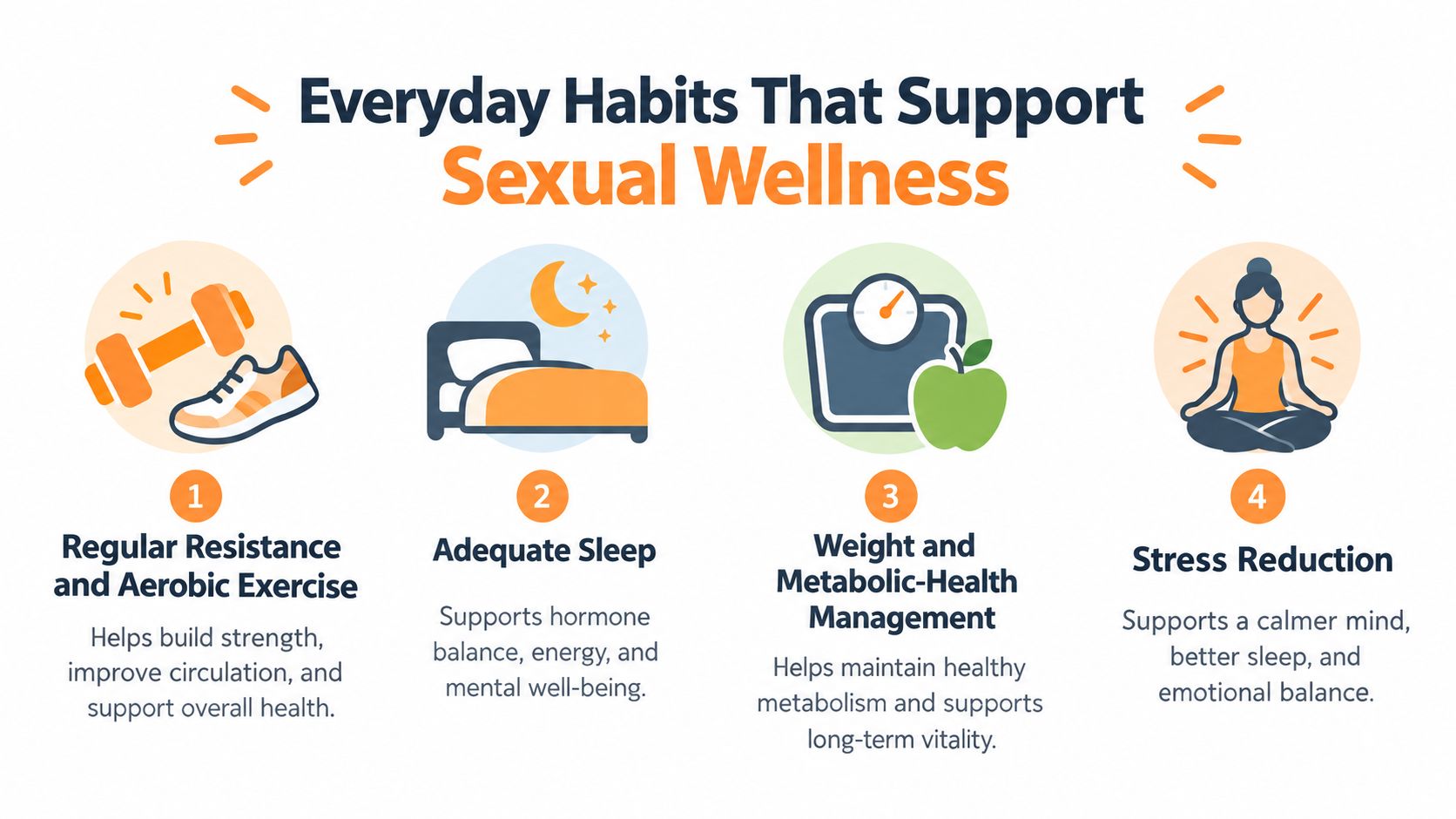
| Habit | Supports | Does not replace |
|---|---|---|
| Resistance and aerobic exercise | General fitness and metabolic health | Assessment of persistent sexual symptoms |
| Adequate sleep | Recovery and day-to-day well-being | Evaluation of an ongoing sleep disorder |
| Weight and metabolic-health management | Overall health and the systems involved in sexual function | Personalized medical care |
| Stress awareness and communication | Emotional connection and awareness of situational factors | Treatment for a medical or relationship concern |
| Medication review with a clinician | Identification of possible medication-related changes | A clinician's full assessment |
Two strength sessions, three 30-minute brisk walks, and a fixed 11 p.m. bedtime covers the core habits in about four hours a week. As the Testosterone Trials findings above indicate, lifestyle and expectations work best when they match your actual situation. If several consistent weeks pass and your interest still hasn't shifted, that pattern becomes useful information in itself, something concrete to bring to a clinician rather than a reason to keep guessing.
Nutrition and Targeted Supplement Research
Supplements are easiest to evaluate when you separate an ingredient's proposed role from evidence for a specific outcome. Zinc is involved in normal reproductive biology, but that doesn't establish that taking more zinc reliably increases desire or improves fertility. In an NIH-supported trial, 2,370 men were assigned to folic acid plus zinc or placebo. Live birth occurred in 34% of the supplement group and 35% of the placebo group, while sperm DNA fragmentation was higher with supplementation, 29.7% versus 27.2%. (Folic Acid and Zinc Supplementation Trial)
L-arginine is a substrate for nitric-oxide production, a pathway involved in blood-vessel relaxation and penile blood flow. A review reports that 2,500 mg daily for 12 weeks improved erectile-function scores in men with low-to-moderate, but not severe, erectile dysfunction. That finding concerns erectile-function measures, not a direct increase in sexual desire, semen volume, or age-related libido. (Review of L-arginine and male sexual function)
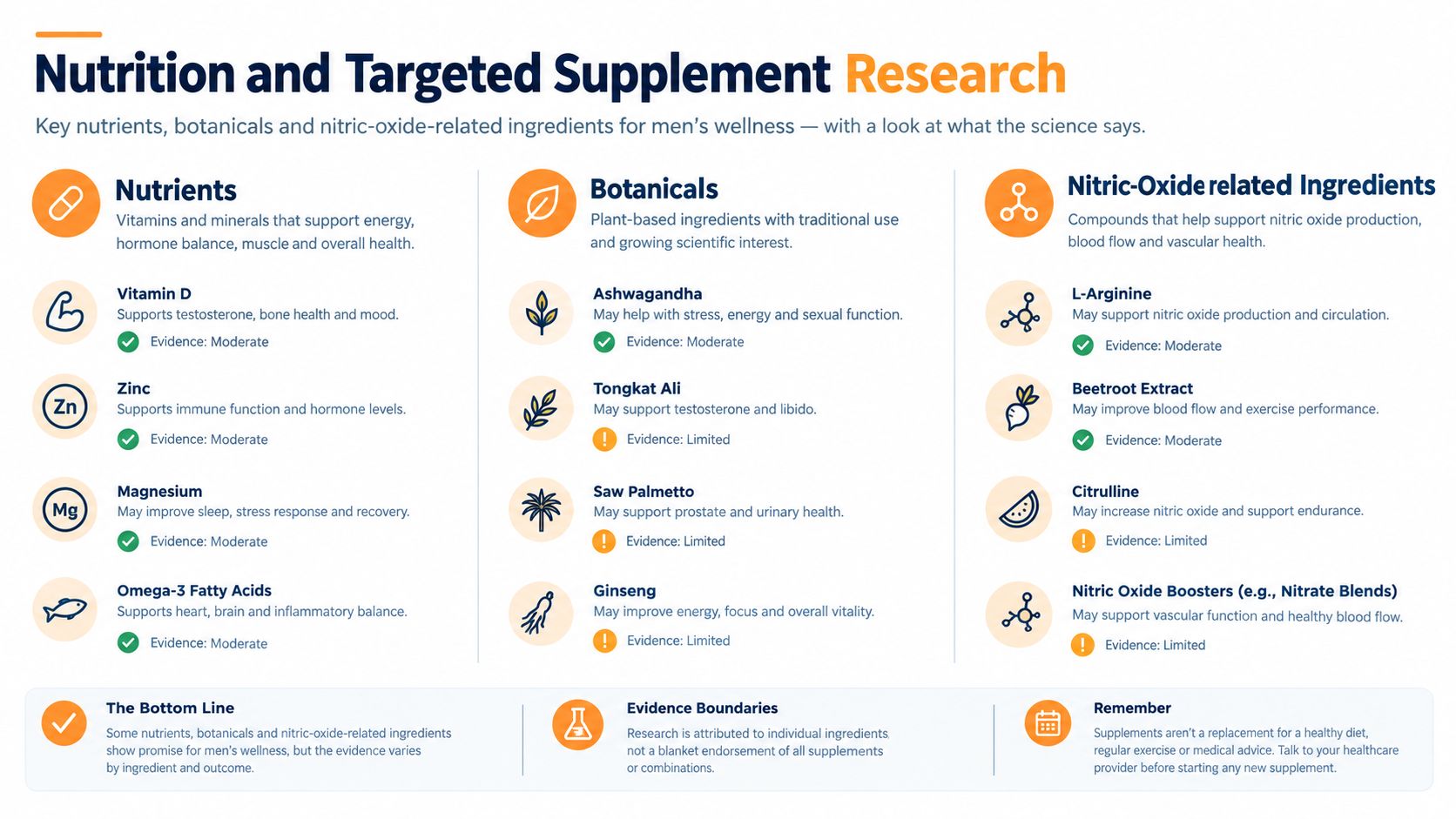
Compare ingredients and product details
A product's ingredient list isn't the same as evidence that the finished formula produces a particular clinical outcome. Check whether research concerns the ingredient itself, what outcome was measured, and whether the product clearly explains its quality controls and directions.
SEMEX is a daily supplement formulated to support semen volume and improve taste. Its formula combines zinc, L-arginine, sunflower lecithin, and bromelain with maca root, Panax ginseng, ashwagandha, tongkat ali, saw palmetto, and horny goat weed. Most men take three capsules daily, with benefits described as building gradually over about 30 days of consistent use. These product details aren't evidence that SEMEX treats low libido or a health condition.
| Criterion | What to inspect | Why it matters |
|---|---|---|
| Ingredient evidence | Research on each ingredient and the outcome measured | Findings for one outcome shouldn't be generalized to another |
| Dose transparency | Clear amounts and directions | Helps you understand what the label describes |
| Quality controls | Testing, manufacturing, and ingredient standards | Provides information about product quality |
| Personal goals | Whether you're focused on desire, erections, or another concern | These goals may call for different questions and evidence |
| Medical context | Medication use, symptoms, and clinician advice | Helps avoid relying on a supplement instead of needed assessment |
SEMEX is described as vegan, non-GMO, made in the USA in a cGMP-registered facility, and third-party tested by Eurofins for microbials, heavy metals, and adulterants, with published testing thresholds and a 90-day money-back guarantee. These are product details, not clinical claims. For an ingredient-focused overview, see what research says about maca root and libido.
When Persistent Changes Need Medical Care
A sustained change in desire deserves attention if it's troubling you, affecting a relationship, or appearing alongside other symptoms. New erectile difficulty, reduced morning erections, painful ejaculation, or other concerning changes are also reasons to speak with a qualified clinician. You don't need to decide in advance whether the cause is hormonal, vascular, emotional, or medication-related.
A clinician may ask when the change began, whether it's persistent, and what's happened with sleep, mood, relationships, and general health. They may review medications and consider cardiovascular, metabolic, or neurological factors. When symptoms make it appropriate, they may also discuss early-morning testosterone testing and whether repeat testing is needed. A hormone result is one piece of the picture, not a standalone explanation.
| Pattern | Reasonable next step | Questions to ask |
|---|---|---|
| Gradual change without other concerning symptoms | Track the pattern and discuss it at a suitable appointment | What has changed, and what else has changed alongside it? |
| New or persistent erectile difficulty or loss of desire | Arrange a conversation with a clinician | Could health conditions, sleep, mood, or medication be contributing? |
| Painful ejaculation or other concerning symptoms | Seek medical assessment | What evaluation is appropriate for these symptoms? |
| Possible hormone-related symptoms | Ask whether morning testosterone testing is appropriate | How should symptoms and test results be interpreted together? |
A supplement label shouldn't delay evaluation of persistent or concerning symptoms. If you're unsure whether a change is significant, describe what you've noticed and ask for guidance; you don't need to self-diagnose. You can also read more about male loss of libido as you prepare questions for a clinician.
Putting Male Libido and Age Into Perspective
Aging can influence sexual function, but it doesn't define a man's libido or determine what his future will look like. Research describes gradual changes across several domains, while individual experience depends on more than age. Desire, erection-related performance, ejaculation, and satisfaction may shift differently.
The practical question is not whether a man's libido is “normal” for his age. It's what has changed for him, when it changed, and whether health, sleep, mood, medication, lifestyle, or relationship circumstances changed alongside it. That framing makes room for both normal variation and problems that deserve attention.
Think of sexual wellness like maintaining a car that's been driven for years. Its needs may change, but careful use and regular checkups still matter. In the same way, steady habits, honest communication, and timely medical assessment can help you respond to change without treating it as inevitable.
If you're considering a supplement, assess its ingredients and product details alongside your goals, and don't use it as a substitute for care when symptoms persist. These statements have not been evaluated by the Food and Drug Administration. This product is not intended to diagnose, treat, cure, or prevent any disease.
SEMEX is a daily men's supplement formulated to support semen volume and improve taste, with a blend that includes zinc, L-arginine, and men's wellness ingredients. If you're comparing supplement ingredients as part of a broader approach to sexual wellness, visit SEMEX to review its formula and product details.