

Is Saw Palmetto Good for You? the Evidence
Most advice about saw palmetto starts with a misleading shortcut: because every bottle carries the same plant name, every product must work in the same way. The evidence doesn't support that assumption. Saw palmetto supplements differ in extract type, dose, standardization, and fatty-acid and phytosterol profile, so a study of one preparation can't automatically validate another.
The more accurate answer to "is saw palmetto good for you?" is conditional. Saw palmetto is generally well tolerated, and some specific extracts have shown more consistent signals for certain urinary symptoms. However, major evidence reviews still conclude that saw palmetto alone provides little or no overall benefit for benign prostatic hyperplasia, or BPH. Its practical value depends less on the plant name on the front of a bottle than on what the extract contains and what outcome it is intended to support.
Table of Contents
- The Reality of Saw Palmetto in Modern Wellness
- How the Active Compounds Interact With the Body
- Evaluating the Clinical Evidence on Urinary and Prostate Support
- Exploring Secondary Benefits and Common Misconceptions
- Understanding the Safety Profile and Medication Interactions
- How to Identify a High-Quality Extract on the Label
- Final Takeaways and Regulatory Context
The Reality of Saw Palmetto in Modern Wellness
Saw palmetto comes from the berries of Serenoa repens, a plant long associated with men's urinary and prostate wellness. Modern supplements, however, rarely resemble a simple whole-berry preparation. Manufacturers may use powders, lipid extracts, or preparations concentrated for particular fatty acids and phytosterols. Those differences can alter how a product compares with the preparations studied in clinical research.
One plant name can hide several formulations
A capsule labeled “saw palmetto” may contain a general berry powder or a more refined lipidosterolic extract. The label may also provide limited information about the specific fatty-acid profile, the presence of phytosterols, or the degree of standardization. This makes the category difficult to evaluate as a single intervention.
The Merck Manual overview of saw palmetto emphasizes the practical problem: products vary in extract type, dose, and standardization, so findings from one preparation can't be generalized to every supplement. That distinction explains why one headline may describe a positive signal while another describes no meaningful difference from placebo.
Traditional use can provide a reason to study an ingredient, but it doesn't establish that every modern formulation produces the same biological or clinical outcome. Processing changes the chemical mixture. A concentrated extract can differ substantially from a ground berry, just as a standardized preparation can differ from a product that lists only the plant material.
Practical rule: The phrase “contains saw palmetto” identifies an ingredient category, not a proven outcome.
The main question is narrower than the marketing
The public question is broad, but the research question is usually specific. Studies may examine urinary symptoms associated with BPH, nighttime urination, urine flow, or other measures of lower urinary tract function. Those outcomes shouldn't be converted into a general promise about energy, hormones, hair, fertility, or overall health.
This distinction also protects consumers from a common reasoning error. A plausible biological mechanism doesn't prove that a supplement will produce a noticeable benefit, and a positive result with one standardized extract doesn't validate every product with the same botanical name. Saw palmetto is therefore better understood as a formulation-specific ingredient with mixed evidence, not as a universally beneficial herb.
How the Active Compounds Interact With the Body
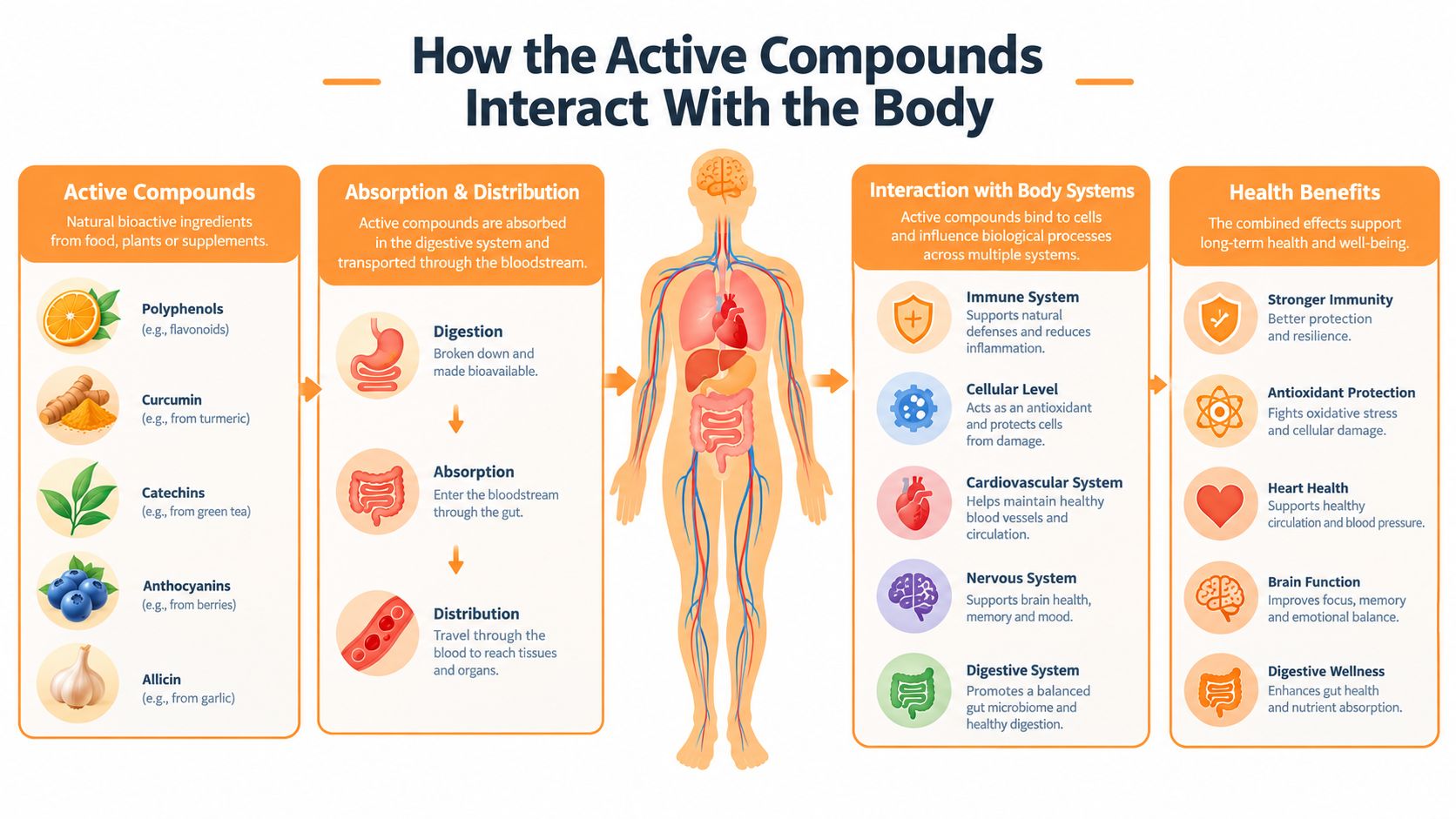
Saw palmetto's scientific rationale centers on its lipid fraction, particularly fatty acids and phytosterols such as beta-sitosterol. These compounds are chemically different from the water-soluble components found in many other plant preparations. Their concentration and balance can change according to the extraction method and the way the finished supplement is standardized.
What the lipid fraction may do
A useful analogy is to think of an extract as a toolbox rather than a single tool. Fatty acids and phytosterols may interact with cell membranes, signaling pathways, and enzymes involved in normal tissue function. The body doesn't respond to the plant name itself. It responds to the compounds that reach relevant tissues in a usable form.
Researchers have also examined whether compounds in saw palmetto can influence pathways associated with inflammation and the enzyme 5-alpha-reductase. That enzyme participates in the conversion of testosterone into dihydrotestosterone, or DHT. However, an ingredient-level interaction with a pathway shouldn't be confused with a demonstrated treatment effect in people.
The distinction matters because laboratory plausibility often travels faster than clinical confirmation. A compound may affect an enzyme in a test system, yet the finished supplement may deliver a different concentration, absorption pattern, or chemical profile. Clinical outcomes then depend on the entire preparation rather than on one attractive mechanism.
Why beta-sitosterol and fatty acids receive attention
Phytosterols are plant sterols with structures related to cholesterol. Beta-sitosterol-enriched preparations have received particular attention in research concerning urinary outcomes. Fatty acids also matter because some extracts are concentrated around a defined lipidosterolic fraction instead of preserving the full composition of the berry.
The discussion of how saw palmetto works can help readers distinguish proposed biological activity from confirmed human outcomes. That distinction is central to responsible supplement evaluation. A mechanism can explain why researchers investigate an ingredient, but it can't establish that the ingredient treats a condition.
A practical interpretation follows:
- Chemical profile matters: The fatty-acid and phytosterol composition can differ between products.
- Extraction matters: A lipidosterolic extract isn't interchangeable with an unstandardized berry powder.
- Biology has limits: Enzyme or inflammation pathway activity doesn't automatically predict a meaningful clinical result.
- Outcome matters: Support for one urinary measure shouldn't be expanded into a broad claim about male health.
Evaluating the Clinical Evidence on Urinary and Prostate Support
The strongest human evidence around saw palmetto concerns urinary symptoms associated with BPH, but that evidence is not uniformly positive. A 2026 systematic review of 16 studies involving more than 3,000 participants found that symptom improvement appeared more consistently with hexanic lipidosterolic extracts and beta-sitosterol-enriched preparations. Results were more variable for urinary flow, post-void residual volume, and quality of life.
That finding changes how conflicting headlines should be read. “Saw palmetto works” is too broad, but “no saw palmetto preparation can ever show a signal” is also too broad. The clinically relevant question is which preparation was tested, at what dose, against what comparator, and for which outcome.
Why extract-specific results matter
Hexanic lipidosterolic extracts are designed to concentrate the berry's fat-soluble components. Beta-sitosterol-enriched preparations emphasize a particular phytosterol profile. A generic powder may not provide the same composition, so a positive result involving a concentrated extract shouldn't be used to predict an identical response from an unspecified capsule.
The review's pattern is also more nuanced than a simple success or failure. Symptom scores improved more consistently in some specific formulations, while objective measures such as urinary flow and post-void residual volume showed greater variation. Quality-of-life outcomes varied as well, which suggests that a change in one measurement may not translate into a broad improvement in daily experience.
The useful conclusion is not that every extract works. It is that the formulation determines how much weight a study deserves.
What the broader evidence says
NCCIH's evidence summary for healthcare providers reaches a more conservative overall conclusion. It states that saw palmetto has been studied for urinary symptoms associated with BPH, but the evidence doesn't support using it for BPH or any other health condition. In a review of 27 studies, saw palmetto used alone provided little or no benefit for BPH symptoms, and large studies and systematic reviews found it no more effective than placebo for urinary symptoms related to prostate enlargement.
These conclusions can coexist with the formulation-specific signals described above. A review of the whole category may find little overall benefit because products, doses, and study designs differ. A narrower analysis may identify more promising results in particular preparations. The responsible interpretation is therefore conservative: some extracts may support selected urinary outcomes, but saw palmetto shouldn't be presented as a treatment for prostate enlargement or as a substitute for medical assessment.
Symptoms also deserve proper evaluation because urinary changes can have multiple causes. A supplement that seems appropriate for general wellness may be inappropriate when a person needs diagnosis, monitoring, or a proven medical intervention.
Exploring Secondary Benefits and Common Misconceptions
Saw palmetto is often placed in broader men's wellness formulas that discuss hair, vitality, hormonal balance, sexual wellness, or reproductive goals. The biological rationale usually comes from the ingredient's lipid fraction or from pathways involving androgen metabolism. That rationale may explain why formulators include it, but it doesn't establish a confirmed benefit for every advertised use.
Plausibility is not proof
A proposed effect on 5-alpha-reductase can sound persuasive because the enzyme has a recognized role in androgen biology. Yet the presence of a plausible pathway doesn't show that a specific supplement changes a meaningful human outcome. Extract concentration, absorption, metabolism, and the endpoint measured in a trial all influence the result.
The same caution applies to claims about hair or general vitality. Evidence for one tissue or outcome can't be transferred automatically to another. A preparation studied for urinary symptoms shouldn't be assumed to support hair growth, sexual performance, semen characteristics, or hormone levels unless appropriate human research has evaluated that exact question.
NCCIH's overview of saw palmetto research and safety also reports that a review of five studies on chronic prostatitis or chronic pelvic pain syndrome found no significant benefit. Saw palmetto has been tested in more than one prostate-related context, yet broader testing hasn't converted the ingredient into a proven solution across men's health.
The whole herb isn't a pharmaceutical equivalent
Another misconception treats saw palmetto as if the whole herb were interchangeable with an isolated pharmaceutical compound that acts on the same biological pathway. It isn't. A plant extract contains a mixture of compounds, and its effect depends on composition, dose, absorption, and the person taking it.
A more defensible role for saw palmetto is as a supportive ingredient in a carefully defined wellness strategy, not as a universal answer to male health concerns. Nutrition, physical activity, sleep, medication review, and professional evaluation remain separate considerations. A supplement can't compensate for an unresolved symptom or turn a mechanistic hypothesis into a diagnosis.
Understanding the Safety Profile and Medication Interactions
Saw palmetto is generally well tolerated, but “natural” doesn't mean inert. NCCIH reports that it has been used safely in research studies for up to three years, while commonly reported adverse effects have been mild and infrequent, including digestive symptoms, dizziness, and headache. The review of adverse events from randomized trials similarly describes mostly mild gastrointestinal effects such as diarrhea, nausea, abdominal discomfort, headache, and fatigue.
Common discomfort versus higher-concern situations
Most reported reactions are not severe, but they can still affect whether a person continues using an extract. A new digestive symptom may reflect the supplement, another ingredient in a blend, or an unrelated change. A complete product review should therefore consider the full formula rather than attributing every effect to saw palmetto alone.
More serious events have appeared rarely in case reports, although causality was unclear. That uncertainty doesn't justify alarm, but it does support a cautious approach when a person has medical conditions, takes several medicines, or plans a procedure.
- Digestive effects: Diarrhea, nausea, and abdominal discomfort are among the reported mild reactions.
- Other mild effects: Headache, fatigue, and dizziness have also been reported.
- Medication review: Blood-thinning and antiplatelet medicines deserve particular attention.
- Symptom changes: Persistent or worsening urinary symptoms call for professional assessment rather than escalating a supplement.
Bleeding risk requires practical screening
For men taking blood thinners or antiplatelet agents, Memorial Sloan Kettering warns of a possible increased risk of bleeding or bruising, as summarized in the adverse-event evidence record above. The concern doesn't mean every person taking such medicine will experience a problem. It means the combination deserves review before use.
The side-effect discussion for saw palmetto and prostate health offers additional consumer context, but medication decisions should come from a qualified healthcare professional who can review the complete list of medicines and supplements. This is especially important when a product combines saw palmetto with other botanicals that may have their own interaction profiles.
The safest process is straightforward. A person can record the product name, extract type, serving instructions, and every medication or supplement currently used. A pharmacist or clinician can then assess whether the combination is appropriate, whether a procedure creates additional concern, and whether a symptom requires direct evaluation.
How to Identify a High-Quality Extract on the Label
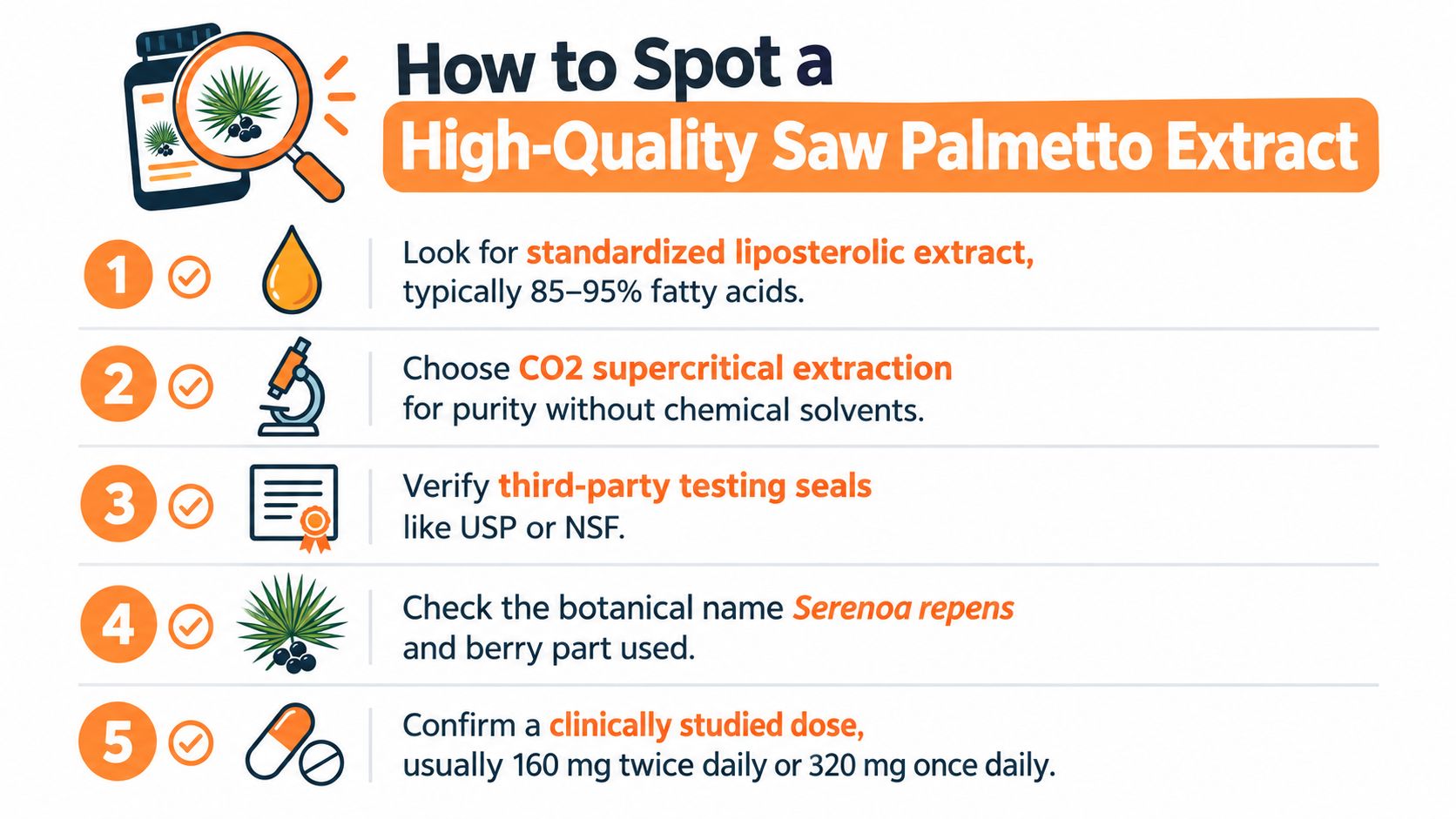
A label should answer a more useful question than “does this contain saw palmetto?” It should show whether the product resembles the type of preparation studied in research. Since products vary in extract type, dose, and standardization, the label is the first place to look for evidence of chemical consistency.
Start with the identity of the preparation
The botanical name, plant part, and extraction description provide more information than a decorative image of berries. A label that identifies Serenoa repens berry and specifies a lipidosterolic extract gives a clearer picture of the material than one that lists only “saw palmetto blend.”
Standardization can also help consumers compare products, provided the label explains what is standardized and how. A stated fatty-acid or phytosterol profile may be more informative than a large amount of uncharacterized powder. The goal isn't to assume that a higher amount guarantees a better result. The goal is to determine whether the product has a defined composition that can be meaningfully compared with research preparations.
The guide to reading supplement labels can help readers assess serving information, ingredient forms, and supporting quality details without treating label language as proof of effectiveness.
Use a label-checking framework
A careful review can follow this sequence:
- Identify the extract: Look for a clearly named lipidosterolic or otherwise defined preparation rather than an unspecified botanical powder.
- Check the composition: Determine whether the label describes fatty acids, phytosterols, or another standardization marker.
- Compare the serving information: A study's findings can't be applied confidently when the product's preparation and serving pattern are unclear.
- Inspect quality verification: Independent testing can provide information about contaminants, identity, and adulteration, but it doesn't prove that the supplement produces a clinical benefit.
- Read the full formula: A combination product may contain other botanicals or nutrients that affect tolerability and medication interactions.
A polished label can describe a product clearly, but it can't turn mixed evidence into a guaranteed outcome.
Third-party testing is useful because consumers generally can't verify identity, heavy metals, microbial contamination, or adulterants by appearance. Still, testing and efficacy answer different questions. Quality verification asks whether the product matches its label and meets specified safety criteria. Clinical research asks whether a defined preparation supports a defined outcome.
The strongest purchasing logic combines both. A product should be chemically described, transparently labeled, and appropriate for the person's medication and health context. Even then, the evidence should remain attached to the specific extract rather than generalized to all saw palmetto products.
Final Takeaways and Regulatory Context
The answer to “is saw palmetto good for you?” depends on three filters: the extract, the outcome, and the person taking it. Hexanic lipidosterolic and beta-sitosterol-enriched preparations have shown more consistent symptom signals in some analyses, while results for urinary flow, post-void residual volume, and quality of life have been less consistent. Broader evidence reviews remain cautious and don't support saw palmetto as a treatment for BPH or another health condition.
That apparent contradiction becomes easier to understand once the plant name is separated from the formulation. A standardized extract used in a study isn't automatically equivalent to a generic berry powder, and a plausible biological pathway isn't the same as a confirmed health benefit. Consumers can evaluate a product more intelligently by checking its extract description, standardization, serving information, and quality testing, then reviewing possible interactions with a clinician or pharmacist.
Diet, exercise, sleep, and appropriate medical care remain independent parts of men's wellness. Saw palmetto can be considered as an ingredient-level support option, but it shouldn't replace evaluation of persistent urinary symptoms or create misplaced confidence about an unproven use.
The FDA explains that qualifying structure/function claims on dietary supplement labels must include a disclaimer stating that the claim hasn't been evaluated by the FDA and that the product isn't intended to diagnose, treat, cure, or prevent disease. That wording defines the boundary between describing support for normal body function and making a disease claim.
These statements have not been evaluated by the Food and Drug Administration. This product is not intended to diagnose, treat, cure, or prevent any disease.
SEMEX offers a daily men's supplement that combines zinc, L-arginine, sunflower lecithin, bromelain, and a broader wellness blend that includes saw palmetto. Men comparing formulations can visit SEMEX to review the product information and consider how its ingredient profile fits their personal goals and safety needs.