

Does Canned Pineapple Have Bromelain? the Honest Answer
Canned pineapple retains only a small fraction of fresh pineapple's bromelain. One comparison measured 76 units per gram in fresh pineapple versus 8.5 units per gram in canned pineapple, which puts the canned fruit at about 11% of the measured activity, or roughly a ninefold drop. Does that mean canned pineapple has no nutritional value, or does it show that nutrition and enzyme function can change independently?
A person reaching for a pantry can may expect the same bromelain associated with fresh pineapple, including its protein-breaking action in marinades or gelatin recipes. The answer depends less on the fruit's label and more on what heat does to a delicate protein.
Table of Contents
- Why This Question Comes Up So Often
- What Bromelain Actually Is
- How Heat Affects Bromelain Activity
- What Happens to Bromelain During Canning
- Does the Packing Liquid Change the Answer
- Fresh, Canned, Cooked, and Supplement Sources Compared
- How to Choose the Right Pineapple Source
Why This Question Comes Up So Often
The confusion usually begins with a reasonable assumption. Fresh pineapple is associated with bromelain, while canned pineapple still looks and tastes like pineapple, so a shopper may expect the canned version to deliver the same enzyme activity. Nutrition labels can reinforce that impression because processed fruit may still provide nutrients, even after heat has changed its enzymes.
Online discussions blur the distinction further. Recipe articles mention bromelain when describing fresh pineapple, supplement pages discuss pineapple-derived enzymes, and home cooks often treat canned fruit as a direct substitute for fresh fruit. In many recipes, that substitution works perfectly for flavor and texture. It doesn't necessarily work when the recipe depends on an active enzyme.
That difference also matters for readers who encounter bromelain in conversations about digestion, inflammation, or intimate wellness. A plain-language discussion of bromelain and taste may describe the ingredient's pineapple connection, but the form of pineapple matters before anyone draws conclusions about activity. Fresh, uncooked fruit and heat-processed fruit shouldn't be treated as chemically identical.
The question behind the question
“Does canned pineapple have bromelain?” can mean several things:
- Does any bromelain remain? A trace amount may remain detectable.
- Is enough still active to break down protein? Usually, canned pineapple won't behave like fresh fruit.
- Does canned pineapple still offer nutrition? Yes, enzyme loss doesn't mean every nutrient disappears.
- Does the packing liquid protect the enzyme? The available evidence points to processing heat as the central issue.
The clearest way to understand the answer is to follow bromelain through the heating process. Enzymes are working proteins, not permanent ingredients stamped into fruit. Their activity depends on shape, temperature, time, and surrounding conditions.
What Bromelain Actually Is
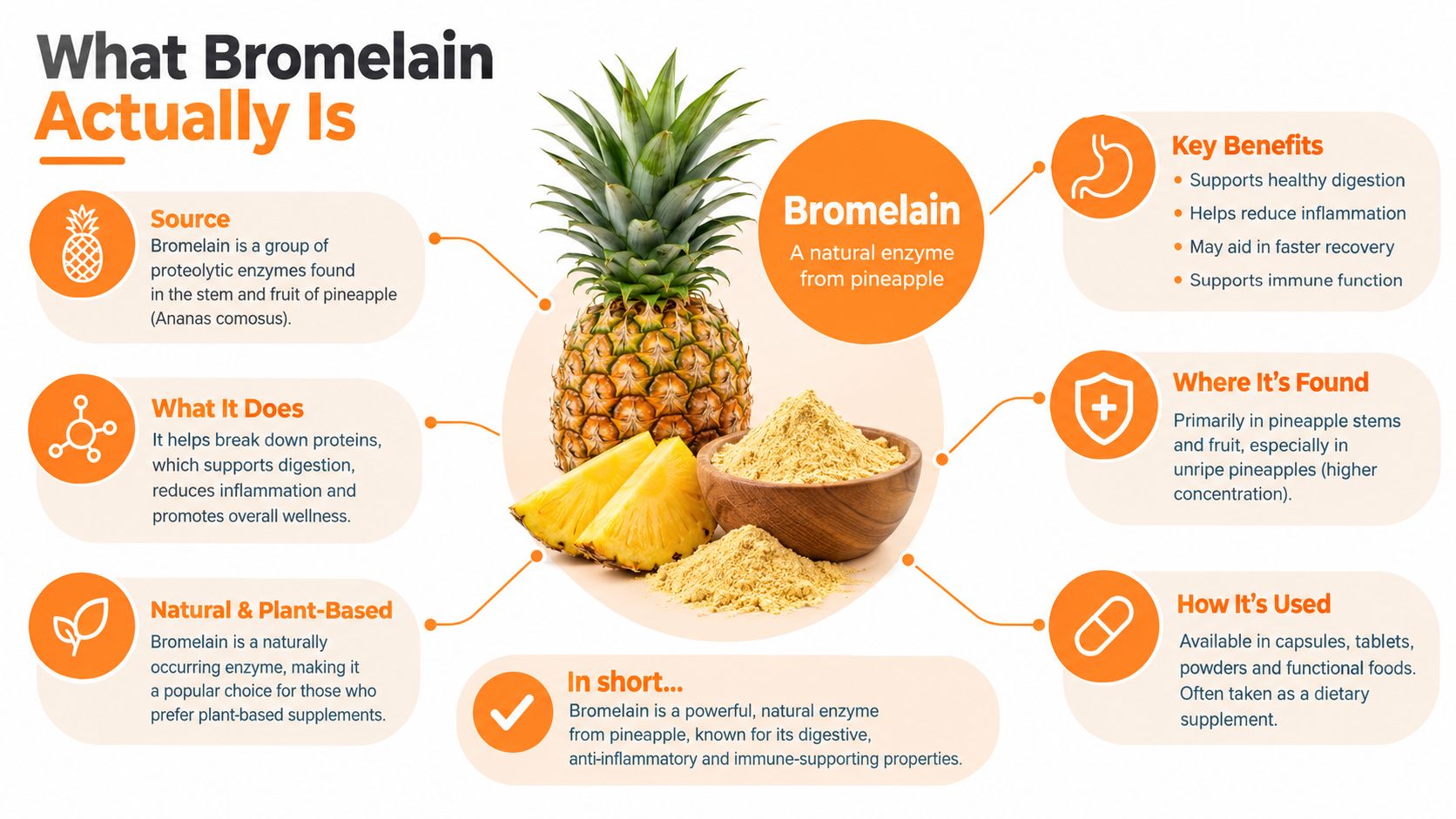
Bromelain is a group of proteolytic enzymes from pineapple, Ananas comosus. Proteolytic means protein-breaking. These enzymes act on peptide bonds, the links that connect amino acids in a protein chain.
A useful analogy is a tiny pair of molecular scissors. The scissors can cut only when the protein chain reaches the active site in a suitable shape. If heat unfolds the enzyme, the blades no longer line up correctly. The protein may still be present in the fruit, but it no longer performs the same chemical task.
Where pineapple stores the enzyme
Bromelain isn't distributed evenly through a pineapple. Activity is generally associated with the stem and core, while the juicy flesh contains less. Commercial bromelain products are commonly derived from stem material because that tissue provides a richer source than the edible flesh.
That distinction prevents another common mix-up. A supplement made from concentrated pineapple stem material isn't equivalent to eating a few pieces of fruit. The fruit's enzyme content varies with tissue, ripeness, storage, and processing, while a labeled supplement is designed to provide a specified ingredient amount.
Bromelain's food-science behavior is easy to recognize. Fresh pineapple can soften protein-rich foods and interfere with gelatin setting because active proteases break down protein structures. Those effects depend on function, not merely presence.
Readers exploring the enzyme's broader role can review this overview of bromelain enzyme benefits, while keeping a key distinction in mind. Ingredient research and supplement formulations shouldn't be used to assume that canned fruit contains the same active amount.
Why shape matters
Enzymes work because their three-dimensional structure creates a precise working surface. Heat can make that structure unfold, a process commonly called denaturation. Once enough unfolding occurs, cooling the food doesn't reliably rebuild the original active shape.
That weakness is central to the canned-pineapple question. Canning doesn't store pineapple at room temperature. It exposes the fruit to deliberate heat processing, and that exposure is exactly what threatens bromelain's working structure.
How Heat Affects Bromelain Activity
Bromelain doesn't respond to every temperature in the same way. Gentle warming and sustained high heat produce different outcomes, so the useful question isn't whether pineapple was “heated” in a broad sense. The useful questions are how hot, for how long, and under what processing conditions.
A temperature-stability study reported no loss of fruit bromelain activity at 40°C for up to 60 minutes, while about 83% of activity remained at 50°C under the reported conditions (temperature-stability research on fruit bromelain). Those findings show that moderate heat doesn't instantly destroy the enzyme.
The pattern changes sharply at higher temperatures. In the same research summary, exposure to 80°C for 8 minutes caused almost complete activity loss. Another technical summary reported that exposure near 70°C for 15 minutes lost about 80% of activity, while 80°C for at least 8 minutes could completely inactivate bromelain in frozen pineapple (technical summary of bromelain heat inactivation).
| Temperature Range | Exposure Time | Approximate Residual Activity | Practical Effect |
|---|---|---|---|
| 40°C | Up to 60 minutes | No reported loss in the cited study | Much of the activity can remain |
| 50°C | Reported study exposure | About 83% retained | Moderate heat may preserve substantial activity |
| 70°C | 15 minutes | About 20% retained in the cited summary | Activity falls substantially |
| 80°C | 8 minutes | Almost none, or complete inactivation in the cited summaries | Enzyme-dependent effects largely disappear |
Why the decline accelerates
Bromelain's activity loss isn't a perfectly smooth slide from active to inactive. The enzyme can tolerate some moderate exposure, then lose function rapidly after a thermal threshold is crossed. The egg-white analogy helps: raw egg white is fluid, but heating makes its proteins set into a new structure. Cooling doesn't return the egg white to its original liquid state.
Bromelain behaves in a comparable way at sufficiently high heat. The protein's structure changes, and the active site no longer performs its cutting job. That helps explain why a short period of moderate warming isn't equivalent to the sustained heat used in commercial food preservation.
Practical rule: If active bromelain is the priority, uncooked fresh pineapple is the relevant food source. Heat-treated pineapple should be treated as a low-activity option.
What Happens to Bromelain During Canning
Canning prioritizes safety and shelf stability, not preservation of delicate enzyme activity. The fruit undergoes heat treatment designed to make it stable for storage, and that thermal exposure places bromelain beyond the conditions where it remains reliably functional.
The exact factory process can vary, but the principle is straightforward. Pineapple is prepared, heated, packed, sealed, and processed under controlled conditions. Each meaningful high-heat stage gives bromelain more opportunity to unfold, while the decisive processing conditions are far more severe than the moderate temperatures associated with preserving much of the enzyme's activity.
The clearest comparison comes from measured activity. One cited comparison reported 76 units per gram for fresh pineapple and 8.5 units per gram for canned pineapple (fresh-versus-canned bromelain comparison). The canned sample therefore measured about 11% of the fresh sample's activity, representing roughly a ninefold reduction.
| Temperature | Approximate Bromelain Activity Retained | Processing Stage |
|---|---|---|
| 40°C | No reported loss for up to 60 minutes | Moderate warming reference |
| 50°C | About 83% in the cited stability study | Moderate heat reference |
| 70°C | About 20% after 15 minutes in the cited summary | Extended high-heat exposure |
| 80°C | Almost none after 8 minutes in the cited research | Severe thermal inactivation |
| Commercial canning heat | Generally minimal active enzyme remains | Food preservation and shelf stability |
Detectable isn't the same as useful
Laboratory measurement can detect residual activity without proving that the food will produce a noticeable enzyme-dependent effect. A can may retain trace bromelain, yet the amount can be too small to tenderize meat effectively or interfere with gelatin in the way fresh pineapple does.
That distinction explains why canned pineapple commonly works in gelatin desserts, while fresh pineapple can prevent gelatin from setting. The canned fruit hasn't become “not pineapple.” Its flavor, sugars, texture, and other nutritional components remain, but most of the enzyme's working structure has been disabled.
A small measurable residue doesn't make canned pineapple equivalent to fresh pineapple. Function depends on active enzyme, not simply on the ingredient's name.
Does the Packing Liquid Change the Answer
Pineapple packed in juice can seem like the more natural choice, especially beside pineapple packed in syrup. The liquid affects sweetness and the eating experience, but it doesn't appear to rescue bromelain after the fruit has gone through heat processing.
The critical timing matters. Bromelain is exposed to the canning heat before the choice between juice and syrup becomes the deciding factor for the consumer. By the time the fruit is sealed in its packing medium, the enzyme has already faced the thermal conditions responsible for most of the activity loss.
That doesn't make juice-packed and syrup-packed pineapple identical in every respect. The packing medium can influence flavor, sweetness, and the overall nutrition profile of the serving. Those are legitimate reasons to compare labels. They aren't evidence that one liquid preserves meaningful bromelain function.
Two different questions on one label
A nutrition label answers questions about nutrients and serving composition. It generally doesn't tell a shopper how much active enzyme remains, whether the enzyme can tenderize meat, or whether it can break down gelatin.
That creates a useful distinction:
- Nutrition preserved: Some nutrients and the fruit's physical components can remain after processing.
- Enzyme function preserved: The bromelain molecule must retain its precise working shape.
- Packing medium selected: Juice or syrup changes the food around the enzyme, but doesn't undo prior heat damage.
The evidence-based takeaway is simple. The main driver of bromelain loss is heat, not whether the can uses juice or syrup. Canned pineapple can still be a convenient fruit choice, but the liquid shouldn't guide a purchase when active bromelain is the goal.
Fresh, Canned, Cooked, and Supplement Sources Compared
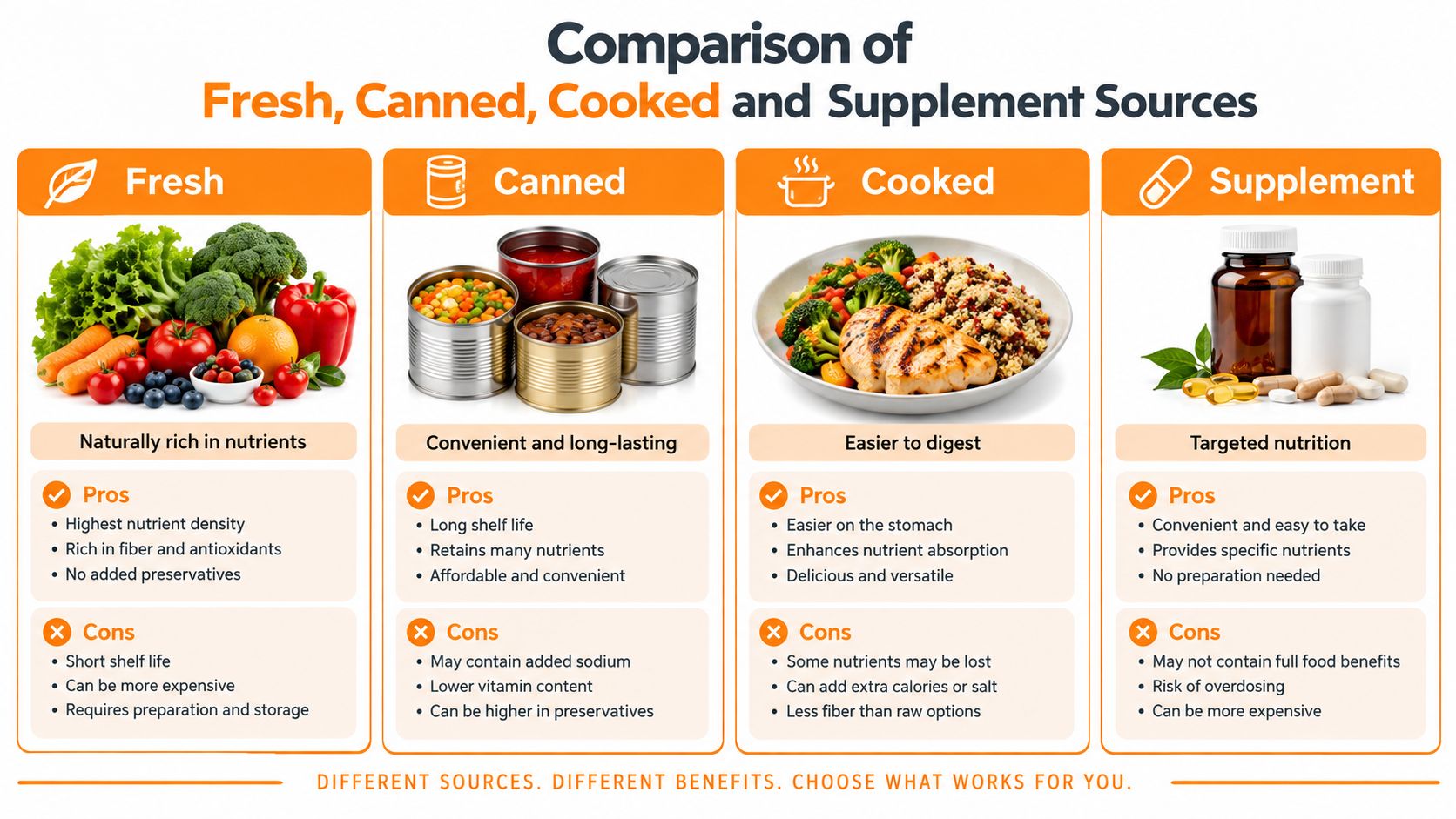
A four-way comparison makes the practical choice easier. Fresh raw pineapple is the food form most likely to retain active bromelain because it hasn't gone through canning heat. Activity still varies across the fruit, with the stem and core generally more enzyme-rich than the flesh.
Canned pineapple sits in a different category. The cited fresh-versus-canned comparison measured 76 units per gram in fresh fruit and 8.5 units per gram in canned fruit, so canned pineapple retains only a small residual fraction of the measured activity (the cited canned-pineapple comparison). It remains useful for sweetness, texture, and convenience, but it usually won't behave like fresh fruit in an enzyme-dependent recipe.
The four options at a glance
| Source | Active bromelain expectation | Practical role |
|---|---|---|
| Fresh raw pineapple | Highest among common food forms | Fresh eating, cold preparations, protein-related kitchen uses |
| Canned pineapple | Small residual fraction | Pantry convenience, desserts, baking, cooked dishes |
| Cooked or baked pineapple | Very low and often functionally absent | Warm recipes where enzyme activity isn't wanted |
| Standardized supplement | Labeled and more predictable than fruit | Consistent ingredient intake, subject to label and safety review |
Cooked or baked pineapple receives even more heat than a cold canned serving after opening, so it shouldn't be selected for reliable enzyme function. A standardized supplement offers a different kind of predictability because the label identifies the ingredient and serving, rather than asking the consumer to estimate activity from fruit tissue and processing history.
The comparison is specifically about active enzyme availability. It isn't a ranking of taste, overall nutrition, affordability, or convenience. Canned fruit can still fit a nutritious eating pattern even when its bromelain activity is minimal.
How to Choose the Right Pineapple Source
The decision becomes easier when the goal is stated first.
Choose canned pineapple when a recipe needs stable texture, sweetness, convenience, or pantry storage. It's especially suitable when active bromelain would interfere with a dish, such as a gelatin preparation. Juice, syrup, and water can then be compared for taste and overall nutrition, not for enzyme preservation.
Choose fresh raw pineapple when bromelain activity matters. A cold, uncooked form is more relevant than a heat-treated form, although natural enzyme content still varies across the fruit. A standardized bromelain supplement is another option when a labeled amount matters more than estimating activity from a food source.
Supplement decisions need more care than a produce choice. Bromelain supplements can interact with blood thinners and certain antibiotics, so readers should consult a qualified clinician before use, particularly during pregnancy, before surgery, or while taking prescription medication. The bromelain safety guide can provide general context, but it isn't a substitute for individualized medical advice.
For readers considering a labeled men's wellness supplement, SEMEX includes bromelain among its ingredients and describes it as a pineapple-derived enzyme included for taste. Product labels and personal suitability should guide that decision, rather than assuming canned pineapple supplies an equivalent amount of active enzyme.
Keep this rule: canned pineapple is a convenience and flavor choice, fresh pineapple is the practical food choice for active bromelain, and supplements are the more predictable labeled option.
The FDA requires the following disclaimer for dietary supplements that make structure/function claims:
“These statements have not been evaluated by the Food and Drug Administration. This product is not intended to diagnose, treat, cure, or prevent any disease.”
For readers comparing pineapple forms with ingredient-based wellness options, SEMEX offers a daily supplement containing bromelain alongside other men's wellness ingredients, with product details available for label review. Visit SEMEX to explore the formula and decide whether its approach fits a personal routine.