

Is Bromelain Safe: A Practical Guide to Side Effects
For most healthy adults taking customary supplemental amounts, bromelain is generally well tolerated, with side effects usually limited to mild gastrointestinal discomfort and occasional allergic reactions. NIH references describe bromelain as generally recognized as safe, while human studies have reported mainly flatulence, nausea, and headache rather than severe toxicity.
That answer sounds reassuring, but “safe” doesn't mean “risk-free,” and bromelain isn't pineapple in capsule form. It's a concentrated enzyme complex with activity that can affect digestion, inflammatory signaling, and blood clotting. The practical question is therefore less “Is bromelain safe for everyone?” and more “Who should be cautious, and what does the evidence support?”
Table of Contents
- Is Bromelain Safe and What Exactly Is It
- How Bromelain Works in the Body
- Typical Bromelain Dosages in Studies and Supplements
- Common Side Effects and Allergic Reactions
- Drug Interactions and Health Conditions to Watch
- What the Research Says About Bromelain and Taste
- Practical Safety Checklist and Common Questions
Is Bromelain Safe and What Exactly Is It
Bromelain is generally considered safe for healthy adults at customary supplement amounts, but “safe” does not mean suitable for everyone. The NIH LiverTox monograph on bromelain describes it as generally recognized as safe, or GRAS, and reports that side effects are uncommon. Reported problems are usually mild, including abdominal discomfort or nausea.
Bromelain is not a single chemical. It is a group of protein-digesting enzymes, often called cysteine proteases, extracted from the stem and fruit of Ananas comosus, the pineapple plant. Manufacturers sell it as a dietary supplement rather than a drug. That classification matters: supplements may support normal body functions, but they cannot legally claim to diagnose, treat, cure, or prevent disease.
Pineapple and bromelain capsules aren't equivalent
Pineapple supplies food, fluid, carbohydrate, and naturally occurring enzymes. Ordinary pineapple consumption is considered to provide negligible enzyme activity by the time it reaches the stomach compared with a concentrated supplement. Capsules are often labeled by enzyme activity, such as 2,000 to 6,000 GDU per dose, rather than by powder weight alone.
The label can be confusing. Milligrams describe the amount of material, while GDU, or gelatin dissolving units, describes protein-digesting activity. A capsule containing more powder is not automatically stronger if its enzyme potency differs.
Practical distinction: Fresh pineapple is a food. A bromelain capsule is a concentrated enzyme preparation with a more specific biological effect.
The clearest safety experience concerns short-term oral use in adults. People with pineapple allergy, bleeding concerns, or a history of strong reactions to supplements should use more caution. Natural origin does not make a capsule equivalent to fruit. Concentration and enzyme activity can change how the preparation behaves in the body.
How Bromelain Works in the Body
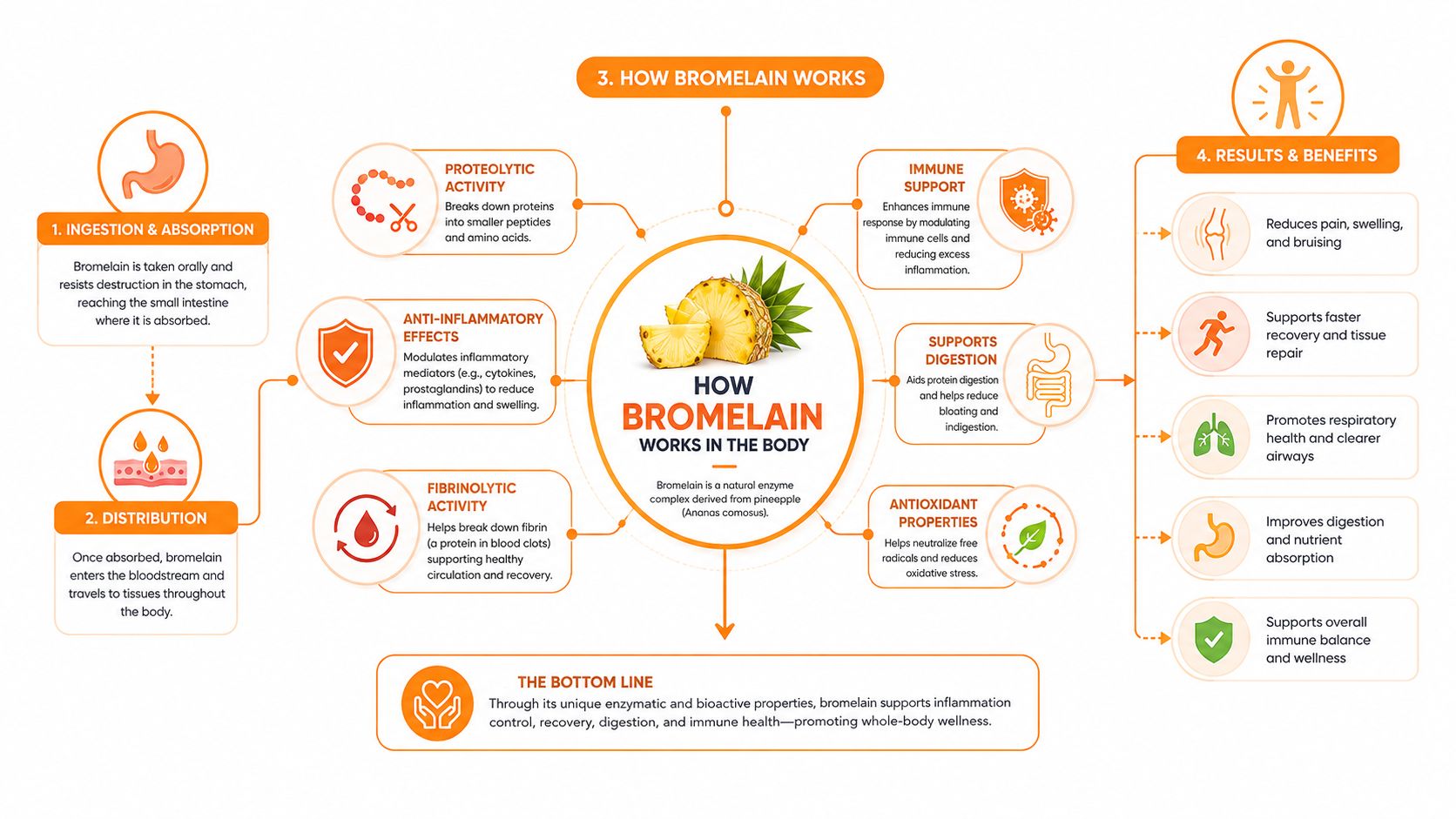
Bromelain's clearest biological action is proteolysis, the breakdown of proteins into smaller fragments. The enzymes act like molecular scissors, but they do not cut every protein indiscriminately. They can act on proteins in the digestive tract and interact with pathways involved in inflammation and clotting.
Research has examined bromelain's effects on mediators such as bradykinin and prostaglandins, as well as fibrin, a protein involved in blood-clot formation. Bromelain may modulate selected inflammatory signals rather than shutting inflammation off entirely. That mechanism explains why researchers investigate it in several settings, while still leaving open the separate question of whether a proposed use produces a meaningful clinical benefit.
Why the mechanism matters for safety
Proteolytic activity in the digestive system may help explain reports of stomach discomfort, nausea, gas, or diarrhea. A concentrated preparation can irritate sensitive people, especially when taken without food.
The fibrin connection points to the main safety concern. Bromelain could add to the effects of medicines that reduce clotting or platelet aggregation, which may increase the chance of bruising or bleeding. This concern has more practical importance than liver toxicity. The NIH safety summary reports no cases of liver injury, jaundice, or hepatotoxicity from oral or topical bromelain despite widespread use.
Allergic reactions involve the immune system instead. Since bromelain comes from pineapple, susceptible people may develop hives or rashes and, rarely, anaphylaxis. Protein-fragment activity also gives researchers a plausible reason to study bromelain's effects on taste receptors. A plausible mechanism, however, does not confirm a benefit.
GDU means gelatin dissolving units, a measure of proteolytic activity. MCU means milk clotting units, another activity measure found on some labels. These units describe enzyme strength, not a guaranteed health outcome.
Typical Bromelain Dosages in Studies and Supplements
Bromelain studies do not use one standard dose. Researchers have tested oral preparations across a wide range, while product labels may report either milligrams or enzyme activity. Those measures are not interchangeable. Two capsules with the same powder weight can provide different enzyme activity, depending on how each preparation is made.
A commonly discussed oral supplement range is roughly 500 to 2,000 milligrams per day, often divided into 2 to 4 doses. The amount varies with the formulation and the study's purpose. Short-term surgical or trauma research has used as much as 3,000 to 6,000 milligrams per day. One literature summary also describes absorption of doses up to about 12 grams per day without major side effects in a specific trial setting. That result describes a research context, not a sensible self-care target.
The 2023 systematic review and meta-analysis indexed in PubMed found that reported adverse events were mainly flatulence, nausea, and headache. Many included studies lasted only 3 to 6 days and enrolled limited numbers of participants. The evidence therefore supports short-term tolerability more clearly than long-term, daily use.
How to read a bromelain label
Read the label in three parts:
- Amount: Check the bromelain weight per serving.
- Activity: Look for GDU or MCU, and check whether the unit applies to one capsule or the full serving.
- Directions: Follow the manufacturer's serving instructions instead of assuming that more will work better.
Food may reduce stomach upset for some people. Some products instead advise taking bromelain away from meals for a particular intended use. Product directions should not override advice from a clinician, especially when medicines or health conditions may affect supplement safety.
| Use Context | Daily Dose | Potency (GDU) | Duration in Studies |
|---|---|---|---|
| Typical oral supplement use | Roughly 500 to 2,000 mg | Label-dependent | Short-term and variable |
| Short-term surgical or trauma research | Up to 3,000 to 6,000 mg | Label-dependent | Short courses |
| High-dose trial context | Up to about 12 g absorbed without major side effects | Not consistently reported | Short-term |
Many adults appear to tolerate 500 to 1,000 milligrams per day, but that practical range does not establish long-term safety for every person or formulation. Dose is only one part of the picture. Preparation, timing, duration, and individual sensitivity also shape the risk.
Common Side Effects and Allergic Reactions
Bromelain's usual safety signal is digestive, not severe toxicity. Oral users may experience abdominal discomfort, nausea, gas, bloating, or loose stools. The NIH NCCIH bromelain information identifies stomach upset and diarrhea among the most commonly reported side effects.
This pattern is best understood as dose- and sensitivity-related gastrointestinal intolerance. A concentrated capsule may cause queasiness for one person while a lower amount, sometimes taken with food, feels easier to tolerate. Symptoms that persist or worsen are a reason to stop the supplement and seek medical guidance.
A review hosted by the NIH describes a wider group of effects reported with excessive intake, including vomiting, heart palpitations, indigestion, reduced appetite, headache, muscle pain, dizziness, drowsiness, and lethargy. “Natural” describes the source, not an unlimited safety margin. Readers comparing bromelain with other products can also consult this guide to supplement side effects, while checking each ingredient's own evidence and interaction profile.
Allergic reactions need a separate category
Allergic reactions appear less common than stomach upset, but the consequences can be more serious. Rare reports include urticaria, rash, and anaphylaxis. Anyone with a known pineapple allergy, or a history of strong reactions to supplements, should discuss bromelain with a clinician rather than experiment casually.
Respiratory symptoms, facial swelling, widespread hives, faintness, or trouble swallowing require urgent medical attention. Repeated workplace exposure to enzyme dust in food-processing settings has also been associated with sensitization. That occupational finding does not establish the same risk from ordinary oral use, but it supports treating bromelain as a substance capable of provoking a genuine immune response.
| Frequency Tier | Reported Effects | Evidence Source |
|---|---|---|
| Commonly reported | Stomach upset, nausea, diarrhea, flatulence | NIH NCCIH |
| Mainly reported across clinical studies | Flatulence, nausea, headache | PubMed systematic review |
| Rare but important | Hives, rash, hypersensitivity, anaphylaxis | NIH LiverTox |
| Associated with excessive intake | Vomiting, palpitations, dizziness, drowsiness, lethargy | NIH-hosted review |
The practical takeaway is tiered: digestive symptoms call for reassessing dose and stopping if they continue, while signs of allergy call for urgent care.
Drug Interactions and Health Conditions to Watch
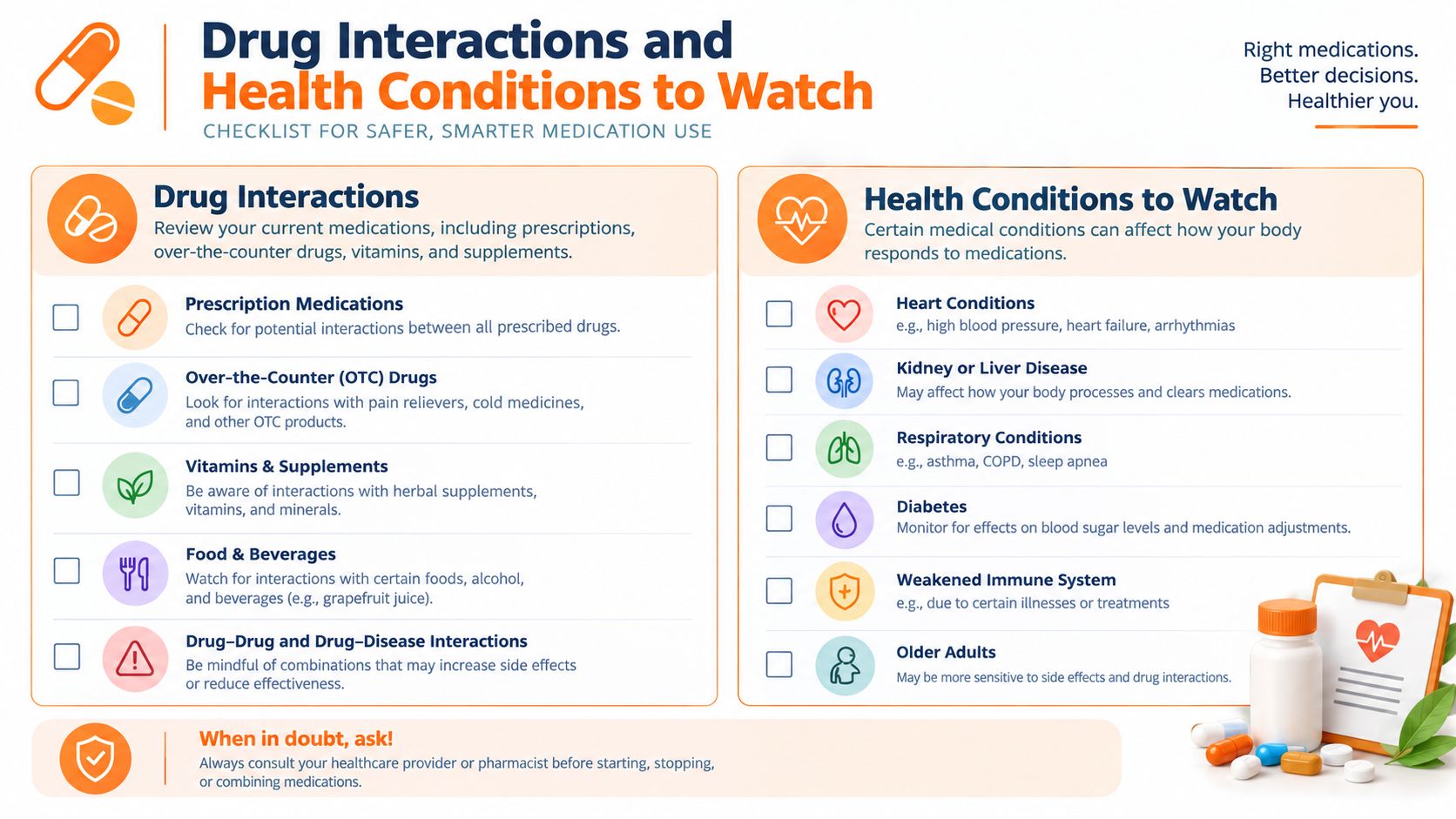
The clearest safety question involves blood clotting. Bromelain may add to the effects of anticoagulant or antiplatelet medicines, including warfarin, heparin, aspirin, and clopidogrel. The PubChem bromelain safety information also advises caution with NSAIDs, since overlapping effects could raise bleeding concerns.
This does not mean everyone using one of these medicines will have a complication. It means the combination merits a medication review before supplementation. A clinician or pharmacist should check the complete regimen, including antiplatelet herbs and over-the-counter products, rather than judging bromelain alone.
Other proposed interactions
Some references raise possible additive effects with blood-pressure medicines, such as ACE inhibitors, or sedating medicines, such as benzodiazepines. These interactions are less consistently demonstrated than the clotting concern, so they should not be treated as established outcomes. People taking several medicines should still disclose bromelain to a prescriber or pharmacist.
Certain health situations call for professional guidance:
- People preparing for surgery: Discuss bromelain with the surgeon well before the procedure because a possible effect on clotting may affect the plan.
- People with active ulcers or bleeding concerns: Gastrointestinal irritation and clotting effects may deserve particular attention.
- Pregnant or breastfeeding individuals: The available safety evidence does not support casual use without professional advice.
- People taking multiple medicines: A pharmacist can review the full regimen more reliably than a single online interaction list.
Medication rule: Warfarin, clopidogrel, aspirin, NSAIDs, and similar medicines make bromelain a medication-safety question, not a casual supplement choice.
The liver evidence is more reassuring. Major NIH summaries have not linked bromelain with clinically apparent liver injury. Individual advice still matters for anyone with complex medical conditions, a bleeding history, or a scheduled procedure. Bring the product label and its activity units to the treating clinician, since formulations can differ.
What the Research Says About Bromelain and Taste
Bromelain may influence taste, but current evidence supports a research signal rather than a settled benefit. Small human and animal studies suggest that applying bromelain to the tongue can temporarily change how some sweet and bitter compounds are perceived. Researchers propose that its protein-cleaving activity may alter proteins on taste-receptor surfaces or within the nearby taste-bud environment.
That mechanism is biologically plausible. It does not prove that oral bromelain, a supplement, or a pineapple-derived product will produce the same effect. Taste depends on receptor proteins, saliva, concentration, exposure time, and individual sensitivity. A brief change after topical enzyme exposure should not be treated as a guaranteed or lasting change in the taste of food or bodily fluid.
Why the evidence remains limited
Taste studies often use small groups, brief observation periods, and different bromelain preparations. Those differences make findings difficult to compare and leave open questions about whether any effect continues with repeated exposure. The evidence currently identifies a possibility worth testing, not a confirmed outcome.
Safety and taste are separate questions. Bromelain taken orally is generally well tolerated by healthy adults, yet applying an enzyme directly to the mouth could still cause irritation or hypersensitivity in susceptible people. Pineapple allergy also matters because bromelain is pineapple-derived. A product's route, formulation, and activity may therefore affect how its safety should be considered.
For a closer look at the ingredient-level findings, see this bromelain and taste research. That overview can explain the hypothesis and study limitations, but it cannot show that a particular product will create a specific taste result.
The most defensible conclusion is modest: bromelain is a plausible taste-modulating ingredient, while short-term use appears generally tolerable for many adults. Better controlled trials are needed. Safety findings may support cautious use, but they do not turn an intriguing mechanism into a proven claim.
Practical Safety Checklist and Common Questions
Bromelain safety depends on both the product and the person using it. Before starting, continuing, or increasing a supplement, check these points:
- Check the activity units: The label should explain GDU or MCU activity for each serving, rather than listing only a vague enzyme blend.
- Review medications: Warfarin, clopidogrel, aspirin, NSAIDs, and other blood-thinning products merit review by a clinician or pharmacist because bromelain may add to bleeding-related effects.
- Flag pineapple sensitivity: A history of pineapple allergy, hives, wheezing, or serious supplement reactions supports avoiding unsupervised use.
- Plan around surgery: Anyone scheduled for an operation should ask the surgical team whether to stop bromelain. A commonly used precaution is stopping two weeks before surgery, but the treating clinician should set the plan.
- Consider pregnancy or breastfeeding: Professional advice is appropriate because available safety evidence does not establish routine use in these circumstances.
- Check quality information: Third-party testing, manufacturing details, and a transparent label help shoppers judge what a product contains. Testing does not remove interaction risks. This third-party verification guide explains what testing can and cannot establish.
Common questions
Is bromelain safe to take daily?
Many adults tolerate customary daily amounts, but long-term evidence is thinner than short-term tolerability evidence. Stop the supplement and contact a clinician if persistent nausea, diarrhea, rash, or unusual bruising occurs.
What daily dose is usually used?
Study and supplement amounts vary. Commonly discussed oral use ranges from roughly 500 to 2,000 milligrams per day, while GDU or MCU activity adds information that the milligram amount alone cannot provide.
Can bromelain be taken with ibuprofen or warfarin?
Do not assume the combination is safe. A prescriber or pharmacist should review ibuprofen, warfarin, or a similar medicine before use, especially when bleeding risk is already a concern.
What happens if bromelain is taken on an empty stomach?
Some people may develop stomach irritation, nausea, or loose stools. Taking it with food may improve tolerance unless a clinician or the product label gives different timing instructions.
Is bromelain safe for children?
The available evidence does not establish routine supplement use for children. Parents should obtain pediatric medical advice instead of applying adult dosing assumptions to a child.
Bring the exact product label to a clinician or pharmacist if any checklist item applies. The label supplies the dose, activity units, ingredients, and directions needed for a more useful review.

SEMEX combines bromelain with zinc, L-arginine, sunflower lecithin, and other men's wellness ingredients in a daily supplement designed to support semen volume and taste goals. Readers can review its formula, manufacturing information, and testing details at SEMEX, then discuss bromelain use with a healthcare professional when medication or allergy concerns apply.
These statements have not been evaluated by the Food and Drug Administration. This product is not intended to diagnose, treat, cure, or prevent any disease.