

Daily Supplements for Men: Ingredients, Dosing, Quality
53.9% of U.S. men aged 20 and older reported taking at least one dietary supplement in August 2021, according to national supplement-use data. That makes supplementation a mainstream habit, but popularity doesn't tell you whether a particular bottle fits your goals.
The useful question isn't whether men should take supplements. It's which ingredient, at what dose, for what purpose, with what evidence and quality checks. Those questions matter especially when a formula promises support for vitality, sexual wellness, or reproductive function.
Table of Contents
- Why Daily Supplements Have Become Part of Men's Routines
- Key Ingredients and How They Work in the Body
- What the Research Shows for Each Ingredient
- Dosing, Timing, and Realistic Expectations
- Reading Structure and Function Claims Correctly
- Testing and Label Quality to Check Before You Buy
- Choosing a Daily Supplement and Your Next Step
Why Daily Supplements Have Become Part of Men's Routines
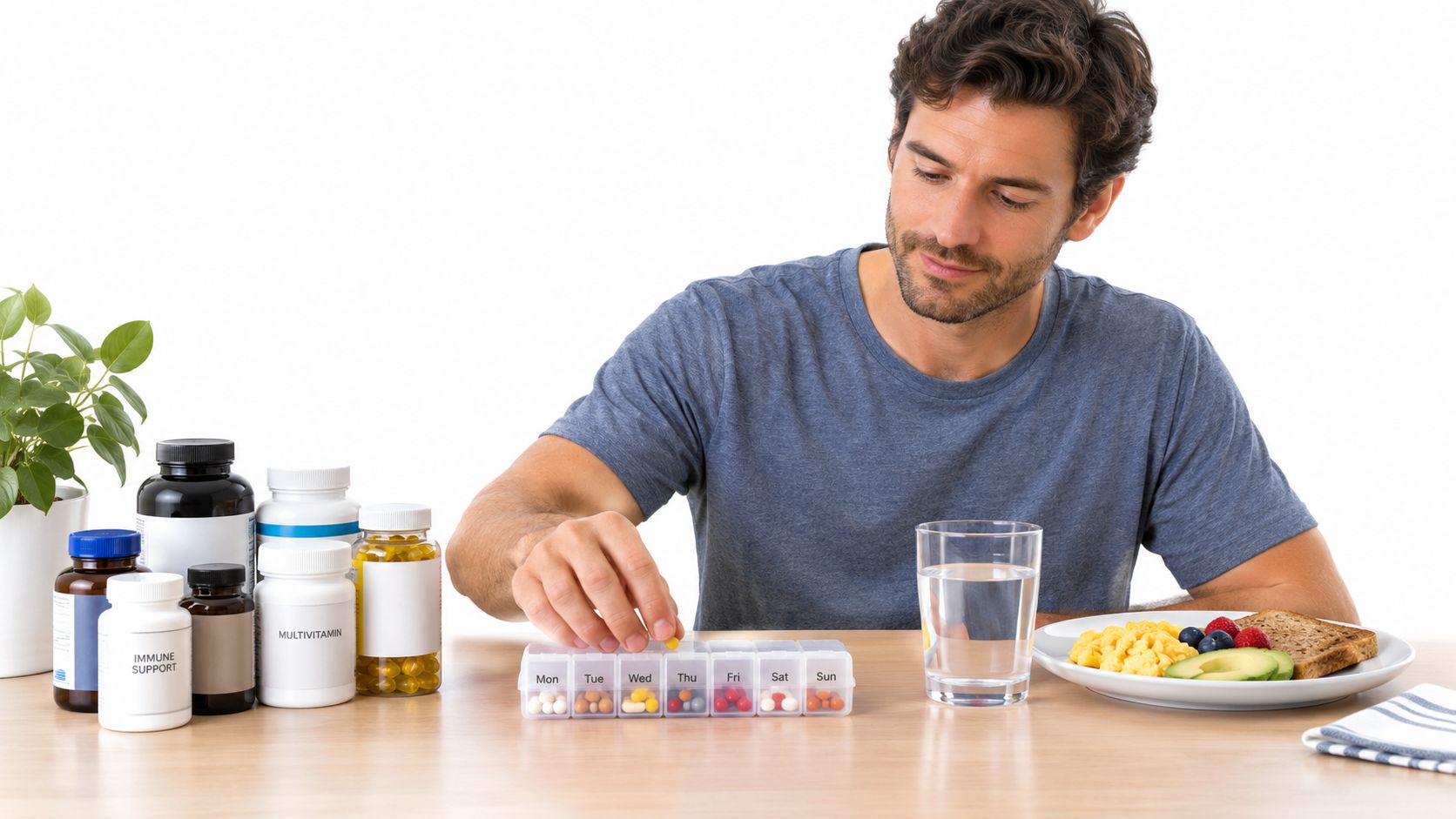
A supplement routine can feel reassuringly simple: breakfast, water, capsules, then on with the day. Choosing that routine deserves more thought than following it.
The national figure above covers dietary supplements broadly, including vitamins, minerals, botanicals, and amino acids. It isn't evidence that a men's formula improves semen volume, libido, or sperm health. A common habit and a demonstrated benefit are different things.
Start with the outcome you actually want
Consider someone interested in semen volume and perceived intensity. He might assume that anything described as reproductive support will address both. A better approach is to ask whether the evidence measures the experience he cares about, rather than accepting a broadly related claim.
A couple interested in taste and shared bedroom satisfaction has a different question. They need to distinguish a product's intended positioning from evidence that its ingredients reliably change taste. Personal preferences also aren't the same as laboratory outcomes.
Someone focused on recovery or everyday vitality should evaluate the formula through another lens. Does it address a plausible nutritional need, or is the ingredient list long and impressive-looking?
- Define the goal: Write down what you'd like to support in plain language.
- Choose the relevant evidence: Look for research measuring that outcome, not an adjacent one.
- Check the practical fit: Consider serving size, ingredient transparency, cost, and whether you're comfortable taking the formula consistently.
Keep the routine in perspective
Daily supplements for men make the most sense as a considered addition to nutrition, sleep, exercise, and appropriate medical care. They shouldn't become a reason to ignore persistent symptoms or postpone a reproductive-health assessment.
Practical rule: Before comparing bottles, finish this sentence: “I'm considering this supplement because I want support for…”
That sentence becomes your filter. If a label can't explain how its ingredients relate to that goal, you don't yet have enough information to choose confidently.
Key Ingredients and How They Work in the Body
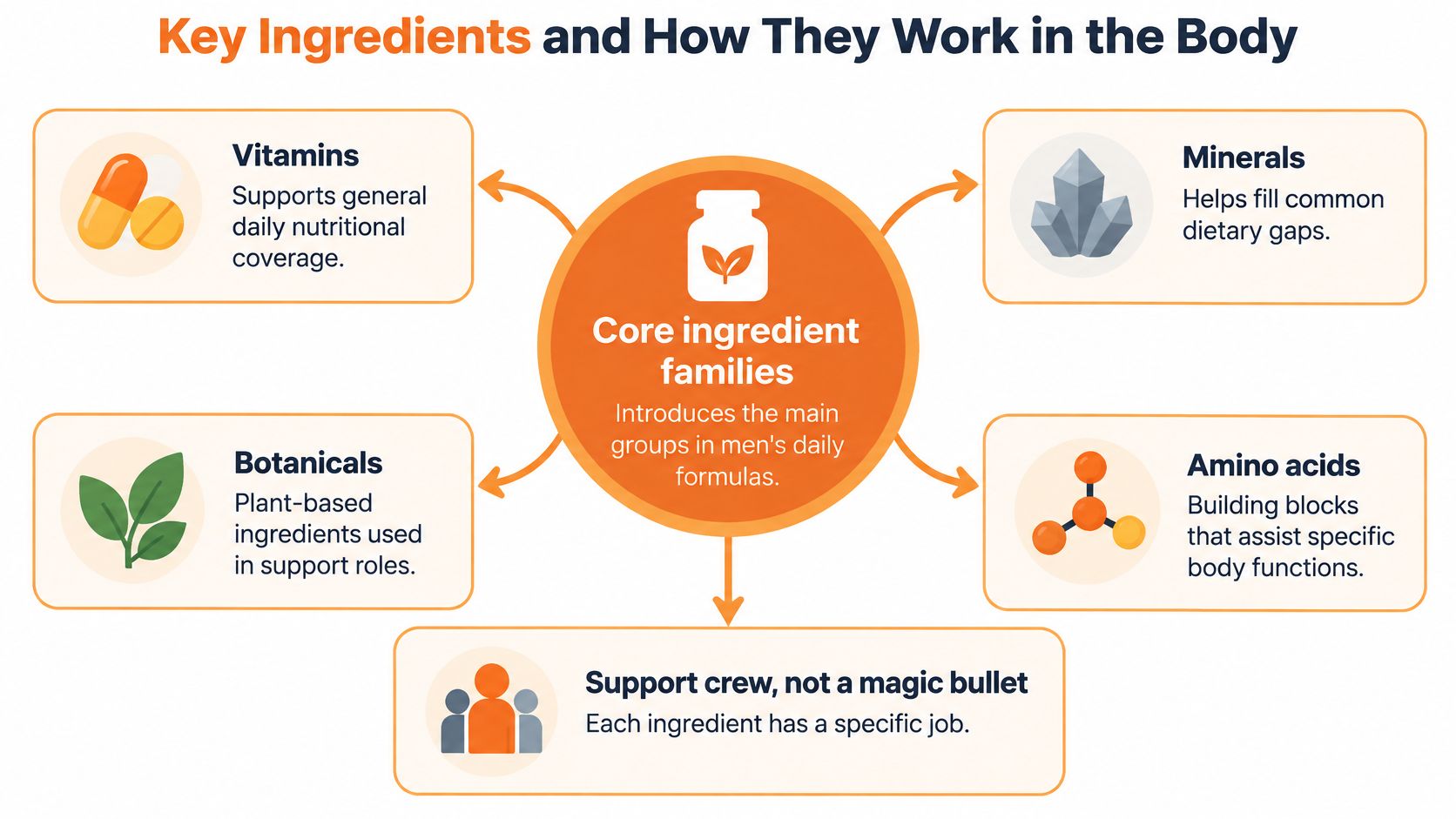
Think of a formula as a support crew, not a magic bullet. Each ingredient needs a defined job, and adding more crew members doesn't automatically improve the result.
This distinction helps separate a plausible biological role from an outcome a person will notice. An ingredient can participate in normal physiology without producing a measurable improvement when taken as an extra supplement.
Minerals and amino acids have different jobs
Zinc belongs to the nutritional-maintenance side of the crew. Its relevance to normal male reproductive function comes from its involvement in fundamental cellular processes, not from being a direct “volume switch.” The important distinction is between meeting a nutritional need and assuming that extra intake produces extra benefit.
L-arginine belongs to the signaling side. As a nitric-oxide precursor, its proposed role relates to endothelial signaling and normal blood flow. Think of a signaling pathway as communication between workers: providing a component doesn't establish how much the entire system's performance will change.
These mechanisms explain why researchers investigate the ingredients. They don't, on their own, establish that a combined formula changes semen volume or bedroom satisfaction.
Separate formulation roles from established outcomes
Sunflower lecithin is included as a phospholipid source in some men's formulas. That identifies its ingredient category, but doesn't establish a clinically meaningful effect on semen volume.
Bromelain is an enzyme positioned in taste-focused formulations. Treat that positioning as a claim to investigate, not proof that taking the enzyme reliably changes semen taste. A persuasive explanation needs human outcome evidence, not just an appealing ingredient story.
The botanical side requires the same discipline:
- Maca root and Panax ginseng: When these appear in vitality-focused blends, ask what specific outcome the supporting research measured.
- Ashwagandha and tongkat ali: Check the exact extract and amount rather than assuming the plant name describes a standardized intervention.
- Saw palmetto and horny goat weed: Don't infer a shared benefit because both appear under a men's-wellness heading.
For a broader ingredient-by-ingredient discussion, the guide to vitality ingredients provides a useful starting point for organizing those questions.
The key is to keep separate columns in your mind: what the ingredient is, what it might do, and what human research demonstrates. For botanicals, the plant part, preparation, extract standardization, and daily amount all deserve scrutiny. A familiar name isn't enough to establish that the label matches the research.
What the Research Shows for Each Ingredient
A mechanism explains why an ingredient might matter. A human study tests whether a particular intervention changes a particular outcome. Neither should be substituted for the other.
Zinc illustrates the difference clearly. It's an essential micronutrient involved in nucleic-acid metabolism, gene transcription, protein synthesis, and spermatogenesis. Yet the NIH-supported FAZST randomized trial found that daily folic acid plus zinc didn't significantly improve semen quality or live-birth rates among couples receiving fertility treatment; the supplemented group also had higher sperm DNA fragmentation at six months and more gastrointestinal symptoms, as summarized in the NIH zinc evidence review.
That same review gives an adult male recommended dietary allowance of 11 mg/day and an adult tolerable upper intake level of 40 mg/day. Those are nutritional reference points, not fertility-treatment doses. The contrast matters: an essential nutrient can be necessary for normal function without additional supplementation improving a desired outcome.
L-arginine shows why the whole evidence picture matters
A systematic review of supplements for male fertility identified a randomized trial associating 1.4 g/day of L-arginine with improved progressive sperm motility in 50 participants. The wider evidence is limited and heterogeneous, with studies commonly using approximately 2–4 g/day, modest changes in concentration or motility, and poorly defined dose-response relationships; a Cochrane assessment also found no advantage over placebo for sperm parameters or biochemical pregnancy in an analyzed trial.
These findings aren't interchangeable. A favorable motility result doesn't establish a reliable effect on semen volume, and a study using a particular daily amount doesn't validate an undisclosed amount inside a capsule blend.
A study result belongs to the ingredient, preparation, dose, participants, and outcome that researchers actually tested.
Ingredient Evidence at a Glance
| Ingredient | Proposed Supportive Role | Documented Reference Point | Evidence Caveat |
|---|---|---|---|
| Zinc | Nutritional support for normal reproductive function | Essential nutrient; FAZST evaluated zinc combined with folic acid | Nutritional necessity didn't translate into improved fertility-treatment outcomes in that trial |
| L-arginine | Nitric-oxide signaling and normal blood flow | Small human trials assessed sperm-related measurements | Results are mixed and don't establish dependable volume enhancement |
| Sunflower lecithin | Phospholipid source | A formulation role rather than an established outcome in the evidence discussed here | Don't treat ingredient identity as proof of a semen-volume benefit |
| Bromelain | Enzyme included in taste-focused formulations | Product positioning doesn't establish a human taste outcome | Reliable taste improvement isn't demonstrated by the evidence discussed here |
| Botanical wellness blend | Intended vitality-related support | Each botanical requires its own preparation-specific assessment | A blended ingredient list isn't evidence for the finished combination |
For the remaining ingredients, the responsible conclusion isn't that they never work. It's that the evidence discussed here doesn't establish the advertised outcomes. Ask for relevant human studies before treating a proposed role as a demonstrated benefit.
Dosing, Timing, and Realistic Expectations
Turn the bottle around before reading the front-label promises. The Supplement Facts panel is where a plausible ingredient story becomes a concrete daily intake.
The U.S. supplement framework established by the Dietary Supplement Health and Education Act of 1994 includes labeling expectations covering serving size, dietary ingredients, and amounts per serving, subject to applicable exceptions. The statutory framework for supplement labeling helps explain why those details matter more than a marketing phrase.
Read the daily amount, not just the ingredient name
- Find the serving size: Determine whether listed quantities apply to a capsule or the full daily serving. Don't assume they're the same.
- Identify elemental zinc: The zinc compound describes its form; the declared zinc amount is what you compare with the nutritional reference points discussed earlier.
- Add overlapping products: Include zinc from multivitamins and other supplements when reviewing total intake. Food contributes too.
- Check L-arginine separately: A total blend weight doesn't tell you its individual amount. If that quantity isn't disclosed, you can't meaningfully compare it with the research.
- Review directions and warnings: Don't increase the serving because a trial used a larger amount of an ingredient.
For example, a panel might list zinc followed by a parenthetical compound name. Read the nutrient quantity first, then the form. With an amino-acid blend, look for the actual L-arginine quantity rather than assuming most of the blend consists of it.
Build a routine without turning a timeline into a promise
The publisher describes a routine of 3 capsules daily, with benefits building gradually over about 30 days of consistent use, in its discussion of how long supplements take to work. That's a brand-described routine and expectation, not a clinical deadline or evidence that every user will notice a change.
Choose a repeatable time that follows the label directions. Keep a simple record of the product, serving, start date, other supplements, and any unwanted effects.
Dose check: Consistency means following an appropriate serving reliably. It doesn't mean doubling the dose when you're impatient.
Avoid changing several supplements at once if you want to understand your experience. If you notice an unwanted effect, don't treat it as proof that the supplement is “working.” Review it with a clinician or pharmacist.
Reading Structure and Function Claims Correctly
A supplement claim isn't a result you can assume you'll receive. Even carefully worded language needs supporting evidence.
The FDA distinguishes structure/function claims, which describe support for normal body structure or function, from disease claims. Its consumer questions and answers about dietary supplements explains that supplements may not claim or imply that they diagnose, mitigate, treat, cure, or prevent disease.
Read the whole message
Words such as supports, helps maintain, and plays a role in can describe normal physiological functions. But those words aren't a compliance shortcut. “Supports” doesn't make an otherwise misleading promise acceptable.
For example, language about supporting normal reproductive function is different from promising to treat infertility, low sperm count, or erectile dysfunction. Read headlines, testimonials, graphics, and surrounding text together, not just the most cautious sentence.
| Label language | Question to ask |
|---|---|
| Supports normal function | Which function, through which ingredient, at what amount? |
| Research-backed ingredients | Does the research match the ingredient form and daily dose? |
| Clinically proven formula | Was this finished formula actually studied for this outcome? |
| Guaranteed improvement | What evidence could justify such certainty across different users? |
Approval, substantiation, and notification aren't the same
The FDA doesn't approve most supplements for safety or effectiveness before marketing. Manufacturers remain responsible for the claims they make.
For covered structure/function statements, manufacturers must notify the FDA no later than 30 days after marketing the supplement with the claim, according to the agency's structure/function claims guidance. That notification isn't premarket approval or confirmation that users will experience a benefit.
A useful buying habit is to translate every broad promise into a specific question. If the answer only repeats the headline, ask for the supporting study and the exact formulation it tested.
The plain-language guide to structure/function claims can help you evaluate that wording. Your standard should be straightforward: a modest verb, a clearly defined function, and evidence that matches the claim.
Testing and Label Quality to Check Before You Buy
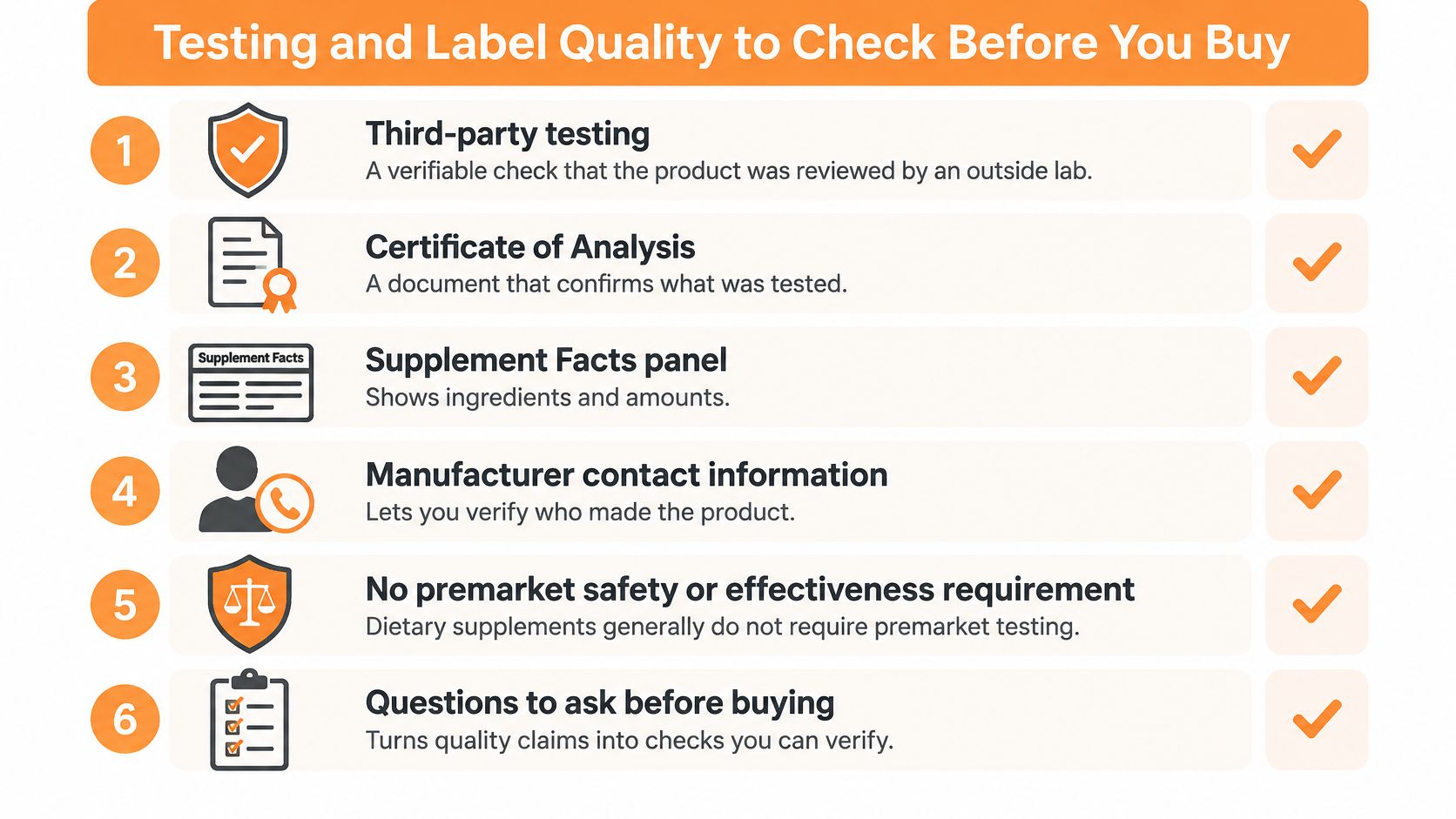
Third-party tested should begin a conversation, not end it. Ask who tested the product, what they measured, and whether you can inspect the results.
The NIH consumer guide to dietary supplements explains that supplements generally aren't required to undergo premarket testing for safety or effectiveness. Independent certification can help verify contents and screen for contaminants, but it doesn't guarantee that a product is safe or effective.
Audit the label and manufacturing information
Start with what you can verify without interpreting laboratory chemistry.
- Named ingredient amounts: Look for individual quantities rather than relying on a proprietary blend total.
- Manufacturer contact details: You should be able to ask who made the product and request documentation.
- Recognized GMP practices: Ask what manufacturing standard applies and what documentation supports the claim.
- Warnings and directions: Check whether the label addresses medication use, health conditions, and appropriate serving instructions.
Manufacturing controls and outcome evidence answer different questions. A well-made supplement can accurately contain its stated ingredients without having demonstrated the benefit you're seeking.
Read the testing scope
A useful Certificate of Analysis should help you determine what was tested. Ask whether the documentation identifies the product or batch, the laboratory, the methods or test scope, and the acceptance criteria.
Check for microbes, heavy metals, and adulterants rather than accepting an unspecified “purity” claim. Published thresholds help you understand what passing means; a laboratory logo alone doesn't.
The guide to third-party laboratory testing offers a framework for requesting that information. If a company can't explain what its testing covers, treat the missing detail as unresolved rather than filling in the blanks yourself.
Review personal safety and buying terms
Products marketed for sexual enhancement deserve particular caution because adulteration with drug ingredients has been identified in this category. Review supplements and medications with a clinician or pharmacist, especially if you take nitrate medicines; combinations and excessive doses can create risks.
Finally, check the return policy and the meaning of sourcing claims.
- Vegan: Describes an ingredient or formulation attribute, not effectiveness.
- Non-GMO: Describes sourcing, not proof of a clinical outcome.
- Made-in-country claims: Identify manufacturing location, not whether the product works.
- Return terms: Clarify eligibility, deadlines, exclusions, and how to contact the seller.
Before buying: Save the label and testing documentation you reviewed. You'll have a concrete reference if the formula or your routine changes.
Choosing a Daily Supplement and Your Next Step
Choose the simplest path that answers your actual need. A complicated routine isn't automatically a more useful one.
A 2025 systematic review and meta-analysis found that supplements may positively affect some sperm parameters, but found no substantial evidence that any specific supplement improves pregnancy, live birth, or male infertility outcomes. That distinction is central to an informed decision.
Semen volume describes fluid quantity; concentration describes sperm relative to fluid; motility concerns movement; and morphology concerns shape. Conception is a different endpoint, and a change in a semen measurement doesn't establish a better chance of pregnancy.
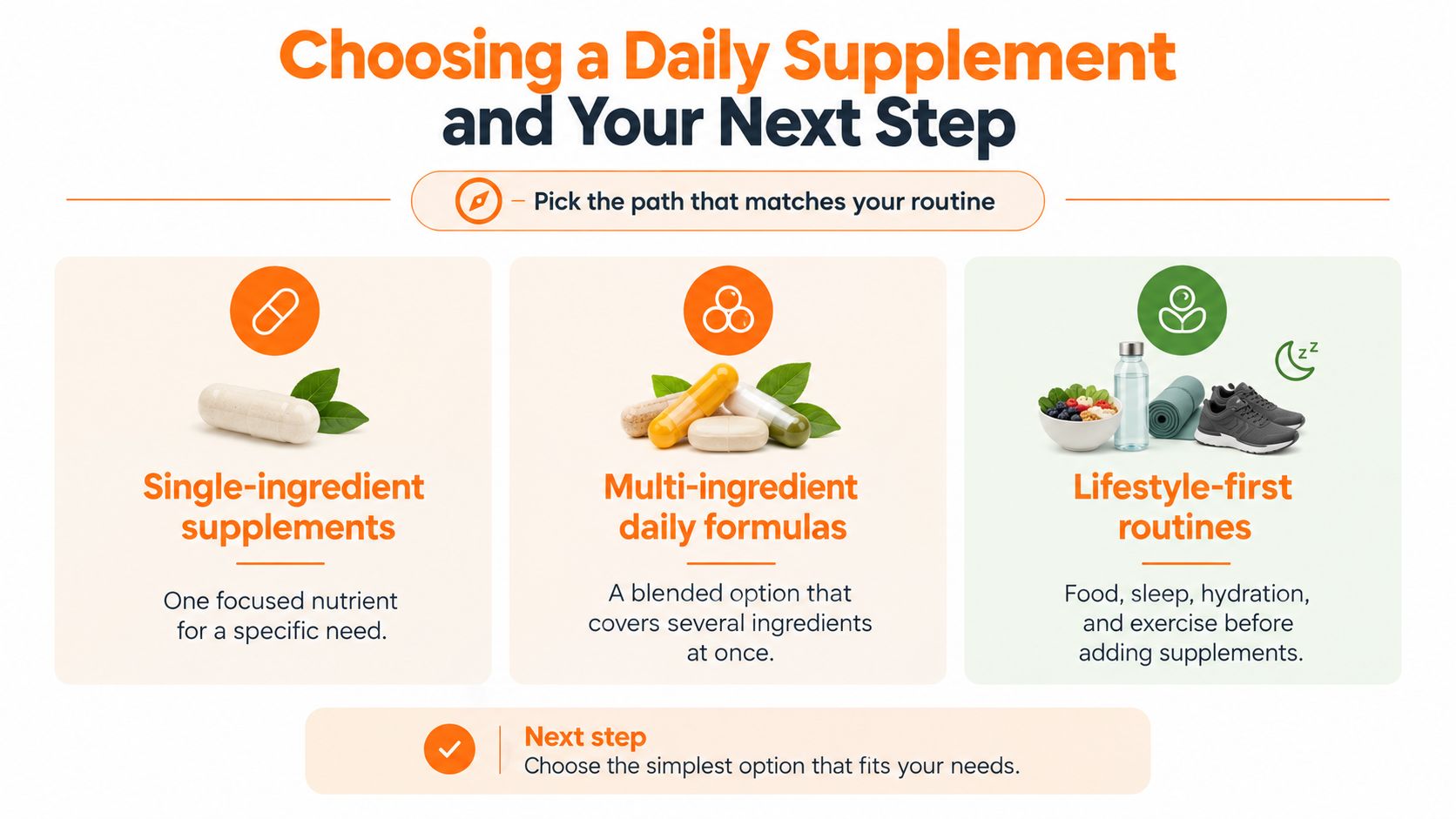
| Path | When it may fit | Main question |
|---|---|---|
| Single-ingredient supplement | You have a focused nutritional need | Is this ingredient appropriate for me? |
| Multi-ingredient daily formula | You prefer a combined routine | Are all amounts, warnings, and tests transparent? |
| Lifestyle-first routine | You want to prioritize nutrition, sleep, hydration, and exercise | What foundational changes need attention before adding products? |
Put a combined formula through the same checks
SEMEX is a multi-ingredient option combining zinc, L-arginine, sunflower lecithin, and bromelain with maca root, Panax ginseng, ashwagandha, tongkat ali, saw palmetto, and horny goat weed. The brand describes it as vegan, non-GMO, made in the USA in a cGMP-registered facility, and tested by Eurofins for microbials, heavy metals, and adulterants, with published thresholds and a 90-day money-back guarantee.
Evaluate those attributes through the same audit you'd apply to any formula. They describe formulation, manufacturing, testing, and purchasing terms, not proof of reproductive or sexual outcomes. If fertility concerns persist, seek medical evaluation rather than relying on a supplement routine.
SEMEX offers a combined daily formula for men considering nutritional and wellness support. Visit SEMEX to review the Supplement Facts panel and testing documentation, then compare the disclosed amounts, warnings, and test scope with your own goals.
These statements have not been evaluated by the Food and Drug Administration. This product is not intended to diagnose, treat, cure, or prevent any disease.