

Bigger Loads Pills: Evidence, Ingredients, and Safety Guide
The most popular advice about bigger loads pills starts with the wrong assumption: that a capsule is the main lever controlling semen volume. In practice, short-term changes can reflect ejaculation timing, abstinence duration, hydration, collection conditions, and normal personal variation. A supplement may support a nutritional or physiological function, but it can't turn semen volume into a simple, predictable output.
That distinction matters because a larger ejaculate isn't automatically evidence of higher sperm concentration, stronger motility, greater fertility potential, or better sexual satisfaction. Men comparing products need to separate four different goals: visible volume, semen quality, reproductive support, and bedroom experience. Those goals overlap biologically, but they aren't interchangeable.
Table of Contents
- Why Timing Might Matter More Than Pills
- Understanding Semen Composition and Volume Sources
- The Science Behind Zinc and Reproductive Function
- WHO Reference Standards and What They Mean
- Evaluating Common Supplement Ingredients
- Safety Considerations and Quality Evaluation
- Setting Realistic Expectations and Next Steps
Why Timing Might Matter More Than Pills
Before comparing ingredients, men should examine the variable most products rarely emphasize: when ejaculation occurs relative to the previous ejaculation. A 2024 analysis of 60,823 individuals reported a mean ejaculate volume of 3.4 mL and a median of 3.1 mL, with volume increasing as abstinence lengthened and reaching a plateau around 84 to 96 hours. The analysis is available in the Journal of Sexual Medicine abstract.
That finding doesn't establish a universal schedule, and it doesn't show that timing is more important for every man. It does show why a single visual comparison can mislead. A sample collected after a longer interval may appear different from one collected after frequent ejaculation, even when no supplement has changed the underlying reproductive function.
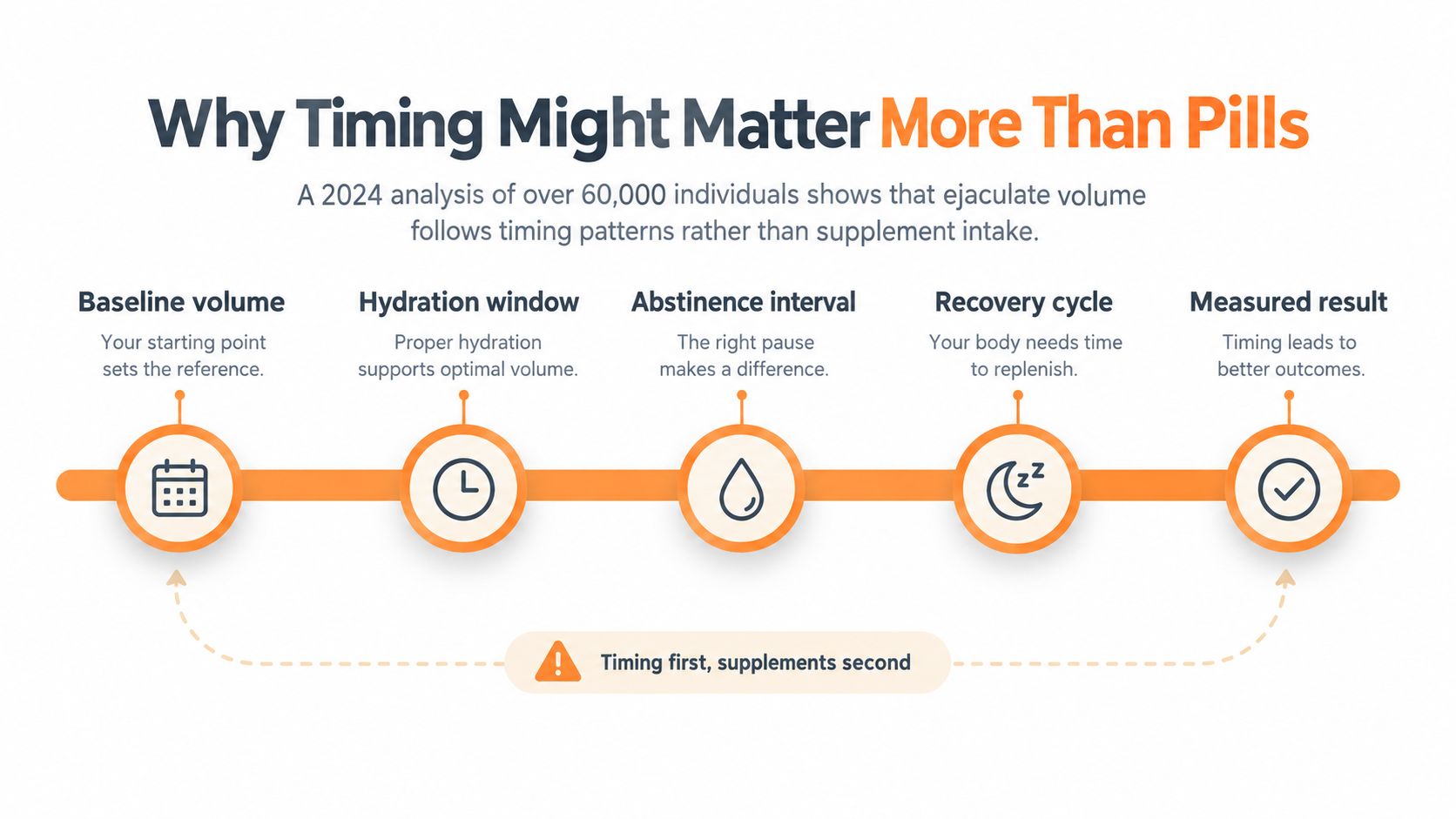
A timing-first measurement approach
Men interested in visible volume can begin with a consistent observation protocol rather than adding several products at once:
- Keep the interval consistent: Compare samples after a similar abstinence period.
- Collect the complete sample: Incomplete collection can make the measured volume look lower.
- Avoid visual scoring: Appearance alone can't establish volume, concentration, motility, or morphology.
- Track repeated patterns: One ejaculation is a weak basis for judging a persistent change.
A practical discussion of timing appears in this guide to ejaculating before sex. The useful conclusion isn't that abstinence guarantees a larger result. It is that timing creates a readily observable source of variation, while many supplements have limited evidence for volume specifically.
Practical rule: A short-term change after adjusting timing shouldn't automatically be credited to a pill, and a lack of visible change shouldn't automatically disprove an ingredient's broader physiological role.
The timing-first perspective also protects consumers from escalating doses in response to ordinary fluctuation. If the objective is a laboratory assessment rather than a visual impression, standardized collection instructions and repeated measurements provide a more meaningful comparison than changing several variables simultaneously.
Understanding Semen Composition and Volume Sources
Semen is mostly fluid. Sperm cells are an important biological component, but they represent only a small share of the total ejaculate. A peer-reviewed review describes human semen as approximately 95% to 98% seminal plasma and approximately 2% to 5% spermatozoa, with reported total sperm counts of roughly 200 million to 500 million in a typical ejaculate under that review's framework. The underlying composition research is summarized in this review of human semen biology.
The fluid comes mainly from accessory glands. The seminal vesicles contribute approximately 65% of total semen volume, the prostate contributes about 25%, and the testes, epididymides, and associated ducts contribute roughly 10%. Another review places seminal-vesicle contribution broadly around 60% to 75% and prostatic contribution around 20% to 30%, so the exact proportions vary by source and measurement context.
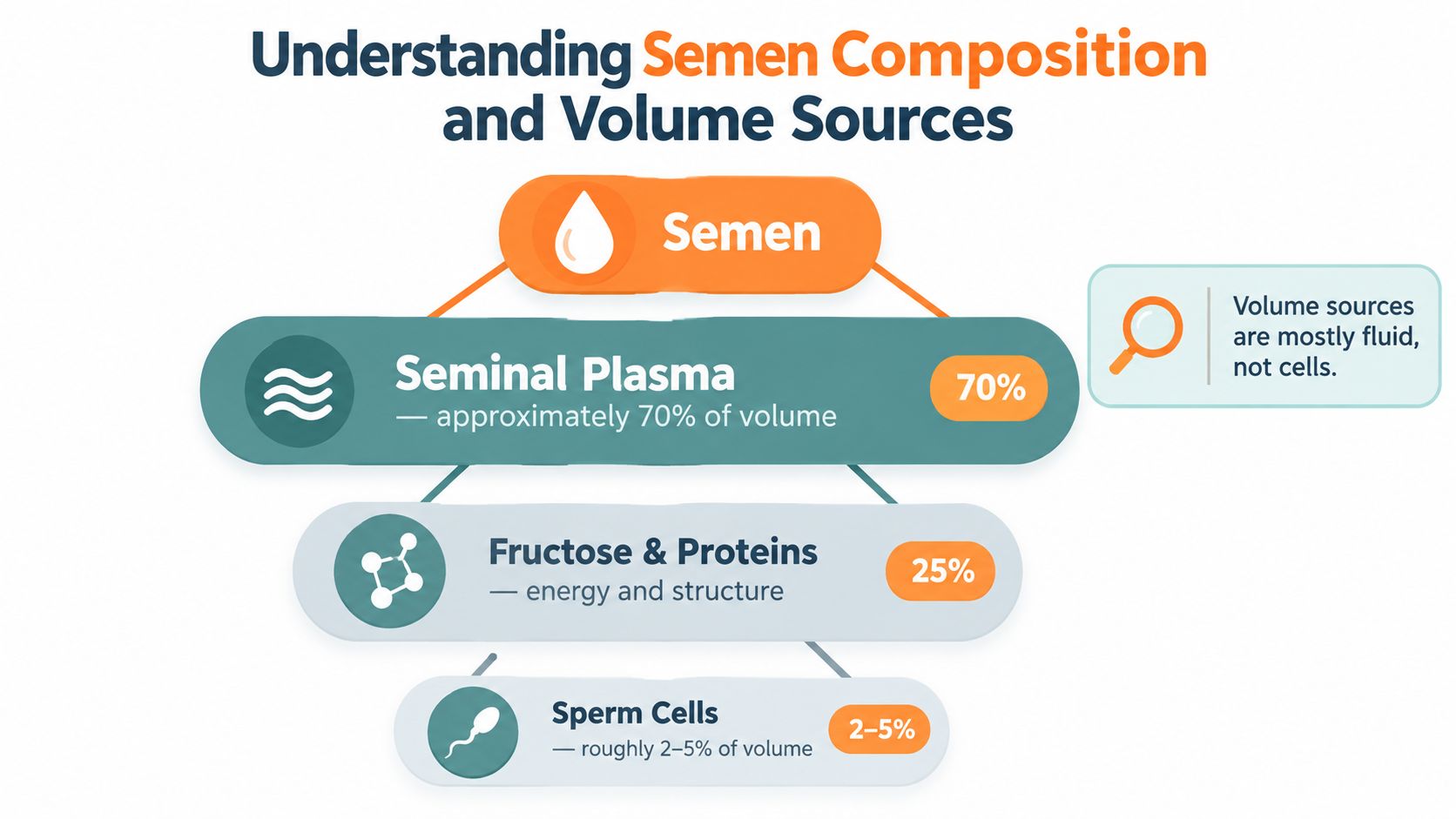
Why fluid volume and sperm content are separate questions
Seminal-vesicle fluid contains fructose and other compounds that provide an energy substrate for sperm movement. Prostatic fluid contributes citrate, enzymes, lipids, ions, and other molecules. These secretions explain why the visible size of an ejaculate depends primarily on glandular fluid, not on a proportional increase in sperm cells.
That creates a critical distinction for anyone researching what sperm contains nutritionally. A product that supports normal reproductive function shouldn't be described as changing every component of semen. An increase in total fluid would not automatically mean a corresponding increase in sperm count or concentration.
| Measure | What it describes |
|---|---|
| Semen volume | The total amount of ejaculate fluid |
| Sperm concentration | The number of sperm cells per unit of volume |
| Total sperm number | The total sperm-cell count in the complete sample |
| Motility | How sperm cells move |
| Morphology | The proportion with a typically shaped form |
The table matters because marketing often compresses all five measures into one visual promise. Clinical interpretation does not. Bigger loads pills may be discussed in relation to semen composition, but ingredient claims should remain narrow, evidence-based, and tied to the specific biological function studied.
The Science Behind Zinc and Reproductive Function
Zinc has a stronger biological rationale than many ingredients sold for semen volume, but that does not make it a reliable volume pill. Baseline nutritional status, timing of supplementation, and the specific semen measure studied may matter more than adding zinc to an already adequate diet. Zinc is concentrated in seminal plasma and contributes to spermatogenesis, sperm membrane stability, chromatin packaging, antioxidant defense, and motility. A review of zinc and fertility links inadequate zinc status with impaired spermatogenesis and abnormal sperm characteristics, while cautioning that these associations do not show that high-dose zinc increases ejaculate volume in men with adequate intake. The biological mechanism and safety limits are discussed in this review of zinc and male reproductive function.
Human evidence is suggestive but not definitive. A 2016 systematic review and meta-analysis reported associations between zinc supplementation and higher semen volume, sperm motility, and the percentage of normally shaped sperm. For semen volume, the standardized mean difference was −0.99, with a 95% confidence interval of −1.60 to −0.38. The corresponding standardized mean differences were −1.82, with a 95% confidence interval of −2.63 to −1.01, for motility, and −0.75, with a 95% confidence interval of −1.37 to −0.14, for normal morphology, as reported in the zinc seminal-plasma meta-analysis.
What the zinc evidence does and doesn't show
The evidence supports a structure/function description. Zinc plays a role in normal male reproductive function, particularly when inadequate intake is relevant. It does not establish that every zinc-containing formula will produce a visible change, nor does it support describing zinc as a treatment for infertility, low sperm count, or another medical condition.
Dose discipline matters. Chronically excessive zinc intake can interfere with copper status and cause adverse effects. Total intake from food, multivitamins, and other supplements should therefore be considered. More zinc is not automatically more useful.
Zinc research supports nutritional adequacy and normal reproductive biology. It does not justify an unrestricted “bigger loads” promise.
Zinc is best evaluated as a nutrient with a plausible role and some human evidence, not as a proven volume booster or a useless ingredient. Outcomes depend on baseline status, study design, formulation, and the semen parameter measured.
WHO Reference Standards and What They Mean
Semen volume only becomes interpretable when measured against a recognized laboratory framework. The World Health Organization's reference criteria have changed over time. Earlier criteria published in 1999 used a minimum semen-volume reference of 2.0 mL. The 2010 fifth edition lowered the lower reference limit to 1.5 mL, while the 2021 sixth edition lowered it again to 1.4 mL, with a 95% confidence interval of 1.3 to 1.5 mL. These historical values are documented in the WHO semen-analysis reference review.
The latest framework also lists reference values of 16 million sperm per mL for concentration, 42% for total motility, and 30% for progressive motility. The broader WHO manual reports 39 million total sperm per ejaculate and 4% normal morphology as corresponding reference values. These figures appear in the WHO sixth-edition manual.
Reference values aren't fertility verdicts
The lower volume limit represents the fifth percentile among men whose partners achieved natural conception within one year. It is a population reference value, not a guaranteed boundary between fertility and infertility. A result below that limit alone doesn't establish a diagnosis.
Semen measurements vary with abstinence duration, hydration, illness, collection completeness, ejaculation frequency, and laboratory methods. That variability is why a clinician may interpret repeated laboratory measurements rather than a single result.
A man comparing bigger loads pills should ask what the product is promising. If the promise concerns visible volume, it should not be confused with a claim about sperm concentration or reproductive potential. If the concern is persistent or accompanied by other symptoms, supplement experimentation isn't a substitute for medical evaluation.
Evaluating Common Supplement Ingredients
The presence of an ingredient does not establish that it will increase ejaculate volume. For products marketed as bigger loads pills, the relevant question is whether human studies measured volume directly, under controlled conditions, and in men with comparable starting characteristics. Zinc has the clearest connection to normal reproductive physiology among commonly listed compounds, while L-arginine, sunflower lecithin, bromelain, lycopene, and maca have weaker or less direct evidence for a volume-specific effect.
L-arginine may influence nitric-oxide pathways and blood flow, but a plausible mechanism does not demonstrate a predictable increase in semen volume. Sunflower lecithin appears in formulas concerned with semen composition, yet biochemical reasoning is not equivalent to a controlled finding of a larger ejaculate. Bromelain is sometimes discussed in relation to taste. That discussion should not be converted into a claim about volume.
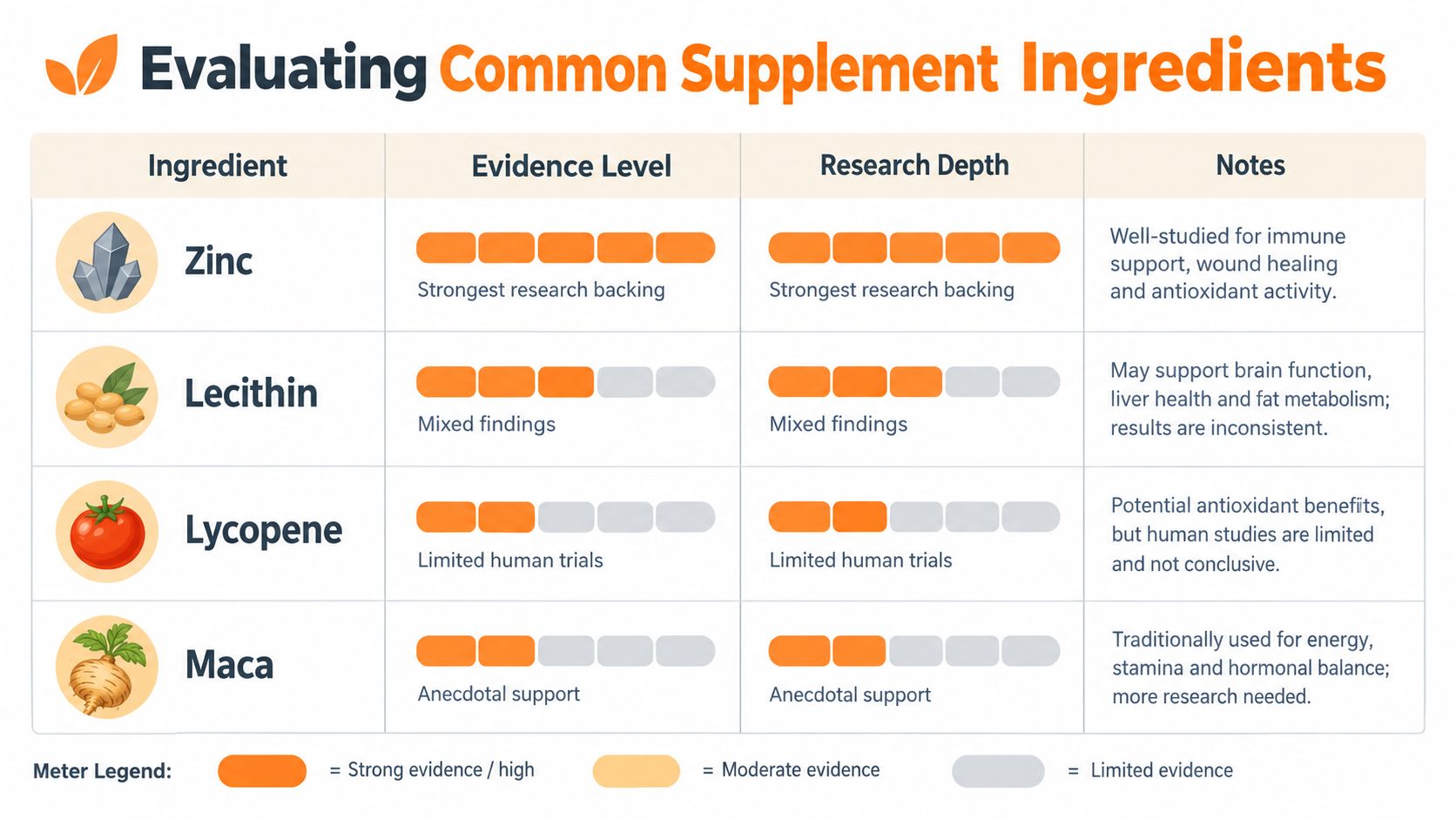
The endpoint problem
The main limitation is often the outcome researchers chose to measure. Studies may assess sperm concentration, motility, oxidative stress, or broader reproductive markers without treating ejaculate volume as a primary, consistently measured endpoint. Baseline differences, collection conditions, and timing can also affect the result, making a general supplement effect harder to separate from normal variation.
One recent evidence review identified only two eligible studies reporting ejaculate volume. Their findings were inconsistent, leaving insufficient evidence for a meaningful effect. A separate 2025 review found no significant effect of CoQ10 on semen volume. These findings are summarized in this review of supplements and male reproductive outcomes.
The ingredient-level interpretation is therefore limited:
- Zinc: Has the strongest support for a role in normal reproductive function, with human evidence covering several semen parameters. That does not prove a larger ejaculate.
- L-arginine: Has a plausible physiological mechanism, but volume-specific evidence remains qualified.
- Sunflower lecithin: May relate to semen composition, while direct evidence for volume is limited.
- Bromelain: Should not be presented as a proven method for increasing ejaculate volume.
- Lycopene and maca: Appear in male-wellness formulas, but their inclusion does not establish a specific volume effect.
The practical conclusion is straightforward: reproductive relevance and visible volume are different endpoints. A transparent formula should distinguish mechanism, human outcome data, and marketing interpretation, while recognizing that baseline variation and timing may matter more than the ingredient list.
Safety Considerations and Quality Evaluation
An ingredient list provides only a partial view of a supplement's safety. Products marketed for sexual enhancement may contain undisclosed pharmaceutical ingredients. The FDA's consumer guidance on dietary supplements warns consumers about this risk, which makes finished-product testing more informative than a promising formula alone.
A practical quality screen
A careful review should look for evidence about the product as sold, not only studies of individual raw ingredients:
- Third-party testing: The manufacturer should identify the testing organization, laboratory, and analyses performed.
- Adulterant screening: Testing should include hidden pharmaceutical ingredients, rather than checking only basic cleanliness.
- Contaminant controls: The quality program should address heavy metals and microbial contamination.
- Dose transparency: Each active ingredient should have a stated amount. Proprietary blends make exposure difficult to assess.
- Interaction review: Men taking prescription medicines or managing a medical condition should consult a pharmacist or clinician about possible interactions.
These checks address product risk, not whether the supplement will increase ejaculate volume. A product can be accurately labeled and free of contaminants while still lacking convincing evidence for that specific outcome. Testing also cannot remove the effects of baseline variation, collection timing, or inconsistent measurement.
“Natural,” “vegan,” and “herbal” describe a product's positioning, not its effectiveness or safety. Attractive packaging and a long ingredient list provide no stronger evidence. More ingredients can also make it harder to identify which compound caused a perceived benefit, side effect, or interaction.
FDA rules permit structure/function statements about how a nutrient or ingredient supports normal body structure or function when those statements are truthful, not misleading, and substantiated. They do not permit disease-treatment claims for dietary supplements. The FDA guidance on structure/function claims states that manufacturers must notify FDA no later than 30 days after first marketing a product with such a claim.
Setting Realistic Expectations and Next Steps
A sensible decision begins with the desired outcome. A man seeking a temporary change in visible volume may learn more from consistent timing and collection conditions than from adding another capsule. A man concerned about sperm concentration, motility, morphology, or fertility potential needs standardized semen analysis, because volume alone cannot answer those questions.
The evidence supports a restrained approach to bigger loads pills. Zinc can be described as playing a role in normal reproductive function, while several other ingredients have more indirect or limited volume-specific evidence. No ingredient should be presented as guaranteeing a particular ejaculate size or as addressing a medical condition.
A decision path based on symptoms and goals
Men with an occasional change and no concerning symptoms can first standardize the variables that commonly affect measurement. That means keeping the abstinence interval consistent, collecting the complete sample, and avoiding conclusions based on visual impressions.
Men with persistent changes in semen volume, pain, blood in semen, urinary symptoms, or fertility concerns should seek professional medical evaluation. Repeatedly increasing supplement doses can delay assessment of an underlying issue and may create avoidable nutrient or interaction risks.
SEMEX can be considered as one product option within the broader category of men's supplements, but its presence in a shopping comparison doesn't change the evidence standards. Any product should be judged by transparent dosing, finished-product quality controls, appropriate structure/function language, and whether its claims match the outcomes studied.
The most defensible conclusion is not that supplements are irrelevant. It is that timing, baseline variation, and measurement quality often determine what men notice first, while evidence for many volume-focused products remains limited or indirect. A careful buyer looks for support of normal function, not a medical promise disguised as a marketing phrase.
These statements have not been evaluated by the Food and Drug Administration. This product is not intended to diagnose, treat, cure, or prevent any disease.
SEMEX offers a supplement option for men evaluating products in the semen-volume category, alongside a need for realistic expectations about timing and evidence quality. Men researching bigger loads pills can visit SEMEX to review the product information and make a more informed comparison.