

Ejaculate Before Sex: What Happens and How to Time It
A man is staring at his phone on the morning of date night, debating whether to masturbate or “save up.” He wants a strong erection, a satisfying orgasm, and maybe a larger visible ejaculation. The problem is that those goals don't always point to the same timing choice.
The practical answer depends on what matters most for that encounter. Prior ejaculation can reduce the amount released later, while a longer pause can increase volume without automatically improving sperm quality, erection strength, or pleasure. The evidence supports planning around the goal, not following bro-science rules.
Table of Contents
- What Ejaculating Before Sex Actually Does
- The 2–7 Day Window and the Volume Trade-Off
- What Happens When You Ejaculate Hours Before Sex
- Matching Your Timing to Your Actual Goal
- Making It Work as a Couple
- Why Saving Up Is Not Always Better
- A Simple Plan and the Honest Bottom Line
What Ejaculating Before Sex Actually Does
Ejaculation before sex sets off a short-term recovery process. The prostate and seminal vesicles contribute much of the fluid in semen, and the body needs time to replenish those secretions after an orgasm. A recent ejaculation also leaves less sperm available for the next release, so the following ejaculation may be smaller.
The clearest immediate effect is practical. If a man ejaculates shortly before planned sex, he may release less fluid during the later encounter. He may also find that another erection or orgasm takes time. That period is called the refractory period, and it can last from roughly 30 minutes to 24 hours, with substantial individual variation, according to research on male sexual recovery (research on the refractory period).
Practical rule: A man who wants maximum volume and immediate erectile readiness shouldn't schedule a preliminary ejaculation on the same day without testing how his body responds.
The second question is whether prior ejaculation changes the actual sexual experience. It can, but not in one predictable way. Some men feel less urgency and more control after an earlier orgasm. Others feel less aroused, need longer stimulation, or experience a weaker second climax. A larger ejaculation also doesn't guarantee a stronger orgasm or a better experience for a partner.
A foundational stopwatch study of 500 heterosexual couples across five countries found a median ejaculation time of 5.4 minutes, with observations ranging from 0.55 to 44.1 minutes (multinational stopwatch study). That range matters because it shows why personal timing shouldn't be judged against one supposed standard.
For a straightforward explanation of the broader concern about ejaculation and energy, men can review whether ejaculation makes men weaker. The short-term question is about recovery within hours. The longer-term question is how several days of abstinence affect volume and semen measures. Those are related, but they aren't the same timeline.
The 2–7 Day Window and the Volume Trade-Off
The World Health Organization has historically used 2–7 days of ejaculatory abstinence before semen collection. That interval standardizes laboratory testing. It isn't a commandment for partnered sex, and it doesn't prove that the longest possible wait produces the best sexual outcome (WHO abstinence guidance and semen reference framework).
The trade-off is simple. A longer gap generally gives the body more time to accumulate semen and sperm for one ejaculation. A shorter gap may produce less volume, but some research associates it with favorable motility or DNA-integrity measures. Volume is only one measurement, and it shouldn't be treated as a score for fertility or sexual performance.
A comparison of 1 day and 4 days of abstinence found total sperm counts of approximately 120.1 million after 1 day and 168.0 million after 4 days. The same evidence makes clear that count alone doesn't describe the full picture (peer-reviewed comparison of abstinence intervals).
Abstinence Days vs. Volume, Motility, and DNA Quality
| Days abstinent | Semen volume | Motility | DNA integrity |
|---|---|---|---|
| 1 day | Often lower than after several days | May be favorable in some studies | May be favorable in some studies |
| 2–3 days | A practical balance for many goals | Often favorable in fertility-focused research | Often favorable in fertility-focused research |
| 4 days | Higher total sperm count than after 1 day in one study | Not automatically superior | Not automatically superior |
| 5–7 days | Longer storage can increase volume | May decline in some research | Fragmentation may increase in some research |
A review of 17 studies found that 15 studies, or 88.2%, reported a significant increase in semen volume with longer abstinence (review of abstinence and semen volume). A 2024 meta-analysis found that shorter abstinence reduced semen volume by a mean difference of 0.83 mL and sperm concentration by 8.39 million/mL, while also reducing DNA fragmentation by 3.82 percentage points and increasing motility.
That is the honest trade-off. Longer abstinence can create a more visible ejaculation, but it doesn't automatically create healthier sperm or a better orgasm. Men comparing practical timing options can also read how to increase ejaculate fluid, while keeping the distinction between appearance, fertility, and pleasure clear.
What Happens When You Ejaculate Hours Before Sex
A man who ejaculates hours before sex should expect the later ejaculation to be smaller in many cases. The body has begun replenishing fluid, but it hasn't necessarily rebuilt the same volume available after several days without ejaculation.
A controlled study required an initial 3–4-day abstinence period, then had participants ejaculate daily for two weeks. Average semen volume fell from 2.5 mL at the initial evaluation to roughly 1.6–1.9 mL during daily ejaculation. The researchers reported that the main change appeared after two days of daily ejaculation, with seminal volume reduced by about 70% and total sperm count by about 50% compared with the initial evaluation (controlled daily-ejaculation study).
That evidence supports a short-term volume effect. It doesn't show that daily ejaculation is harmful, and it doesn't prove that abstinence is always better. A man may prefer a smaller second ejaculation if the first orgasm lowers anxiety, reduces sensitivity, or helps him last longer during partnered sex.
The refractory period creates the second constraint. After emission and expulsion, another erection or ejaculation may be temporarily difficult or impossible. Recovery can take roughly 30 minutes to 24 hours, and age is one factor associated with longer recovery, although individual variation matters more than a fixed rule.
A planned second round can work for some men, but it shouldn't be treated as guaranteed. The second ejaculation may be smaller, the climax may feel different, and the erection may need more stimulation. Men looking for practical expectations can also review whether men can ejaculate twice.
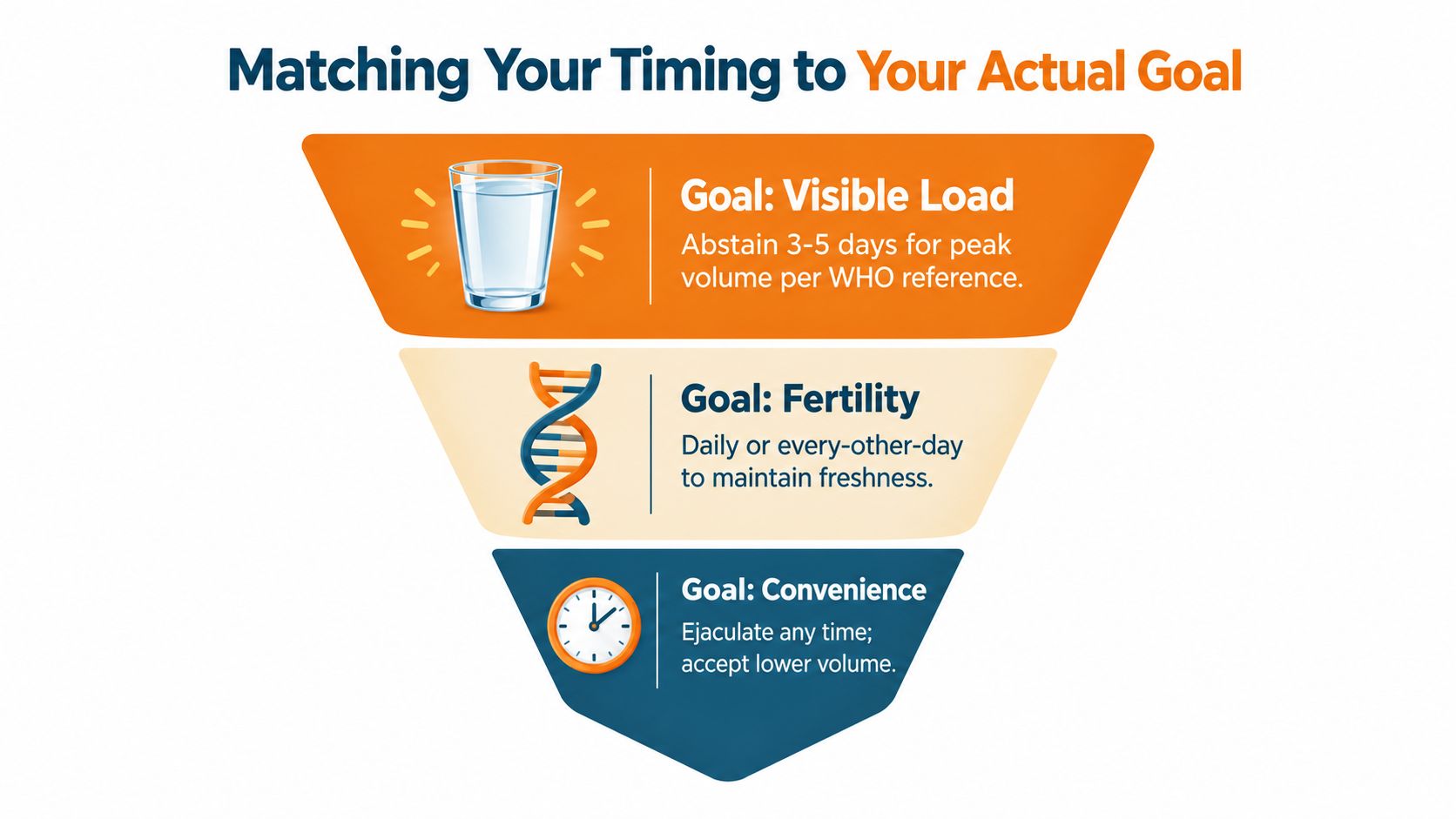
Matching Your Timing to Your Actual Goal
Choose the outcome first. Volume, conception, a strong first round, and a planned second round require different timing, so one schedule cannot optimize all four.
For a larger visible ejaculation
If volume is the priority, avoid ejaculating shortly before sex. Allow roughly 2–7 days of abstinence, with a 3–5-day interval as a practical middle option within the WHO collection range. No single day guarantees the biggest result. Stay normally hydrated, and do not dehydrate yourself to manipulate semen.
A larger ejaculation does not automatically mean better fertility. It usually reflects more stored fluid and sperm, not better sperm movement or DNA integrity.
For conception
Couples trying to conceive should prioritize regular intercourse over holding out for a larger visible release. Shorter abstinence, including frequent or daily ejaculation, is associated with fresher sperm and improved motility or DNA-integrity measures, particularly in men with otherwise normal semen parameters, according to this recent literature review on abstinence and sperm quality.
Intercourse every 1–2 days is a practical fertility schedule. Save the longer abstinence window for a laboratory semen sample, and follow the lab's stated 2–7-day collection requirement exactly. Sex timing and sample-collection timing serve different purposes.
For a stronger first round
Men who want their best erection and fullest first orgasm should avoid a same-day preliminary ejaculation. Use your own recovery pattern instead of copying another man's schedule. If an earlier orgasm regularly leaves you less interested or slower to respond, it is working against this goal.
For a planned two-round night
An earlier ejaculation may reduce sensitivity and make later sex easier for some men. The trade-off is a smaller second release and a recovery period that may disrupt the plan. Test the approach on an ordinary day, not before an important date, and judge it by erection quality, desire, and control rather than semen volume alone.
Make one goal primary. Choose abstinence for visible volume, regular intercourse for conception, no same-day ejaculation for a strong first round, or personal testing for a second round.
Making It Work as a Couple
A date-night conversation can turn awkward when a partner asks, out of nowhere, whether the man masturbated earlier. The question often isn't really about semen volume. It may be about whether he has energy, whether he expects to last, or whether he has put effort into the shared experience.
A couple can handle the subject without making it a performance review. The man can answer plainly and explain what he was trying to achieve, whether that was reducing sensitivity, managing arousal, or preserving energy for the evening. The partner then has useful information instead of having to interpret a smaller ejaculation or a slower erection.
Three practical moves keep the conversation grounded:
- Frame the timing clearly: If masturbation is part of managing sensitivity or practicing arousal control, say so instead of presenting it as a secret activity.
- Set expectations for a second round: If the man has already ejaculated, the partner should know that recovery may take time and that a second release may be smaller.
- Discuss preferences without scorekeeping: Partners can talk about whether volume, intensity, duration, or closeness matters most for that encounter.
Taste and intensity can vary with ordinary factors such as hydration and ejaculation frequency, but those details shouldn't become a source of shame or exaggerated promises. A partner usually cares more about attention, foreplay, communication, and enthusiasm than a particular amount of fluid.
The conversation itself often builds more intimacy than the timing decision. A man who communicates his plan gives the partner room to participate rather than leaving her to guess what a change in arousal or ejaculation means.
Why Saving Up Is Not Always Better
Saving up can make sense when the only target is a larger visible ejaculation. It becomes poor advice when men treat stored semen as a complete measure of fertility, sexual function, or satisfaction. A fuller release is one outcome, not proof that the encounter will be better.
The abstinence window matters because semen volume and sperm quality do not always move together. Longer gaps generally produce more fluid and more sperm per ejaculation. Research also links longer intervals, often 4–7 days, with lower motility and more DNA fragmentation in some settings. Shorter intervals, including 2 days or less, may produce fresher sperm and more favorable motility or DNA-integrity measures, especially for some men dealing with fertility problems (reviewed evidence on abstinence and sperm quality).
That gives the timing question a practical answer. Choose a longer hold when visible volume or a semen sample is the priority. Choose a shorter interval when fertility quality matters more than the amount seen in the condom or toilet. Do not use either choice as a universal rule.
The bedroom result is separate. Saving semen does not automatically create a harder erection, stronger orgasm, or more pleasure. Arousal, comfort, stimulation, sleep, stress, and pelvic-floor control have a more direct effect on how sex feels. A man who arrives tense from treating abstinence like a discipline test can undermine the result he wanted.
A larger ejaculation is visible, not a complete performance score.
Controlled arousal, relaxed breathing, and clear communication usually improve the encounter more than counting days. Pelvic-floor exercises can help some men build awareness and control, but constant clenching can make arousal feel tight and uncomfortable. Use abstinence to support a defined goal, then stop treating the number of days or the amount of fluid as a verdict on your sexual performance.
A Simple Plan and the Honest Bottom Line
A man deciding whether to ejaculate before sex can use a short checklist rather than guesswork:
- Choose the goal. The main target should be visible volume, conception, a strong first erection, or a planned second round.
- Choose the matching interval. Around 2–3 days offers a practical balance for motility and volume. Around 3–5 days favors a larger visible ejaculation. A short interval may make sense only when a man has personally tested the recovery effect and accepts lower volume.
- Don't chase a marathon hold. Longer abstinence can raise volume while worsening some sperm-quality measures.
- Protect the basics. Normal hydration, consistent sleep, and less alcohol support a better overall setup than last-minute tricks.
- Separate supplements from medical care. L-arginine plays a role in nitric-oxide signaling and blood-flow processes involved in erection physiology, but that mechanism doesn't prove an increase in semen volume (review of L-arginine and sexual function).
A man considering a daily supplement can review SEMEX as one product option, while keeping expectations tied to general wellness support rather than treating it as a medical solution. Persistent erection problems, ejaculation pain, major changes in semen, or fertility concerns belong with a urologist, not a Reddit thread.
The habits that really matter are simple. Men should maintain normal hydration, aim for 7–9 hours of sleep, reduce alcohol 48 hours before an important encounter, and leave a personal recovery buffer instead of forcing a week-long drought. Timing can influence volume, but communication, arousal, and realistic expectations usually shape the experience more.
These statements have not been evaluated by the Food and Drug Administration. This product is not intended to diagnose, treat, cure, or prevent any disease.
Men who want to compare a daily supplement designed around semen volume and taste can visit SEMEX. The practical next step is to choose the goal first, then use timing and product information without confusing visible volume with fertility or sexual performance.