

What Is Maca Root and Does It Actually Work
Those asking what is maca root are really asking a different question. Is it a testosterone booster, a libido herb, a fertility food, or just another trendy powder with an exotic origin story?
The honest answer is less dramatic and more useful. Maca sits in the space between food and supplement. It has a long agricultural history, a distinct chemistry, and a modest but real human research base. What it doesn't have is a clean record of reliably raising testosterone. What it may support, based on the better human data, is subjective sexual wellness, mood, and perceived energy without obvious hormone shifts, as summarized in a 2024 NIH review of maca research.
That distinction matters. It changes how a person shops for maca, how results should be measured, and how expectations should be set.
Table of Contents
- A 4,000-Year-Old Root from the Top of the World
- What Maca Actually Is Inside the Plant
- From Andean Staple to Global Supplement Ingredient
- What the Research Shows About Libido and Vitality
- Practical Dosing and How to Use Maca Daily
- How Maca Compares to Other Men's Wellness Herbs
- Quality, Safety, and How to Choose a Clean Extract
- Who Should Try Maca and How to Track Your Results
A 4,000-Year-Old Root from the Top of the World
Why would a food from a windswept mountain plateau end up in capsules marketed for libido and stamina?
Part of the answer starts with where maca grows. In the central Peruvian Andes, it is cultivated at roughly 4,000 to 4,500 meters above sea level, in a setting with thin air, cold nights, intense sun, and a short growing season. Peer-reviewed historical work describes maca as a high-Andean crop cultivated for more than 2,000 years, with domestication tied to the Junín Plateau and estimates that place that process roughly 1,300 to 2,000 years ago, according to a historical review of maca cultivation and trade.

That backdrop matters because maca was shaped first by survival agriculture, not by supplement marketing.
A useful comparison is a cellar crop. In harsh places, farmers value plants that store energy well, dry well, and remain useful after harvest. Maca built its reputation in that kind of practical role. It was part of mountain food culture long before anyone framed it as a natural aphrodisiac or a men's health shortcut.
Why the Andes matter
Maca is best understood as a high-altitude storage crop from a specific ecological niche. That helps clear up two common mistakes.
First, origin matters. A plant adapted to the upper Andes is not automatically interchangeable with any cheap powder labeled "maca." Place, cultivation, and post-harvest handling all shape what ends up in a bag or capsule.
Second, traditional use does not prove a modern hormone effect. It does explain why maca earned a reputation for strength, resilience, fertility, and sexual well-being in its home region. Those older associations are cultural and nutritional before they are pharmacologic.
Maca makes more sense when you start with the Andean food tradition, then ask what modern extracts may add on top of that.
The root with a modern identity problem
An ancient crop can have a strong reputation and still fail to act like a testosterone booster in controlled human studies.
That distinction is the practical one. Maca's better-supported effects sit closer to subjective sexual wellness, mood, and perceived vitality than to measurable testosterone elevation. So the right first question is not "Does maca raise hormones?" It is "Which form was studied, and was it standardized well enough to expect a repeatable effect?"
That question becomes even more important once a traditional Andean food turns into a global ingredient sold as raw powder, gelatinized powder, and concentrated extract.
What Maca Actually Is Inside the Plant
Botanically, maca is Lepidium meyenii, a member of the Brassicaceae family, the same broader plant family that includes vegetables like broccoli and radish. The part people use isn't the leaf and isn't the seed. It's the hypocotyl, a swollen underground storage organ that sits at the center of maca's food and supplement use.
That detail matters because supplement labels often simplify maca into "root powder," which hides the fact that the active commercial material is this dense underground structure.
What the dried material contains
Fresh maca contains more than 80% water, while dried maca powder is typically composed of about 55 to 73% carbohydrate, 8.2 to 25.6% fiber, 8.9 to 21% protein, and 0.6 to 2.2% fat, according to a 2024 nutritional review of maca composition. That means the nutrient profile people see on a label comes largely from dehydration and post-harvest handling.
In plain language, fresh maca in the field and maca powder in a jar are related, but they aren't nutritionally identical experiences.
Maca Color Types Compared
| Color Type | Traditional Use | Notable Compounds | Research Focus |
|---|---|---|---|
| Yellow | General food use and broad daily wellness use | Contains maca's characteristic compound families, including macamides, macaenes, glucosinolates, sterols, and alkaloids | General wellness and broad commercial use |
| Red | Traditionally discussed for targeted specialty use | Same core compound classes, with a profile that can differ from yellow and black depending on phenotype and processing | Studied in selected specialty applications |
| Black | Often discussed in relation to vigor and male-focused use | Often highlighted for distinct phytochemical expression within the same core families | Frequently mentioned in male vitality and reproductive discussions |
The key point isn't that one color is magic. It's that phenotype can change chemistry, and chemistry changes outcomes.
The compounds that buyers should care about
The compounds most associated with maca's identity are macamides, macaenes, glucosinolates, sterols, and alkaloids. Among these, macamides are often treated as a practical marker for finished products. Reported macamide levels commonly fall around 0.1 to 1.2 mg/g dry weight, depending on root color and extraction method, according to a review of maca bioactives and analytical variability.
That range explains why two products labeled "maca" can feel very different.
Practical rule: A maca product with no disclosed standardization may still be real maca, but it tells the buyer very little about likely phytochemical exposure.
This is also why maca shouldn't be lumped in with generic stimulant products. Its profile isn't built around caffeine-like stimulation. If it helps, it likely helps through its own plant chemistry, not through a simple "energy boost" ingredient trick.
From Andean Staple to Global Supplement Ingredient
How does a high-altitude food from the central Andes end up in capsules, drink mixes, and men's wellness formulas around the world?
The shift was gradual at first, then fast. Maca spent centuries as a local crop and food, then drew scientific interest, and later became a supplement ingredient with global demand. One review of maca's development summarizes both sides of that transition: human research had already spread beyond Peru, including randomized trials in countries such as Italy, Australia, and the UK, and cultivation in its native region expanded sharply from a very small base in the late 1980s to a much larger planting area by the late 1990s, according to this review of maca studies and market development.
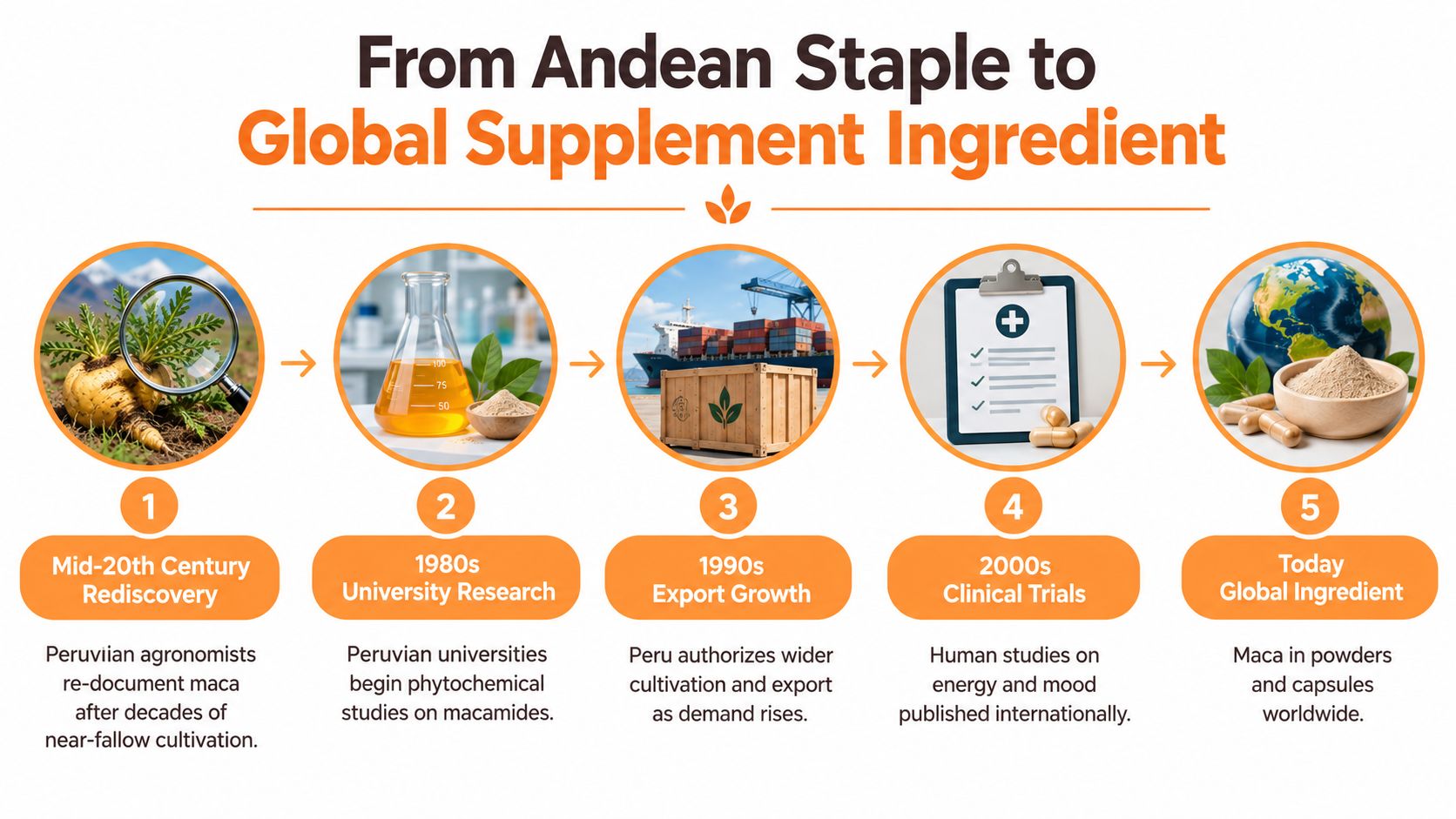
That pattern matters because supplement markets often change a plant faster than the plant changes the person.
Once demand rises, the ingredient usually splits into several versions. With maca, that means raw powders, cooked powders, mixed-color powders, concentrated extracts, and products that say "maca" on the label but tell you very little about phenotype, processing, or standardization. A shopper can easily assume these are close substitutes. They are not.
This is also where the testosterone story started to outrun the evidence. Maca became popular in part because it was easy to market as a natural male vitality herb. But the more consistent human interest has been in subjective outcomes such as libido, mood, and perceived energy, not a reliable rise in testosterone. That difference is easy to miss when product labels compress everything into one vague promise.
Three market changes followed as maca went global:
- Consumer demand grew faster than buyer education
- Low-cost powders became common
- Marketing claims became more confident than product disclosure
A practical way to read the modern maca category is to separate tradition, research, and manufacturing.
Tradition explains why people started paying attention. Human research helps show where the strongest signals are. Manufacturing quality determines whether the jar in front of you resembles the material used in studies or just delivers inexpensive root powder. That last point is where many buyers get misled, especially in men's wellness products that imply a hormone effect without showing a standardized extract profile.
So the modern maca story is not wider popularity. It is the move from a regional staple to a crowded supplement category where form, processing, and standardization now shape the product far more than the front-label promise.
What the Research Shows About Libido and Vitality
Can a root improve sex drive without raising testosterone much, or at all? That question explains most of the confusion around maca.
The clearer reading of the human research is narrower and more useful. Maca shows its best signal in subjective outcomes such as sexual desire, mood, and perceived energy. Testosterone is a different target, and human studies have not shown a reliable pattern of hormone elevation.
A good way to frame maca is to treat it less like an anabolic hormone tool and more like a dimmer switch for how desire, drive, and resilience feel day to day. That does not mean it works for everyone. It means the expected result, if it helps, is usually a change in experience rather than a dramatic lab-value shift.
Maca Research Outcomes at a Glance
| Study | Dose & Duration | Population | Key Outcome |
|---|---|---|---|
| Review of randomized and clinical human studies on maca and sexual function (overview in a research review) | Varied across trials | Adults in several countries and study settings | Human trials suggest possible benefit for sexual desire and related self-reported outcomes |
| Broader clinical review of maca uses and human findings (review summary) | Varied across trials | Men, women, and condition-specific groups | The research signal is broader than one single use, but outcomes are often subjective |
| Human study interpretations summarized across modern literature | Varied | Mixed adult populations | The stronger pattern is in libido, mood, and perceived vitality, not a consistent testosterone rise |
A reader who wants a narrower breakdown focused on desire can compare the evidence in this guide with SEMEX's article on whether maca root increases libido.
What maca can and cannot reasonably do
Maca is often sold as if it were a direct testosterone booster. Human research supports a more restrained view.
The practical expectation is that some users may feel:
- More interest in sex
- Better day-to-day mood
- Steadier usable energy
- More confidence around sexual performance or desire
Those are meaningful outcomes. They are also easy to misread. A person may assume, "I feel more interested, so my testosterone must be up." Biology does not work that neatly. Libido is shaped by mood, stress load, sleep, relationship context, and brain signaling, along with hormones.
That is why maca keeps showing up in men's wellness discussions. It may help with the experience of vitality without acting like a classic hormone intervention.
Why product form matters when people judge whether maca "worked"
Research headlines can make maca sound stronger or weaker than it really is because studies do not always use the same material. Raw powder, heat-processed powder, and extracts are not interchangeable. Comparing them as if they were the same is like comparing whole coffee beans, instant coffee, and espresso concentrate by weight alone. The label may use one plant name, but the delivered material can differ a lot.
That matters here because libido and mood outcomes are subtle. If a study uses a prepared extract and a shopper buys a cheap bulk powder with no standardization, the mismatch can lead to the common conclusion that maca is either amazing or useless. Often the issue is that the product in the jar does not resemble the product behind the claim.
So the honest answer is simple. Maca may help some people feel more desire, better mood, and better vitality. It should not be treated as a reliable shortcut to higher testosterone.
Practical Dosing and How to Use Maca Daily
Maca works better when the form is clear. A scoop of raw powder, a gelatinized powder, and a concentrated extract can all say "maca" on the label while behaving differently in the body and delivering different amounts of key compounds.
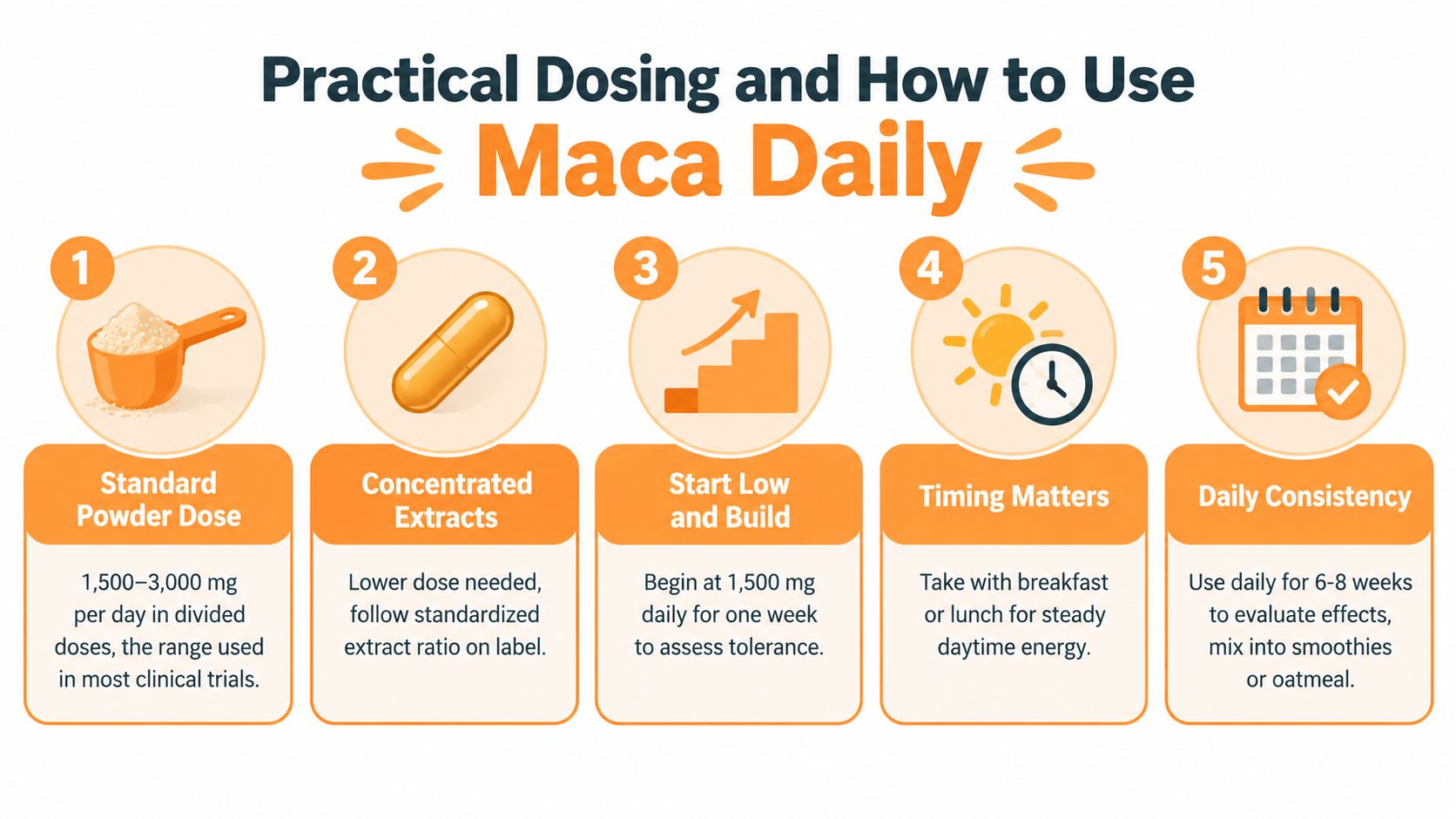
The practical starting point for dried maca powder comes from common clinical use ranges discussed in the background literature: 1,500 to 3,000 mg daily. That range is a reasonable framework for general adult use when a product is plainly labeled as maca powder rather than as a concentrated extract.
Powder versus extract
These forms shouldn't be treated as interchangeable.
- Dried hypocotyl powder: Usually fits the higher milligram range and is closer to a food-format supplement.
- Concentrated extract: Often uses a lower serving size because extraction changes density and phytochemical delivery.
- Standardized extract: Most useful when the label tells the buyer what marker compounds are present.
A reader comparing formats and daily serving decisions can also review SEMEX's guide to maca root dosage for men.
A label checklist that actually helps
Most labels say far too little. A better checklist looks like this:
- Check the form first. Is it raw powder, gelatinized powder, or extract?
- Look for quantified compounds. A macamide percentage or other clear standardization tells more than a vague "proprietary blend."
- Scan the excipients. Fillers such as maltodextrin may be there for manufacturing reasons, but a crowded formula makes evaluation harder.
- Confirm serving transparency. Buyers should be able to tell how many milligrams of maca are in one serving.
- Note timing. Many people do better taking maca with breakfast or lunch rather than late in the day.
Start with the least confusing product. A simple, transparent maca formula is easier to judge than a flashy blend with hidden amounts.
A gentle ramp-up approach
A practical two-week trial can stay simple:
- Week one: Start low with a clearly labeled daily serving taken with food.
- Week two: Move toward the full label serving if digestion and sleep remain comfortable.
There's very little hard data on cycling maca, so rigid on-off schedules should be treated as preference, not established science. Consistency and good label transparency matter more than supplement folklore.
How Maca Compares to Other Men's Wellness Herbs
Maca often gets compared with herbs that do very different jobs. That creates a lot of bad shopping decisions.
The cleanest comparison uses four questions men care about: Does it seem aimed at testosterone, libido, stress, or energy? Maca fits that grid, but it doesn't dominate every category.
Maca vs Tongkat Ali, Ashwagandha, and Fenugreek
| Herb | Primary Mechanism | Best For | Pairs With Maca? |
|---|---|---|---|
| Maca | Non-hormonal support linked most clearly to subjective sexual wellness, mood, and perceived energy | Men who want a daily base for libido and vitality without leaning on a testosterone claim | Yes |
| Tongkat Ali | Often chosen when the goal is more directly testosterone-oriented support | Men prioritizing hormone-focused positioning | Yes |
| Ashwagandha | Often used where stress load and anxious fatigue are major drivers | Men whose low drive seems tied to tension, poor recovery, or stress burden | Yes |
| Fenugreek | Commonly positioned for libido and performance support through a different pathway than maca | Men wanting a more performance-framed option | Sometimes |
A reader weighing these choices directly can compare the category logic in SEMEX's maca root vs tongkat ali breakdown.
Where maca stands out
Maca's main advantage is that it doesn't need to be a strong androgen herb to be useful. That makes it attractive for men who want support around sexual interest, mood, or daily vitality without chasing a harsher hormonal identity.
This also makes maca easier to place in a stack. It often works better as a foundation ingredient than as a hero ingredient.
- Choose maca first when the main goal is broad sexual wellness with modest expectations.
- Choose ashwagandha first when stress and worn-down energy seem central.
- Choose tongkat ali first when the conversation is about testosterone.
- Treat fenugreek separately because its commercial positioning tends to be more performance-oriented.
No herb fixes poor sleep, strained relationships, or medical causes of low libido. Maca makes the most sense when those basics are at least reasonably handled.
Quality, Safety, and How to Choose a Clean Extract
The biggest mistake buyers make is assuming all maca products are close enough. They aren't.
A bag of cheap maca flour can be legitimate plant material and still be a poor choice for someone who wants consistency. The reason is simple. Processing changes the finished product. Raw powder, gelatinized powder, and standardized extract don't offer the same digestibility or the same compound density.
What to look for on a serious label
The strongest buyer checklist is practical, not romantic.
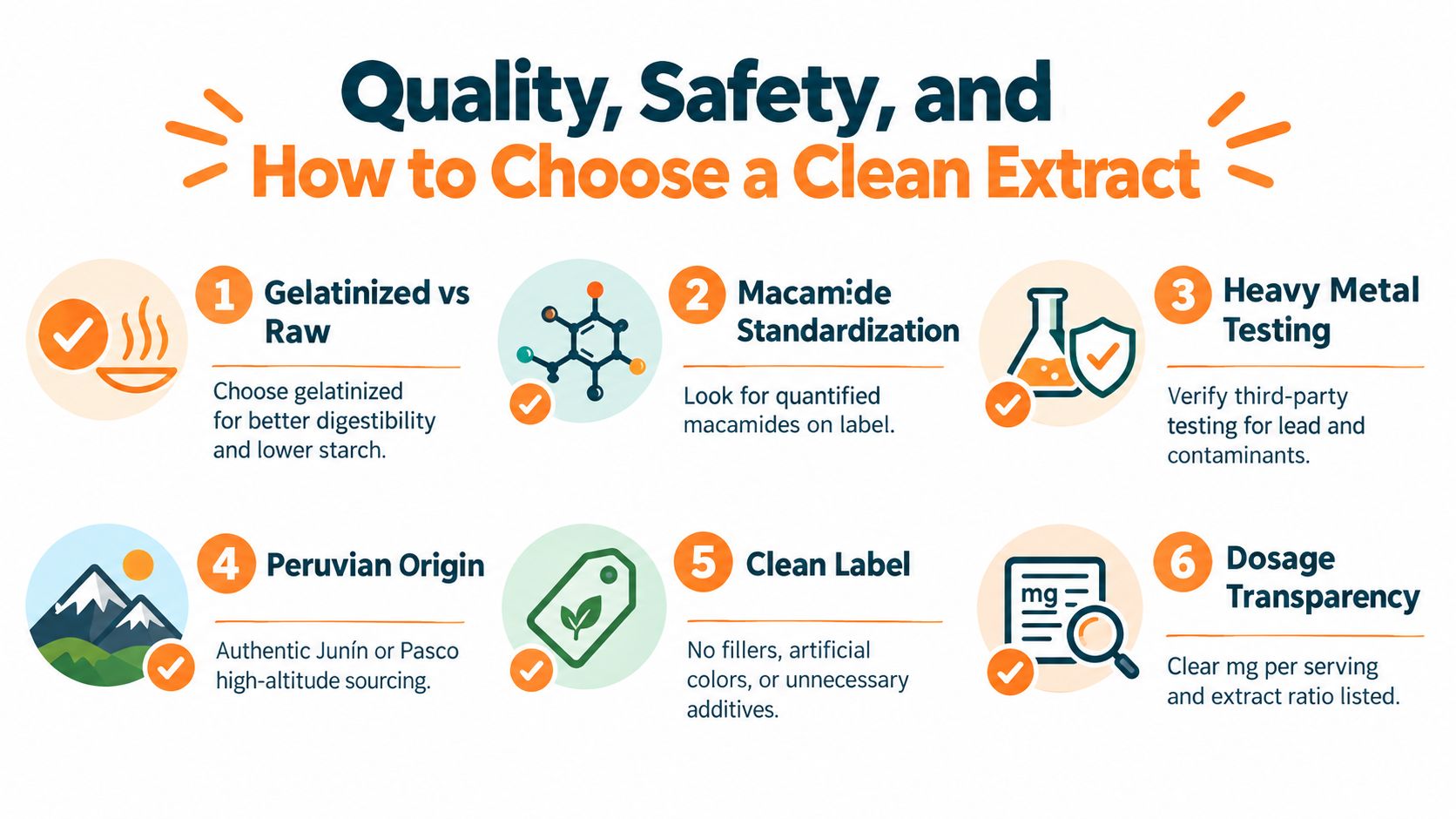
- Gelatinized form: Often preferred by people who don't tolerate heavy starch well.
- Standardization: A quantified macamide level is more informative than marketing copy.
- Third-party testing: Look for clear contaminant testing and batch-level transparency.
- Country of origin: High-altitude Peruvian sourcing should be stated clearly if it's central to the brand's identity.
- No vague blend language: Hidden dosages make evaluation harder.
One example of a men's wellness formula that discloses quality controls is SEMEX, which states that it is made in the USA in a cGMP-registered facility and third-party tested by Eurofins for microbials, heavy metals, and adulterants. That doesn't make it a medical product, but it does show the kind of manufacturing transparency buyers should look for in any supplement category.
Safety and realistic caution
On the safety side, maca's profile is relatively reassuring. NIH LiverTox states there have been no convincing reports linking maca to liver injury, either as transient enzyme elevations during therapy or as clinically apparent acute liver injury, according to the NIH LiverTox entry for maca.
That said, "generally well tolerated" doesn't mean "for everyone."
People using thyroid medication, hormone therapy, or managing hormone-sensitive conditions should involve a clinician before adding maca.
Pregnant and breastfeeding individuals should also get medical guidance first because safety questions in those settings shouldn't be guessed at.
Red flags that deserve suspicion
Some labels and sellers practically announce that they're not worth trusting.
- Missing batch numbers
- No testing disclosure
- Amazon-only traceability with no manufacturer detail
- Grand claims with no quantified standardization
- Proprietary blends that hide the actual maca amount
The buyer rule is simple. Choose gelatinized or clearly processed maca, quantified compounds when available, third-party testing, and a transparent label.
Who Should Try Maca and How to Track Your Results
Maca is a sensible option for an adult man who notices a mild dip in sexual interest, daily vitality, or mood, wants a low-risk plant ingredient, and already has the basics in place. If sleep is chaotic, stress is crushing, alcohol intake is heavy, or relationship conflict is severe, maca probably won't solve the problem.
The best candidate is usually someone who wants a supportive layer, not a dramatic hormonal intervention.
Who should pause first
Some readers shouldn't self-experiment casually.
- People on thyroid medication: Cruciferous plant compounds raise reasonable questions about compatibility.
- People using hormone therapy: A clinician should review the context first.
- People with hormone-sensitive conditions: Extra caution makes sense.
- Pregnant or breastfeeding individuals: Supplement decisions should go through a medical professional.
A simple 30-day trial
A clean self-test beats supplement guesswork.
- Pick one product only. Don't stack three new libido supplements at once.
- Use a consistent daily serving. A plainly labeled product in the common clinical-use range is easier to assess.
- Track four markers: libido, morning energy, gym output, and mood.
- Score each on a 1 to 10 scale at day 0, day 14, and day 30.
- Stop if nothing changes. No supplement deserves a permanent spot just because it sounded promising.
The right question isn't "Did maca transform everything?" It's "Did it create a noticeable, repeatable lift in the outcomes it actually has some reason to influence?"
That's the grounded way to answer what is maca root in practical terms. It's not magic. It's not a reliable testosterone hack. It's an old Andean food-derived supplement with a distinct chemistry and a real, though limited, role in modern sexual wellness and vitality support.
SEMEX offers a daily men's wellness supplement that includes maca root alongside ingredients such as zinc, L-arginine, sunflower lecithin, bromelain, Panax ginseng, ashwagandha, and tongkat ali in a formula designed to support semen volume, taste, and overall vitality. For readers who want to see how maca fits into a broader men's supplement stack with transparent manufacturing details, visit SEMEX.
These statements have not been evaluated by the Food and Drug Administration. This product is not intended to diagnose, treat, cure, or prevent any disease.