

What Is Ashwagandha and How Does It Actually Work
Ashwagandha is a standardized root extract from Withania somnifera, a plant used in Ayurvedic medicine and now studied mainly as an adaptogen for stress and resilience. The bigger question isn't only what it is, but which form people are taking, how it may affect the body, and who should be careful before using it.
A lot of articles stop at “it helps with stress” and move on. That leaves out the part people need when they're standing in front of a label or comparing supplements online. What does “standardized extract” mean? Why do some studies focus on root extract instead of the whole plant? And if something is natural, does that automatically make it low risk?
That gap matters with ashwagandha. The short version is that it has deep roots in traditional medicine, a growing modern research base, and a safety profile that looks more nuanced than marketing copy usually admits. Some evidence supports stress-related benefits. Some evidence suggests a role in male vitality. But product consistency, medication interactions, thyroid questions, and rare liver injury reports deserve equal attention.
Table of Contents
- What Is Ashwagandha in Plain Language
- From Ancient Roots to Modern Monographs
- How Ashwagandha Works Inside the Body
- What the Stress and Resilience Research Shows
- Ashwagandha for Male Vitality and Reproductive Health
- Dosing, Forms, and Product Quality Basics
- Safety, Interactions, and Who Should Avoid It
What Is Ashwagandha in Plain Language
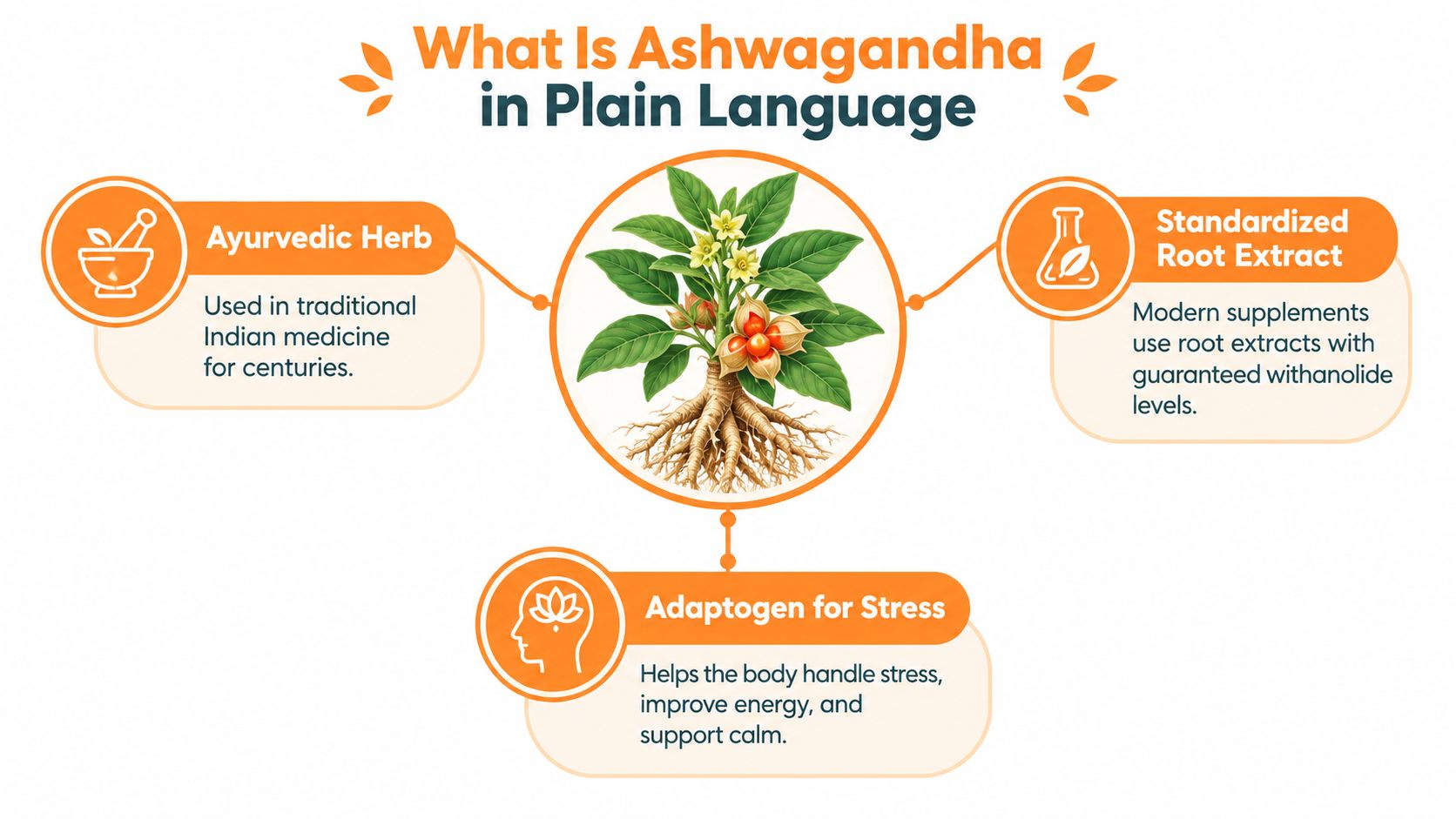
What are people talking about when they say “ashwagandha”? In plain language, they usually mean a supplement made from the root of Withania somnifera, a plant used in Ayurveda and now studied mostly for its effects on stress, resilience, and recovery.
That sounds simple until you look at a bottle.
Some products contain plain root powder. Others use concentrated extracts. Some are standardized to certain withanolide levels, and some are not. So “ashwagandha” is a little like saying “tea” without saying whether it is green tea, black tea, or a strong extract. The category is real, but the details change what you are getting and how closely it matches the research.
What “adaptogen” actually means
“Adaptogen” is one of those supplement words that can sound more precise than it really is. At its simplest, it refers to herbs studied for helping the body respond to stress in a steadier way, rather than acting like a direct stimulant or a knockout sedative.
A thermostat is a useful comparison. It does not create weather from scratch. It helps keep conditions from swinging too far in one direction. Ashwagandha is often discussed in that same broad spirit. The main idea is support for stress response systems, especially the HPA axis, which is the network linking the brain, adrenal glands, and stress hormones.
That does not mean everyone will feel calmer, and it does not mean the herb “balances” everything. It means the most credible research question is fairly narrow: whether certain ashwagandha extracts may improve stress-related measures in some adults.
Why the extract matters
The word “standardized” matters because plants are messy by nature. Two roots grown in different soil, harvested at different times, or processed in different ways can end up with different chemical profiles.
Standardization is the manufacturer's attempt to make batches more alike, often by measuring withanolides, the compounds commonly used as marker compounds in ashwagandha products. That does not guarantee a product is better, safer, or right for you. It does mean researchers and clinicians can talk about a more defined ingredient instead of a moving target.
This point gets missed a lot. If a study used a specific root extract, the results apply most directly to that extract or something close to it. They do not automatically apply to every gummy, tea, powder, or “blend” that puts ashwagandha on the label.
What readers should expect from the evidence
Ashwagandha sits in the middle ground between traditional use and modern clinical research. There are human studies, which is more than many herbs have. There is also plenty of uncertainty, especially once marketing claims drift beyond stress support into broad promises about hormones, performance, or everyday wellness.
Safety belongs in the definition, too.
If you only describe ashwagandha as a stress herb, you miss the practical question many people should ask first: what else am I taking, and is this product consistent enough to trust? Herb-drug interactions, thyroid questions, sedation effects, and product quality are part of understanding what ashwagandha is in real life, not side notes saved for the end.
A useful way to frame it is this:
- It is a plant ingredient, not one uniform product.
- The best-studied versions are standardized root extracts.
- The strongest evidence is for stress-related outcomes, with other uses less settled.
- Safety depends on the person, the product, the dose, and possible medication interactions.
From Ancient Roots to Modern Monographs
How does a root used for centuries end up in modern safety monographs and supplement labels?
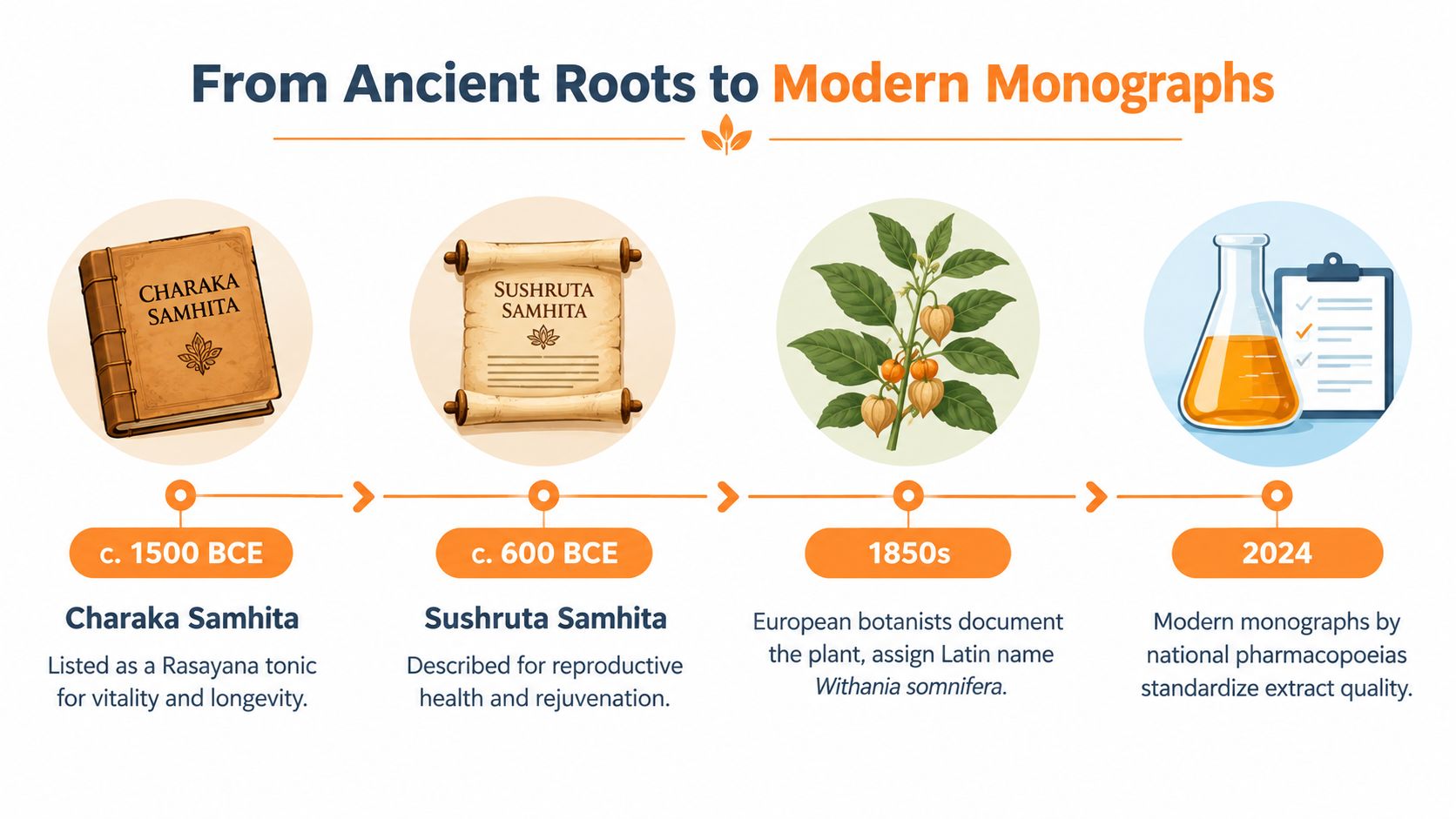
Ashwagandha has a long history in South Asian healing traditions, especially Ayurveda, where herbs were often described by their broader role in supporting recovery, stamina, and day-to-day resilience rather than by a single symptom target. That older framework matters because it helps explain a modern confusion point. People now talk about ashwagandha as if it were only a "stress supplement," but historically it sat inside a much wider idea of restoration and general vitality.
A plant with a long memory
References to ashwagandha are commonly linked to early Sanskrit medical traditions and later Ayurvedic practice. In that setting, it was treated as a rejuvenating plant, one used in the context of long-term support rather than quick relief.
That does not prove every modern claim attached to the herb. It does tell you why researchers and supplement companies keep returning to it. Traditional use gave ashwagandha a reputation for breadth, and modern marketing often stretches that breadth further than the evidence can support.
From traditional category to botanical identity
Modern botany gave the plant a more precise name, Withania somnifera. That shift sounds minor, but it changed the conversation in a practical way. Common names are loose. Botanical names are meant to pin down exactly which plant is being discussed, much like using a full street address instead of saying "the blue house near the corner."
For readers trying to judge supplements, history meets safety. A label that says "ashwagandha" still leaves open several real questions: Is it the right species? Is it made from root, leaf, or both? Was it extracted in a way that changes the chemical profile? Those details affect consistency and may affect tolerability, which is why they matter more than the herb's reputation alone.
Ayurveda also influenced nearby medical systems, including Unani, and that helped carry ashwagandha beyond one tradition. Its modern life is a blend of inherited use, botanical classification, and commercial standardization.
An herb can be old and still be a moving target. Much of the confusion around ashwagandha comes from treating all products with the same plant name as if they were interchangeable.
Why modern monographs matter
One of the quiet but important milestones in ashwagandha's modern history was its inclusion in formal reference monographs such as the World Health Organization's work on medicinal plants. A monograph is basically a technical profile. It does not turn an herb into an approved drug, but it does set out what experts look for in identity, plant material, preparation, chemistry, and safe use.
That matters for a reason many articles barely mention. Once an herb moves from traditional reputation into monographs and lab methods, the central question becomes less romantic and more practical: are people buying a consistent ingredient, and is it appropriate for the person taking it?
That is the part worth keeping in view. The modern story of ashwagandha is not just ancient roots meeting stress research. It is also the shift from folk recognition to quality control, from broad traditional use to narrower evidence, and from "natural" marketing to real questions about interactions, dosing, and who should avoid it.
How Ashwagandha Works Inside the Body
The clearest modern explanation of how ashwagandha may work centers on HPA-axis modulation. That sounds technical, but the basic idea is manageable once the jargon is stripped away.
The thermostat analogy
The hypothalamus-pituitary-adrenal axis, or HPA axis, is part of the body's stress control network. It helps decide when to release stress-related signals, including cortisol. When stress is brief, that system is useful. When stress keeps firing all day, it can start acting like a thermostat stuck too high.
Ashwagandha is often studied as a kind of gentle recalibrator. Not a hammer. Not an off switch. More like something that may help the body stop over-signaling and return closer to baseline.
A randomized, double-blind, placebo-controlled trial reported that supplementation was associated with greater reductions in morning cortisol and DHEA-S than placebo, and the authors explicitly noted that its stress-relieving action may occur through moderating the hypothalamus-pituitary-adrenal axis (PubMed study summary).
What standardization is trying to capture
Ashwagandha contains compounds commonly grouped under the name withanolides. These are the markers many extract makers use when they standardize a product. In plain terms, standardization tries to make sure one bottle resembles the next bottle, instead of leaving the amount of active compounds to chance.
That doesn't guarantee identical biological effects in every person. It does make research more meaningful.
| Plant Part | Key Withanolides | Typical Use in Research | Evidence Focus |
|---|---|---|---|
| Root | Withanolides used as marker compounds | Most human supplement studies | Stress support, resilience, male vitality |
| Leaf | Different withanolide profile, often discussed separately | Less commonly the focus of mainstream consumer trials | Distinct pharmacology, less directly tied to common stress-product claims |
| Whole plant blends | Mixed profile depending on formulation | Variable | Harder to compare across studies |
Why plant part changes the conversation
One reason “what is ashwagandha” gets messy is that people talk about the plant as if all versions work the same way. They don't. The evidence most readers are looking for usually comes from standardized root extract.
That distinction also helps when reading labels or comparing formulas in broader men's wellness products. Some products use ashwagandha as one ingredient among several adaptogenic compounds, such as the patterns discussed in this overview of an adaptogenic supplement. The key question isn't only whether ashwagandha is present. It's whether the form matches what has been studied.
What the Stress and Resilience Research Shows
Could a plant meaningfully change how your body handles stress, or are the claims mostly good marketing?
Ashwagandha is one of the better-studied herbal options for this question, but the answer is narrower than many labels suggest. The clearest human research focuses on people dealing with ongoing stress, fatigue, anxious mood, or poor sleep. In that lane, the evidence points in a favorable direction. It does not show that ashwagandha works like a sedative, an antidepressant, or a cure for burnout.
What the research trend actually shows
A useful high-level snapshot comes from a 2023 review that gathered 23 studies with 2,684 participants. The authors reported that ashwagandha supplementation was associated with lower cortisol and improvements in stress-related outcomes (2023 pharmacy journal review).
That matters because stress research is messy. One trial may measure perceived stress, another sleep quality, another morning cortisol, and another fatigue. A review helps by looking for a pattern across many smaller studies instead of asking one paper to carry the whole argument.
The NIH Office of Dietary Supplements describes ashwagandha as commonly studied for stress, anxiety, and sleep, while also stressing that the evidence is still limited and not a basis for broad treatment claims (NIH ODS fact sheet).
That is the honest middle ground.
Why stress effects are biologically plausible
The main idea is not mysterious. Your stress-response system, often discussed through the HPA axis, works a bit like a home thermostat connected to an alarm system. When life keeps signaling "pressure, pressure, pressure," the system can stay switched on longer than is helpful. Cortisol is one of the chemical outputs in that process.
Ashwagandha is studied as an adaptogen because it may help that system respond with less overshoot in some people. Researchers are still sorting out the exact mechanisms, and human biology is never as neat as a diagram, but the overall model makes sense. If the body is spending less time in a chronic stress state, some people may feel steadier, sleep better, or recover from daily strain more easily.
That does not mean cortisol is "bad" and should be pushed down as far as possible. Cortisol is useful. You need it. The question is whether an herb can help bring an overworked stress system closer to normal.
| Study / Sample | Dose & Extract | Duration | Key Outcome |
|---|---|---|---|
| 2023 review, 2,684 participants | Multiple protocols across studies | Multiple study lengths | Lower cortisol and improved stress-related outcomes |
| Randomized, placebo-controlled human trials summarized by NIH and recent reviews | Varies by extract and study design | Varies | Signals of benefit for perceived stress, anxiety, and sleep in some groups |
Why one person swears by it and another feels nothing
Mixed results are not surprising.
First, product form matters. A standardized root extract used in a clinical trial is not the same as a loose powder, a root-and-leaf blend, or a formula where ashwagandha is one minor ingredient.
Second, starting point matters. Someone under heavy work strain, poor sleep, and high mental load has more room to notice change than someone who already feels stable.
Third, outcomes matter. One trial looks for lower stress scores. Another looks for sleep improvement. Another tracks cortisol. Those are related, but they are not interchangeable.
For readers who want a more practical breakdown of what these stress-support claims mean in real life, this guide to ashwagandha for stress support explains how extract type, expectations, and study design shape the results people notice.
One more point gets skipped too often. Even if the stress data look encouraging, safety still belongs in the same conversation, not as a footnote after the benefits. The practical question is never only "does it help?" It is also whether the product is consistent, whether it fits your medications, and whether you are in a group that should avoid it.
Ashwagandha for Male Vitality and Reproductive Health
Could a stress herb really affect male reproductive health, or is that where supplement marketing starts to outrun the evidence?
Ashwagandha is one of the few herbs in this category with some direct human research in men, but the safest way to read that research is with a narrow lens. The studies suggest possible benefits for a few male vitality markers in certain settings. They do not support treating it like a universal testosterone fix.
What one direct human trial actually found
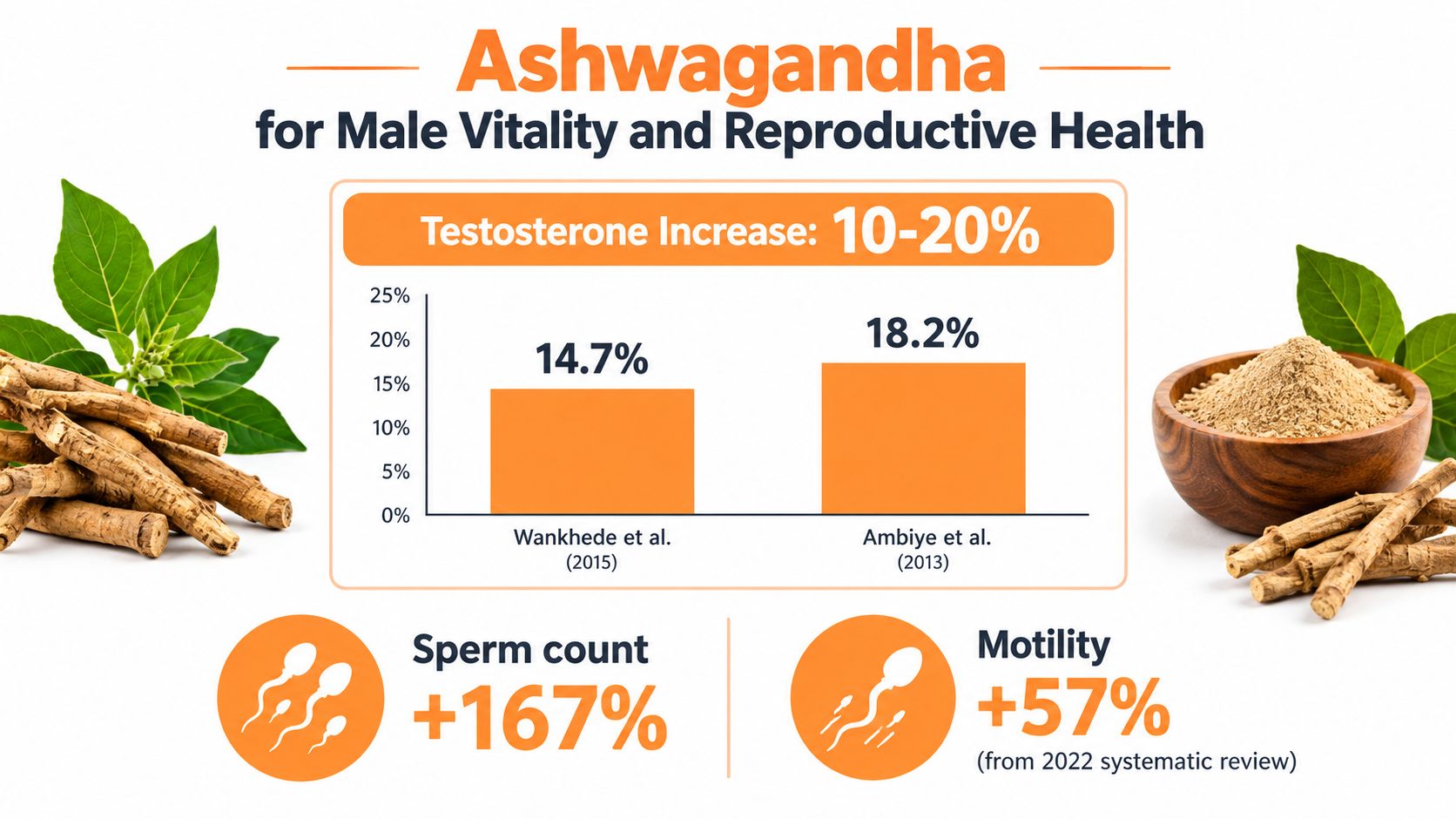
One randomized trial in 57 young men reported that 600 mg/day of KSM-66 for 8 weeks was associated with a larger rise in testosterone than placebo (trial PDF). That result is useful because it comes from a controlled human study, not from animal work or broad marketing claims.
The practical catch is specificity. A result tied to one extract, one dose, one population, and one time frame does not automatically transfer to every ashwagandha product on a store shelf.
Why stress biology may help explain the signal
A simple way to picture this is to treat the stress response like a thermostat that can get stuck too high. When that stress circuit stays switched on, the body may shift resources away from functions that are less urgent for immediate survival, including parts of reproductive signaling.
That does not prove a direct fertility effect. It does help explain why ashwagandha might show stronger results in men who are under strain, training hard, sleeping poorly, or otherwise carrying a heavier physiological load.
In other words, some of the male vitality story may be indirect. If stress regulation improves, hormone-related markers and day-to-day energy may improve downstream in some men.
What this section of the evidence can and cannot support
The evidence here is promising, but still thinner than many headlines suggest.
A careful takeaway looks like this:
- Ashwagandha may support some male vitality markers in certain studied groups.
- The best-known positive trial used 600 mg/day for 8 weeks with a standardized extract.
- Results are context-dependent. Stress burden, training status, sleep, baseline hormone status, and product quality all likely influence what a person notices.
- Safety deserves equal weight with benefit. A man taking medications, trying to conceive, managing a thyroid condition, or buying a poorly standardized product has a different risk-benefit calculation than a healthy study volunteer.
That last point often gets skipped. Male-health marketing tends to focus on testosterone and ignore the more practical question. Is the product consistent, and is it a good fit for the person taking it? For ashwagandha, that is not a side note. It is part of a responsible interpretation of the evidence.
Dosing, Forms, and Product Quality Basics
How do you choose an ashwagandha product that resembles what researchers study?
That question matters more than the front-label promises. Two bottles can both say “ashwagandha” and still differ in plant part, extract strength, testing, and likely consistency. It is a little like buying coffee by weight alone without knowing whether you are getting whole beans, instant powder, or a concentrated espresso shot. The name is the same. The composition is not.
Start with the form, not the marketing
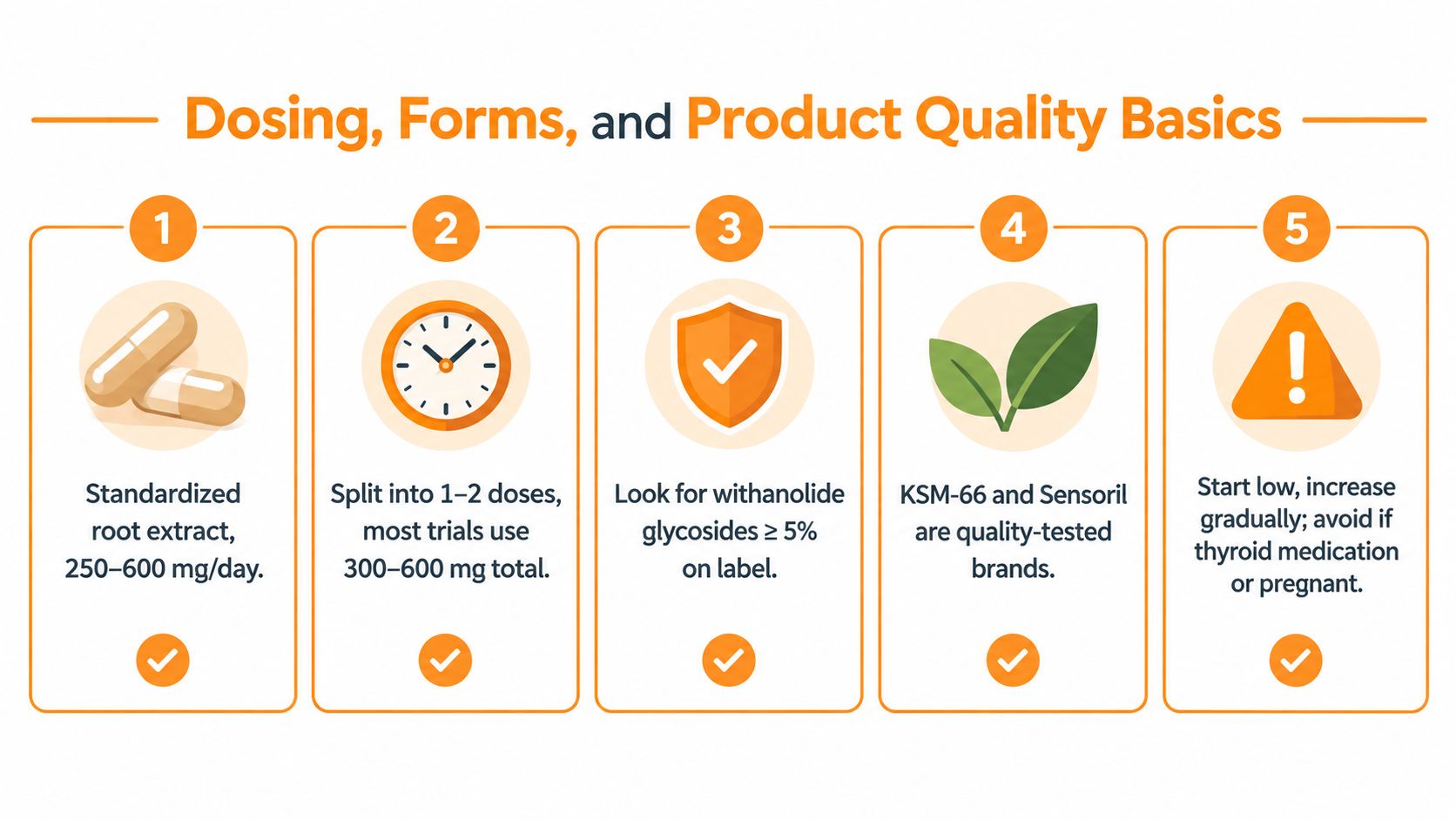
The first useful filter is simple. Check whether the product uses a standardized extract and whether it names the plant part, most often the root.
Why does that matter? Because dose only means something when the material is defined. A large scoop of plain powder can sound impressive on a label, but if the company does not say what compounds were standardized or even which part of the plant was used, comparison becomes fuzzy fast.
Capsules usually make dose consistency easier. Powders can still be reasonable, especially for people who prefer flexible serving sizes, but they require clearer measuring and labeling to be comparable from day to day. Gummies are convenient, though they sometimes trade precision for simplicity.
Dose means less if the product is poorly defined
A common point of confusion is that “600 mg” or “2,000 mg” does not automatically tell you how comparable two products are. One may be a concentrated root extract. Another may be mostly raw powder. Those are different inputs, and the body is not reading the front label. It is responding to what is in the capsule.
That is also why short-term tolerability claims need context. A defined extract used under controlled study conditions can look reasonably well tolerated in healthy adults over a limited period. That does not guarantee the same experience with a loosely labeled product bought online, taken for longer, or combined with medications.
Safety and quality are tied together here. If you do not know what form you are taking, it becomes harder to judge both expected effect and expected risk.
A buyer's checklist
A few label details do more work than flashy branding.
- Check the plant part. Root extract is the form most often connected to common human research.
- Look for standardization details. The label should state what the extract is standardized to, instead of relying on vague herbal wording.
- Favor transparent testing. Third-party testing and an accessible certificate of analysis are stronger signals than lifestyle marketing alone.
- Match the formula to the goal. A single-ingredient product answers a different question than a multi-ingredient blend. If you want a practical breakdown, this guide to ashwagandha daily dosage is more useful than guessing from the front of the bottle.
One example of a broader men's wellness blend is SEMEX, which includes ashwagandha alongside zinc, L-arginine, sunflower lecithin, bromelain, maca root, and Panax ginseng. That does not make it directly comparable to a standalone ashwagandha extract used in a trial. It means the ingredient list needs to be read with a more careful eye, because blends can change both the purpose of the product and the way someone interprets the dose.
This is the part many articles rush past. They jump from “ashwagandha may help with stress” to “here's a dose” without asking whether the bottle itself is consistent, transparent, and a sensible fit for the person taking it. For this herb, that practical safety question belongs near the center, not in fine print.
Safety, Interactions, and Who Should Avoid It
This is the part many ashwagandha explainers treat like a footnote. It should be near the center.
Short-term tolerability is only part of the story
Ashwagandha often appears generally well tolerated in short clinical studies. But that broad statement can become misleading if it erases who should avoid it, which medications may interact with it, and what remains uncertain about long-term real-world use.
The National Center for Complementary and Integrative Health flags important cautions for pregnancy, breastfeeding, surgery, autoimmune disease, thyroid disorders, hormone-sensitive prostate cancer, and medication classes including diabetes drugs, blood pressure medicines, sedatives, anticonvulsants, immunosuppressants, and thyroid drugs (NCCIH ashwagandha safety overview).
The interaction question people skip
Why would a plant interact with medication? Usually because “natural” doesn't mean biologically passive.
If an herb may affect stress signaling, thyroid function, immune activity, or sedation, it can potentially overlap with medications that do those same jobs. That doesn't mean every interaction will happen. It does mean clinicians should know about supplement use before someone adds ashwagandha to an existing regimen.
| Group or Medication | Reason for Caution | Suggested Action |
|---|---|---|
| Pregnancy or breastfeeding | Public-health sources advise caution | Avoid unless a clinician specifically approves |
| Upcoming surgery | Sedation and perioperative concerns are flagged | Stop in advance and disclose use to the surgical team |
| Autoimmune conditions | Possible immune-related concerns | Use only with clinician guidance |
| Thyroid disorders or thyroid medication | Thyroid-related cautions are specifically listed | Review with a prescribing clinician before use |
| Diabetes or blood pressure medication | Possible overlap with medication effects | Monitor only under medical guidance |
| Sedatives or anticonvulsants | Potential additive central nervous system effects | Avoid self-stacking without professional input |
| Immunosuppressants | Potential conflict with intended immune control | Discuss before use |
| Hormone-sensitive prostate cancer | Public-health caution is listed | Avoid unless cleared by a specialist |
Stop thinking of “safe” as a single yes-or-no category. Ashwagandha may fit comfortably for one healthy adult and be a poor choice for someone else on thyroid medication or preparing for surgery.
The liver risk that deserves honest mention
Another issue often minimized in supplement marketing is the growing record of rare but serious liver-injury reports tied to commercial ashwagandha products. A safety review discussing reports documented by regulators in Australia and the Netherlands highlights that split between generally good short-term tolerability and accumulating real-world liver concerns, especially for people with liver disease (Lareb safety review).
That doesn't prove every product is dangerous. It does mean that unexpected fatigue, dark urine, yellowing of the skin or eyes, or significant digestive distress after starting a supplement should not be waved away.
The balanced bottom line is straightforward. A healthy adult may tolerate a standardized extract well in the short term. Someone who is pregnant, breastfeeding, managing autoimmune or thyroid disease, taking sedatives or other interacting medicines, living with liver disease, or heading into surgery needs a far more cautious conversation.
Ashwagandha is one ingredient in the broader men's wellness conversation, and that's exactly how SEMEX approaches it. SEMEX offers a daily men's supplement that includes ashwagandha alongside other ingredients chosen to support semen volume, taste, and overall vitality, with third-party testing and clear product standards for men who want a more informed way to evaluate what they take.
These statements have not been evaluated by the Food and Drug Administration. This product is not intended to diagnose, treat, cure, or prevent any disease.