

Watery Sperm Meaning: What It Really Signals
A man notices that his semen looks thinner during cleanup, perhaps more transparent than usual, and within minutes he's searching for “watery sperm meaning.” The mind often jumps straight to low sperm count or infertility. That reaction is understandable, but a single visual change rarely provides enough information to reach either conclusion.
Semen is a biological fluid, so its appearance can shift with ejaculation frequency, recent illness, hydration, and the natural liquefaction process after ejaculation. Occasional watery semen is often harmless, while a persistent change, very low volume, pain, urinary symptoms, or difficulty conceiving deserves a closer look. The useful question isn't only whether semen looks watery. It's whether the change is temporary, measurable, and connected to another symptom or fertility concern.
Table of Contents
- Why You Noticed a Change and What Comes Next
- The Biology of Semen and Why It Can Look Watery
- Everyday Reasons Semen Looks Thinner Than Usual
- Low Sperm Count Versus Low Semen Volume
- Medical Conditions That Can Cause Watery Semen
- When to See a Doctor and What to Expect
- Lifestyle and Supplement Support for Semen Health
Why You Noticed a Change and What Comes Next
You notice semen looks thinner than usual and wonder whether it signals low sperm count. Start by asking when the change appeared. A sample can look more liquid after ejaculation has occurred more often than usual, or because the normal gel has already begun to break down. Patient-facing medical guidance from NCBI describes semen as thick at ejaculation and more liquid within about 15–30 minutes. A thin appearance during cleanup therefore does not mean the same thing as a sample that is consistently thin immediately after ejaculation.
A short tracking record can replace guesswork with a clearer pattern. Note whether the change appears every time, whether the amount seems smaller, and whether ejaculation has been more frequent. Also record pain, blood, burning with urination, fever, or unusual discharge. These observations can guide the next decision, but appearance alone cannot measure sperm concentration, movement, or shape.
Practical rule: Appearance can prompt a question, but a semen analysis provides the measurements that answer it.
Semen is a mixture, not a direct window into sperm production. Sperm cells are one ingredient, while accessory glands provide much of the visible fluid. Changes in those secretions can alter thickness, volume, or color without proving that the testes are producing fewer sperm. The clinical explanation of semen volume and accessory-gland fluid explains why this distinction matters.
The next step depends on the pattern. An occasional change may fit normal liquefaction or a temporary behavior change. A persistent change, fertility difficulty, pain, urinary symptoms, or a history of surgery, infection, hormonal illness, or medication use warrants medical assessment.
The Biology of Semen and Why It Can Look Watery
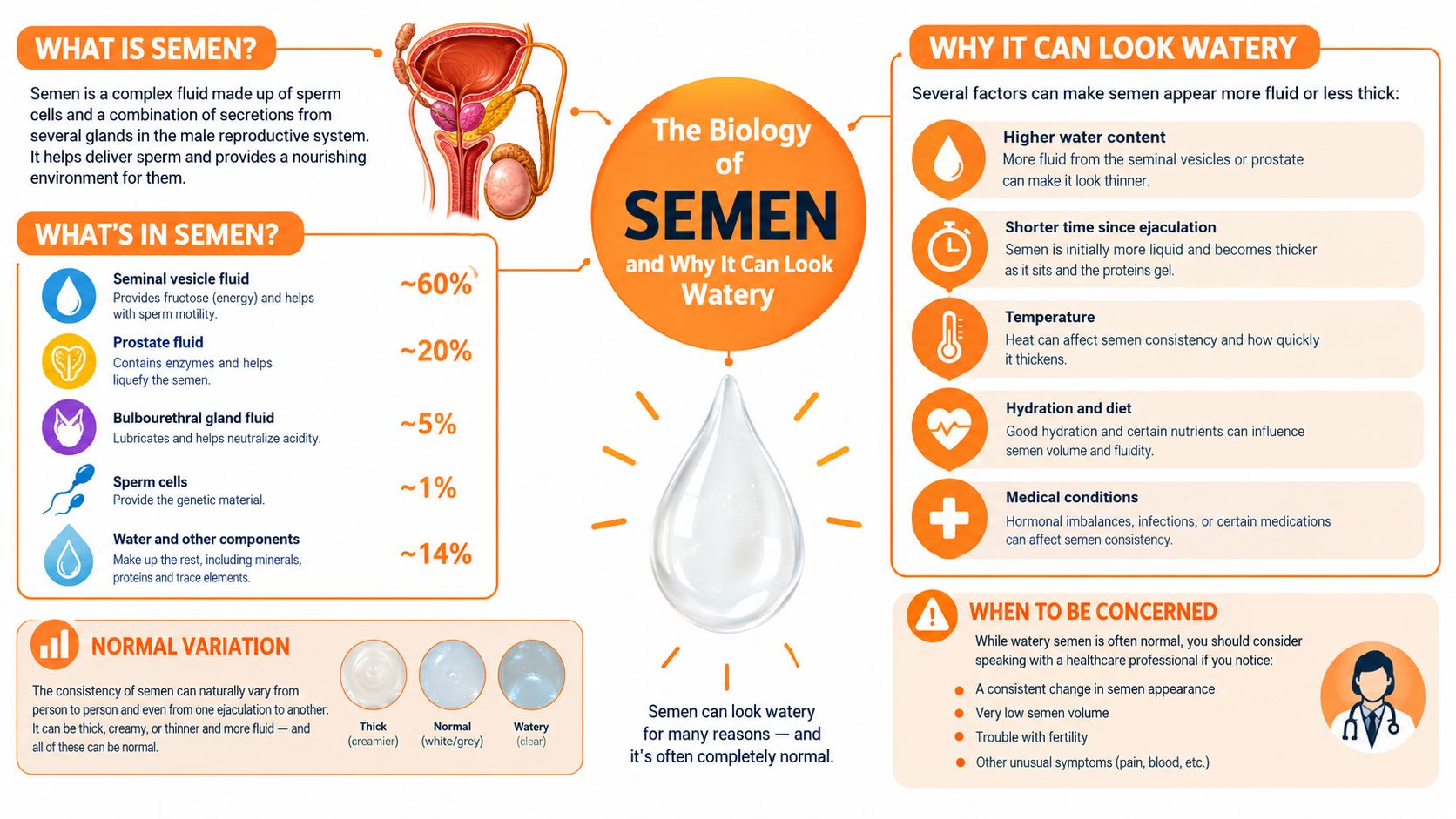
Semen is better understood as a smoothie than as a single ingredient. The testes contribute sperm cells, while the seminal vesicles, prostate, and other accessory glands contribute fluids that carry, nourish, protect, and transport those cells. A smoothie can look different when one ingredient changes, even though the other ingredients remain the same. Semen works in a similar way.
At ejaculation, semen often has a thicker, gel-like texture. Proteins from the seminal vesicles help create that initial consistency, while enzymes from the prostate gradually break the gel down. Research on semen rheology describes normal liquefaction as occurring about 20–30 minutes after ejaculation, and it also explains why viscosity is a measurable laboratory property rather than a cosmetic detail. A review of semen viscosity and sperm parameters connects abnormal viscosity with changes in concentration, progressive motility, and morphology.
That timing creates a common source of confusion. A sample that looked thick immediately after ejaculation may look much thinner later, just as a smoothie becomes easier to pour after sitting and settling. A reader comparing the fluid during cleanup with a memory of its initial appearance may be comparing two different stages of the same normal process.
Why appearance cannot provide a fertility result
The word “watery” describes what the eye sees. It doesn't provide a reading for sperm concentration, total sperm number, motility, morphology, pH, or liquefaction time. A semen analysis is needed because the fluid portion and the sperm portion can vary independently.
A clear or thin appearance may also be influenced by how long arousal lasted, how recently ejaculation occurred, and ordinary day-to-day changes in fluid composition. This is why a man with healthy sperm parameters may sometimes produce a thin-looking sample, while a thicker sample can still contain a low concentration of sperm. Readers looking specifically at clear semen can find a more focused explanation in this guide to what clear semen may mean.
Everyday Reasons Semen Looks Thinner Than Usual
Frequent ejaculation is one of the most practical explanations. When ejaculation happens repeatedly over a short period, the next sample may contain less sperm density and may look thinner. That change is usually temporary, and it doesn't by itself indicate a lasting fertility problem. For a formal test, the laboratory's collection instructions matter more than visual comparison.
Hydration can also change the fluid impression. A person's fluid intake affects the body's overall fluid balance, although hydration alone doesn't determine sperm concentration or fertility. The sensible approach is ordinary, consistent hydration rather than trying to force a particular semen texture.
Heat and illness belong in a different category. Hot tubs, saunas, and sustained heat near the testes can interfere with sperm production, while a recent fever or illness can temporarily affect reproductive function. Poor sleep, heavy alcohol use, smoking, and ongoing stress may also work against healthy semen parameters, but none of these factors can be diagnosed from appearance alone.
| Factor | How It Affects Appearance | Typical Duration |
|---|---|---|
| Frequent ejaculation | May reduce sperm density in a recent ejaculate, making it look thinner | Usually temporary |
| Hydration changes | Can alter the fluid impression and overall concentration of secretions | Often short-lived |
| Heat exposure | May interfere with sperm production and contribute to later changes in a sample | Can persist beyond the exposure |
| Recent fever or illness | May temporarily disrupt sperm production and semen characteristics | Depends on recovery |
| Poor sleep, alcohol, smoking, or stress | May affect reproductive function and semen parameters over time | Varies with the habit |
The pattern matters more than any single factor. A thin sample after several ejaculations is less concerning than a persistent change that appears during normal routines. Similarly, a change after a fever deserves observation, while a change accompanied by pain or urinary symptoms deserves medical review.
A useful comparison: One watery sample is a snapshot. Repeated watery samples under similar conditions are a pattern.
Lifestyle adjustments can support general reproductive health, but they shouldn't replace evaluation when warning signs are present. The purpose of these changes is to remove reversible pressures and create a clearer baseline, not to promise that semen will become thicker or that fertility will improve.
Low Sperm Count Versus Low Semen Volume
A thin-looking sample can raise two separate questions: how much fluid was released, and how many sperm cells that fluid carries. Semen is the complete fluid mixture, while sperm are microscopic reproductive cells within it. Volume and concentration are independent measurements. A normal-volume ejaculate can still have a low sperm concentration, and a small-volume ejaculate can still contain a normal concentration.
A semen analysis checks several measurements together, including volume, sperm concentration, total sperm number, motility, morphology, pH, and liquefaction. The WHO-based clinical reference summary lists reference limits that include 39 million sperm per ejaculate, 16 million sperm per milliliter, total motility of 42%, and progressive motility of 30%. These figures explain why appearance alone cannot establish whether sperm production is low or fertility may be affected.
The volume reference point has also changed. The 2010 WHO manual used 1.5 mL as a semen-volume reference point, while newer standards use 1.4 mL as the lower reference limit. That difference reflects updated reference standards. It does not mean that a watery appearance, by itself, diagnoses low volume or disease.
| Factor | Low Sperm Count, Oligospermia | Low Semen Volume, Hypospermia |
|---|---|---|
| What is reduced | The number of sperm in a given amount of semen | The total amount of ejaculate released |
| What may contribute | Hormonal, testicular, genetic, inflammatory, or lifestyle factors | Incomplete collection, retrograde ejaculation, low androgen activity, or duct obstruction |
| What appearance can show | Possibly a thinner or clearer sample, but not reliably | A visibly smaller amount may be noticed |
| How clinicians assess it | Concentration, total number, motility, and morphology | Measured volume, history, pH, urine testing, and other findings |
| Does appearance confirm it? | No | No |
The decision point is whether the concern is a one-off visual change or a repeated finding confirmed by testing. A man may have normal sperm concentration in a thin-looking sample, while another may have low concentration in semen that appears thick. The laboratory report must be interpreted as a whole, alongside symptoms, collection conditions, and any fertility concern. A tissue or the skin cannot provide those measurements.
Medical Conditions That Can Cause Watery Semen
Persistent watery semen becomes more meaningful when it appears with low volume, pain, urinary changes, or a fertility concern. Clinicians usually sort possible causes by asking where the sperm or fluid may be reduced, diverted, or altered.
Retrograde ejaculation occurs when semen moves backward into the bladder rather than forward through the urethra. The visible ejaculation may be very small or absent. Diabetes, spinal cord injury, prostate surgery, multiple sclerosis, alpha-blocker medicines, and other nerve or outlet problems can contribute. A clinician may examine urine collected after ejaculation, because substantial sperm in that urine supports the diagnosis. The relationship between Flomax and retrograde ejaculation is one example of why a medication review matters.
Hormonal problems can affect both sperm production and glandular secretions. Testosterone deficiency and other endocrine disturbances may lead to a low sperm concentration or reduced ejaculate volume. Blood tests help clinicians assess hormone patterns rather than guessing from texture.
Conditions involving inflammation or blockage
Prostatitis, urethritis, and sexually transmitted infections can change semen consistency, color, smell, or comfort during ejaculation. Burning urination, pelvic discomfort, discharge, fever, or blood in semen makes infection or inflammation more important to investigate. A clinician may use an examination, urine testing, culture, or infection testing based on the symptoms.
An obstruction in the ejaculatory ducts can reduce the amount of sperm-rich material entering the ejaculate. Congenital conditions affecting the vas deferens or seminal vesicles can create a similar pattern. Low volume, abnormal pH, and semen-analysis findings may lead to ultrasound or other imaging.
Medication and exposure history also matters. Testosterone replacement therapy and anabolic steroids can suppress the body's own sperm production. Finasteride, some antidepressants, chemotherapy, and sustained heat exposure may affect sexual or reproductive function in some men. The NICE fertility investigation guidance supports evaluating measurable semen parameters and the clinical history together.
The central point is reassuring: these causes are distinct, and clinicians have different ways to tell them apart. A watery appearance doesn't identify which category applies, but it can help a man describe a change that deserves proper context.
When to See a Doctor and What to Expect
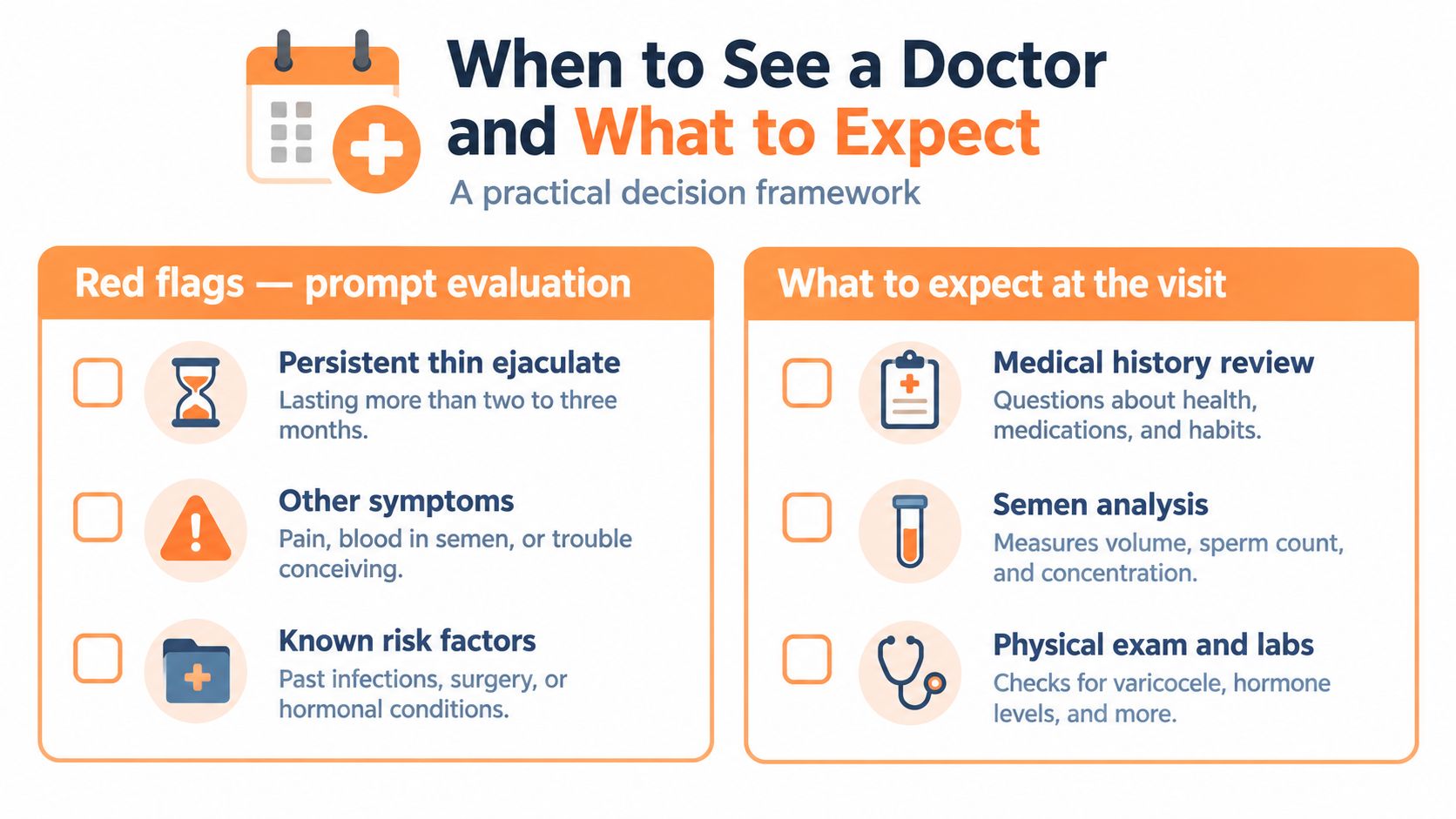
Occasional thin semen without other symptoms usually calls for observation rather than panic. Persistent thin ejaculate for more than two to three months, very low or absent volume, blood in semen, pain with ejaculation or urination, foul-smelling or cloudy discharge, fever, scrotal swelling, or a new erectile change should prompt a medical appointment.
Fertility goals create another clear decision point. A couple under 35 who hasn't conceived after 12 months of regular attempts should seek an evaluation, while a couple over 35 should consider evaluation after 6 months. Recurrent pregnancy loss, a history of an undescended testicle, varicocele, or mumps orchitis also lowers the threshold for testing. These timeframes are part of fertility guidance rather than a diagnosis based on semen appearance.
A typical evaluation
A first appointment is usually practical and private. The clinician may ask about ejaculation patterns, medications, surgeries, infections, heat exposure, illness, sexual function, and the timing of the change. A physical examination can look for testicular differences, a varicocele, or other findings.
The semen analysis is the key measurement. Collection instructions commonly specify two to seven days of abstinence, and the laboratory assesses volume, concentration, total number, movement, shape, pH, and liquefaction. If retrograde ejaculation is suspected, a post-ejaculation urine sample may be added. Hormone bloodwork can help assess endocrine causes, while imaging may be considered when obstruction or another structural problem is suspected.
The appointment's purpose isn't to label the sample. It's to identify which part of the reproductive system needs attention, if any.
A reader can make the visit more useful by writing down when the change began, whether it occurs every time, recent illnesses, current medications, and any associated symptoms. A single unusual sample can be difficult to interpret, while a clear history gives the clinician a better starting point.
Many possible explanations are manageable once identified. Booking an evaluation doesn't mean that infertility has been confirmed. It means that appearance is being replaced with useful information.
Lifestyle and Supplement Support for Semen Health
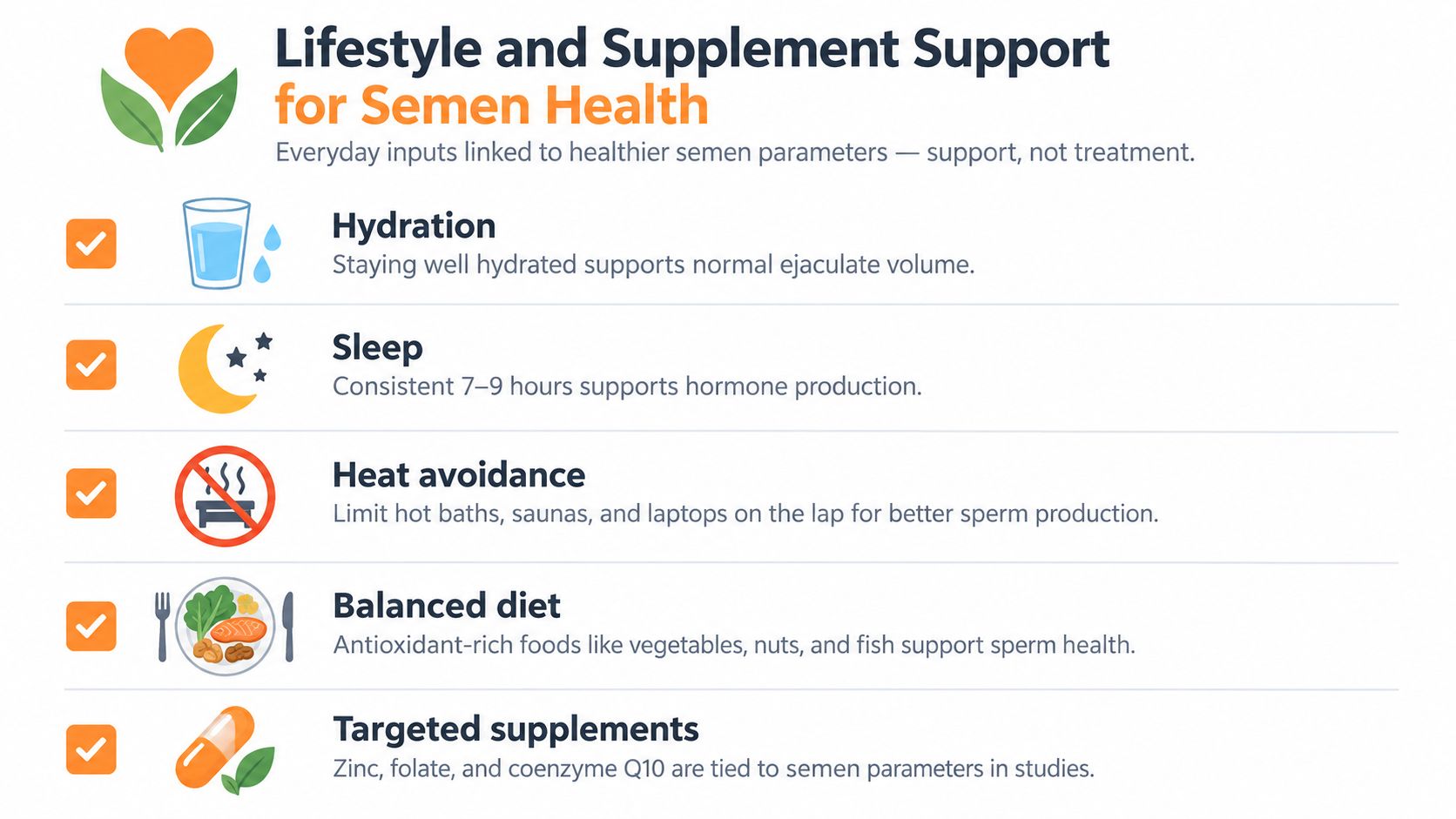
Supportive habits can create better conditions for normal reproductive function, but they aren't substitutes for testing or treatment. Hydration supports normal ejaculate volume, consistent sleep supports hormonal function, and avoiding prolonged heat exposure may help protect sperm production. Regular exercise, smoking cessation, and moderation with alcohol also fit into a broader plan for reproductive wellness.
Food quality matters because sperm production depends on many nutrients. Zinc, selenium, folate, coenzyme Q10, omega-3 fatty acids, L-carnitine, and antioxidant compounds have all been studied in relation to semen parameters such as concentration, motility, or morphology. The strength and relevance of those findings vary, and a nutrient is most useful when it addresses an actual dietary gap rather than being treated as a universal answer.
Choosing a sensible support plan
A practical routine can begin with the basics:
- Hydration: Regular fluid intake supports the body's normal fluid balance without trying to manipulate semen texture.
- Sleep: A consistent sleep schedule supports general hormonal and metabolic health.
- Heat avoidance: Limiting hot baths, saunas, and prolonged laptop contact with the lap reduces avoidable heat exposure.
- Balanced meals: Vegetables, fruit, fish, nuts, seeds, legumes, and other nutrient-dense foods supply compounds involved in normal cell function.
- Exercise and recovery: Moderate activity supports overall health, while excessive strain, poor recovery, smoking, and heavy alcohol use can work against reproductive goals.
- Supplement review: A qualified clinician or pharmacist can check whether zinc, selenium, folate, CoQ10, omega-3s, or L-carnitine fit a person's diet, medications, and laboratory findings.
SEMEX is one dietary supplement option formulated for men's wellness, but it shouldn't be presented as a test, diagnosis, or treatment for watery semen, low sperm count, or infertility. Ingredient labels and personal medical circumstances matter more than a product name, especially when a persistent change needs clinical evaluation.

The most useful mindset is measured rather than reactive. A man who notices an occasional thin sample can observe the pattern and restore ordinary routines. A man with a lasting change, associated symptoms, or a fertility goal can arrange a semen analysis and receive information that visual inspection can't provide.
Readers looking for a daily men's wellness supplement can review what SEMEX offers as part of a broader routine supporting semen volume and overall vitality. Visit SEMEX to learn more, while contacting a qualified healthcare professional for persistent changes or fertility concerns.
These statements have not been evaluated by the Food and Drug Administration. This product is not intended to diagnose, treat, cure, or prevent any disease.