

Tongkat Ali Supplement Benefits: The Complete Evidence Guide
A 2022 systematic review and meta-analysis reported a significant improvement in total testosterone among men taking tongkat ali, especially those with low baseline levels or hypogonadal status. Research summaries commonly describe standardized extracts in the 200–400 mg per day range for at least 2–4 weeks, but tongkat ali isn't a universal testosterone booster.
That distinction changes how the supplement should be judged. A man whose testosterone is already well within the normal range may notice little hormonal change, while someone starting from a lower or stress-suppressed baseline may have more reason to expect a meaningful response. The most credible tongkat ali supplement benefits therefore involve targeted hormonal and stress support, not instant performance enhancement.
Tongkat ali, also known as Eurycoma longifolia, has a long history in Southeast Asia. Written botanical and medicinal records date back to the early 19th century, and traditional use in Malaysia, Thailand, and Indonesia included male tonics, aphrodisiacs, and general wellness preparations. Modern research has placed that traditional herb into a more structured supplement category, but the evidence still demands careful interpretation.
Table of Contents
- What the Research Actually Says About Tongkat Ali
- How Tongkat Ali Works in the Body
- Evidence Summary for Libido, Energy, and Stress
- Tongkat Ali Compared to Other Men's Wellness Ingredients
- Safety, Standardization, and Quality Control
- How to Dose and Use Tongkat Ali Effectively
- Common Misconceptions About Tongkat Ali
- Who Should Consider Tongkat Ali
What the Research Actually Says About Tongkat Ali
The strongest human evidence concerns total testosterone. A 2022 systematic review and meta-analysis of clinical trials reported significant improvement in total testosterone among men using Eurycoma longifolia, with particularly notable findings among healthy volunteers and men with hypogonadal status.
That result supports a real testosterone signal, but it doesn't prove that every user will experience the same change. Baseline hormone status appears to be one of the most important variables. Men who begin with low or stress-suppressed testosterone have more room for normalization than men whose levels are already optimized.
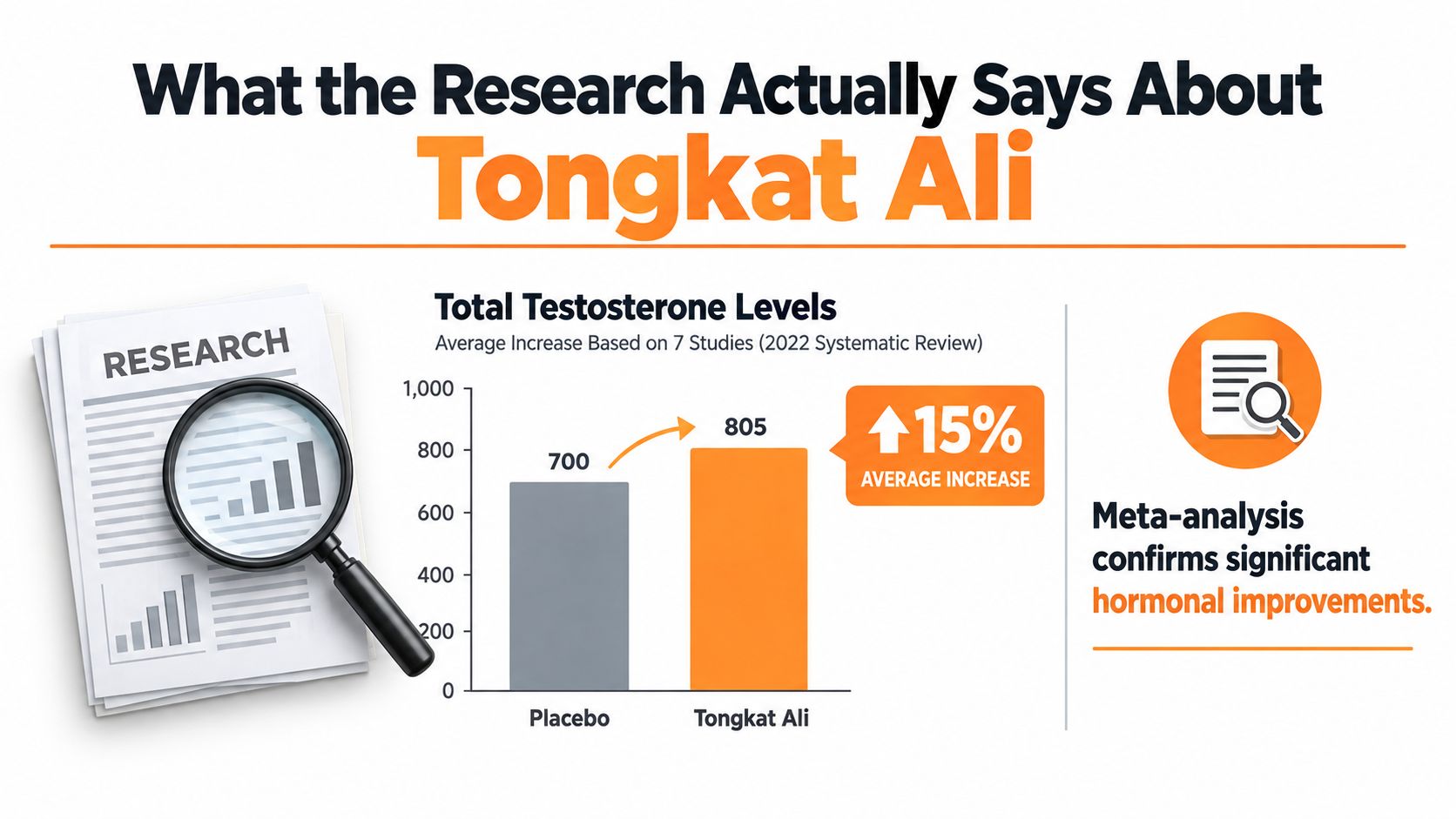
Why starting levels matter
The evidence points toward a normalizing effect, rather than an unlimited upward push. A review of the meta-analysis describes the clearest testosterone response in men with lower baseline levels or hypogonadal status, while men who already fall within a healthy range may see a smaller shift. That makes tongkat ali different from the way many marketing pages describe it.
The practical question isn't merely whether tongkat ali can raise testosterone. It is whether the user has a physiological reason to respond. Symptoms such as low sexual interest, reduced vitality, and poor stress resilience can have many causes, so a healthcare professional can help determine whether hormone testing or another evaluation is appropriate.
What the evidence doesn't establish
The research doesn't establish tongkat ali as a replacement for medical care, testosterone treatment, or foundational habits such as adequate sleep, nutrition, and resistance training. It also doesn't justify promising dramatic muscle gain, immediate sexual effects, or uniform results across all men.
The most defensible conclusion is narrower and more useful: tongkat ali may support testosterone production, particularly when baseline testosterone is low or suppressed. That finding explains both the supplement's popularity and the mixed experiences reported by users.
How Tongkat Ali Works in the Body
Tongkat ali's proposed action is easier to understand through the relationship between stress hormones and androgen hormones. The hypothalamic-pituitary-adrenal axis helps coordinate the body's response to stress, while the androgen profile includes hormones such as testosterone that influence sexual function, mood, and aspects of physical vitality.
A controlled human study reported that 200 mg per day of tongkat ali root extract for multiple weeks lowered cortisol while increasing testosterone. The same study also reported improvements in mood-state measures including tension, anger, and confusion, as described in the published human trial.
The stress and testosterone connection
Cortisol isn't harmful. It helps the body respond to demands, but prolonged psychological or physical stress can coincide with poorer sleep, reduced libido, and less favorable hormone patterns. If an extract helps moderate the stress response, the resulting improvement in well-being may support sexual and physical vitality indirectly.
That doesn't mean tongkat ali "blocks" cortisol or acts like a stimulant. The human evidence supports an association between the extract, cortisol measures, testosterone measures, and mood outcomes in a controlled setting. It doesn't prove that every user will experience the same pathway or intensity of response.
Practical rule: A stress-related benefit is more plausible when low energy, reduced libido, and ongoing tension appear together, but those symptoms still warrant a broader health assessment.
Why this may feel different from a stimulant
Caffeine can produce an obvious short-term change in alertness. Tongkat ali is better understood as a potential hormonal and stress-support ingredient, so any perceived benefit may build gradually rather than appear immediately. A user may notice changes in mood, sexual interest, or general vitality before detecting any measurable difference in training performance.
Readers interested in the ingredient's preparation can review this explanation of what tongkat ali extract is. The extract type matters because research findings apply to particular preparations, not automatically to every powder or blended capsule sold under the same botanical name.
Evidence Summary for Libido, Energy, and Stress
Testosterone is the clearest evidence category, but it isn't the only reason men investigate tongkat ali. Broader reviews describe possible support for libido, erectile function, fertility, mood, and muscle strength, while finding no clear support for endurance performance in the same way.
The quality of these outcomes isn't identical. Testosterone-related findings have the most coherent human evidence, while sexual well-being, mood, and strength outcomes can depend more heavily on the participants' age, stress level, hormone status, extract, and study design.
Sexual well-being
Libido may improve when several factors shift together. A modest change in testosterone, lower perceived stress, and improved mood can all affect sexual interest and confidence. That doesn't make tongkat ali an on-demand erectile medication, and it doesn't establish that the supplement can address every cause of sexual dysfunction.
The most reasonable expectation is gradual support for sexual well-being, especially among men whose low vitality overlaps with stress or less favorable androgen status. A persistent sexual concern still deserves medical evaluation rather than self-treatment with a supplement.
Mood and stress
The controlled human study discussed above reported improvements in tension, anger, and confusion alongside cortisol and testosterone changes. Those findings suggest that mood support may be part of the herb's broader stress-hormone profile, rather than an isolated energizing effect.
This distinction matters because “energy” can mean different things. Tongkat ali may be relevant to a man who feels worn down under sustained stress, but the available evidence doesn't justify describing it as a universal energy enhancer or endurance aid.
Strength versus endurance
Review material describes possible support for muscle strength, particularly when hormone status or age creates room for improvement. It doesn't provide the same level of support for endurance performance. Training, recovery, and nutrition remain the primary drivers of physical adaptation.
Tongkat ali makes more sense as a targeted support ingredient than as a shortcut around training fundamentals.
Tongkat Ali Compared to Other Men's Wellness Ingredients
Tongkat ali occupies a specific position in men's wellness formulas. Its research profile centers on testosterone and stress-related hormonal support, while other botanicals are commonly selected for different reasons. Comparing these ingredients by intended role is more useful than declaring a single winner.
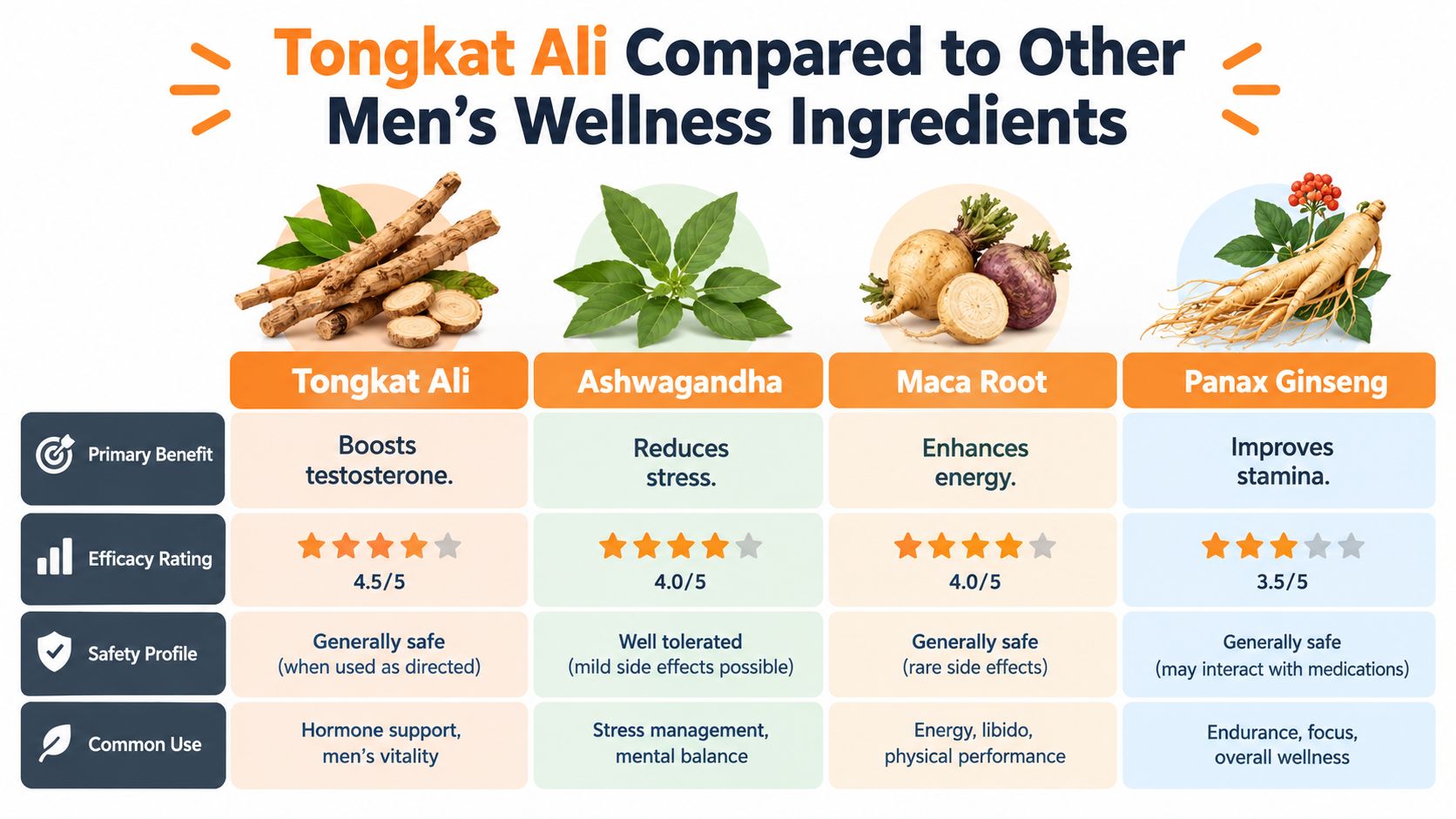
Different ingredients, different targets
| Ingredient | Common wellness focus | How it differs from tongkat ali |
|---|---|---|
| Tongkat ali | Testosterone, libido, stress-related vitality | Most directly associated with androgen outcomes |
| Ashwagandha | Stress adaptation and calm | More commonly positioned around stress support |
| Maca root | Energy, libido, and general vitality | Doesn't occupy the same testosterone-focused evidence niche |
| Panax ginseng | Stamina and broader vitality | Often selected for energy and performance support |
These categories describe common use cases, not guarantees. The evidence for any botanical depends on its preparation, dose, participants, and measured outcome. A product label that combines several ingredients also makes it harder to know which component is responsible for a perceived change.
Choosing by the primary goal
A man concerned mainly with stress may prioritize an ingredient traditionally used for stress adaptation. Someone evaluating testosterone-related support may look more closely at tongkat ali, while a person focused on general vitality may consider maca root or Panax ginseng.
The comparison should also include safety and quality control. Readers considering sexual wellness ingredients can examine horny goat weed versus tongkat ali, but the same rule applies: the ingredient's intended role should match the user's goal, and the formula should disclose enough information to evaluate it.
Safety, Standardization, and Quality Control
Safety deserves equal billing with benefits. Most consumer coverage emphasizes testosterone, libido, and energy, while giving less attention to whether the extract is standardized or independently tested. That omission matters because different products may not provide equivalent preparations of Eurycoma longifolia.
A safety review reports that EFSA concluded tongkat ali root extract safety hasn't been established under any condition of use, citing concern about potential DNA damage. The same review notes that LiverTox flags reported liver injury cases in supplement users. These findings don't prove that every product causes harm, but they do make indefinite use, high-dose experimentation, and complex stacking poor assumptions.
Why standardization matters
Clinical findings apply to defined extracts, not just any product containing tongkat ali on the label. Standardization can help identify the extract's composition, while independent testing can address contamination, adulteration, and whether the product matches its stated contents.
A useful evaluation starts with the label. It should identify the botanical name, the amount of extract, the extract type, and any available testing information. A proprietary blend that hides individual quantities makes comparison difficult.
Regulatory and safety notes
| Source | Finding | Implication |
|---|---|---|
| EFSA | Safety of tongkat ali root extract hasn't been established under any condition of use, with concern about potential DNA damage | Long-term safety shouldn't be assumed |
| LiverTox | Reported liver injury cases have been flagged among supplement users | Anyone with liver concerns should seek professional guidance before use |
| Clinical trials | Short-term studies have reported reassuring findings at studied doses | Short-term tolerance doesn't establish safety for indefinite use |
| Product quality controls | Extract identity and testing affect what a capsule actually contains | Standardization and independent testing deserve attention |
Anyone taking prescription medication, managing a liver condition, or considering a stacked supplement formula should consult a qualified healthcare professional first. Guidance on third-party testing for supplements can help consumers understand why testing documentation matters, but it can't replace individualized medical advice.
How to Dose and Use Tongkat Ali Effectively
Clinical summaries commonly describe 200–400 mg per day of standardized tongkat ali extract, with use extending for at least 2–4 weeks in many research discussions. Those figures describe studied patterns, not a universal prescription, and the extract's concentration and preparation can affect how a labeled amount should be interpreted.
A careful approach begins with the product rather than the largest dose available. The label should distinguish root extract from raw powder and provide enough information to compare the preparation with the extracts used in human research.
A practical evaluation process
- Establish the starting point. A healthcare professional can help assess symptoms and determine whether baseline testosterone testing is appropriate. Without a starting point, a user may mistake normal day-to-day variation for a supplement effect.
- Choose a transparent extract. Products should disclose the botanical identity, extract amount, and relevant quality information. Standardized extracts are easier to evaluate than unlabeled mixtures.
- Use consistent daily intake. Research summaries describe benefits over weeks rather than immediate use. Taking the product inconsistently makes it harder to judge tolerance or response.
- Track meaningful outcomes. Libido, perceived stress, mood, sleep quality, and general vitality are more relevant than chasing a dramatic sensation. A person should also monitor unwanted effects and stop if concerning symptoms appear.
- Reassess rather than escalate automatically. A lack of benefit isn't a reason to keep increasing the dose or combine multiple testosterone-focused products. The evidence is more supportive of measured evaluation than aggressive experimentation.
Better measurement: Compare the user's starting symptoms, product quality, consistency, and medical context before concluding that tongkat ali does or doesn't work.
Common Misconceptions About Tongkat Ali
The most persistent misconception is that tongkat ali raises testosterone equally in every man. Recent summaries indicate that the clearest effects appear in men who start with low testosterone or hypogonadal status, while men already in the normal range may experience much smaller hormonal changes, as noted in this overview of Eurycoma longifolia.
That pattern makes physiological sense. A supplement that supports normalization has more opportunity to change an unfavorable starting point than an already optimized one. It also explains why personal reports can conflict without either side necessarily being dishonest.
Three claims that need correction
- “It works overnight.” The research uses sustained daily intake over weeks, not a single on-demand serving. A same-day surge shouldn't be treated as the expected outcome.
- “More testosterone always means better performance.” Hormones are only one part of strength, recovery, mood, and sexual function. Sleep, training, nutrition, and stress can influence the same outcomes.
- “A higher label number means a stronger product.” The amount alone doesn't reveal extract quality, composition, or safety. A transparent standardized preparation is easier to assess than a bold potency claim without supporting details.
Tongkat ali also shouldn't be treated as a substitute for evaluating persistent symptoms. Low libido, fatigue, or mood changes may reflect many factors, and a supplement can obscure the need for appropriate care if users assume every complaint is a testosterone problem.
Who Should Consider Tongkat Ali
The evidence most closely matches men aged 40 and above, particularly those with low-to-normal baseline testosterone or stress-related reductions in vitality. A review summarizing the available research identifies men aged 40 and above as the group with the strongest clinical support, rather than young athletes with already optimized hormone levels.
A reasonable candidate is therefore someone seeking measured support for testosterone-related vitality, libido, or stress resilience and who understands that results may be modest. The decision should include product transparency, personal health history, current medications, and a plan for monitoring tolerance.
Men with liver concerns, those taking medications, and anyone considering long-term or high-dose use should speak with a healthcare professional before starting. Anyone with persistent sexual, hormonal, or fertility concerns should seek an appropriate evaluation instead of relying on tongkat ali alone.
The central conclusion is simple: baseline testosterone matters more than marketing suggests. Tongkat ali is most defensible as a targeted wellness ingredient for men whose starting point leaves room for improvement, not as a universal performance booster.
These statements have not been evaluated by the Food and Drug Administration. This product is not intended to diagnose, treat, cure, or prevent any disease.
SEMEX combines tongkat ali with ingredients including maca root, Panax ginseng, ashwagandha, zinc, L-arginine, sunflower lecithin, and bromelain in a daily men's wellness supplement. Men evaluating tongkat ali alongside broader semen-volume and vitality support can visit SEMEX to review the formula and product details.