

Testosterone Support Supplement Guide for 2026
Most testosterone support supplements aren't built to do one job well. They're built to sell the idea that every man needs the same handful of ingredients, even though the evidence says the category splits into two very different lanes: correcting a deficiency and nudging hormones or performance in otherwise healthy men. That's a bigger distinction than most buyers realize, and it's the reason so many bottles disappoint.
The category is also far bigger than many assume. One 2026 market report on testosterone booster supplements estimated the market at USD 4.22 billion in 2026 after USD 3.82 billion in 2025, with a projection to reach about USD 10.32 billion by 2035 at a 10.45% CAGR. That growth says one thing clearly: testosterone support supplements have moved well beyond a niche shelf into a mainstream men's wellness category. It does not mean every formula deserves trust.
A smarter buyer needs a filter, not hype. The useful questions are simple: what does bloodwork show, which ingredient matches that gap, and does the label prove the formula is serious.
Table of Contents
- The Hard Truth About Testosterone Support Supplements
- How Testosterone Production Actually Works
- The Ingredients That Show Up Again and Again
- Side-by-Side Comparison of Ingredient Categories
- How to Read the Label Like a Buyer Who Has Done the Research
- Where Supplements Fit Next to Sleep, Training, and Stress
- Choosing the Right Product and Stacking It With Smart Habits
The Hard Truth About Testosterone Support Supplements
Most men shop for a testosterone support supplement as if every product on the shelf aims at the same target. That's the first mistake.
One formula is trying to help a man who's under-consuming key nutrients tied to reproductive function. Another is trying to squeeze a modest performance or hormone signal out of a man whose labs are already in range. Those aren't the same job. They shouldn't be judged the same way, and they definitely shouldn't be sold with the same lazy marketing language.
Two goals get blended into one bottle
Recent reviews make this problem hard to ignore. Most over-the-counter boosters don't meaningfully increase serum testosterone in healthy men, and whatever benefit they offer is often limited to correcting a deficiency or helping a narrower subgroup. That same review also points out that zinc and vitamin D look most useful when baseline status is low, while ashwagandha, tongkat ali, and fenugreek show the most consistent, though still modest, human data in the broader category of support ingredients, according to this review of common testosterone support ingredients.
That means a man with low zinc intake and poor recovery may respond to a very different formula than a man with normal nutrient status who wants a performance-oriented edge.
Bottom line: a deficiency-corrector and a true “needle-mover” aren't interchangeable, even if they sit next to each other online and both say “supports testosterone.”
Three questions matter more than brand claims
A useful buying framework starts with three checks:
- Bloodwork first: If zinc status, vitamin D status, sleep quality, recovery, or stress is poor, that gap matters more than a flashy ingredient panel.
- Mechanism second: Minerals and vitamins usually support normal production when intake is inadequate. Adaptogens and select botanicals aim at stress, signaling, or binding dynamics.
- Label quality third: A formula only counts if it discloses actual doses, extract standardization, and quality testing.
A peer-reviewed analysis of commercially available testosterone-boosting supplements found heavy ingredient overlap: zinc appeared in 64.4% of products, ashwagandha extract in 17.8%, and tongkat ali extract in 15.6% among the products reviewed in this published supplement analysis. That's why the label matters so much. Most brands aren't differentiating through novel ingredients. They're differentiating through dosage quality, standardization, and whether they're transparent enough to prove anything.
A practical way to judge any bottle
The fastest way to avoid junk is to stop asking, “Does this look powerful?” and start asking:
- Is this formula correcting a likely gap?
- Is this formula using one of the few ingredients with real human data?
- Is the company hiding weak dosing behind a proprietary blend?
Men who don't separate those questions usually overpay for long labels and underdosed blends.
How Testosterone Production Actually Works
Testosterone production isn't a single switch. It's a cascade.
The brain starts the process. The hypothalamus releases GnRH. That signals the pituitary to release LH, and LH tells the Leydig cells in the testes to produce testosterone. Once produced, some testosterone stays available, some gets bound by proteins such as SHBG, and some can be converted by aromatase into estradiol.
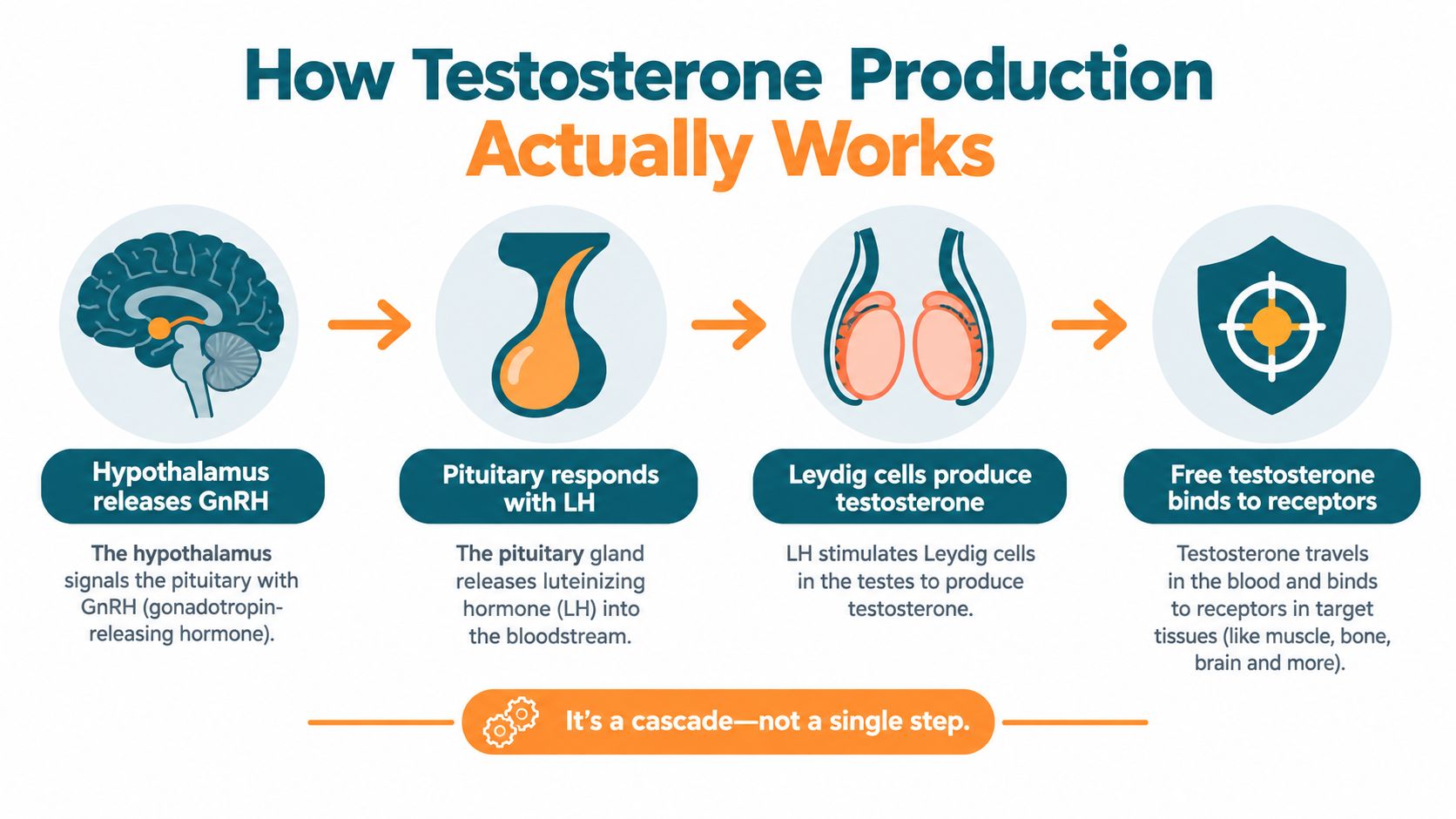
A clear breakdown of the broader hormone system sits in this guide to the male reproductive system and hormones.
Think of it like a factory
The easiest way to understand the pathway is to treat testosterone production like a factory.
- Supply chain: cholesterol and micronutrients provide raw material and support the enzymatic machinery.
- Supervisors: GnRH, LH, and FSH tell the factory when to work and how hard to push.
- Output control: SHBG can bind testosterone and limit how much remains free.
- Overflow management: aromatase converts some testosterone into estradiol.
A supplement can only help if it acts somewhere on that chain. If the raw material side is weak, minerals and vitamins may matter. If stress is suppressing signaling, adaptogens may help. If a formula claims to “boost testosterone” without any plausible lever, it's just branding.
Where ingredient categories fit
Different ingredient classes target different bottlenecks.
Minerals such as zinc are foundational. Zinc has longstanding links to male reproductive function. In an early human zinc-restriction study, oligospermia was induced in 4 of 5 men, and sperm measures fell before returning to normal 6 to 12 months after zinc supplementation, according to this market overview summarizing zinc and reproductive findings. Separate reviews also note that zinc deficiency impairs spermatogenesis and can negatively affect serum testosterone concentration.
Adaptogens sit in another lane. They don't supply raw material. They tend to work through stress response, recovery, and hormone signaling conditions that affect output indirectly.
Tongkat ali and D-aspartic acid are usually marketed as signaling ingredients. They're pitched to influence the LH side of the equation more than the nutrient side. Whether that translates into a useful real-world effect depends heavily on the man taking them and the actual dose.
It's a cascade, not a magic ingredient contest. When the wrong bottleneck gets targeted, even a well-known ingredient can do very little.
The Ingredients That Show Up Again and Again
Most labels repeat the same cast of characters. That's not automatically bad. It just means a buyer should judge the version of the ingredient, the dose, and the fit for the user.
Common Testosterone Support Ingredients at a Glance
| Ingredient | Mechanism | Studied Dose | Best Evidence In | Verdict |
|---|---|---|---|---|
| Zinc | Supports normal reproductive function and testosterone when deficient | Around 30 mg elemental | Men with inadequate zinc status | Worth using when intake or status is low |
| Magnesium | Often positioned for free testosterone support, recovery, and sleep-related support | 400 to 450 mg | Men with low intake, poor recovery, or older men | Useful if the formula provides enough actual magnesium |
| Vitamin D3 | Supports normal hormone function most clearly when status is low | 2000 to 5000 IU | Men with low baseline vitamin D | Good deficiency-corrector, not a universal booster |
| Ashwagandha | Adaptogen tied to stress response and short-term testosterone support | 600 mg | Healthy men, especially under stress or training load | One of the stronger non-deficiency ingredients |
| Tongkat ali | Often used for free testosterone, mood, and stress-related support | 200 to 400 mg | Men under stress or with lower baseline vitality | Promising, but quality and standardization matter a lot |
| Fenugreek | Often positioned around free testosterone and SHBG dynamics | 500 to 600 mg | Men seeking modest support | Can be useful, but not a dramatic fix |
| D-aspartic acid | Marketed for short-term LH signaling | 3 g | Short-term use cases | Often overhyped, effect may fade |
| Boron | Sometimes used for free testosterone shifts | 6 to 10 mg | Narrow use cases | Secondary ingredient, not a reason to buy alone |
Zinc and vitamin D are correction tools first
Zinc earns its place, but buyers need to stop treating it like a universal booster. Reviews hosted on NIH and PubMed resources state that zinc is essential for male reproductive potential, that adequate zinc in seminal plasma is needed for normal sperm function and fertilization, and that zinc-deficient nutrition can cause poor sperm quality and male infertility, according to this NIH-hosted review on zinc and male fertility.
That is a strong reason to include zinc in a men's wellness formula. It is not proof that extra zinc will push testosterone meaningfully higher in every already-replete man.
The same logic applies to vitamin D. It matters most when status is low. A label that includes it at a serious dose can be useful. A label that throws it in as decoration usually isn't.
Ashwagandha has the clearest human signal
Among commonly used testosterone support ingredients, ashwagandha has one of the clearer short-term signals in healthy men. In one randomized, placebo-controlled study, 600 mg/day of standardized ashwagandha root extract for 8 weeks was associated with a 15.3% increase in testosterone versus 2.7% with placebo, and another trial reported an 11.4% testosterone increase versus no change in placebo, according to this review of ingredients used in testosterone support supplements.
That doesn't make ashwagandha magic. It does make it one of the ingredients worth taking seriously when the formula uses the studied form and dose.
A bottle that lists plain “ashwagandha root” with no standardization is selling the name, not the research.
Tongkat ali and fenugreek can make sense
Tongkat ali belongs in the “promising but label-sensitive” category. It shows up often because buyers want support for vitality, stress resilience, and hormonal tone without stepping into prescription territory. The problem is that tongkat quality varies a lot, and weak extracts hide behind the ingredient's reputation.
Fenugreek sits in a similar middle ground. It's often included for free testosterone support rather than dramatic total testosterone changes. That can still matter to the right buyer, but it's rarely the hero ingredient people imagine.
The ingredients that get too much credit
Three names deserve more skepticism than they usually get:
- Tribulus: famous in gym talk, far less convincing on the evidence side.
- Maca: better known for libido and subjective vitality support than direct testosterone elevation.
- Proprietary testosterone complexes: usually a dumping ground for underdosed ingredients that sound impressive together.
A serious testosterone support supplement should never need a mystery blend to look convincing.
A few ingredient cautions buyers should respect
Not every ingredient is harmless just because it's sold over the counter.
- Zinc caution: high zinc use over time can create copper issues if the formula ignores balance.
- D-aspartic acid caution: this is the ingredient most likely to be oversold for fast hormonal effects that don't hold.
- Broad blend caution: the more ingredients a brand stacks into a proprietary panel, the more likely the buyer is paying for label theater.
Side-by-Side Comparison of Ingredient Categories
Looking at single ingredients is helpful. Looking at categories is better. It shows what each class is trying to do.
Testosterone Support Ingredient Categories Compared
| Category | Best For | Evidence Strength | Typical Studied Dose | Time To Notice | Label-Quality Risk |
|---|---|---|---|---|---|
| Minerals and micronutrients | Correcting low intake or low status | Strongest when deficiency exists | Product-specific, often daily foundational dosing | Usually gradual | Moderate, especially when elemental amounts are hidden |
| Herbal adaptogens | Stress-related support and modest hormone performance support | Mixed, but stronger than most generic blends | Ingredient-specific standardized extracts | Often gradual to moderate | High if extract standardization is omitted |
| Nitric-oxide vasodilators | Blood-flow support rather than direct testosterone elevation | Different mechanism entirely | Ingredient-specific | Often felt sooner than hormonal ingredients | Moderate, especially in “male performance” blends |
| Combination blends | Convenience for broad support goals | Varies widely by formula | Varies widely | Unpredictable | Very high when proprietary blends are used |
Minerals raise the floor
Minerals and micronutrients are the least exciting part of the category and often the most honest.
They don't usually create a dramatic result in a man who already has enough. What they do is support the machinery that should've been working properly in the first place. That makes them useful, but only when the formula supplies meaningful amounts and the buyer needs them.
Adaptogens are the more interesting lane
Outside deficiency correction, adaptogens usually offer the most compelling category story. Ashwagandha has the clearest short-term human testosterone signal among the most common ingredients discussed earlier. Tongkat ali also gets attention because it may support men dealing with stress, low drive, or poor vitality rather than just nutrient insufficiency.
That's why a clean adaptogen-based formula often makes more sense than a loud “test complex” loaded with pixie-dusted minerals.
If a healthy man with decent nutrition wants a legitimate over-the-counter category to investigate first, adaptogens usually deserve more attention than another generic mineral blend.
Vasodilators matter, but for a different reason
Nitric-oxide support ingredients don't directly belong in the testosterone lane, but they often show up in adjacent products because men care about performance, not just lab numbers.
PubMed-indexed research notes that L-arginine is the precursor to nitric oxide, a potent vasodilator, and that in healthy humans it can induce peripheral vasodilation and increase nitric oxide production. A more recent review also states that oral L-arginine can increase nitric oxide synthesis and blood flow in tissues, including skeletal muscle and the corpora cavernosa of the penis, according to this review of L-arginine and nitric oxide.
That's useful context. It just shouldn't be confused with direct testosterone elevation.
Blends are where buyers get burned
Combination formulas can be smart or terrible. There's rarely much middle ground.
The good version combines a few proven ingredients at credible doses with clear labeling. The bad version throws everything into a proprietary blend, hides weak amounts, and lets the ingredient list do the selling. That's why category comparison matters more than brand slogans.
How to Read the Label Like a Buyer Who Has Done the Research
A supplement label tells the truth if a buyer knows where to look. Many never get past the front of the bottle. That's where companies want them.
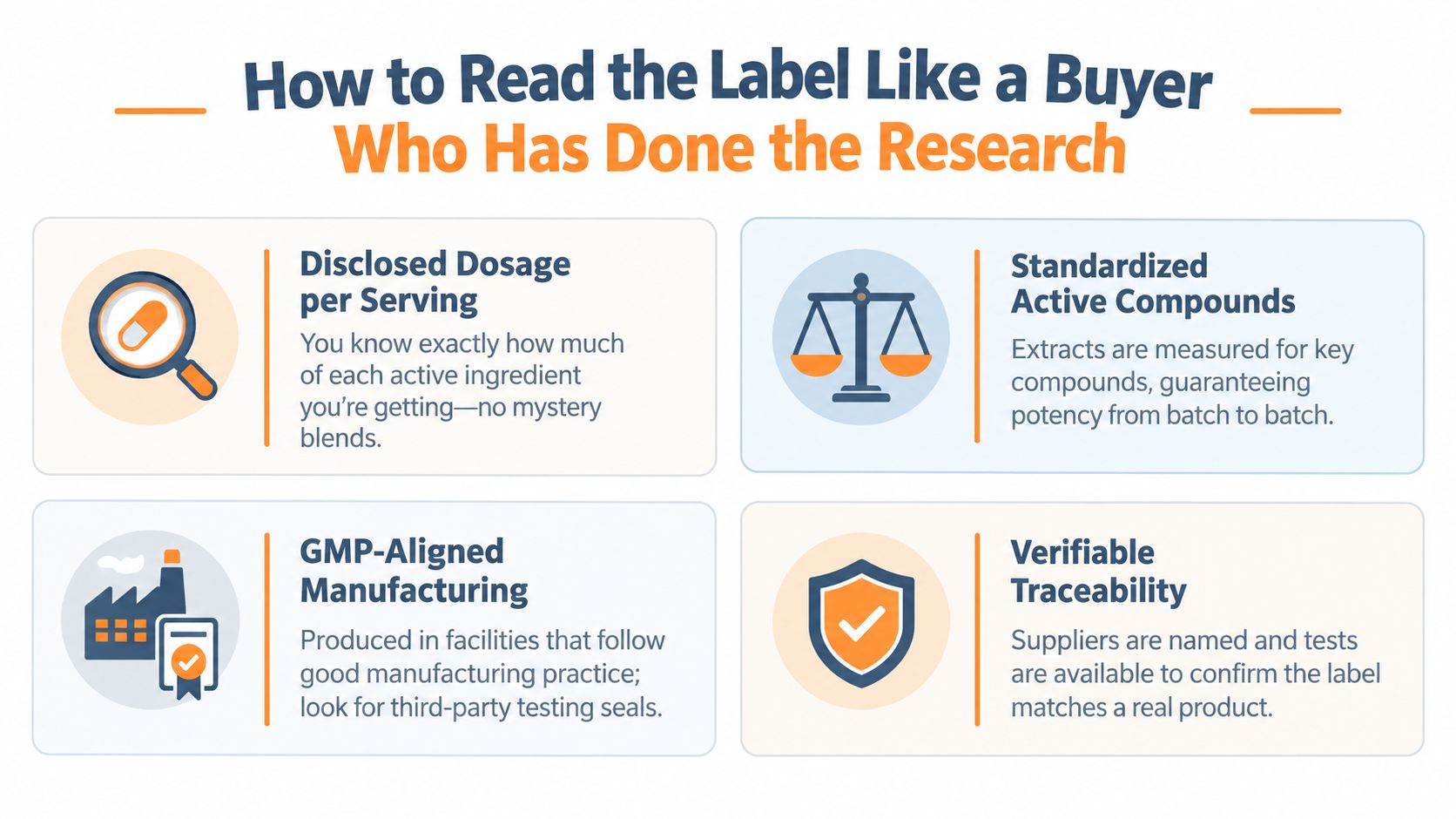
This deeper walkthrough on how to read supplement labels is useful, but the essentials are straightforward.
Start with dose disclosure
The first check is simple. Does the label tell the buyer exactly how much of each active ingredient is in a serving?
If the answer is no, the bottle goes back on the shelf. Proprietary blends are the oldest trick in the category because they let a company borrow the reputation of good ingredients while hiding weak amounts.
A line that says “testosterone matrix” means almost nothing. A line that says “ashwagandha root extract 600 mg” says much more.
Standardization separates real extracts from filler
Not all botanicals are equal. A branded extract or a standardized extract gives the buyer a way to judge consistency.
A formula listing KSM-66 ashwagandha at 600 mg with a stated standardization is more credible than one that says only “ashwagandha root.” The same logic applies to tongkat ali and fenugreek. The extract identity matters because the research is tied to a specific preparation, not just the plant name.
Practical rule: if the label names a botanical but won't identify the extract form or standardization, the buyer should assume the formula is leaning on marketing more than manufacturing discipline.
Check elemental amounts, not just compound weight
Plenty of buyers get fooled.
Minerals can be listed as compounds that sound heavy on paper but deliver much less active material. A big number next to magnesium or zinc doesn't automatically mean the user is getting a meaningful amount of the active mineral. The Supplement Facts panel should make that clear.
Weak formulas rely on visual weight. Better formulas rely on disclosed active content.
Third-party testing is where trust gets real
Independent quality coverage has pointed out that consumers rarely get clear guidance on purity, contamination risk, and what testing verifies, according to this independent review of testosterone booster quality concerns. That matters because efficacy claims are only half the story. The other half is whether the bottle contains what it claims and whether it has been screened for things buyers don't want.
A stronger product gives buyers tangible quality signals such as:
- Third-party testing: seals or documentation tied to identity, contaminants, or adulterant screening.
- Manufacturing clarity: cGMP-aligned production language that's specific enough to be meaningful.
- Traceability: named ingredient suppliers, published testing standards, or verifiable quality pages.
Weak labels often also reveal themselves through cheap formulation habits, including filler-heavy capsules and vague manufacturing language.
Compliance language matters too
Any dietary supplement using a structure/function claim has to stay in its lane. FDA guidance requires the exact disclaimer, “This statement has not been evaluated by the Food and Drug Administration. This product is not intended to diagnose, treat, cure, or prevent any disease.” The same guidance states that the disclaimer must be prominently displayed and in boldface type, and the claim can't say or imply disease treatment, according to FDA guidance on structure/function claims for dietary supplements.
A brand that ignores basic compliance details shouldn't get the benefit of the doubt on quality either.
Where Supplements Fit Next to Sleep, Training, and Stress
A testosterone support supplement belongs on top of strong habits, not in place of them.
That's where plenty of men waste time. They shop for a kitchen-sink capsule while sleep is wrecked, training is inconsistent, and stress is crushing recovery. Then they blame the category when the result is mediocre.
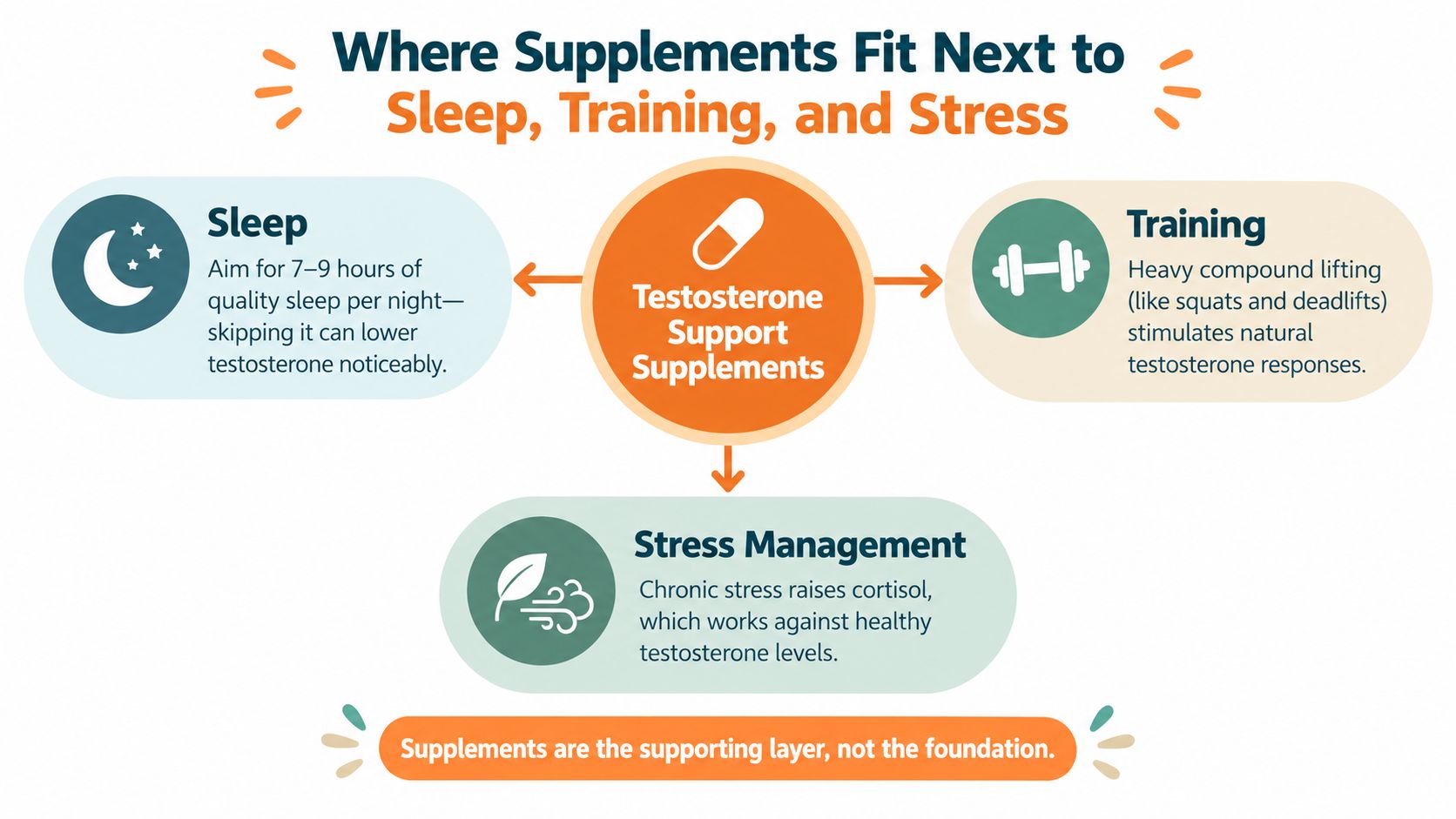
Sleep is still the first lever
Hormones are built on rhythm and recovery. A man sleeping badly shouldn't expect any supplement to carry the load.
That's one reason ashwagandha is more interesting than trend ingredients with no clear lane. It doesn't just sit in a “test booster” fantasy. It fits into the real-world overlap between stress, recovery, and endocrine output.
Training creates the environment
Resistance training matters because it supports the conditions in which better hormone signaling and better body composition can happen together. The most useful style is boring on paper and effective in practice: compound movements, consistent effort, and enough recovery to repeat that effort week after week.
A supplement can support that setup. It can't replace it.
Stress quietly sabotages output
High stress pushes the body in the wrong direction. Men often chase “boosters” when the issue is really chronic suppression from poor sleep, relentless workload, poor recovery habits, or all three together.
That's where adaptogens earn their place in the category. They're not a substitute for fixing the stress load, but they fit a real mechanism better than many overhyped ingredients do.
No over-the-counter formula replaces prescription therapy. It isn't supposed to. The smart use case is supporting a man whose baseline is suboptimal or whose lifestyle has improved enough that a well-built formula can add a small but worthwhile lift.
Why simple stacks usually beat kitchen-sink pills
A focused formula paired with solid habits beats a chaotic blend almost every time.
The reason is practical. When a man combines better sleep, hard training, and stress management with one or two ingredients that match an actual need, the outcome is at least interpretable. When he uses a 14-ingredient proprietary blend on top of bad habits, nothing can be read clearly. The experiment is junk from day one.
Choosing the Right Product and Stacking It With Smart Habits
Buying the right product doesn't require obsession. It requires a system.
Start by ranking products based on what predicts usefulness: disclosed dose, standardized extracts, manufacturing clarity, and credible testing. Then compare those formulas against the studied ingredient ranges already discussed. Anything that hides dosages or leans on a proprietary blend should be cut immediately.
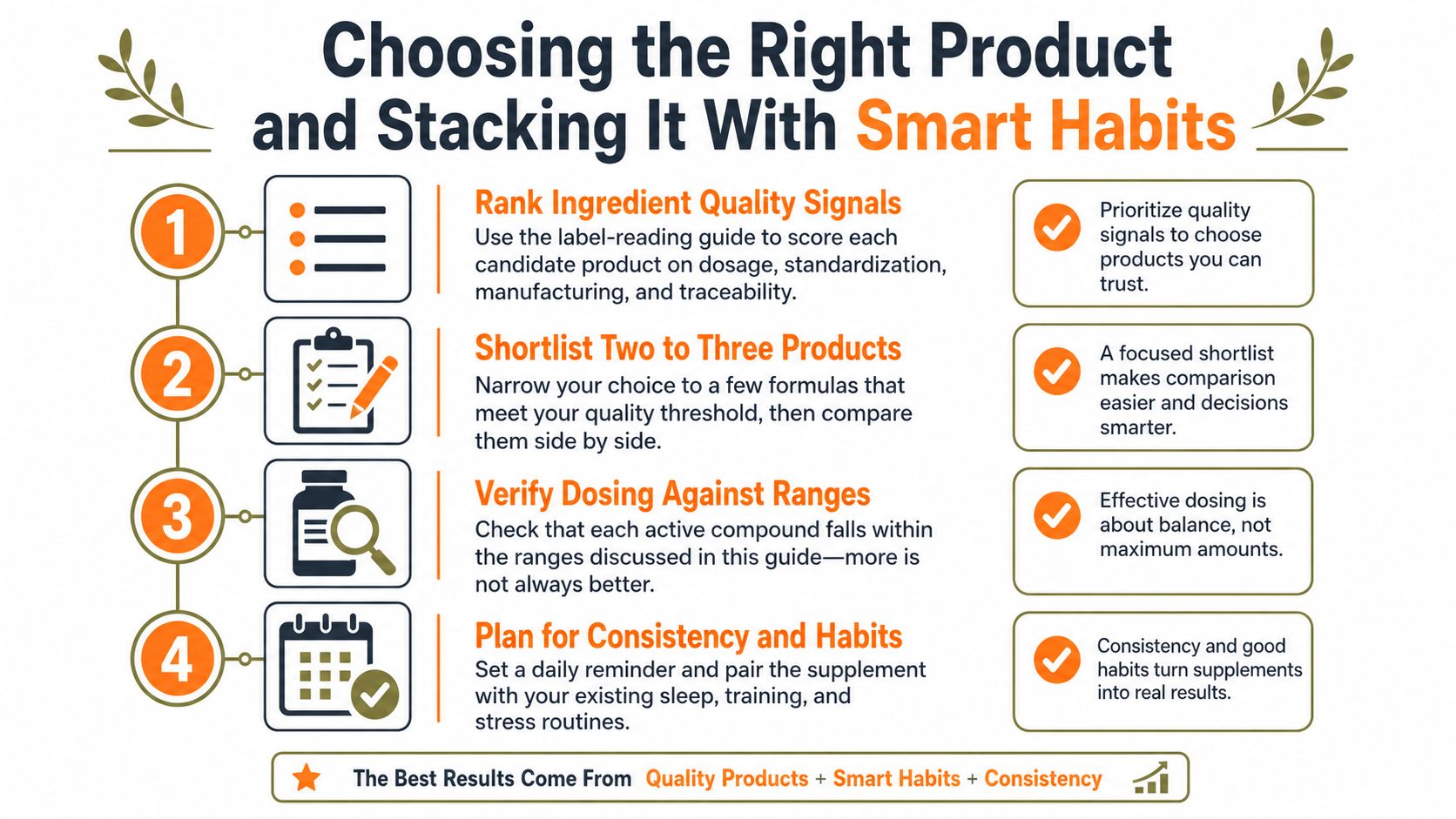
For a broader framework on tailoring a routine, this resource on personalized supplement plans adds useful context.
A clean selection process
A practical shortlist should pass four checks:
- The formula has a clear identity. It should be obvious whether the product is built around deficiency correction, adaptogen support, or broader performance support.
- The doses are visible. Every active ingredient should be listed in a real amount.
- The extract form is named. Especially for ashwagandha, tongkat ali, and fenugreek.
- Testing and manufacturing signals are verifiable. A quality claim that can't be checked is weak.
A smart 30-day setup
Once a formula is chosen, the routine should stay simple:
- Morning consistency: take the product at the same time daily unless the formula or a clinician suggests otherwise.
- Sleep support: protect a consistent nightly schedule.
- Training anchor: keep at least a few weekly resistance sessions in place.
- Food support: keep zinc-rich whole foods in the diet instead of expecting capsules to do every job.
The common claim that natural testosterone support is useless unless a man is on prescription therapy misses the use case. Over-the-counter products can help when the baseline is suboptimal, when nutrient intake is weak, or when a few well-studied ingredients fit a specific gap. They just can't mimic medical therapy, and buyers should stop demanding that they do.
An eight-week decision window
A reasonable trial is 8 weeks when the formula includes ingredients that were studied over that kind of window, especially ashwagandha. Track practical signals such as morning energy, libido, training recovery, and general vitality. If bloodwork is available, compare a starting point against the end of the trial before escalating to a clinician conversation.
That approach is much better than hopping from bottle to bottle every two weeks.
The men who get the most out of this category don't buy the loudest product. They buy the clearest one, run it consistently, and judge it against real habits and real feedback.
SEMEX offers a daily men's wellness formula built around ingredients men recognize from this category, including zinc, L-arginine, ashwagandha, and tongkat ali, with a focus on semen-volume support, taste support, and overall vitality. It's vegan, non-GMO, made in the USA in a cGMP-registered facility, and third-party tested by Eurofins for microbials, heavy metals, and adulterants. Men who want a transparent formula in this lane can visit SEMEX.
These statements have not been evaluated by the Food and Drug Administration. This product is not intended to diagnose, treat, cure, or prevent any disease.