

Testicle One Bigger Than Other: Normal vs Concerning Signs
A small size gap between testicles is normal and usually harmless for most men, often measuring about half a teaspoon. In a clinical study of 3,202 men evaluated for infertility, 705 men, or 22%, had a measurable difference of at least 4 mL between sides.
A man may notice the difference while showering, changing clothes, or checking himself after reading about testicular health. The immediate thought is often alarming: “Why is one testicle bigger than the other?” In many cases, the answer is ordinary anatomy. One testicle can be slightly larger, and one can hang lower, without indicating a disease.
The useful approach isn't to judge the shape once in isolation. It's to compare both sides calmly, learn what feels normal, and watch for a new change, pain, swelling, firmness, or lump. That turns a frightening observation into a practical health checklist.
Table of Contents
- Why Testicular Asymmetry Happens
- Normal Variation Versus Clinical Concerns
- Common Causes of Unequal Testicle Size
- How to Perform a Testicular Self-Exam
- When to Seek Medical Evaluation Immediately
- Conclusion and Ongoing Health Guidance
Why Testicular Asymmetry Happens
A man standing under warm shower water may notice that one testicle sits lower and seems a little larger. The scrotum isn't designed like a perfectly symmetrical container. It works more like a flexible support pouch, allowing each testicle to move in response to temperature, muscle activity, and body position.
The testicles also don't have to occupy identical positions. One may rest slightly lower, while the other sits closer to the body. This arrangement helps reduce direct contact between them during movement. A small difference in size or position can therefore be part of normal anatomy rather than evidence that something is wrong.

The difference between appearance and change
The most important comparison isn't between one man's anatomy and an imagined standard. It's between the current appearance and what has normally been present for him. A testicle that has always been slightly larger may be ordinary. A testicle that becomes noticeably larger over a short period deserves professional assessment.
The same principle applies to position. A lower-hanging testicle usually isn't concerning by itself, especially when there's no pain, swelling, or change in texture. Men who want a broader explanation of how the organs connect can review this overview of the male reproductive system and its functions.
Practical rule: Symmetry matters less than a new, persistent, or rapidly developing difference.
Anxiety often makes normal variation feel more dramatic. Repeated checking can also irritate the area and make it harder to judge accurately. A calm visual check followed by gentle examination is more useful than frequent squeezing or comparing with diagrams online.
Normal Variation Versus Clinical Concerns
You notice in the shower that one testicle looks slightly larger. That finding alone is often part of normal anatomy. Patient-facing medical guidance notes that one testicle may be larger, the other may hang lower, and the right side is often larger. A small difference, sometimes described as about half a teaspoon, can be ordinary, as explained in this medical guidance about unequal testicle size.
Measurable asymmetry can also appear during a medical assessment without proving that disease is present. In a 2010 study of 3,202 men evaluated for infertility, 705 men, or 22%, had a discrepancy of at least 4 mL between sides. The participants were already being assessed for reproductive concerns, so this result does not mean that every size difference causes infertility. It shows that physical variation can be recorded even when the difference itself is not the diagnosis.
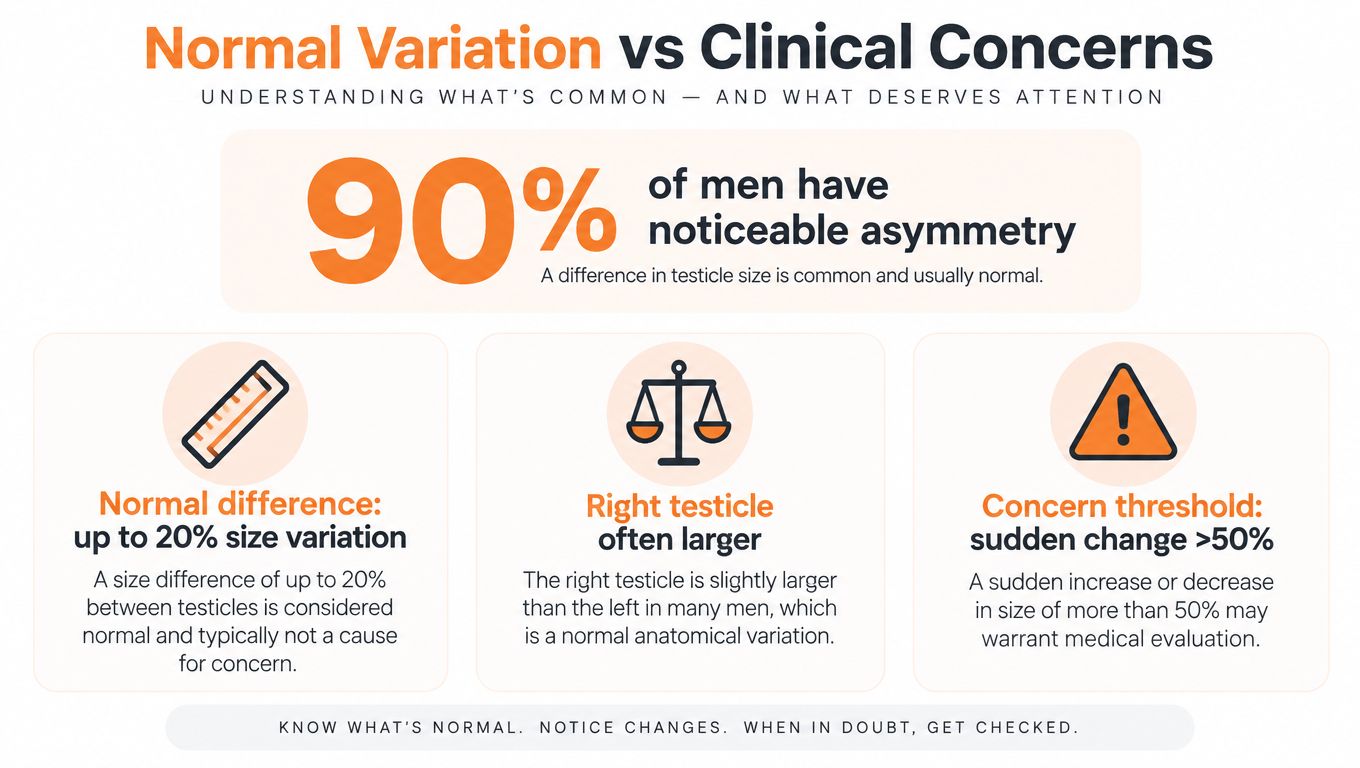
For a closer look at why one side often sits higher, see this guide to why one testicle hangs higher than the other.
A practical comparison
| Usually reassuring | More concerning |
|---|---|
| A small difference present for a long time | A new or rapidly increasing difference |
| One testicle hangs lower | A testicle becomes firm, misshapen, or enlarged |
| No pain, swelling, or skin change | Pain, swelling, fever, or tenderness |
| Smooth, familiar texture | A distinct lump or unusual hard area |
Use the table as a checklist, not a diagnosis. Online infographics may quote precise thresholds, but a sudden, noticeable change deserves medical attention rather than comparison with an unsupported percentage. You do not need to measure yourself against a diagram.
SEMEX is a separate men's wellness product. It cannot explain a testicular size change or replace an examination. If the difference is new, persistent, or paired with pain, swelling, tenderness, fever, a lump, or altered firmness, arrange an assessment so a clinician can examine the area and decide whether imaging is needed.
Common Causes of Unequal Testicle Size
A size difference can come from the testicle itself, the surrounding tissues, or normal development. These possibilities can feel similar at first, but their patterns often differ.
Developmental asymmetry
During adolescence, the two testicles may not grow at exactly the same pace. A major study of healthy adolescent boys found that 203 of 345 boys, or 58.84%, had a smaller left testis, while 142, or 41.16%, had a smaller right testis. The same study found a larger discrepancy, defined by a testicular asymmetry index of at least 20%, in about 14.78% of adolescent boys. These findings support the idea that unequal growth can occur during normal development, while a substantial or changing difference still merits medical attention. The figures are reported in this review of testicular position and size asymmetry.
Varicocele
A varicocele is an enlargement of veins around the testicle. It can be compared with varicose veins in the leg, although the location and medical implications differ. The enlarged veins may create a dragging sensation or a soft, cord-like fullness above the testicle. In some men, the affected testicle may be smaller because surrounding blood-flow and temperature conditions can influence development.
In infertile men with varicoceles, the cited study found testicular size discrepancy in 32%, compared with 17% in men without varicocele. Among men with a left varicocele, a smaller left testicle appeared in 30%, compared with 13% without one. These figures describe the studied groups, not every man with a varicocele, and they don't establish that a size difference alone identifies the condition.
Hydrocele and surrounding swelling
A hydrocele is fluid around the testicle rather than a change in the testicle's internal tissue. It can make one side of the scrotum look enlarged, smooth, or heavier. The distinction matters because the apparent size increase may come from the surrounding sac, not from testicular growth.
Infection, inflammation, injury, and other conditions can also change the appearance or feel of the scrotum. A new difference should therefore be assessed based on its timing and associated symptoms, not on appearance alone. A clinician may use a physical examination and, when appropriate, ultrasound to distinguish the testicle from surrounding structures.
A familiar, stable difference is usually less concerning than a new difference that continues to develop.
How to Perform a Testicular Self-Exam
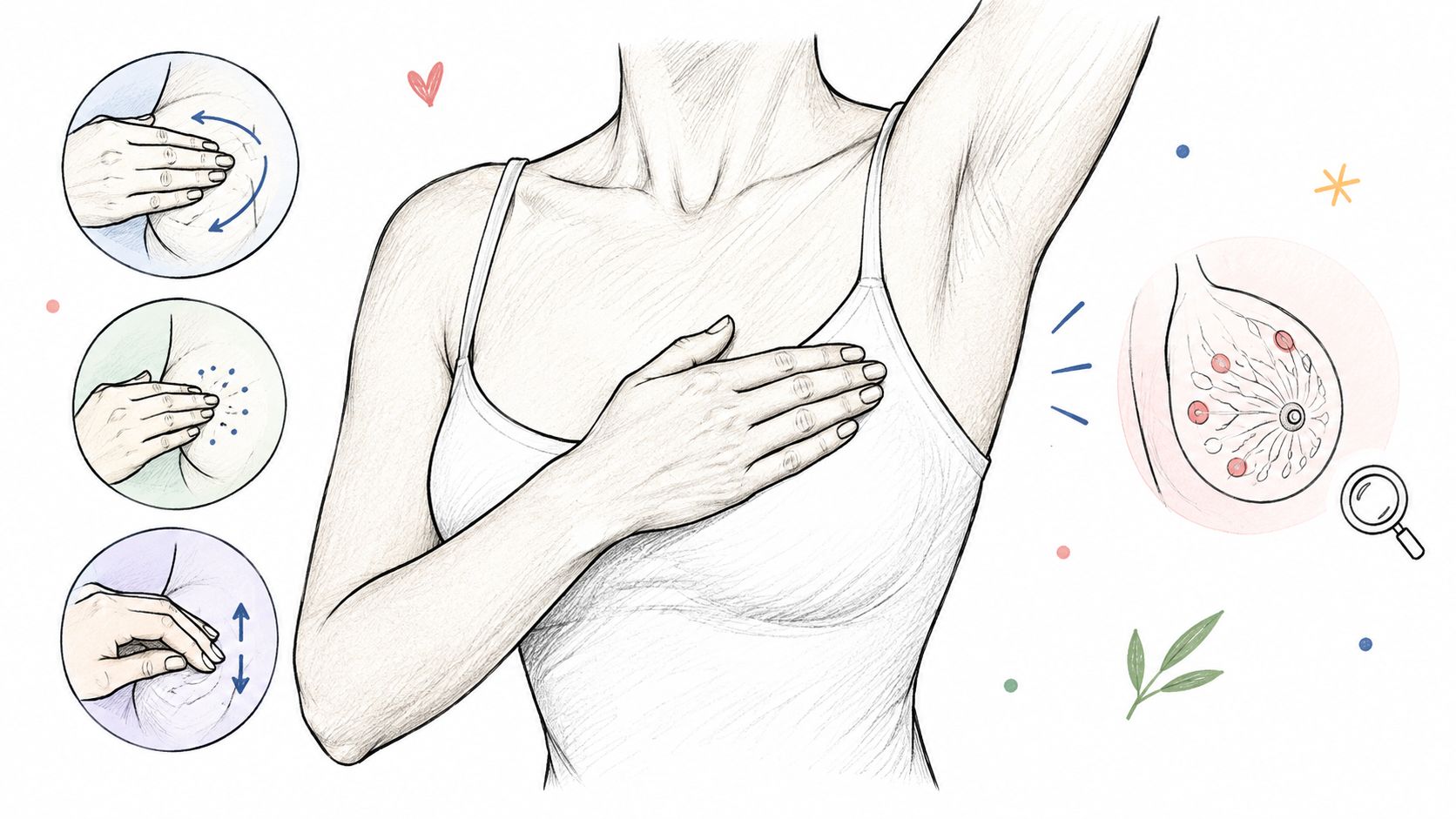
If you notice that one testicle looks larger, a calm, consistent check can help you separate your usual anatomy from a new change. The scrotum is easiest to examine when relaxed, often after a warm bath or shower. Warmth loosens the skin, so you can inspect and feel the area without pressing hard.
A simple examination sequence
- Choose a warm setting. Use a bath or shower for privacy and relaxed scrotal skin. A mirror can help you notice visible changes.
- Look before touching. Move the penis aside and check for new enlargement, discoloration, or an unusual contour. One side may naturally hang lower. Compare what you see with your normal appearance.
- Examine one side at a time. Gently support a testicle between your fingers and thumb. Roll it carefully instead of squeezing it, feeling the front, sides, and back for a new lump, firm area, swelling, or change in texture.
- Identify familiar structures. Behind each testicle is the epididymis, a soft, cord-like structure that stores and carries sperm. It may feel unlike the smooth testicle itself, so its presence alone does not indicate a tumor.
- Compare with your baseline. You do not need to measure exact volume. The useful question is whether one side feels meaningfully different from how it normally feels.
A steady routine turns uncertainty into a simple checklist. You are checking for change, not trying to diagnose yourself.
What deserves an appointment
Arrange a medical assessment for a distinct hard lump, ongoing swelling, a newly firmer testicle, or a difference that remains after the first check. Pain does not have to be present, and a self-exam cannot identify the underlying cause.
During the check: Use gentle handling. Repeated pressing can cause soreness and make normal structures harder to interpret.
Keep the routine consistent rather than checking repeatedly throughout the day. Familiarity helps you notice a real change without making every minor difference feel urgent.
When to Seek Medical Evaluation Immediately
Sudden severe testicular pain is an emergency symptom. Medical guidance recommends urgent evaluation when intense pain begins suddenly, particularly if it occurs with nausea, vomiting, abdominal pain, swelling, or a high-riding testicle. These features can indicate testicular torsion, in which the testicle twists and its blood supply may be threatened. The Merck Manual guidance on scrotal pain supports emergency assessment in this situation.
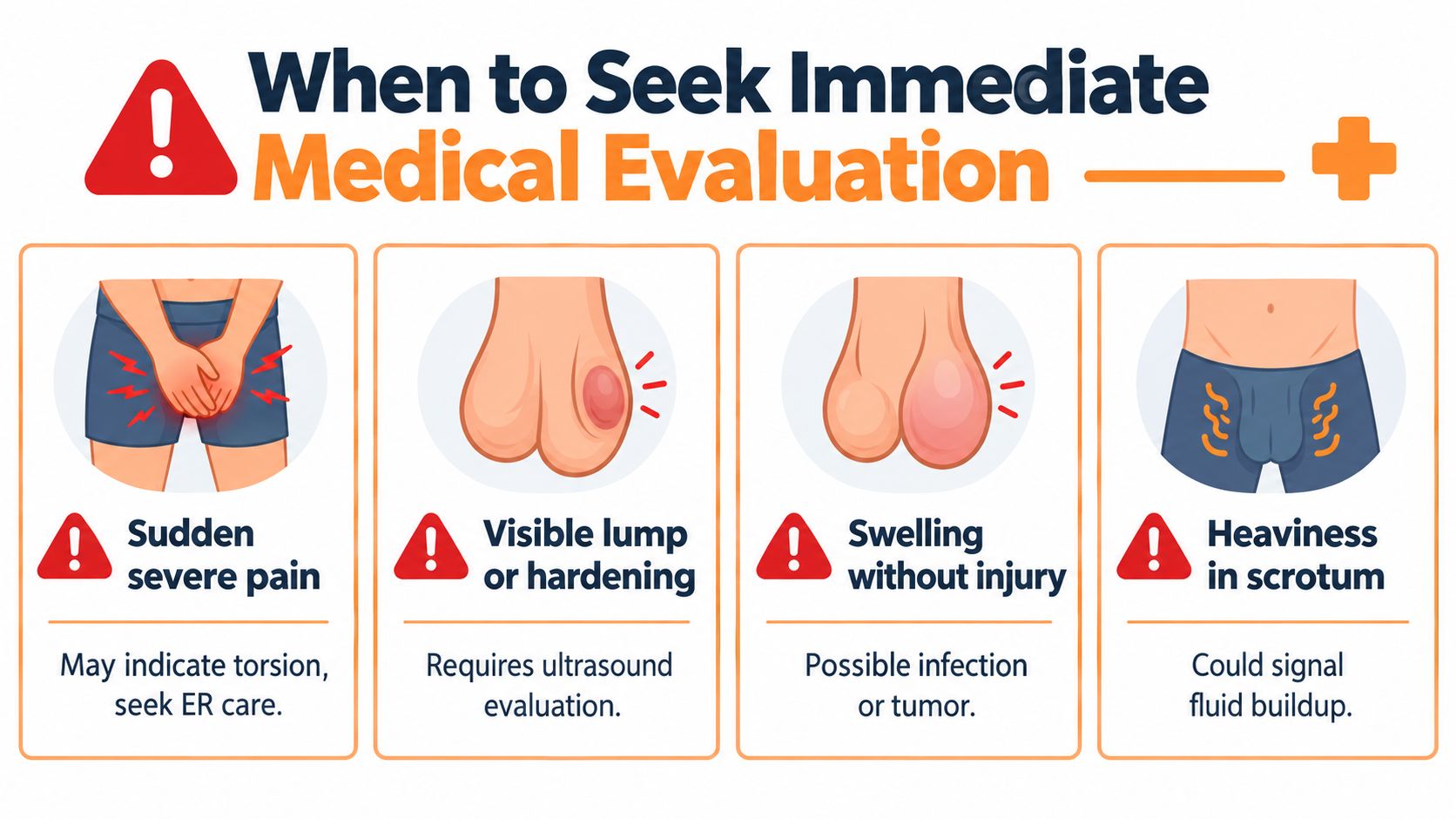
Use the symptom pattern, not just the size
A slow, painless difference may allow time for a scheduled medical appointment, but a painful or rapidly changing scrotum shouldn't be monitored at home. Immediate attention is especially important when swelling appears without a clear injury or when the testicle seems pulled upward compared with its usual position.
The infographic's labels mention specific thresholds and diagnoses that aren't verified for this article. They shouldn't be treated as medical rules. The reliable decision points are the symptoms themselves:
- Sudden intense pain: Seek emergency care, particularly with nausea, vomiting, abdominal pain, swelling, or a high-riding testicle.
- Rapid swelling: Arrange urgent assessment rather than waiting for the swelling to settle.
- New firmness or a lump: Contact a clinician promptly, even if the area isn't painful.
- Pain with other genital symptoms: Don't rely on self-examination to identify the cause.
For a focused explanation of how clinicians interpret a size difference, readers can review this guide to testicle size differences and medical evaluation.
Conclusion and Ongoing Health Guidance
A slightly larger testicle, a lower-hanging side, and a stable difference can all be normal. The more important warning is a new or persistent change, especially when it involves swelling, firmness, a lump, pain, or altered shape.
Persistent or rapidly changing swelling needs medical attention, particularly when it occurs with blood in urine or semen, a change in testicle appearance or shape, fever, pain during sex or urination, or severe genital pain without trauma. These warning signs are outlined in Cleveland Clinic guidance on swollen testicles and scrotal swelling.
A calm self-check can help a man recognize his normal baseline, but it can't diagnose the cause of a change. Sudden severe pain requires emergency evaluation, while a new painless lump or persistent enlargement deserves a prompt clinical appointment.
These statements have not been evaluated by the Food and Drug Administration. This product is not intended to diagnose, treat, cure, or prevent any disease.
SEMEX offers a daily men's supplement formulated around semen volume and taste, but it isn't a diagnostic or treatment product for testicular changes. Men who want to learn more about SEMEX can visit SEMEX and discuss any concerning symptoms with a qualified healthcare professional.