

Supplements for Male Libido: An Honest 2026 Guide
Most advice about supplements for male libido starts with the wrong question. Men are told to find the pill with the longest ingredient list, the most dramatic promise, or the most familiar “male enhancement” label. A more useful question is narrower: which ingredient has plausible human data, at a meaningful dose, inside a product that's transparent and clean?
A man can spend an afternoon comparing bottles and still have no way to tell whether a formula contains a studied amount, a decorative sprinkle of several herbs, or a blend whose individual quantities are hidden. The evidence points toward modest, ingredient-specific effects rather than a universal libido booster. It also makes product quality, medication interactions, and baseline health part of the same decision.
Table of Contents
- Why Most Libido Supplements Underperform
- The Biology Behind Sexual Desire and Performance
- Ingredients With Real Human Evidence
- How Ingredient Categories Stack Against Each Other
- Reading a Libido Supplement Label Like a Pro
- Lifestyle Habits That Set the Baseline
- A Realistic 90-Day Plan and Safety Reminders
Why Most Libido Supplements Underperform
A crowded shelf can make weak evidence look like broad choice. One bottle highlights desire, another blood flow, and a third groups numerous botanicals under a proprietary name. The label may appear polished while leaving the useful questions unanswered: Which ingredient is active, how much does it contain, and has the finished product been tested for contamination?
Underperformance usually reflects several quality problems at once. Some formulas provide weak ingredient doses, well below amounts examined in human research. Proprietary blends may disclose only a combined weight, leaving the quantity of each compound unknown. Contamination and adulteration also remain meaningful concerns across the sexual-health supplement market. A discussion of these products notes limited scientific support and the possibility that marketing or placebo expectations carry more weight than solid evidence, as summarized in this review of supplement safety and claim quality.
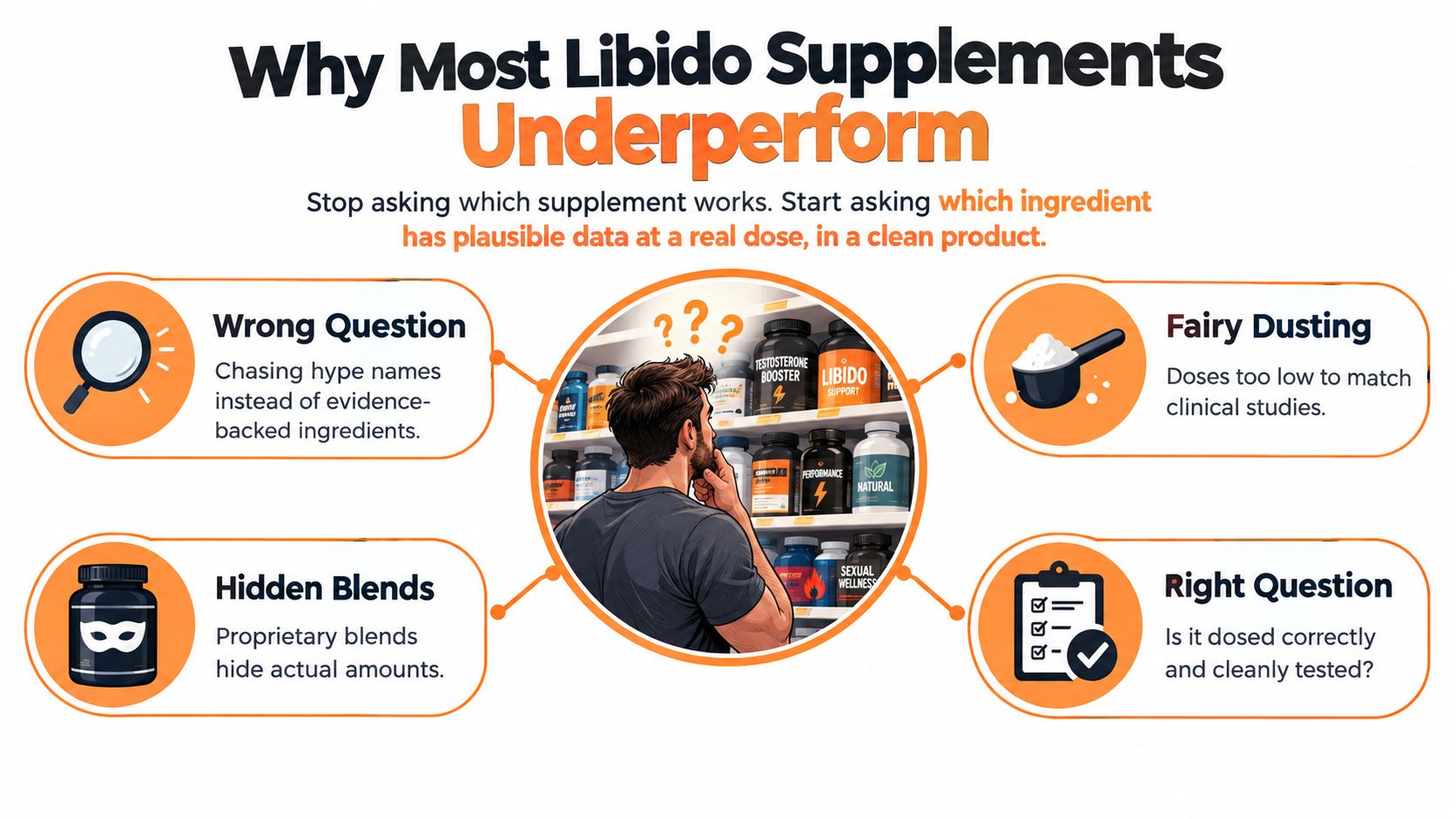
The label can conceal the central problem
Dietary supplements do not undergo the same pre-sale evaluation as prescription medicines. A libido product may make a structure/function statement about supporting sexual function, but it cannot legally claim to diagnose, mitigate, treat, cure, or prevent a specific disease. FDA guidance requires such claims to be truthful and not misleading, along with the agency's standard disclaimer when the claims appear on labeling or promotional material. The FDA structure/function claim guidance explains the distinction.
That regulatory framework does not establish whether a formula contains a clinically sensible dose. It limits the wording a seller can use. A persuasive claim can therefore appear beside an under-dosed formula without showing that the finished product matches the ingredient profile examined in research.
Practical rule: Consider a supplement only after checking transparent ingredients, meaningful quantities, credible testing, and realistic claims. The number of promises on the bottle adds little by itself.
Readers comparing labels can use this guide to supplement effectiveness as a separate quality check. Ingredient, dose, form, and testing determine how seriously a product claim deserves to be taken.
The Biology Behind Sexual Desire and Performance
Sexual desire and erection quality involve overlapping mechanisms but serve different functions. Desire is shaped by the brain, mood, attention, hormones, and relationship context. Erection quality depends more directly on nerve signaling, smooth-muscle relaxation, and sustained blood flow in penile tissue.
Nitric oxide, commonly abbreviated as NO, connects these processes at the vascular level. It signals vascular smooth muscle to relax. The plumbing analogy remains useful: the brain and nerves initiate the request, nitric oxide helps open the faucet, and adequate blood flow supplies the pressure needed for firmness. L-arginine contributes to this pathway as a nitric-oxide precursor. Human research supports its role in blood-flow regulation. The broader literature also reports that nitric-oxide donors and L-arginine increased cortical cerebral blood flow in permanent ischemia models, with a standardized mean difference of +0.86, 95% CI 0.52 to 1.21, p<0.01, in this PubMed review of nitric-oxide donors and L-arginine. That evidence concerns cerebral circulation rather than sexual performance, so it supports biological plausibility, not a product-level libido claim.
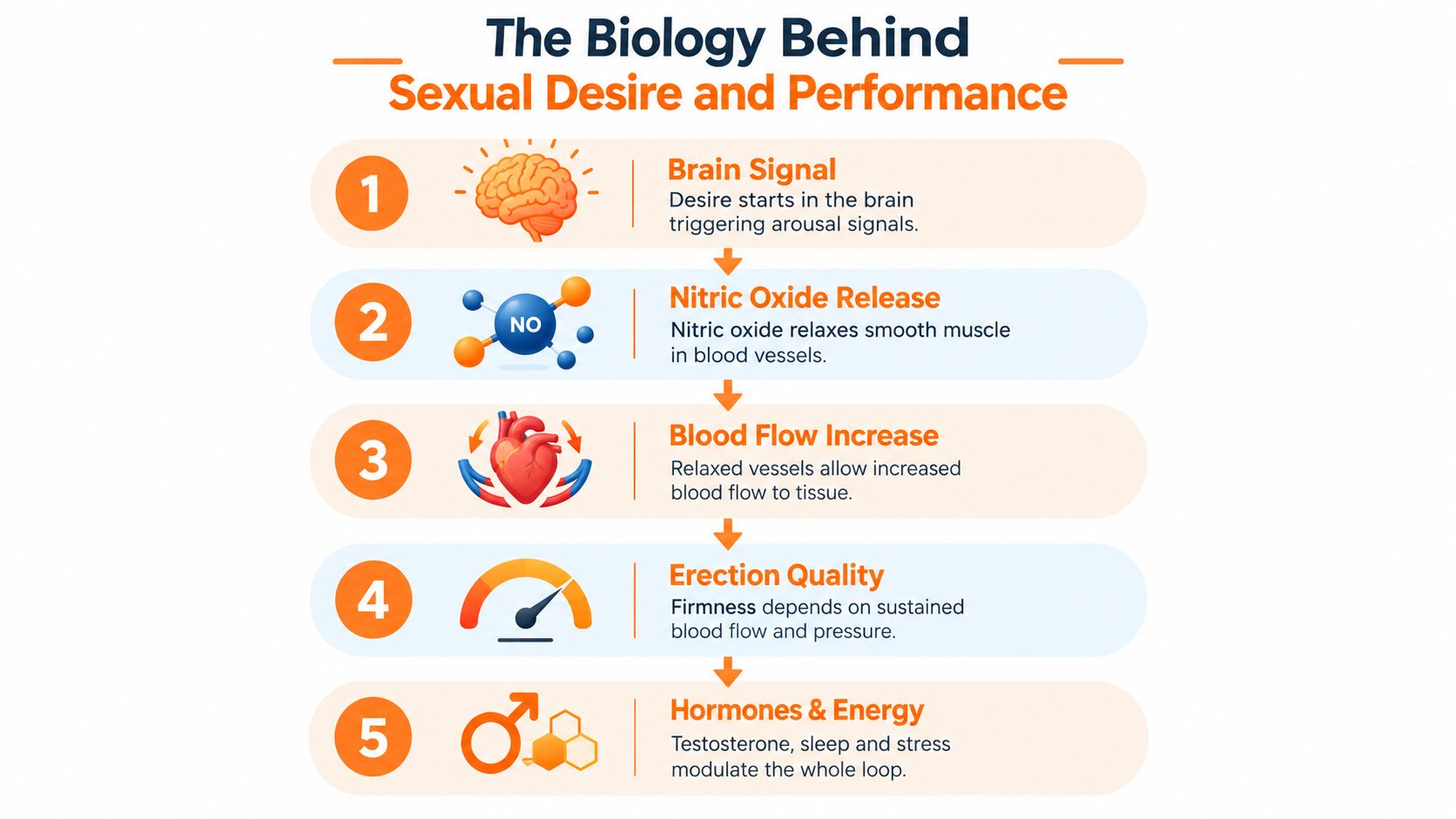
Hormones influence the signal, but they don't explain everything
Testosterone production involves the hypothalamus, pituitary gland, luteinizing hormone signaling, and Leydig cells in the testes. A modest change in available testosterone may affect desire for some men without indicating a clinical hormone disorder. Free testosterone can also vary with binding proteins, sleep quality, body composition, illness, medication use, and energy availability.
Stress adds another layer. Persistent mental load can increase sympathetic nervous-system activity, the state associated with vigilance rather than relaxed arousal. Stress-related hormonal changes may disrupt sexual attention, nitric-oxide signaling, sleep, and the hormonal environment that supports desire. A difficult week can therefore reduce drive even when no single disease has appeared.
The practical analysis is ingredient-specific. L-arginine points toward nitric-oxide biology and circulation. Panax ginseng has a more mixed botanical evidence profile. Zinc mainly supports normal reproductive biology when intake or status is inadequate. None of those pathways supports the claim that a supplement treats low libido.
Ingredients With Real Human Evidence
Ingredient evidence offers a more useful starting point than a product ranking. Plausible pathways exist, but the strength of support changes with the compound, extract, dose, study design, and participant profile. The following profiles describe ingredient-level support grounded in human research rather than treatment claims for finished formulas.
L-arginine has the clearest direct mechanistic rationale among common libido-support ingredients because it contributes to nitric-oxide production. A systematic review and meta-analysis of dietary supplements for erectile function found that L-arginine at 1,500 to 5,000 mg per day improved erectile outcomes compared with placebo or no treatment. The analysis included four studies and 246 patients, with reported gains in overall satisfaction, intercourse satisfaction, and orgasmic function, according to the systematic review of dietary supplements for erectile function. The broader evidence makes benefit more plausible for men with lower baseline arginine status or vascular limitations. A universal libido effect remains unsupported.
L-citrulline converts to arginine and can support the same nitric-oxide pathway. It therefore deserves close label review. A product may advertise “circulation support” while providing too little citrulline to resemble studied use. Human evidence is more limited and depends heavily on formulation than the direct L-arginine evidence, so citrulline is best treated as pathway support rather than an automatic performance solution.
Botanical options depend more on the population
Panax ginseng is one of the better-studied botanicals for male sexual function, although its effect is modest and varies with the extract and dose. A meta-analysis reported improved erectile function compared with placebo, with an IIEF-5 comparison of 140 ginseng versus 96 placebo and a standardized mean difference of 0.43, 95% CI 0.15 to 0.70. A Cochrane review judged the effect likely trivial to clinically small. Another review found about 58% of men improved on some sexual-function measure versus 20% on placebo across 4 to 12 week trials. The ginseng evidence review supports standardized extracts in the 200 to 400 mg per day range. Expectations should remain limited to incremental support for desire, rigidity, or confidence.
Ashwagandha, including named extracts such as KSM-66 or Shoden, is commonly positioned for stress and cortisol-related changes in desire. A 2026 sexual-health trial reported statistically significant improvements across desire and related outcomes, but that finding remains extract-specific. It should not be generalized to every ashwagandha powder. The label should identify the extract and provide an amount that can be compared with the studied preparation.
Tongkat ali is usually presented as support for free testosterone, particularly in stressed men or those with moderately low baseline levels. Fenugreek seed extracts have also been examined through libido scores and sexual-wellness outcomes. Both require careful interpretation because extract standardization varies widely. A label that names only the plant, without extract details, makes meaningful comparison with human studies difficult.
Zinc has the strongest rationale when intake or status is marginal. Reviews associate zinc deficiency with impaired spermatogenesis, sperm abnormalities, and lower serum testosterone. Reduced seminal-plasma zinc is also linked with low sperm count and poorer sperm quality. These findings concern normal reproductive biology and do not establish that a zinc-containing product treats a sexual condition, as explained in this review of zinc and male reproductive function.
Vitamin D follows a similar logic. Supplementation is more rational when baseline status is low. Maca, saffron, rhodiola, and shilajit remain possible adjuncts, but their evidence and product quality vary. A label should preserve that distinction instead of presenting weaker ingredients as equivalent to those with better human support.
| Ingredient | Primary mechanism | Evidence quality | Typical studied daily dose |
|---|---|---|---|
| L-arginine | Nitric-oxide precursor and blood-flow support | Direct human evidence, modest and population-dependent | 1,500 to 5,000 mg |
| Panax ginseng | Botanical support for erectile function and arousal physiology | Several human reviews, modest effect | 200 to 400 mg standardized extract |
| L-citrulline | Conversion to arginine and nitric-oxide support | Mechanistically plausible, human evidence varies by formulation | Study-dependent |
| Ashwagandha | Stress-response and desire support | Human evidence is extract-specific | Study-dependent |
| Tongkat ali | Testosterone-pathway support | Limited, population-dependent human evidence | Study-dependent |
| Fenugreek | Libido and sexual-function scoring support | Mixed, extract-specific human evidence | Study-dependent |
| Zinc | Normal reproductive biology | Strongest rationale when status is inadequate | Status-dependent |
| Vitamin D | General endocrine and reproductive support | Most plausible when baseline status is low | Status-dependent |
| Shilajit | Adjunctive traditional botanical support | Limited and quality-sensitive | Study-dependent |
For a wider discussion of ingredient categories, the male enhancement ingredient guide can provide label context. Its claims still require the same distinction between a plausible pathway, a studied ingredient, and a treatment claim for a finished product.
How Ingredient Categories Stack Against Each Other
The most useful comparison isn't a leaderboard. It's a map of which concern a category plausibly addresses and where its benefits tend to stop.
| Category | Primary mechanism | Typical onset | Evidence strength | Best prioritized for |
|---|---|---|---|---|
| Nitric-oxide donors | Supports vascular smooth-muscle relaxation and circulation | Often linked to use around circulation or performance, depending on ingredient | Strongest mechanistic case for L-arginine | Blood-flow or erection-quality concerns |
| Testosterone-pathway botanicals | May support hormonal signaling or stress-related endocrine balance | Usually gradual rather than immediate | Mixed and extract-dependent | Men with stress-related dips or relevant baseline concerns |
| Traditional aphrodisiacs | Desire, mood, or arousal support through varied pathways | Gradual and inconsistent | Variable | Men seeking adjunctive desire support |
| Micronutrients | Supports normal reproductive and endocrine biology | Depends on correcting inadequate status | Strongest when deficiency exists | Men with confirmed or plausible nutritional gaps |
| Nervous-system modulators | Supports stress regulation and mental readiness | Gradual, especially when stress is prominent | Ingredient- and extract-dependent | Stress-linked reductions in desire |
Nitric-oxide ingredients have the clearest connection to blood flow, but they won't automatically address relationship distress or exhaustion. Testosterone-adjacent botanicals may fit a stress-related pattern, yet combining several of them doesn't guarantee additive hormonal support. Traditional aphrodisiacs often have a wider gap between cultural reputation and consistent clinical evidence.
Redundancy is the hidden cost of stacking
A blend containing L-citrulline and L-arginine may look thorough because both names point toward nitric oxide. The second ingredient may add complexity without adding a clearly demonstrated benefit. The same issue appears when several testosterone-adjacent herbs share overlapping positioning but lack evidence for the exact combination.
A cleaner selection process gives priority to one primary category, then checks whether a second ingredient addresses a different bottleneck. A blood-flow-focused formula paired with a stress-support ingredient is conceptually different from a formula that contains three similarly marketed testosterone herbs. This doesn't prove the first combination will work. It avoids paying for duplicate theory.
The highest-quality stack is often the smallest one that can be evaluated clearly.
That approach also makes adverse effects easier to attribute. If five ingredients start at once, a man can't tell which compound produced a benefit, caused discomfort, or interacted with an existing medication. One or two well-characterized ingredients create better feedback than an opaque collection of fashionable names.
Reading a Libido Supplement Label Like a Pro
A label can be treated as a research abstract with missing footnotes. The buyer's task is to restore the missing information before deciding whether the product deserves a trial.
Six checks that separate evidence from decoration
- Verify the dose. Each major ingredient should appear in an amount that can be compared with human research. A formula that lists a familiar compound without a meaningful quantity may be using “fairy dusting,” where presence creates marketing value without matching the evidence.
- Demand exact quantities. Proprietary blends are a problem because the total weight may be visible while the individual amounts remain hidden. Without per-ingredient quantities, dose verification isn't possible.
- Identify the actual form. Citrate and malate aren't interchangeable labels, and generic ashwagandha doesn't necessarily match a named extract such as KSM-66 or Shoden. Form, extraction method, and standardization affect whether a study can reasonably inform label interpretation.
- Look for independent testing. USP, NSF, and Informed Sport marks can help buyers identify products that submit to third-party quality processes. Testing is especially relevant because the broader sexual-health category has contamination and adulteration concerns, as discussed in the earlier analysis of supplement claim problems.
- Scan the excipient panel. Artificial colors, unnecessary fillers, and undeclared allergens aren't evidence of poor efficacy by themselves, but a simple formula is easier to audit and tolerate.
- Challenge the promise. “Supports circulation” is materially different from claiming to treat erectile dysfunction. Miracle language, guaranteed outcomes, and vague references to clinical proof should reduce confidence rather than increase it.
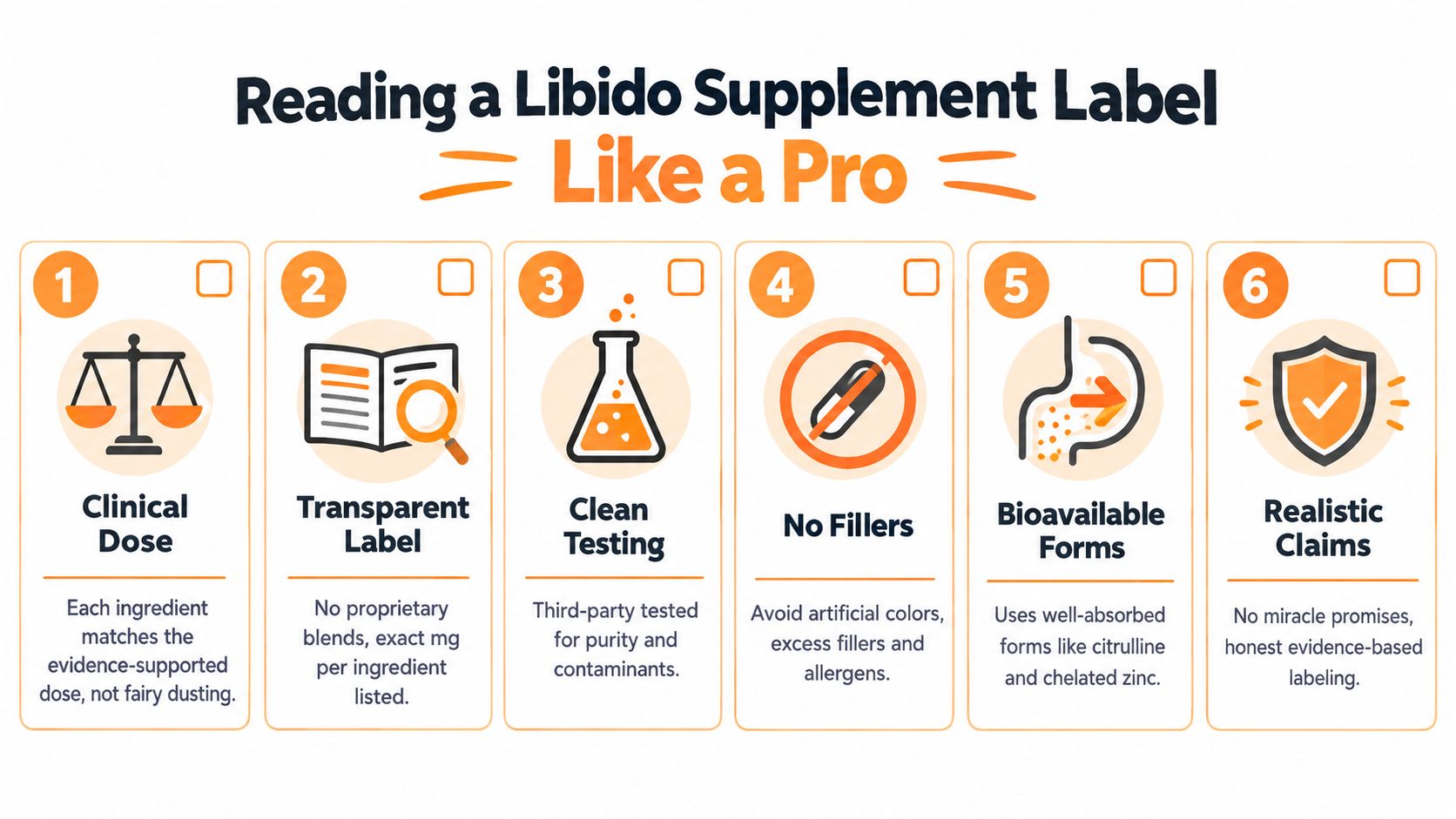
The supplement label-reading guide can support a more systematic review. A careful buyer should also compare the serving size with the amount used in studies. If the research uses grams but the bottle provides a tiny amount hidden inside a blend, the label isn't presenting equivalent evidence.
Lifestyle Habits That Set the Baseline
A supplement operates on the baseline created by daily behavior. Poor sleep, chronic stress, inactivity, and relationship strain can overwhelm a modest ingredient effect because they influence the same desire, energy, and blood-flow systems that supplements claim to support.
Sleep deserves the first audit. A consistent schedule and seven to nine hours give the body a better setting for testosterone production, cortisol rhythm, mood, and sexual attention. A practical target for this week is a fixed wake time, a defined wind-down routine, and fewer stimulating activities before bed.
Resistance training and regular movement provide a second foundation. A man can schedule two to four strength sessions weekly, add ordinary walking, and avoid treating exercise as an occasional rescue tactic. Training supports circulation, body composition, physical confidence, and general energy, all of which can influence sexual readiness without turning exercise into a libido medication.
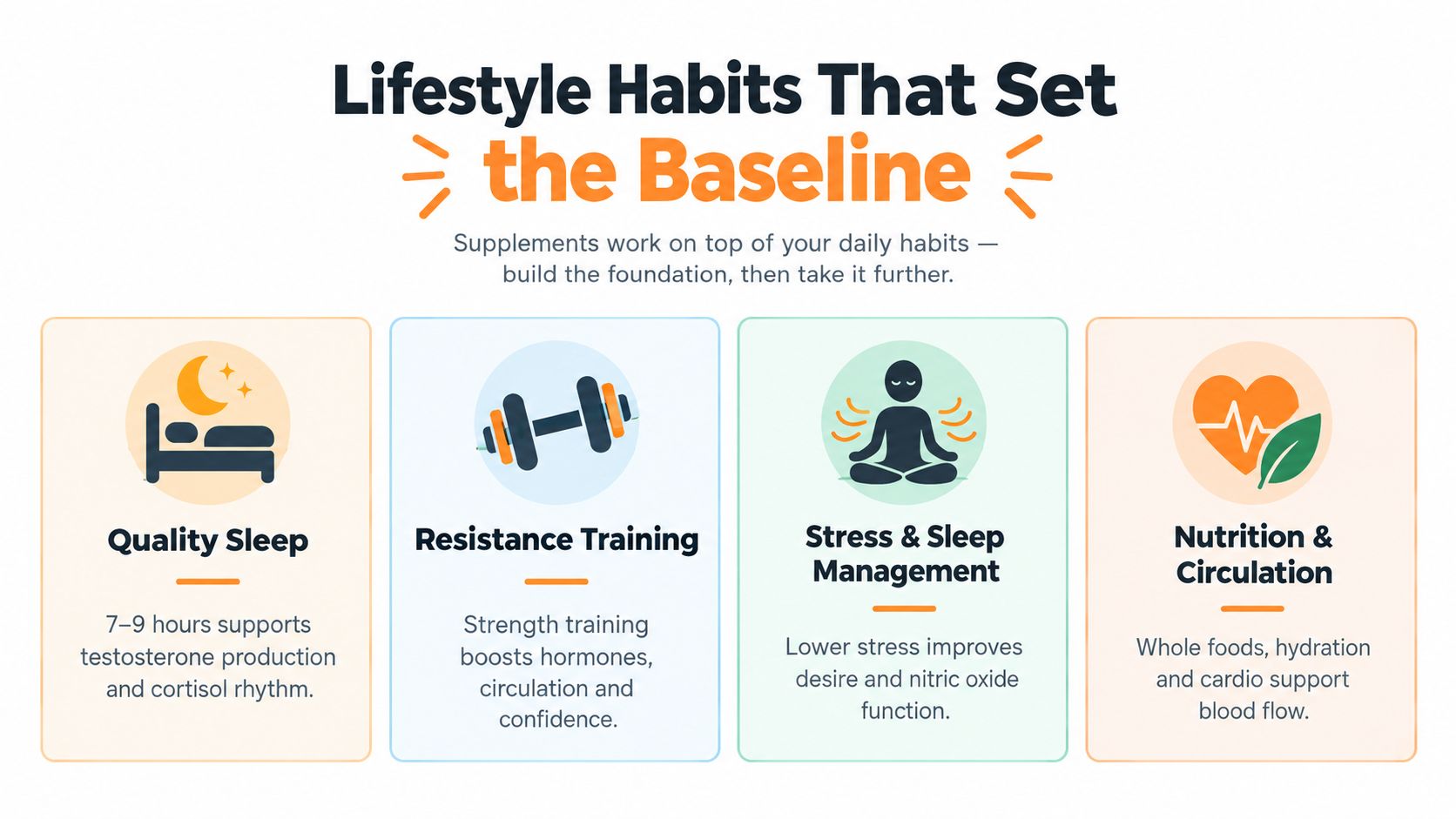
Desire also has a psychological setting
Stress and mental load can keep the nervous system in a state that competes with relaxed arousal. A defined evening shutdown, brief breathing practice, fewer unresolved work tasks, and honest attention to anxiety can matter more than adding another capsule to a crowded stack.
Relationship context deserves equal seriousness. Emotional safety, novelty, conflict, and mood disorders can change desire even when blood flow and hormone levels look ordinary. Persistent low mood, loss of pleasure, or relationship strain warrants direct attention rather than being disguised as a supplement problem.
A capsule can support a baseline. It can't build the baseline by itself.
Nutrition and hydration also belong in the foundation. Whole foods, adequate protein and micronutrients, and regular movement help maintain the physiological conditions that sexual function depends on. When the baseline is broken, supplement shopping often becomes a way to postpone the more informative questions.
A Realistic 90-Day Plan and Safety Reminders
A disciplined trial starts with observation, not a shopping spree.
During weeks one and two, a man can record sleep timing, training, stress, desire, erection quality, alcohol use, and current medications. A clinician can help decide whether bloodwork is appropriate, especially when symptoms persist or a hormonal concern is plausible. The baseline should include the possibility that a medication, mood disorder, cardiovascular issue, or relationship problem is contributing.
During weeks three through six, the cleanest approach is to introduce one or two evidence-backed ingredients at doses that resemble human research, rather than starting a large proprietary blend. L-arginine has the clearest direct evidence among the common options, while standardized Panax ginseng has a more modest botanical case. Zinc makes more sense when inadequate intake or status is relevant. The purpose is evaluation, not escalation.
During weeks seven through twelve, the user can assess whether any change is consistent, meaningful, and free from adverse effects. Expectations should remain modest. If no useful difference appears, adding more overlapping ingredients is less rational than reviewing the diagnosis, product quality, dose, sleep, stress, and medication list.
Men with cardiovascular disease, suspected hypogonadism, or persistent sexual symptoms should involve a clinician before self-experimentation. The same applies to men using antidepressants, blood-pressure medicines, nitrate medications, or hormone therapies, because supplement ingredients can affect circulation, nervous-system activity, or medication response. A clinician should review any formula before use when these factors are present.
FDA guidance requires the following disclaimer for applicable structure/function claims, and the agency says the wording must not be modified and should be prominently displayed in boldface: “These statements have not been evaluated by the Food and Drug Administration. This product is not intended to diagnose, treat, cure, or prevent any disease.”
SEMEX is one example of a daily men's wellness supplement that combines zinc, L-arginine, sunflower lecithin, bromelain, maca root, Panax ginseng, ashwagandha, Tongkat Ali, saw palmetto, and horny goat weed, with product information describing vegan, non-GMO, USA-made, cGMP-registered-facility production and third-party testing by Eurofins. Those details describe the product and its ingredients, not proof that SEMEX treats any condition or delivers a guaranteed libido outcome.
Men evaluating SEMEX can review its ingredient formula and quality information as part of the same evidence-first process used for any supplement. The practical next step is to compare its label with personal goals, medication considerations, and the ingredient doses supported by human research, then consult a healthcare professional when persistent symptoms or health risks are present.
These statements have not been evaluated by the Food and Drug Administration. This product is not intended to diagnose, treat, cure, or prevent any disease.