

Supplements for Bigger Loads: Evidence and Timing
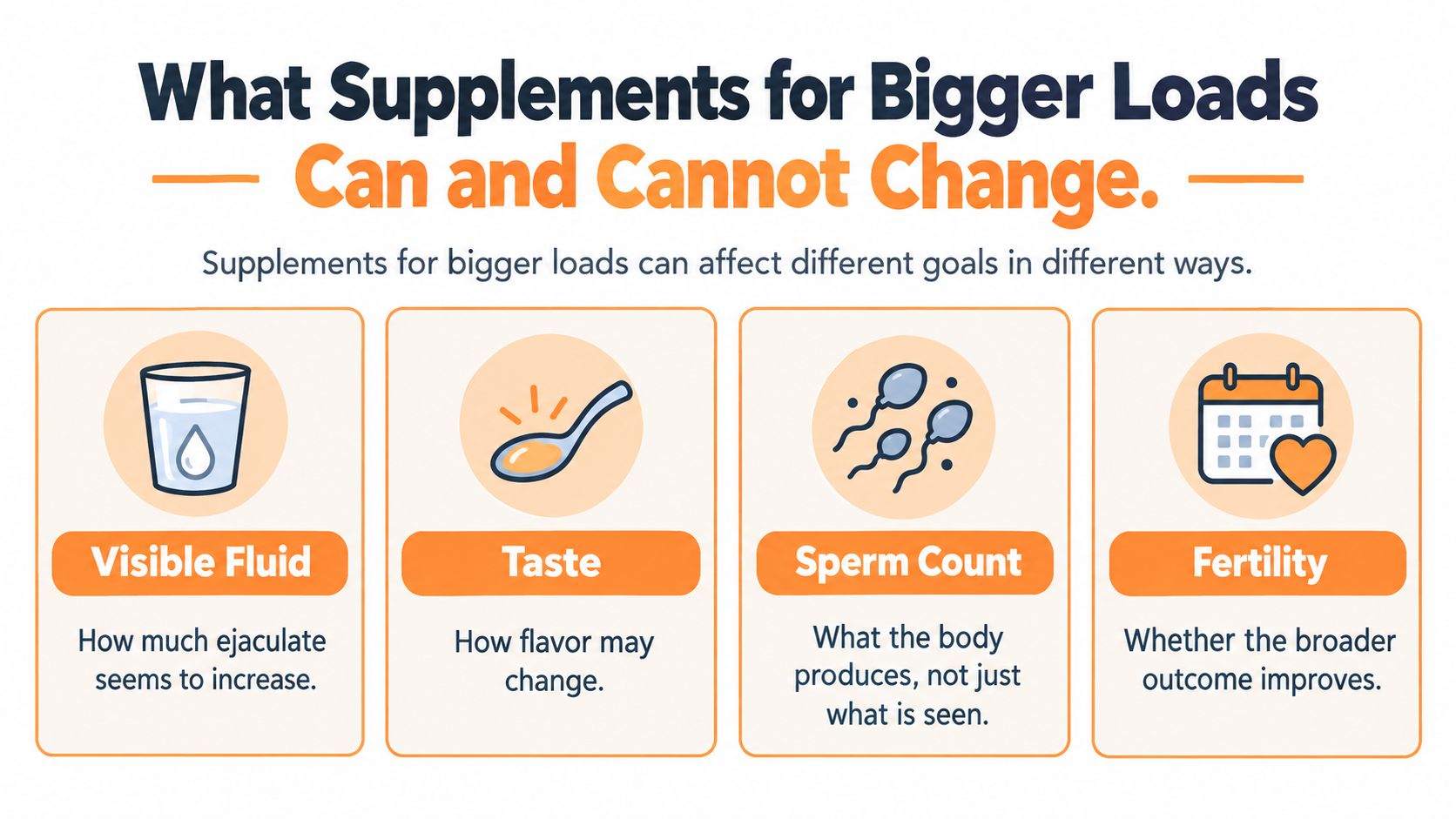
The most popular advice about supplements for bigger loads often assumes that more visible fluid means more sperm, better fertility, and a more satisfying sexual experience. Those are different outcomes. Semen volume can be measured, sperm characteristics require their own tests, and taste or perceived intensity can't be inferred from a lab result.
| Goal | What the evidence can address | What it can't establish by itself |
|---|---|---|
| Visible fluid | Semen volume | Fertility or sperm quality |
| Sperm measures | Count, motility, vitality, and morphology | A visibly larger ejaculation |
| Taste | A subjective sensory experience | A validated clinical change from a supplement |
| Fertility | Outcomes such as pregnancy or live birth | A conclusion based on volume alone |
The useful question isn't whether an ingredient is marketed for men's health. It's which outcome was studied, and whether that outcome matches your goal.
Table of Contents
- What Supplements for Bigger Loads Can and Cannot Change
- Ingredients and Habits Linked to Volume and Taste
- Comparing Zinc Arginine Lecithin and Bromelain
- Matching an Approach to Your Actual Goal
- How Long to Wait Before Judging Results
- Dosing Safety and How to Read a Label
- A Practical Next Step for Choosing a Formula
What Supplements for Bigger Loads Can and Cannot Change
Semen volume is one measured endpoint, not a summary of reproductive health. The World Health Organization's 2021 laboratory manual reports a fifth-percentile semen volume of about 1.4 mL, a median of 3.0 mL, and a 90th percentile of 5.5 mL among men whose partners conceived naturally within 12 months (analysis of WHO reference data). These values describe a reference group; they do not predict an individual's fertility.
The same distribution places fifth-percentile total sperm number at 39 million per ejaculate. Volume and sperm number are separate lab measurements, and neither alone establishes motility or the chance of pregnancy (review of semen reference methods.
WHO reference limits shifted between editions: the lower reference for semen volume changed from 1.5 mL in 2010 to 1.4 mL in 2021, while the lower reference for total motility changed from 40% to 42% (analysis of changes to WHO semen reference values). A clinician interprets these lab measures alongside the person's history and, where appropriate, repeat testing.
Claims about supplements should name the endpoint under discussion. An effect on a sperm measure would not by itself show a change in fluid volume, taste, or pregnancy outcomes. For definitions and measurement context, see what sperm volume measures. Use structure/function wording, such as supporting normal reproductive function, rather than suggesting a product treats infertility or low sperm count.
Ingredients and Habits Linked to Volume and Taste
A biological role does not establish a visible effect. That distinction matters when assessing ingredients promoted for semen volume or taste.
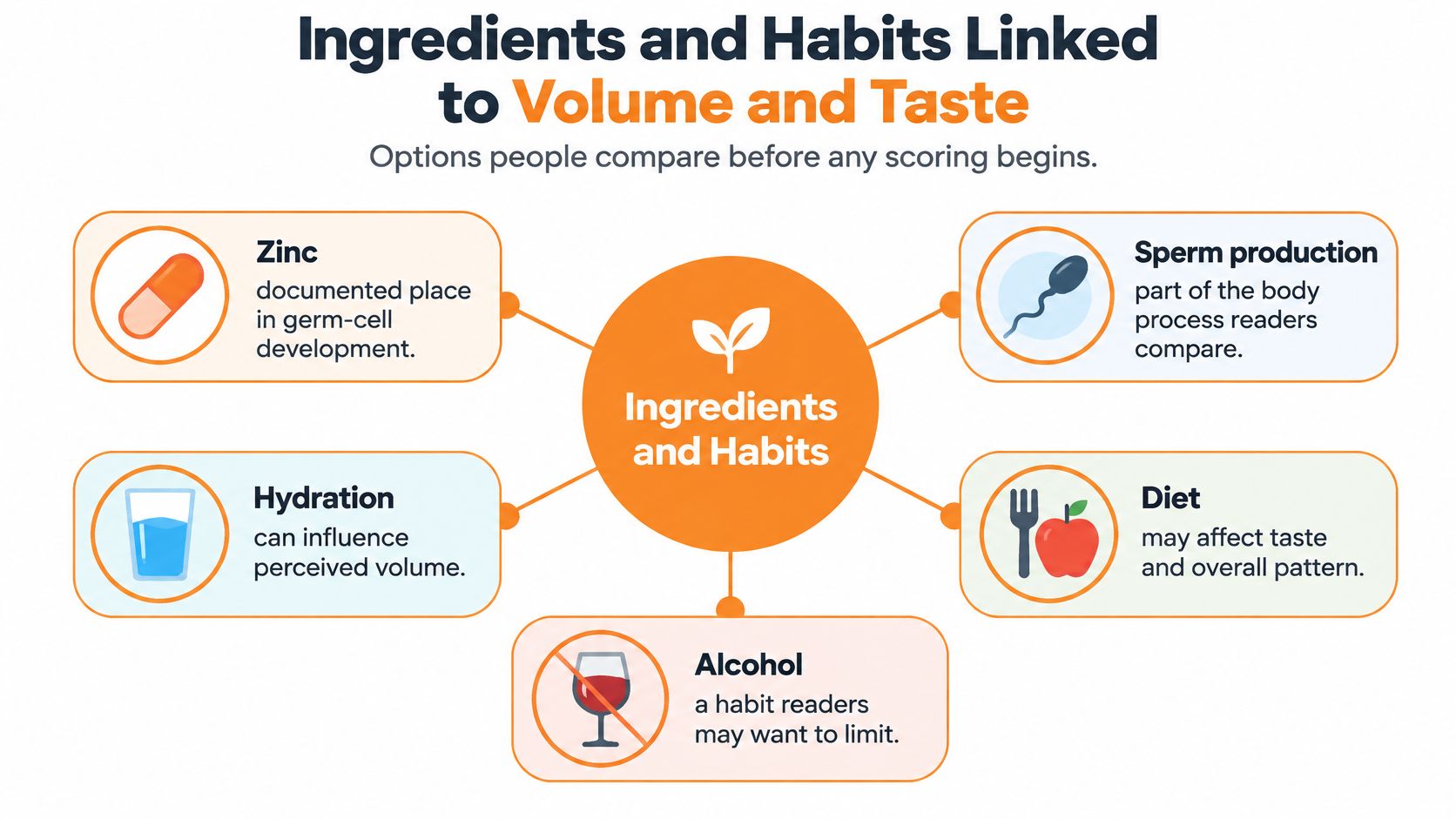
Zinc supports several processes in male reproductive biology, including germ-cell development, sperm production and maturation, and semen liquefaction. The prostate also releases zinc into seminal fluid, where it contributes to sperm release and motility (review of zinc and male reproductive biology). These roles support discussing zinc in relation to normal reproductive function; they do not show that extra zinc increases ejaculate volume.
L-arginine is used by endothelial nitric-oxide synthase to produce nitric oxide, which helps regulate blood flow by relaxing vascular smooth muscle (review of L-arginine and nitric-oxide pathways). This pathway is relevant to blood-flow physiology, but does not establish an effect on semen volume or guarantee a sexual benefit.
Sunflower lecithin appears in formulas marketed around volume, while bromelain, an enzyme derived from pineapple, is often associated with taste claims. Those label uses are not evidence that either ingredient changes semen volume or taste. Diet, alcohol, sleep, heat exposure, and exercise belong to the broader wellness picture, but none is established here as a reliable way to alter semen characteristics.
Track visible volume, taste, and laboratory results as separate outcomes.
Comparing Zinc Arginine Lecithin and Bromelain
The same formula can contain ingredients studied for different outcomes. Zinc has evidence tied to semen measures, L-arginine has been examined for sperm concentration and motility, while lecithin and bromelain lack established human results for volume and taste, respectively.
| Ingredient | Endpoint in the research | Study context | Label check |
|---|---|---|---|
| Zinc | Semen volume, motility, and normal morphology were associated with supplementation; several other sperm measures did not significantly improve | Meta-analysis of 20 studies, with 2,600 cases and 867 controls | Check the amount of elemental zinc, not just the weight of a zinc compound |
| L-arginine | Small human studies reported modest changes in sperm concentration and motility; it is not established as a volume enhancer | Studies commonly enrolled about 20–40 men and used roughly 2–4 g daily; an older report used a liquid protocol | Compare the amount per serving with the gram-level study protocols |
| Sunflower lecithin | Used in volume-oriented formulas; no trial result establishing an effect is cited here | No additional trial figures available | Check whether the amount is disclosed |
| Bromelain | No validated human endpoint establishing a change in semen taste | No authoritative controlled human taste result identified | Treat taste claims as unverified, and check whether the amount is disclosed |
The zinc meta-analysis reported pooled standardized mean differences of −0.99 for semen volume, −1.82 for motility, and −0.75 for normal morphology, with confidence intervals excluding zero. It found no significant improvement in sperm viability, concentration, total sperm count, or abnormal morphology (zinc supplementation meta-analysis). The findings vary by endpoint. They do not establish zinc as a universal answer for volume, fertility, or other reproductive concerns.
L-arginine research addresses sperm measures, not a demonstrated increase in ejaculate volume. Small studies used approximately 2–4 g daily and reported modest changes in concentration and motility. An older clinical report used 80 mL of a 10% L-arginine hydrochloride solution daily for six months and reported improved motility without observed side effects (review of L-arginine research). Those protocols may not resemble a capsule blend, so the label's stated amount matters.
For ingredient context, see this overview of lecithin and sperm-related discussions. SEMEX combines zinc, L-arginine, sunflower lecithin, and bromelain with maca root, Panax ginseng, ashwagandha, tongkat ali, saw palmetto, and horny goat weed. A blend's ingredient list and product-quality details do not establish that each ingredient changes semen volume, sperm measures, or taste.
Matching an Approach to Your Actual Goal
A change in one outcome does not establish a change in another. Visible fluid, taste, nitric-oxide pathways, sperm measures, and fertility outcomes require separate ways of assessing whether an approach is relevant.
If the goal is more visible fluid
Zinc has been associated with semen volume, but that association does not guarantee a noticeable change for an individual. Judge visible fluid as a subjective observation, not as evidence of a change in sperm count or fertility.
If the goal is taste
Bromelain is discussed as a taste-related hypothesis, not as a proven clinical outcome. Diet and hydration can provide context, but a partner's impression remains subjective and does not show that semen quality has changed.
If the goal is nitric-oxide or blood-flow support
The body uses L-arginine to produce nitric oxide. As noted earlier, small studies have examined L-arginine in relation to sperm measures. That research does not establish that the ingredient increases semen volume, and the amount in a blend may differ from the protocols studied.
Maca, ginseng, ashwagandha, tongkat ali, saw palmetto, and horny goat weed may appear in men's wellness formulas. Their presence alone does not demonstrate an effect on ejaculate volume.
Evidence for a sperm parameter does not establish a larger-looking ejaculate, improved taste, or a fertility benefit.
People concerned about infertility, low sperm count, or difficulty conceiving should seek clinical evaluation rather than infer a diagnosis from appearance. A 2025 systematic review found no convincing evidence that dietary supplements improve pregnancy or live-birth outcomes (review of supplements and male infertility outcomes).
How Long to Wait Before Judging Results
A single comparison between ejaculates offers little evidence of a supplement's effect. Collection interval and measurement method can shift the result, while perceived changes in taste or appearance remain separate from lab measures such as volume and motility.
The useful waiting period depends on the outcome being tracked. Subjective changes can be recorded over time, while studies of semen parameters often assess results over longer periods, including around three months. Research findings vary by ingredient and study design, so an early impression is a weak basis for judging sperm measures.
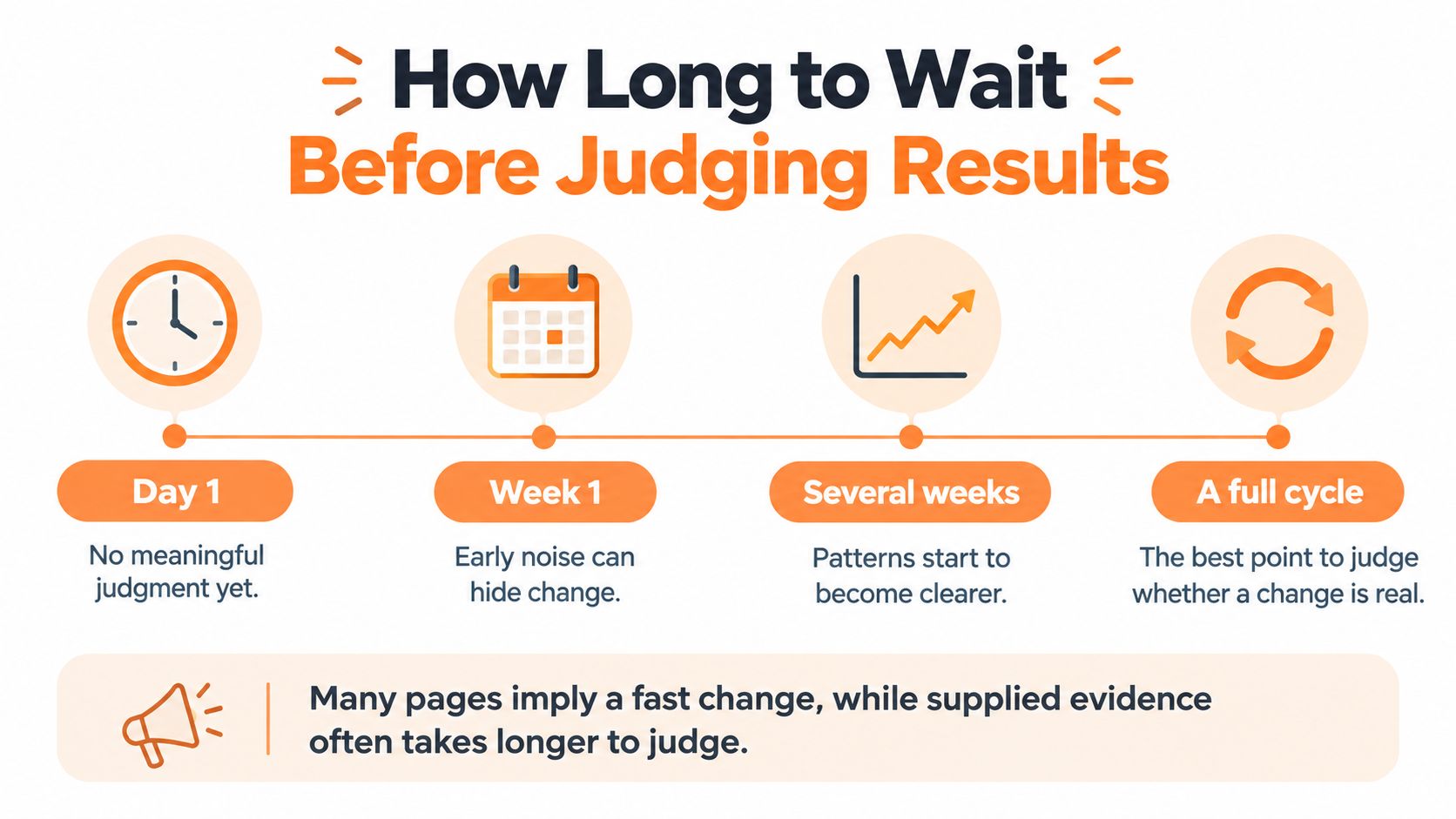
A 2025 review abstract on exercise interventions reported improvements across several semen measures, including volume. Its findings concern exercise interventions and do not establish that an individual supplement will produce the same effects (exercise-intervention review abstract). A separate 2025 network meta-analysis found substantial variation among supplement studies and included evaluation periods of around three months. That variation makes a single timetable unsuitable for every ingredient or endpoint.
For practical guidance on how long supplement results may take to notice, distinguish personal observations from clinical measurements. If fertility is the concern, seek clinical evaluation rather than relying on appearance or extending a supplement trial.
Dosing Safety and How to Read a Label
A label can name an ingredient without showing whether its amount matches the human research. Zinc is a useful example: safety calculations depend on elemental zinc, not the total weight of the zinc compound. As noted earlier, adult men's recommended daily zinc intake is 11 mg, and the upper limit is 40 mg per day from food and supplements combined. Count zinc across your diet and all products, and ask a clinician or pharmacist about your intake if you have questions.
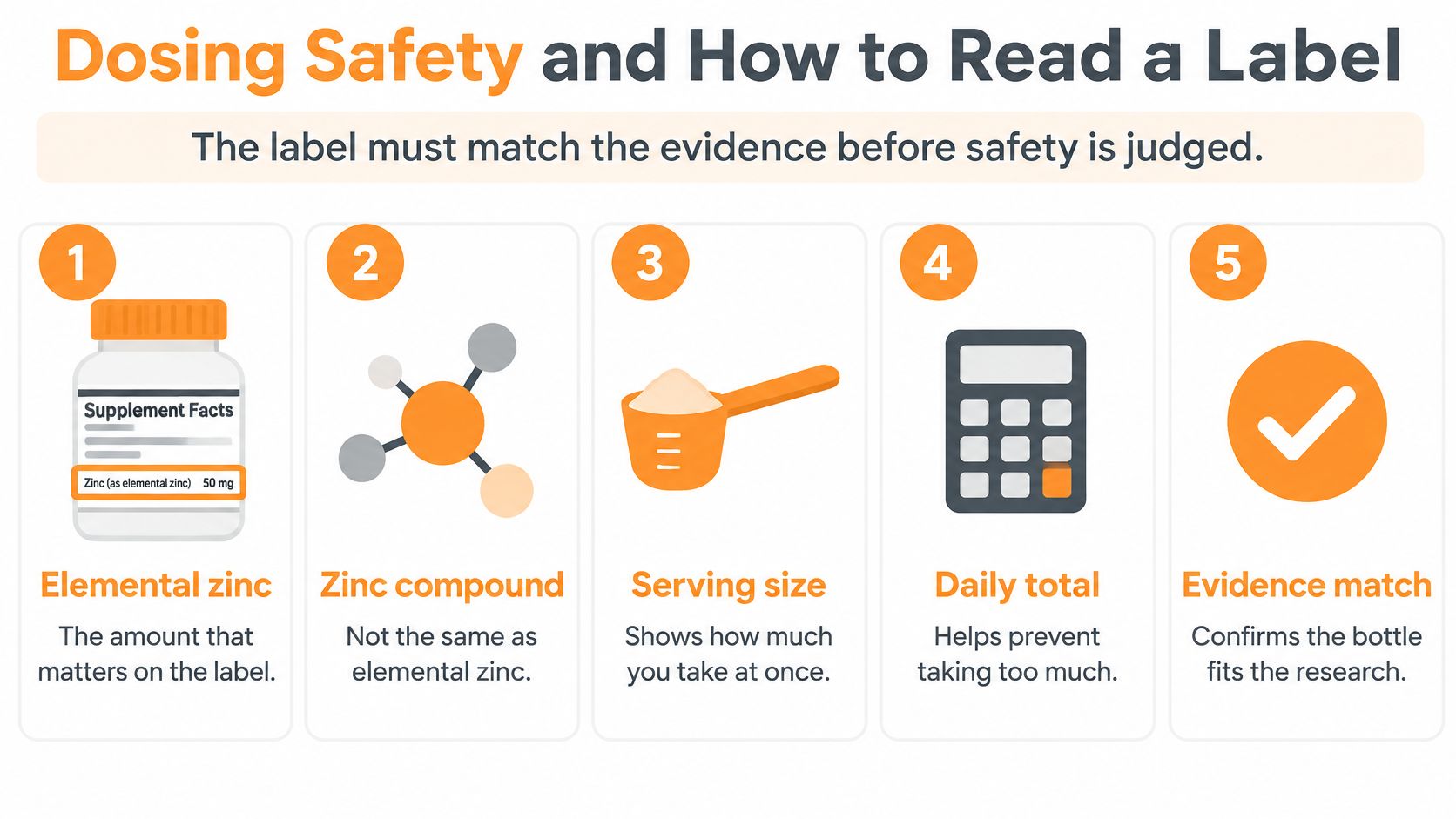
L-arginine requires a different comparison. Small human studies have used gram-level amounts, so check the amount per serving rather than relying on its place in an ingredient blend. A lower amount does not establish that a product has no effect; it does mean the label and study protocol are not directly comparable.
Focus on the information needed to interpret your own intake: the amount of each ingredient per serving, the number of capsules or tablets in that serving, and the form of zinc listed. A guide to reading supplement labels explains what to look for. A money-back guarantee describes a purchase policy, not a physical outcome.
A Practical Next Step for Choosing a Formula
Choose one outcome to track before buying: visible volume, taste, vitality, or a fertility concern. Keep the measure specific. For example, record ejaculation frequency, hydration, and a simple volume rating in a daily log, alongside any change in taste or other subjective effects. These observations can help identify patterns, but they cannot measure sperm quality or establish fertility.
Use the dosing section's guidance to assess zinc, and check the listed L-arginine amount rather than assuming a blend matches amounts used in research. Lecithin appears in volume-focused formulas, while bromelain is used in connection with taste; neither ingredient's presence alone establishes a benefit for your chosen outcome.
If you try a combined daily formula, follow its label and keep hydration and ejaculation frequency reasonably consistent while tracking changes. Anyone trying to conceive or concerned about a diagnosed semen problem should seek a clinician's evaluation rather than rely on a supplement.
These statements have not been evaluated by the Food and Drug Administration. This product is not intended to diagnose, treat, cure, or prevent any disease.
SEMEX combines zinc, L-arginine, sunflower lecithin, and bromelain with a men's wellness blend in a daily formula for readers comparing supplements for bigger loads. Review the ingredient amounts, quality details, and serving instructions, then visit SEMEX to learn more.