

Supplement Quality Testing: What It Actually Checks
A consumer comparing two men's wellness supplements may see the same reassuring phrase on both bottles: third-party tested. One company provides a certificate tied to a specific lot, identifies the finished capsules tested, names the laboratory, and lists results for identity, potency, microbes, heavy metals, and adulterants. The other shows only a laboratory logo, with no batch number, methods, thresholds, or actual findings.
Those products don't offer the same evidence. Supplement quality testing isn't a single checkbox. It's a layered process designed to establish whether the correct ingredients are present, whether they match the label, whether contaminants remain within defined limits, and whether undeclared pharmaceutical substances are absent. A heavy-metal result alone can't confirm potency. A microbial screen can't prove botanical authenticity. A passing result for one batch can't establish that every future batch will be identical.

For consumers, the practical question isn't whether a brand uses the words “tested” or “quality assured.” The useful question is what was tested, how it was tested, which lot was sampled, and what standard determined a pass. A helpful overview of these principles appears in supplement quality standards, but the same evaluation logic applies to any dietary supplement.
Table of Contents
- Introduction to Supplement Quality Testing
- What Supplement Quality Testing Actually Checks
- How to Read a Certificate of Analysis
- Understanding cGMP, ISO, and USP Standards
- The Third-Party Testing Reality Check
- Red Flags When Evaluating Supplement Brands
- Building a Personal Quality Assessment Routine
Introduction to Supplement Quality Testing
You buy a supplement that looks professional, lists familiar ingredients, and claims it was tested. Then you compare two documents. One reports a real lot number, named methods, and actual results. The other says only “pass.” Those are not the same kind of evidence.
Supplement quality testing exists because a finished bottle can appear normal while several different quality questions remain unanswered. Manufacturing controls have to cover raw-material identity, production conditions, formulation, packaging, records, and finished-batch release. Under the FDA's cGMP framework for dietary supplements, manufacturers set specifications for identity, purity, strength, composition, and contamination limits, then verify finished batches against those specifications through appropriate sampling or testing. FDA and USP quality framework information
That point matters because one clean result does not stand in for everything else. A heavy-metal screen does not confirm label strength. An identity test does not rule out an undeclared drug. A passing result on one lot does not prove the next lot will match it. Quality works more like a chain of checkpoints than a single gate.
Why the label alone isn't enough
The label states what the manufacturer intends to sell. Testing shows what analysts found in a sampled material or lot. Those two should line up, but they are not interchangeable.
A botanical may be substituted with a related plant that looks similar in raw form. A powder may contain the right ingredient but less of it than the label declares. A capsule may meet microbial limits and still contain a drug that should not be there. Each problem calls for a different test, which is why broad phrases such as “tested for purity” or “quality assured” do not answer the questions an informed buyer should ask. A practical framework for this appears in these supplement quality standards explained.
Quality has several dimensions
A useful way to read supplement quality is to separate the main dimensions:
- Identity: Is the named ingredient present?
- Strength and composition: Does the product contain the declared ingredients at the specified amounts and proportions?
- Purity: Are microbes, elemental contaminants, pesticides, or residual solvents controlled?
- Adulteration control: Has the product been screened for undeclared pharmacologically active substances?
Independent verification can add facility audits, document review, and product testing. Even then, scope matters. A seal or logo may indicate participation in a program, not proof that every quality question was examined for every batch.
What Supplement Quality Testing Actually Checks
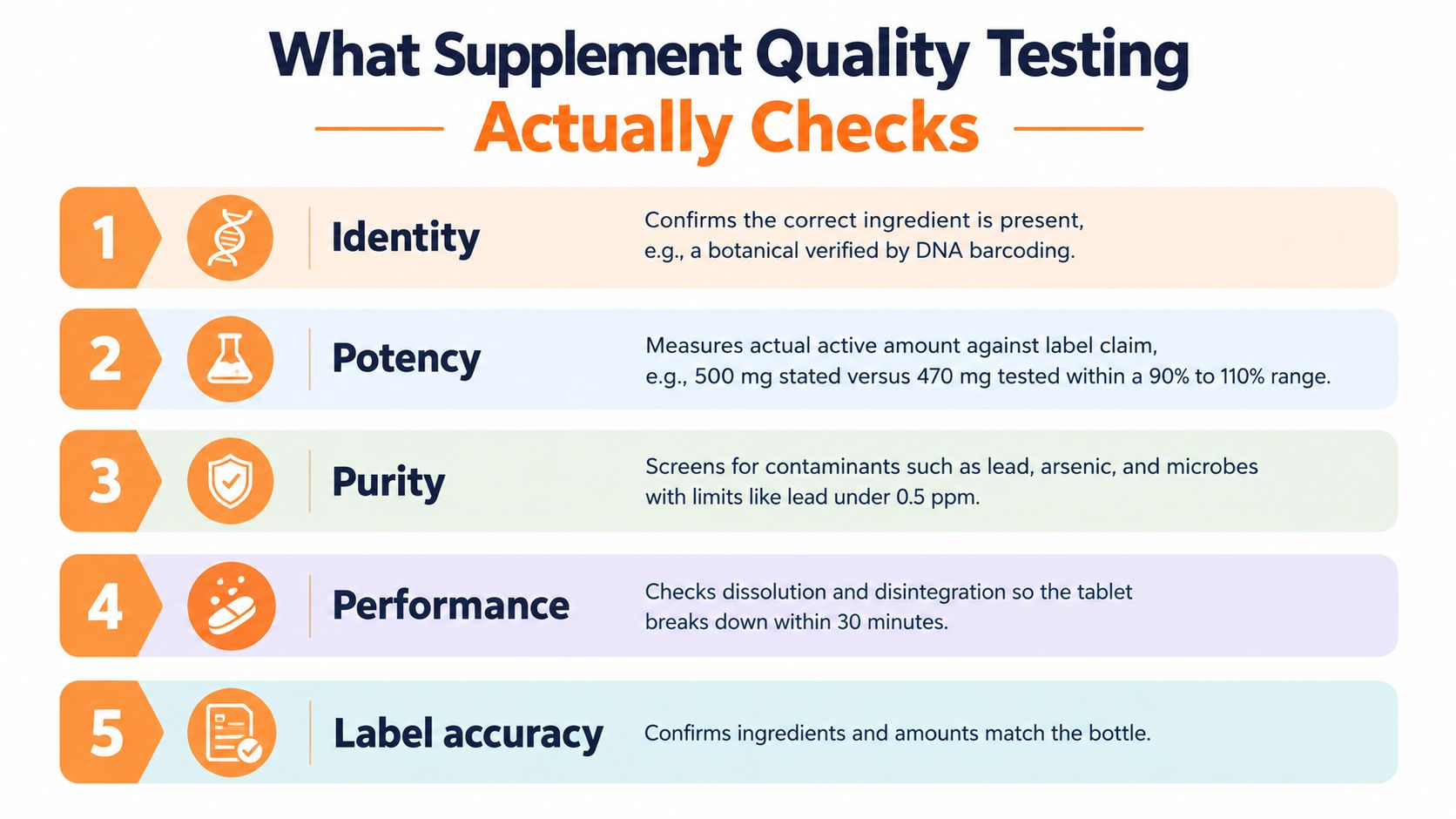
The most reliable way to understand a test report is to separate the questions it answers. Identity, potency, purity, performance, and adulterant control overlap, but none can replace the others.
Identity confirms the material
Identity testing establishes that the ingredient is what the label says it is. For a botanical, laboratories may use chromatographic, spectroscopic, microscopic, macroscopic, or genetic techniques. DNA barcoding can help identify substitution, but genetic testing alone may not establish chemical composition, potency, or the presence of the compounds responsible for the intended formulation.
For a multi-ingredient capsule, one “blend identity” result may be inadequate. Each meaningful ingredient should have an appropriate identity approach, particularly when closely related botanicals could be confused.
Potency measures the declared amount
Potency testing asks whether the active ingredient appears at the amount specified by the product's quality standard or label declaration. A capsule can contain the correct botanical and still provide less active material than expected. Conversely, a result above the established range may also indicate a formulation or blending problem.
This is why a certificate should show the actual result and acceptance range, not merely the word “compliant.” A potency assay also needs a defined method and a sample that represents the finished product.
Microbial screening addresses biological contamination
Microbial tests may assess overall microbial levels and specified pathogens relevant to the product and manufacturing process. They help identify contamination that can arise from agricultural materials, water, handling, storage, or inadequate environmental controls.
A microbial pass answers a narrow question. It doesn't verify botanical identity, confirm potency, establish stability, or rule out pharmaceutical adulterants.
Heavy-metal analysis measures elemental contaminants
USP General Chapter <2232> focuses on arsenic, cadmium, lead, and mercury as elemental contaminants commonly evaluated in dietary supplements. Modern elemental analysis is more specific than older color-comparison procedures, allowing laboratories to compare measured results with established limits. Technical overview of elemental-contaminant testing
The result should identify the elements tested, the units, the detection or quantitation limit, and the acceptance criterion. “Heavy metals tested” without those details leaves the scope unclear.
Adulterant testing looks for a different hazard
Adulteration control targets undeclared pharmacologically active substances. This matters particularly for products marketed around men's vitality, sexual performance, weight management, or athletic performance, because ordinary contaminant panels may not detect compounds that weren't included in the method.
A 2018 analysis of the FDA Tainted Supplements database found that 97.6 percent of 776 adulterated supplements reported between 2007 and 2016 did not declare the unapproved pharmaceutical ingredients on their labels. Analysis of the FDA Tainted Supplements database
SEMEX is one example of a men's supplement whose product information can be considered alongside the same questions: what quality attributes are tested, which lot is covered, and whether thresholds are disclosed.
How to Read a Certificate of Analysis
A Certificate of Analysis, or COA, becomes useful only when it connects a result to a defined sample and a defined standard. A polished PDF with a signature isn't enough if the report doesn't show which product and lot were tested.
Start with the sample identity
The report should name the product, dosage form, lot or batch number, manufacturing date or relevant sample date, and sample matrix. “Finished capsules” is materially different from “raw botanical powder.” Raw-material testing may support supplier qualification, but it doesn't prove that the finished capsule remained accurately formulated or free from contamination introduced during processing.
The report should also identify the laboratory and its qualification. Accreditation details, method references, analyst approval, and chain-of-custody information help establish that the result came from a controlled process rather than an untraceable internal check.
Read the method and threshold together
A result has meaning only in relation to its method and acceptance criterion. A report should identify whether the method is compendial, validated, or otherwise scientifically appropriate, and it should state the detection or quantitation limit where relevant.
The acceptance criterion must match the risk. A microbial count, a lead result, and an adulterant screen aren't interchangeable. Each requires its own analyte list, method, threshold, and interpretation.
Practical rule: A COA that reports only “pass” asks the reader to trust the laboratory's conclusion without showing the evidence behind it.
Use the result table as a completeness check
The following reference table illustrates the fields a transparent report should make visible. The examples are explanatory rather than results from a particular product.
| Test Category | Typical Acceptance Criterion | Pass Example | Fail Example | Why It Matters |
|---|---|---|---|---|
| Microbials | Product-specific total-count and pathogen limits | Result is below the stated limit and specified pathogens are not detected | Count exceeds the limit or a specified pathogen is detected | Indicates whether biological contamination is controlled |
| Lead | Defined elemental-contaminant limit | Measured lead is below the laboratory's stated limit | Measured lead exceeds the stated limit | Supports control of a toxic elemental contaminant |
| Arsenic | Defined elemental-contaminant limit, with species or method clarified where relevant | Result is below the stated criterion | Result exceeds the stated criterion | Helps evaluate elemental contamination |
| Mercury | Defined elemental-contaminant limit | Result is below the stated criterion | Result exceeds the stated criterion | Addresses a separate elemental hazard |
| Cadmium | Defined elemental-contaminant limit | Result is below the stated criterion | Result exceeds the stated criterion | Supports control of another toxic element |
| Adulterants | Named target compounds and detection limits | Targeted undeclared compounds are not detected at or above the method limit | A targeted compound is detected above the reporting threshold | Addresses pharmacological adulteration that ordinary purity tests may miss |
A U.S. Government Accountability Office analysis cited in peer-reviewed research found trace amounts of at least one contaminant, including lead, arsenic, mercury, cadmium, or pesticides, in 93 percent of 40 tested dietary supplements. The finding doesn't mean every detected trace exceeded a safety limit, but it does show why a report should identify limits instead of using “clean” as a blanket conclusion. Peer-reviewed discussion of contaminant testing
A practical guide to the documentation questions appears in third-party lab testing. The strongest report links the lot on the bottle to the lot on the document and distinguishes raw-material results from finished-product results.
Understanding cGMP, ISO, and USP Standards
A bottle can carry several quality signals and still leave important questions unanswered. FDA cGMP, ISO-based quality systems, and USP verification cover different parts of quality, so one seal does not confirm label accuracy, batch consistency, or freedom from undeclared drugs on its own.
In the United States, the formal framework for dietary-supplement manufacturing took shape through the FDA's Current Good Manufacturing Practice rule, published in 2007. Those rules cover manufacturing, packaging, labeling, records, specifications, identity checks, and finished-batch controls. They set the operating rules for how a product should be made, documented, and released.
cGMP controls the manufacturing system
cGMP works like a plant's operating manual plus its paper trail. It asks whether a company has suitable procedures, equipment, sanitation, supplier qualification, production records, laboratory methods, complaint handling, and release decisions. That matters because a well-run system reduces preventable errors. It does not, by itself, prove what any single bottle contains.
The rule also requires manufacturers to establish specifications for components and finished products, including identity, purity, strength, composition, and contamination limits. They must use scientifically valid methods and verify the identity of each dietary ingredient unless an exemption applies. A supplier COA can support some decisions, but it does not replace the manufacturer's own responsibility for finished-product quality. If you want a clearer explanation of what cGMP certification means, focus on whether the claim refers to facility practices, an audit result, or a tested product lot.
ISO concerns the quality-management process
ISO certification usually speaks to the management system behind the work. It looks at documented processes, records, assigned responsibilities, corrective actions, and continual improvement. The practical question is narrower than many labels suggest. Which ISO standard applies, what activities are covered, and who holds the certificate?
That distinction matters in supplement testing. An ISO-qualified laboratory may improve confidence that a method is performed consistently, but laboratory process quality does not automatically show that the supplement matches its label. The product still needs the right identity, potency, purity, and adulterant testing.
USP verification adds independent review
USP standards include defined articles, analytical procedures, and acceptance criteria. USP also states that federal legislation recognized USP standards for dietary supplements in 1994, and that its verification programs began in 2004. USP verification history
For consumers, the useful reading is layered rather than interchangeable. cGMP addresses how the product is made. ISO may describe how quality systems or laboratory processes are controlled. USP verification can add outside review of facilities, documents, and products. A company can perform well in one area and still leave gaps in another. That is why a facility standard and a product-specific COA should be read as separate pieces of evidence, not as substitutes for each other.
The Third-Party Testing Reality Check
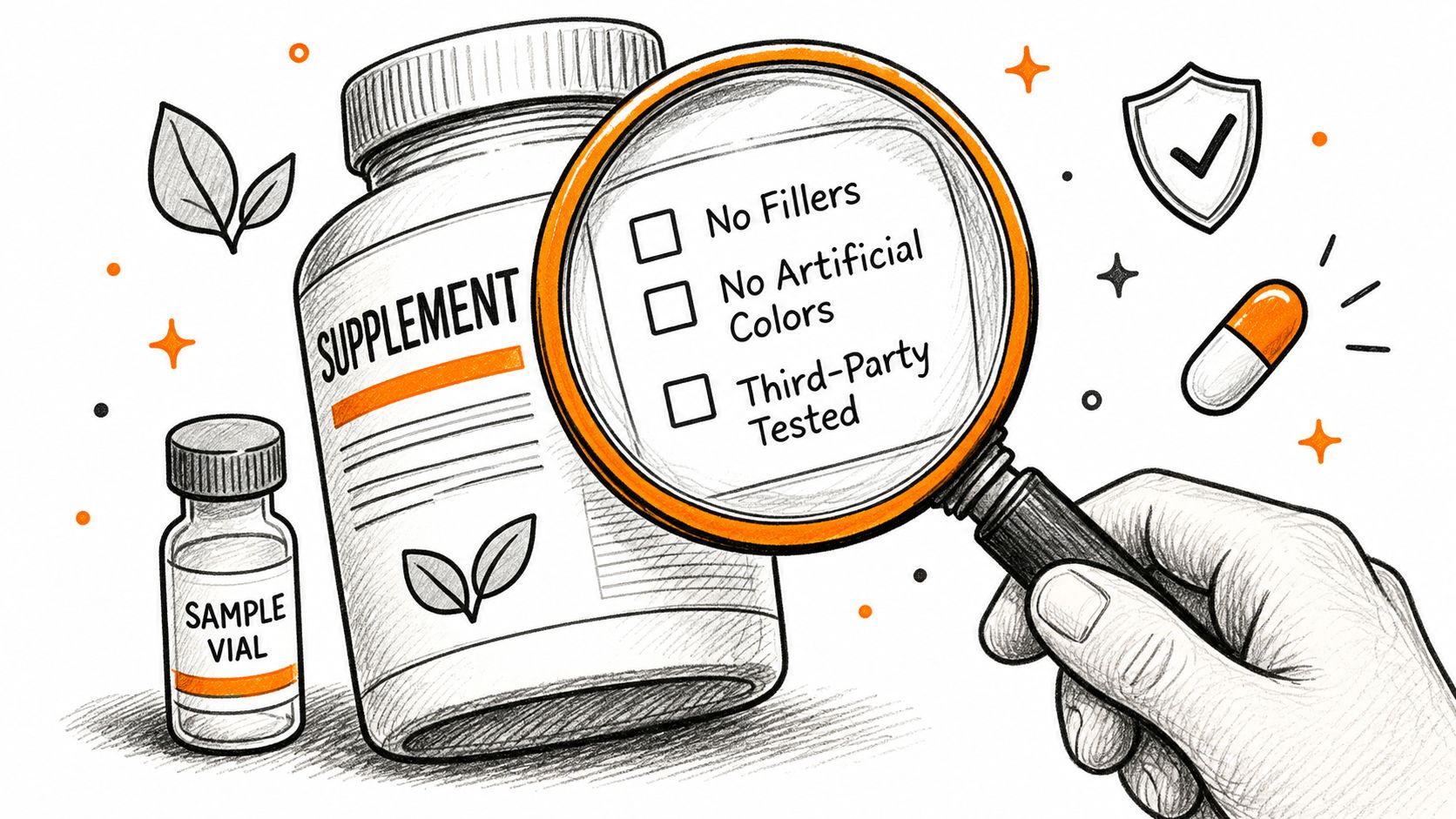
“Third-party tested” sounds thorough, but it can describe a narrow screen. One laboratory may test only heavy metals. Another may examine microbial levels. A broader program may add identity, potency, pesticides, residual solvents, and undeclared pharmaceutical compounds. The phrase alone doesn't reveal the difference.
The practical test is whether the program uses a panel matched to the product's realistic risks. Botanical capsules may need ingredient-specific identity testing, quantitative assays, elemental analysis, microbial testing, and pesticide or residual-solvent analysis where sourcing or extraction makes those hazards plausible. Men's vitality products may also need targeted adulterant screens because pharmacologically active compounds present a different risk from ordinary contamination.
What makes independent testing meaningful
A useful independent program should make several elements visible:
- Risk-matched scope: The panel addresses the product's ingredients, manufacturing process, and likely contamination pathways.
- Validated or compendial methods: The laboratory can explain how the analyte was measured and why the method is suitable.
- Appropriate sensitivity: Detection or quantitation limits sit below the applicable acceptance threshold.
- Traceable sampling: The sample has a documented chain of custody and a clear relationship to the lot sold.
- Pre-established specifications: The laboratory compares results with criteria decided before the result is interpreted.
- Lot-level retention: Reports are retained by lot because one passing batch doesn't prove that future batches are identical.
A logo may still be useful, but it should prompt further questions rather than end the evaluation. Consumers should ask whether the lab tested raw ingredients, finished capsules, or both, and whether the published report shows actual data.
Why a negative test has boundaries
No analytical method detects every possible compound. A microbial screen doesn't find every drug. A heavy-metal method doesn't verify the label's botanical identity. A single negative result also applies to the tested sample and defined scope, not automatically to all products made at another time.
The most defensible conclusion is narrower than “this supplement is fully verified.” It is more like: this identified lot was tested for these analytes, using these methods, against these limits, with these results. That level of precision helps consumers compare products without confusing a limited pass with universal assurance.
Red Flags When Evaluating Supplement Brands
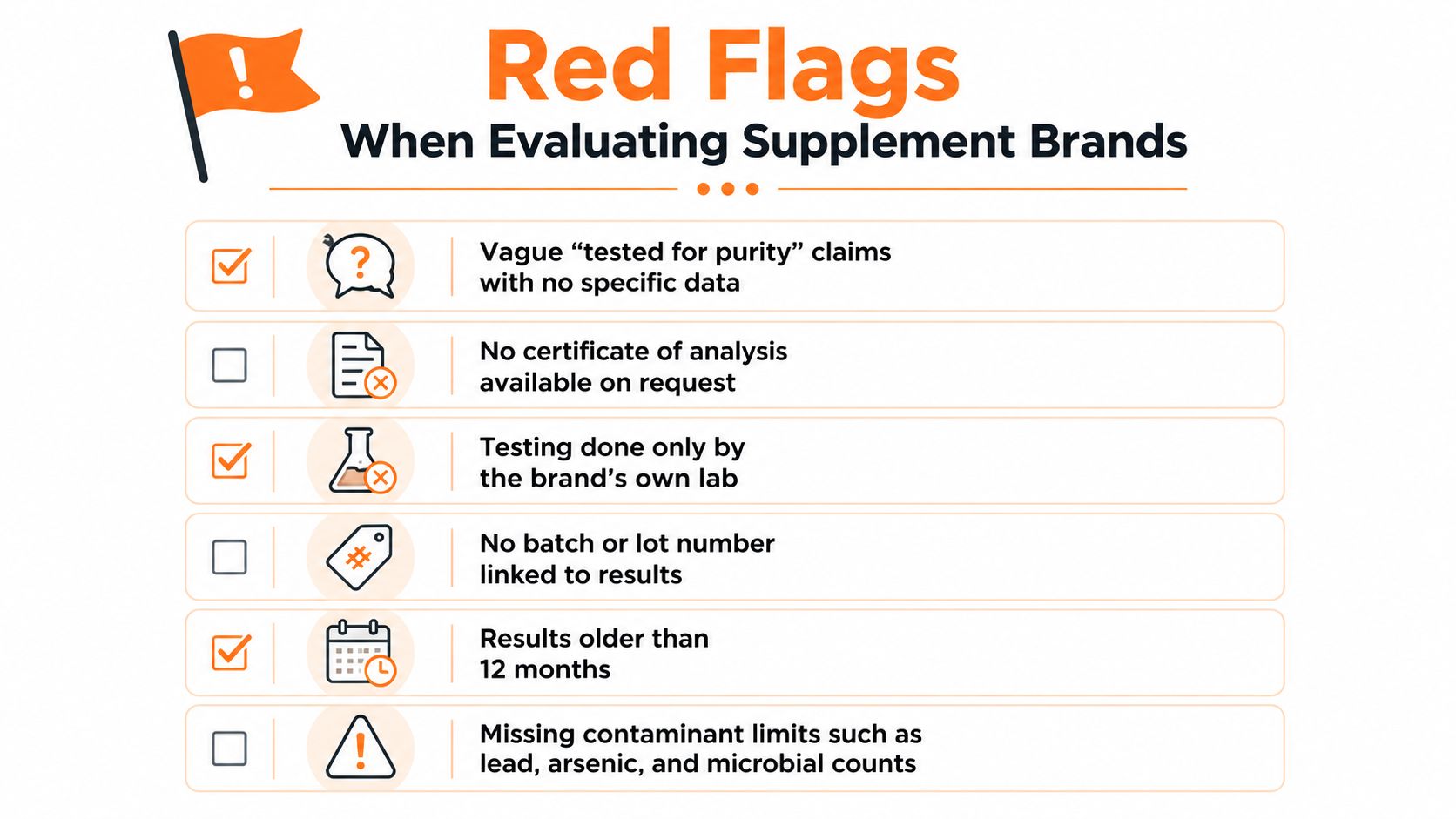
A buyer can often identify weak testing claims quickly by comparing the evidence beside the marketing language. The issue isn't that every short product page is deceptive. The issue is that specific claims should lead to specific documentation.
Weak evidence versus useful evidence
| Weak signal | Stronger evidence |
|---|---|
| “Tested for purity” with no analyte list | Named tests for identity, potency, microbes, elemental contaminants, and adulterants |
| A laboratory logo without a report | A COA tied to the product's lot or batch |
| An aggregated or undated result | A current, lot-specific document |
| No laboratory qualification information | Accreditation or documented laboratory credentials |
| “Pass” without a method or threshold | Method, result, reporting limit, and acceptance criterion |
| Testing only on raw materials | Finished-capsule testing, with raw-material controls described separately |
| A claim that testing proves the product works | Separate substantiation for any structure/function claim |
A refusal to provide a COA isn't automatic proof of a defective product, but it limits the consumer's ability to evaluate the claim. Missing detection limits also matter. “Not detected” can mean the compound was absent at the method's sensitivity, but the reader needs that sensitivity to understand what the result excludes.
Testing doesn't authorize disease claims
FDA structure/function claims for dietary supplements aren't pre-approved by the agency. A manufacturer must possess substantiation showing that a claim is truthful and not misleading, then notify FDA no later than 30 days after first marketing the product with the claim. FDA guidance on structure/function claims
Laboratory testing can support statements about identity, strength, composition, purity, and contamination. It doesn't authorize claims that a supplement diagnoses, treats, cures, or prevents a disease, and a disclaimer can't make an unsupported disease claim acceptable.
The required disclaimer is:
“These statements have not been evaluated by the Food and Drug Administration. This product is not intended to diagnose, treat, cure, or prevent any disease.”
Where a qualifying structure/function claim appears on a label or other labeling, FDA guidance says the disclaimer should remain immediately adjacent to the claim, or appear in a connected box using a matching symbol, with prominent presentation and boldface under the relevant notification framework. FDA disclaimer placement guidance
Building a Personal Quality Assessment Routine
A practical routine can turn a vague quality claim into a short evidence check:
- Find the lot-specific COA.
- Confirm it covers finished capsules, not only raw materials.
- Check the laboratory's qualifications and methods.
- Look for identity, potency, microbes, elemental contaminants, and adulterants.
- Verify detection limits, acceptance criteria, and actual results.
- Treat “third-party tested” as an invitation to inspect the scope, not as a conclusion.
| Red-flag brand | More transparent brand |
|---|---|
| Logo only | Lot-linked COA |
| “Pure” without criteria | Named analytes and limits |
| One narrow screen | Risk-based testing panel |
| No method details | Method and laboratory information |
| No batch traceability | Finished-product lot identification |
Meaningful supplement quality testing is a system connecting specifications, sourcing, manufacturing controls, laboratory methods, and documented release decisions. It gives consumers a more realistic basis for comparison than a badge alone.
SEMEX offers a men's daily supplement formulated around semen volume and taste-focused ingredients, with product information available for consumers evaluating formulation and quality documentation. Visit SEMEX to review the product and apply the same questions about testing scope, lot traceability, and transparency before making a purchase.