

Supplement for Sexual Health: What Actually Works
If an ingredient has been studied for blood flow, does that mean a supplement containing it will also increase semen volume, improve taste, or support fertility? Those are different outcomes, and treating them as interchangeable is where many sexual-wellness claims become misleading.
Choosing a supplement for sexual health starts with a more useful question than whether its ingredient list looks impressive: What was studied, at what dose, and does that evidence apply to the product you're considering? Safety testing and medication compatibility deserve the same attention as potential benefits.
Table of Contents
- Why Men Are Turning to Sexual Health Supplements
- Understanding How Supplements Support Sexual Health
- The Evidence Behind Key Ingredients
- What Timeline to Expect from a Daily Supplement
- How to Audit a Supplement Label Like a Pro
- Choosing a Tested and High-Quality Product
- Safety, Interactions, and When to Ask a Doctor
- Putting It All Together for Your Decision
Why Men Are Turning to Sexual Health Supplements
A man opens a product page because he wants more confidence with his partner. He reads about stamina, semen volume, sperm health, and circulation, then assumes they're different ways of describing the same benefit. They aren't, and buying a product without separating those goals makes it difficult to judge whether it's useful.
Another shopper may care mainly about taste or shared satisfaction. Someone else may be worried about conception. These motivations are understandable, but they call for different evidence and, sometimes, a conversation with a healthcare professional rather than another purchase.
Start with the concern behind the search
Fertility concerns deserve particular care. The World Health Organization's global infertility analysis estimated that approximately 17.5% of adults, about 1 in 6 people worldwide, experience infertility during their lifetimes, using evidence covering 1990 through 2021. That establishes the importance of reproductive health, not the effectiveness of supplements.
A useful starting point is to describe your goal without marketing language:
- Confidence and satisfaction: What would a better experience mean to you and your partner?
- Erection support: Are you asking about firmness or maintaining an erection?
- Ejaculate characteristics: Are volume or taste your actual priorities?
- Reproductive concerns: Are you seeking reassurance about sperm health or having difficulty achieving pregnancy?
These aren't interchangeable shopping categories. A claim about sperm movement doesn't answer a question about desire, and a circulation ingredient doesn't automatically address taste.
Practical rule: If you can't name the outcome you want, you can't meaningfully evaluate a promise to improve it.
A dietary supplement intended to support normal wellness also belongs in a different category from a medication used to treat a diagnosed condition. You don't need to dismiss supplements outright, but you do need to recognize that distinction before deciding what a product can reasonably offer.
Understanding How Supplements Support Sexual Health
Think of sexual and reproductive function as a workshop rather than a single machine. Different workers handle signaling, circulation, reproductive cells, and fluid production. Providing a material used in one job doesn't mean every part of the workshop will perform differently.
The same logic applies to nutrients. A biological role explains why researchers might study an ingredient. It doesn't establish that taking extra amounts produces a noticeable benefit. Supporting a normal process and improving an outcome in a clinical trial are separate questions.
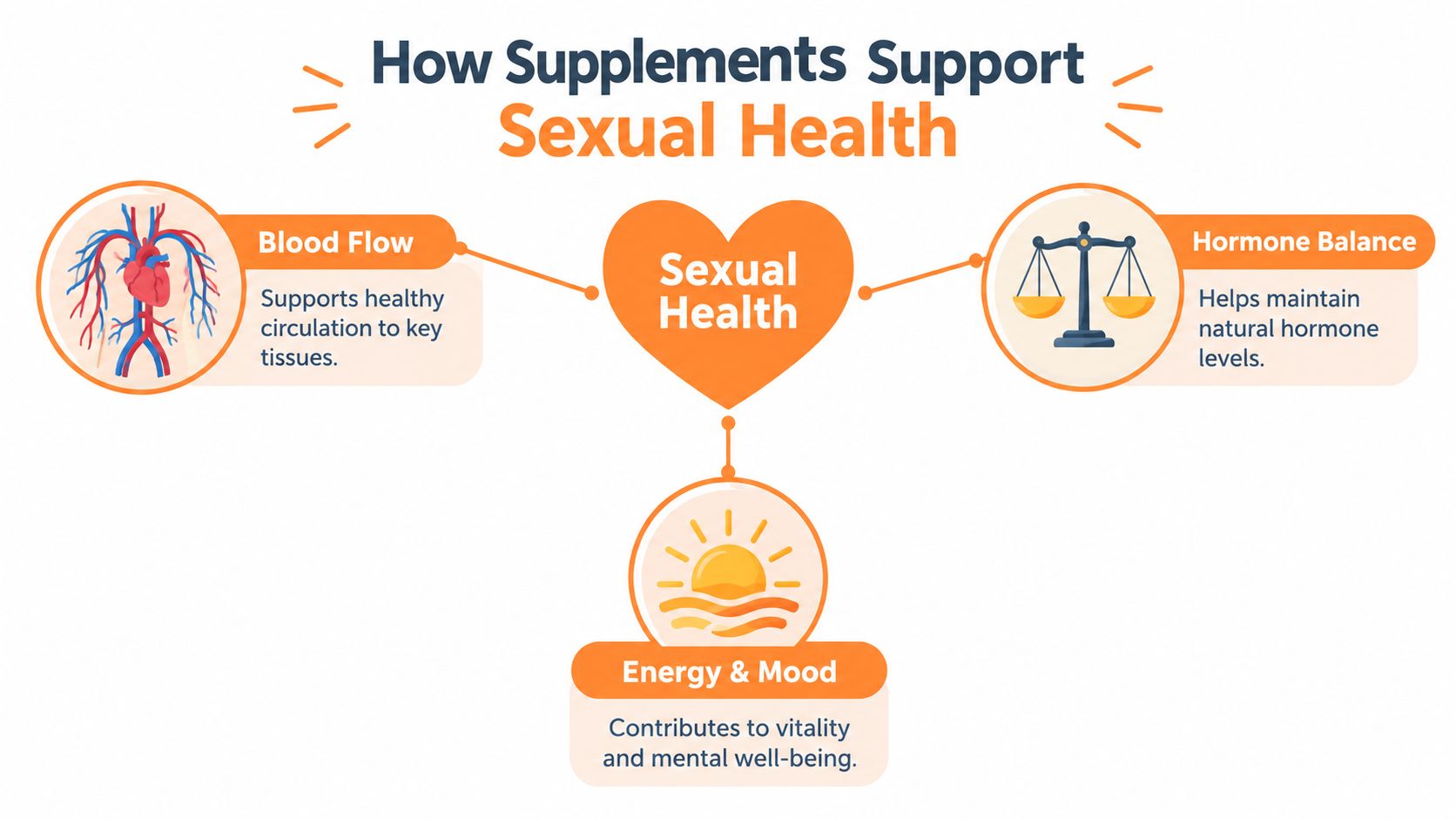
Different ingredients have different jobs
Zinc illustrates the distinction. A review of zinc in male reproductive processes describes its involvement in sperm development, maturation, ejaculation, and seminal-fluid function. That makes zinc relevant to normal reproductive physiology, but it doesn't make a zinc-containing supplement a treatment for low sperm count.
L-arginine has a different role. The body uses it in a pathway that produces nitric oxide, a signal involved in relaxing vascular smooth muscle and supporting penile blood-flow signaling during sexual stimulation. A systematic review of sexual-function ingredients discusses this mechanism and the heterogeneous human evidence, which concerns erectile-function measures rather than semen taste or sperm production.
The diagram groups broad wellness themes, but it shouldn't be interpreted as evidence that every supplement improves hormones, energy, mood, or circulation. Each branch requires its own supporting research.
- Mechanism: What does the ingredient do in normal biology?
- Measured outcome: What did researchers assess in people?
- Practical relevance: Does that measurement match your reason for taking it?
For example, a questionnaire about erectile function can provide information about sexual experience. It cannot tell you whether sperm concentration changed unless researchers measured that separately.
This is why broad phrases such as “supports male performance” need unpacking. Ask which process the manufacturer means, then look for evidence tied to that process rather than assuming the phrase covers everything.
The Evidence Behind Key Ingredients
Zinc, L-arginine, and bromelain often appear in conversations about men's supplements, but their evidence isn't equivalent. The important comparison isn't which ingredients a formula includes. It's which outcomes researchers examined and how confidently those findings can be interpreted.
Zinc and measurable semen characteristics
A systematic review and meta-analysis of seminal-plasma zinc covering 20 studies, with 2,600 cases and 867 controls, found lower seminal zinc among infertile men than controls. Its supplementation analysis reported favorable findings for semen volume, sperm motility, and normal morphology, but not significant improvements in sperm concentration, total sperm count, or viability.
Those distinctions matter. Motility means movement; concentration describes sperm within a given amount of semen. Neither is the same as a pregnancy or live birth, and an association between zinc levels and infertility doesn't prove that extra zinc resolves infertility.
L-arginine and dose-dependent findings
In a randomized trial of oral L-arginine, men with organic erectile dysfunction received 5 g daily for six weeks. Subjective improvement occurred in 9 of 29 men receiving L-arginine, or 31%, compared with 2 of 17 receiving placebo, approximately 12%, while objective measures didn't change. The apparent benefit occurred among participants who initially had low urinary nitric-oxide metabolites.
A separate placebo-controlled crossover study evaluated 500 mg three times daily, totaling 1.5 g per day, and concluded that the regimen wasn't superior to placebo. Different doses and study populations make a universal promise inappropriate, and neither trial establishes benefits for semen volume or taste.
Bromelain and taste-related claims
Bromelain requires a particularly cautious reading. The evidence discussed here doesn't establish that oral bromelain reliably improves semen taste, nor does it establish a clinically supported dose for that purpose. An appealing explanation or positive testimonial isn't a substitute for a study that measures the claimed outcome.
Key Ingredients and What the Research Shows
| Ingredient | Studied Role | Outcome Evidence |
|---|---|---|
| Zinc | Normal reproductive physiology and semen characteristics | Favorable findings for selected parameters, not proof of improved fertility |
| L-arginine | Nitric-oxide-related signaling and erectile-function measures | Mixed human findings that depend on regimen and population |
| Bromelain | Taste-focused marketing requires direct investigation | No supporting taste-outcome evidence established here |
A broader review of vitamin and mineral supplementation examined 18 randomized, double-blind, placebo-controlled trials, but pregnancy rates were assessed in only four trials in its meta-analysis and three studies in its systematic review. Limited outcome reporting makes sweeping fertility claims difficult to justify.
Use an ingredient-by-ingredient male-enhancement guide to organize label questions, not to turn ingredient research into proof of a finished formula. A product needs its own testing before its complete formulation can be credited with a studied result.
What Timeline to Expect from a Daily Supplement
There isn't a universal countdown to sexual-health benefits. A daily schedule tells you how a product is intended to be used; it doesn't tell you when, or whether, you'll notice a meaningful change.
The fitness analogy is useful up to a point. Consistent training is easier to evaluate than sporadic workouts, but consistency alone doesn't guarantee a particular result. Similarly, regular supplement use can make your experience easier to assess without proving that the formula works.
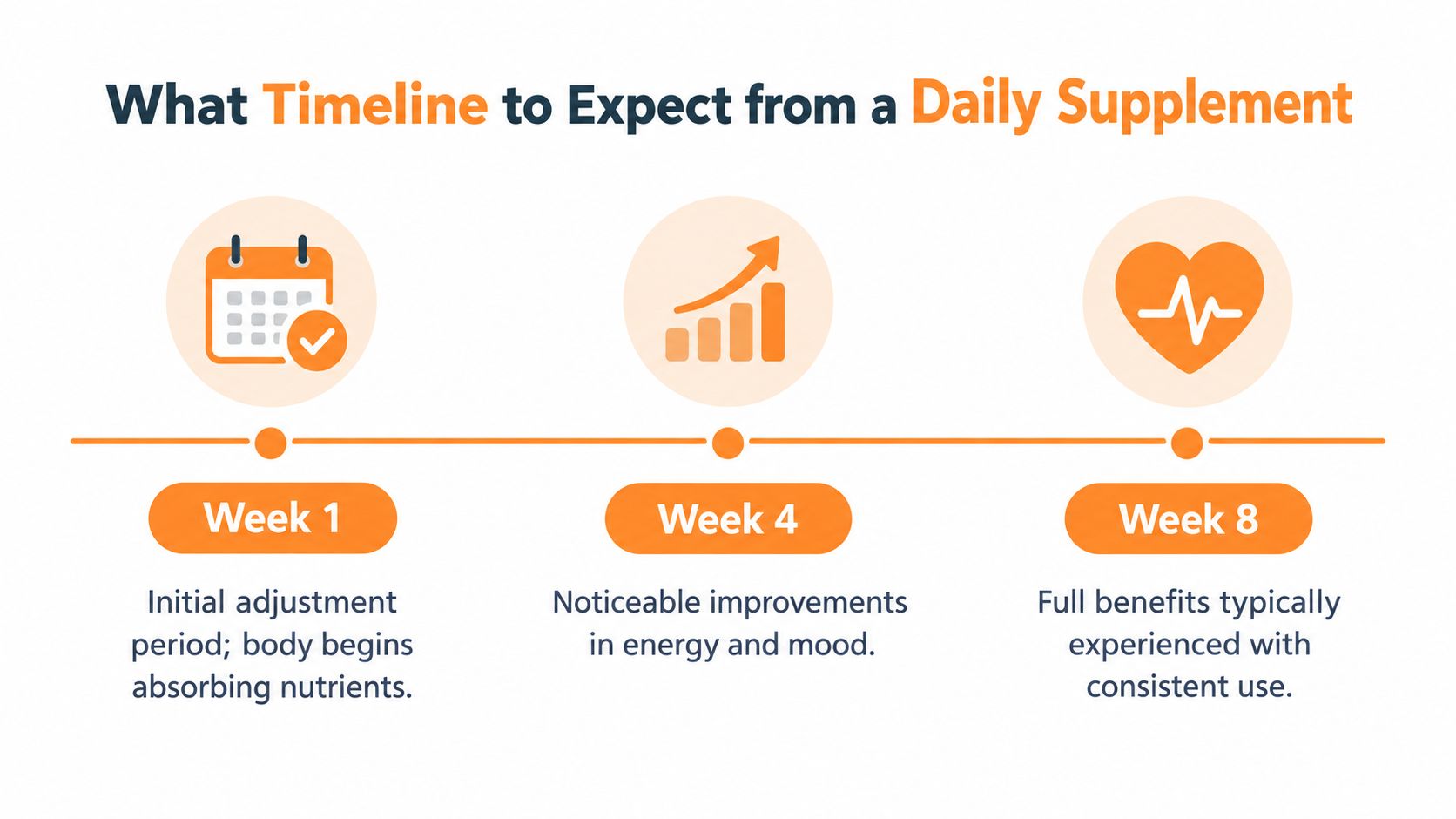
Use timelines as questions, not promises
The graphic presents an illustrative progression, not a clinically validated schedule. Its milestones shouldn't be taken to mean that energy, mood, or full benefits will predictably change at those points. Study duration, marketing expectations, and time to a noticeable effect are different things.
Rather than treating a calendar as proof, establish an evaluation plan:
- Define your starting point: Write down the specific concern before you begin, using language you can revisit.
- Keep the comparison understandable: Avoid introducing several new supplements together, which makes any perceived change difficult to interpret.
- Follow labeled directions: Don't increase the dose to chase faster results.
- Set a review point: Discuss an appropriate assessment period with a clinician or pharmacist, especially if symptoms are persistent.
A useful journal records both desired changes and unwanted effects. It should also note major changes in your routine, so you don't automatically credit the supplement for everything that happens afterward.
A study lasting several weeks doesn't establish that everyone should expect a benefit by its final day.
When reading about how long supplements take to work, look for the outcome, formulation, and study population behind each timeline. If a manufacturer can't explain those connections, treat the timetable as an expectation to question rather than a result to count on.
How to Audit a Supplement Label Like a Pro
A longer ingredient list can look more complete without offering stronger evidence. In an evidence-based assessment of male-fertility supplements, 50% of 24 reviewed products had no expected efficacy, 65.2% contained at least one ingredient without evidence for male fertility, and 21 formulations included potentially active ingredients below reported minimal effective daily doses.
Those findings don't prove that every complex formula is ineffective. They show why counting ingredients is a poor substitute for evaluating amounts and outcomes.
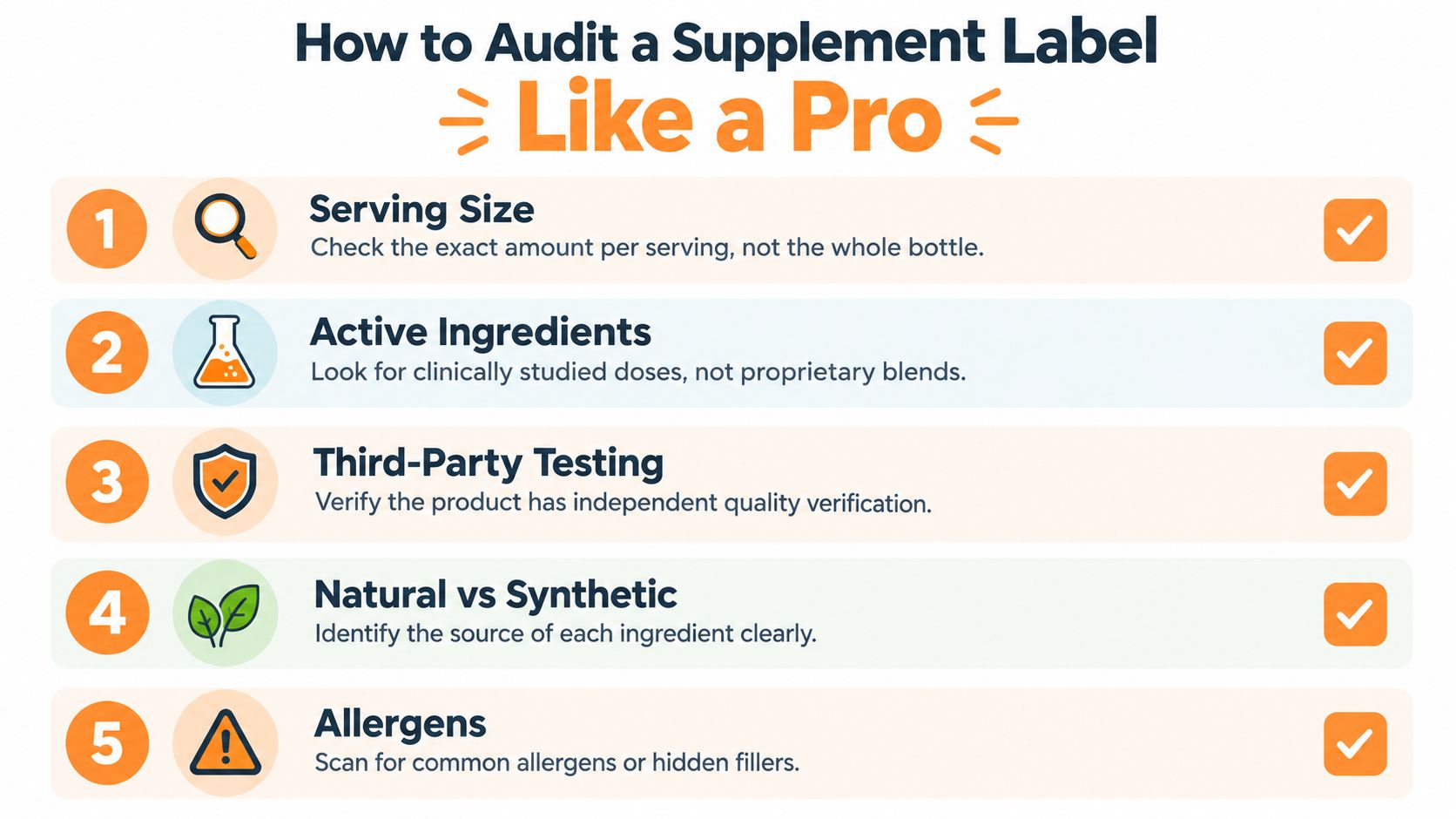
Read from serving size to supporting study
Begin with the serving size, not the front-label headline. Determine how much of each ingredient you'd consume when following the directions, then compare that amount with relevant research.
- Match the outcome: Research on erection questionnaires doesn't validate a semen-volume claim.
- Match the ingredient: Look for the studied form or combination rather than assuming similarly named preparations are interchangeable.
- Check disclosure: If individual amounts are hidden within a blend, you can't complete a meaningful dose comparison.
- Identify the evidence level: Ask whether the cited study tested the ingredient alone, an ingredient combination, or the exact finished product.
The phrase minimal effective daily dose also needs context. It refers to an amount associated with an effect under particular study conditions, not a universal minimum that guarantees results for every user.
Separate an evidence match from a buying decision
Suppose a label includes L-arginine and cites a trial involving a much larger daily amount. The shared ingredient name doesn't close that gap. Equally, matching a research dose doesn't establish that the dose is suitable or safe for you.
Label-audit shortcut: Ask the manufacturer to identify the study that matches the ingredient, daily amount, and advertised outcome.
A completed audit may lead to different conclusions: a plausible formulation, an evidence gap, an undisclosed dose, or a safety question that needs professional review. “Contains studied ingredients” is only the beginning of that process.
Keep a practical guide to reading supplement labels beside the product page and record unanswered questions. If you can't determine what you'd be taking, don't treat the uncertainty as a minor detail.
Choosing a Tested and High-Quality Product
Quality testing and effectiveness testing answer different questions. A laboratory report can help establish what's in a product and whether specified contaminants meet its testing criteria. It cannot establish that the product improves sexual satisfaction or reproductive outcomes.
This distinction matters in the sexual-enhancement category. The FDA's sexual-enhancement and energy-product notifications warn that products may contain hidden prescription drugs or other undeclared substances, with potentially serious consequences.
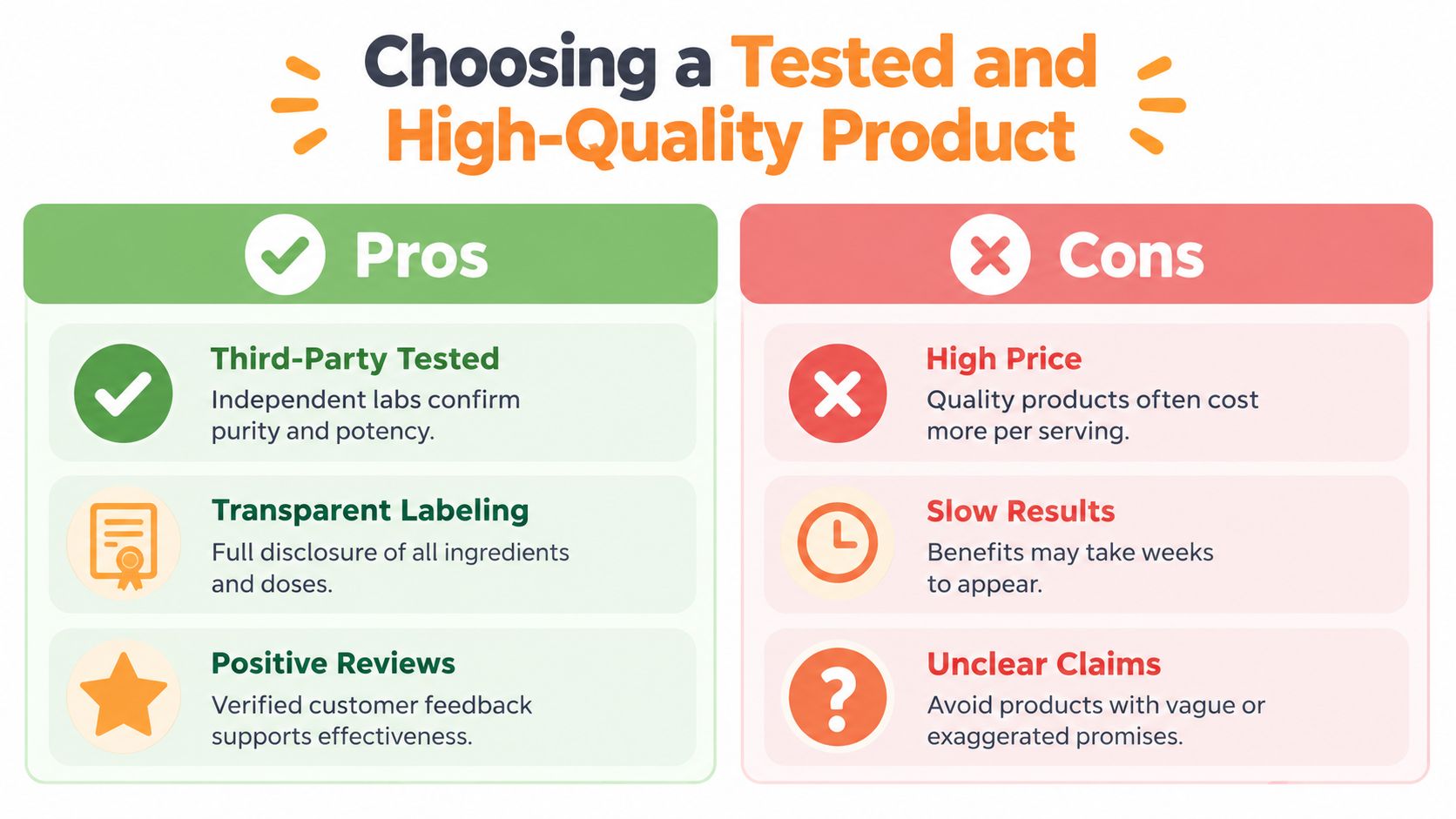
Ask for documents rather than badges
A third-party-tested badge should lead to verifiable information. Ask for a report that identifies the product, the relevant batch, the laboratory, and what was tested.
- Identity and amounts: Does the testing address the declared ingredients and their quantities?
- Contaminants: Does it cover heavy metals and microbes?
- Adulterants: Does the testing specifically address undeclared drug ingredients?
- Thresholds: Does the company publish the limits used to determine a passing result?
A report is useful only within its stated scope. Don't assume that a test for heavy metals also screened for hidden pharmaceuticals, or that a report for a different batch describes the bottle you're buying.
Interpret other quality signals carefully
If a manufacturer cites a cGMP-registered facility, ask what that designation means and what documentation supports it. Treat manufacturing information as part of the quality assessment, not evidence that the formula delivers an advertised benefit.
Vegan and non-GMO describe sourcing choices. They don't establish medication compatibility, purity, or clinical effectiveness. Likewise, a money-back guarantee is a purchasing term, not a scientific finding.
The comparison graphic also needs that distinction: customer reviews can describe experiences, but they don't establish efficacy. Price alone doesn't establish quality either, so compare documentation rather than assuming that the more expensive bottle is better tested.
A transparent manufacturer should be willing to answer specific questions without replacing the answer with testimonials. If the company won't explain its testing scope or provide meaningful documentation, that's a reasonable reason to choose another option.
Safety, Interactions, and When to Ask a Doctor
Safety isn't a final checkbox after you've decided to buy. Medication compatibility can determine whether an otherwise interesting ingredient is appropriate at all. A natural-sounding name doesn't remove that responsibility.
L-arginine can lower blood pressure and may be unsuitable alongside nitrates, some antihypertensives, or other vasodilatory agents, as discussed in the ingredient review cited earlier. Don't assume you can manage that concern just by taking the supplement at a different time.

Check your full daily intake
For zinc, the NIH Office of Dietary Supplements lists an adult male recommended dietary allowance of 11 mg daily and an adult upper limit of 40 mg daily from food, beverages, supplements, and medications combined. Excessive intake can interfere with copper absorption and may reduce immune function or HDL cholesterol.
That makes stacking products important. A multivitamin and a separate men's formula may both contribute zinc, even if you bought them for different reasons.
- Request a medication review: Speak with a clinician or pharmacist if you use blood-pressure medicines, nitrates, anticoagulants, or diabetes medication.
- Discuss existing conditions: Bring up chronic health concerns before starting a new formula.
- Bring the actual label: Include serving directions and every ingredient amount, along with your other supplements.
- Establish stopping rules: Stop taking the supplement and seek medical advice for dizziness, palpitations, or allergic symptoms. Chest pain or severe allergic symptoms warrant urgent medical attention.
Don't use supplements to postpone evaluation
Persistent erection difficulties, changes in desire, or fertility concerns deserve a proper assessment. A product marketed as a rapid erectile-dysfunction solution should prompt particular caution, not an assumption that it's more effective.
Use a supplement-interaction checklist to prepare questions, but let a qualified professional assess your specific combination. That review is more useful than relying on a broad “safe for men” statement.
Putting It All Together for Your Decision
The most useful decision isn't “Which bottle promises the most?” It's “Which option, if any, fits my goal, evidence standards, and safety needs?” Not buying is a valid outcome when the information doesn't support a confident choice.
Keep your comparison focused on the unresolved questions rather than revisiting every marketing claim. A short written record can help you avoid changing your standards when a product page sounds persuasive.
Make the decision you can explain
Before placing an order, complete this checklist:
- My goal is specific: I can describe the outcome without using a vague term such as enhancement.
- The evidence is relevant: I know whether the research concerns the ingredient or the finished formula.
- The amount is disclosed: I can identify the daily intake and explain how it relates to the cited research.
- The quality claim is verifiable: I've checked what independent testing covers.
- My safety questions are answered: I've reviewed medication compatibility and know when to stop.
Keep supplements in proportion to the rest of your life. Diet, exercise, stress management, communication with your partner, and appropriate healthcare shouldn't be pushed aside while you wait for a capsule to change your experience.
You don't need certainty about every biological detail. You do need enough transparency to distinguish a reasonable wellness choice from an unsupported promise, and enough flexibility to reconsider if your experience doesn't justify continuing.
These statements have not been evaluated by the Food and Drug Administration. This product is not intended to diagnose, treat, cure, or prevent any disease.
SEMEX offers a daily men's supplement formulated to support semen volume and taste, making it an option to evaluate alongside other sexual-wellness products. Visit its product information, review the ingredient amounts and testing documentation, and use the audit above to decide whether it fits your goals and safety requirements.