

Sunflower Lecithin Vegan: A Practical 2026 Guide
Yes, pure sunflower lecithin is vegan because it comes from sunflower seeds, but the full picture depends on the rest of the label. Sunflower lecithin products can contain different phosphatidylcholine levels, including 12%–18%, 19%–23%, and 8%–10% in forms listed in an FDA GRAS notice, so “vegan” describes the source, not a fixed chemical profile.
Could a product be made with vegan sunflower lecithin and still fail a strict vegan check? Yes. The lecithin itself may be plant-derived while the capsule shell, glazing agent, carrier, or manufacturing process remains unclear. That's why the useful question isn't only “Is sunflower lecithin vegan?” It's “Does the entire finished product meet the shopper's vegan standard?”
Table of Contents
- What Sunflower Lecithin Actually Is
- How Sunflower Lecithin Compares to Soy and Egg Lecithin
- Where Sunflower Lecithin Comes From and How It's Made
- Hidden Non-Vegan Risks on Lecithin Labels
- Where Sunflower Lecithin Shows Up in Supplements
- Safety, Regulation, and the FDA Disclaimer
- A Practical Buyer's Checklist for Vegan Sunflower Lecithin
What Sunflower Lecithin Actually Is
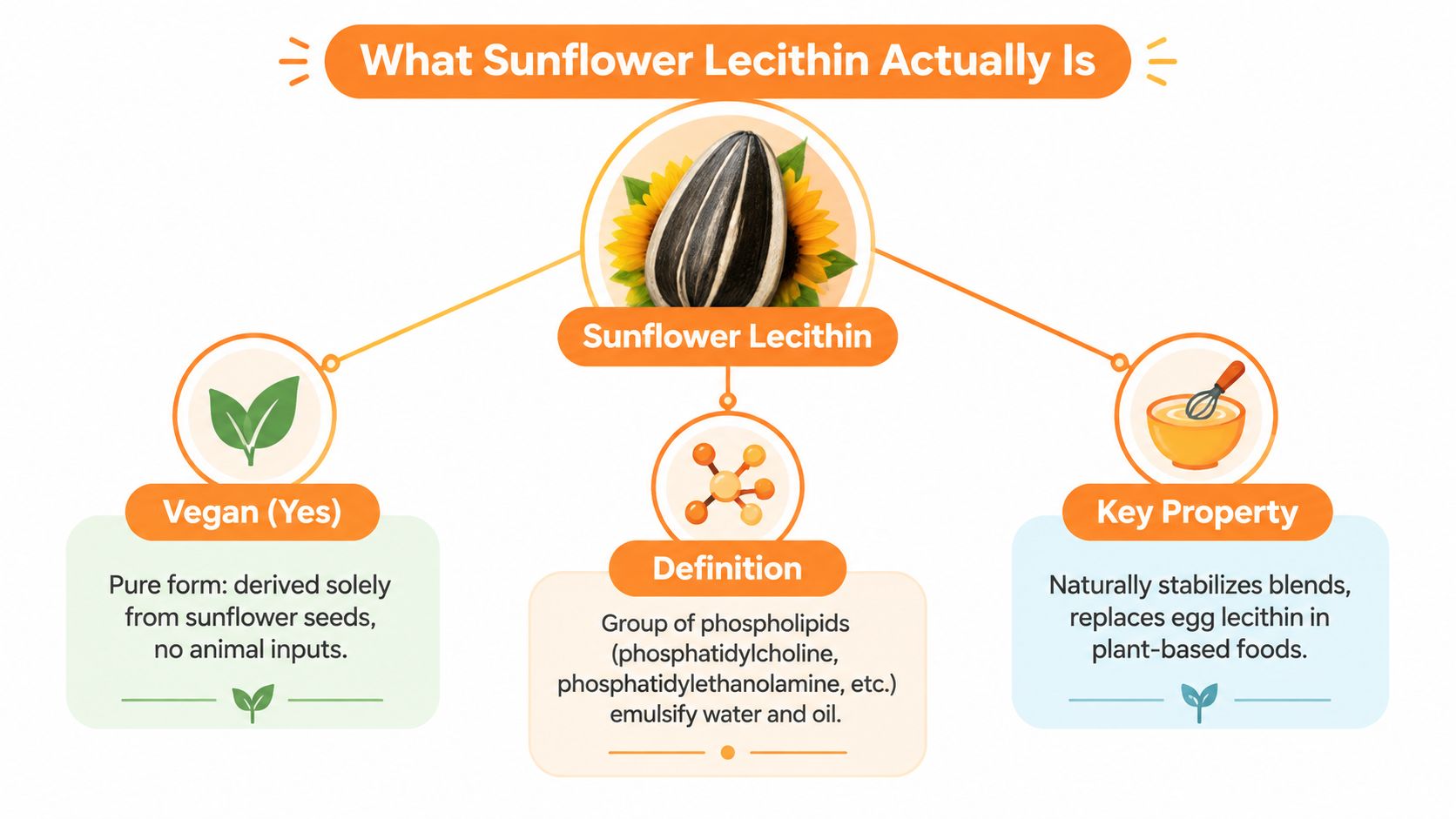
What makes sunflower lecithin useful in a supplement? It is a mixture of phospholipids, not one isolated chemical. These molecules have one part attracted to water and another attracted to oil. They work like tiny two-headed connectors, with one end facing water and the other facing fat, helping ingredients stay blended instead of separating.
That behavior gives lecithin its role as an emulsifier in foods, powders, liquids, and supplements. One of its best-known components is phosphatidylcholine, usually abbreviated as PC. Other phospholipids include phosphatidylinositol and phosphatidylethanolamine.
A de-oiled sunflower lecithin powder specification lists roughly 25% phosphatidylcholine, 20% phosphatidylinositol, 12% phosphatidylethanolamine, and about 3% phosphatidic acid. Those figures describe one specification, not every sunflower lecithin product. Sunflower lecithin composition specification
Why the percentage matters
Manufacturers often describe lecithin by its phosphatidylcholine concentration, but grade and processing method change the result. A de-oiled powder, a liquid grade, and a hydrolyzed form may have different phospholipid profiles. The same ingredient name therefore does not guarantee the same PC level.
For vegan label checking, this distinction matters because E322 is the general food-additive designation for lecithins. An E322 listing alone does not identify the source. Look for “sunflower lecithin” or another clear source statement rather than assuming that E322 means sunflower.
Source verification is only the first check. A product may use sunflower lecithin while its capsule shell contains gelatin, or while another ingredient, coating, or carrier has an animal origin. Manufacturing equipment shared with non-vegan materials can also matter to shoppers who avoid cross-contamination. Ingredient guidance on lecithin and vegan compatibility
Read the full finished-product label, not just the lecithin line.
How Sunflower Lecithin Compares to Soy and Egg Lecithin
Could two lecithins perform similar emulsifying work yet lead to different vegan buying decisions? Yes. The main differences are source, allergen considerations, composition, and label clarity. Sunflower lecithin comes from sunflower oil processing, soy lecithin from soybeans, and egg lecithin from egg yolk. Sunflower and soy can fit a vegan formula, while egg lecithin cannot.
Sunflower is often chosen by shoppers who want a plant-based, soy-free option. Soy lecithin can also be vegan when it comes from soy and the formula contains no animal-derived inputs, but soy is a regulated major allergen in many markets. Egg lecithin has an animal source, so it is incompatible with vegan products.
Composition depends on grade and processing. A source comparison should therefore avoid assuming that one plant source always has more of a particular phospholipid. Published research describes variation across sunflower lecithin products and applications. Peer-reviewed review of sunflower lecithin applications
| Attribute | Sunflower Lecithin | Soy Lecithin | Egg Lecithin |
|---|---|---|---|
| Source organism | Sunflower seeds and sunflower oil processing | Soybeans and soybean oil processing | Egg yolk |
| Vegan status | Generally vegan-compatible when the finished formula contains no animal-derived additions | Vegan-compatible when no animal-derived ingredients are added | Not vegan |
| Allergen focus | Supports soy-free positioning, although the full label still matters | Soy allergen declaration may be relevant | Egg allergen and animal origin are central concerns |
| PC profile | Depends on grade and specification | Depends on processing and specification | Depends on product and application |
| Traceability | The source can be named clearly as sunflower | The source can be named clearly as soy | The animal source should be clear when declared |
| Common buyer question | Are the capsule and processing chain also vegan? | Is soy acceptable for the shopper? | Can this ingredient fit a vegan formula? |
The table answers the source question, but a finished supplement needs closer inspection. E322 is a general designation for lecithins, so it does not identify sunflower, soy, or egg by itself. Look for a specific source statement, then check the capsule shell, coatings, carriers, and other ingredients. Gelatin in the shell can make a sunflower-labeled supplement non-vegan, and shared equipment may matter when cross-contamination must be avoided.
For a closer plant-source comparison, review sunflower lecithin versus soy lecithin, particularly if soy avoidance or a sunflower-based formulation guides the purchase.
Where Sunflower Lecithin Comes From and How It's Made
How does a seed become the lecithin found in a vegan supplement? The process starts with sunflower seeds, not a synthetic phospholipid made in a laboratory. Manufacturers clean the seeds, recover sunflower oil, and separate the phospholipid-rich fraction from it.
A simplified production path includes:
- Seed preparation: Sunflower seeds are cleaned and prepared for oil recovery.
- Oil release: Mechanical pressing produces crude sunflower oil.
- Degumming: Water hydrates the phospholipids, helping them separate from the oil.
- Separation: The hydrated gum fraction is removed from the oil.
- Drying: The material becomes a powder or remains a liquid concentrate.
- Standardization: Manufacturers adjust the ingredient to a target phospholipid or PC profile.
Degumming works like skimming a raft from a stockpot. The raft is the hydrated phospholipid fraction, which can be collected rather than discarded. Further concentration resembles sorting marbles by size, retaining the phosphatidylcholine-rich fraction suited to a particular formulation.
Concentrated sunflower phospholipid products can have higher PC levels than ordinary fluid or powder grades. A 2021 patent application described 45%–70% PC compositions, while published formulations have used sunflower lecithin at about 90% PC as a starting material for phospholipid conversion. These figures describe particular compositions, not every sunflower lecithin product. Research on sunflower lecithin and phospholipid conversion
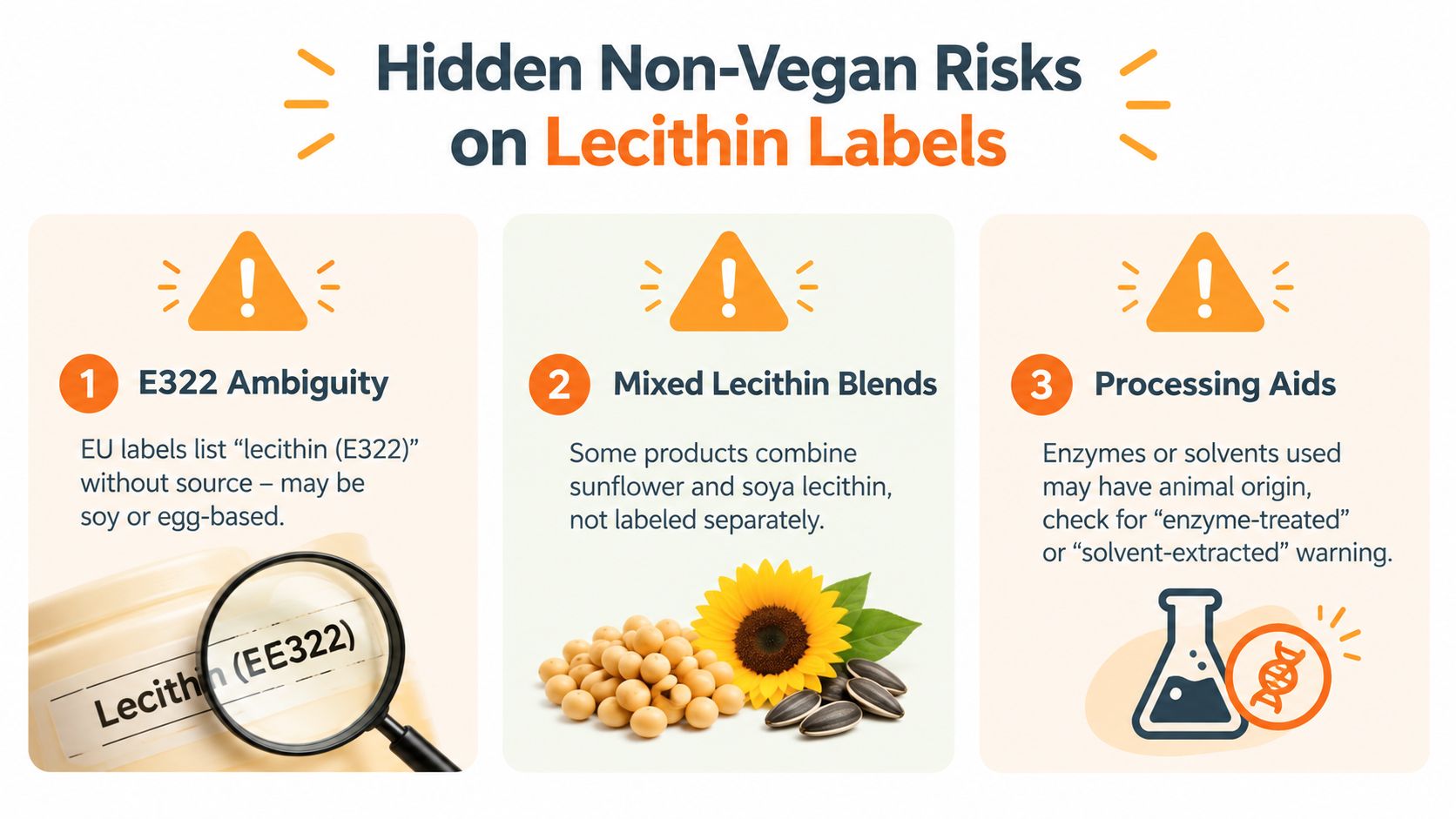
Some manufacturers use ethanol, acetone, or other processing aids during concentration. Their use does not automatically make the ingredient non-vegan, because the substances may be removed during processing. Shoppers who care about extraction methods or residual aids should request a clear specification or certificate of analysis. The product format also matters, so review this guide to sunflower lecithin powder when comparing powders with liquid concentrates.
Hidden Non-Vegan Risks on Lecithin Labels
The words “sunflower lecithin” identify a plant-derived lecithin source, but they don't automatically certify the entire supplement. Vegan verification has three separate layers: the lecithin source, the other ingredients, and the manufacturing environment.
The E322 problem
European labels may use E322 for lecithin without naming the source. That code can cover plant or animal-derived lecithin, so a vegan shopper can't rely on E322 alone. The same caution applies to a label that says “lecithin” without identifying sunflower, soy, or another plant source. Label guidance on ambiguous lecithin sources
A product can also contain a blend. “Sunflower lecithin” may appear prominently on the front while the full ingredient line includes another lecithin source, a carrier, or an emulsifier that needs separate review.
Capsule shells and minor ingredients
Softgels commonly use gelatin, which comes from animal collagen. A strict vegan shopper should look for alternatives such as pullulan, HPMC, or tapioca-based shells, then inspect the remaining ingredients for animal-derived glycerine, shellac, lanolin-based glazing agents, or unclear processing aids.
A practical label exercise includes these checks:
- Source line: It should say “sunflower lecithin,” not only “lecithin” or “E322.”
- Other ingredients: Review the entire line, including carriers and capsule materials.
- Allergen statement: Look for egg or soy declarations that conflict with the intended formula.
- Facility statement: Shared equipment can matter to shoppers who avoid cross-contamination.
- Certification: Look for a recognized vegan seal, such as Vegan Society, Certified Vegan, or BeVeg.
Practical rule: A named sunflower source is a strong starting point, but a vegan decision belongs to the complete product label.
Brands can clarify whether animal-derived materials are used in processing or shared facilities. A guide to vegan certification can help shoppers understand why certification may provide more assurance than a front-label plant claim alone.
Where Sunflower Lecithin Shows Up in Supplements
Sunflower lecithin appears in supplements for two different reasons. Sometimes it's the intended phospholipid ingredient. In other products, it helps disperse oils and powders, making a blend easier to mix or fill into capsules.
| Category | Typical Sunflower Lecithin Dose | Role of Lecithin | Vegan Compatibility Notes |
|---|---|---|---|
| Cognitive and liver support formulas | Product-specific | Provides phospholipids, with PC content varying by grade | Check the PC specification and capsule shell |
| Cardiovascular and lipid-balance blends | Product-specific | Supplies phospholipid functionality and may accompany plant sterols or plant oils | Review every added ingredient, not just the lecithin |
| Men's wellness formulas | Product-specific | Can provide sunflower-derived phospholipids within a broader formula | Confirm the finished product's vegan claim and shell material |
| Oil suspensions and omega blends | Product-specific | Helps stabilize or disperse oil-based ingredients | Liquid carriers and flavor systems need review |
| Pet supplements | Product-specific | May support blend consistency or provide phospholipids | Animal-oriented products aren't automatically vegan for human shoppers |
The Supplement Facts panel should answer three practical questions. First, does it identify the material as liquid, powdered, de-oiled, or phosphatidylcholine-rich sunflower lecithin? Second, does it state an amount per serving? Third, does the “other ingredients” line identify a plant-based capsule or delivery system?
SEMEX is one example of a vegan men's wellness supplement whose formula includes sunflower lecithin, alongside zinc, L-arginine, bromelain, maca root, Panax ginseng, ashwagandha, tongkat ali, saw palmetto, and horny goat weed. Its product positioning connects the formula with support for semen volume and taste, but those are structure/function-style supplement claims, not disease-treatment claims. Shoppers should still inspect the current package label for the exact capsule material and ingredient details.
The important distinction is between an active phospholipid source and a formulation helper. A product may contain a modest amount of lecithin to improve blend behavior, while another may emphasize PC content as a principal ingredient characteristic.
Safety, Regulation, and the FDA Disclaimer
Sunflower lecithin occupies two regulatory contexts. In conventional foods, lecithin is recognized by the FDA through GRAS use, while finished dietary supplements are generally marketed under the Dietary Supplement Health and Education Act framework rather than reviewed like prescription medicines before sale.
That distinction affects label language. A brand can use a structure/function statement such as “supports normal cellular structure” when it has substantiation that the statement is truthful and not misleading. It can't claim that sunflower lecithin diagnoses, mitigates, treats, cures, or prevents a disease. FDA guidance on structure/function claims
The FDA also specifies the disclaimer required for dietary supplement structure/function claims. It must appear prominently in boldface and accompany the claim under the agency's labeling guidance. FDA dietary supplement labeling guidance
For safety, shoppers should distinguish ordinary food use from a concentrated supplement. A person who is pregnant, breastfeeding, taking medication, managing a medical condition, or choosing a product for a child should consult a qualified clinician before using a concentrated phospholipid supplement. People using blood thinners or medicines with anticholinergic effects should also ask a healthcare professional to review the complete formula.
Potential tolerance issues are usually practical rather than dramatic. Some users may experience digestive discomfort, particularly when introducing a new concentrated supplement. A balanced plant-based diet remains the foundation, and a lecithin product should complement food rather than replace it.
A Practical Buyer's Checklist for Vegan Sunflower Lecithin
Could a supplement contain vegan sunflower lecithin yet fail to be vegan overall? Yes. The ingredient is only one link in the chain. Check the finished product, much like checking every component of a recipe rather than approving one plant-based ingredient.
- Confirm the source: The label should name sunflower lecithin. “Lecithin” or “E322” alone is incomplete because E322 can describe lecithin from different sources.
- Verify the PC specification: If the product emphasizes concentrated phospholipids, look for phosphatidylcholine content and compare it with the grades described earlier. A clear percentage helps you compare products without assuming all lecithin powders or liquids are equivalent.
- Inspect the capsule shell: Read the shell material separately from the active ingredient. Gelatin makes a capsule non-vegan, while a plant-based shell still requires review of its full ingredient list.
- Look for certification: Vegan Society, Certified Vegan, V-Label, and BeVeg marks can offer added assurance about ingredients and production controls. Treat certification as supporting evidence, not a substitute for reading the panel.
- Scan additives: Review carriers, coatings, glycerine, magnesium stearate, mono- and diglycerides, shellac, and flavor systems. A vague “natural flavor” or unqualified processing aid may require a question to the manufacturer.
- Read allergen and facility statements: “Made in a facility” wording does not automatically make a product non-vegan. It can matter if you want to avoid shared equipment with egg or dairy, or if the brand does not explain its cleaning controls.
- Match the delivery form: Powder suits smoothies, liquid allows flexible dosing, and capsules favor convenience. Each format has its own excipients, so check the actual version you plan to buy.
- Ask for documentation: A transparent brand should explain its extraction method, identify any animal-derived processing materials, and provide a current certificate of analysis when available. FDA sunflower lecithin GRAS notice
Use this sequence before relying on a vegan badge or a plant-based headline.
Label habit: If the source, shell, additives, or processing chain remains unclear, contact the manufacturer before buying. “Lecithin” by itself does not verify vegan status.
For shoppers comparing a plant-based men's wellness option, SEMEX lists a vegan formula that includes sunflower lecithin and is intended for daily use. Visit SEMEX to review its current ingredient panel, product details, and vegan positioning before deciding.
These statements have not been evaluated by the Food and Drug Administration. This product is not intended to diagnose, treat, cure, or prevent any disease.