

Sunflower Lecithin Side Effects: What to Know
A new bottle of sunflower lecithin can look simple enough: capsules beside a protein powder, granules mixed into a shake, or an ingredient listed on a fortified food label. Then the first few servings bring bloating, loose stools, nausea, or an unfamiliar stomach sensation. The immediate question is usually whether the supplement is unsafe, but the more useful question is personal: Was the dose too high, was it taken without food, or could an allergy be involved?
Most reported sunflower lecithin side effects are mild and digestive. Still, people with seed sensitivities, those taking several lecithin-containing products, and anyone planning long-term daily use need a more careful framework than a simple “generally safe” label.
Table of Contents
- Why People Ask About Sunflower Lecithin Side Effects
- What Sunflower Lecithin Actually Is
- The Most Common Digestive Side Effects
- Allergy and Hypersensitivity Reactions Worth Knowing
- How Dose Changes the Risk Picture
- What the Evidence Does and Does Not Cover
- How to Start, Monitor, and Know When to Stop
Why People Ask About Sunflower Lecithin Side Effects
Sunflower lecithin appears in several forms, including capsules, powders, chocolate, nutrition bars, and protein products. A person may add it to an existing supplement routine without realizing that another product already contains lecithin. That makes the total intake harder to judge, especially when a new symptom appears soon after the change.
The usual complaints are bloating, gas, nausea, loose stools, diarrhea, stomach discomfort, and reduced appetite. These effects are generally described as mild, particularly when the product is used at ordinary supplemental amounts, and public-facing safety guidance says they often improve after lowering the dose or taking it with meals. A safety and dosage guide for sunflower lecithin also notes that allergic reactions can occur, including breathing problems, wheezing, dizziness, and vomiting.
A personal risk map
Three details often explain why one person tolerates sunflower lecithin while another doesn't:
- Dose size: A sudden increase gives the digestive system less time to adapt.
- Food intake: Taking capsules on an empty stomach may make nausea or loose stools more noticeable.
- Allergy history: A person sensitive to sunflower seeds, soy, eggs, or another relevant source may need more careful label review.
Practical rule: A new digestive symptom after starting sunflower lecithin doesn't automatically indicate toxicity. It does justify reviewing the dose, timing, total daily intake, and any history of food reactions.
The evidence also has limits. Sunflower lecithin has fewer dedicated clinical trials than many established supplements, so its side-effect profile isn't measured with the same precision across every dose and duration. The clearest pattern remains dose-related digestive upset, while allergy questions and long-term use deserve separate attention. A review of sunflower lecithin for clogged ducts describes the clinical-trial data as limited and places the practical focus on dose, food intake, and individual sensitivity.
What Sunflower Lecithin Actually Is
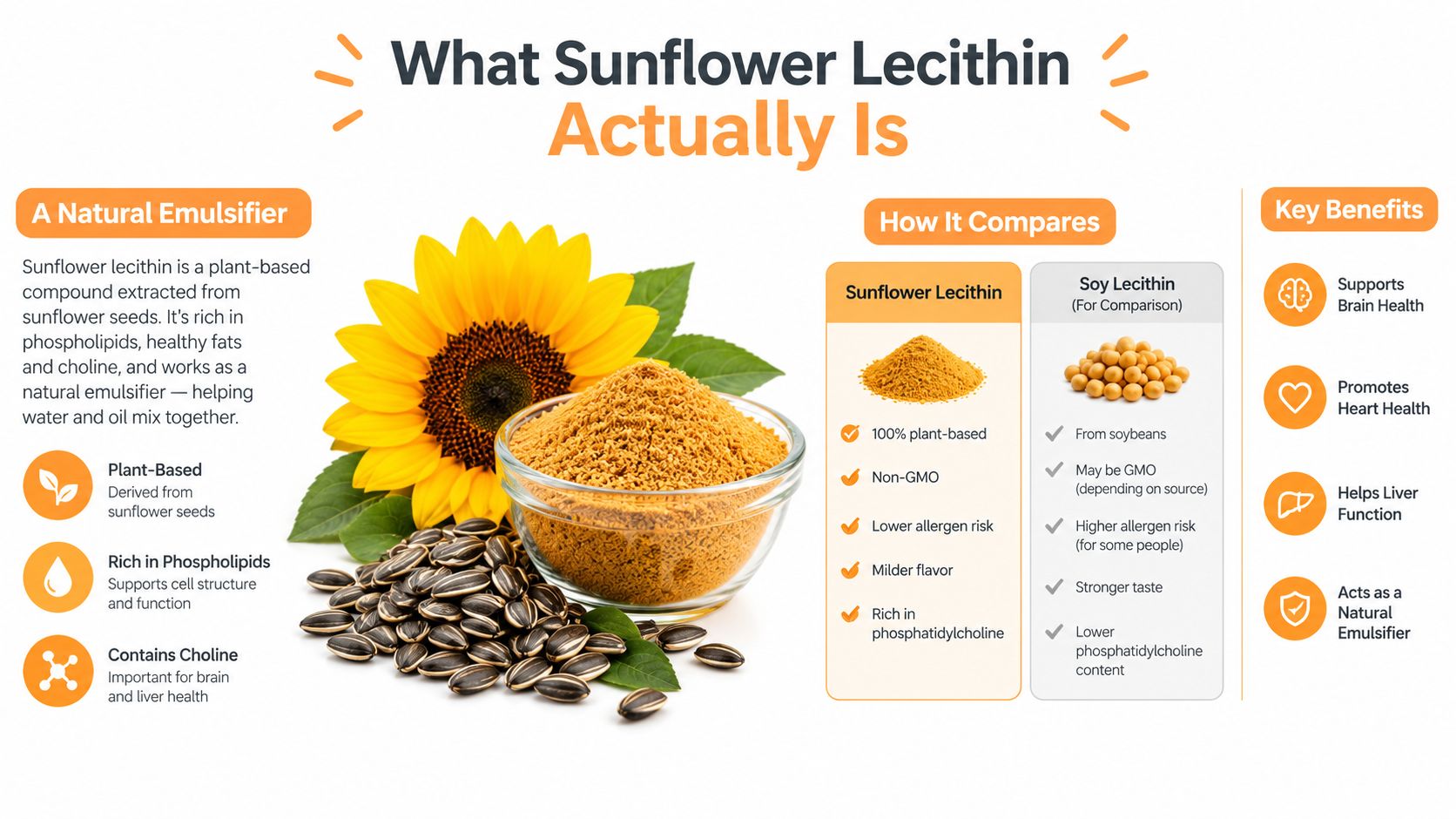
Sunflower lecithin is a mixture of phospholipids obtained from sunflower seeds. One important fraction is phosphatidylcholine, a choline-containing phospholipid involved in cell structure and fat transport. In food manufacturing, lecithin works as an emulsifier, helping ingredients that normally separate, such as fats and water, remain blended.
Manufacturers commonly process sunflower material by separating the oil-rich portion, concentrating the lecithin fraction, and converting it into a liquid or powder that is easier to handle and store. The finished ingredient isn't the same as sunflower cooking oil. Its composition and function come from phospholipids rather than from the bulk oil used for frying or dressings.
Why brands choose it over soy lecithin
Sunflower lecithin and soy lecithin share an emulsifying role, but their source profiles differ:
- Origin: Soy lecithin comes from a legume, while sunflower lecithin comes from a seed.
- Protein concerns: Residual source proteins and cross-contact can matter for people with allergies, although the exact risk depends on processing and labeling.
- Formula preferences: Brands may choose sunflower lecithin when they want a non-soy, plant-derived emulsifier for capsules, chocolate, powders, or nutrition products.
Sunflower lecithin is often selected because it fits clean-label and soy-avoidance preferences. That doesn't mean it is allergy-proof. The source still matters, and people with known food allergies should inspect the ingredient statement, allergen declaration, and manufacturing warnings rather than relying only on the word “sunflower.”
Men comparing phospholipid ingredients can also review what sunflower lecithin is and why men use it. The key distinction is that an ingredient's role in a formula doesn't remove the need to assess personal tolerance.
The Most Common Digestive Side Effects
Digestive symptoms form the most consistent cluster associated with sunflower lecithin. Reports commonly include bloating, gas, loose stools, diarrhea, nausea, stomach cramps, and general discomfort. An evidence-based safety overview describes these effects as mild, dose-related, and usually reversible after reducing the amount or taking the supplement with food.
The likely reason is related to lecithin's emulsifying behavior. Phospholipids interact with fats, bile, intestinal fluids, and gut movement. That interaction can alter how the digestive tract handles fluid and contents, particularly when a person introduces a larger amount quickly. The mechanism is plausible, but it doesn't predict the exact response of every individual.
Why timing and stacking matter
An empty stomach can make nausea or stomach irritation more obvious. A large serving can also create a sharper digestive response than the same daily amount divided between meals. Products can add another layer of confusion because a person may combine capsules with a powder, fortified shake, or food that already contains lecithin.
A practical approach is to change one variable at a time. Taking the product with a meal, dividing the daily amount across meals, and beginning below the full label serving can make it easier to identify whether the problem is dose-related. A fat-containing snack may also make capsules easier to tolerate, although it isn't a guarantee against symptoms.
| Symptom | Common Trigger | Adjustment That Helps |
|---|---|---|
| Bloating or gas | Increasing the amount quickly or combining several lecithin products | Reduce the total intake and reintroduce it more gradually |
| Loose stools or diarrhea | A higher intake or taking it without food | Take it with meals and pause or lower the dose if symptoms appear |
| Nausea | Empty-stomach dosing | Pair the serving with food and avoid adding other new supplements at the same time |
| Stomach cramps | A concentrated serving that exceeds personal tolerance | Split the amount across meals or stop until symptoms settle |
| Fishy body odor or increased salivation | Very high lecithin or choline intake | Review the full supplement stack and seek professional guidance before continuing |
The last row reflects broader lecithin and choline safety literature rather than a common response at ordinary sunflower lecithin use. A lecithin safety summary notes that very high intakes can produce cholinergic-type effects, including sweating, salivation, reduced appetite, and fishy body odor. Those effects are uncommon at typical supplemental doses, but they become more relevant as intake rises.
Allergy and Hypersensitivity Reactions Worth Knowing
Digestive discomfort and an allergic reaction don't look the same. Bloating or loose stools that improve after lowering the dose usually points toward intolerance or dose sensitivity. Hives, itching, swelling, wheezing, breathing difficulty, dizziness, or vomiting require a more cautious response, particularly when symptoms develop soon after exposure.
Sunflower lecithin is a lipid-rich extract, but commercial ingredients can contain residual source proteins or encounter cross-contact during manufacturing. Those proteins, rather than the phospholipid itself, may be relevant for a sensitised person. A sunflower-seed allergy therefore deserves direct attention, even though many consumers choose sunflower lecithin specifically to avoid soy.
Allergy versus intolerance
Classic immune-mediated reactions may include hives, itching, facial or throat swelling, wheezing, and severe breathing difficulty. A person experiencing breathing problems, rapidly developing swelling, faintness, or signs of a severe reaction should seek emergency medical care rather than waiting to see whether the symptom passes.
Other reactions are less clearly characterised. Headache, flushing, dermatitis, or a nonspecific rash may reflect intolerance, contact exposure, another ingredient, or an immune response that needs assessment. Reports of dermatitis and respiratory irritation exist, but severe reactions are uncommon. WebMD's lecithin overview highlights allergy concerns and lists reactions such as breathing problems, hives, swelling, nausea, and dizziness.
People with soy or egg allergies should also examine the product's source and cross-contact statements. A sunflower-based label doesn't automatically describe every processing aid or shared facility. People with pollen or seed sensitivities may want to discuss possible cross-reactivity with an allergist, particularly if they have reacted to related plant materials before.
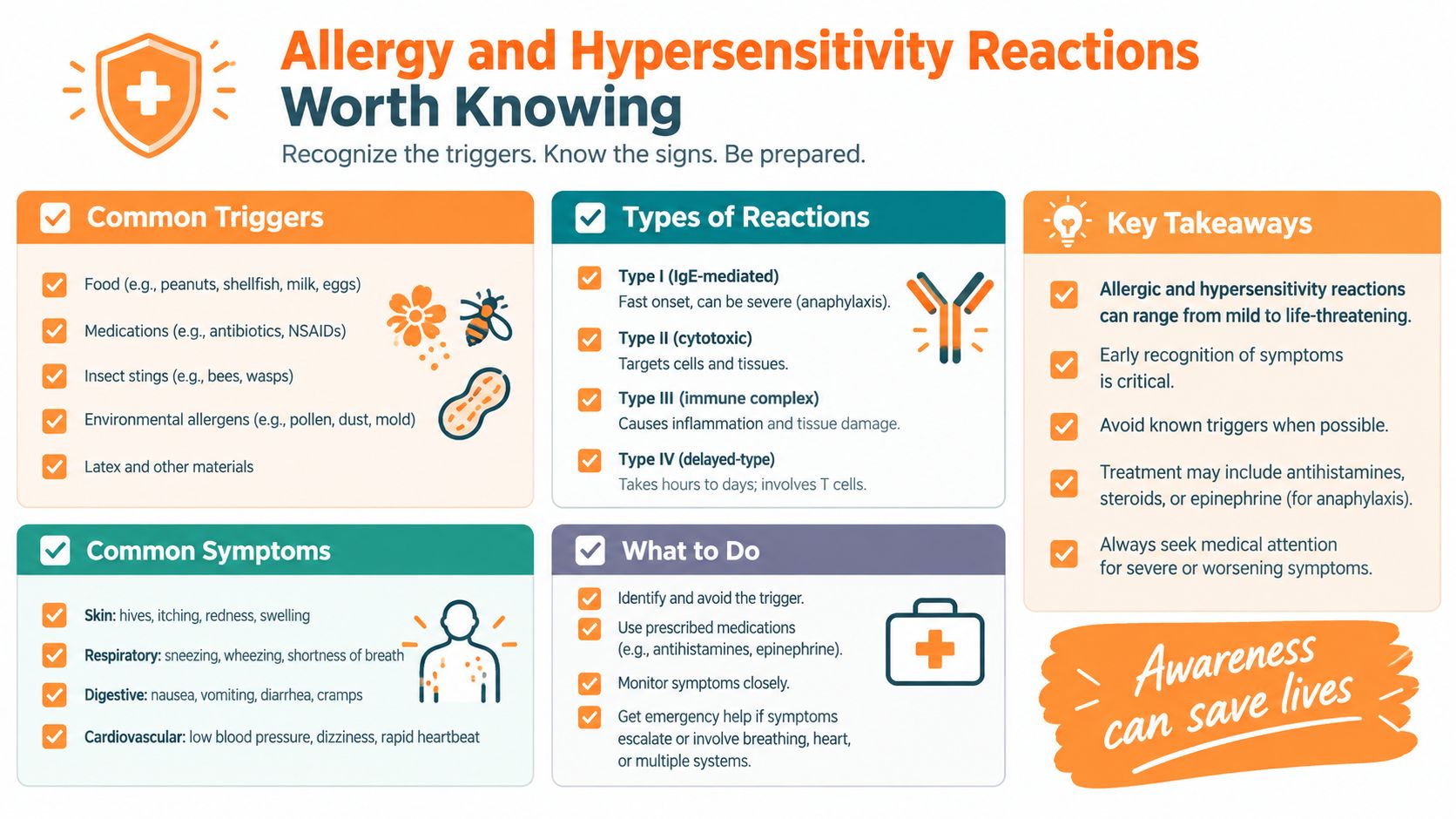
Antihistamines or immunosuppressive medicines can complicate symptom recognition because they may blunt some warning signs. They don't make a questionable reaction safe to ignore. Anyone with a documented seed or legume allergy, a prior supplement reaction, or uncertainty about a rash should stop the new product and speak with a clinician or allergist before retrying it.
How Dose Changes the Risk Picture
Sunflower lecithin side effects are better understood as dose and sensitivity issues than as a fixed property of the ingredient. A person who tolerates a small amount in food may still experience diarrhea or cramping after adding a concentrated supplement serving, especially when the total daily intake rises quickly.
Typical lactation-use guidance commonly describes 3,600 to 4,800 milligrams per day as generally well tolerated, although that doesn't establish a universally appropriate dose. The relevant safety discussion also emphasises that clinical data for sunflower lecithin remain limited. Separately, WebMD states that lecithin is likely safe at doses of up to 30 grams daily for up to 6 weeks, which is a short-term framing for lecithin generally, not proof of long-term sunflower lecithin safety. WebMD's lecithin monograph provides that boundary.
| Intake range | Typical use | Most common symptoms | Safety framing |
|---|---|---|---|
| Food-level exposure | Emulsified foods and fortified products | Usually no noticeable effect for tolerant users | Food-use safety depends on the product and total exposure |
| Ordinary supplement use | Capsules or powder used according to a label | Digestive upset can occur in sensitive users | Start with the label directions and assess individual tolerance |
| Lactation-style use | Higher daily amounts divided across servings | Loose stools, nausea, bloating, or cramping become more relevant | The commonly described range is generally tolerated by most people, but individual advice still matters |
| Very high short-term intake | Amounts approaching broader lecithin limits | Digestive effects and cholinergic-type symptoms deserve attention | The cited upper framing applies to lecithin generally and only for a limited period |
Taking a serving with food and dividing larger amounts across meals may soften the digestive response. Men evaluating a product can compare serving sizes and total daily intake using this sunflower lecithin dosage guide, while remembering that dose-response data specific to sunflower lecithin are often extrapolated from broader lecithin and phospholipid research.
What the Evidence Does and Does Not Cover
“Generally well tolerated” is useful shorthand, but it can hide what researchers haven't measured. Food use and short-term supplemental use provide the strongest practical reassurance. A U.S. FDA GRAS notice for sunflower lecithin states that the ingredient can be used in foods at specified levels, and the notifier concluded that adverse reproductive or developmental effects weren't expected at the intended use levels. The FDA GRAS notice supports a dose-and-route assessment, not a blanket guarantee for every concentrated supplement routine.
Where the evidence is thinner
Several questions remain less settled:
- Product-specific trials: Few randomised trials examine purified sunflower lecithin itself, rather than lecithin more broadly.
- Long-term use: Safety data are stronger for shorter periods than for high supplemental intake continued over many months.
- Sensitive populations: Pregnancy, nursing, chronic digestive illness, and multiple-medication use require individual assessment.
- Allergy reporting: Sparse case-level reporting makes the frequency and severity of hypersensitivity harder to quantify.
- Upper limits: There isn't a clearly established upper limit specific to sunflower lecithin that can be treated as a universal personal target.
That evidence gap changes how a careful educator should phrase the conclusion. Sunflower lecithin appears low risk for many people at ordinary use, but “low risk” isn't the same as risk-free, and a food-use safety evaluation doesn't answer every question about concentrated capsules or powders.
Manufacturers often set serving conventions for practical reasons, while independent evidence may not define the ideal amount for a particular person. That leaves tolerance, total exposure, and personal history at the centre of a responsible decision.
How to Start, Monitor, and Know When to Stop
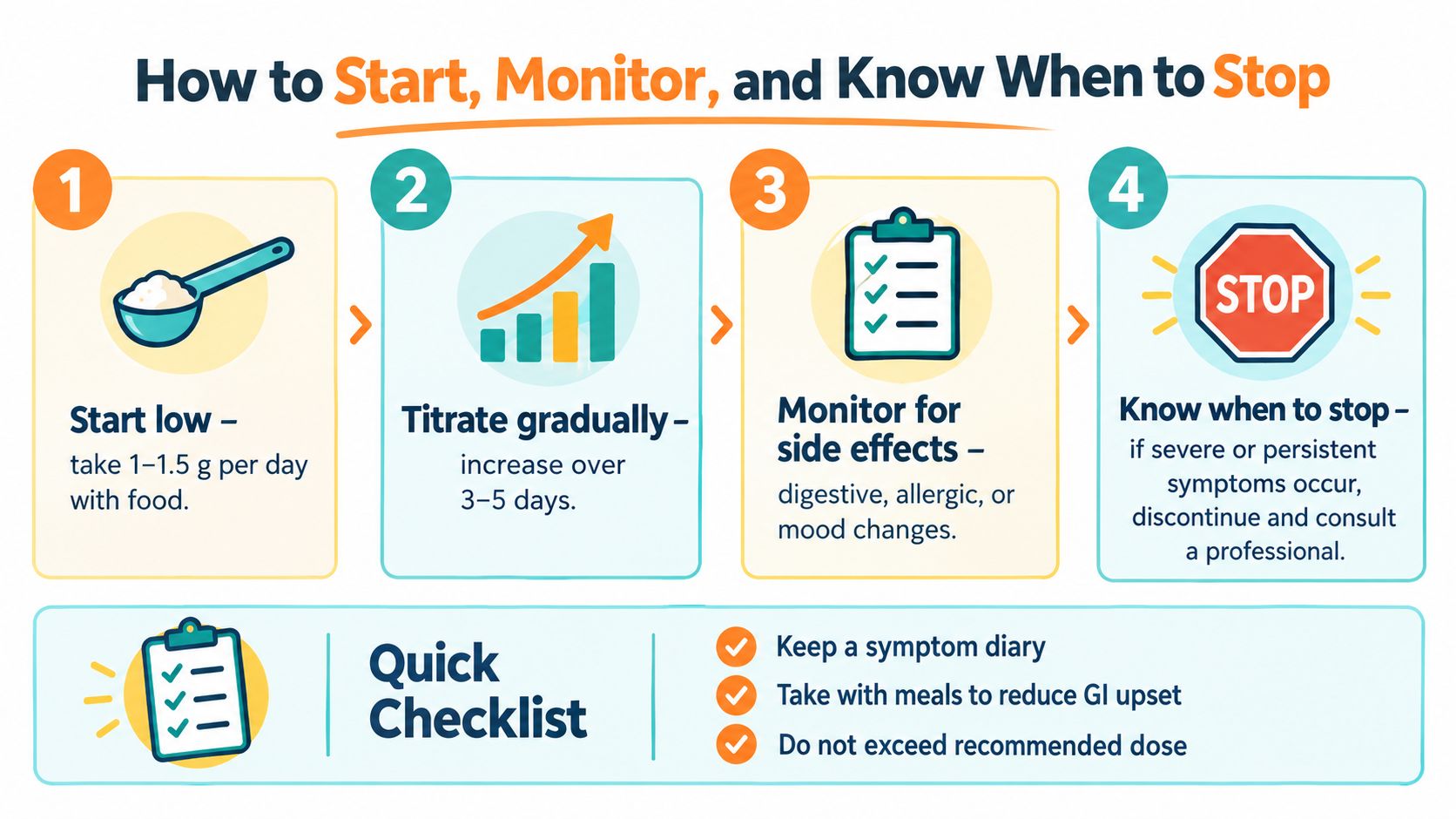
A cautious trial can be simple. A person without a known contraindication may begin with about 1 to 1.5 grams per day with food, then consider gradual adjustment over a 3 to 5 day window if the product is tolerated. The label serving still matters, and a clinician should guide decisions when the supplement is being used during pregnancy or nursing, alongside medication, or for a specific health concern.
A practical monitoring record
For the first week, a short note can reveal patterns that memory misses:
- Digestive response: Record stool changes, nausea, cramps, gas, and bloating.
- Timing: Note whether symptoms occur after an empty-stomach serving or after a larger meal.
- Skin and breathing: Record itching, rash, hives, swelling, throat tightness, or wheezing.
- Stack changes: List any new medication, protein powder, capsule, or fortified food introduced at the same time.
Several groups should consult a clinician before starting. These include people taking blood thinners, pregnant or nursing users, people with documented seed or legume allergies, and anyone with chronic gastrointestinal conditions. A pharmacist can also help identify duplicate ingredients across a supplement stack.
Clear stopping rules
Persistent diarrhea lasting beyond 72 hours, hives, wheezing, breathing difficulty, or any symptom that resembles a known allergen reaction should prompt discontinuation and professional advice. Severe breathing symptoms or rapidly developing swelling call for emergency care.
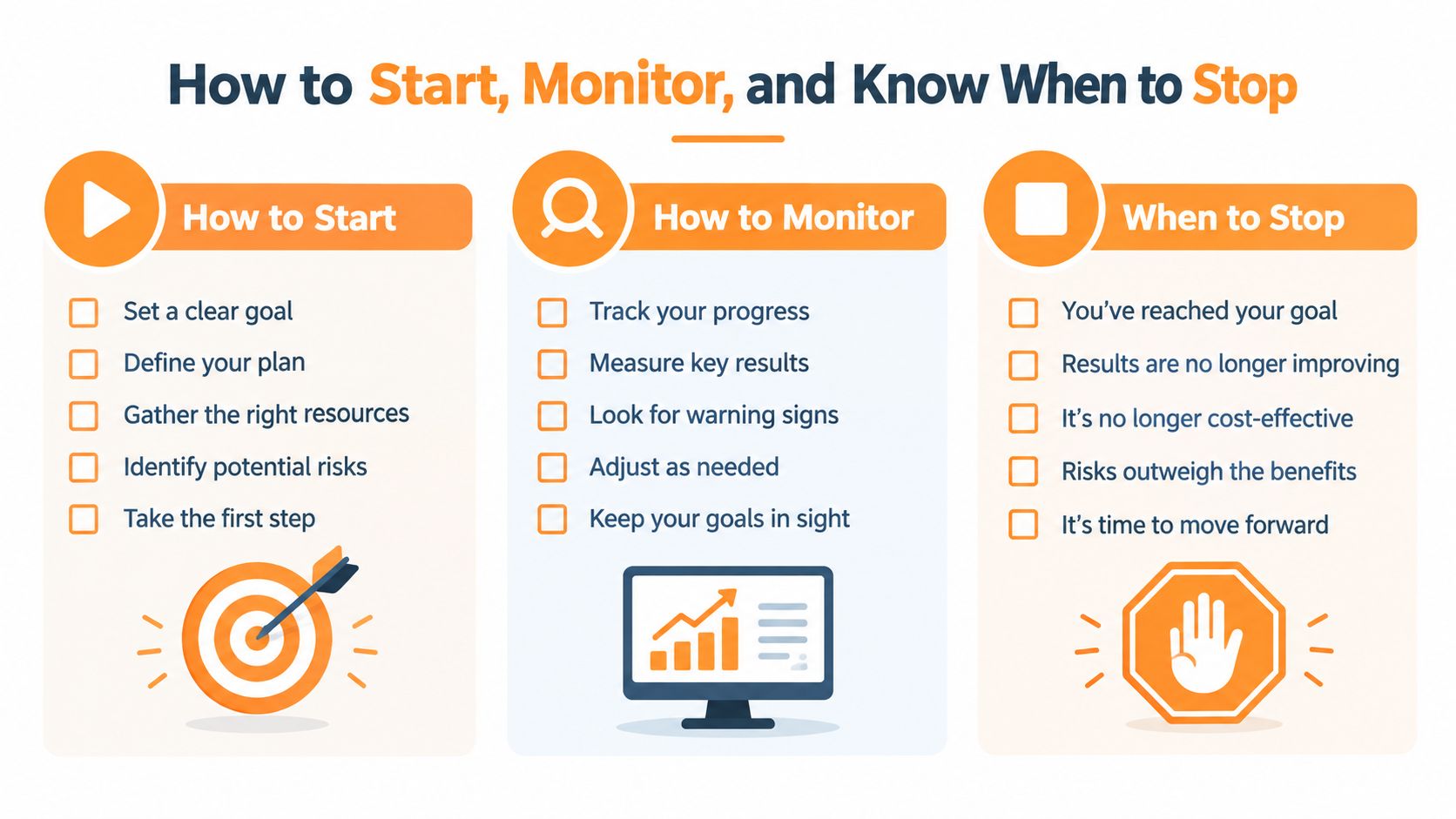
Sunflower lecithin is typically tolerated at normal supplemental intakes, but informed starting is more useful than fear-based avoidance. Readers comparing ingredient formulas can review this sunflower lecithin supplement guide, then discuss the choice with a healthcare professional when allergy history, medication use, or persistent symptoms changes the risk picture.
These statements have not been evaluated by the Food and Drug Administration. This product is not intended to diagnose, treat, cure, or prevent any disease.
SEMEX combines sunflower lecithin with zinc, L-arginine, bromelain, and other men's wellness ingredients in a daily formula designed to support semen volume, taste, and overall vitality. Men who want to review the full ingredient profile, testing information, and usage details can visit SEMEX and make a choice based on their own tolerance and supplement routine.