

Sunflower Lecithin Ingredients: What They Are
If two bottles both list sunflower lecithin, are you getting the same ingredients? Not necessarily. The name tells you where the lecithin comes from, but it doesn't tell you its precise phospholipid profile, how it was processed, or whether research supports the benefit advertised on the bottle.
That distinction matters when you're comparing sunflower lecithin ingredients, especially in men's wellness supplements. Understanding what's measurable, and what's merely plausible, lets you evaluate a formula without mistaking familiar chemistry for a promise of results.
Table of Contents
- What Sunflower Lecithin Actually Is
- The Phospholipid and Fatty Acid Profile
- Sunflower Lecithin Compared to Soy Lecithin
- Why These Ingredients Are Used in Semen Health Supplements
- Grades, Purity, and What a Certificate of Analysis Should Show
- Common Misconceptions Worth Clearing Up
- A Practical Checklist for Reading Any Sunflower Lecithin Label
- Frequently Asked Questions About Sunflower Lecithin Ingredients
What Sunflower Lecithin Actually Is
What does a manufacturer mean when it lists sunflower lecithin as a single ingredient? It means a mixture, not one purified molecule. Think of a pantry blend: the name identifies the category, while the proportions determine what you have.
Sunflower lecithin comes from sunflower-oil processing. Its defining components are phospholipids, accompanied by varying amounts of oil and other compounds. Processing separates a phospholipid-rich material from the oil, and further preparation changes the resulting blend's composition.
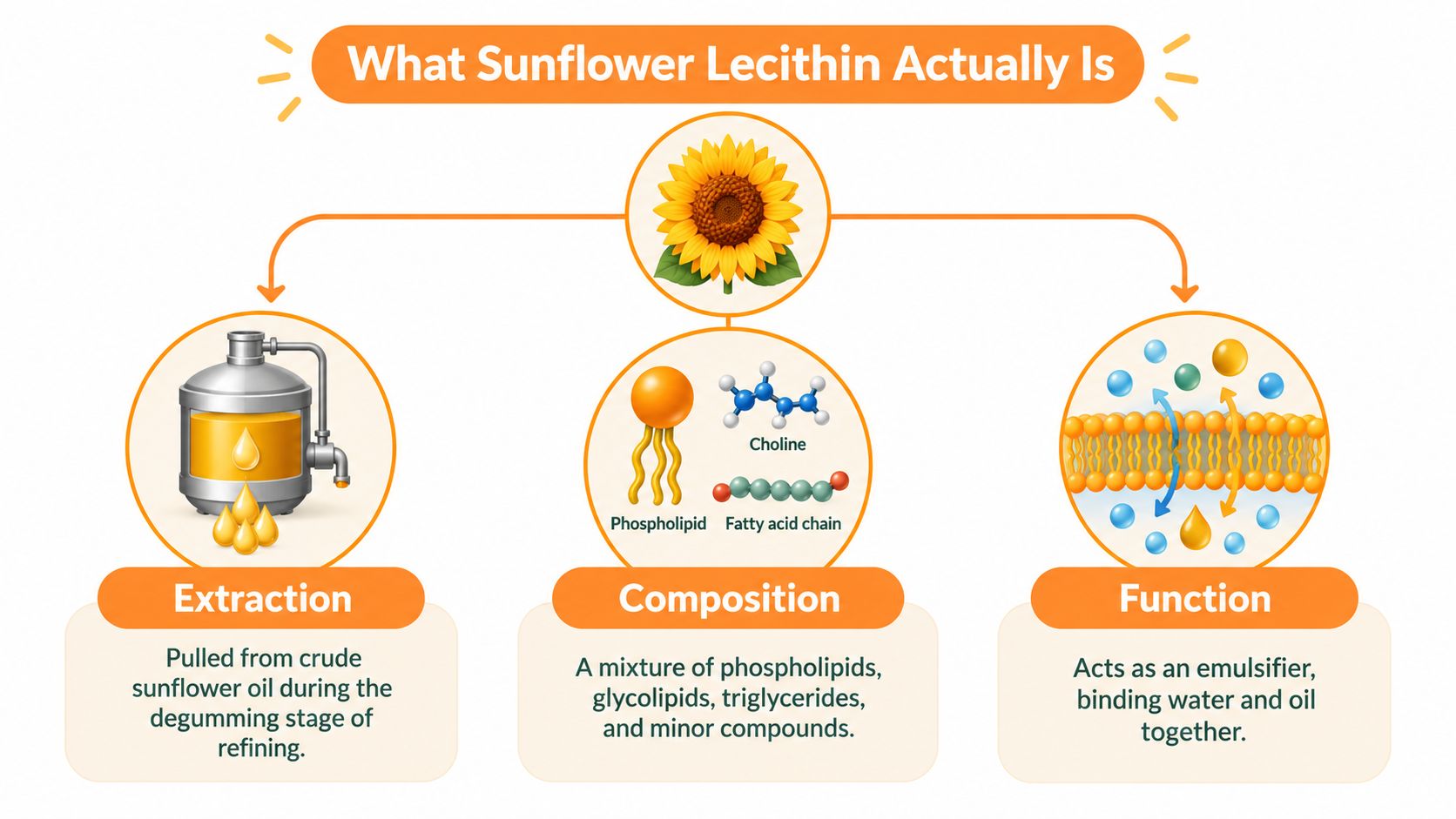
From sunflower oil to a phospholipid blend
In one 2024 study, sunflower-oil refining waste contained approximately 50–60% phospholipids; a separate compositional analysis of a commercial sunflower-lecithin starting material reported 43.1% total phospholipids, 33.4% oil, and 23.5% other compounds, illustrating the variation described in the research on sunflower lecithin production and composition.
Those figures describe particular materials, not a universal recipe. Sunflower variety, oil-processing conditions, purification, and the finished grade can all affect the proportions. The accompanying compounds may include glycolipids and complex carbohydrates, so the material isn't only phospholipids mixed with sunflower oil.
Practical rule: An ingredient name identifies the blend. A specification tells you what's in that blend.
A useful distinction is the difference between lecithin weight and phospholipid weight. A label's sunflower lecithin amount includes the whole ingredient, not automatically the same amount of phosphatidylcholine or total phospholipids. You need a supplier specification or certificate of analysis to establish those values.
For a shopper, this means similarly named products shouldn't be treated as chemically identical. A fluid ingredient and a more concentrated preparation may both say sunflower lecithin while delivering different proportions of the molecules you're interested in.
The guide to sunflower lecithin and whole-food shopping offers another starting point for comparing how this ingredient appears in shopping contexts. Keep the distinction clear: the sunflower source identifies its origin, while the composition identifies the material.
The Phospholipid and Fatty Acid Profile
The long chemical names become easier to follow when you treat them as labels for related molecules. PC, PE, PI, PS, and phosphatidic acid belong to the phospholipid family, but they aren't interchangeable entries on a specification sheet.
A helpful analogy is a set of building materials. Related materials can contribute to the same structure while having different shapes and properties. For supplement evaluation, the important question isn't whether the blend contains familiar phospholipids, but which ones were measured and how the manufacturer expresses their amounts.
Identity cards for the main constituents
- Phosphatidylcholine, or PC: The choline-containing phospholipid. Its name is especially relevant when a product highlights choline or PC, because total lecithin weight doesn't establish either amount.
- Phosphatidylethanolamine, or PE: A separate phospholipid group with an ethanolamine-containing head. A PC specification won't tell you its concentration.
- Phosphatidylinositol, or PI: The inositol-containing member of the blend. It can represent a meaningful share of sunflower lecithin's phospholipid fraction.
- Phosphatidylserine, or PS: A serine-containing phospholipid identified among sunflower lecithin's constituents, generally in smaller amounts in the materials described.
- Phosphatidic acid: Another phospholipid constituent that belongs in a fuller compositional profile rather than being counted as PC.
These are membrane-related lipid building blocks, not separate promises of a supplement benefit. Knowing their identities helps you read analytical results; it doesn't establish what taking a particular blend will do.
Reported Phospholipid Ranges in Sunflower Lecithin
The NIH Dietary Supplement Label Database example lists typical phosphatide content of 19% PC and 12% PI; reported HPLC profiles of sunflower fractions show approximately 56% PC, 7–14% PE, 24–31% PI, and 6% phosphatidic acid. These are distinct examples, not interchangeable measurements.
| Phospholipid | Typical Range | Role in the Mix |
|---|---|---|
| Phosphatidylcholine | Label example and analyzed fractions differ substantially | Choline-containing phospholipid |
| Phosphatidylethanolamine | Reported fraction values vary | Separate ethanolamine-containing component |
| Phosphatidylinositol | Label example and fraction values differ | Inositol-containing component |
| Phosphatidylserine | No universal range established here | Smaller phospholipid constituent |
| Phosphatidic acid | Fraction-specific value reported above | Additional component of the profile |
The table deliberately avoids turning isolated measurements into a universal “typical” formula. A fraction enriched during processing isn't necessarily representative of the entire commercial ingredient. The denominator matters: a percentage of a phospholipid fraction may describe something different from a percentage of the whole lecithin material.
Fatty acids and accompanying lipids add another layer. Triglycerides, free fatty acids, and other polar lipids can be present alongside the named phospholipids, depending on preparation.
When reviewing a specification, ask whether the reported percentage applies to the whole ingredient, a separated fraction, or typical phosphatide content. Without that context, a precise-looking figure can still be difficult to interpret.
Sunflower Lecithin Compared to Soy Lecithin
Sunflower and soybean lecithin shouldn't be ranked by the plant name alone. A useful comparison starts with their measured phospholipid profiles, then considers source preferences and manufacturing documentation.
The most revealing difference isn't necessarily PC. In a 2024 analysis, both materials contained approximately 25% PC by weight, while sunflower lecithin contained roughly 14% PE and 24% PI, compared with approximately 24% PE and 15% PI in soybean lecithin, according to the comparative phospholipid analysis.
Sunflower vs Soy Lecithin Phospholipid Snapshot
| Component | Sunflower Lecithin | Soybean Lecithin |
|---|---|---|
| Phosphatidylcholine | Similar measured share | Similar measured share |
| Phosphatidylethanolamine | Lower in the cited analysis | Higher in the cited analysis |
| Phosphatidylinositol | Higher in the cited analysis | Lower in the cited analysis |
This is a snapshot of analyzed materials, not a rule for every supplier. It also shows why a general claim that sunflower lecithin always contains more PC is too broad. The source name doesn't replace a product-specific measurement.
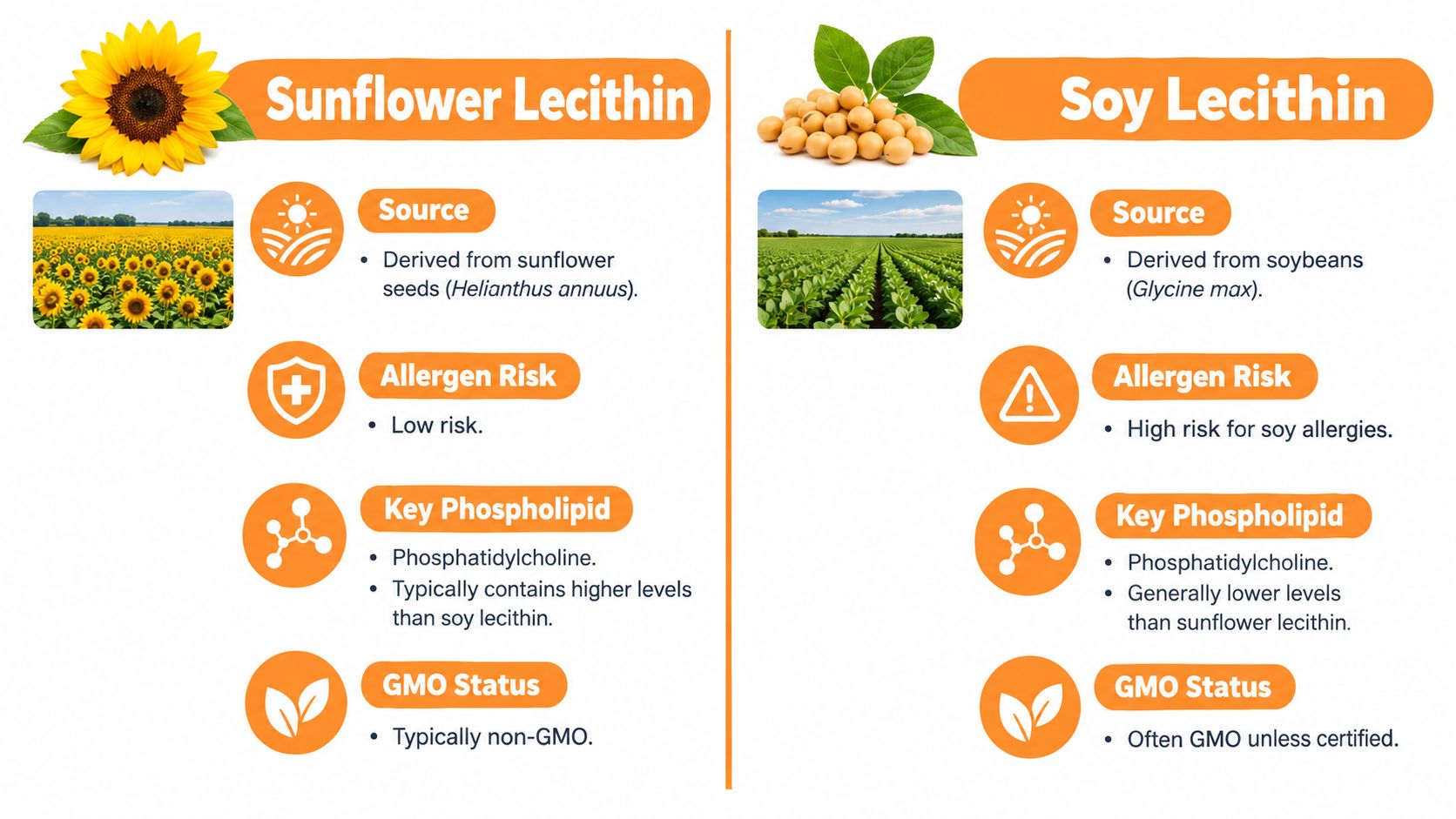
Treat broad source, allergy, and GMO comparisons as questions to verify, not guarantees attached to either ingredient. In particular, the measured PC comparison above is more informative than a blanket higher-PC claim.
Choose by the requirement, not the reputation
A supplement maker may choose sunflower lecithin to meet a sunflower-source preference or avoid intentionally adding a soy-derived ingredient. That's a sourcing decision, not evidence that the resulting formula will perform better.
Likewise, the fatty-acid profile requires more detail than “sunflower-derived.” Linoleic-type and oleic-type sunflower materials can differ, so a meaningful comparison needs the sunflower type and analytical fraction identified.
For purchasing, separate your criteria. If PC concentration is your priority, request the PC specification. If avoiding soy is your priority, review the complete formula and allergen information. If organic or non-GMO status matters, look for documentation rather than assuming it from a seed illustration.
The right comparison is between documented materials that meet your needs, not between plant names with different marketing reputations.
Why These Ingredients Are Used in Semen Health Supplements
Sunflower lecithin appears in semen-health discussions because its phospholipids offer a plausible nutritional and formulation rationale. That rationale explains interest in the ingredient. It doesn't establish a measurable change in semen volume, taste, sperm quality, or sexual performance.
Men's wellness blends marketed around semen volume and taste may combine sunflower lecithin with zinc, L-arginine, and bromelain. Each ingredient needs its own evidence assessment, and the complete formula needs to be evaluated separately from its individual components.
What the chemistry actually demonstrates
Phospholipids are amphiphilic: they have regions that interact with water and regions that interact with fat. Think of a molecule with different preferences at each end. This helps explain why lecithin can work at the boundary between oil and water.
That boundary behavior supports emulsification and dispersion. In an oil-in-water experiment, 0.1% sunflower lecithin increased resistance to droplet coalescence compared with the control, as described in the sunflower lecithin emulsion study.
The measured outcome was physical stability in an experimental emulsion. It wasn't semen production, taste, or reproductive function. You can't translate better droplet stability directly into a bedroom benefit.
Where the evidence boundary belongs
PC's choline-containing structure and phospholipids' relationship to membranes help explain why readers encounter nutritional discussions about lecithin. But there's a difference between identifying a biological building block and showing that adding more of it changes a particular human outcome.
- Composition evidence establishes which molecules a material contains.
- Mechanism evidence explains a relevant chemical interaction.
- Human outcome evidence tests whether taking a defined preparation changes a defined result.
A product description can move too quickly between those categories. Terms such as supports don't remove the need for evidence that matches the intended claim.
The guide to lecithin and sperm-related questions provides context for this common area of interest. When evaluating any claim, ask whether the study tested the same ingredient preparation, the same outcome, and a comparable supplement context.
You don't need to dismiss sunflower lecithin to remain cautious. You can recognize its measurable chemistry while declining to treat that chemistry as proof of increased semen volume or improved taste.
Grades, Purity, and What a Certificate of Analysis Should Show
Suppose you're choosing between a liquid sunflower lecithin and a powdered preparation. Both have clear labels, but only one seller supplies a detailed certificate of analysis, often abbreviated CoA. The useful next step isn't choosing whichever sounds purer; it's finding out what each grade means.
A grade describes how the ingredient was prepared and specified. Crude material is less refined, fluid describes a liquid preparation, and standardized indicates that the supplier works to defined specifications. Hydrolyzed and de-oiled identify additional processing distinctions that can change composition and handling.
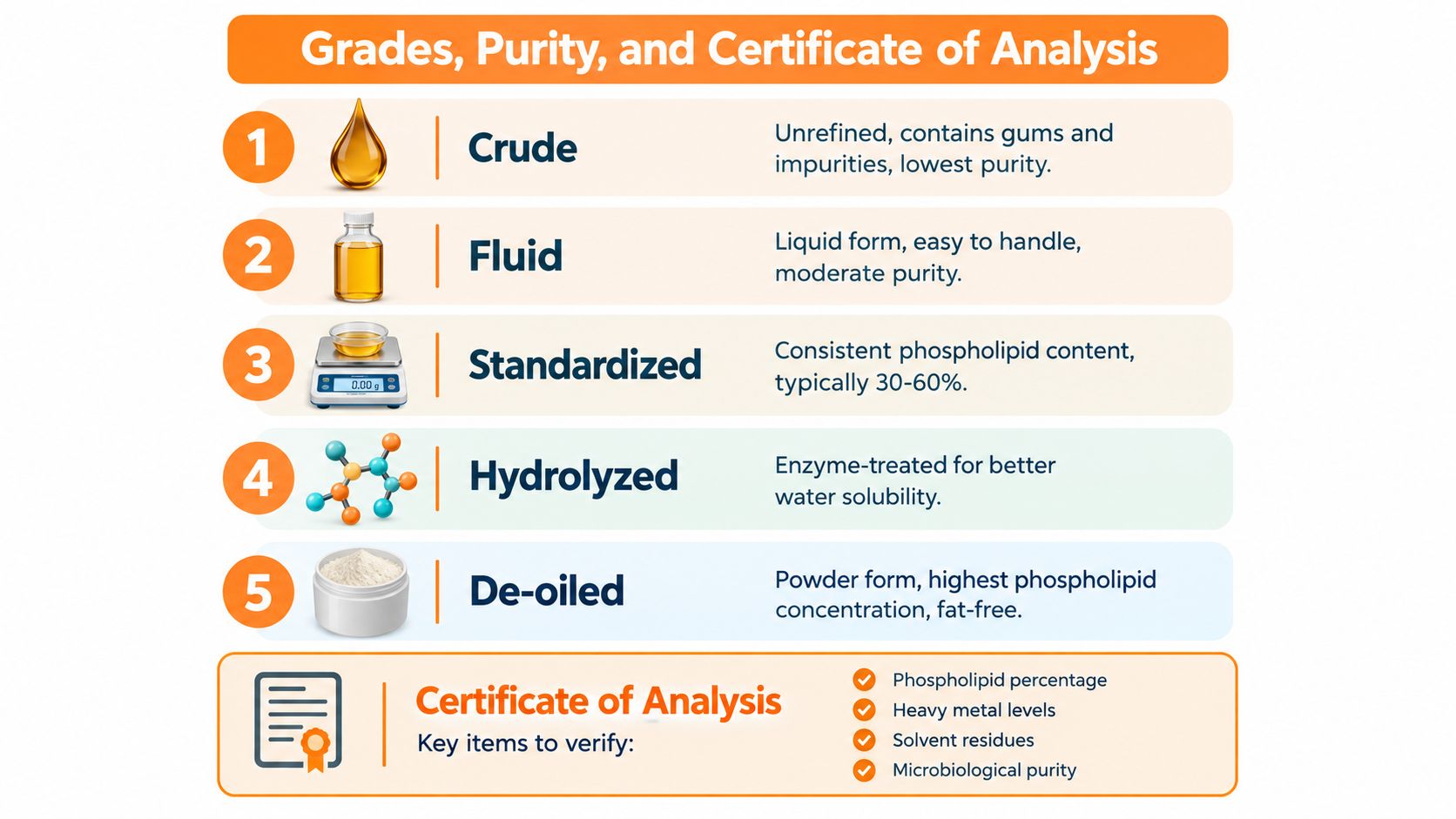
Read the specification behind the grade
The FDA's GRAS documentation describes total phospholipids using acetone-insoluble matter, with representative specifications of at least 60% for standardized liquid lecithin and at least 96% for de-oiled lecithin, as detailed in the FDA lecithin GRAS documentation.
Those reference points are more useful than a loose purity ranking. “Liquid” isn't a complete concentration specification, and “de-oiled” shouldn't be interpreted as proof of absolute fat absence. A visual summary can simplify the categories, but the actual analytical specification should govern your decision.
Acetone-insoluble matter is a technical specification measure. It isn't another name for PC, so a high value doesn't tell you the PC content by itself.
Follow the document through the purchasing decision
A useful CoA should identify the material clearly and report the fields relevant to that ingredient:
- Grade and composition: Lecithin grade, total phospholipids, and PC content when relevant.
- Condition-related measurements: Moisture, peroxide value, and acid value.
- Residue and contaminant controls: Residual solvents and specified contaminant limits.
- Document traceability: The material or lot covered, analytical methods, and results rather than a general assurance.
Ask the seller to explain unfamiliar fields instead of treating every low-looking number as automatically acceptable. Methods and limits matter, and they should relate to the actual material being sold.
Independent testing answers a different question from compositional analysis. A laboratory such as Eurofins may test for microbials, heavy metals, and adulterants, but naming a laboratory doesn't establish which tests were performed on a particular product.
The guide to third-party verification can help you distinguish a testing statement from a report you can review. Prefer documentation that connects the named product to defined tests and published limits.
Buying insight: Concentration, manufacturing quality, and evidence of benefit are separate decisions. A document supporting one doesn't automatically settle the others.
Common Misconceptions Worth Clearing Up
“Sunflower” sounds reassuring because it names a familiar plant. But it doesn't automatically mean allergen-free, organic, non-GMO, solvent-free, or clinically validated. Those are separate claims requiring separate support.
The ingredient's source is useful information. Problems arise when shoppers or marketers make it stand in for manufacturing controls, certifications, and human research.
A source declaration isn't an allergy guarantee
In the United States, major-allergen labeling rules require disclosure of the food source when a major allergen is used to make a food, as explained in the FDA's food-allergy labeling guidance. That rule doesn't establish identical cross-contact controls for every sunflower-lecithin product.
Review the complete ingredient list, allergen declaration, and any facility statements. If you have a diagnosed allergy, ask the manufacturer about the relevant controls and discuss the product with your clinician or allergist.
- Organic status: Look for an explicit, verifiable certification rather than inferring it from the crop.
- Non-GMO status: Check the product's claim and supporting documentation.
- Vegan suitability: Review the full formula and capsule ingredients, not just the lecithin source.
- Cross-contact controls: Ask about the specific allergen you need to avoid.
Safety recognition doesn't establish effectiveness
GRAS, or generally recognized as safe, concerns safety under intended conditions of use. The regulatory documentation discussed earlier isn't proof of reproductive, semen-volume, taste, or performance benefits.
Outcome-specific evidence illustrates the distinction. A 2025 double-blind trial involving 31 patients receiving 4,800 mg/day for 90 days did not find that sunflower lecithin significantly outperformed placebo on the study's eye-related outcomes. Those findings don't test men's sexual-health goals, and the FDA allergy guidance above is not the publication reporting that trial.
The interpretation should stay narrow. An eye-related study can't establish a semen-related benefit, nor can it rule one out. It does challenge the assumption that phospholipid content automatically produces a measurable improvement wherever a supplement is marketed.
Marketing language needs a measurable counterpart
A claim such as “phospholipid-rich” should lead you to a composition specification. A claim about a human benefit should lead you to relevant human research. Neither is a substitute for the other.
Be cautious when a product description moves from membrane chemistry to a specific outcome without showing the intervening evidence. A sensible position is neither automatic enthusiasm nor blanket rejection: recognize what the ingredient is, verify its quality, and keep expectations tied to the outcomes studied.
A Practical Checklist for Reading Any Sunflower Lecithin Label
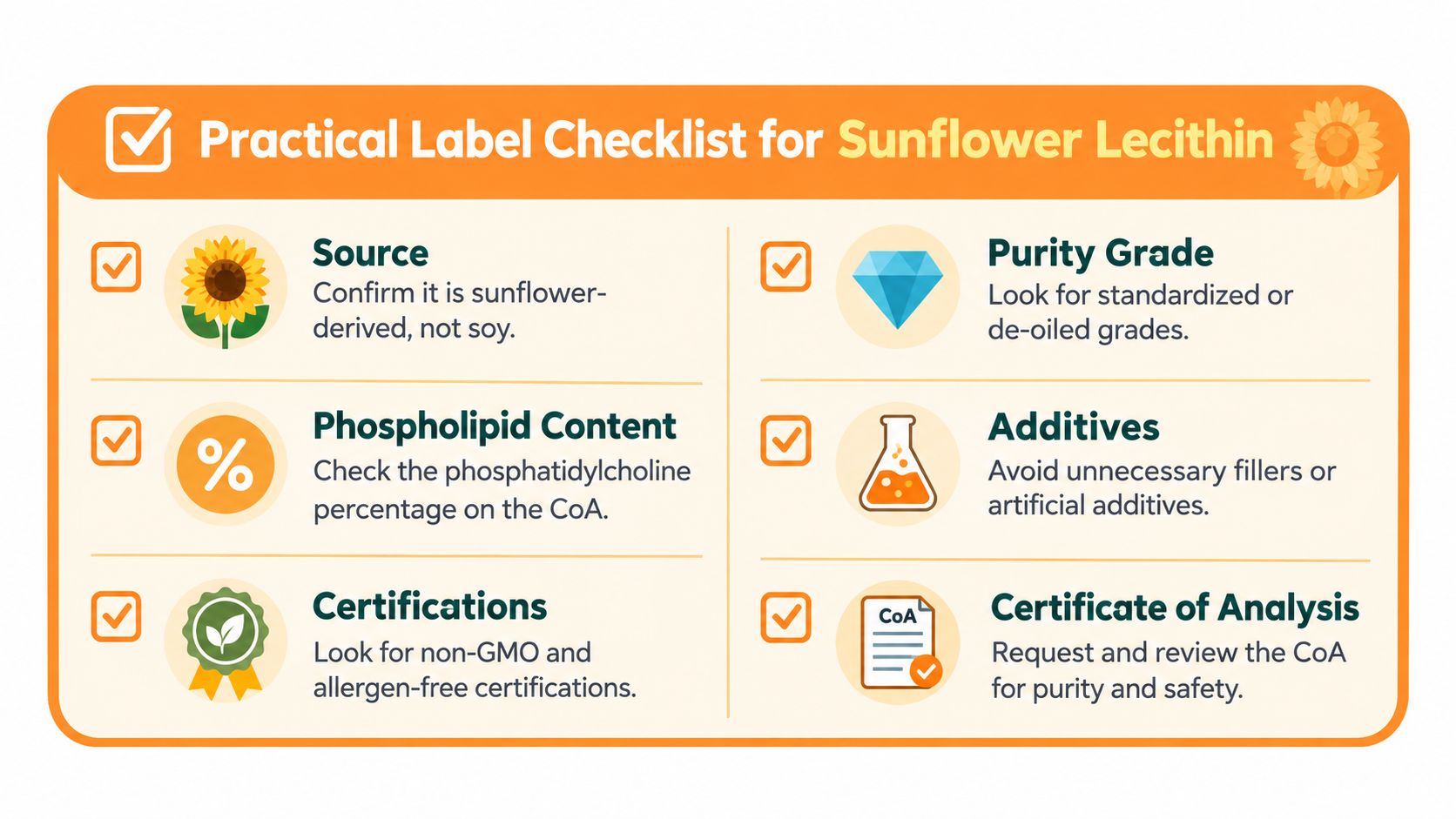
Use the label to identify the product, then use supporting documents to answer the questions the label can't. The most useful comparison isn't the longest ingredient description. It's the clearest connection between identity, composition, quality controls, and the claim you care about.
Keep these questions beside the label
- Confirm the source and grade. Apply the distinctions in the opening and grades discussions rather than accepting “lecithin” as sufficient detail.
- Check the PC specification. Use the phospholipid-profile guidance to determine what the percentage describes.
- Request total phospholipids. Don't confuse this measurement with a PC result.
- Review peroxide and acid values. Ask how the supplier assesses results against its specification.
- Inspect testing evidence. Look for the actual report, test scope, and product identification.
- Verify dietary claims. Check allergen statements and vegan, organic, or non-GMO documentation.
- Match evidence to expectations. Separate ingredient quality from proof of the advertised benefit.
Sunflower type also matters: vegetable-lecithin research reported approximately 63.6% polyunsaturated fatty acids in the acetone-soluble fraction of linoleic-type sunflower lecithin and 81.3% monounsaturated fatty acids for oleic-type material, illustrating the composition differences discussed in the research on vegetable lecithin properties.
Those fraction-specific figures aren't a universal nutritional profile for every bottle. Use the supplement-label reading guide to organize your comparison, and ask manufacturers to clarify missing information before buying.
Frequently Asked Questions About Sunflower Lecithin Ingredients
Is sunflower lecithin suitable if I avoid soy?
It identifies a sunflower-derived ingredient rather than a soy-derived one. For a soy allergy, review the complete product and cross-contact information discussed above; the source name alone isn't enough.
What does standardized mean?
It means the supplier prepares the material to defined specifications. Ask which properties are standardized, because the word alone doesn't establish a particular PC concentration.
Can it interact with medications?
Don't assume compatibility from the plant source. Ask a pharmacist or clinician to review your medications and the entire supplement formula, including any herbs and other active ingredients.
What's a reasonable daily intake?
There isn't a universal dose established here for semen-volume or taste goals. Follow the product's directions and seek individualized advice rather than borrowing a dose from an unrelated study.
What quality red flag should make me pause?
An unclear source, missing grade information, or a testing claim without accessible documentation deserves follow-up. A seller should be able to explain what its ingredient specification establishes.
These statements have not been evaluated by the Food and Drug Administration. This product is not intended to diagnose, treat, cure, or prevent any disease.
SEMEX offers a daily men's supplement formulated to support semen volume and improve taste, combining sunflower lecithin with zinc, L-arginine, bromelain, and a men's wellness blend. Visit to review its complete formula and published testing information, then apply this checklist before deciding whether it fits your goals.