

Sunflower Lecithin Alternative Options Worth Considering
A formulator can choose sunflower lecithin to avoid soy, simplify an allergen brief, or satisfy a vegan positioning requirement, then discover that the ingredient still misses the target. The powder may taste more noticeable than expected, the emulsion may separate, or the supplier's certificate may omit the phosphatidylcholine level that determines much of the ingredient's behavior.
That's why a sunflower lecithin alternative should be selected by functional fit, not by the phrase “clean label” alone. Lecithin is a mixed phospholipid ingredient, and its source, phosphatidylcholine content, phosphatidylethanolamine balance, processing method, and sensory profile can all change the finished product. The comparison below gives formulators and supplement buyers a practical starting point.
| Source | Main functional position | Vegan | Allergen or sourcing concern | Best reason to consider it |
|---|---|---|---|---|
| Sunflower | Balanced plant-based emulsifier | Yes | Usually chosen to avoid soy, but supplier documentation still matters | Non-soy positioning with useful PC content |
| Soy | Established, cost-efficient emulsifier | Yes | Soy allergen declaration and non-GMO requirements | Reliable performance-per-cost |
| Egg yolk | Naturally PC-rich phospholipid source | No | Egg allergen and animal origin | High-PC applications |
| Rapeseed or canola | Plant-based niche option | Yes | Source and GMO status require verification | Neutral sensory profile in selected fractions |
| Hemp, pumpkin, or camelina | Specialized seed-derived options | Yes | Less standardized supply and functionality | Differentiated fatty acid, sterol, or sustainability positioning |
Table of Contents
- Why People Look for a Sunflower Lecithin Alternative
- How Lecithin and Phosphatidylcholine Work
- Sunflower vs Soy vs Egg Yolk Lecithin Compared
- Niche Phospholipid Sources Worth Knowing
- Taste, Texture, and Use in Men's Wellness Formulas
- Sourcing, Testing, and Reading Supplement Labels
- Which Source to Pick for Your Specific Goal
Why People Look for a Sunflower Lecithin Alternative
A brand often starts with sunflower lecithin for a straightforward reason. The team wants a plant-based, non-soy ingredient that fits a clean-label brief. Then procurement reports a supply problem, the sensory panel detects flavor drift, or the product separates after the formula moves from bench scale to production.
The recurring triggers are familiar:
- Soy allergen declarations: Soy lecithin remains functional and widely used, but the source creates a labeling consideration that sunflower can avoid.
- GMO disclosure requirements: A non-GMO positioning strategy can make verified sunflower or another documented source more attractive. The USDA technical report on lecithin identifies sunflower, rapeseed or canola, and egg as alternative lecithin sources, while noting that concern about non-GMO soy integrity is increasing demand for alternatives.
- Vegan certification: Sunflower, soy, rapeseed, hemp, pumpkin, and camelina lecithins can support a vegan brief, while egg yolk lecithin cannot.
- Processing objections: Some customers push back on solvent-based processing, so manufacturers may request mechanically processed or solvent-residue documentation rather than accepting a generic lecithin declaration.
- Functional inconsistency: A sunflower lecithin label doesn't automatically reveal the PC level, purification grade, or whether the ingredient is a standardized fraction.
- Flavor drift: An unflavored powder can develop a more noticeable nutty, bitter, or oily impression when the phospholipid load changes.
Start with the performance problem
The right replacement depends on what failed. A beverage formulator needs oil-in-water stability. A capsule manufacturer may prioritize PC concentration and fill weight. A protein powder developer may care more about dispersibility and flavor neutrality. A men's wellness formula can require a plant-based ingredient that remains tolerable in a concentrated capsule fill.
A practical screening order is:
- Define the PC target. Do suppliers provide a phosphatidylcholine specification, or only a broad phospholipid total?
- Review emulsion behavior. Test the ingredient at the intended pH, ionic strength, oil load, and processing temperature.
- Assess oxidative quality. Compare peroxide values and storage data, especially for liquid or fatty lecithin formats.
- Run sensory testing. Taste the finished product, not just the raw ingredient.
- Confirm the label story. Verify source oil, allergen controls, non-GMO status, vegan documentation, and processing disclosures.
Formulation rule: A source that wins the allergen review can still lose the emulsion test. The replacement should pass both.
Sunflower lecithin remains a strong candidate, but it isn't the only answer. PC-enriched sunflower fractions, soy, egg, rapeseed, hemp, pumpkin, and camelina each solve different bottlenecks. The useful question is not whether an ingredient is marketed as an alternative. It's whether its phospholipid profile matches the finished product.
How Lecithin and Phosphatidylcholine Work
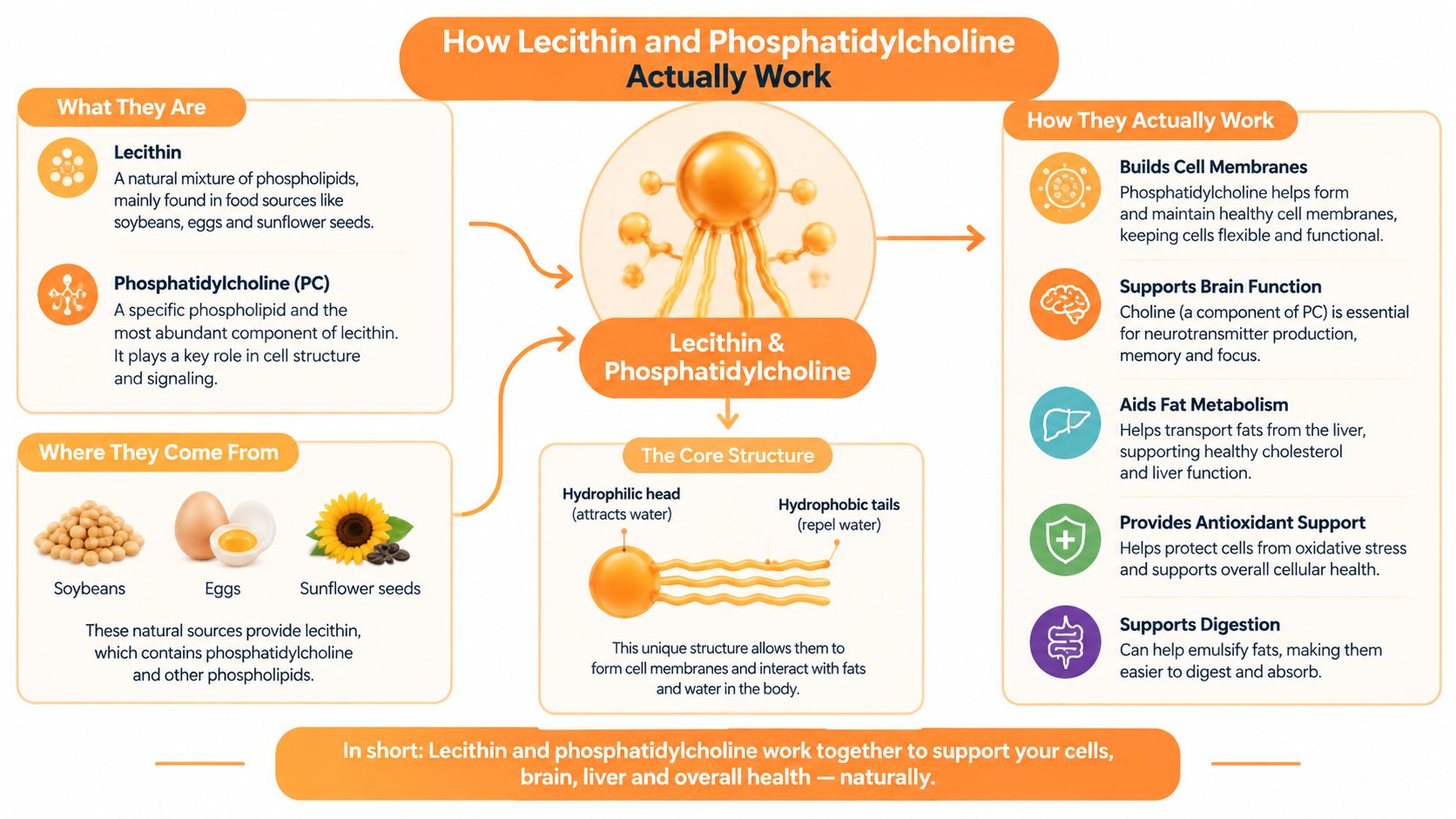
A lecithin replacement succeeds or fails at the interface between oil and water. Lecithin is a mixture, not one uniform molecule. Its phospholipids include phosphatidylcholine, phosphatidylethanolamine, and phosphatidylinositol, and their proportions affect wetting, dispersion, stability, and taste. French chemist Théodore Gobley first isolated lecithin in 1845 and named phosphatidylcholine “lécithine” by 1850, as documented in the historical overview of lecithin.
For an emulsifier buyer, phosphatidylcholine, or PC, provides a more useful comparison than total phospholipids alone. One published comparison reported approximately 36% PC in sunflower lecithin versus 34% in soybean lecithin (comparative lecithin data). A technical source lists sunflower lecithin grades at 14%, 20%, 25%, and 50% PC, depending on purification (technical discussion of phospholipid fractions). These figures describe specific grades, not a universal sunflower profile.
PC generally forms lamellar interfacial layers around oil droplets. With suitable dosage and processing conditions, that layer can help an oil-in-water system resist coalescence. Phosphatidylethanolamine, or PE, has different packing behavior and can favor reverse structures. A higher PE contribution may therefore perform less effectively in a particular oil-in-water formula. PC-enriched or hydrolyzed fractions often provide more predictable performance than crude lecithin when dispersion stability is demanding.
Format changes the formulation
Liquid lecithin retains more native oil, which can simplify handling in some food systems while changing dose accuracy, oxidation control, and storage requirements. De-oiled lecithin removes much of that carrier fat and usually arrives as a powder, making dry-blend dosing easier. Test the powder for moisture response, flow, dispersibility, and flavor.
A higher PC value does not automatically improve every formula. Liposome-oriented systems may prioritize phospholipid delivery. Beverages need rapid wetting and stable oil dispersion. Capsules need a concentrated payload without an objectionable odor, while bakery systems may value dough handling more than maximum PC enrichment.
Residual phospholipids can contribute bitter or nutty notes at meaningful inclusion levels. Test the replacement in the finished product, especially in unflavored powders, liquid tinctures, and capsule fills. Specification-sheet comparisons cannot predict the complete sensory result.
Sunflower vs Soy vs Egg Yolk Lecithin Compared
A beverage that turns cloudy, a capsule with a noticeable odor, or a powder that develops bitterness can point to the same formulation mistake: treating every lecithin source as interchangeable. Sunflower, soy, and egg yolk lecithin provide different phospholipid profiles and interface behavior. Choose the source by PC and PE balance, emulsion target, sensory result, and label requirements, not by the word “lecithin” alone.
| Attribute | Sunflower | Soy | Egg Yolk |
|---|---|---|---|
| PC content | Reported grades range from 14% to 50%, depending on purification; one comparison reported 36% | One comparison reported 34%; cited soy material lists PC at approximately 12.69% to 16.7% | Often selected for a naturally PC-rich fraction, but the supplied specification must confirm the actual level |
| PE profile | Cited sunflower material lists approximately 4.85% to 6.82% | Cited soy material lists approximately 6.45% to 13.57% | Varies by grade and processing |
| Allergen profile | Useful for soy avoidance, but supplier allergen controls still require review | Soy allergen declaration is relevant | Egg allergen and animal origin are relevant |
| GMO exposure | Often chosen for non-GMO positioning, subject to verification | Non-GMO status must be documented where required | Depends on feed and supply-chain documentation |
| Vegan status | Yes | Yes | No |
| Typical sensory contribution | Mildly nutty or neutral depending on grade | Can become beany or bitter at higher inclusion | Richer, more yolk-like mouthfeel |
| Emulsion behavior | Functional range comparable to soy; PC-enriched grades can improve oil-in-water performance | Familiar and effective across many food systems | Useful where a naturally concentrated PC fraction fits the application |
USDA compositional data lists sunflower PC at approximately 14.34% to 17.23%, compared with 12.69% to 16.7% for soy in the cited material. The same comparison places sunflower PE at approximately 4.85% to 6.82%, versus 6.45% to 13.57% in soy. That PC and PE balance affects interfacial behavior, so two ingredients carrying the same lecithin label can wet, disperse, and stabilize an oil-in-water system differently.
Sunflower is the cleanest fit for a vegan, non-soy brief, but the source name does not define performance. A low-PC crude grade may behave differently from a purified or PC-enriched grade. Request the phospholipid specification before approving a replacement.
Soy remains the practical benchmark when established processing, broad supply, and performance-per-dollar lead the brief. Its beany or bitter note can become more apparent at higher inclusion, and the soy allergen declaration requires label and facility review. Compare sunflower lecithin versus soy lecithin at the ingredient level rather than treating the sources as automatic substitutes.
Egg yolk suits formulas that can accept animal origin and egg allergen controls. Its richer, yolk-like mouthfeel may support certain food applications, while its naturally PC-focused profile can help when PC concentration matters more than vegan positioning. It does not belong in a plant-based supplement or food line, regardless of emulsion performance.
My recommendation is direct. Use soy when cost control, supply familiarity, and established emulsification dominate. Use sunflower when soy avoidance and vegan positioning define the brief, then select the grade by PC, PE, sensory data, and dispersion testing. Use egg yolk only when animal origin is acceptable and its PC profile addresses a documented formulation need.
Niche Phospholipid Sources Worth Knowing
Niche sources earn consideration when sunflower, soy, or egg lecithin leaves a specific formulation problem unresolved. Rapeseed, hemp, pumpkin, and camelina do not outperform sunflower across the board. Their value depends on the target PC/PE ratio, emulsion behavior, fatty acid profile, taste, sterol content, and supply documentation.
| Source | PC content typical | Allergen status | GMO risk | Notable edge over sunflower | Main limitation |
|---|---|---|---|---|---|
| Rapeseed or canola | Fraction-dependent and supplier-specific | Plant source, with facility controls still required | Must be verified by certificate or certification | Some fractions can provide a higher PC ratio and a neutral sensory profile | Commercial availability and standardization vary |
| Hemp seed | Supplier-specific | Plant source, but cross-contact and regulatory review matter | Must be verified | Distinctive fatty acid and sustainability positioning | Stronger sensory identity and less uniform functionality |
| Pumpkin seed | Supplier-specific | Plant source, subject to facility controls | Must be verified | Seed-derived differentiation and potential sterol positioning | Flavor and supply consistency can complicate use |
| Camelina | Supplier-specific | Plant source, subject to facility controls | Often selected for non-GMO positioning, but documentation remains essential | Emerging cold-pressed option with specialized phospholipid potential | Limited industrial-scale infrastructure compared with sunflower |
| Sunflower | Reported grades range from 14% to 50% PC by purification level | Commonly used for soy avoidance | Verify the actual claim | Established non-soy and vegan route | PC and sensory behavior vary across grades |
A recent review of food-industry lecithins describes sunflower as the principal commercial non-GM substitute while also examining hemp, flax, pumpkin, corn germ, and camelina, including their processing tradeoffs (review of niche oil lecithins). The practical lesson is straightforward. Choose a niche source because it solves a defined technical or positioning problem, not because the ingredient name sounds specialized.
Match the source to the bottleneck
Rapeseed or canola is worth screening when sensory neutrality matters and the supplier can provide a suitable PC-rich fraction. That profile may fit a beverage or powder in which sunflower's mild nutty note remains noticeable. Availability is less predictable, so qualify multiple lots and confirm dispersion, emulsion stability, and phospholipid composition before approval.
Hemp supports a sustainability-led concept and provides a distinctive fatty acid profile. Its earthy seed character can be difficult to mask, especially in delicate vanilla systems or clear liquids. Use it where that flavor supports the product identity, then verify oxidation behavior and batch consistency.
Pumpkin can strengthen a seed-focused men's wellness concept, particularly when sterol positioning already belongs in the broader ingredient story. That story does not establish formulation suitability. Run sensory trials, measure PC content, and review oxidative data before treating pumpkin lecithin as a functional replacement.
Camelina fits a cold-pressed, non-GMO-oriented brief and may provide specialized phospholipid characteristics. Its developing industrial infrastructure makes supplier qualification, documentation, and supply continuity more demanding than with sunflower.
The source should match the bottleneck:
- For a higher PC ratio, request fraction-specific PC and PE data.
- For a cleaner taste, compare the complete formula, not the raw lecithin alone.
- For seed or sterol positioning, confirm that the sensory and stability costs support the claim.
- For process stability, test wetting, dispersion, emulsion hold, and lot variation.
Buyer's test: Ask what the source beats sunflower on. If the answer is not PC specification, sensory neutrality, sustainability, sterol positioning, or process stability, the switch lacks a functional reason.
Taste, Texture, and Use in Men's Wellness Formulas
Taste can decide whether a phospholipid ingredient survives commercial use. A formula may meet its PC target and remain stable in testing, yet fail because consumers notice a beany, bitter, oily, or egg-like finish. The source also changes mouthfeel, wetting, and the amount of flavor masking required.
Soy lecithin can contribute a beany or bitter note at higher inclusion levels. Sunflower lecithin is often milder, with a light nutty baseline that generally fits vanilla, chocolate, and seed-forward profiles more comfortably. Egg yolk lecithin creates a richer mouthfeel, which can help in some emulsified foods but works against vegan positioning and may be too distinctive for a clean-tasting capsule or powder.
Format determines tolerance
A chocolate protein matrix can hide a seed-derived note better than an unflavored drink. A vanilla powder gives sunflower or rapeseed a narrower sensory margin. A liquid tincture exposes separation, oiliness, and aftertaste quickly, while a capsule fill can tolerate more flavor if the ingredient doesn't create odor or poor flow.
A practical screening sequence looks like this:
- Protein powders: Compare wetting time, clumping, and aftertaste in the complete protein system.
- Liquid supplements: Check separation during storage and after shaking, then assess the flavor immediately and after the product sits.
- Capsules: Review fill uniformity, odor, powder flow, and whether the PC specification justifies the amount included.
- Men's wellness formulas: Choose the least intrusive source that still meets the intended phospholipid specification.
Some men's wellness content discusses dietary phospholipids in relation to semen taste modulation. That concept should stay in structure/function language. A formulation may be described as supporting normal phospholipid intake or helping maintain normal body structures, but it shouldn't be marketed as treating a reproductive condition or guaranteeing a change in semen taste.
The ingredient discussion in lecithin for sperm should be read with that distinction in mind. Lecithin is not a treatment, and claims about reproductive outcomes require careful substantiation. A product developer should separate ingredient research from product-specific promises.
Flavor systems need a real test
Acidic beverages can amplify bitterness and change emulsion behavior. Chocolate can mask more than vanilla. Natural flavors can cover a nutty note but may not remove an oily finish. A replacement should be evaluated at the intended use level, with the actual sweetener, acidulant, protein, botanical blend, and packaging conditions.
The strongest sensory choice is often not the ingredient with the most impressive marketing profile. It's the one that lets the finished formula remain pleasant without excessive flavor correction.
Sourcing, Testing, and Reading Supplement Labels
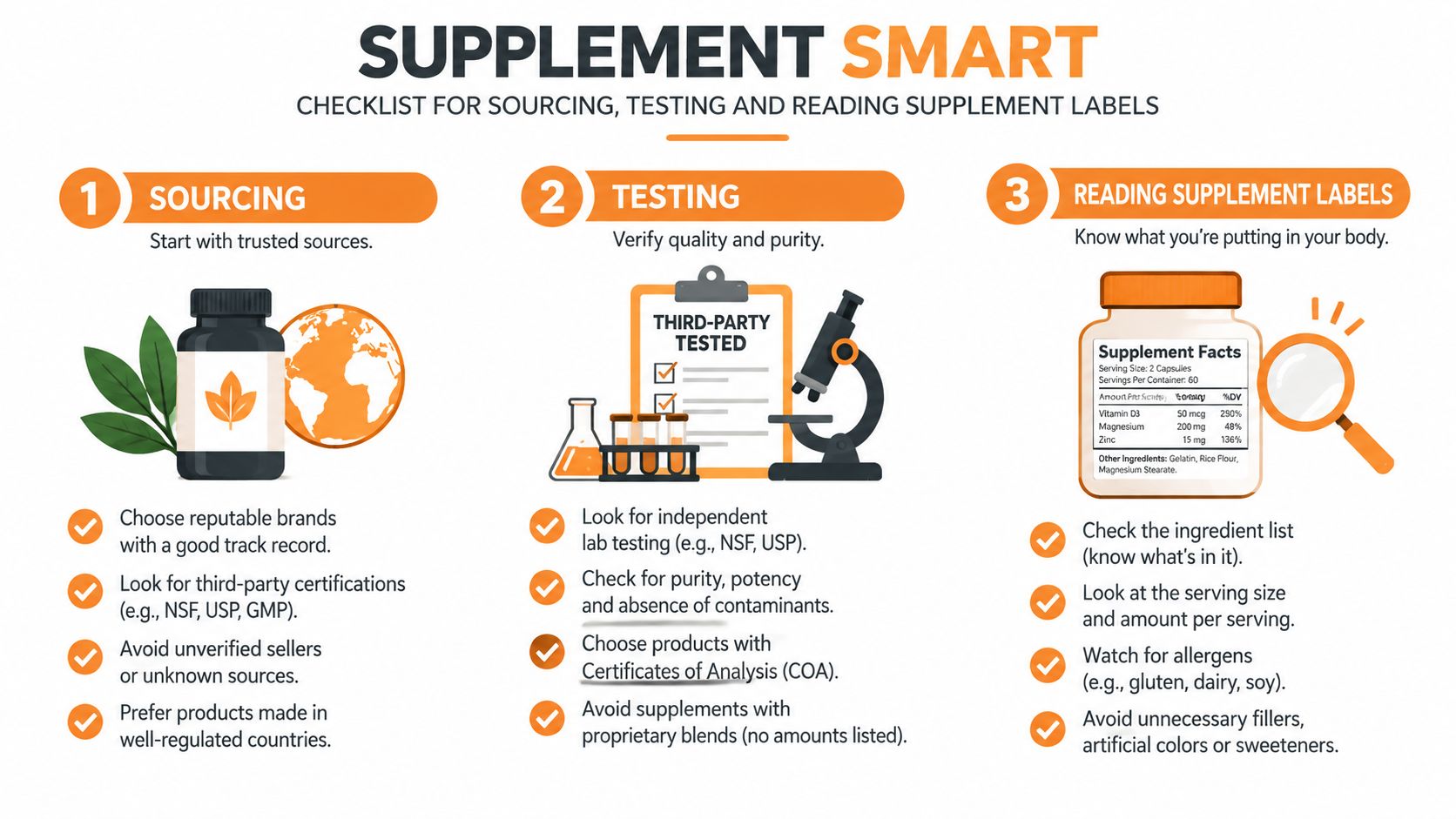
A genuine sunflower lecithin ingredient should have a traceable source, a defined specification, and test results that match the intended use. A label that says “phospholipid complex” may describe a useful material, but it doesn't prove that the ingredient is lecithin or that it contains the PC level a formulator expects.
HPLC testing is the clearest route for confirming phosphatidylcholine content. A supplier should provide the PC result on the Certificate of Analysis, along with the test method and lot identity. Acetone insolubles remain an important industry benchmark for lecithin purity, while peroxide values help assess oxidative quality, especially for liquid materials and ingredients with meaningful residual oil.
The certificate should answer specific questions
A supplier's documentation should make the following points easy to verify:
- PC percentage: The certificate should state the actual phosphatidylcholine result, not only “phospholipids.”
- Source oil: The document should identify sunflower, soy, rapeseed, egg, or another origin clearly.
- Purity indicators: Acetone insolubles and related quality tests help distinguish a refined lecithin from a poorly characterized blend.
- Oxidative status: Peroxide values provide a useful quality check for oxidation risk.
- Processing disclosure: Buyers should ask whether the material was mechanically processed, extracted with solvents, hydrolyzed, or fractionated.
- Allergen controls: The supplier should identify intentional allergens and cross-contact controls.
- Certification: Non-GMO Project Verified, IP non-GMO, USDA Organic, and clear allergen-control statements carry more value than vague “natural” or “clean” language.
The FDA guidance on structure/function claims is also relevant for supplement labels. A structure/function claim must describe the role of a nutrient or dietary ingredient in affecting normal body structure or function, remain truthful and not misleading, and appear with the required disclaimer.
For consumers, guidance on reading supplement labels offers a useful starting point, but buyers evaluating a phospholipid ingredient should go further. They should request the source, PC result, allergen statement, and relevant quality testing from the manufacturer.
Documentation rule: If the label names the source but the certificate omits PC content, the ingredient has not been fully characterized for a PC-driven application.
A vague “phospholipid complex” can still be legitimate, but it shouldn't be treated as interchangeable with standardized lecithin. The distinction affects dosing, emulsion behavior, sensory impact, and any structure/function language built around the ingredient.
Which Source to Pick for Your Specific Goal
The right sunflower lecithin alternative depends on the formulation priority that cannot change. Allergen avoidance, vegan suitability, taste neutrality, and emulsion performance lead to different selections. Sunflower lecithin is one phospholipid source among several, and its value depends on PC and PE balance, sensory behavior, and supplier control.
| Priority | Best pick | Why it wins | Trade-off vs sunflower |
|---|---|---|---|
| Avoiding soy | Sunflower or verified rapeseed | Provides a plant-based route without relying on soy lecithin | Sunflower grades vary in PC level, while rapeseed supply and standardization can be less established |
| Vegan suitability | Sunflower, soy, rapeseed, hemp, pumpkin, or camelina | Plant-derived sources can fit vegan formulas | Soy brings allergen and GMO documentation issues; niche sources can bring sensory or supply limitations |
| Taste neutrality in men's wellness supplements | Sunflower or a neutral rapeseed fraction | Usually easier to fit into vanilla, chocolate, or capsule systems than egg or strongly flavored seed sources | Sunflower can still contribute a mild nutty note, and neutral fractions may cost more or be harder to source |
| Emulsion performance | Soy benchmark or PC-enriched sunflower | Established soy performance and PC-enriched sunflower fractions support oil-in-water systems | Soy conflicts with some label briefs; refined sunflower fractions require tighter sourcing |
| High PC requirement | PC-enriched sunflower or egg yolk, if animal origin is acceptable | Higher-PC fractions suit applications where PC drives function | Egg is not vegan, while refined sunflower can be more expensive and grade-dependent |
Four decisions that work in practice
For soy avoidance, sunflower is the straightforward starting point. A verified rapeseed fraction deserves consideration when sensory neutrality or a specific PC ratio matters more than broad market familiarity. Request the actual PC and PE profile, because rapeseed products can differ in functional behavior.
For vegan suitability, sunflower is only one workable route. Soy, rapeseed, hemp, pumpkin, and camelina can also fit, provided the supplier verifies the source and cross-contact controls. Egg yolk belongs outside a vegan formula even when its PC performance suits the application.
For taste neutrality, sunflower or a neutral rapeseed fraction usually fits better than egg or a strongly flavored seed lecithin. Run sensory testing in the finished product. A mild raw material can become noticeable in an unflavored powder or concentrated capsule, especially when the formula has little flavor coverage.
For emulsion performance, soy remains the practical benchmark when the allergen and GMO brief permits it. A non-soy formula has a stronger technical case for a PC-enriched or hydrolyzed sunflower fraction than for a generic sunflower powder. The technical literature on enriched sunflower fractions describes their use as emulsifiers across food, pharmaceutical, and cosmetic applications. PC enrichment can support oil-in-water systems, but the result still depends on processing conditions and the finished formula.
The tie-breaker
When a buyer needs both non-GMO positioning and a defined PC percentage, let the supplier with the clearest certificate win the tie, regardless of whose marketing story sounds stronger. A documented sunflower fraction is usually the cleanest route. A documented rapeseed or camelina fraction can work when its sensory and supply characteristics match the formula.
Blending two sources can solve a practical formulation conflict. One may provide stronger emulsification while the other improves taste, sustainability positioning, or label fit. Test the blend for stability, sensory performance, allergen status, and certificate coverage. The properties of the individual ingredients do not automatically add together.
SEMEX is one men's wellness supplement option that includes sunflower lecithin alongside zinc, L-arginine, bromelain, maca root, Panax ginseng, ashwagandha, tongkat ali, saw palmetto, and horny goat weed. Its ingredient positioning uses structure/function language. It should not be presented as treating, curing, preventing, diagnosing, or fixing any condition.
These statements have not been evaluated by the Food and Drug Administration. This product is not intended to diagnose, treat, cure, or prevent any disease.
Men comparing phospholipid sources can review the formula, testing information, and ingredient positioning at SEMEX, then assess whether its sunflower lecithin-based approach fits their dietary and formulation preferences. Compare the label with the criteria above, especially source documentation, vegan status, PC specification, sensory fit, and the claims used.