

Sperm Quality with Age What Changes and How to Support It
A man in his late 30s may still feel perfectly healthy, have a normal sex drive, and produce what looks like a typical ejaculate. So why can fertility conversations become more complicated with age if sperm production continues throughout adult life?
The answer is that sperm quality with age is multidimensional. Age doesn't change every semen measurement at the same pace, and a stable concentration doesn't necessarily mean that movement, shape, semen volume, or DNA integrity have remained unchanged. A major meta-analysis pooled 90 studies involving 93,839 men and found that age was consistently associated with lower semen volume, lower motility, lower progressive motility, poorer morphology, and more sperm DNA fragmentation. Sperm concentration, however, didn't show a clear age-related decline in that dataset. The PubMed review is an important foundation for understanding why “sperm count” alone can give an incomplete picture.
That distinction matters for men planning a family, evaluating a semen analysis, or trying to make informed wellness decisions. A gradual shift in one metric doesn't predict the same shift in every other metric, and individual results can vary considerably.
This guide builds the topic step by step. It starts with the parts of sperm quality, then follows the age pattern across the 30s, 40s, and 50s, explains the biology behind the changes, separates visible semen findings from hidden DNA-level changes, and closes with practical support strategies that use consistent lifestyle habits and cautious ingredient-level research. Men seeking a broader foundation can also review what male fertility includes.
Table of Contents
- Introduction Why Sperm Quality With Age Matters Now
- Understanding Sperm Quality Beyond Sperm Count
- How Sperm Quality Changes Across Your 30s 40s and 50s
- Why Aging Affects Sperm Mechanisms Behind the Decline
- Visible Semen Changes Versus Hidden DNA Changes
- Supporting Sperm Health With Lifestyle and Ingredient Research
- Key Takeaways and Next Steps for Your Fertility Journey
Introduction Why Sperm Quality With Age Matters Now
Men often hear that male fertility is less time-sensitive than female fertility. That comparison can create a misleading conclusion, namely that age has little relevance for sperm. Men can remain capable of fathering children later in life, but the quality of sperm can change gradually and unevenly, which may affect conception potential and the biological quality of the sperm sample.
A man approaching 40 might therefore ask a more useful question than “Am I still fertile?” He may ask, “Which parts of sperm quality should be monitored, and which habits can support them?” That question recognizes the difference between fertility capacity and semen quality. A man can continue producing sperm while experiencing changes in how well those sperm move, how consistently they form, and how intact their genetic material remains.
The central idea: A semen result isn't one score. It's a group of measurements describing fluid, production, movement, shape, and genetic integrity.
The age pattern also isn't a sudden on-off switch. The large 2015 review found that several functional measures worsened with age, while concentration remained less consistent. Later evidence has described stronger age effects after approximately 40 to 50, depending on the metric and the population studied. A 2022 systematic review and meta-analysis similarly reported age-dependent declines in semen volume, total sperm count per ejaculate, total and progressive motility, and normal morphology, alongside increased sperm DNA fragmentation.
That information shouldn't be used to create fear or to predict an individual outcome from age alone. It provides a framework for better conversations with a healthcare professional and for practical choices that support general reproductive wellness.
The most useful approach is to separate what can change first, what may remain stable longer, and what standard testing cannot reveal. Once those categories are clear, sperm quality with age becomes less mysterious and more manageable as a health topic.
Understanding Sperm Quality Beyond Sperm Count
A semen sample works more like a delivery system than a single number. The reproductive system supplies the fluid, produces the sperm, prepares them for movement, and packages genetic material that must remain usable. Each part contributes something different.
The delivery system analogy
Semen volume is the amount of fluid released in an ejaculate. It provides the surrounding medium that carries sperm, but volume alone doesn't show how many sperm are present or how well they move.
Concentration describes how many sperm are present in each milliliter. It resembles the number of delivery vehicles on a section of road. A high number can be useful, but it doesn't show whether those vehicles are moving effectively or carrying intact cargo.
Total count considers the total number of sperm in the entire ejaculate. It combines concentration with semen volume, so a change in volume can affect total count even when concentration appears relatively steady.
Motility describes movement. Progressive motility focuses more specifically on sperm that move forward rather than vibrating or moving in place. In the delivery analogy, these are the vehicles that can travel toward the destination instead of remaining stuck in the same area. Men who want a plain-language explanation can review what sperm motility means.
Morphology refers to sperm shape and structure. A sperm with an unusual head, middle section, or tail may have more difficulty completing the steps required for fertilization, although morphology must be interpreted as part of the overall result.
DNA fragmentation concerns breaks or damage in the genetic material carried by sperm. This is more like checking the condition of the cargo inside each vehicle. A vehicle may look functional from the outside while its cargo has been compromised.
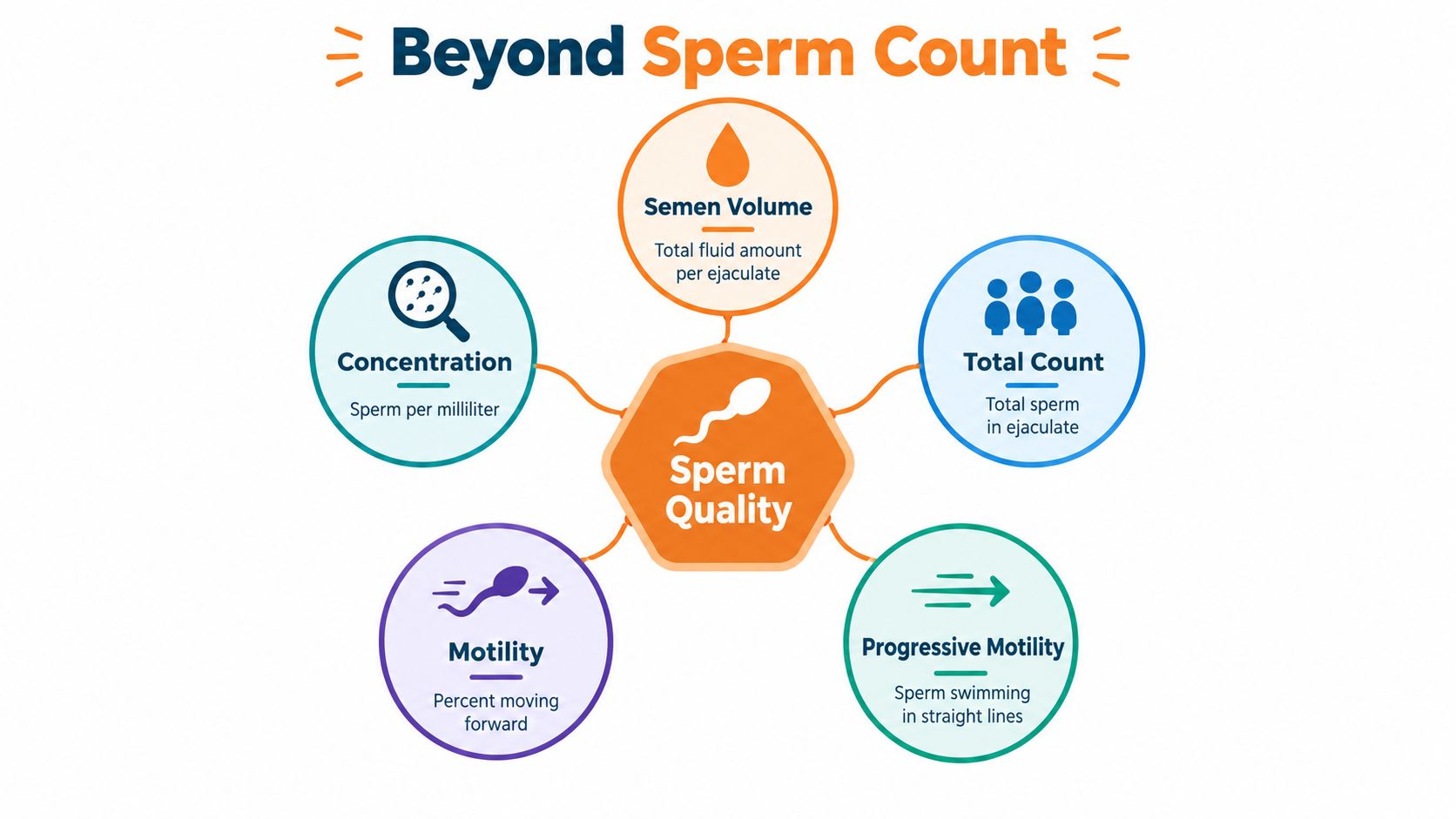
Clinicians therefore interpret the full panel rather than treating concentration as a complete verdict. A man can maintain concentration while seeing changes in motility, morphology, or DNA integrity. That is why a normal-looking count doesn't automatically mean every relevant aspect of sperm quality is unchanged.
How Sperm Quality Changes Across Your 30s 40s and 50s
The age pattern becomes easier to understand when each metric is placed on a rough timeline. These thresholds aren't personal deadlines. They describe patterns observed across groups, and different studies can identify different points at which a change becomes more noticeable.
Evidence summarized in a 2020 population study reported that men aged 31 and older were more likely to show reduced motility, men aged 41 and older were more likely to show lower concentration, and men over 50 were 2.09 times more likely to have abnormal sperm concentration than men aged 21 to 30. The same review reported that daily sperm production decreases by more than 30% in men over 50. The PubMed Central review also described earlier cohort findings in which median normal sperm motility fell from 55% to 50%, while normal morphology fell from 59% to 55%, between the youngest and oldest groups studied.
A practical age map
| Sperm Metric | Typical Age Threshold | Direction of Change |
|---|---|---|
| Motility | 31 and older | Reduced motility becomes more likely |
| Semen volume | Mid-30s onward, with clearer changes later | Gradual decline |
| Progressive motility | After 35, with a stronger decrease over 40 | Decline in forward movement |
| DNA fragmentation | Higher after 35 to 40 | Increased DNA damage |
| Concentration | 41 and older, with stronger effects after 50 | Lower concentration becomes more likely |
| Daily sperm production | Over 50 | Production decreases |
The table shows why the phrase “sperm count decline” can be too narrow. Motility may show an age association before concentration becomes clearly different. Volume and progressive motility can also shift gradually, while DNA fragmentation may increase without a dramatic change in routine count.
A 2025 analysis of men undergoing assisted reproduction found declines in sperm volume, progressive motility, and total motility, with increased sperm DNA fragmentation. The clearest drop began after 35, and the most pronounced decrease occurred over 40, according to the 2024 review and related evidence.
The practical lesson is simple: men in their 30s, 40s, and 50s shouldn't interpret age as a single prediction. Instead, age can guide which questions deserve attention, especially when conception takes longer, a prior semen analysis was inconsistent, or a couple is discussing family planning.
Why Aging Affects Sperm Mechanisms Behind the Decline
Sperm production depends on coordinated work inside the testes. Cells must divide, mature, package DNA, and release sperm that can move through the reproductive tract. With age, that production line can become less efficient, and several mechanisms may contribute at the same time.
An aging production line
Testicular function can become less efficient as tissue structure and cellular support change. The result may be altered semen production and weaker sperm performance, although the exact pattern differs between men.
Hormonal signaling also matters. The testes respond to signals that regulate sperm development, and age-related changes in endocrine communication can affect the production environment. A change in signaling doesn't automatically translate into infertility, but it can influence the conditions in which sperm mature.
Oxidative stress describes an imbalance in which reactive molecules can overwhelm protective systems. Sperm are particularly vulnerable because their cell structure and genetic packaging leave limited room for repair after damage occurs. Excess oxidative pressure can affect membranes, movement, and DNA integrity.
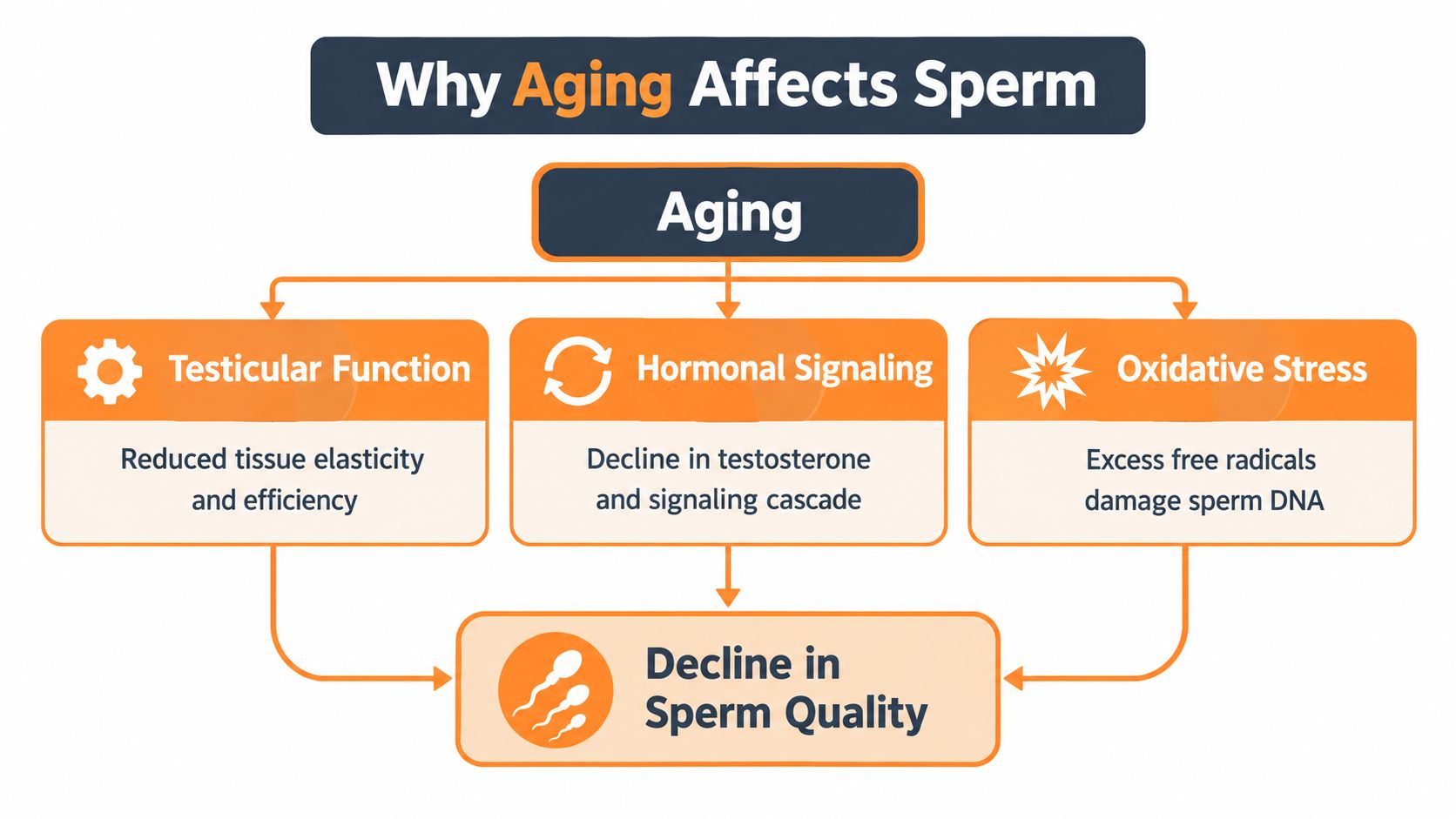
A helpful analogy is a production line that still operates but has experienced years of wear. The machines may continue producing the same general output, yet quality control becomes less consistent, movement systems run less smoothly, and copying errors become more likely. This explains why concentration can remain relatively stable while motility, morphology, or DNA fragmentation changes.
Why DNA deserves separate attention
Sperm DNA is tightly packaged to protect the genetic instructions delivered to an egg. Age-related oxidative stress and changes in sperm maturation can weaken that packaging and increase fragmentation. A conventional semen analysis may identify volume, concentration, movement, and shape, but it doesn't automatically measure every aspect of chromatin integrity.
Independent cohort data found higher sperm DNA damage in men aged 36 to 44 than in men 35 or younger, with the reported figures rising from 14.7% to 15.9%, and reaching 16.2% among men aged 45 and older. Older men also had more than twice the odds of high sperm DNA damage in that study. The cohort report helps explain why age can affect embryo-development potential even when standard semen parameters appear only modestly changed.
These mechanisms don't establish an individual diagnosis. They show why sperm quality with age involves more than production volume, and why a broader assessment may be useful when personal circumstances warrant it.
Visible Semen Changes Versus Hidden DNA Changes
A basic semen analysis focuses on measurements that can be observed in a laboratory. It can assess semen volume, sperm concentration, total count, motility, progressive motility, and morphology. These results provide valuable information about the sample's physical and functional features.
Some age-related changes may also be noticed outside the laboratory, such as a perceived change in ejaculate volume. Visual impressions, however, can't reliably estimate concentration, movement, morphology, or DNA integrity. Semen appearance is therefore not a substitute for testing when a couple has a fertility concern.
What routine testing can show
The visible or routinely measured side of sperm quality includes:
- Fluid amount: Semen volume can decline with age.
- Movement: Total and progressive motility can become weaker.
- Shape: Morphology can become less favorable.
- Sperm supply: Concentration and total count provide quantity information, although those measures don't always change at the same pace as movement or DNA integrity.
The hidden side requires specialized assessment or genomic analysis. DNA fragmentation concerns breaks in sperm DNA, while mutation burden concerns sequence changes that may not alter the appearance or movement of sperm.
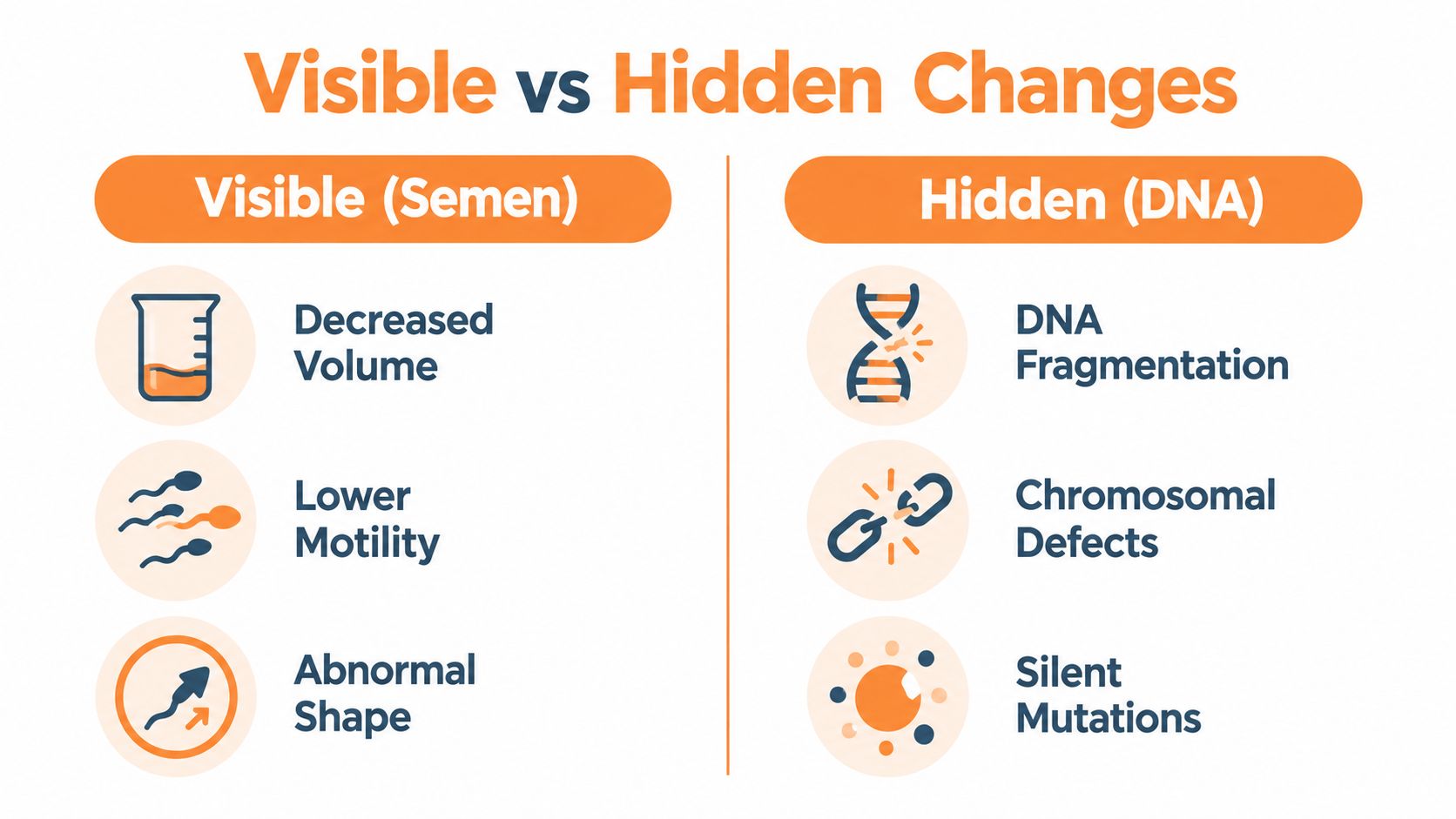
A 2025 Nature-reported study used NanoSeq to examine sperm from 81 healthy men aged 24 to 75. It found that disease-causing mutations increased with age, from about 2% in men in their early 30s to 3% to 5% in middle-aged and older men, reaching roughly 4.5% by age 70. The report describing that study highlights a key distinction: sperm can appear normal under routine assessment while age-related genetic changes accumulate.
A normal semen analysis is reassuring, but it isn't a complete genetic report.
That doesn't mean every older man has a hidden problem, or that a specialized test is necessary for everyone. It means family-planning conversations should consider age, reproductive history, partner factors, and clinical context together. A healthcare professional can explain whether routine testing is sufficient or whether additional evaluation could add useful information.
Supporting Sperm Health With Lifestyle and Ingredient Research
Age can't be paused, but daily habits can support the environment in which sperm develop. The strongest foundation is not a single ingredient. It is consistent attention to nutrition, sleep, exercise, heat exposure, smoking, alcohol, and medical guidance.
A balanced eating pattern supplies nutrients involved in normal reproductive function. Regular physical activity supports general metabolic and cardiovascular health, while adequate sleep helps maintain healthy hormonal rhythms. Smoking can work against reproductive wellness, and heavy alcohol use may also be unhelpful, so moderation and cessation support deserve practical attention.
Prolonged heat exposure around the testes is another consideration. Men can reduce avoidable exposure from hot tubs, saunas, or other sustained heat sources, particularly when they are already paying close attention to sperm health. Readers looking at food choices can also review how diet affects sperm quality.

How ingredient research fits
Ingredient research should be interpreted as ingredient research, not as proof that a finished supplement treats a condition.
- Zinc plays a role in normal male reproductive function.
- L-Arginine participates in nitric oxide pathways and blood flow.
- Sunflower lecithin supplies phospholipids involved in cell structure.
- Bromelain has been studied for effects related to taste and protein breakdown.
- Maca root and Panax ginseng are commonly researched in relation to vitality and sexual wellness.
- Ashwagandha has been examined in studies of stress, wellness, and male reproductive measures.
- Tongkat Ali, Saw Palmetto, and Horny Goat Weed are included in some men's wellness formulas, with research focused on their individual botanical properties.
SEMEX is described as a vegan, non-GMO daily supplement made in the USA in a cGMP-registered facility and third-party tested by Eurofins. The stated routine is 3 capsules daily, with benefits building over about 30 days of consistent use. Those product details describe use and composition, not a treatment outcome.
Men should review supplement ingredients with a healthcare professional when they use medications, have a medical condition, or are actively pursuing fertility care. Supplements can support wellness routines, but they aren't a replacement for semen analysis, specialist evaluation, or individualized medical advice.
Key Takeaways and Next Steps for Your Fertility Journey
Sperm quality with age changes gradually, not uniformly. The most consistent age-linked shifts involve semen volume, total and progressive motility, morphology, and DNA fragmentation. Concentration may remain more stable for longer, so a satisfactory count doesn't necessarily describe every important feature of the sample.
The practical framework is straightforward:
- Look beyond concentration: Movement, progressive movement, shape, volume, and DNA integrity each answer a different question.
- Interpret age by pattern: Changes often become more apparent from the late 30s through the 40s and 50s, but individual results vary.
- Separate visible from hidden findings: Routine analysis can describe semen and sperm performance, while DNA fragmentation and mutation burden may require specialized evaluation.
- Build consistent habits: Nutritious food, regular exercise, adequate sleep, reduced smoking and alcohol exposure, and sensible heat management support general reproductive wellness.
- Use supplements carefully: Ingredient-level research can inform a wellness routine, but supplements aren't treatments for infertility or other medical conditions.
A man concerned about conception timing, repeated unsuccessful attempts, a previous abnormal analysis, or advanced paternal age can discuss the situation with a qualified healthcare professional. A clinician can decide whether a semen analysis, repeat testing, DNA fragmentation assessment, or genetic counseling is appropriate.
The FDA requires the following disclaimer for applicable dietary-supplement structure/function claims: “These statements have not been evaluated by the Food and Drug Administration. This product is not intended to diagnose, treat, cure, or prevent any disease.” FDA labeling guidance specifies that the disclaimer must appear immediately adjacent to the claim or elsewhere on the same panel or page with a clear link.
SEMEX offers a daily, ingredient-based men's wellness option for men who want to support semen volume, taste, and overall vitality as part of a consistent routine. Men can visit SEMEX to review the product details and decide whether it fits their personal wellness goals.