

Sperm Health Test: What It Measures and How to Read Results
A man can spend an evening scrolling through fertility forums, comparing home kits, and wondering whether testing makes sense before trying to conceive or after months of uncertainty. The appeal is obvious. A single number seems as though it should answer a profoundly personal question.
A sperm health test can provide useful information, but it isn't a fertility verdict. It's better understood as a snapshot of a freshly produced semen sample, with clear strengths and important limits. The most useful interpretation comes from knowing what the laboratory measures, how collection affects the result, and when a basic test needs support from more advanced evaluation.
Table of Contents
- What a Sperm Health Test Actually Is
- The Parameters a Semen Analysis Measures
- At-Home Kits Versus Clinic Semen Analysis
- How to Prepare and Collect Your Sample
- How Results Are Reported and Interpreted
- What a Basic Test Misses About Sperm Health
- Ingredients Studied for Sperm Health Support
- When to Seek Follow-Up After Testing
What a Sperm Health Test Actually Is
A sperm health test usually means a laboratory semen analysis. A person provides a semen sample, and trained laboratory staff examine its physical and microscopic characteristics. The report may describe semen volume, sperm concentration, total sperm number, movement, vitality, shape, pH, and other observations.
That information can help a clinician decide whether the sample broadly resembles samples from fertile men, whether a repeat analysis is sensible, or whether additional evaluation is appropriate. The European Association of Urology guidance on male infertility explains that semen analysis is built around standardized reference limits developed through the World Health Organization's laboratory manuals.
What the test can and cannot answer
A semen analysis isn't a single yes-or-no answer to “Is this man fertile?” It doesn't measure sexual desire, erection quality, orgasm, or general sexual function. It also doesn't identify every problem that can affect fertilization, embryo development, or pregnancy.
The test is a screening snapshot. A reassuring profile may reduce concern, while an unusual result can point toward lifestyle review, repeat testing, or a specialist referral. A result outside a reference limit doesn't automatically prove infertility, just as a result inside the range doesn't guarantee conception.
Sperm production also changes over time. Illness, stress, heat exposure, sleep disruption, collection errors, and other factors can influence one sample. Most clinical guidance therefore supports repeat testing before major decisions, with the AUA and ASRM review noting the value of at least two semen analyses because of biological variability: guidance on male infertility evaluation.
Practical rule: One semen analysis can start the conversation, but a pattern across properly collected samples usually provides a stronger basis for decisions.
The Parameters a Semen Analysis Measures
A laboratory report can look technical because each line describes a different part of the reproductive process. Volume relates to the fluid that carries sperm. Concentration and total number describe supply. Motility shows movement, morphology describes shape, and vitality identifies whether sperm are alive.
The WHO 2021 lower reference limits are statistical reference points based on the 5th centile of fertile men, not pass-or-fail rules. The WHO semen examination manual provides the framework laboratories use to standardize these measurements.
| Parameter | Lower Reference Limit | Plain-English Meaning |
|---|---|---|
| Semen volume | 1.4 mL | The amount of fluid in the ejaculate |
| Sperm concentration | 16 million/mL | The number of sperm in each milliliter |
| Total sperm number | 39 million per ejaculate | The total sperm present in the entire sample |
| Total motility | 42% | The share of sperm that move in any way |
| Progressive motility | 30% | The share moving forward effectively |
| Vitality | 54% | The share of sperm that are alive |
| Normal morphology | 4% | The share with a normal shape under strict criteria |
| pH | At least 7.2 | A measure of the sample's acidity or alkalinity |
Reading the individual lines
Volume describes how much semen was collected. A lower volume can reflect incomplete collection, a short abstinence interval, or an issue involving semen production or transport. Volume alone doesn't reveal how many sperm are capable of moving.
Concentration counts sperm per milliliter, while total sperm number counts every sperm in the ejaculate. A smaller volume can still contain a reasonable total number if concentration is higher, and a larger volume can contain fewer sperm if concentration is low.
Motility measures movement. Progressive motility matters because sperm need to travel through the reproductive tract rather than just move in place. A helpful analogy is a long-distance swimming race. Total motility counts swimmers showing movement, while progressive motility focuses on those moving in a useful direction. Readers seeking a clearer explanation can review this guide to what sperm motility means.
Morphology describes sperm shape and structure. Strict criteria may classify only 4% of sperm as normal forms while the sample still falls at the reference limit. That number can feel surprisingly low, but morphology is one part of a larger profile, not a standalone fertility score.
Vitality asks whether sperm are alive, which is different from whether they move. A non-moving sperm may be alive but impaired, or it may be nonviable.
The lab may also describe liquefaction, viscosity, and appearance. Semen normally becomes more fluid after collection, while unusual thickness can complicate movement. A leukocyte result can flag possible inflammation, with the WHO reference point set below 1.0 million per milliliter for peroxidase-positive leukocytes. These findings require clinical context rather than self-diagnosis.
At-Home Kits Versus Clinic Semen Analysis
At-home kits can feel private and convenient, especially for someone who isn't ready to schedule a fertility appointment. They can provide an initial screening signal, but most measure a narrower range of characteristics than a clinic laboratory.
Many home tests focus on concentration or a motile count. They often don't report morphology, vitality, pH, liquefaction, viscosity, or leukocytes. A clinic semen analysis can examine a broader panel and give a physician a report that supports decisions about repeat testing or additional workup.
| Criterion | At-Home Kit | Clinic Semen Analysis |
|---|---|---|
| Parameters measured | Often concentration or motile count | Volume, concentration, total number, motility, vitality, morphology, pH, and additional observations |
| Sample handling | Depends on kit instructions, transport, and shipping | Controlled collection and laboratory processing |
| Analytical context | Usually limited to the kit's reporting method | Laboratory staff and standardized equipment interpret the sample |
| Convenience | Private collection and remote ordering may be available | Requires an appointment or clinic visit |
| Turnaround | May depend on shipping or home processing | Often provided through the clinic's reporting process |
| Follow-up | Usually limited unless a clinician is involved | Direct pathway to repeat testing, examination, or referral |
Choosing based on the decision ahead
An at-home kit may suit a curious first check when the result won't determine treatment. It can help someone decide whether a formal evaluation feels warranted. It shouldn't be treated as a complete fertility assessment, particularly when a couple has been trying to conceive or when a previous result was abnormal.
Clinic testing makes more sense when the result will guide medical decisions. The laboratory can document collection conditions, assess a broader set of parameters, and connect an unusual finding with a clinician who can investigate possible causes.
Home testing also has a practical limitation. A single result can look reassuring even when it doesn't cover the parameter that matters most. The right question isn't only “Is the kit accurate?” It's also “What information does this kit leave out?”
How to Prepare and Collect Your Sample
Collection conditions can change the usefulness of a sperm health test. A person who follows the laboratory's instructions gives the report a better chance of reflecting typical sperm production rather than an avoidable collection problem.
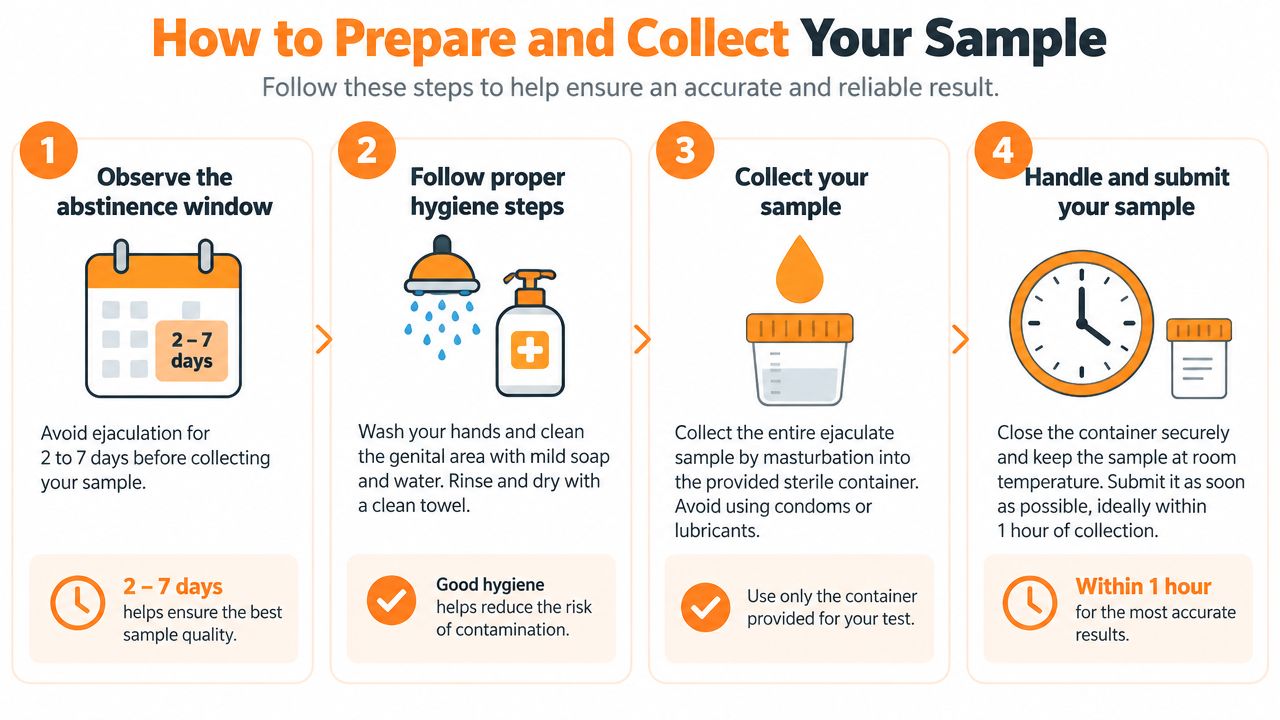
A practical preparation sequence
- Follow the instructed abstinence window. Clinics commonly specify 2 to 7 days without ejaculation. A shorter interval can affect volume and total sperm number, while a longer interval may influence motility and the age distribution of sperm in the sample.
- Keep the preparation ordinary. Maintain hydration and follow the laboratory's instructions about alcohol, heat exposure, and supplements before collection. The plan notes for a test may advise avoiding alcohol and substantial heat exposure for several days, often 2 to 5 days, but the testing laboratory's own directions take priority.
- Use the approved container. Collection should take place in a sterile container supplied or approved by the laboratory. Lubricants can interfere with sperm movement, so they shouldn't be used unless the clinic specifically provides a sperm-safe option.
- Capture the full ejaculate. Losing the first portion can matter because it often contains a higher concentration of sperm. Any missed portion should be reported rather than ignored.
- Protect the sample during transport. The sample should reach the laboratory within 30 to 60 minutes when the clinic requires direct delivery. It should remain near body temperature, not exposed to extreme heat or cold.
A clinic may offer a private collection room. Some approved home arrangements allow collection at home, remote pickup, or shipment, but the exact rules differ by test. The package instructions determine whether a sample can be shipped, how quickly it must arrive, and whether a special collection method is required.
How Results Are Reported and Interpreted
Most laboratory reports place the patient's value beside a reference range and may mark results as low, high, or outside range. That flag is useful for directing attention, but it isn't a diagnosis. The report needs to be read as a profile.
The WHO 2021 reference limits below are lower 5th-centile values from fertile men, as summarized in this review of updated semen-analysis reference limits.
| Parameter | Reference Value (5th percentile) |
|---|---|
| Semen volume | 1.4 mL |
| Sperm concentration | 16 million/mL |
| Total sperm number | 39 million per ejaculate |
| Progressive motility | 30% |
| Total motility | 42% |
| Vitality | 54% |
| Normal forms | 4% |
| pH | At least 7.2 |
A value just below a reference limit isn't equivalent to a value far below it, and one weaker line may carry a different meaning when the other parameters are strong. For example, a lower volume with preserved total sperm number creates a different clinical question from low volume combined with low concentration.
Why repeat testing can change the picture
Semen quality varies. Fever, poor sleep, stress, heat, medication changes, and collection timing can affect the sample. WHO guidance has allowed one analysis when results fall within range, while AUA and ASRM guidance continues to support at least two tests because individual samples can differ.
A repeat test should follow the laboratory's timing instructions and use careful collection again. A clinician may pay particular attention when multiple parameters remain abnormal, when sperm are absent or extremely scarce, or when symptoms suggest inflammation or another reproductive issue.
The report also describes the sample, not the entire person. Even a normal-looking color or consistency doesn't replace the measured parameters. Readers can use this semen color guide for general context, but pain, blood, swelling, fever, or persistent changes belong in a clinical conversation.
What a Basic Test Misses About Sperm Health
A basic semen analysis can show whether concentration, movement, shape, and volume sit near reference benchmarks. It cannot show whether every sperm carries intact DNA or whether a sperm can complete every step required for fertilization.
That distinction matters because semen quality isn't the same as sperm DNA quality. A man may have a broadly reassuring count and motility profile while still having a reason for a specialist to consider additional testing. The review of advanced sperm testing describes expanded evaluation that can include DNA fragmentation, aneuploidy, genetics, membrane ion channels, and other specialized markers.
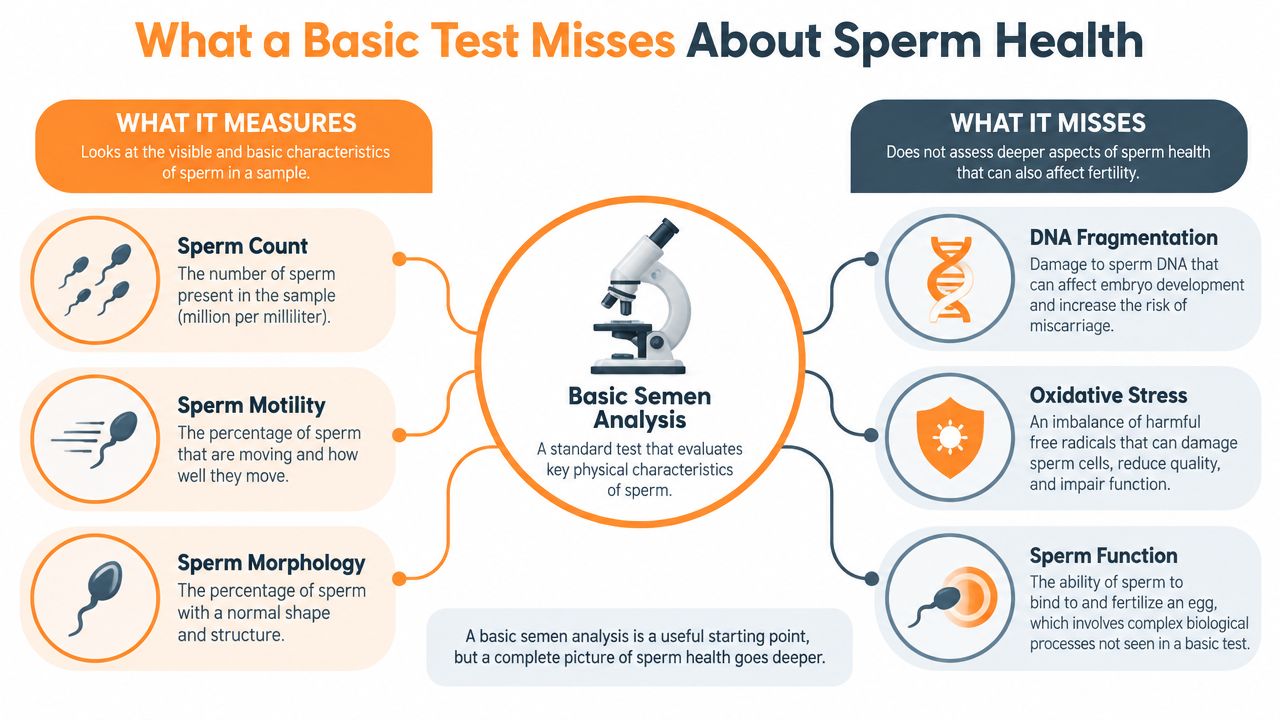
Advanced questions require targeted tests
Sperm DNA fragmentation testing examines breaks or damage in sperm DNA. Expert reviews describe growing clinical utility, but methods don't share one universally accepted cutoff. A threshold around 20% is often discussed as a discriminative point, although assay-specific validation and laboratory standardization remain essential before a result can guide care.
Oxidative stress testing explores reactive oxygen species that may affect sperm membranes and DNA. It isn't part of every first-line evaluation, and a clinician needs to decide whether it adds useful information for a particular patient.
Genetic and chromosomal testing can examine issues outside the view of a microscope. Examples include Y-chromosome microdeletions, karyotype abnormalities, and CFTR mutations associated with obstructive azoospermia. Such tests are generally considered when the semen pattern and medical history make them relevant.
Morphology also deserves caution. A 2025 expert review argues that traditional morphology percentages shouldn't be used alone as a prognostic criterion before IUI, IVF, or ICSI: expert discussion of morphology and advanced testing. A basic test remains a strong starting point, but it isn't the whole reproductive evaluation.
Ingredients Studied for Sperm Health Support
Ingredient research makes sense only when tied to what a laboratory measures. A supplement may support a biological process without changing every semen result, and a product label cannot predict an individual outcome.
Zinc has the most quantified evidence among the ingredients discussed here. A systematic review and meta-analysis assessed zinc supplementation against WHO semen parameters and reported significant increases in semen volume, sperm motility, and normal morphology, with effect sizes of SMD −0.99 for volume, −1.82 for motility, and −0.75 for normal morphology: systematic review of zinc and male infertility. These findings describe studies of zinc supplementation, not a guaranteed result from any formula.
A separate review reports that even a reduction of less than 5 to 7 ppm in zinc can impair reproductive function. It also notes that total seminal-plasma zinc content may relate to semen quality more usefully than concentration alone: review of zinc in human reproduction.
| Ingredient Category | Examples | Linked Parameter | Evidence Strength |
|---|---|---|---|
| Minerals and vitamins | Zinc and other nutrients | Concentration, motility, morphology | Zinc has quantified review evidence; evidence for other nutrients varies |
| Amino acids and antioxidants | L-arginine, L-carnitine, CoQ10, vitamins C and E | Motility, vitality, oxidative-stress markers | Mechanistically relevant, but results depend on study design |
| Supportive botanicals | Ashwagandha, maca, fenugreek | Motility, volume, general reproductive wellness | Preliminary and variable evidence |
L-arginine is studied for its role in nitric oxide and blood flow. L-carnitine is commonly examined in relation to sperm energy use and movement, while CoQ10 and vitamins C and E are investigated for antioxidant activity and possible effects on oxidative-stress markers.
Small studies of ashwagandha, maca, and fenugreek have reported changes in measures such as motility or volume, but findings are not uniform. See this overview of the best supplements for sperm health for how evidence strength varies by ingredient.
A product such as SEMEX combines zinc, L-arginine, sunflower lecithin, bromelain, maca root, Panax ginseng, ashwagandha, Tongkat Ali, saw palmetto, and horny goat weed for male wellness and semen-volume support. It should not replace testing or physician-guided care. Diet quality, sleep, heat exposure, alcohol use, medication review, and consistent collection practices remain relevant context when interpreting any result.
When to Seek Follow-Up After Testing
A sperm health test becomes more useful when it leads to an appropriate next step. A mildly unusual line may call for repeat testing, while a striking result or concerning symptom deserves clinical review without relying on a home interpretation.
Prompt review is sensible when a report shows zero sperm, a very low count, severely reduced movement, absent normal forms, or a pH result that appears markedly abnormal. The thresholds supplied in consumer plans can be inconsistent with modern WHO reference limits, so a clinician should verify the result rather than treating an isolated flag as a diagnosis.
A decision path after the report
- Review the collection first. Confirm abstinence timing, complete collection, container use, transport time, and temperature handling.
- Repeat a questionable result. A second properly collected sample can show whether an abnormality persists rather than reflecting one unusual day.
- Contact a clinician for symptoms. Pain, swelling, fever, blood in semen, urinary symptoms, or possible infection need medical assessment.
- Escalate when patterns persist. Repeated abnormalities may lead to hormone testing, a scrotal ultrasound, post-ejaculation urine analysis, or genetic testing.
Repeat timing depends on the result and the clinician's plan. Some evaluations repeat after a few weeks, while others wait two to three months, particularly when the question involves a lifestyle change or the development of new sperm. The NCBI overview of male infertility describes semen analysis as a measurable clinical assessment used within a broader evaluation.
A general practitioner can coordinate initial testing and referrals. A urologist, especially a reproductive urologist, can evaluate male reproductive anatomy, hormones, obstruction, and sperm production. A reproductive endocrinologist can coordinate fertility treatment when both partners need assessment or when assisted reproduction becomes part of the discussion.
These statements have not been evaluated by the Food and Drug Administration. This product is not intended to diagnose, treat, cure, or prevent any disease.