

Side Effects of L Arginine Supplement: What You Need to Know
Alex had expected L-arginine to fit neatly into his workout routine. He chose it after reading about nitric oxide and blood flow, took it with water before training, and carried on with his day. By the third day, he noticed an unsettled stomach and an unfamiliar headache. The practical question wasn't whether L-arginine was “good” or “bad,” but whether those symptoms were tolerable, dose-related, or a reason to stop.
That distinction matters for men using L-arginine in routines focused on exercise, vascular support, sexual wellness, or semen quality. Natural doesn't mean risk-free, yet mild digestive discomfort isn't automatically an emergency either. The safest approach is to understand the evidence, recognize personal risk factors, and use a clear triage system before deciding whether to continue.
Table of Contents
- Starting Your L-Arginine Journey With Open Eyes
- What the Clinical Evidence Says About Common Side Effects
- Understanding Dose-Related Risks and Tolerance Limits
- How L-Arginine Affects Blood Pressure and Heart Health
- Drug Interactions and Medical Conditions to Watch
- Building Your Personal Safety Protocol for L-Arginine
- Making Informed Choices About L-Arginine Supplementation
Starting Your L-Arginine Journey With Open Eyes
Alex's experience is common in one important way: supplement users often begin with the expected benefit in mind and only investigate safety after a symptom appears. A stomach that feels unsettled, loose stools, bloating, or a headache can create uncertainty, especially when the product label presents L-arginine as a simple amino acid.
The answer depends on what the symptom is, how intense it feels, whether it persists, and what else the person takes. A brief episode of mild bloating after a new supplement calls for a different response than faintness, breathing difficulty, chest tightness, or a racing heartbeat.

A useful first distinction
Men can sort an unwanted reaction into three broad categories:
- Mild and short-lived: Slight nausea, bloating, abdominal discomfort, or a headache may reflect individual tolerance or a dose that feels too high.
- Persistent or worsening: Repeated diarrhea, ongoing stomach pain, dizziness, or palpitations means the supplement shouldn't be pushed through.
- Urgent warning signs: Faintness, breathing difficulty, chest tightness, severe weakness, or signs of an allergic reaction require immediate medical attention.
The purpose of this guide isn't to create fear around L-arginine. It's to replace vague reassurance with practical judgment. A man who understands the difference between a manageable digestive complaint and a cardiovascular warning sign can make a more informed decision than someone relying on marketing language or an isolated online anecdote.
L-arginine also doesn't affect every user in the same way. The response can depend on dose, duration, blood pressure, existing medical conditions, and medication combinations. The sections that follow focus on those variables so a new user can evaluate symptoms with more discipline and less guesswork.
What the Clinical Evidence Says About Common Side Effects
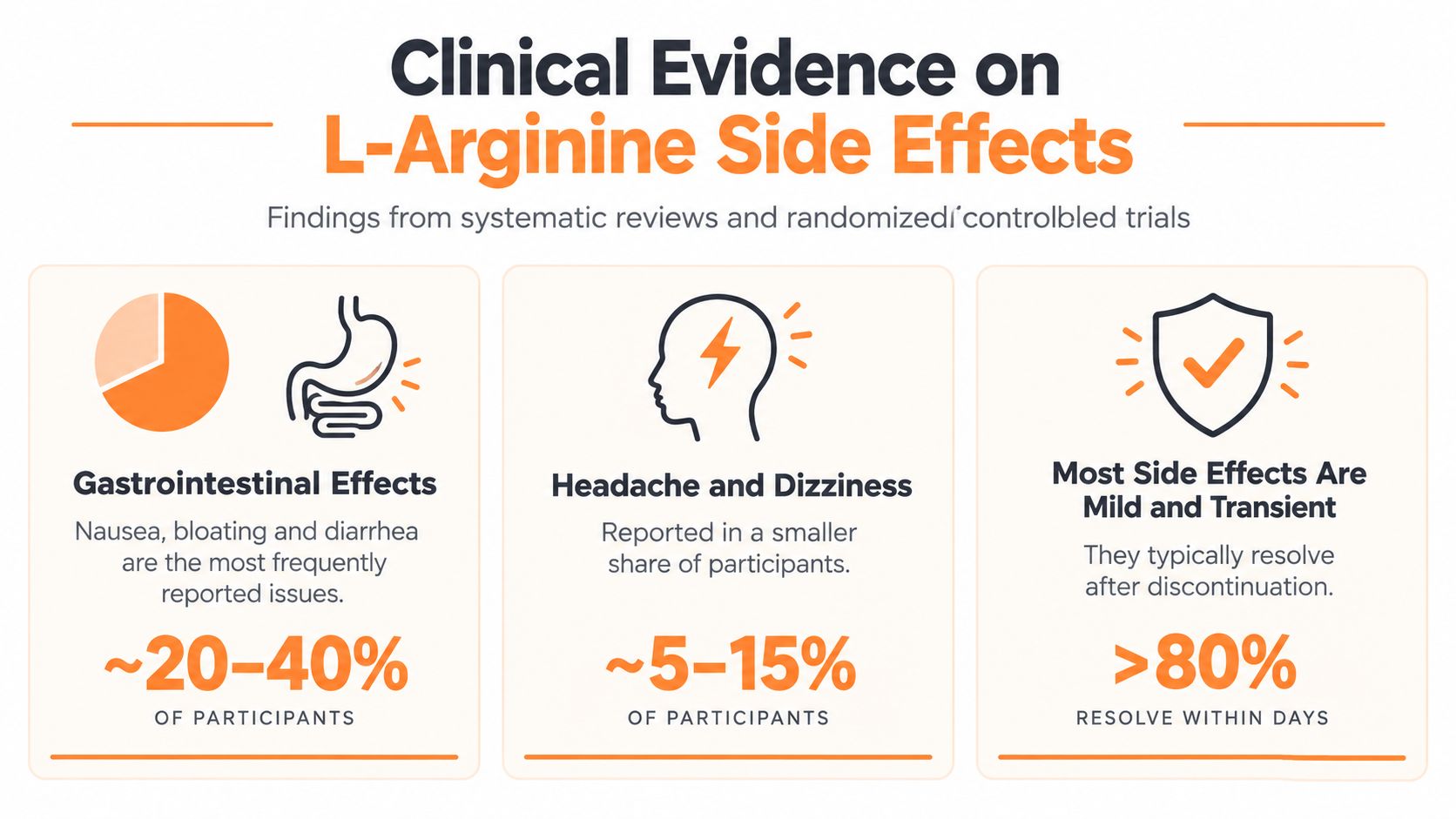
A man may notice stomach discomfort after starting L-arginine and immediately wonder whether the supplement is responsible. Clinical reports most often describe abdominal discomfort, nausea, diarrhea, bloating, dyspepsia, and, less often, headache or insomnia, according to a systematic safety review of L-arginine trials.
A reported symptom does not automatically prove causation. Participants can develop digestive complaints because of diet, strenuous exercise, illness, or chance. Researchers account for this uncertainty by comparing people who receive L-arginine with those who receive a placebo. That comparison helps separate a supplement-related pattern from symptoms that would have occurred anyway.
What the review found
The safety review included 23 randomized controlled trials involving 647 participants in which gastrointestinal symptoms were reported. The pooled risk difference was 0.01, with a 95% confidence interval from -0.02 to 0.04, and the result was not statistically significant, with P=0.34. In practical terms, the available trials did not show a reliable overall increase in gastrointestinal symptoms compared with placebo, as the same systematic review reported.
This result describes an average across studies, not a guarantee for each user. A person can still react poorly, especially after taking a large serving, combining several products, or using L-arginine with an already sensitive digestive system. Clinical averages are like a weather forecast for a region. They provide useful context, while personal conditions determine what happens at ground level.
Use a simple observation plan if a symptom appears during a trial. Record the product, serving size, timing, meals, exercise, and symptom intensity. If bloating follows each serving for three consecutive days, halve the amount for one week and note whether the symptom changes with the dose. If the same problem continues, worsens, or is joined by dizziness, palpitations, breathing difficulty, chest tightness, or faintness, stop the supplement and seek appropriate medical guidance rather than testing a higher amount.
The evidence supports a measured decision. L-arginine is not automatically dangerous because digestive symptoms appear in reports, yet its amino-acid status does not make it free of side effects. The useful question is whether the symptom follows a repeatable pattern, changes with the amount, and fits the person's wider health situation.
Understanding Dose-Related Risks and Tolerance Limits
A man may feel fine after several days on a modest L-arginine serving, then develop stomach upset after increasing it to chase a stronger effect. Dose is one of the clearest practical factors in tolerance. Evidence summarized by the U.S. National Institutes of Health in its health professional guidance indicates that amounts up to 9 g/day were generally tolerated for several days to weeks, while 9 to 30 g/day more often caused nausea, diarrhea, gastrointestinal discomfort, and a modest blood-pressure reduction.
These figures are reference points, not a universal safety cutoff. Individual response varies with serving size, other products, digestion, and health conditions. Increasing the amount can therefore add discomfort without delivering a matching benefit.
Why higher amounts feel different
L-arginine supports a pathway involved in nitric oxide production. That pathway can influence blood vessels and may also make digestive effects more noticeable as intake rises. Technical reviews describe vomiting, bloating, abdominal pain, heartburn, headache, and palpitations, with gastrointestinal intolerance increasing above approximately 9 g/day, as the same NIH fact sheet notes.
Use this quick triage sequence:
- Check the total daily amount. Count L-arginine in combination products, pre-workout formulas, and other supplements.
- Review the serving pattern. A large single serving may feel worse than the same daily amount divided across the day, if the product directions allow it.
- Track timing. Note whether symptoms begin soon after use or continue independently of the supplement.
- Stop and seek advice for warning signs. Persistent diarrhea, dizziness, faintness, or palpitations should not be managed by repeatedly changing the dose without professional guidance.
Practical rule: Feeling comfortable at one dose does not establish tolerance for a higher dose.
Men comparing products can review L-arginine recommended dosage guidance, but product guidance cannot replace individualized medical advice. Long-term safety data beyond roughly three months remain limited. Digestive discomfort may call for reassessment, while faintness, palpitations, or persistent symptoms warrant stopping rather than pushing through.
How L-Arginine Affects Blood Pressure and Heart Health
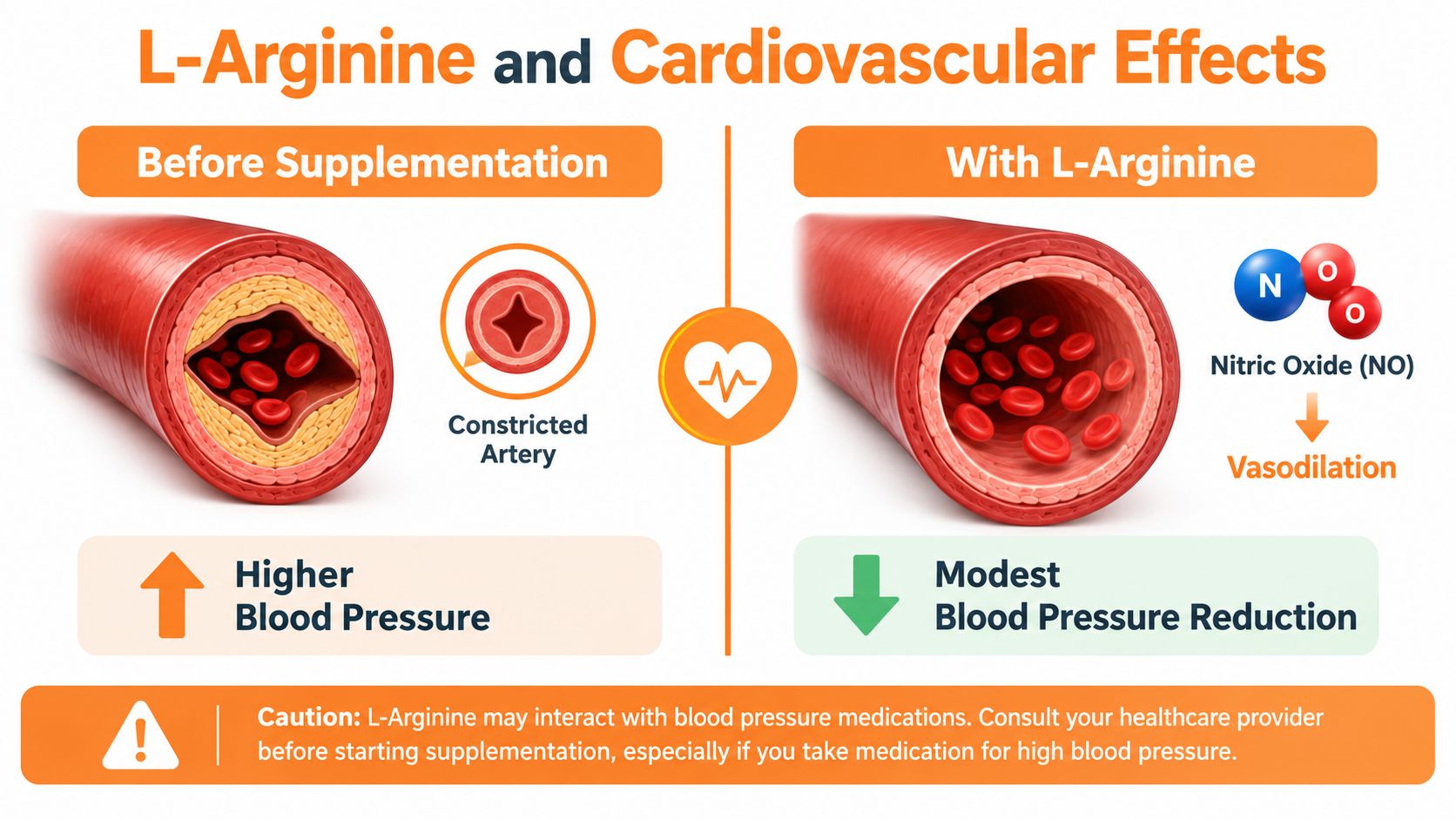
L-arginine can lower blood pressure because the body uses it in a pathway that supports nitric oxide production. Nitric oxide relaxes vascular smooth muscle, allowing blood vessels to widen, a process called vasodilation. That mechanism may be relevant to men interested in blood flow, but it also creates a possible problem for anyone whose blood pressure is already low or whose medication lowers it.
What the blood pressure evidence means
A systematic review and meta-analysis found that lower doses of up to 9 grams per day, used for no more than 24 days, appeared more effective for reducing blood pressure than higher doses or longer treatment periods. Another pooled analysis reported average reductions of approximately 6.40 mm Hg in systolic blood pressure and 2.64 mm Hg in diastolic blood pressure at a median dose of 9 grams per day for about four weeks, according to the meta-analysis of L-arginine and blood pressure.
Those results describe average changes in study populations. They don't predict exactly what will happen to a particular man, and they don't make L-arginine a treatment for high blood pressure. A modest reduction can still feel unpleasant if it combines with medication, dehydration, strenuous exercise, or naturally low readings.
The most serious warning comes from a historical randomized trial involving people recovering from acute ST-segment-elevation myocardial infarction. Participants received oral L-arginine at 9 g per day for six months, and the trial stopped early after 8.6% of patients in the L-arginine group died compared with 0% in the control group, with P=0.01, as summarized in the clinical safety review of L-arginine.
Separating populations
That trial doesn't establish the same risk for healthy adults using ordinary supplement amounts. It does establish why men who've recently experienced a heart attack shouldn't start L-arginine without direct medical supervision.
A man who develops lightheadedness after taking L-arginine should sit or lie down, avoid driving, and stop further doses until a healthcare professional provides guidance. Chest tightness, fainting, severe weakness, or difficulty breathing calls for urgent medical care rather than dose experimentation. Men interested in the ingredient's relationship with circulation can read more about L-arginine and blood flow, while keeping cardiovascular history at the center of the decision.
Drug Interactions and Medical Conditions to Watch
A man taking prescription medicine, managing a chronic condition, or combining several supplements needs a medication check before trying L-arginine. Its vasodilatory action can add to blood-pressure-lowering effects, and the product label may not reveal how strong that combination could feel.
The Cleveland Clinic's L-arginine guidance identifies medication categories that may require caution:
- ACE inhibitors and angiotensin-receptor blockers: These drugs already affect blood pressure, so L-arginine may intensify the response.
- Beta-blockers, calcium-channel blockers, and alpha-blockers: Combined effects may cause dizziness or blood pressure that falls too low.
- Nitrates: Nitroglycerin and related medicines act through vascular pathways, making unsupervised use with L-arginine inappropriate.
- Isoproterenol and sildenafil: These medicines may also interact with L-arginine's effects on blood pressure.
The right response depends on the symptom. Mild, short-lived digestive discomfort is different from faintness, palpitations, or breathing trouble. Medication interactions can turn an ordinary supplement trial into a situation that needs prompt medical advice.
Conditions that change the decision
Kidney disease requires particular care. The L-arginine safety monograph cautions that L-arginine may disturb electrolyte balance, and dangerous irregular heart rhythms have been reported in people with impaired kidney function or kidney failure.
Men with liver impairment, asthma, allergies, recurrent herpes, cardiovascular disease, or a recent heart attack should consult a healthcare professional before using L-arginine. Arginine may support herpes-virus replication, while asthma or allergies may raise concern about worsening respiratory symptoms.
Use this screening framework before starting:
| Screening question | Safer decision |
|---|---|
| Is a prescription blood-pressure medicine being used? | Ask the prescriber before starting. |
| Has a heart attack occurred recently? | Avoid self-directed use and seek medical advice. |
| Is there kidney or liver impairment? | Obtain individualized guidance first. |
| Are there recurrent herpes outbreaks, asthma, or allergies? | Discuss the potential risk with a clinician. |
| Are several supplements being combined? | Review the full stack, not just L-arginine. |
For a broader review of combined ingredients, consult this supplement interactions guide as a question prompt, not as a replacement for a pharmacist or physician. Never stop or change prescribed medicine to accommodate L-arginine.
Building Your Personal Safety Protocol for L-Arginine
A safety protocol turns general information into observable decisions. The aim isn't to make every user measure every sensation obsessively. It's to create enough structure to identify patterns before a mild problem becomes a serious one.
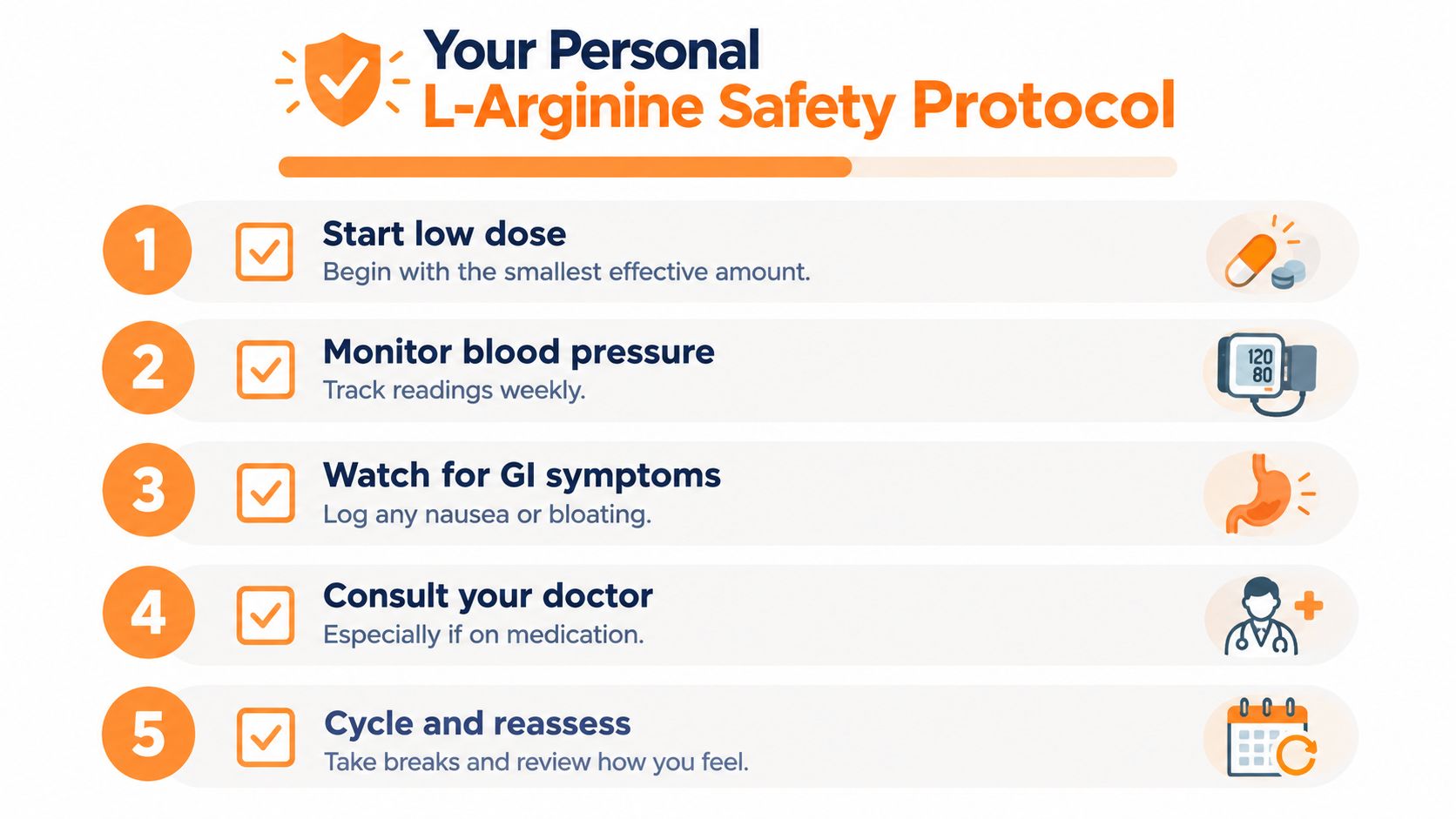
Five practical steps
- Review the full label. Check whether L-arginine appears alone or inside a pre-workout or men's wellness formula. Record the amount per serving and avoid unknowingly stacking products.
- Start conservatively. Use the smallest amount allowed by the product directions rather than beginning with an aggressive serving. A slower introduction gives the body a clearer tolerance test.
- Keep a symptom log. Record the serving time, food intake, exercise, nausea, bloating, diarrhea, headache, flushing, dizziness, or palpitations. A simple note on a phone can reveal whether symptoms repeatedly follow the supplement.
- Separate mild discomfort from danger. A brief, mild stomach complaint may justify pausing and seeking advice. Persistent diarrhea, dizziness, faintness, or palpitations means the next dose shouldn't be taken until a healthcare professional weighs in.
- Reassess the entire routine. If symptoms begin after adding several products, changing the whole stack at once makes the cause harder to identify. A clinician or pharmacist can review every ingredient and medication together.
Persistent symptoms are a stop signal, not a test of willpower.
Some people may find L-arginine easier to tolerate with food or in divided servings, but product directions and personal medical circumstances come first. Men with blood-pressure concerns can discuss whether home monitoring is appropriate, especially if they already use medication that affects circulation.
For a man considering L-arginine as part of SEMEX, the same screening principles apply. The presence of multiple wellness ingredients makes label review especially important, and medication use or a heart, blood-pressure, hormone-related, kidney, liver, asthma, or allergy condition warrants professional guidance before starting.
Making Informed Choices About L-Arginine Supplementation
The side effects of L-arginine supplement use are best understood as a decision problem, not a simple list. Digestive symptoms are the most relevant measurable complaints, yet controlled evidence hasn't shown a reliable overall increase compared with placebo. Dose still matters, and higher intake can make nausea, diarrhea, discomfort, headache, or vascular symptoms more noticeable.
The cardiovascular picture requires more care. L-arginine can contribute to vasodilation and blood-pressure reduction, while a historical trial raised a serious concern for people recovering from acute myocardial infarction. Medication interactions and conditions involving the heart, kidneys, liver, asthma, allergies, or recurrent herpes can change an otherwise ordinary supplement decision.
A sensible user doesn't ignore every mild symptom, and he doesn't panic over every instance of bloating. He checks the dose, watches the pattern, stops persistent or concerning reactions, and asks a qualified healthcare professional before combining L-arginine with medication or using it with a significant medical history. That approach supports informed choice without confusing confidence with risk-taking.
Men evaluating a broader wellness routine can compare the ingredient label, serving instructions, testing information, and personal health needs before adding any product. Knowledge is useful only when it changes daily decisions.
Men who want to evaluate L-arginine alongside a broader daily wellness formula can visit SEMEX to review its ingredient profile, serving guidance, and product testing information. Any new supplement should be checked against current medications, medical conditions, and personal tolerance before use.
These statements have not been evaluated by the Food and Drug Administration. This product is not intended to diagnose, treat, cure, or prevent any disease.