

7 Sex Positions for a Small Penis: A Sensitive Guide
Depth almost never determines satisfaction. Arousal, angle, clitoral contact, and communication usually do more, so the most useful sex positions for a small penis are built around skill rather than anatomy.
The popular advice often starts with “find a position that creates deeper penetration.” That can help some partners, but it can also turn intimacy into a geometry exam with poor lighting. The better question is how two people can create comfortable pressure, steady friction, pelvic alignment, and enough arousal for pleasure to build naturally.
Research supports a careful reframe. A 2009 peer-reviewed study of men who have sex with men found a statistically significant association between perceived penis size and sexual positioning, with men reporting below-average size more likely to identify as bottoms and men reporting above-average size more likely to identify as tops. Men with average penises were more likely to identify as versatile, but the finding describes a correlation, not a rule or destiny. The study reported χ²(4)=19.7, p<.001, γ=-.20, as detailed in the peer-reviewed research.
A 2022 literature review also concluded that research connecting penis size with partner satisfaction remains incomplete, limited by small samples and mixed methods. Older survey data found that 45 of 50 women said width mattered more than length, while 85% reported satisfaction with their partner's penis size, according to the review and its cited evidence in this literature analysis. That makes technique, feedback, and shared confidence more useful than chasing an imaginary perfect measurement.
The seven approaches below pair a position with a practical adjustment and a sentence a partner can say. SEMEX's men's wellness angle belongs in the wider conversation too. Its formula combines Zinc, L-Arginine, Sunflower Lecithin, and Bromelain with ingredients such as Maca Root, Panax Ginseng, Ashwagandha, Tongkat Ali, Saw Palmetto, and Horny Goat Weed, with ingredient-level wellness support rather than treatment claims. The required FDA disclaimer appears at the end.
Table of Contents
- 1. The Angles Approach for Positioning and Sensation
- 2. The Compression Technique for a Closer Fit
- 3. The Shallow Penetration Strategy for the Entry Zone
- 4. The Partner-on-Top Control Position
- 5. The Spooning Approach for Low-Pressure Intimacy
- 6. The Targeted Stimulation Method
- 7. The Foreplay-First Framework for Arousal
- 7-Point Comparison: Sex Positions for a Small Penis
- Bringing It All Together Your Next Conversation With Your Partner
1. The Angles Approach for Positioning and Sensation
A small change in pelvic angle can matter more than a determined attempt to thrust deeper. Legs-up missionary, a supported rear-entry variation, or a close-legged position can bring the pelvis into better alignment and create more consistent contact without turning the receiving partner into a folded lawn chair.
A firm pillow under the receiving partner's hips can lift the pelvis and alter the entry angle. Raised legs can also shorten the vaginal canal and help the penis make steadier contact with sensitive areas. The point isn't maximum depth at every moment. It's finding the angle where the shaft, pubic bone, and external stimulation work together.
Adjust the pelvis before adjusting the pace
Partners can begin slowly, then make small changes. A receiving partner might tilt the hips slightly upward, lower the legs, or bring the knees closer together. The penetrating partner can keep the movement shallow while checking whether pressure improves.
Practical rule: Change one variable at a time. A pillow, a pelvic tilt, or a different rhythm gives clearer feedback than changing everything at once.
A couple trying this after work might start in missionary with a pillow beneath the receiving partner's hips. If the receiving partner says, “A little higher and slower feels better,” the penetrating partner can hold that angle instead of assuming that harder or deeper is automatically better.
For additional ideas involving supported movement and stability, couples can explore stability-ball sex positions, provided the surface is secure and both partners feel balanced.
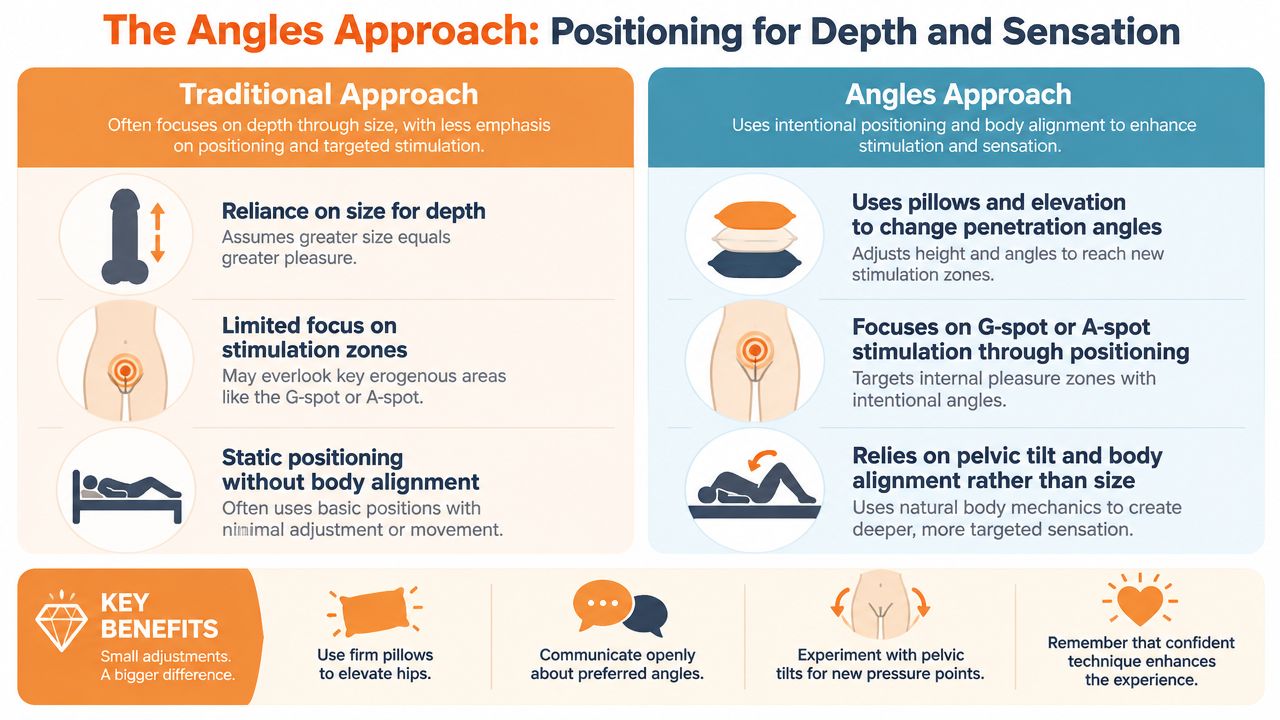
Confidence grows when a partner sees careful adjustment producing better sensation. Technique becomes attractive because it shows attention, not because it performs a measurement miracle.
2. The Compression Technique for a Closer Fit
Fullness doesn't require maximum length. A closer fit can come from body position, controlled movement, and intentional pelvic floor engagement. The receiving partner may gently contract the pelvic floor around the penis, while both partners keep the rhythm slow enough to notice pressure and comfort.
This approach works best as a conversation rather than a surprise squeeze. A strong contraction that feels exciting for one person may feel uncomfortable for another, especially if the muscles are already tense. Pleasure should feel focused, not painful, numb, or forced.
Use pressure without turning it into a performance
The penetrating partner can begin with short, controlled movements. The receiving partner can try a gentle contraction, relax, then repeat while describing the difference. A useful script is, “Tell me whether this pressure feels good, and say when it needs to ease up.”
For a couple who usually rushes toward deeper thrusting, the change may feel surprisingly playful. They might stay nearly still for a moment, add a small rocking motion, and let the receiving partner control the contractions. The result can feel more connected because both partners are actively shaping the sensation.
A few practical reminders help keep this technique comfortable:
- Start gently: Slow movement makes it easier to distinguish pleasurable pressure from strain.
- Use clear feedback: “More,” “less,” “hold there,” and “pause” are useful instructions, not mood killers.
- Relax between contractions: The receiving partner shouldn't treat the pelvic floor like a permanent clenched fist.
- Keep lubrication available: Less friction from dryness makes controlled pressure more comfortable.
The most useful goal is not to imitate a sensation of larger size. It's to discover whether compression, rocking, or stillness creates better pleasure for that particular partner.
3. The Shallow Penetration Strategy for the Entry Zone
Deep penetration receives plenty of attention, but the entrance and outer portion of the vagina can be highly responsive. Shallow strokes can create predictable friction near the opening, while the free hand adds clitoral or perineal stimulation. For anal penetration, the same principle applies with extra attention to relaxation, lubrication, gradual entry, and ongoing consent.
The receiving partner can lie on their back with the hips slightly raised, lie side by side, or choose a face-to-face position that keeps bodies close. The penetrating partner then uses short strokes and varies the rhythm rather than pushing toward depth as the only measure of success.
Let rhythm do the heavy lifting
One couple might try a slow rocking pattern, pause, then add a quicker series of shallow movements. Another might keep the penis almost still while the receiving partner moves the hips. The most useful script is specific: “Stay near the entrance and keep that rhythm while the hand stays on the clitoris.”
The anterior vaginal wall, commonly associated with the G-spot area, is often discussed within the outer two to three inches, but bodies vary and no single map guarantees pleasure. The evidence around penis size and satisfaction remains limited, so the receiving partner's feedback matters more than a diagram. The 2022 review describes that evidence as incomplete and methodologically weak in its discussion of size and sexual satisfaction research.

A real-world example might involve a partner who rarely enjoys deep thrusting but responds well to steady external stimulation. A shallow strategy lets the couple stop competing with depth and coordinate penetration with the clitoris, breathing, kissing, or pressure on another sensitive area.
For comfort, any anal version should proceed only with enthusiastic consent, plenty of suitable lubricant, gradual pacing, and a stop signal that both partners respect immediately.
4. The Partner-on-Top Control Position
Partner-on-top works because the receiving partner controls the variables that matter most to comfort and stimulation. They can choose depth, speed, hip angle, and whether the movement is a lift, rock, grind, or gentle bounce. The penetrating partner can stay attentive rather than trying to prove anything with increasingly dramatic thrusts.
A receiving partner leaning forward may create more pressure toward the front wall. Sitting upright may make clitoral contact with the base of the penis or pubic area easier. Small hip circles can create friction without requiring repeated withdrawal and re-entry.
Give control without disappearing
The penetrating partner still has an active role. Hands can support the hips, stimulate the clitoris, trace the back, or hold the receiving partner close. A useful line is, “Set the pace, and guide the angle that feels best.”
A couple might begin with the receiving partner kneeling over the penetrating partner, then switch to a more upright posture when external pressure becomes more important. If either partner feels tired, they can pause, kiss, use hands, or change positions without treating the pause as a failure.
The partner-on-top position guide can offer additional variations, but the essential principle remains simple: the receiver's body gets to lead.
“The most useful position is the one that lets the receiving partner make adjustments without having to apologize for them.”
This position can also support longer, less frantic encounters. The receiving partner doesn't need to maintain one pace, and the penetrating partner can focus on staying present, responsive, and affectionate. Pleasure becomes collaborative rather than a test of stamina or length.
5. The Spooning Approach for Low-Pressure Intimacy
Spooning removes much of the visual pressure that can make penis size feel like the headline. Both partners lie on their sides, with the penetrating partner behind or alongside the receiving partner. The bodies stay close, the movements naturally remain smaller, and hands remain available for clitoral, breast, perineal, or other touch.
The position suits a relaxed morning, a slow weekend, or an evening when neither partner wants acrobatics. It also makes pauses easy. A couple can stop moving and continue kissing, holding, or talking without breaking physical contact.
Keep the hips flexible
The receiving partner can angle the hips slightly forward or backward to change penetration. The penetrating partner can use a hand beneath the top leg for support, then adjust the rhythm to a gentle rocking motion. A simple script is, “Should the hips come forward, or does this angle feel right?”
One couple may use spooning for shallow penetration while the receiving partner stimulates the clitoris. Another may decide that penetration is secondary and spend most of the time touching, breathing together, and building anticipation. Both are valid outcomes.
The snake sex position guide offers another intimacy-first variation for couples interested in close body contact and adaptable angles.
Comfort matters more than staying in the position. A pillow between the knees, lubricant within reach, and permission to change sides can keep the experience relaxed. Spontaneous adjustments often work better than holding an awkward pose because an online list called it optimal.
6. The Targeted Stimulation Method
Penetration is only one source of sensation, so there's no reason to make it carry the entire evening. Hands, fingers, a small vibrator, or another appropriate aid can add clitoral, anterior-wall, perineal, or broader body stimulation. The receiving partner can guide placement and pressure while the penetrating partner coordinates rather than competes.
A partner might use a hand on the clitoris during missionary, guide a vibrator during partner-on-top, or add fingers before and during penetration if that feels comfortable. For anal play, appropriate lubrication, gradual pacing, clean hands, and suitable barriers remain essential.
Layer sensation with a clear rhythm
Synchronization can feel wonderful, but alternating stimulation can work just as well. For example, the penetrating partner might maintain a slow rocking motion while the receiving partner guides a hand, then pause penetration during a stronger wave of external stimulation.
A practical script sounds like, “Keep the hand there, use less pressure, and let the penetration stay slow.” That sentence gives three useful instructions without asking either partner to guess.
The anterior wall is commonly discussed as being within the outer one to three inches, but anatomy and preference differ. A partner can explore gently rather than treating the G-spot as a guaranteed button. Lubrication, trimmed nails, and attention to comfort matter more than technical confidence.
A realistic bedroom example involves a couple who notices that penetration alone creates pleasant sensation but not enough intensity. Adding steady clitoral stimulation changes the experience without requiring a different body. The improvement comes from combining inputs, not from pretending size has no physical characteristics.
Better question: “What combination of touch, pressure, rhythm, and angle helps this partner stay engaged?”
That question keeps the focus on pleasure rather than comparison.
7. The Foreplay-First Framework for Arousal
Arousal changes how touch feels, how easily the body relaxes, and how much attention a partner can give to pleasurable sensation. Foreplay-first sex treats kissing, massage, full-body touch, anticipation, and verbal connection as part of the experience, not as a warm-up that must be rushed through.
A couple might begin with a massage, linger over kissing, use soft lighting, play music, or introduce textures that the receiving partner enjoys. The aim isn't to create a staged performance. It's to give the body and mind time to become involved before penetration enters the scene.
Build anticipation instead of chasing proof
Delayed gratification can be simple. One partner can pause just when the other expects penetration, return to kissing, then use a different kind of touch. The script might be, “There's no rush. Tell me what makes the anticipation better.”
Once penetration begins, the couple can keep the pace unhurried and continue external stimulation. A partner who already feels highly aroused may care less about depth because other sensations are carrying more of the experience. That doesn't mean every partner prefers shallow penetration, only that size isn't the sole driver of pleasure.
A regular foreplay-first routine can also reduce the pressure to perform on command. Partners learn each other's reactions, discover favorite transitions, and build confidence through repeatable skills. The emotional tone matters too. Feeling wanted, listened to, and free to change direction can make a greater difference than selecting a supposedly perfect position.
The framework works across bodies, orientations, and types of penetration. It can include oral sex, mutual masturbation, toys, massage, or no penetration at all. The best plan is the one both partners want.
7-Point Comparison: Sex Positions for a Small Penis
| Technique | Implementation complexity | Resource requirements | Expected outcomes | Ideal use cases | Key advantages |
|---|---|---|---|---|---|
| The Angles Approach: Positioning for Depth and Sensation | Medium, requires experimentation to find angles | Low, pillows/cushions, willing partner | Greater perceived depth and targeted stimulation | Partners seeking deeper sensation without relying on size | Enhances contact with targeted zones (G-/A-spot); builds technique-based confidence |
| The Compression Technique: Tight Fit and Focused Sensation | Medium–High, requires pelvic muscle control and coordination | Low, training (Kegels), practice time | Intense, concentrated pressure and perceived fullness | Partners wanting high-intensity sensation with smaller dimensions | Increases sensation via muscular engagement; promotes shared control |
| The Shallow Penetration Strategy: Focusing on the Sensitive Entry Zone | Low, simple stroke and rhythm adjustments | Low, knowledge of sensitivity zones, communication | Strong stimulation of entrance zones; often stronger orgasms | Those prioritizing nerve-rich stimulation and stamina management | Size becomes irrelevant; effective for extended, controlled sessions |
| The Woman-on-Top Control Position: Leveraging Partner Agency | Low, easy to adopt though requires practice for rhythm | Low, comfortable surface, partner willingness | Enhanced control of depth/angle and better clitoral access | Partners wanting agency, clitoral stimulation, or reduced pressure on penetrator | Receiving partner controls pleasure variables; reduces performance anxiety |
| The Spooning Approach: Intimacy-First Positioning | Low, minimal technique needed | Low, comfortable bed/couch and pillows | Increased emotional closeness and shallow, sustained intimacy | Relaxed, unhurried sessions; morning or low-energy moments | Maximizes full-body contact and reduces fatigue/performance pressure |
| The Targeted Stimulation Method: Manual and Mechanical Enhancement | Medium–High, requires coordination and feedback | Medium, hands, fingers, and optional toys | Layered sensations, higher likelihood of orgasms | Partners seeking multi-source stimulation and variety | Makes size irrelevant by combining penetration with direct stimulation; highly customizable |
| The Foreplay-First Framework: Building Arousal and Perception | Medium, requires time and intentional pacing | Medium, time, environment (lighting, music), sensory aids | Heightened arousal, stronger orgasms, improved emotional connection | Couples prioritizing long-form intimacy and psychological arousal | Emphasizes mental/physical build-up; reduces performance anxiety and increases satisfaction |
Bringing It All Together Your Next Conversation With Your Partner
The seven approaches point to one practical conclusion: pleasure is co-created. A position can help, but it can't replace arousal, lubrication, consent, curiosity, or feedback. A confident partner doesn't need to pretend that anatomy is irrelevant. Confidence comes from knowing how to adapt.
A simple same-night plan can look like this:
- Choose one position: Start with partner-on-top, spooning, or angled missionary rather than attempting every variation.
- Name one desire: Ask for a specific preference, such as “slower,” “more external pressure,” or “stay at this angle.”
- Add clitoral contact: Use a hand, a small vibrator, or body-to-body pressure during penetration.
- Adjust the hips: Try a pillow beneath the receiving partner's hips before changing depth.
- Keep checking in: Short questions such as “More of this?” or “Want to switch?” protect comfort and keep both partners engaged.
The couple should also treat the receiving partner's response as useful information rather than a judgment. If deep penetration feels good, the couple can use it. If shallow rocking and clitoral stimulation work better, that isn't a consolation prize. It's effective technique.
SEMEX fits into a separate men's wellness conversation, not as a solution for sexual dissatisfaction. Its daily formula includes Zinc, L-Arginine, Sunflower Lecithin, and Bromelain, alongside Maca Root, Panax Ginseng, Ashwagandha, Tongkat Ali, Saw Palmetto, and Horny Goat Weed. At the ingredient level, Zinc plays a role in normal male reproductive function, L-Arginine supports nitric oxide and blood-flow pathways, and the formula is positioned around semen volume, taste, and overall vitality. The product information describes three capsules daily, gradual support over about 30 days of consistent use, vegan and non-GMO ingredients, USA manufacturing in a cGMP-registered facility, Eurofins third-party testing for microbials, heavy metals, and adulterants, and a 90-day money-back guarantee.
Those product details describe structure/function support, not diagnosis or treatment. They also don't replace a conversation with a qualified healthcare professional about persistent pain, sexual difficulties, or reproductive concerns.
These statements have not been evaluated by the Food and Drug Administration. This product is not intended to diagnose, treat, cure, or prevent any disease.
A pillow can improve an angle. A partner's hand can add stimulation. A thoughtful question can change the entire mood. Over time, confidence, communication, and shared curiosity will outperform any single positional trick.
SEMEX offers a daily men's wellness formula with Zinc, L-Arginine, Sunflower Lecithin, Bromelain, and a broader vitality blend, with vegan, non-GMO ingredients and third-party testing by Eurofins. Couples and men exploring this topic can visit SEMEX to review the formula, quality details, and 90-day money-back guarantee.