

Seman Volume Enhancer
Zinc supplementation was associated with higher semen volume, with a standardized mean difference of −0.99, but a larger ejaculation still doesn't guarantee better sperm quality or fertility. A semen volume enhancer may offer modest, gradual support, yet only selected ingredients have a plausible mechanism and results generally require roughly a month of consistent daily use.
The popular advice is simple: take a supplement, wait for a dramatic increase, and assume more fluid means better reproductive performance. The evidence is less flattering. Volume is only one semen parameter, and the difference between a fuller ejaculation, healthier sperm, and a meaningful fertility outcome matters more than an impressive product promise.
Men may seek more volume for confidence, sexual novelty, perceived intensity, or shared bedroom satisfaction. Couples may also care about taste. Those goals are legitimate, but they aren't interchangeable with conception outcomes. A supplement should therefore be judged by its ingredients, elemental doses, testing standards, and measured effects, not by the size of its marketing claims.
Table of Contents
- What Semen Volume Enhancers Actually Claim
- Key Ingredients Behind Semen-Volume Formulas
- The Hidden Trade-Off Between Volume and Sperm Quality
- Why Ingredient Plausibility Rarely Equals Meaningful Outcomes
- How to Evaluate Supplements Safely and Critically
- Building a Realistic Routine and Expectations
- Smart Buying Decisions and Final Takeaways
What Semen Volume Enhancers Actually Claim
A semen volume enhancer is usually a dietary supplement, not a drug. Its label may describe support for normal reproductive function, circulation, vitality, or fluid production. Under U.S. rules, those are structure/function concepts. A product cannot lawfully claim to diagnose, treat, cure, or prevent infertility or another disease, and the manufacturer must have substantiation showing that its claims are truthful and not misleading. The FDA's explanation of dietary-supplement label claims sets out that distinction.
The category usually makes three connected promises, although the evidence behind them differs.
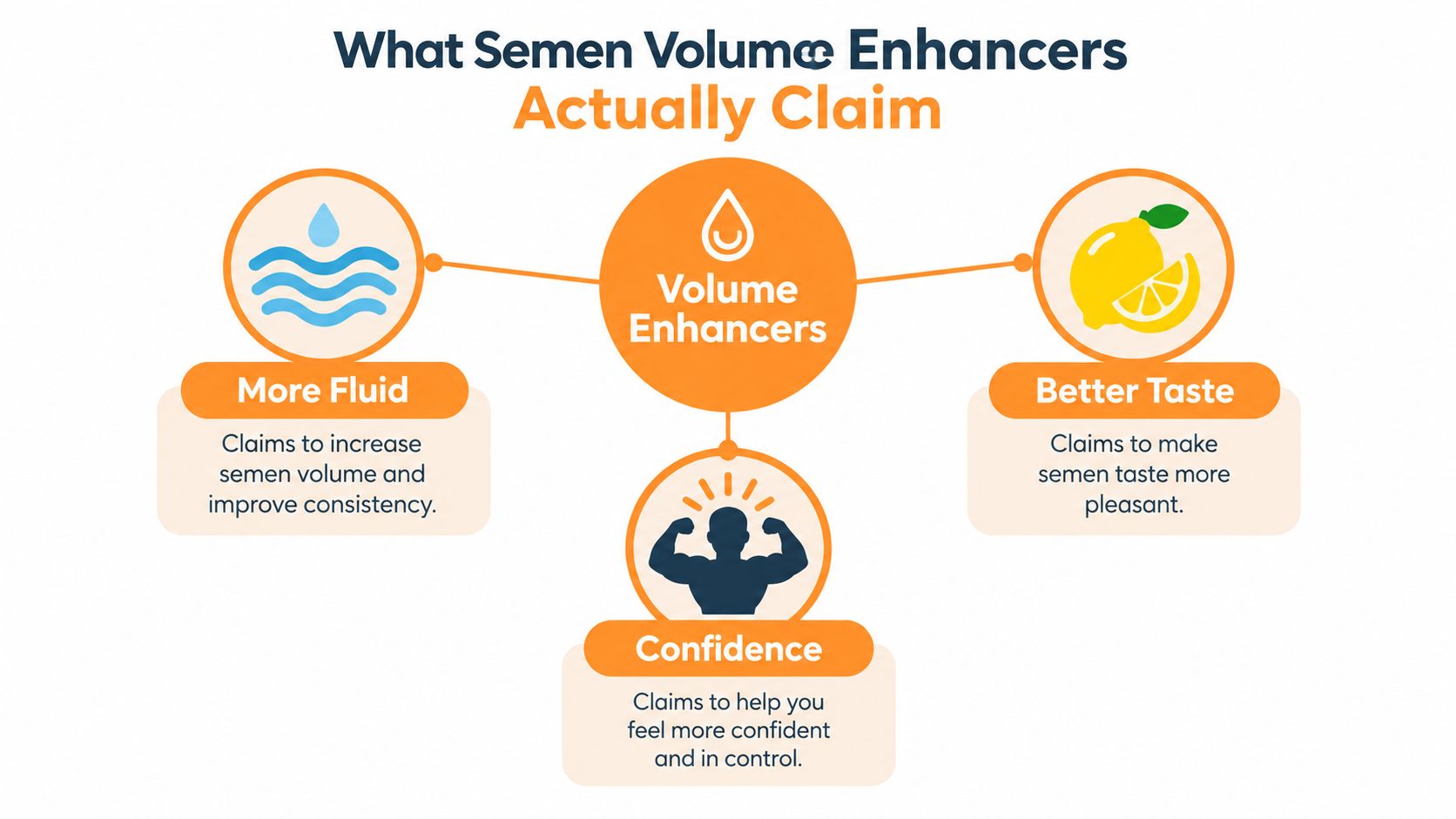
More fluid is the most measurable claim. Semen volume reflects the liquid portion of ejaculate, not just the number or health of sperm cells. Taste is a subjective bedroom experience and is influenced by many factors, so ingredient claims in this area deserve more caution than claims tied to a defined laboratory measure. Confidence is a personal response, not a clinical endpoint.
Men comparing products can find a useful primer in what volume pills claim to do, but the central question should remain: what did the research measure?
Plausibility is not proof
Zinc has the strongest direct relevance among common volume-focused ingredients. Seminal zinc participates in sperm structural stability, motility, and reproductive function. A meta-analysis covering 20 studies, 2,600 infertile cases, and 867 controls found lower seminal-plasma zinc in infertile men than in controls, with a standardized mean difference of −0.64, and supplementation was associated with higher semen volume, improved motility, and a greater proportion of normally shaped sperm in the published meta-analysis.
That finding still doesn't make zinc a universal fertility solution. The same analysis found no significant improvement in sperm concentration, total sperm count, or viability. The defensible baseline is therefore modest: some formulas may support selected semen parameters, while volume alone remains an incomplete scorecard.
Key Ingredients Behind Semen-Volume Formulas
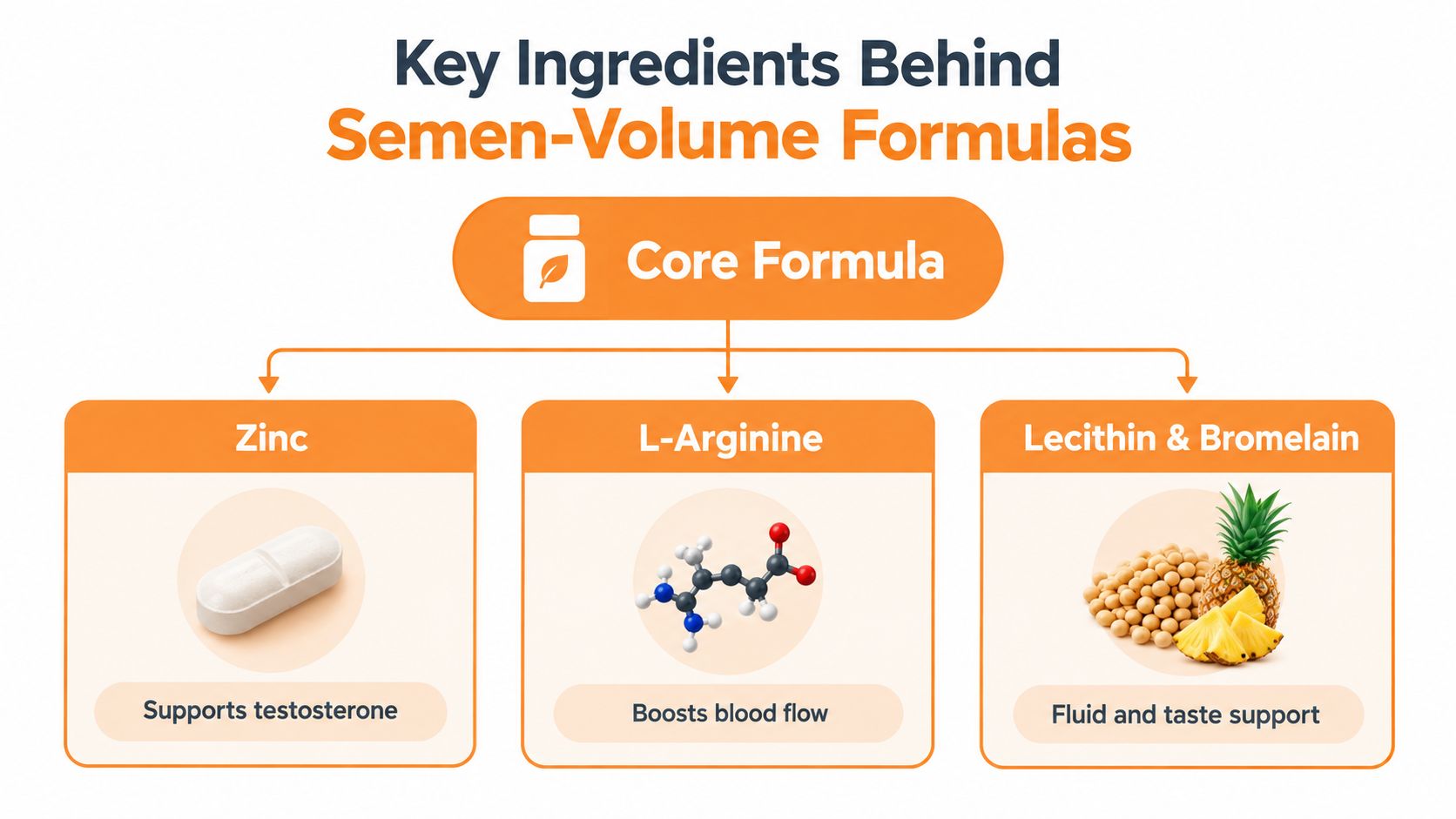
A long ingredient list can create an impression of certainty that the evidence does not support. Minerals, amino acids, enzymes, and botanicals should be judged separately, using four checks: biological rationale, human research, disclosed dose, and relevance of the measured outcome to the buyer's goal.
Ingredients that warrant closer scrutiny
Zinc has a recognized role in male reproductive biology, but label precision matters more than broad marketing language. A formula should state the amount of elemental zinc, rather than only listing the total weight of a zinc compound. Those figures are not interchangeable. The compound name alone does not show how much zinc the user receives, and both inadequate and excessive intake can create problems.
A practical label check is simple: identify the chemical form, find the elemental amount per serving, confirm the serving size, and add zinc from other supplements before judging the total exposure. This dose information is more useful than a general claim that zinc supports fertility.
L-arginine supplies material for nitric-oxide synthesis, which gives it a plausible connection to vascular signaling and blood flow. Research in male subfertility has examined approximately 1.4 grams per day, with findings that include progressive motility and, in some studies, sperm concentration or motility within broader nutrient protocols as reviewed in the male-subfertility literature. That research does not establish a guaranteed increase in ejaculate volume.
Dose disclosure remains important because L-arginine studies often combine it with antioxidants, zinc, carnitines, or other micronutrients. If a product hides individual amounts inside a proprietary blend, buyers cannot compare its formula with the research or determine which ingredient may account for an observed effect. A plausible mechanism cannot identify the outcome of the finished product.
Ingredients with limited volume evidence
Sunflower lecithin appears often in volume-focused products, yet the available material does not establish a clinically proven human dose for increasing semen volume. Bromelain is also marketed in connection with taste support, but its inclusion does not demonstrate a specific change in ejaculate. Labels should describe these ingredients without implying a proven bedroom result.
The same caution applies to maca root, Panax ginseng, ashwagandha, Tongkat ali, saw palmetto, and horny goat weed. They may be associated with vitality, energy, libido, or general male wellness, but mechanistic interest differs from evidence for a semen-volume outcome. This review of arginine, zinc, pygeum, and lecithin formulations can help readers compare proposed ingredient roles. The useful question remains whether the product discloses research-relevant doses and measures an outcome that matters beyond volume.
The Hidden Trade-Off Between Volume and Sperm Quality
The most important question isn't always how to produce more semen. For men trying to conceive, it may be how to increase volume without sacrificing sperm quality.
Longer abstinence generally raises semen volume and total sperm count, but extended intervals may reduce motility and worsen DNA integrity. A literature review found that abstinence of roughly 4 to 7 days can increase volume and count while being associated with poorer motility and greater DNA fragmentation. Shorter intervals can produce fresher sperm with better motility and DNA integrity as summarized in the abstinence review.
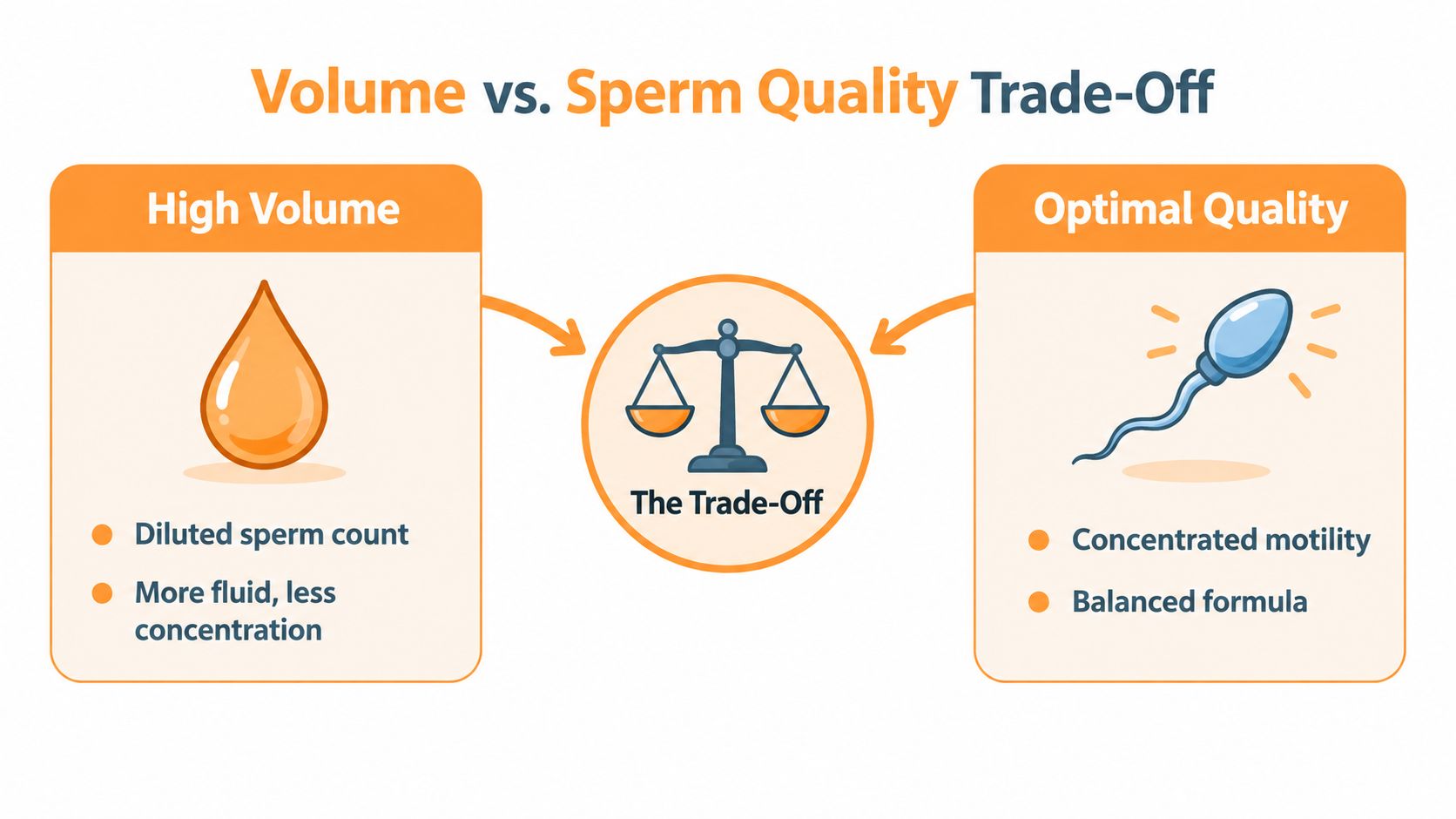
This creates two different targets. A man seeking a fuller ejaculation for bedroom confidence may notice volume as the primary experience. A couple timing intercourse around conception may care more about motility, DNA integrity, and the complete semen profile. The interval that maximizes one objective may not maximize the other.
Volume isn't a fertility shortcut
Semen contains fluid from several reproductive glands, while sperm cells account for a different part of the reproductive picture. A large ejaculate can contain less concentrated or less mobile sperm, and a smaller sample can still contain sperm with useful characteristics. Therefore, visual volume is not a reliable proxy for fertility.
A supplement also cannot override normal physiology. Zinc may support selected parameters, and L-arginine may support nitric-oxide biology, but neither ingredient proves that a man can bypass the biological trade-offs associated with ejaculation timing.
Practical rule: A man should choose abstinence timing according to his goal, then evaluate fertility with semen analysis rather than judging reproductive health by appearance.
That distinction protects consumers from the most common category error. Bedroom satisfaction is real, but it isn't a laboratory endpoint. Couples with persistent concerns about quantity, sperm count, or conception should seek professional evaluation rather than escalating supplement doses.
Why Ingredient Plausibility Rarely Equals Meaningful Outcomes
A mechanism explains how an ingredient might act. It doesn't establish that a finished supplement changes the experience a consumer cares about.
L-arginine illustrates the problem. Nitric oxide and blood flow provide a coherent biological story, yet studies often combine L-arginine with antioxidants, zinc, carnitines, or other micronutrients. If motility changes, researchers may not be able to determine which ingredient caused the result. A blend can therefore appear stronger on paper because several plausible theories are grouped together.
The endpoint matters
A serious evaluation separates four questions:
- What was measured? Semen volume, motility, morphology, pregnancy, and live birth are different endpoints.
- At what dose? A study dose may not match the amount in a commercial serving.
- For how long? Changes commonly emerge over multiple months, consistent with spermatogenic timing, rather than immediately after a capsule.
- Does the result matter? A change in one laboratory parameter doesn't automatically improve fertility or bedroom satisfaction.
The evidence gap is substantial. A 2025 systematic review and meta-analysis found no evidence that dietary supplements improved pregnancy or live-birth rates in the limited available research. Some supplements affected individual sperm parameters, but results were inconsistent, isolated, and generally supported by low-certainty evidence in the systematic review and meta-analysis. An earlier evidence-based analysis found that only 22% of ingredients in popular male-fertility supplements had published fertility evidence, while only 17% had positive randomized-trial evidence, as reported in the same review.
Those findings don't mean every ingredient is useless. They mean consumers should resist the leap from “supports a pathway” to “improves the outcome that matters.”
Manufacturing is part of the evidence question
In the United States, FDA doesn't preapprove or routinely test dietary supplements before sale. That makes transparent manufacturing, identity testing, contaminant controls, and adulterant screening relevant purchasing criteria, not optional decoration. A clean label can describe a plausible formula, but it cannot prove that the bottle contains the stated ingredients in the stated amounts.
Readers examining legal wording can use the explanation of structure/function claims for supplements as a practical reference. The safest language stays ingredient-specific and supportive. It doesn't turn a supplement into a treatment.
How to Evaluate Supplements Safely and Critically
A careful evaluation begins with the label, then tests whether the claims match the evidence. The product should name each active ingredient, serving size, and amount per serving. Proprietary blends hide the doses needed for comparison with human studies, making confident evaluation difficult.

A practical label audit
Check elemental zinc first. The meaningful figure is elemental zinc, not the total weight of zinc picolinate, citrate, gluconate, or another compound. For example, a label might list 30 mg of zinc picolinate but show “Zinc (as zinc picolinate) 6 mg” in the Supplement Facts panel. Compare the 6 mg elemental amount with the dose and population studied, rather than treating the larger compound weight as the active dose.
Match each ingredient to a defined endpoint. Zinc may relate to selected semen parameters, while L-arginine has a plausible nitric-oxide mechanism discussed in the literature. Lecithin, bromelain, and botanicals may serve different proposed purposes. None should be presented as proof of increased semen volume unless the relevant human outcome has been studied.
The key question is whether the formula changes a measured parameter that matters, not whether every ingredient has a biologically plausible story.
Look for evidence of batch control. A testing certificate should identify the product or batch, the methods used, and the results or acceptance criteria. A logo without accessible documentation provides little basis for judging whether the stated formula is present or whether contaminants were assessed.
Inspect the facility claim. cGMP registration, a traceable manufacturing location, and available quality records provide more useful information than phrases such as “premium quality.” Vegan and non-GMO credentials may matter for personal preferences, but they do not establish dose accuracy or clinical effectiveness.
Check the legal boundaries
A structure/function claim must remain beside its required disclaimer or clearly link to it on the same panel or page. FDA does not preapprove these claims, and the manufacturer must notify the agency no later than 30 days after first marketing a product with such a claim under the FDA's structure/function guidance. Careful wording helps distinguish wellness support from medical treatment.
SEMEX is presented as a daily supplement containing zinc, L-arginine, sunflower lecithin, bromelain, maca root, Panax ginseng, ashwagandha, Tongkat ali, saw palmetto, and horny goat weed. The stated format is three capsules daily, with vegan, non-GMO, U.S.-made, cGMP-registered, and Eurofins third-party testing claims. Verify those details against current product documentation. They describe the product and its controls, not a guaranteed semen outcome.
Building a Realistic Routine and Expectations
Start by defining the outcome. Bedroom experience, general wellness, and conception support call for different measures. Perceived fullness may matter for the first goal, while a couple trying to conceive needs professional semen analysis and reproductive guidance. A larger ejaculate does not automatically indicate better sperm function.
A useful routine also controls avoidable variables. Keep hydration, sleep, physical activity, stress, and ejaculation timing reasonably consistent. Track one outcome for 30 days in a simple three-column log, recording hydration, sleep hours, and abstinence interval alongside the observed change. This makes personal impressions easier to interpret and reduces the risk of crediting a supplement for normal day-to-day variation.
A responsible routine measures progress without turning every ejaculation into a laboratory experiment.
Use the product according to its label rather than escalating the dose after one disappointing result. Reviews of spermatogenesis timing make an immediate transformation biologically implausible, so early impressions should remain provisional. Consistent observation is more informative than comparing isolated ejaculations, and objective testing matters when fertility is the goal.
Persistent low volume, a sudden change, pain, blood, difficulty ejaculating, or ongoing fertility concerns warrant professional evaluation. A clinician can assess whether the cause may involve lifestyle, medication, reproductive anatomy, hormones, or another condition that a supplement is not designed to treat. This is the point at which testing should replace speculation.
Smart Buying Decisions and Final Takeaways
The category becomes easier to judge once its claims are separated. More fluid is not the same as better sperm, a plausible ingredient is not the same as a proven finished product, and a change in one semen parameter is not the same as a pregnancy or live-birth outcome.
A careful buyer can use four checkpoints:
- Define the target. Bedroom confidence and conception support require different measures.
- Read the dose. Elemental zinc and the actual amount of each active ingredient matter more than a long ingredient list.
- Verify quality controls. Look for third-party testing that addresses microbials, heavy metals, and adulterants, alongside transparent manufacturing information.
- Set a biological timeline. Gradual daily use is more credible than an overnight promise, and persistent reproductive concerns belong with a qualified professional.
The strongest conclusion is also the least marketable: a semen volume enhancer may support selected parameters for some men, but it cannot promise that a larger ejaculation will improve sperm quality, fertility, taste, or satisfaction for everyone. Men should buy based on transparent evidence and safety information, then judge the product against a realistic goal rather than a dramatic claim.
SEMEX offers a daily formula combining volume- and taste-focused ingredients with a broader men's-wellness blend, alongside stated vegan, non-GMO, cGMP-registered, and third-party testing features. Men comparing options can review the current formula and product information at SEMEX before deciding whether it fits their goals.
These statements have not been evaluated by the Food and Drug Administration. This product is not intended to diagnose, treat, cure, or prevent any disease.