

How to Do the Rocking Chair Sex Position Safely
A couple sees the rocking chair sex position mentioned in a trend article and pauses. The name sounds playful and uncomplicated, but the practical questions arrive quickly: Is an actual rocking chair safe? Which partner carries the effort? What happens when the seat is too high, the furniture shifts, or one partner tires?
The position can be intimate and highly controlled, but it isn't automatically easy. Furniture, hip alignment, balance, mobility, and communication determine whether it feels comfortable or becomes awkward. The guide below focuses on those decisions, including the situations in which a simpler seated position makes more sense.
Table of Contents
- Why the Rocking Chair Position Keeps Coming Back
- What the Position Actually Involves
- Choosing Furniture That Will Not Fail You
- Getting Into Position Step by Step
- When the Position Works and When It Does Not
- Communication Consent and Safety Essentials
Why the Rocking Chair Position Keeps Coming Back
The rocking chair sex position uses a seated, face-to-face arrangement. One partner sits upright while the other straddles them, usually facing them and leaning back slightly. Rather than relying on repeated vertical thrusting, the partners create a gentle forward-and-back rocking motion while staying close enough for kissing, eye contact, and hands-on communication.
That combination helps explain why the position keeps resurfacing. It offers novelty without requiring an acrobatic setup, and the receiving partner can influence depth, angle, and rhythm almost immediately. The seated frame also gives both partners a clear reference point, which can make small adjustments easier than in positions where one body is suspended or supported mainly by the knees and arms.
Interest has also returned alongside broader attention to slower, more controlled intimacy styles such as slow sex and edging. Those approaches prioritize pacing, anticipation, and deliberate changes instead of constant intensity. The rocking chair position can fit that mood because a couple can begin with stillness, add shallow movement, and pause without having to completely change positions.
The historical association is older than current trend coverage. Rocking chairs had existed in America since the early 18th century, but European travelers began noting their prevalence in the 1830s. During the Victorian era, erotic writing connected rocking chairs and other springy seats with sexual charge, while upholstery springs entered train seating in the mid-19th century, helping associate rocking movement with bodily stimulation. The history of rocking motion and erotic furniture offers context for why the position feels familiar rather than entirely new.
The useful question isn't whether the position is fashionable. It's whether the furniture, bodies, and pace make it sustainable for the partners involved.
What the Position Actually Involves
The basic frame is simple. The seated partner stays upright with the pelvis supported by the seat, while the receiving partner settles over them with one leg on either side. The receiving partner may lean back slightly, hold the seated partner's shoulders, or use the chair for support, depending on balance and comfort.
The defining movement is an oval rock, not a bounce. The hips travel gently forward and backward, with a small change in pelvic angle that can maintain contact without forcing the bodies into repeated vertical impact. This can allow the receiving partner to manage depth and rhythm in real time, while the seated partner supports the torso and communicates through touch.
Hip alignment matters because the pelvis needs to move as a unit. If the receiving partner folds sharply at the waist or twists away from the seated partner, the movement may transfer strain into the lower back, thighs, or knees. A comfortable version usually feels connected through the hips, with the feet or knees providing a stable base rather than acting as the main source of power.
A 2020 Czech study examined reported use and pleasure ratings for common sexual positions. It found that higher female coital orgasmic capacity was positively associated with the frequency of face-to-face/female-above positions, with OR = 1.005, P < .001, and sitting/face-to-face positions, with OR = 1.003, P < .001. The study also reported that face-to-face/male-above, face-to-face/female-above, and kneeling/rear-entry positions were the most commonly used overall among heterosexual men and women. The research summary on seated and face-to-face positions supports the view that these mechanics are established patterns, not merely a novelty.
Choosing Furniture That Will Not Fail You
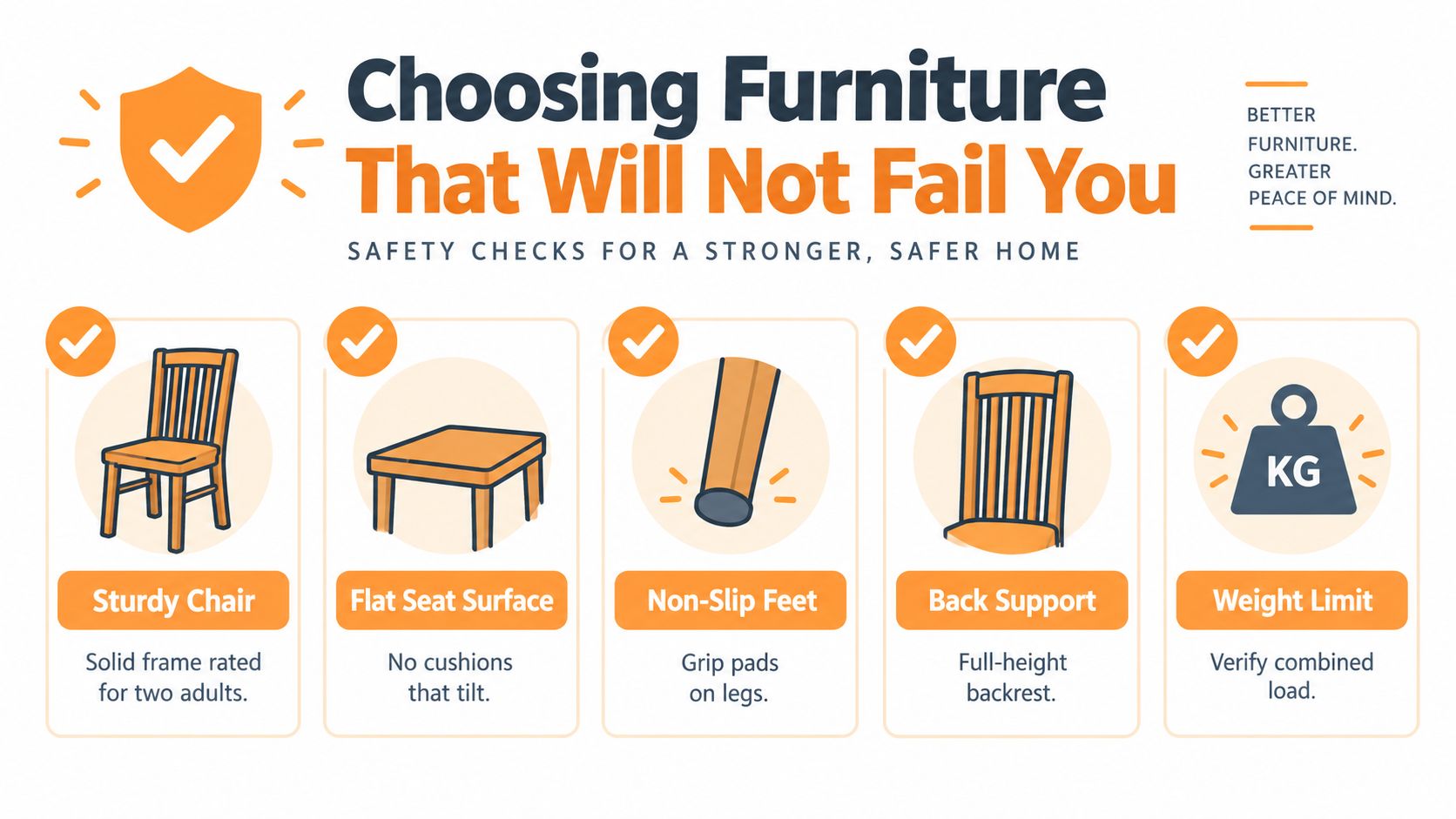
An actual rocking chair is often the wrong piece of furniture for this position. Its movement comes from curved runners or a flexible structure, while the position benefits from a stable base that resists shifting. A firm couch, a sturdy chair on a flat floor, or the supported edge of a bed may provide a safer starting point than furniture designed to rock.
Furniture selection is a load-management decision. The combined body weight should stay within the chair's rated capacity, with additional margin because active movement creates forces that static sitting doesn't. Many quality frames are rated around 300 to 350 lb, or 136 to 159 kg, but the rating alone doesn't guarantee suitability for dynamic use. A lightweight chair, folding chair, rolling office chair, or narrow stool may shift even when the combined weight appears acceptable. These capacity figures and setup principles are discussed in this chair safety guide for partnered movement.
Stability checks before movement
A short inspection can prevent the most common problems:
- Test for wobble: Partners can press down on the seat and gently shift it before anyone climbs on.
- Check the surface: A flat seat is preferable to cushions that tilt, slide, or collapse toward one side.
- Secure wheels: Any rolling furniture should have its wheels locked. Wedges can add resistance, but unstable rolling furniture is better replaced.
- Clear the surroundings: Hard table corners, lamps, cables, and clutter should be moved away from the movement area.
- Protect pressure points: A folded towel or firm pad can reduce discomfort at the knees, hips, or seat edge without making the base unstable.
The same reasoning applies to a couch. A deep, soft couch may feel comfortable at rest but can make alignment difficult once a partner straddles the other. A firmer seat with enough width for both bodies usually provides more predictable support.
Partners who want to compare other furniture-supported ideas can review this stability-ball sex position guide, while remembering that a ball introduces different balance demands and shouldn't be treated as interchangeable with a stable chair.
A practical pre-session check looks like this: stable frame, flat surface, verified capacity, secured floor contact, clear surroundings, and a reachable pause point. If any answer is uncertain, the furniture isn't ready.
Getting Into Position Step by Step
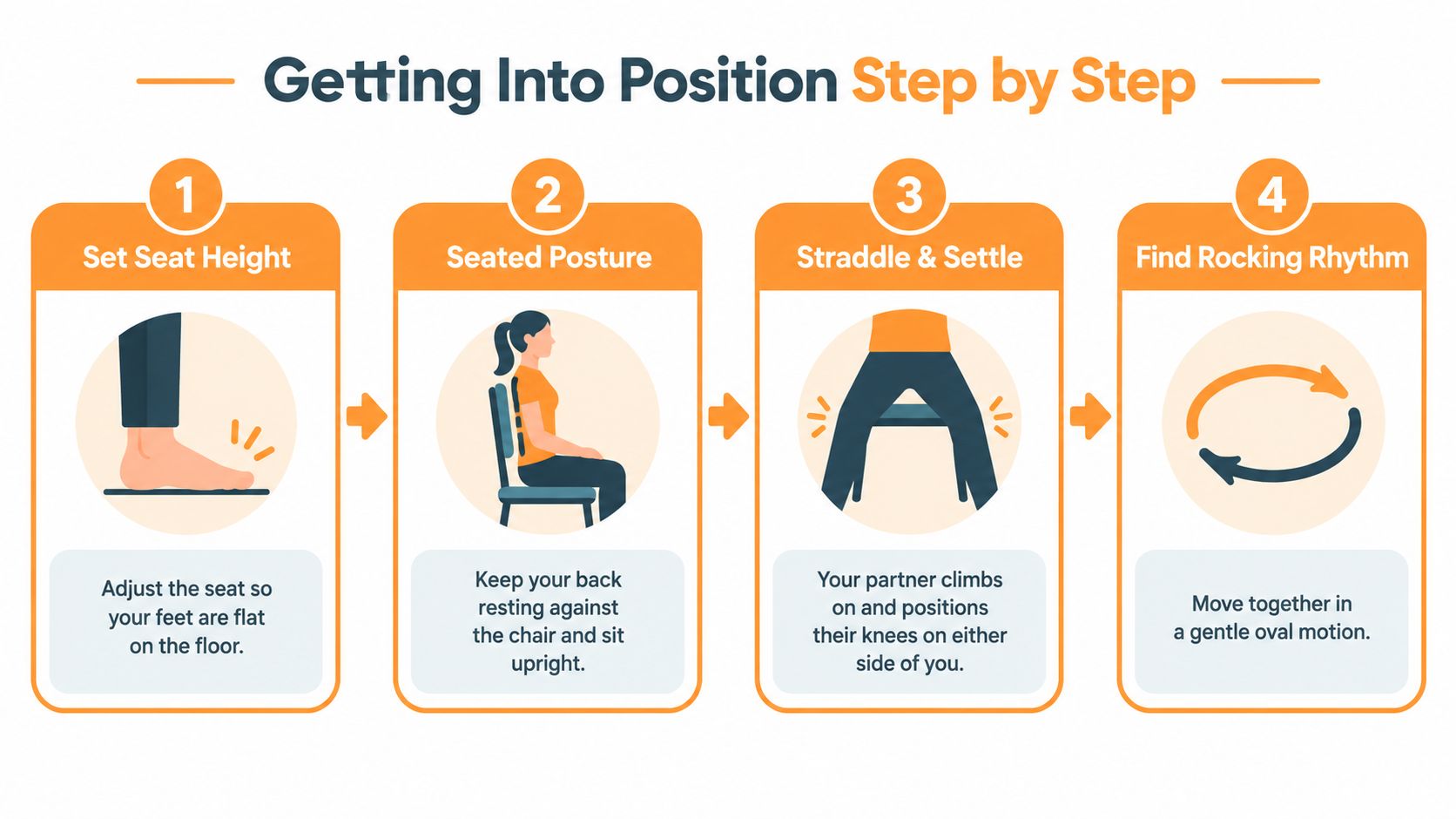
The seated partner begins by choosing a height that allows both feet to rest flat on the floor. Flat feet provide a base for balance and make it easier to absorb movement without pushing the chair backward. If the seat is too high, the seated partner may dangle their feet or lose grip; if it is too low, the knees and hips may compress uncomfortably.
The seated partner then settles upright, using the backrest for support when available. Hands can rest on the receiving partner's hips, thighs, or upper back, but they shouldn't pull suddenly or force a change in depth. The receiving partner can hold the seated partner, the seat, or a stable armrest, provided the armrest doesn't flex or interfere with the knees.
The receiving partner climbs into a straddling position gradually and pauses before any movement begins. That pause allows both partners to check pelvic alignment, breathing, balance, and comfort. A roughly 90-degree hip angle can make entry easier, while a 45-degree hip hinge can help the lumbar spine stay more neutral and reduce disc pressure, as described in this guide to the rocking chair position's mechanics.
Once the bodies are aligned, the receiving partner can lean back only as far as balance allows. The movement starts with a small forward-and-back rock, closer to grinding than bouncing. Feet remain planted, the seated partner stays stable, and the partners adjust depth or rhythm as soon as either body signals that the angle isn't working.
Reading the body's feedback
A workable alignment usually feels smooth, supported, and easy to stop. Trouble signs include the knees pressing into hard edges, the lower back rounding sharply, the chair shifting, or the receiving partner needing to grip tightly to avoid falling.
The position doesn't require a large range of motion. Smaller movement often preserves contact and reduces fatigue. Partners can also pause while remaining close, then restart at a different angle rather than pushing through discomfort.
Anyone comparing variations can use this guide to the snake sex position as a reminder that body-supported positions often depend more on alignment and pacing than on dramatic movement.
When the Position Works and When It Does Not
The rocking chair position tends to suit partners who enjoy close contact, partner-led pacing, and frequent control over depth. The seated frame can reduce the need for one partner to support their full weight with their arms, and the receiving partner can change the rhythm without waiting for the other partner to interpret a movement.
It can be a poor fit when the receiving partner has limited knee flexibility, reduced core endurance, or difficulty balancing on a raised seat. A significant height difference may also create an awkward pelvic angle. Fatigue can arrive sooner than expected because the receiving partner may use the thighs and core to stay upright, even when the movement itself is slow.
Small modifications can change the experience. A pillow under the knees may reduce pressure, an armrest can provide hand support if it is structurally solid, and a lower seat may make foot placement easier. Shorter sessions with planned pauses can work better than treating the position as something that has to be maintained continuously. Body size isn't a barrier by itself, but the furniture must provide enough width, strength, and stability for both partners.
Broader trend coverage has increasingly emphasized slower, controlled styles such as slow sex and edging, but novelty shouldn't outrank comfort. The discussion of body-fit and pacing tradeoffs in current position coverage reinforces the value of choosing a position around the bodies present, not around an idealized demonstration.
| Factor | Rocking Chair | Basic Seated |
|---|---|---|
| Control | The receiving partner can lead depth, angle, and rocking pace. | Control is often shared through stillness, grinding, or small adjustments. |
| Effort | Core, thigh, and balance demands may build over time. | Usually easier to sustain when the partners want minimal movement. |
| Comfort | Works well with stable support and careful alignment. | Often more forgiving when mobility or fatigue is a concern. |
| Novelty | Offers a distinctive rocking rhythm and close face-to-face frame. | Provides familiar intimacy with fewer setup variables. |
The quick decision is straightforward. If balance and furniture are dependable, the rocking chair position can add controlled variety. If either factor is uncertain, a basic seated arrangement or side-lying position may offer more comfort with less risk.
Communication Consent and Safety Essentials
Consent should cover the furniture, the pace, and the option to stop. Partners can agree on a simple signal for “adjust” and another for “pause,” especially if movement makes speaking difficult. A check-in before starting and another after the first few rocks can catch problems early.
The first movement should be slow enough for both partners to evaluate the angle. Muscle fatigue may feel like warmth, shaking, or ordinary exertion, while joint pain, sharp pain, numbness, tingling, or nerve-like discomfort calls for an immediate stop. Pain isn't a test of commitment, and a position doesn't become more successful because someone tolerates it.
A short readiness check
- Furniture: The seat is stable, flat, strong, and free from loose wheels.
- Bodies: Both partners can balance, breathe comfortably, and change position without rushing.
- Movement: The starting rhythm is gentle, with no forced bouncing.
- Communication: A clear pause signal is understood by both partners.
- Environment: The floor and surrounding space are free from hard obstacles.
Practical rule: If either partner has to concentrate more on staying upright than on enjoying the contact, the setup needs to change.
The first-time sex tips guide also fits the broader principle that comfort, consent, and communication matter more than performing a position exactly as pictured.

For men considering a supplement alongside broader wellness habits, SEMEX is described by its publisher as a men's wellness supplement designed to support semen volume and taste, with ingredients including Zinc, L-Arginine, Sunflower Lecithin, and Bromelain. It should remain separate from the position's safety decisions, since no supplement replaces stable furniture, consent, or attention to physical discomfort.
The rocking chair position works best when partners treat it as an adjustable setup rather than a performance challenge. A stable seat, aligned hips, planted feet, slow rocking, and an agreed pause signal create a practical foundation for exploring it safely.
These statements have not been evaluated by the Food and Drug Administration. This product is not intended to diagnose, treat, cure, or prevent any disease.
SEMEX offers a men's wellness supplement formulated around support for semen volume and taste, making it a relevant option for men who are also paying attention to shared bedroom satisfaction. Couples can learn more about the product and its ingredients by visiting SEMEX.