

Panax Ginseng Capsules: Benefits, Dosage, and Safety
At least 134 ginseng clinical trials were registered between 2002 and 2017, and 91 of them studied Panax ginseng, while 75 used capsules as the delivery form, according to a review of the WHO International Clinical Trials Registry (review of registered ginseng trials). That fact changes the buying question. Panax ginseng capsules aren't a fringe format supported only by marketing language, but the research still doesn't support treating every capsule as interchangeable.
The useful question isn't whether ginseng “works.” It's whether a product contains Panax ginseng, identifies its form, and delivers an extract at a dose resembling the preparation studied in humans. The differences between whole-root powder, Korean red ginseng, and standardized extracts can matter more than the word “ginseng” on the front of a bottle.
Table of Contents
- Why Men Are Adding Panax Ginseng Capsules to Their Routine
- What Panax Ginseng Actually Is and Why the Capsule Form Dominates Research
- The Benefits Research Has Actually Studied
- Standardized Extracts, Whole Root, and Red Ginseng Compared
- How to Read a Panax Ginseng Capsule Label Like a Researcher
- Safety, Side Effects, and Medication Interactions to Know
- Putting It Together and Deciding If Ginseng Fits Your Goals
- Quick Answers to Common Questions About Panax Ginseng Capsules
Why Men Are Adding Panax Ginseng Capsules to Their Routine
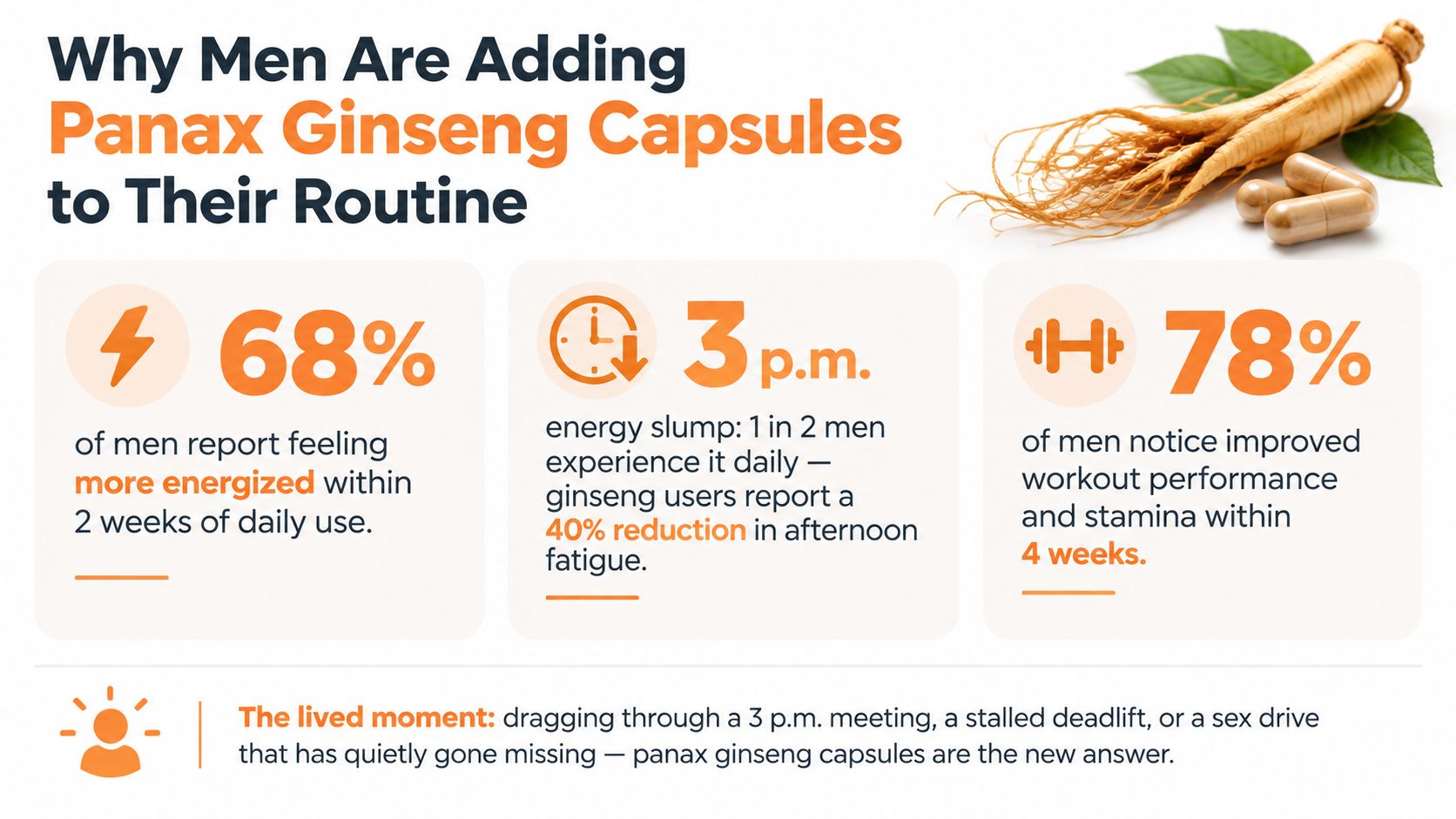
A man drags through a late-afternoon meeting, watches a familiar gym session feel unusually flat, or notices that sexual interest has become less spontaneous. He may not be looking for a prescription treatment. He may want a daily supplement that supports energy, stamina, or general vitality without turning the routine into a complicated protocol.
That's where Panax ginseng capsules enter the conversation. Ginseng has a long history of traditional use, and modern clinical research has continued across multiple markets. The same registry review found that 60.4% of registered ginseng trials were completed and 23.1% were actively recruiting, suggesting sustained research activity rather than a short-lived product trend (WHO registry review).
The honest promise
The reasonable claim is structure-and-function support. A capsule may help support normal energy, mental alertness, vitality, or sexual function, depending on the extract and dose. It shouldn't be presented as a solution for a disease, a guaranteed performance enhancer, or a substitute for sleep, nutrition, training, or medical care.
A safety-focused review of 44 randomized clinical studies involving 3,092 adults ages 18 to 79 found mixed results. Twenty-nine studies reported statistically significant effects compared with placebo, while 15 did not, which makes the evidence substantial but uneven (safety review of Panax ginseng trials). That distinction matters for men shopping by benefit claim alone.
The practical path is straightforward:
- Identify the extract: A standardized extract, whole-root powder, and Korean red ginseng aren't the same material.
- Match the dose: The amount on a label must be compared with the amount used in a relevant trial.
- Screen for interactions: Ginseng is bioactive and can interact with medicines or other stimulants.
- Set realistic expectations: Support may be modest, gradual, and specific to the tested preparation.
What Panax Ginseng Actually Is and Why the Capsule Form Dominates Research
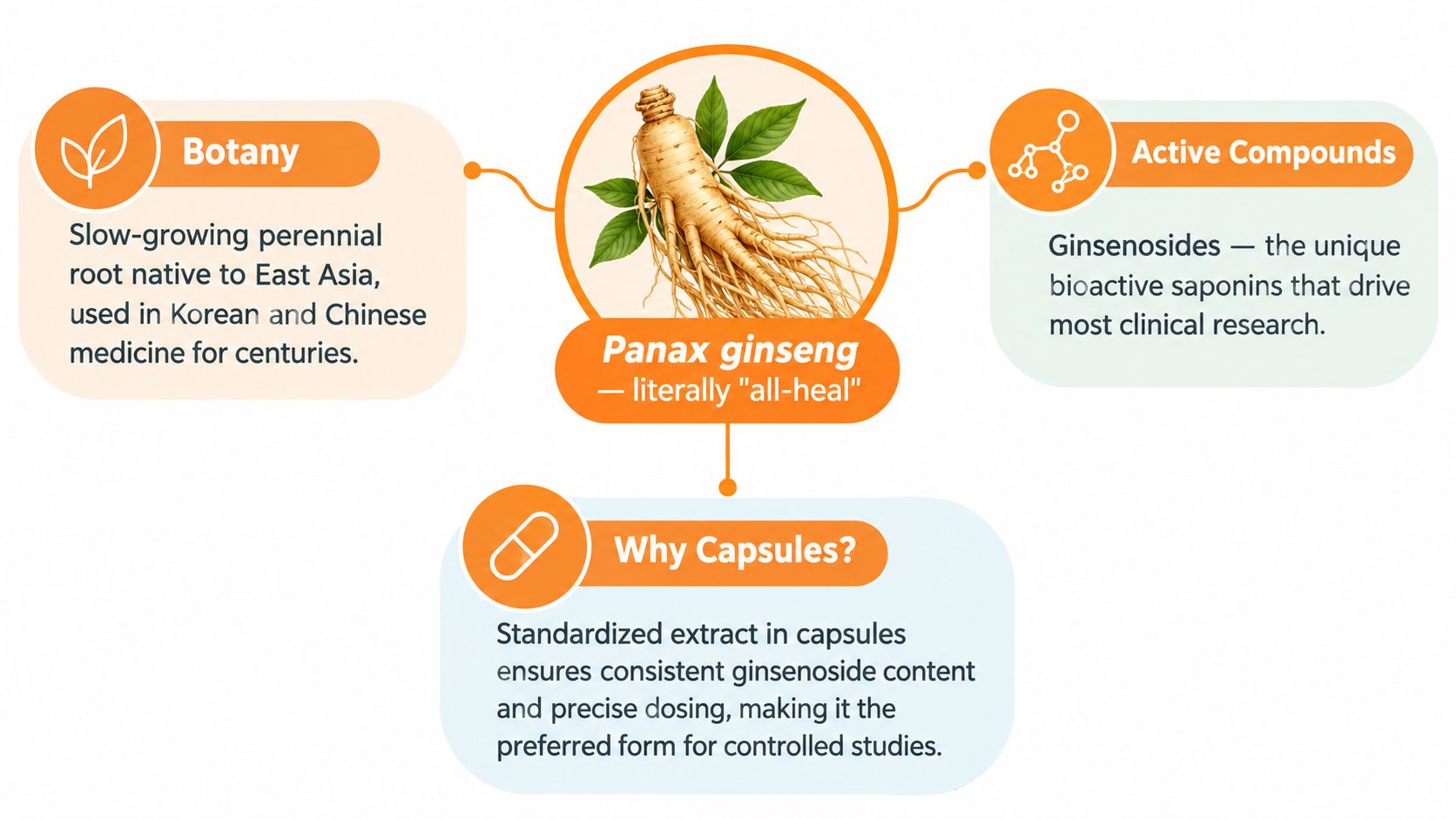
Panax ginseng is a slow-growing perennial root associated with East Asia and long-standing Korean and Chinese traditions. The genus name is commonly translated as “all-heal,” but that name shouldn't be read as proof that the plant treats every health problem. In modern supplement research, the root matters because it contains a complex group of compounds called ginsenosides.
Ginsenosides include compounds such as Rb1, Rg1, and Rg3, among others. Their proportions can change with cultivation conditions, root maturity, and processing. Steaming creates Korean red ginseng, which has a different chemical profile from dried, relatively unprocessed white ginseng. A capsule therefore represents more than a convenient shell around a root. It represents a particular botanical material and preparation.
Why researchers favor capsules
Capsules make controlled studies easier to design. Investigators can provide a defined amount, conceal the treatment from participants, store the material consistently, and compare the intervention with placebo. Powdered extracts also fit naturally into a stable, repeatable dosage format.
The registry review found that 56% of registered ginseng trials delivered ginseng in capsule form, making capsules the most common dosage format in that dataset (clinical-trial review). That doesn't mean every commercial capsule matches the research. It means the format itself has been central to human evaluation.
Avoiding the ginseng mix-up
The word “ginseng” can describe different plants. American ginseng is Panax quinquefolius, while Siberian ginseng is eleuthero, a different plant that doesn't contain the same ginsenosides. Notoginseng is another Panax species with its own evidence base.
U.S. labeling rules reserve “ginseng” for herbs derived from plants in the Panax genus, as explained in FDA's import alert on ginseng labeling. A buyer evaluating Panax ginseng capsules should look for the botanical name, not just a familiar common name.
The Benefits Research Has Actually Studied
The research supports a careful hierarchy, not a universal benefits list. A major review of randomized studies found meaningful effects in some trials and no clear effect in others, while another review noted that one analysis included only eight randomized controlled trials and 678 participants, with individual study sizes ranging from 19 to 218 (clinical evidence review). That range illustrates why the extract and dose must stay attached to every claim.
Energy and fatigue
Energy support is among the more plausible uses, but “energy” can mean reduced perceived fatigue rather than a measurable increase in physical output. Standardized extracts such as G115, studied in the range of 200 to 400 mg per day, are central to the evidence discussed in independent reviews (evidence overview for Panax ginseng). The most defensible description is support for perceived mental or general vitality, with results varying by study design.
Libido and sexual function
Sexual-function research has often used Korean red ginseng, including preparations in the range of 1,000 to 3,000 mg per day. Some randomized trials reported improved erectile-function scores, but those findings shouldn't be transferred automatically to a low-dose standardized extract or an unlabeled whole-root powder. The preparation used in the trial is part of the claim.
Cognitive support
Small studies have examined attention, working memory, and processing speed. The evidence remains preliminary and inconsistent, particularly because some effects may reflect reduced fatigue rather than a direct cognitive enhancement. A capsule that contains a studied standardized extract still shouldn't be marketed as a guaranteed focus product.
Immune-related support
Researchers have examined immune markers, vaccination responses, and respiratory-infection outcomes. The findings don't line up consistently, and changes in immune-cell measures don't necessarily translate into fewer infections. A careful label can use language such as “supports normal immune function,” not disease-prevention language.
Vitality and recovery
Exercise studies and subjective well-being measures have produced mixed results. The evidence may support a modest role in perceived resilience or daily vitality for some users, but it doesn't establish Panax ginseng capsules as a reliable way to increase strength, muscle gain, or athletic performance.
| Benefit Area | Extract and Dose Studied | Evidence Strength | Key Caveat |
|---|---|---|---|
| Energy and fatigue | Standardized extracts such as G115 at 200 to 400 mg/day (evidence review) | Emerging | Perceived fatigue may change without improved physical performance |
| Libido and sexual function | Korean red ginseng at 1,000 to 3,000 mg/day (clinical review) | Preliminary to emerging | Results shouldn't be generalized to every capsule |
| Cognitive support | Various Panax preparations | Preliminary | Effects vary by age, task, and study design |
| Immune support | Standardized extracts and red ginseng | Inconsistent | Immune markers don't guarantee fewer infections |
| General vitality | Whole-root and extract preparations | Preliminary | “Vitality” is often subjective and difficult to standardize |
Standardized Extracts, Whole Root, and Red Ginseng Compared
A shelf label reading “Panax ginseng capsules” can hide three very different products. One bottle may contain a concentrated extract with declared ginsenoside content. Another may contain ground root with naturally variable chemistry. A third may contain steamed Korean red ginseng, the preparation used in many sexual-function and vitality trials.
The main differences
Standardized extracts aim to deliver a defined concentration of selected ginsenosides. G115 is a familiar research reference, and independent reviews identify standardized extracts in the 200 to 400 mg/day range as a major part of the clinical literature (Panax ginseng evidence library).
Whole-root powders preserve more of the original root matrix, but batch-to-batch variation can make potency harder to predict. The powder weight alone doesn't reveal the ginsenoside profile.
Korean red ginseng is steamed and dried. Processing changes the compound pattern, so a red-ginseng trial shouldn't be treated as evidence for an unrelated raw-root product. A focused comparison of the two preparations appears in Panax ginseng versus red ginseng.
| Form | How It's Made | Typical Ginsenoside Content | Research Context |
|---|---|---|---|
| Standardized extract | Concentrated from Panax root with defined marker compounds | Declared by the manufacturer when properly standardized | Useful for controlled dosing and trial matching |
| Whole-root powder | Dried and ground root | Variable across batches | Traditional and broad-spectrum, but less predictable |
| Korean red ginseng | Panax root steamed, then dried | Changes with processing and source | Common in sexual-function, vitality, and immune research |
Extraction ratio also matters. A 4:1, 5:1, or 8:1 ratio indicates how much raw material was used to produce the extract, but it doesn't replace a clear ginsenoside assay. Two capsules with the same root-equivalent weight can behave differently if their extraction method and marker profile differ.
How to Read a Panax Ginseng Capsule Label Like a Researcher
A researcher starts with identity, not the front-panel promise. The label should name Panax ginseng, specify the root, and separate the ginseng amount from any proprietary blend. If the product lists only “ginseng complex,” the buyer can't reliably compare it with a clinical trial.
Five label checks
- Dose per capsule versus daily dose. One capsule may contain only part of the intended daily serving. Research often uses a defined extract amount, not simply a large raw-powder number. The independent evidence review highlights standardized extracts around 200 to 400 mg/day (Panax ginseng dosing evidence).
- Extract ratio. Ratios such as 4:1, 5:1, and 8:1 describe concentration, but they don't prove potency. A higher ratio isn't automatically a better match for a study.
- Ginsenoside standardization. Look for total ginsenosides or named markers such as Rg1 and Rb1. The label should make clear whether the percentage applies to the extract itself or to the entire capsule serving.
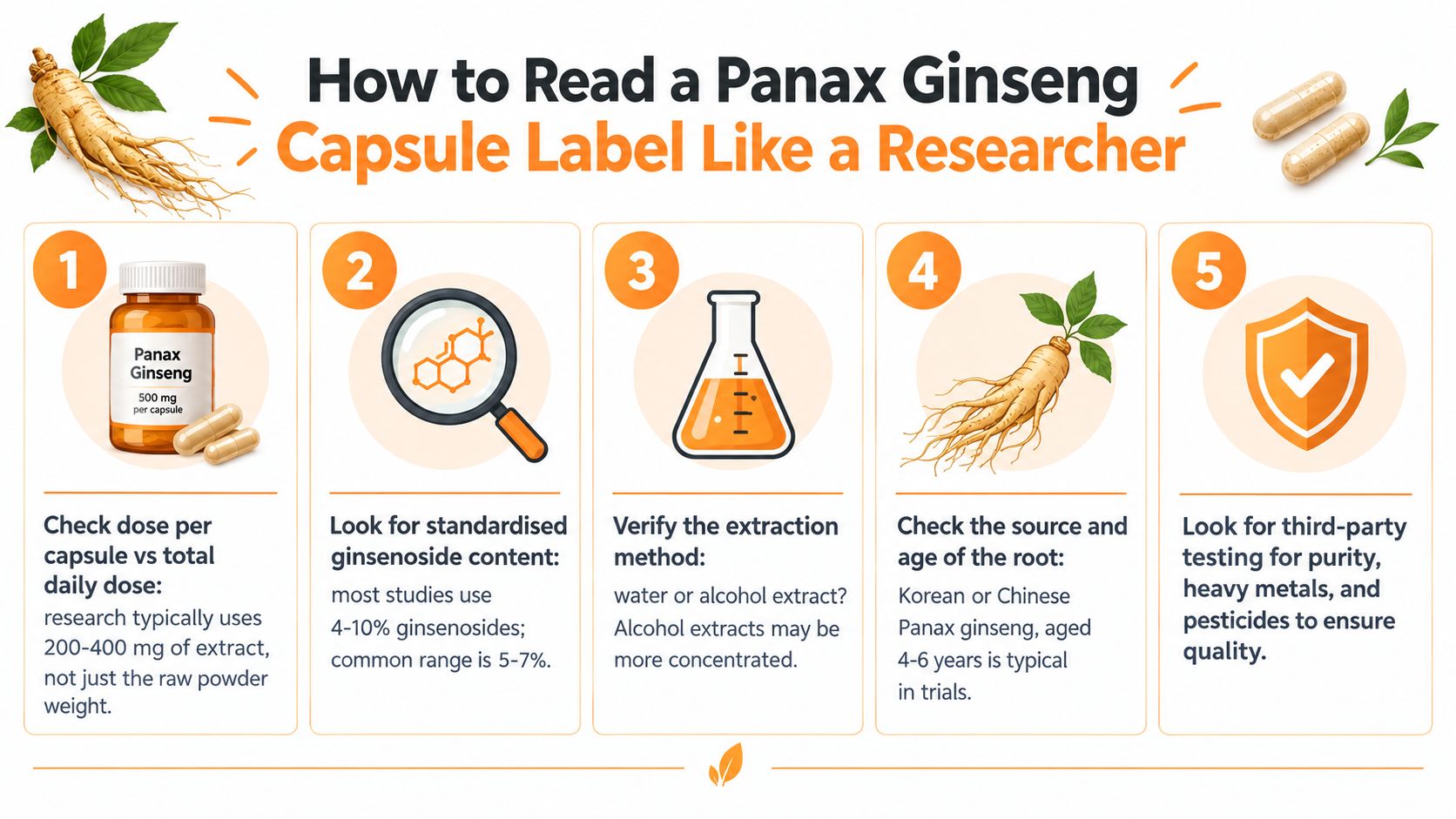
- Testing and traceability. Seals or verification from organizations such as USP, NSF, or ConsumerLab can help buyers assess identity and contamination controls. Country of cultivation, expiration dating, and lot information add useful context, but a seal doesn't make an unstudied dose equivalent to a studied one.
- Capsule materials. Vegetarian capsules and gelatin capsules can both deliver the ingredient. This choice concerns dietary preference and formulation, not proof of greater efficacy.
Label rule: A precise botanical identity and a stated ginsenoside profile are more informative than a large number printed beside the word “root.”
A quick decoding exercise makes the framework practical. Suppose a label says “Panax ginseng root extract, 250 mg, 5:1,” but doesn't state ginsenosides. The extract amount is visible, yet potency remains unclear. A label stating “Panax ginseng root extract, 250 mg, standardized to a declared ginsenoside percentage,” gives the buyer a stronger basis for comparison. Additional Panax ginseng dosage guidance can help readers interpret the serving size without confusing raw-root weight with extract weight.
Safety, Side Effects, and Medication Interactions to Know
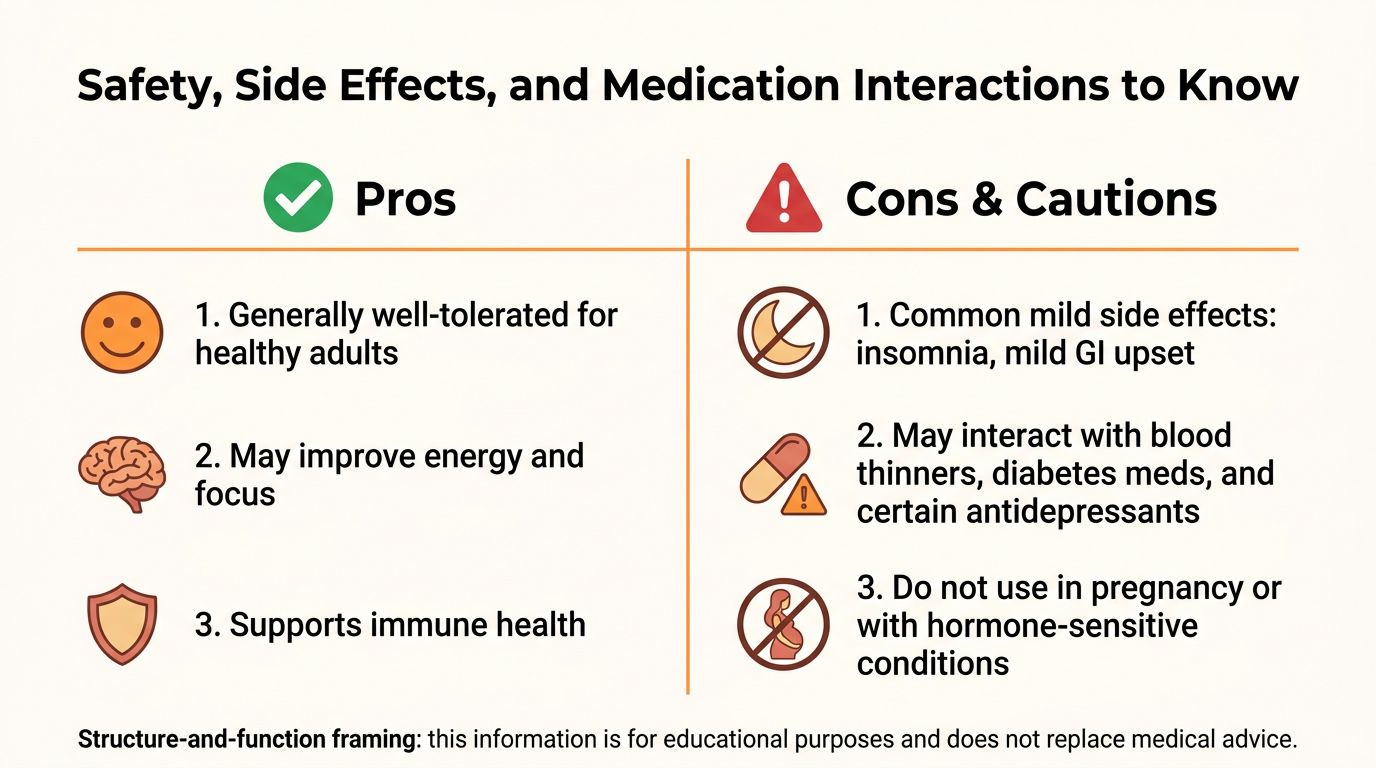
Panax ginseng capsules deserve the same caution as other bioactive supplements. A systematic review reported 135 minor adverse events across 40 studies and no serious adverse events in the included randomized trials, while an older review concluded that efficacy wasn't established beyond reasonable doubt for any examined outcome (systematic safety and efficacy review). That combination, generally reassuring short-term findings alongside uncertain benefit, supports careful rather than casual use.
Reported reactions can include insomnia, headache, gastrointestinal upset, nervousness, and blood-pressure changes. Rare reports have also raised concerns about liver effects, mood changes, and other problems with prolonged or high-dose use, particularly in vulnerable people. Anyone developing a severe rash, marked agitation, unusual mood changes, or other concerning symptoms should stop the product and seek medical advice.
Medication screening comes first
Several interaction categories deserve attention:
- Blood thinners: Warfarin and other anticoagulant or antiplatelet medicines may require professional review before ginseng use.
- Blood-sugar medicines: Insulin and oral hypoglycemics can interact because ginseng products may affect glucose in different directions.
- Stimulants: Coffee, pre-workouts, caffeine-containing formulas, and ADHD medicines may increase unwanted stimulation.
- Antidepressants: Monoamine oxidase inhibitors require particular caution, and mood-related concerns deserve attention in people with bipolar disorder.
- Other prescriptions: Ginseng may affect medication pathways involved in drug metabolism, so a pharmacist should review the full medication list.
The American Academy of Family Physicians medication-interaction reference specifically identifies concerns involving warfarin, oral hypoglycemics, insulin, caffeine, and monoamine oxidase inhibitors. People with uncontrolled hypertension, diabetes, known hypersensitivity, autoimmune conditions, or a history of significant mood instability should seek clinical guidance before starting. Pregnancy, breastfeeding, and unsupervised use in children also warrant avoidance.
A cautious starting process
A sensible introduction begins with one clearly labeled product, not a stack of stimulants and performance supplements. Taking the capsule earlier in the day may reduce the chance of sleep disruption, while a user should monitor sleep, headaches, digestion, mood, blood pressure, and glucose when relevant.
Medication rule: Anyone taking a prescription medicine should show the exact supplement label to a clinician or pharmacist before adding Panax ginseng.
Putting It Together and Deciding If Ginseng Fits Your Goals
Panax ginseng capsules may fit an adult who wants gentle support for daily vitality, perceived fatigue, or sexual well-being and is willing to evaluate the label carefully. They're less suitable for someone expecting a pharmaceutical-like energy shift, a guaranteed change in sexual function, or a shortcut around persistent symptoms that need medical assessment.
The decision becomes clearer when four checkpoints are written down:
- Current medicines: Blood thinners, diabetes medicines, antidepressants, stimulants, and other prescriptions may change the risk calculation.
- Caffeine tolerance: A ginseng capsule combined with coffee or a pre-workout may feel more stimulating than expected.
- Primary goal: Energy, libido, focus, and recovery are different targets with different research bases.
- Product match: The extract, ginsenoside profile, and daily dose should resemble the relevant trial as closely as the label allows.
A capsule works best as one part of a broader routine. Consistent sleep, adequate protein intake, resistance training, and sensible caffeine use give the body a stronger foundation than any single botanical. If the goal involves male sexual wellness, SEMEX is one supplement option that combines Panax ginseng with zinc, L-arginine, sunflower lecithin, bromelain, maca root, ashwagandha, tongkat ali, saw palmetto, and horny goat weed, with directions to take three capsules daily.
A defined trial period can make the decision less subjective. The user can record sleep quality, afternoon energy, training perception, and libido before starting, then reassess whether the specific product produces a meaningful change without unwanted effects. If nothing changes, the label should be reviewed before increasing the dose.
Quick Answers to Common Questions About Panax Ginseng Capsules
How soon might effects appear?
Some users notice changes in perceived energy relatively early, while other outcomes may require consistent use over several weeks. The timeline depends on the extract, dose, goal, and individual response, so a product's label should be compared with the study protocol rather than with a generic promise.
Does daily use require cycling?
There isn't a clear scientific basis for a universal cycling schedule. A user should prioritize the studied duration, follow the product label, and reassess ongoing use with a clinician when the product is taken regularly or alongside medicines.
Should capsules be taken with food or training?
Timing can depend on the goal and the formula. Earlier-day use may be more comfortable for people sensitive to stimulation, while taking a capsule with food may suit users who experience stomach discomfort. A capsule shouldn't be treated as a substitute for a pre-workout plan.
Can ginseng be combined with coffee?
Caution is sensible. Ginseng products can be paired with undisclosed or added caffeine, and combining multiple stimulating products may increase insomnia, nervousness, or agitation.
What if nothing changes?
The first review should cover botanical identity, extract form, ginsenoside disclosure, and total daily dose. If the label doesn't allow comparison with studied preparations, changing the product may be more rational than taking more.
SEMEX offers a daily men's wellness formula that includes Panax ginseng alongside ingredients selected for semen-volume and taste support, and it's designed for a consistent three-capsule routine. Men comparing options can visit SEMEX to review the full formula, testing information, and directions before deciding whether it fits their goals.
These statements have not been evaluated by the Food and Drug Administration. This product is not intended to diagnose, treat, cure, or prevent any disease.