

Natural Testosterone Supplements: A 2026 Evidence Guide
Only 9 of 32 studies in a 2020 review of herbal approaches to raising testosterone in men showed statistically significant increases in testosterone concentrations, according to the NIH-hosted review of herbal testosterone modulators. That single ratio changes how this category should be judged. The default assumption shouldn't be that natural testosterone supplements work and a few fail. It should be that most fail to clear a basic evidence bar, and a small number show limited, context-dependent signals.
That distinction matters because the market is built around a broad promise. Labels imply “boosting,” but the stronger evidence usually points to something narrower. Some ingredients appear more relevant for men who are deficient, under high stress, or starting from a low baseline. That's a different claim from raising testosterone meaningfully in healthy men with normal hormone levels.
A careful buyer should treat this category less like a hunt for a miracle ingredient and more like an exercise in evidence triage. Trial design, baseline status, dose transparency, and product testing matter more than dramatic label language.
Table of Contents
- What Natural Testosterone Supplements Actually Are
- The Evidence Base and Why Most Ingredients Fail to Impress
- Comparing the Best-Studied Natural Ingredients
- Why Your Starting Point Changes the Outcome
- How to Evaluate a Natural Testosterone Supplement
- Safety, Adulteration, and FDA Context You Should Know
- Who Actually Benefits and What to Look For
- Common Questions About Natural Testosterone Supplements
What Natural Testosterone Supplements Actually Are
About 3 out of 4 herbal testosterone studies in the review cited earlier did not show a statistically significant increase in testosterone. That matters because the label category is much broader than the evidence behind it.
Natural testosterone supplements are over-the-counter products built from herbs, minerals, vitamins, and amino acids that are sold as support for testosterone, libido, performance, or male vitality, without using prescription testosterone. In practice, that label covers products with very different mechanisms and very different odds of doing anything measurable.
A useful way to sort them is by what they are trying to do in the body.
Three product types hidden inside one category
Some formulas are really deficiency correction products. A mineral such as zinc fits here. If intake is low, restoring adequacy can support normal reproductive and hormonal function, which is why zinc is discussed in a review on zinc and male fertility. That is closer to fixing a limiting factor than creating a hormonal surge.
Some are stress or recovery support products. Ashwagandha is the clearest example. Human trials have created interest because the ingredient may influence stress physiology and, in some groups, modestly affect testosterone-related outcomes. That is a narrower and more population-specific claim than “boosts testosterone.”
The rest are general male-performance blends sold under a testosterone banner. These often combine several ingredients with weak, indirect, or unclear links to testosterone itself. A buyer may end up purchasing a libido, energy, or marketing product rather than a product with a plausible hormonal effect.
That distinction shapes expectations. A supplement aimed at correcting low zinc status should not be judged the same way as a proprietary herb blend sold to healthy men with normal labs.
Why labels use the word “support”
Supplement companies in the United States are not allowed to market these products as if they were testosterone drugs. Under FDA guidance, structure/function claims can describe support for normal body function but cannot claim to treat or correct a disease state, as outlined in the FDA's structure/function claim guidance.
That is why labels usually promise support for testosterone, strength, drive, or vitality instead of promising to raise testosterone to a clinically meaningful degree.
A better reading of the category is simple. These products are usually attempts to influence conditions around testosterone, nutrient status, stress load, sleep quality, training recovery, sexual function, or subjective energy, with only a minority having credible evidence for changing testosterone itself in a measurable way.
For a careful buyer, the first question is not whether a formula sounds natural. It is whether the product is trying to correct a specific problem, or whether it is borrowing testosterone language to sell a broad wellness blend.
The Evidence Base and Why Most Ingredients Fail to Impress
A useful starting statistic is this: in the review cited earlier, only 9 of 32 human studies reported a statistically significant rise in testosterone, and only fenugreek and ashwagandha showed reasonably consistent positive signals across the included herbal ingredients, according to the 2020 review in NIH/PMC.
That result defines the category better than any label claim. Most products are built around ingredients with either mixed findings, weak study design, or no reliable evidence of testosterone change in healthy men.
The evidence gap matters because "testosterone support" can describe very different realities. In one formula, it may mean a studied extract used near trial doses. In another, it means a long proprietary blend with ingredients that were never shown to outperform placebo in the kind of buyer most brands target: healthy men with no documented deficiency.
A practical evidence tier
A more useful sorting method is to rank ingredients by human evidence quality, not by how often they appear on labels.
- Tier A: Ingredients with repeated human data and at least some consistency in outcome. Ashwagandha fits here. Fenugreek also fits here, though effect size and study quality still vary. Zinc belongs here only in deficiency-related contexts.
- Tier B: Ingredients with a plausible mechanism or scattered positive trials, but limited replication, narrow populations, or unclear dosing.
- Tier C: Ingredients used mainly to decorate a label. These often appear in underdosed blends, rely on animal data, or are attached to claims that exceed the human evidence.
That ranking leads to a non-obvious buying conclusion. The best formula on paper is not the one with the most ingredients. It is the one that concentrates budget on a small number of ingredients that were tested in humans, at disclosed doses, in a population resembling the buyer.
Why weak studies produce confident marketing
A large share of the category depends on study designs that make positive findings easier to advertise than to interpret.
- Small samples: Early trials can suggest an effect, but they also increase the chance that the result is unstable or exaggerated.
- Broad participant selection: Men with different baseline testosterone, sleep quality, training status, age, and nutrient intake often get analyzed together, which can hide who responded and who did not.
- Short duration: Some trials run only a few weeks, which is enough to generate marketing copy but not enough to establish a durable hormonal effect.
- Inconsistent outcome measures: Studies may report total testosterone, free testosterone, calculated free testosterone, or symptom scores, and those endpoints do not carry equal weight.
- Poor product transparency: If a study uses a branded standardized extract, a store formula with a proprietary blend is not the same intervention.
This is why buyers should be skeptical of isolated positive studies. A supplement can generate a favorable headline while still offering little practical value once you account for placebo response, baseline status, assay choice, and whether the commercial product matches the studied one.
For a broader framework on separating marketing from outcomes, this examination of whether a supplement really works helps explain why promising mechanisms often fail in real-world products.
The signal in this category is narrow. A few ingredients may help in specific populations. Most formulas still ask healthy men to pay for evidence that is incomplete, indirect, or unlikely to translate into a meaningful testosterone change.
Comparing the Best-Studied Natural Ingredients
A useful comparison starts with a simple filter. Which ingredients have randomized human trials, in what population, at what dose, and with what size of effect relative to placebo?
That standard removes most of the category.
Side-by-Side Comparison of Best-Studied Natural Testosterone Ingredients
| Ingredient | Studied Dose | Trial Length | Study Population | What the Human Evidence Suggests |
|---|---|---|---|---|
| Ashwagandha | 600 mg/day standardized extract | 8 weeks | Healthy men aged 40 to 70 years | In a randomized, double-blind, placebo-controlled crossover trial, testosterone increased 11.4% from baseline in the active group versus 0.1% with placebo. The between-group increase was 14.7%, according to the clinical trial report |
| Fenugreek | Standardized extracts. Specific dose varies by product studied | Short-term trials | Adult men in small published studies | Human studies report mixed but occasionally favorable hormonal or symptom-related findings. The signal is weaker than marketing suggests because extracts, endpoints, and study designs differ across trials |
| Zinc | Repletion in deficient or marginally deficient men | 6 months in the cited older study | Marginally zinc-deficient elderly men | Serum testosterone rose from 8.3 ± 6.3 to 16.0 ± 4.4 nmol/L (p = 0.02) in the older study of deficient men. That finding applies to repletion, not to zinc-sufficient buyers using a generic “booster” product |
| D-aspartic acid | 3 g/day in published human trials | 12 days in one early study. 14 to 28 days in later studies | Healthy men and resistance-trained men | The best-known early trial reported an increase after short-term use, but later studies in trained or otherwise healthy men often failed to reproduce a meaningful testosterone rise. The ingredient has a defined human dose, but not a consistent outcome |
| Tongkat Ali | Standardized extracts at doses used across small human studies, commonly 200 mg/day | Often 4 to 12 weeks | Men under stress, older men, and some men with lower baseline testosterone | The signal looks more plausible for stress-related symptoms or men starting lower, but the human literature is still too small and heterogeneous to define a reliable testosterone effect for healthy eugonadal men |
The pattern matters more than any single positive headline.
Ashwagandha has one of the cleaner datasets because the trial design was stronger than much of the category. Even there, the result is a modest shift over eight weeks in a defined group, not a large pharmacologic effect. That difference should shape expectations. A product built around ashwagandha may be defensible if it matches the studied extract and dose. It should not be sold as a replacement for diagnosing low testosterone.
Zinc teaches a different lesson. The impressive result came from correcting deficiency. That makes zinc a status-dependent ingredient, not a universal testosterone enhancer. For a buyer already meeting zinc needs, the probability of a meaningful hormonal return is much lower.
D-aspartic acid is a good example of why trial replication matters. It remains common in formulas because an early short study was marketable. Later human work made the picture less favorable. If a label relies heavily on D-aspartic acid, the evidence gap is part of the product, not a minor footnote.
Tongkat Ali and fenugreek sit in the middle. Neither should be dismissed outright, but neither has the kind of large, repeatable human evidence that would justify broad claims for healthy men. With both, extract standardization and study population drive interpretation. A proprietary blend that hides the extract type or underdoses the ingredient gives you little reason to expect the study result.
What buyers often miss
Many formulas combine one or two ingredients with modest population-specific signals and surround them with ingredients that support a different outcome entirely.
L-arginine is a good example. It is often included in men's wellness products because it feeds the nitric oxide pathway involved in vascular function and blood flow, as described in this NIH/PMC review on nitric oxide and vascular function. That rationale may fit erection or exercise-related positioning. It does not establish direct testosterone support.
The practical buying decision is less about finding a “best” booster and more about spotting mismatch. If the formula does not disclose the studied form, the dose falls short of the human literature, or the evidence applies mainly to deficient or higher-stress populations, the product is asking healthy men to pay placebo prices for uncertain endocrine benefit.
Why Your Starting Point Changes the Outcome
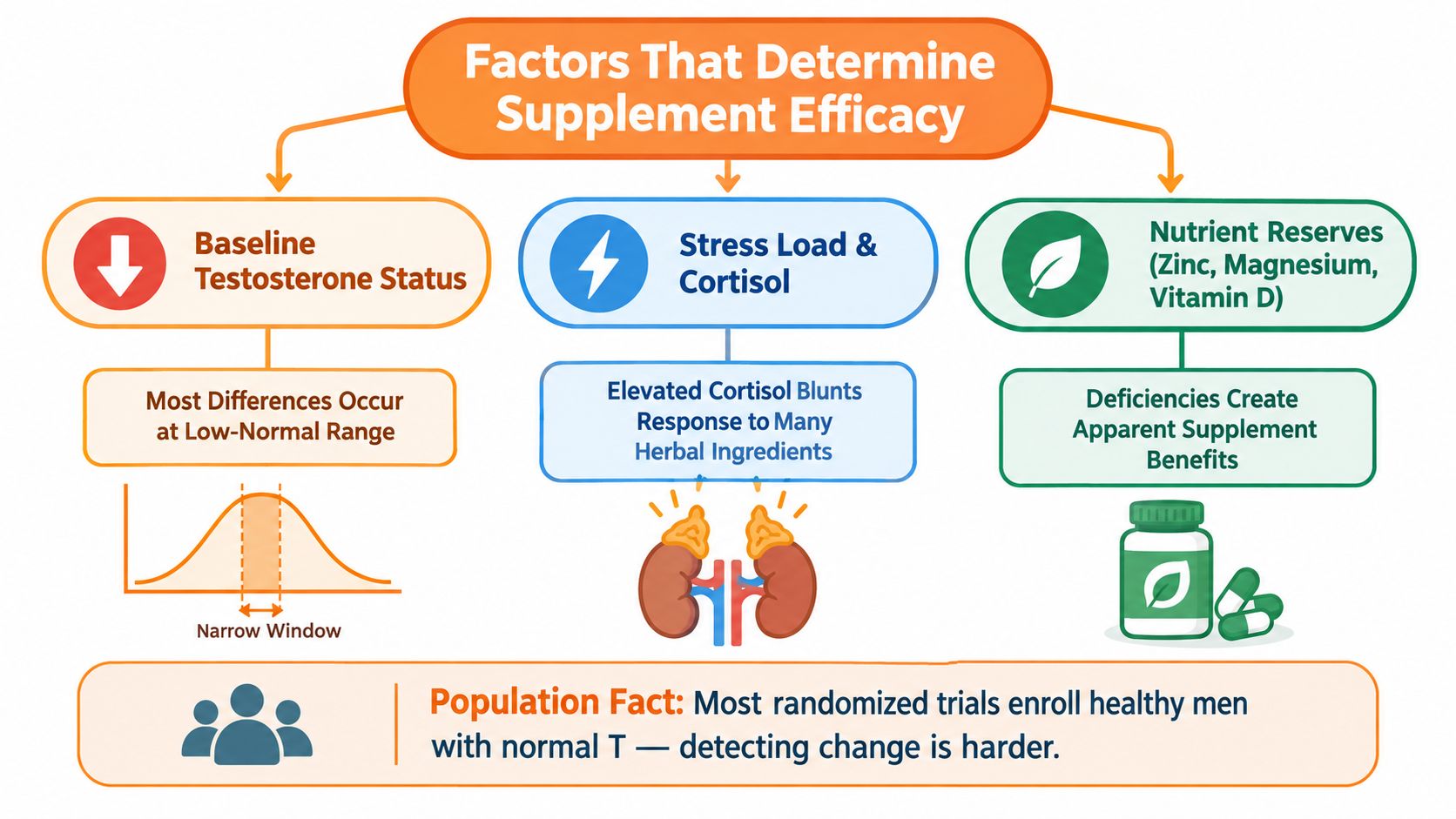
Trial results in this category often separate along a simple line: men with a correctable deficit or higher physiological strain are more likely to show movement than healthy, well-nourished men starting near baseline.
A supplement response begins before the first capsule. Baseline status affects whether an ingredient is addressing a bottleneck or adding more of something the body already has enough of.
Zinc repletion is not the same as zinc boosting
Zinc is one of the clearest examples of why starting point matters. Earlier research found that men with low zinc status, including some older adults, could see testosterone rise after repletion. In zinc-sufficient men, the same story usually does not hold.
That difference changes the buying decision. A product with zinc may make sense for someone with low intake, restricted dieting, malabsorption risk, or documented insufficiency. For a man already meeting intake targets, zinc is usually a nutritional insurance ingredient, not a reliable testosterone strategy.
The category often blurs those two uses.
Stress changes the reading on herbs
Herbal ingredients create a different kind of status effect. With ashwagandha, the more plausible signal is not mineral correction but context. Some trials report better outcomes in men under higher training load, poorer recovery, or greater stress burden than in men who are already sleeping well, eating adequately, and training within capacity.
That does not make ashwagandha a general testosterone supplement. It makes it a population-specific option with indirect logic. If stress physiology is part of the problem, a modest hormonal change is easier to interpret. If stress is low and baseline health is good, the same product has less room to produce a noticeable effect.
A low response can be predictable.
Why placebo-level outcomes are common in healthy men
Healthy men with normal testosterone, adequate micronutrient intake, and no clear recovery deficit are the toughest group for this category to impress. That is not because every product is fraudulent. It is because many formulas are sold far outside the population in which a signal, if any, was observed.
This is the evidence gap in practical form. A study result from deficient, older, stressed, or subfertile men does not transfer cleanly to younger healthy buyers. Labels rarely make that distinction, but trial interpretation depends on it.
The useful question is not whether a supplement can change testosterone under any condition. The useful question is whether your baseline matches the condition in which the ingredient showed benefit. If it does not, the most likely outcome is an expensive null result.
How to Evaluate a Natural Testosterone Supplement
A label in this category often does two jobs at once. It lists ingredients, and it implies an evidence story that may or may not exist. Evaluating a natural testosterone supplement means checking whether those two things match.
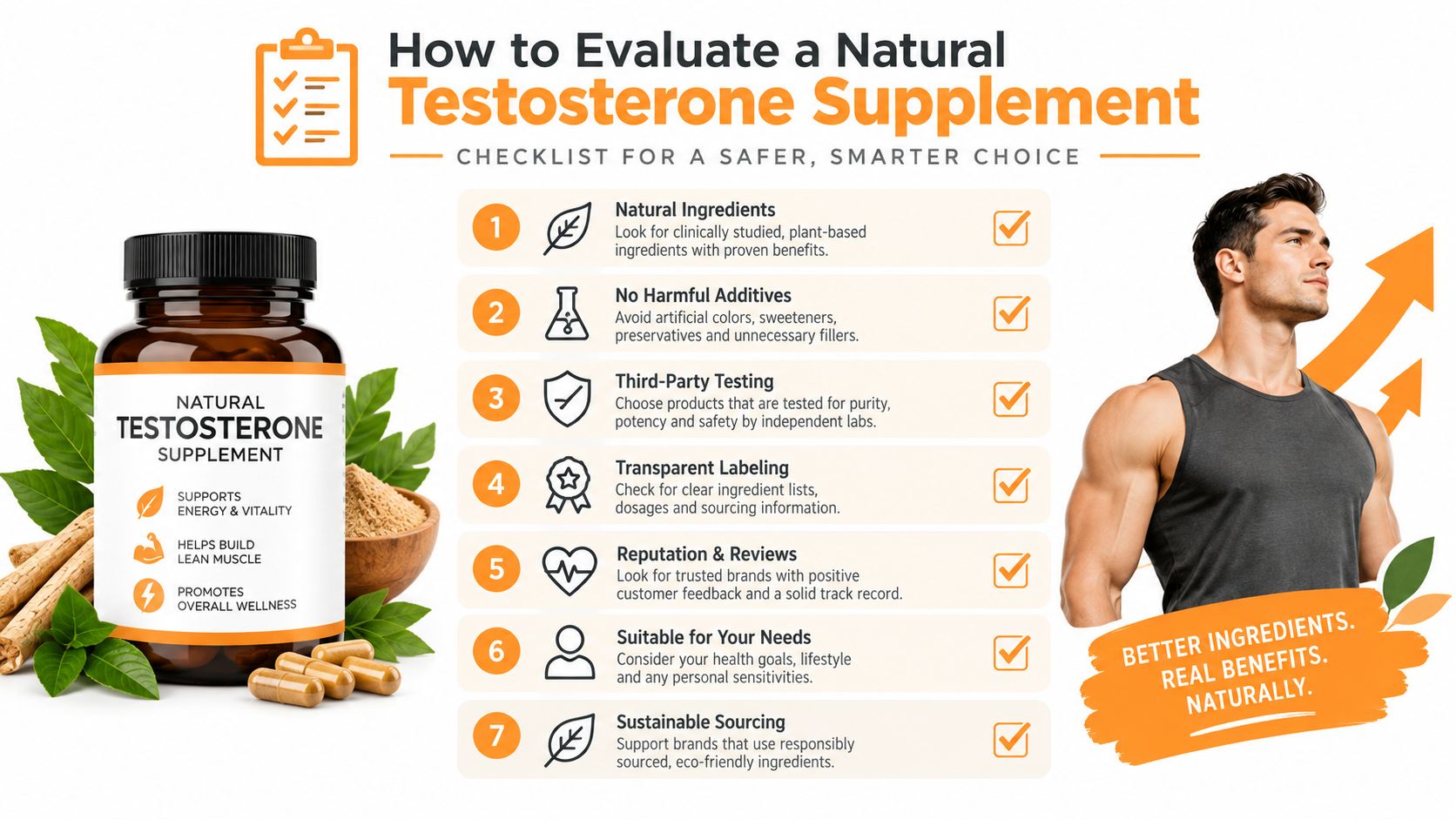
Three checks matter most: dose transparency, manufacturing credibility, and formula logic. That order matters because a product can look polished while still making it impossible to compare the label with the studies used to market it.
Tier one is the label itself
Start with whether the product gives enough detail to test its claims against published research.
- Exact doses matter: Proprietary blends make trial comparison difficult because the active amount of each ingredient is hidden.
- Ingredient form matters: “Ashwagandha” is vague. A standardized extract is more informative. “Zinc” is incomplete without the elemental dose and form.
- Study matching matters: A formula that includes a well-known ingredient at a token dose is using borrowed credibility, not evidence.
For readers comparing products line by line, this guide on how to read supplement labels shows how to separate active dosing from label decoration.
A useful shortcut is simple. If you cannot tell what dose you are getting, you also cannot tell whether the product resembles the trial behind the claim.
Tier two is manufacturing verification
Supplements are not reviewed by FDA for effectiveness before sale, so label detail is only the first screen. The next question is whether the bottle likely contains what it says it contains.
Look for third-party testing, lot-specific certificates of analysis when brands provide them, and clear GMP manufacturing claims. Those signals do not prove that a supplement works. They do reduce a more basic risk: paying for a formula whose identity or potency is uncertain.
FDA warning and enforcement materials on tainted sexual enhancement and bodybuilding supplements have shown that undeclared drug ingredients remain a real issue in adjacent categories, especially where marketing promises prescription-like effects. That is a practical reason to discount exaggerated claims and give more weight to plain documentation than to branding.
Tier three is whether the formula makes sense
The strongest formulas in this category usually make a narrow claim and support it with a small number of ingredients in plausible dose ranges. Weaker formulas often stack long ingredient lists to create the appearance of coverage, even when each component is underdosed.
That difference matters because most ingredients marketed for testosterone have weak or population-specific evidence. A crowded label does not solve that problem. It can make it harder to see whether the product is built around mineral repletion, stress support, fertility support, or general men's wellness.
One example is SEMEX, which is positioned around semen volume and broader men's wellness rather than as a prescription-like testosterone product, and includes ingredients such as zinc, L-arginine, and ashwagandha in that context. That is easier to assess than a formula that implies large hormonal effects without showing how the doses connect to any studied use case.
A practical buyer filter works well here. First, ask whether the label is specific enough to compare with research. Next, ask whether the manufacturing claims are verifiable. Then ask whether the formula is designed for a realistic outcome in a defined user, rather than for a broad promise that healthy men are unlikely to feel.
Safety, Adulteration, and FDA Context You Should Know
A product can be legal to sell and still be poorly supported, loosely standardized, or adulterated. That distinction matters more in testosterone supplements than in many other categories because the marketing often implies drug-like hormonal effects.
Consumer confusion also comes from mixing two very different product classes. Prescription testosterone is regulated as a drug with formal labeling, postmarket surveillance, and clinician oversight. Dietary supplements are regulated under a separate framework that does not require premarket proof that a formula raises testosterone, improves symptoms, or matches the label claim before sale. As noted earlier, FDA labeling changes for prescription testosterone should not be read as evidence that over-the-counter “boosters” are a safer substitute.
The bigger safety problem is undeclared content
The highest-risk scenario is not usually a transparent herb at a stated dose. It is a product that contains something the label does not disclose.
That risk shows up most often in physique and performance products that borrow testosterone language without behaving like ordinary botanical supplements. FDA public warnings on tainted sexual enhancement and bodybuilding supplements have repeatedly centered on undeclared drug ingredients, steroid analogs, or other pharmacologically active compounds. A buyer comparing labels cannot detect that problem from branding alone.
FDA Adulteration Pattern Buyers Should Recognize
| Product category | Typical marketing angle | Main hidden risk | Why it matters |
|---|---|---|---|
| Bodybuilding or performance products using testosterone-style claims | Fast muscle gain, extreme masculinity, prescription-like results | Undeclared steroids, steroid-like compounds, or other drug ingredients | The safety profile no longer matches the label, and adverse effects can reflect an unlisted active compound rather than the named herbs |
Why regulation leaves more screening work to the buyer
For supplements, enforcement often starts after a problem surfaces through adverse event reports, inspections, or lab testing. That is a reactive system.
Buyers therefore need a simple filter that goes beyond ingredients. Identity testing, contaminant screening, and batch-level quality controls matter at least as much as the marketing story. A practical place to start is this guide to third-party verification standards for supplements, which explains what independent testing can and cannot confirm.
A quieter implication follows from the evidence gap discussed earlier. If a formula promises large testosterone effects in healthy men, the claim is already out ahead of the human data. If that same product also hides its blend amounts, skips standardization details, or borrows aggressive bodybuilding aesthetics, uncertainty compounds on both fronts. The efficacy claim is weak, and the quality signal is weak.
Better-studied ingredients still require caution
Even ingredients with some human data should be judged by dose, extract identity, and user context. Ashwagandha and fenugreek have at least been tested in randomized trials, but that does not make every multi-ingredient blend low risk or well designed.
The safer end of this category is usually easier to recognize. Narrow claims. Transparent dosing. Fewer ingredients. Verifiable manufacturing controls. Products built that way still may not raise testosterone meaningfully in healthy men, but they are easier to evaluate than formulas that combine modest evidence, vague labeling, and the possibility of undeclared actives.
Who Actually Benefits and What to Look For
The most plausible beneficiaries of natural testosterone supplements are usually not the men featured in the marketing.
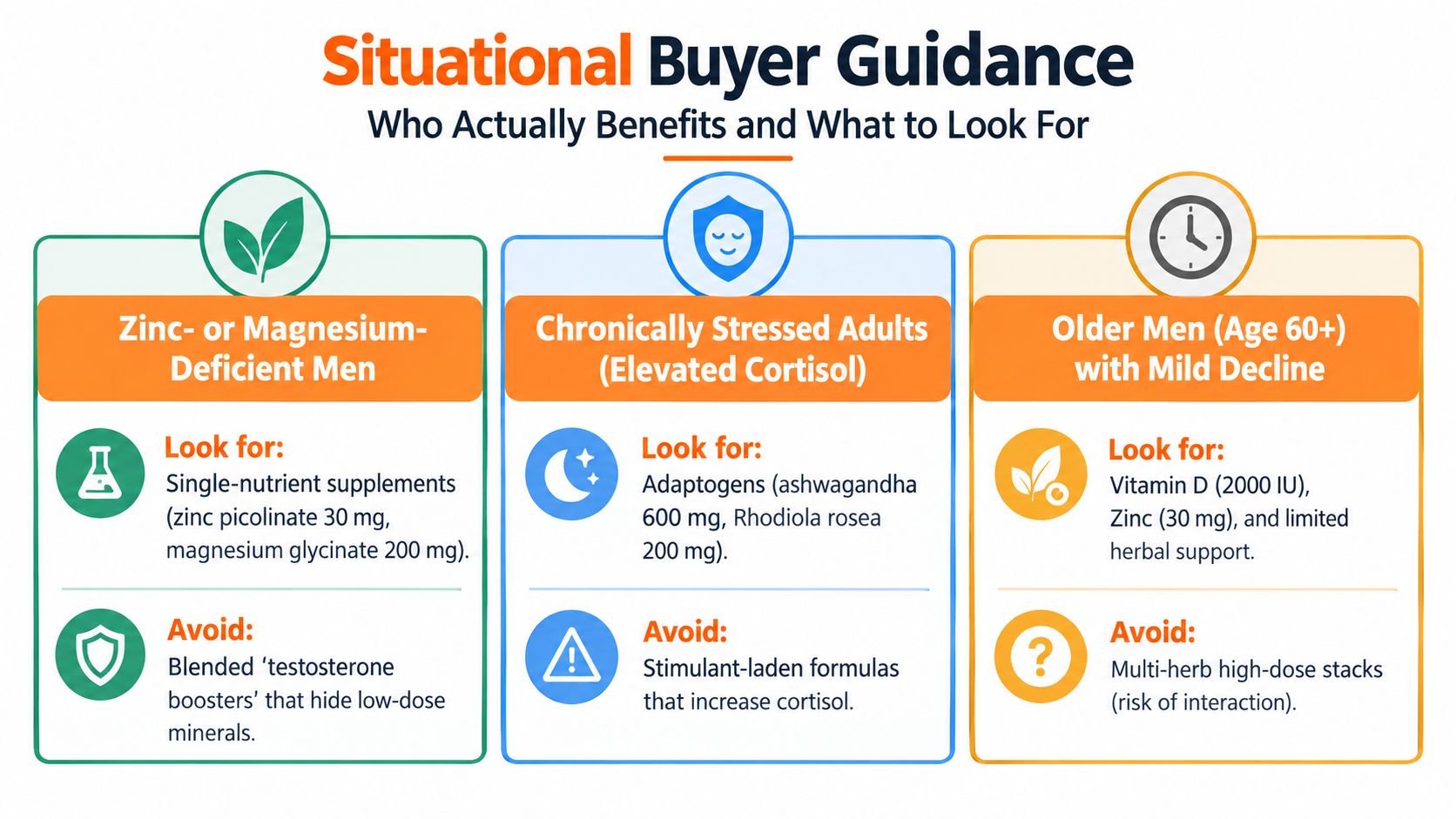
Men with low nutrient reserves are one clear group. A targeted zinc product can make more sense than a broad “male power” blend when low intake or marginal deficiency is part of the picture.
Chronically stressed adults are another group worth separating from the general market. In that setting, an adaptogen-centered approach may fit the evidence better than a stimulant-heavy formula that confuses arousal with endocrine support.
Three buying profiles
- Deficiency-driven buyers: These men should prioritize single-ingredient products, lab context, and repletion before considering blends.
- Stress-loaded buyers: These men should lean toward products with a narrower, recovery-oriented rationale rather than maximalist formulas.
- Older men with borderline-low status: These buyers should be more conservative, more label-focused, and quicker to involve a clinician if symptoms persist.
Likely non-responders
Healthy men with normal hormone panels, adequate sleep, and no obvious nutrient gap are the least compelling candidates for these products.
In that group, a purchase often becomes a bet on hope rather than on mechanism. The most sensible pre-purchase sequence is simple. Confirm baseline status. Choose transparent ingredients over proprietary blends. Reassess after a reasonable trial window instead of adding more ingredients immediately.
Common Questions About Natural Testosterone Supplements
Should ingredients be stacked?
Usually with caution. If two ingredients act through overlapping “support” logic rather than correcting distinct problems, stacking may add cost more reliably than benefit. A cleaner strategy is to match one ingredient to the most plausible need.
When should an ingredient be judged?
Human trials in this category often run for 8 to 12 weeks when a measurable effect appears, especially with botanicals such as ashwagandha, based on the clinical pattern summarized in the earlier ashwagandha discussion. Very short self-tests can produce false negatives or false optimism.
Does timing matter?
Morning use is a reasonable, practical choice for many buyers because it aligns with how men typically think about energy, routine, and consistent adherence. More important than clock time is taking the product consistently and judging it against defined outcomes rather than mood on a single day.
What's the difference between total and free testosterone?
A lab report can show total testosterone and free testosterone, but those markers don't always move together. Buyers shouldn't assume that a product marketed around “free T” has stronger evidence because the term sounds more precise.
When should a clinician enter the picture?
Persistent symptoms, unexpectedly low lab values, or repeated disappointment with over-the-counter products should shift the conversation to medical evaluation. That's especially true when the goal is diagnosis or treatment rather than general nutritional support.
SEMEX offers a daily men's wellness supplement built around semen volume and taste support, with ingredients such as zinc, L-arginine, and selected botanicals that are often discussed in broader male reproductive and vitality conversations. Men comparing natural testosterone supplements with more general men's wellness formulas can review the product details and testing standards directly at SEMEX.
These statements have not been evaluated by the Food and Drug Administration. This product is not intended to diagnose, treat, cure, or prevent any disease.