

Natural Male Supplement Guide for Volume and Vitality
A man may start with a simple question: can a natural male supplement support more semen volume, a different taste, stronger circulation, or everyday vitality? Search results often blend those goals together, even though they involve different ingredients, different evidence, and different expectations. A product aimed at bedroom experience isn't automatically a fertility formula, and a fertility-related ingredient isn't automatically a direct volume enhancer.
The practical approach is to identify the job first. Volume and taste support, circulation support, and general vitality belong in separate categories. Ingredient research then becomes more useful than broad product language, because each ingredient has a role, a level of human evidence, and limits that buyers should understand.
Table of Contents
- Introduction to Natural Male Supplements and What They Can Support
- Overview of Natural Male Supplement Categories and Buyer Goals
- Detailed Comparison of Common Ingredients and Their Evidence
- How to Evaluate Quality Transparency and Testing Standards
- Dosing Patterns Consistency and When to Expect Gradual Benefits
- Safety Considerations Interactions and What Supplements Do Not Do
- Choosing the Right Natural Male Supplement for Your Situation
Introduction to Natural Male Supplements and What They Can Support
A buyer looking for a natural male supplement may be comparing labels late at night, trying to decide whether zinc, amino acids, or a botanical blend fits the actual goal. One man may want to support semen volume and taste for shared sexual satisfaction. Another may be thinking about sperm health, while a third may be seeking everyday energy, stress resilience, or circulation support. Those aims overlap in conversation, but they aren't interchangeable outcomes.
Dietary supplements generally use structure/function language, such as “supports normal male reproductive function” or “helps maintain circulation,” rather than promising to diagnose or treat a condition. That distinction matters. Zinc has a biological role in male reproductive function, but controlled research doesn't support treating every fertility concern with zinc supplementation. The same principle applies to botanicals and amino acids. An ingredient can support a normal process without functioning as a drug.
The U.S. Food and Drug Administration requires a standard disclaimer when supplement labeling makes a structure/function claim. The wording must accompany the claim and be displayed prominently, as explained in the FDA dietary supplement labeling guide:
Required disclaimer: These statements have not been evaluated by the Food and Drug Administration. This product is not intended to diagnose, treat, cure, or prevent any disease.
Ingredient-level research also helps prevent a common mistake, assuming that a formula inherits the strongest claim associated with one ingredient. A botanical studied for vitality doesn't automatically support a fertility claim, and an ingredient associated with blood-flow signaling isn't automatically a direct semen-volume driver.
Results from supplements, when they occur, should be judged gradually and consistently rather than against drug-like expectations. A careful buyer checks the formula, serving instructions, testing records, and intended goal before deciding whether the product deserves a fair trial.
Overview of Natural Male Supplement Categories and Buyer Goals
The market becomes easier to understand when formulas are grouped by what the buyer wants to support rather than by the number of ingredients on the label.
Volume and taste formulas usually combine ingredients positioned around semen-related experience and male reproductive function. Zinc, sunflower lecithin, bromelain, and ingredients associated with fluid or flavor discussions often appear in this category. Their language should remain supportive, because evidence for a consumer experience such as taste is not the same as evidence for fertility outcomes.
Circulation and performance formulas focus on nitric-oxide pathways, blood-flow signaling, exercise support, or sexual performance. L-arginine belongs here because it serves as a substrate for nitric oxide synthesis. That makes it relevant to vasodilation and circulation, but not automatically a direct semen-volume ingredient. Independent medical discussion of nitric-oxide supplements describes variable evidence and emphasizes that combinations can matter more than L-arginine alone, as outlined in this overview of nitric-oxide supplement evidence.
Vitality and stress-resilience blends use botanicals such as maca root, Panax ginseng, ashwagandha, and tongkat ali. These formulas are usually positioned around energy, libido, resilience, or general men's wellness. They may complement a volume-focused formula, but they shouldn't be presented as a substitute for medical evaluation of fertility concerns.
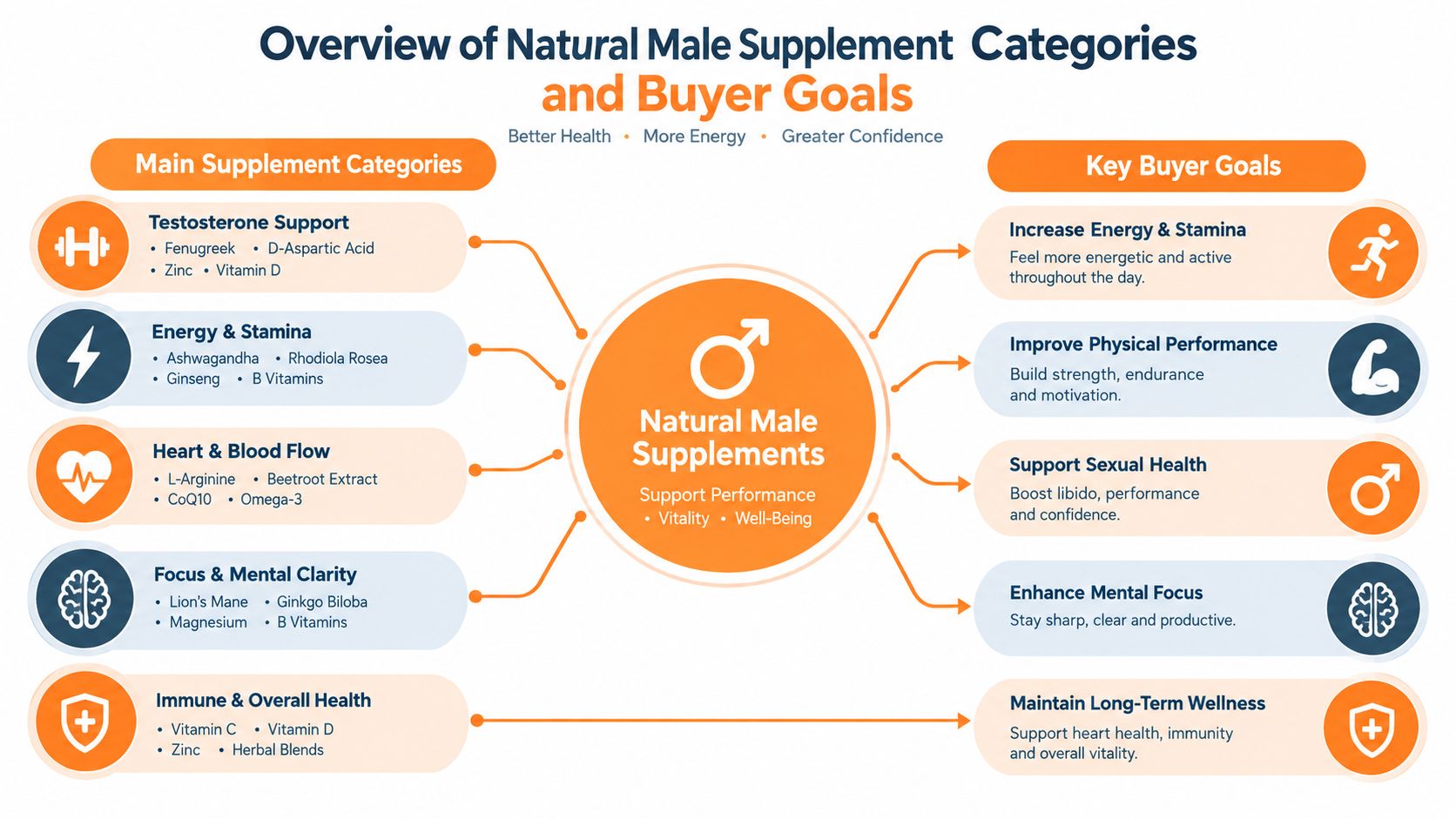
A product can combine all three categories. SEMEX is an example of a daily men's wellness formula using a volume- and taste-focused ingredient group alongside a broader men's wellness blend. That description identifies its ingredient approach, not a treatment outcome.
The useful question is simple: What is the formula trying to support first? Once that answer is clear, a buyer can compare ingredients without treating every capsule as a fertility intervention or every botanical as a quick performance solution.
Detailed Comparison of Common Ingredients and Their Evidence
Ingredient labels often look more precise than the underlying evidence. A useful comparison separates biological role from human outcome and avoids treating a blend's presence on a label as proof of a product-level result.
| Ingredient | Primary Role Discussed in Research | Evidence Context | Best Fit When Your Goal Is |
|---|---|---|---|
| Zinc | Normal male reproductive biology and semen parameters | Mixed, context-dependent human evidence | Reproductive-function support |
| L-arginine | Nitric-oxide substrate and blood-flow signaling | More relevant to circulation than semen volume | Circulation and performance support |
| Sunflower lecithin | Formula ingredient associated with semen-related positioning | Limited direct outcome evidence in this context | A volume-focused blend |
| Bromelain | Enzyme used in digestive and formulation discussions | Limited direct human evidence for taste outcomes | A taste-focused formula concept |
| Maca root | Botanical vitality and libido positioning | Human evidence varies by preparation and outcome | General vitality support |
| Panax ginseng | Botanical traditionally associated with energy and performance | Evidence depends on extract and endpoint | Vitality and performance support |
| Ashwagandha | Stress resilience and hormone-related support | Controlled human data for selected outcomes | Vitality and stress support |
| Tongkat ali | Botanical men's wellness and vitality positioning | Evidence varies by extract and study design | General men's wellness |
| Saw palmetto | Botanical commonly associated with prostate-focused formulas | Not a direct volume ingredient | A broader wellness blend |
| Horny goat weed | Traditional sexual-wellness positioning | Human evidence is limited and formulation-dependent | A supplemental vitality ingredient |
Zinc deserves careful interpretation. A 2016 meta-analysis reported significant increases in semen volume, sperm motility, and normal morphology among infertile men receiving zinc supplementation. The reported standardized mean differences were -0.99 for semen volume, -1.82 for motility, and -0.75 for morphology in the published meta-analysis. Yet a large randomized trial found that 30 mg of zinc plus folic acid didn't improve semen quality or live birth rates compared with placebo. Zinc's biological role is real, but supplementation isn't universally linked to better reproductive outcomes.
L-arginine belongs in a different column. Since it contributes to nitric-oxide synthesis, it makes more sense as a circulation-support ingredient than as a direct semen-volume driver. Sunflower lecithin and bromelain may appear in volume- or taste-oriented formulas, but buyers should look for transparent dosing and avoid assuming that inclusion proves a specific consumer outcome.
For a broader ingredient discussion, the male enhancement ingredients guide can help readers compare roles without collapsing circulation, vitality, and reproductive support into one claim.
Botanicals require the same discipline. Maca root, Panax ginseng, tongkat ali, saw palmetto, and horny goat weed are often selected for men's wellness positioning, but the relevant question is whether the extract, dose, population, and endpoint match the buyer's goal. Ashwagandha has more concrete controlled data than many botanicals, though its findings still support structure/function language rather than treatment claims.
How to Evaluate Quality Transparency and Testing Standards
A natural male supplement can support different jobs, such as semen volume or taste, fertility-related goals, or general vitality. Quality checks do not prove that an ingredient will deliver any of those outcomes. They show whether the product contains what the label says and whether avoidable contaminants were screened. The FDA does not approve dietary supplements before sale, so buyers must assess the brand's verification signals. Independent guidance on supplement testing and evidence also explains why third-party testing matters.
What a transparent label should show
A useful label names every ingredient and gives its amount per serving. Proprietary blends make comparison difficult because several ingredients may appear without individual quantities. The serving size, manufacturer identity, lot information, and contact details should be easy to find. A named “matrix” or “complex” is less informative when these details are missing.
Quality signals include:
- Vegan status: Helps buyers avoid animal-derived ingredients, but says nothing about efficacy.
- Non-GMO status: Describes a sourcing preference, not a specific health outcome.
- cGMP manufacturing: Shows that recognized manufacturing practices are followed. It does not make the product a treatment.
- Third-party testing: Look for checks covering label accuracy, microbes, heavy metals, and adulterants.
- Published thresholds: Specific acceptance criteria provide more information than a general “lab tested” badge.
- Refund policy: A 90-day money-back guarantee can reduce purchase risk, but it cannot demonstrate that the formula will work for every person.
Reading the test claim
A meaningful testing claim identifies the laboratory, test categories, methods, and standards used. Testing by a named laboratory, such as Eurofins, is more useful when the brand explains its thresholds, as described in this guide to third-party lab testing. Buyers should question pages that say “tested” without showing what was screened or providing supporting documentation.
Label rule: Testing supports confidence in identity and cleanliness. It does not turn a supplement claim into a clinical treatment claim.
Check quality evidence before weighing marketing promises. Clear ingredient amounts, a stated purpose for each ingredient, manufacturing controls, contamination screening, and accessible lot documentation give buyers a better basis for choosing a natural male supplement than testimonials or aggressive volume claims.
Dosing Patterns Consistency and When to Expect Gradual Benefits
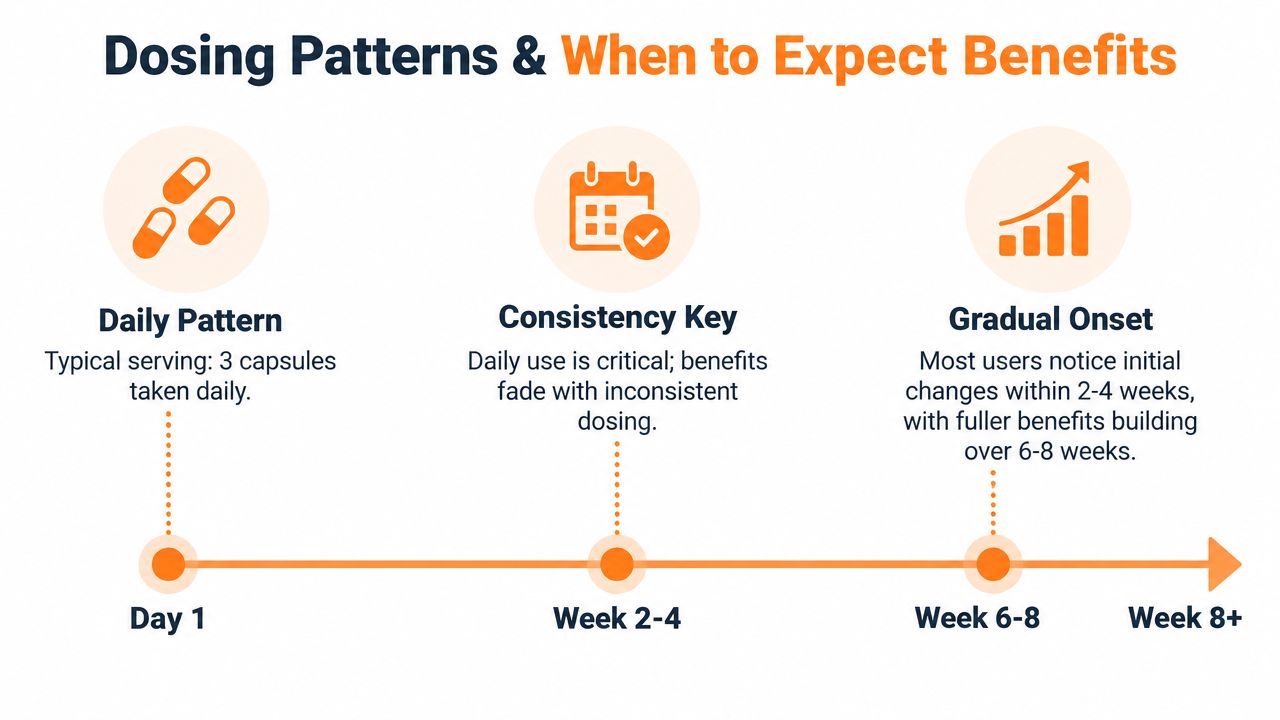
A daily supplement only gets a fair evaluation when the serving pattern is clear and consistent. Many men's formulas use a routine of 3 capsules daily, while the exact label directions should always control. Occasional use makes it difficult to tell whether a formula supports a gradual change or whether normal day-to-day variation explains what the buyer notices.
A practical routine can be built around an existing habit. Taking capsules with a regular meal, keeping the container in a visible but appropriate place, and using a calendar reminder can reduce missed servings. Hydration and a balanced diet also support general wellness, but they shouldn't be presented as proof that a supplement will produce a specific outcome.
A realistic evaluation window
The commonly described build period for a daily men's supplement is about 30 days of consistent use. That timeline should be treated as a practical evaluation period, not a promise. Some buyers may notice no clear change, while others may pay attention to subjective factors such as confidence, perceived vitality, or sexual experience.
Ashwagandha provides a useful example of why gradual evaluation matters. In an 8-week randomized, double-blind, placebo-controlled crossover study of healthy men aged 40 to 70, a standardized extract at 600 mg per day was associated with an 18% greater increase in DHEA-S and a 14.7% greater increase in testosterone compared with placebo, according to the clinical study published in PMC. Those findings apply to the studied extract and outcomes, not automatically to every ashwagandha product or formula.
The guide to how long supplements take to work offers a consumer-oriented way to think about consistency and timing. A buyer can track serving adherence, subjective vitality, and the original goal without changing several variables at once. If side effects appear, the routine should stop rather than continue in pursuit of a promised timeline.
Safety Considerations Interactions and What Supplements Do Not Do
“Natural” describes a source or positioning, not a guarantee of safety. Herbs and supplements can interact with medicines, and higher doses can cause side effects. Independent medical guidance states that herbs and supplements aren't proven treatments for infertility, with evidence often limited or inconclusive, as described in this medical guidance on herbs and fertility.
A buyer should speak with a qualified clinician before starting a multi-ingredient product when prescription medicines, chronic health concerns, upcoming procedures, or fertility evaluation are involved. The clinician can review the full label, including botanical extracts and serving amounts, rather than assessing one familiar ingredient in isolation.

Volume and fertility are different questions
A man may want more semen volume or a different taste without seeking fertility support. Those goals shouldn't be treated as interchangeable. Semen volume is only one aspect of reproductive health, and a supplement marketed around sexual experience shouldn't be described as a solution for infertility, sperm count concerns, or any diagnosed condition.
Zinc illustrates the distinction well. Medical reviews describe zinc's involvement in sperm motility, capacitation, and acrosomal processes, and lower zinc status has been associated with poorer sperm quality in some contexts, as explained in this NIH-hosted review of zinc and male reproduction. That biological role doesn't establish that a particular supplement will produce a desired fertility outcome.
A product should be paused if a user experiences an unexpected reaction, persistent discomfort, or a change that raises concern. Medical care is appropriate for persistent reproductive symptoms, sexual dysfunction, or fertility worries. Supplements can support a wellness routine, but they shouldn't delay evaluation when a clinical question needs an answer.
Choosing the Right Natural Male Supplement for Your Situation
The right choice starts with the desired outcome, not the most impressive ingredient list. A man focused on semen volume and taste should look for a formula that clearly identifies those goals and discloses the amounts of its ingredients. A man focused on stress resilience or vitality may place more weight on botanical extracts such as ashwagandha, maca root, or Panax ginseng, while a circulation-focused buyer should evaluate L-arginine as a blood-flow support ingredient rather than a direct volume solution.
| Buyer situation | Priority to evaluate | What to avoid |
|---|---|---|
| Volume and taste focus | Clear volume- and taste-oriented ingredient approach | Fertility-treatment language |
| Vitality and stress support | Identified botanical extracts and transparent serving information | Vague proprietary blends |
| Circulation and performance focus | Nitric-oxide and blood-flow positioning | Promises of guaranteed sexual results |
| First-time buyer | Simple label, testing details, and clear directions | Unnamed testing or exaggerated claims |
| Fertility concern | Clinician discussion and appropriate evaluation | Treating a supplement as infertility care |
A long-term couple may value a formula positioned around shared sexual experience and a simple daily routine. A fitness-minded user may prefer to separate circulation and vitality goals from semen-related expectations. A first-time buyer can use the label as a filter: identify the job, inspect the amounts, check manufacturing and testing information, then review interaction risks.
The clinical record also argues for restraint. In an NIH-backed randomized trial, men seeking infertility treatment took 5 mg of folic acid and 30 mg of elemental zinc daily for 6 months. Live births were 404, or 34%, in the supplement group, compared with 416, or 35%, with placebo, according to the NIH report on the trial. That result doesn't erase zinc's biological role. It shows why buyers should match an ingredient to a support goal instead of assuming that a reproductive ingredient treats infertility.
SEMEX is a vegan, non-GMO daily formula made in the USA in a cGMP-registered facility and third-party tested by Eurofins for microbials, heavy metals, and adulterants. Its stated approach combines volume- and taste-focused ingredients with a broader men's wellness blend, giving buyers a concrete example to assess using the same evidence and transparency standards applied to any natural male supplement.
These statements have not been evaluated by the Food and Drug Administration. This product is not intended to diagnose, treat, cure, or prevent any disease.
SEMEX offers a daily men's wellness formula built around volume and taste support, with additional ingredients positioned for overall vitality. Men comparing natural male supplements can review its formula and quality information against the criteria above by visiting SEMEX.