

Men's Wellness Supplements Guide to Vitality and Choice
A man can walk into a supplement aisle looking for something simple, perhaps more daily energy, better workout recovery, or support for sexual wellness, and leave with several bottles that make similar promises. One label emphasizes testosterone, another lists a long fertility blend, and a third highlights plant-based sourcing without explaining what its ingredients do. The result is choice without much clarity.
Men's wellness supplements have become a substantial consumer category. The global market was estimated at USD 75.09 billion in 2024 and is projected to reach USD 132.13 billion by 2030, implying a 10.07% CAGR from 2025 to 2030, according to the market data summarized in the cited PubMed reference. Asia Pacific held the largest regional share in 2024, at 37.98%, which shows that men's wellness is a broad consumer segment rather than a niche interest.
That scale creates opportunity, but it also makes ingredient literacy more important. A supplement may support normal physiology, yet it isn't a drug and shouldn't be presented as one. The useful question is not, “Which product makes the biggest promise?” It's, “Which formula matches the specific job, uses sensible doses, and provides credible quality signals?”
This guide focuses on three jobs: vitality and daily resilience, sexual and reproductive support, and recovery and performance. It also explains how zinc and L-arginine work, where popular botanicals fit, how to assess manufacturing and testing, and how to build realistic daily habits.
Table of Contents
- Introduction to Men's Wellness Supplements Today
- What Men's Wellness Supplements Are and How They Work
- Three Core Categories of Men's Wellness Support
- Key Ingredients Evidence and What Research Actually Shows
- How to Choose Quality Men's Wellness Supplements
- Safe Use Daily Habits and Realistic Expectations
- Making Your Choice and Next Steps with Confidence
Introduction to Men's Wellness Supplements Today
A busy professional may eat well, train when time allows, and still find that sleep, stress, and recovery feel less steady than before. Another man may care less about gym performance and more about reproductive wellness or sexual confidence. Both want support, yet their priorities point toward different formulas.
The supplement aisle often compresses these goals into one word, performance. Testosterone-focused marketing can make everyday vitality sound like a hormone problem. Large ingredient panels can make sexual health seem like a reason to take more of everything. A clearer view separates the jobs involved: energy metabolism, circulation, reproductive biology, stress response, and recovery all belong to men's wellness, but they are not the same target.
The category has meaningful demand within the broader supplement market. Men's general health sales were reported at about $1.9 billion in 2024, representing 6.5% of overall supplement sales, as described in the PubMed-linked market reference. The figures suggest a sizable market, while also showing that men's general health is less developed than some other wellness categories.
A more useful way to think about the category
Start with the outcome you want, then examine the ingredients and quality signals that fit it. A vegan or non-GMO label may describe sourcing, while third-party testing speaks to how the finished product was checked. Neither signal proves that a formula suits every goal, but both can add useful context beside the ingredient list.
- Vitality support centers on everyday energy, resilience, and normal metabolic or immune functions.
- Sexual and reproductive support centers on nutrients and compounds related to reproductive physiology, circulation, and sexual wellness.
- Recovery and performance support centers on training demands, muscle function, blood flow, and maintaining a consistent routine.
These jobs may overlap, like lanes joining the same road, but they still direct attention toward different destinations. A broad multivitamin may suit someone seeking nutritional coverage. Someone with a defined aim may prefer a shorter formula whose ingredients connect more directly to that purpose.
Practical rule: A clear purpose is more useful than a dramatic promise.
Supplements can support normal structure or function, but they do not guarantee an outcome, diagnose a condition, or replace medical care. Read a formula with the same care you would use when choosing a tool: identify the job, check whether the design fits, and look for credible signs of quality.
What Men's Wellness Supplements Are and How They Work
A dietary supplement is best understood as concentrated nutritional or botanical support. It may contain vitamins, minerals, amino acids, plant extracts, or other dietary ingredients intended to support normal structure or function in the body. The FDA's structure/function claim guidance explains that these claims describe how a nutrient or dietary ingredient affects the body's structure or function, or the documented mechanism by which it helps maintain that structure or function.
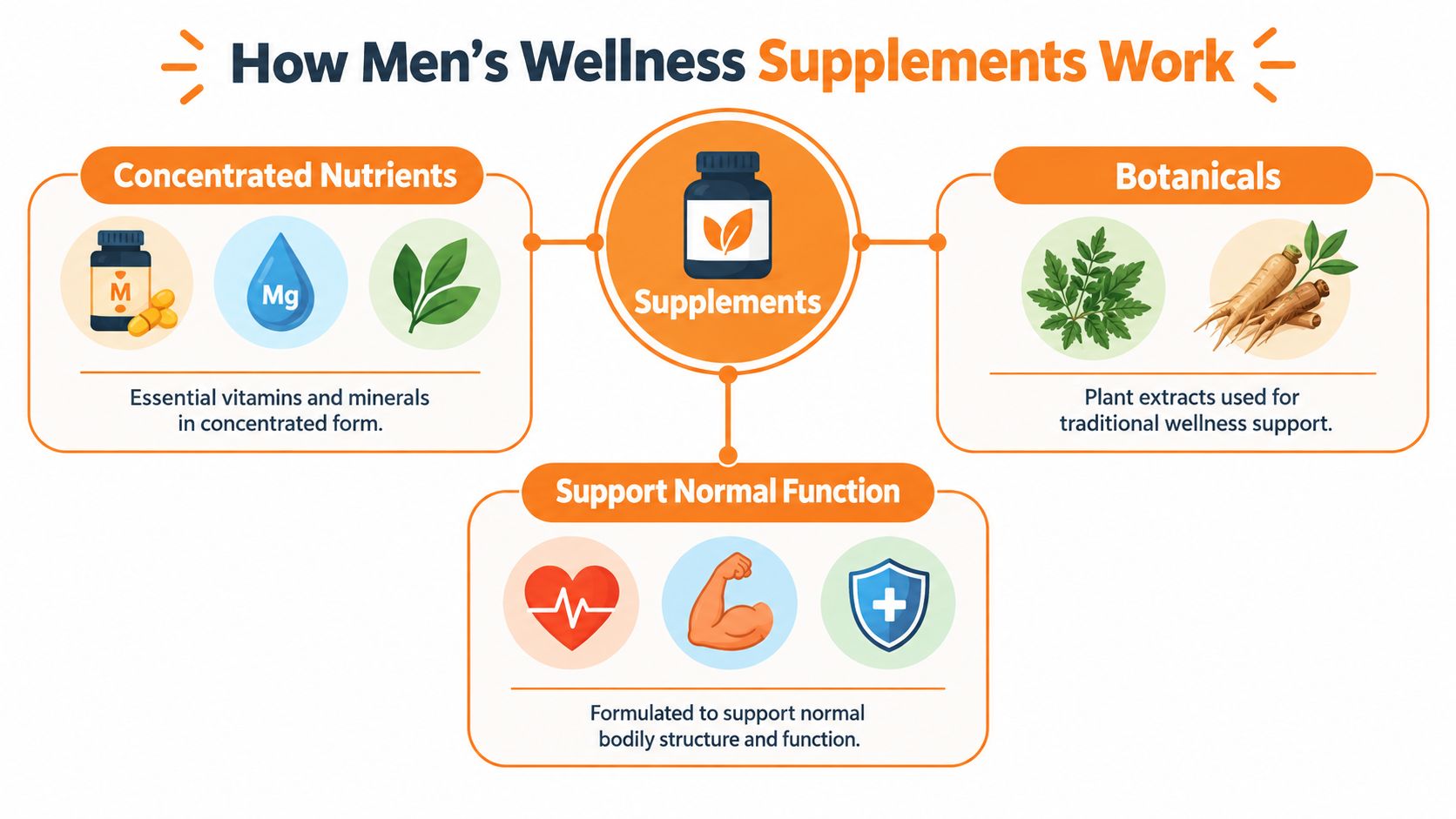
A useful analogy is a high-performance engine. Food supplies the main fuel, sleep allows maintenance, movement creates demand, and a targeted supplement can help fill a particular nutritional gap. Adding more fuel won't repair a damaged part, and adding several overlapping products won't automatically make the engine run better.
The four-part mental model
- Identify the ingredient. Zinc, L-arginine, and a botanical extract don't perform the same job. The label should make each ingredient and its amount easy to find.
- Understand the role. Zinc participates in normal reproductive physiology. L-arginine serves as a precursor for nitric oxide, a molecule involved in blood-flow regulation. These are biological roles, not promises of a particular personal outcome.
- Consider baseline status. A nutrient may matter more when intake is inadequate than when a person already has sufficient levels. Diet, training load, sleep, age, medications, and health history all influence how a body responds.
- Allow consistent use. Supplements generally support ongoing physiology rather than producing a guaranteed instant effect. Absorption, regular intake, and the rest of the routine shape the experience.
A multivitamin provides broad coverage across vitamins and minerals. A targeted blend narrows the focus, perhaps toward reproductive support, circulation, or training recovery. Neither approach is automatically correct. The better fit depends on the reader's diet, goal, tolerance for complexity, and advice from a qualified healthcare professional.
The important boundary is simple: a supplement supports normal function. It isn't intended to diagnose, treat, cure, or prevent disease. That boundary protects consumers from confusing a nutrition product with medical treatment, and it gives responsible brands a clearer way to communicate what an ingredient can reasonably contribute.
Three Core Categories of Men's Wellness Support
A man comparing formulas can start by assigning the product to one primary job. The table below separates the three most common lanes without pretending that each formula fits only one.
Which Men's Wellness Category Matches Your Goal
| Category | Primary Job | When to Prioritize |
|---|---|---|
| Vitality and daily resilience | Support normal energy, nutrient intake, stress response, and general wellness | When diet, work demands, travel, or inconsistent routines create broad nutritional gaps |
| Sexual and reproductive support | Support normal reproductive physiology, sexual wellness, and circulation-related functions | When the main interest is reproductive health, sexual confidence, or ingredients connected to semen quality and blood flow |
| Recovery and performance | Support muscle function, circulation, training consistency, and post-exercise recovery | When exercise, physical work, or demanding routines place greater demands on normal recovery systems |
Vitality is the broadest category. It often includes foundational nutrients and botanicals selected for general wellness rather than one narrow outcome. A man who regularly skips meals or follows a restrictive diet may value transparent nutritional coverage more than a complex performance stack.
Sexual and reproductive support requires more careful reading because labels frequently combine distinct biological ideas. Zinc has a documented role in normal male reproductive function, while L-arginine relates to nitric oxide biology and circulation. Those ingredients may belong in the same formula, but they should still be judged by their individual evidence and dose.
Recovery and performance is often associated with the gym, although the underlying needs also apply to physically demanding work. Muscle function, circulation, hydration, sleep, and adequate food intake all matter. A supplement can support part of that system, but it can't compensate for a routine that consistently lacks rest or nutrition.
Why categories overlap
The same man may value all three jobs at different times. A training-focused buyer may also care about sexual wellness, while someone prioritizing reproductive health may want support for daily energy. The mistake is assuming that one ingredient or one marketing phrase covers every need equally well.
A targeted formula should answer a specific question: what normal function is this ingredient intended to support, and why is it included at this dose?
That question also prevents testosterone hype from becoming the default decision rule. Men's wellness is broader than hormone language. Prostate health, stress resilience, cognition, metabolic wellness, and reproductive health are all emerging areas of attention beyond the traditional energy and performance framing, as discussed in industry coverage of men's supplement innovation.
Key Ingredients Evidence and What Research Actually Shows
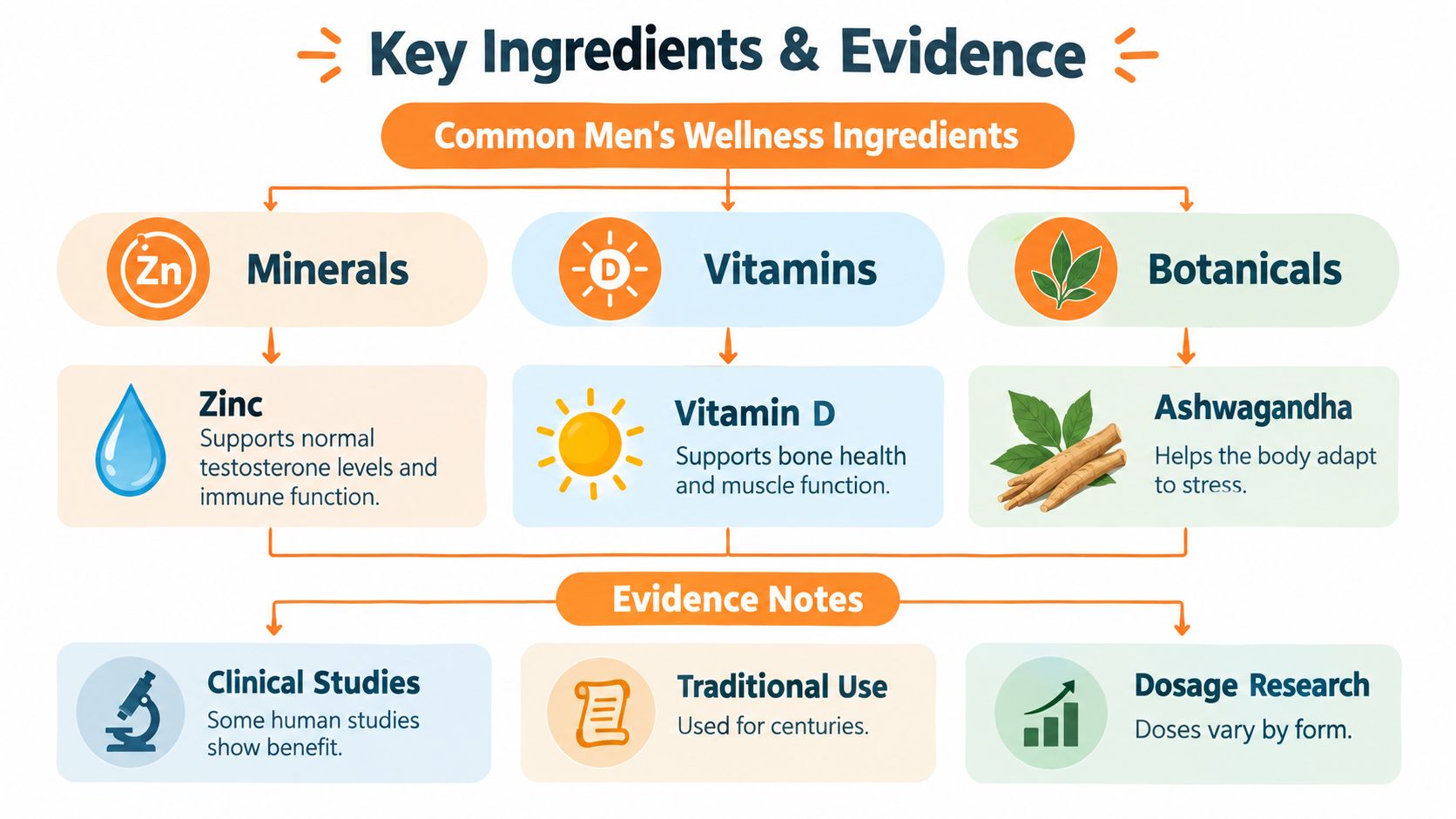
Ingredient science becomes easier to interpret when each compound is assigned one biological job. A formula can contain several ingredients, but the evidence still belongs to the individual ingredient, its form, its dose, and the population studied.
Zinc and normal reproductive physiology
Zinc has one of the clearest histories in men's wellness. It is concentrated in the male reproductive tract and participates in spermatogenesis, sperm membrane and chromatin stability, and semen enzyme activity, according to the reviewed literature on zinc and male fertility. Other NIH-reviewed research describes zinc as essential for normal testicular development and reproductive function, and notes an association between lower seminal-plasma zinc and poorer sperm count or quality.
A 2016 systematic review and meta-analysis found that zinc supplementation significantly increased normal sperm morphology, sperm motility, and semen volume, with standardized mean differences of -0.75, -1.82, and -0.99, respectively, as reported in the Journal of Molecular Sciences review. The finding doesn't mean every healthy man will experience the same result. Evidence is strongest when nutritional status, dose, and the study population are considered together.
A large trial reported in 2020 found that zinc and folic acid didn't improve live birth outcomes or semen function. That result is a useful guardrail. Zinc is better described as a nutrient that supports normal reproductive physiology, not as a guaranteed solution.
L-arginine and nitric oxide biology
L-arginine is an amino acid precursor for nitric oxide, which helps regulate vasodilation, blood flow, and thrombosis control. The mechanism is plausible, but oral supplementation doesn't create a universal response. An NIH professional evidence summary notes that arginine generally had no effect on nitric oxide concentration, blood flow, or exercise metabolites in well-trained athletes across interventions lasting 1 to 28 days.
The same source discusses a review reporting an average blood-pressure reduction of about 5.39/2.66 mmHg under some conditions. The practical interpretation is cautious: L-arginine may support nitric oxide and circulation-related biology, but baseline physiology and duration matter.
Botanicals and supporting compounds
Maca root and Panax ginseng are commonly used in formulas aimed at vitality and sexual wellness. Ashwagandha is often positioned around stress adaptation and general resilience, while tongkat ali is traditionally associated with male vitality. Saw palmetto is generally selected for prostate-focused formulas, and horny goat weed is included in some blends that emphasize sexual wellness. These descriptions identify common formulation roles, not guaranteed outcomes.
Sunflower lecithin and bromelain may appear as supporting compounds in reproductive or semen-focused formulas. Their inclusion should prompt the same questions as any other ingredient: what is the intended structure/function role, what form is used, and is the amount disclosed clearly?
Independent commentary highlights why this scrutiny matters. A review of 34 male fertility supplement brands found that 27 exceeded the recommended daily allowance for at least one nutrient and 2 exceeded the tolerable upper intake level, while overall evidence quality was poor, according to the review of common male fertility supplement brands. A separate Cleveland Clinic summary found published evidence for sperm parameters or live birth rates for only 20 of 90 ingredients, with only 15 showing a positive effect. Those findings favor prioritized ingredients, transparent doses, and realistic language over crowded labels.
For readers comparing formulas, the natural supplements for male vitality guide can serve as a further ingredient-focused reference.
How to Choose Quality Men's Wellness Supplements
A polished label doesn't prove a reliable product. Quality assessment starts with the manufacturing details, the completeness of the label, and the company's willingness to explain how it verifies the finished formula.
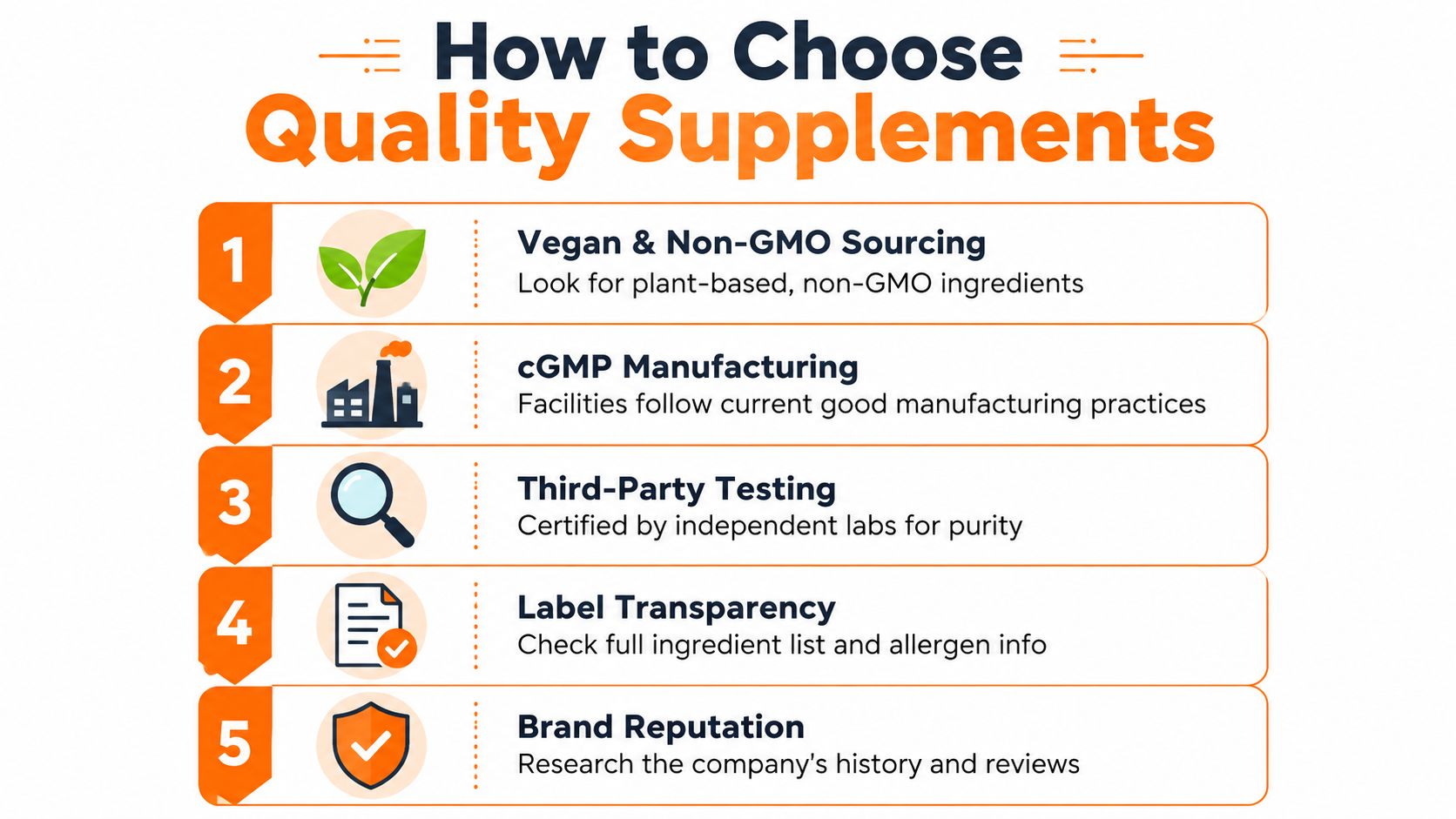
A quick label inspection
- Check the source: Vegan and non-GMO sourcing can matter to buyers who want plant-based ingredients and a clearly defined supply chain.
- Look for cGMP manufacturing: Current good manufacturing practices provide a framework for consistent production, sanitation, testing, and recordkeeping.
- Ask about independent testing: A credible program should address microbials, heavy metals, and adulterants, rather than relying only on an internal quality statement.
- Read the full label: Every active ingredient should have a disclosed amount, with serving size, other ingredients, allergens, and directions presented plainly.
- Assess the guarantee carefully: A money-back policy can reduce purchase risk, but it isn't evidence that every user will experience the same result.
A buyer should also compare a formula against other products already in use. Overlapping zinc, vitamin D, botanicals, or other nutrients can push total intake higher than intended. The concern isn't that every combination is unsafe, but that stacking without checking amounts makes it harder to understand exposure and tolerance.
What quality signals mean in practice
“Third-party tested” is more useful when the brand identifies the independent laboratory and the test categories. A label that uses a quality badge without explaining what was tested leaves important questions unanswered. The guide to third-party-tested supplement brands offers a practical way to think about testing transparency.
SEMEX is one example of a product that states it is vegan, non-GMO, made in the USA in a cGMP-registered facility, and third-party tested by Eurofins for microbials, heavy metals, and adulterants, with published testing thresholds and a 90-day money-back guarantee. Those are quality and purchasing details, not a promise that the product treats a condition or delivers a guaranteed personal outcome.
A responsible buyer should also examine the claim language. “Supports normal reproductive function” describes a structure/function role. A statement that a supplement diagnoses, treats, cures, prevents, or fixes a medical condition crosses into a very different category.
Safe Use Daily Habits and Realistic Expectations
A supplement works best when its use is simple enough to repeat. The label should determine serving size and timing, and a healthcare professional should be consulted when a man has a medical condition, takes medication, is preparing for a procedure, or has concerns that need evaluation.
Many daily formulas are designed around 3 capsules daily, but serving instructions vary by product and shouldn't be generalized. Taking the recommended serving with water and following the label is safer than increasing the amount because a result hasn't appeared quickly.

Build a routine that can survive real life
A consistent habit may be attached to breakfast, a daily water bottle, or another established part of the morning. If a formula causes stomach discomfort, the label may provide food-related guidance, but persistent or concerning symptoms warrant professional advice rather than self-experimentation.
Benefits can build gradually over approximately 30 days of consistent use for formulas positioned around ongoing men's wellness support. That timeframe isn't a guarantee, and it doesn't override differences in baseline nutrition, absorption, lifestyle, or the ingredient evidence.
Sleep, hydration, and nutrition remain the foundation. A man who regularly sleeps poorly or eats an unbalanced diet shouldn't expect capsules to perform the work of those basics. Supplements may complement a routine, but they can't replace the conditions that allow normal body systems to function well.
Expectation check: A slower, measurable change in routine or perceived support is more realistic than an immediate transformation.
Safety also depends on avoiding unnecessary stacking. The discussion of potential supplement side effects can help readers identify questions to raise with a healthcare professional, especially when several products contain the same nutrients or botanicals.
Making Your Choice and Next Steps with Confidence
The clearest decision path is short. First, choose the primary job: vitality, sexual and reproductive support, or recovery and performance. Next, inspect the ingredient panel and ask whether each compound has a recognizable role, a disclosed amount, and evidence that fits the intended use.
Then evaluate the product itself. Vegan or non-GMO sourcing may matter for personal standards, cGMP manufacturing supports production quality, and independent testing for microbials, heavy metals, and adulterants gives the label more substance. A transparent serving size helps prevent accidental overlap with other supplements.
Zinc can be a rational choice when the goal involves normal male reproductive physiology, while L-arginine may appeal to readers focused on nitric oxide and circulation biology. Botanicals such as maca root, Panax ginseng, ashwagandha, tongkat ali, saw palmetto, and horny goat weed should be judged by their specific role, evidence quality, form, and dose rather than by the size of the ingredient list.
A supplement supports normal structure or function. It doesn't diagnose, treat, cure, or prevent disease, and persistent health concerns deserve qualified medical guidance.
These statements have not been evaluated by the Food and Drug Administration. This product is not intended to diagnose, treat, cure, or prevent any disease.
SEMEX offers a daily, vegan and non-GMO formula built around zinc, L-arginine, sunflower lecithin, bromelain, and a broader men's wellness blend for support related to semen volume, taste, vitality, and circulation. Men who want to compare its ingredients, testing details, and daily-use approach can visit SEMEX and review the product information before making a choice.