

Men's Performance Supplements: Ingredients and Quality
Most advice about men's performance supplements starts with the wrong promise. A larger semen volume, faster arousal, or an overnight transformation may sound persuasive in an advertisement, but the human body doesn't work like a light switch. Dietary supplements are better understood as tools that support normal biological pathways, and their value depends on ingredient quality, personal needs, consistent use, and realistic expectations.
That distinction matters in a category that has grown far beyond a niche market. The global sexual health supplement market was estimated at USD 3,520.9 million in 2023 and is projected to reach USD 7,020.1 million by 2030, implying a 10.4% compound annual growth rate from 2024 to 2030, according to Grand View Research's sexual health supplements market analysis. Growth creates more choice, but it also gives consumers more exaggerated claims to sort through.
Table of Contents
- The Reality of the Men's Wellness Market
- Foundational Ingredients for Reproductive and Circulatory Support
- Adaptogens and Botanicals for Overall Vitality
- Evaluating Quality and Safety Standards
- Setting Realistic Timelines for Daily Use
- Navigating Supplement Regulations and Claims
- Building Your Personal Wellness Strategy
The Reality of the Men's Wellness Market
Men's performance supplements are often sold through dramatic promises, yet their biological role is usually more modest. Nutrients and botanical compounds work more like inputs in a maintenance system than switches that create instant results. Zinc, amino acids, and plant extracts may participate in pathways related to reproductive function, circulation, energy, or stress response. They do not turn a dietary supplement into a pharmaceutical treatment.
The expanding market reflects interest in natural formulations, online purchasing, and products built around recognizable ingredients. The market analysis from Grand View Research projects growth for adjacent sexual enhancement supplements, including an increase of USD 2.1 billion between 2024 and 2029 and a 12.6% projected CAGR. Those figures describe commercial activity. They do not show that every formula works equally well.
Support is different from treatment
Pharmaceutical products are developed and regulated for defined medical indications. Dietary supplements belong to a different category, so their claims should match what the ingredients can reasonably support. A responsible formula may support normal blood-flow physiology, help maintain reproductive nutrient status, or contribute to overall vitality. It should not be marketed as treating a disease or correcting a medical diagnosis.
Semen-volume advertising illustrates the gap between a plausible mechanism and a proven finished-product result. A 2026 synthesis of 21 trials reported that no supplement produced a statistically significant change in semen volume versus placebo. A 2023 review also concluded that dietary supplements for erectile dysfunction lacked enough evidence to serve as first-line therapy, as summarized in this evidence review on sexual health supplementation. Ingredients can still have relevant biological roles, but those roles do not justify guaranteed outcomes.
Practical rule: A credible product supports a biological pathway. It does not promise the same result for every man.
Product comparisons make more sense when supplements are placed within a broader routine. This guide to sexual wellness for men covers sleep, nutrition, exercise, stress management, and communication with a partner. A formula may complement those habits, while third-party testing and cGMP compliance provide added checks in a market where product quality can vary. Neither supplement use nor a quality seal replaces medical advice for persistent symptoms.
Foundational Ingredients for Reproductive and Circulatory Support
A larger semen volume is not the clearest measure of reproductive health. The more useful question is whether an ingredient supports a biological process involved in reproduction or circulation. Two ingredients appear often in men's performance supplements for that reason: zinc and L-arginine. Zinc is a mineral involved in reproductive physiology, while L-arginine is an amino acid used in nitric oxide production and blood-flow signaling.
Zinc is found at a much higher concentration in seminal fluid than in blood. Research connects adequate seminal zinc with sperm function, motility, chromatin stability, and fertilization competence. It contributes to spermatogenesis, sperm-cell membrane stability, nuclear chromatin protection, and seminal enzyme regulation. Zinc therefore functions more like a maintenance nutrient than an instant “volume booster.”
A 2016 meta-analysis associated zinc supplementation with increases in semen volume, sperm motility, and normal sperm morphology. The reported standardized mean differences were -0.99 for semen volume, -1.82 for motility, and -0.75 for morphology, according to the meta-analysis published in Scientific Reports. These findings require context. A zinc-plus-folic-acid study summarized by the NIH found no improvement in pregnancy rates, sperm counts, or sperm function. Live births were 34% in the supplement group versus 35% with placebo, as reported in the NIH zinc and folic acid trial summary.
Zinc and L-arginine serve different jobs
L-arginine supports a different pathway. Nitric oxide synthase uses it as a dietary precursor for nitric oxide, which relaxes vascular smooth muscle and supports blood flow to tissues. That mechanism explains its presence in both men's wellness products and exercise-oriented formulas. A classic human study indexed by PubMed describes L-arginine as a precursor of endogenous nitric oxide and reports peripheral vasodilation in healthy humans.
A 2019 review identified L-arginine as one of the supplements commonly used by men seeking natural support for erectile function. One study cited in that review used 2,500 mg daily for 12 weeks and reported improved erectile function in men with low to moderate erectile dysfunction. Individual response can vary with dose, baseline arginine status, diet, consistency, and the other ingredients in a formula.
| Ingredient | Primary Biological Role | Wellness Support Area |
|---|---|---|
| Zinc | Reproductive cofactor involved in seminal and sperm physiology | Normal reproductive function and nutrient support |
| L-arginine | Precursor used by nitric oxide synthase | Blood-flow and circulation support |
| Sunflower lecithin | Phospholipid ingredient used in formulation strategies | Semen-focused and nutritional support |
| Bromelain | Enzyme-derived botanical ingredient | Ingredient-led taste-focused formulations |
Readers who want a clearer explanation of the circulation pathway can review L-arginine benefits for men. The practical conclusion is limited but useful: zinc supports normal reproductive physiology, while L-arginine supports nitric oxide production and blood-flow signaling. Neither ingredient guarantees a specific result. Product quality also matters, so third-party testing and cGMP compliance provide important safeguards when comparing formulas in a loosely regulated market.
Adaptogens and Botanicals for Overall Vitality
Reproductive and circulatory support are only parts of sexual confidence. Stress, energy, mood, and general resilience can influence how a man feels about intimacy, training, and daily performance. That's where formulas often add botanicals such as Maca Root, Panax Ginseng, Ashwagandha, and Tongkat Ali.

These ingredients are often grouped under the broad label adaptogens, although the term can become too vague when marketers use it without explaining the intended role. A more useful interpretation is that they belong to a wellness blend designed to complement foundational nutrients. Maca Root is commonly included in vitality and libido-oriented formulas. Panax Ginseng is traditionally associated with energy and resilience. Ashwagandha is used in formulas focused on stress balance and recovery, while Tongkat Ali is commonly positioned around men's vitality and confidence.
A blend is not the same as proof of synergy
Combining several botanicals doesn't automatically prove that they work better together. Each plant has its own extract type, concentration, preparation method, and evidence profile. Without clear dosing and standardized sourcing, a label can sound advanced while giving consumers little information about what they're taking.
The most reasonable way to evaluate these ingredients is to ask what role each one is intended to play:
- Maca Root: Often used to complement libido and everyday vitality goals.
- Panax Ginseng: Commonly selected for energy and resilience support.
- Ashwagandha: Frequently included in stress-response and recovery-oriented formulas.
- Tongkat Ali: Typically positioned around male vitality and performance confidence.
- Saw Palmetto and Horny Goat Weed: Botanical additions that appear in broader men's wellness blends.
Plant-based doesn't mean risk-free, and traditional use doesn't establish a guaranteed modern outcome. Botanical supplements can vary substantially in extract strength and purity, so transparent labels and independent testing matter as much for herbs as they do for minerals and amino acids.
A strong formula should therefore be viewed as a wellness blend, not a shortcut. Zinc and L-arginine provide foundational nutritional and circulation support, while botanicals may broaden the formula's focus toward stress, energy, and daily resilience. The consumer still needs to judge the finished product by its evidence, label clarity, manufacturing controls, and fit with personal goals.
Evaluating Quality and Safety Standards
Ingredient names alone don't tell consumers whether a supplement deserves trust. The same botanical can appear in a carefully controlled product or in a poorly documented formula with unclear identity, weak testing, or undisclosed amounts. In a category where quality can vary, manufacturing and verification deserve as much attention as the front-label promise.
Five checks belong on every shopping list
cGMP manufacturing is a starting point. Current good manufacturing practices are intended to support controlled production, accurate records, sanitation, quality systems, and consistency. A brand should identify where its products are made and provide meaningful information about the facility rather than relying on a vague “made in a quality facility” statement.
Third-party testing adds another layer of accountability. An independent laboratory can evaluate finished products for microbials, heavy metals, and adulterants, rather than asking the brand's own marketing copy to serve as proof. Buyers should look for a named laboratory, a current certificate or testing record, and clearly stated thresholds. “Tested” without details is difficult to verify.
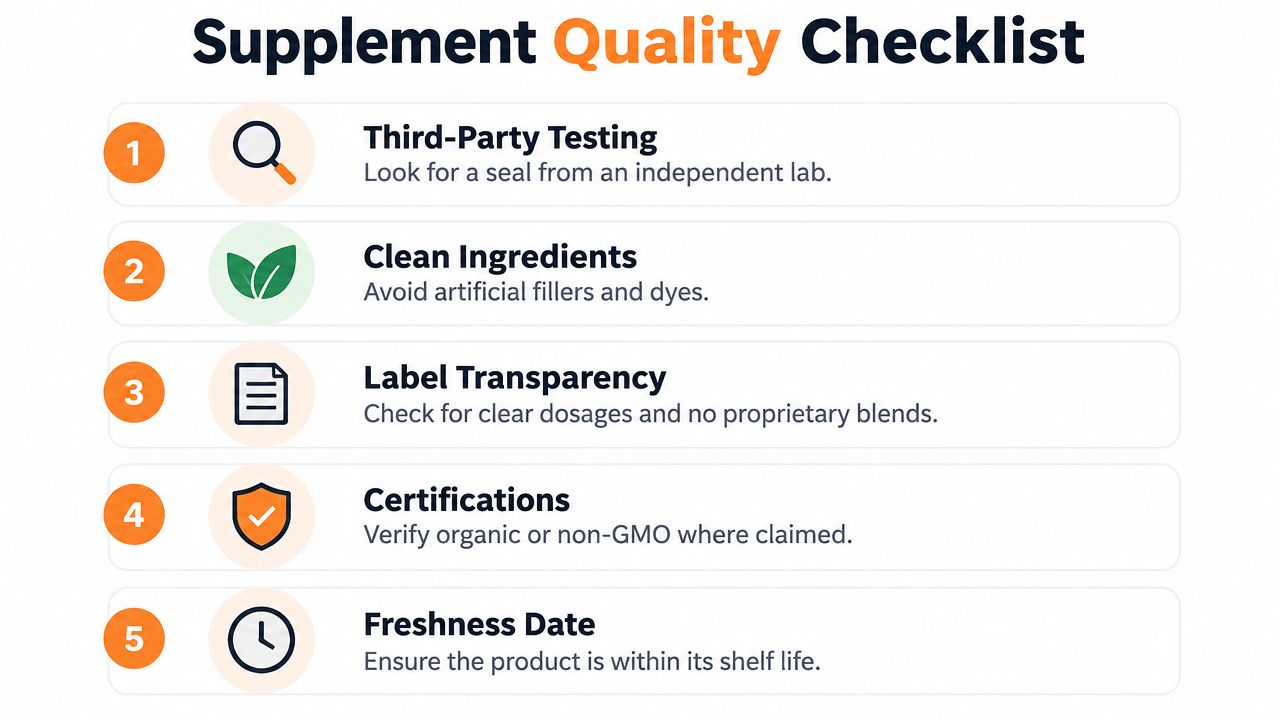
The supplement quality standards guide can help consumers compare quality markers before purchasing. A practical review should include:
- Testing records: Can the brand identify the independent laboratory and the substances tested?
- Ingredient clarity: Does the label list each ingredient and its amount?
- Manufacturing information: Is the facility identified as cGMP-registered or otherwise clearly documented?
- Certifications: Are vegan or non-GMO claims supported by meaningful verification?
- Freshness details: Does the package show a readable expiration or best-by date?
Clean labeling needs substance
“Vegan” and “non-GMO” can matter to consumers with specific dietary or sourcing preferences, but those terms shouldn't distract from dosage and testing. A formula can be vegan and still use under-dosed ingredients or offer poor documentation. Conversely, a familiar ingredient name doesn't guarantee the ingredient is present at the stated strength.
Proprietary blends create a similar problem. They may list several ingredients without showing the amount of each one, making it harder to compare products or understand whether a formula contains meaningful doses. Clear labels make informed decisions possible.
The NIH fact sheet on exercise and athletic performance supplements also highlights a broader concern: some performance supplements have little evidence of benefit, while contamination and inconsistent quality remain important safety issues. The safest approach combines realistic claims, transparent sourcing, independent testing, and professional guidance when medications or health conditions are involved.
Setting Realistic Timelines for Daily Use
Dietary supplements do not work like fast-acting pharmaceuticals. Expecting an immediate change after one serving can misrepresent a product intended for daily nutritional support. Reproductive physiology, nutrient status, circulation habits, stress, and general health interact over time, like several systems contributing to the same result.
Many daily formulas recommend a routine such as three capsules a day because regular intake is easier to maintain than occasional use. The routine is meant to provide steady exposure to selected nutrients and botanicals, not produce an acute effect.
Consistency is the practical variable
Start with the product label. Take capsules as directed, ideally at a consistent time connected to an existing habit. A calendar reminder, a place near breakfast, or pairing the serving with another daily task can reduce missed doses without making supplementation difficult.
For SEMEX, the stated product positioning suggests benefits may build over about 30 days of consistent use. Treat that period as a practical reference, not a promise or fixed biological deadline. Some men may notice changes in subjective confidence or routine sooner, while others may notice little difference.
Daily-use principle: Judge a supplement routine by sustained, consistent use, not by the sensation produced by one serving.
Avoid combining several products with overlapping ingredients unless a healthcare professional has reviewed the full regimen. Adding more ingredients does not automatically provide more support, and zinc has a dose-sensitive biological window. Adequate zinc supports normal reproductive function, while excessive intake may cause harm, as described in the clinical literature on zinc and male reproductive function. Product quality also matters, so transparent labels, third-party testing, and cGMP-compliant manufacturing provide a stronger basis for daily use than volume claims alone.
Navigating Supplement Regulations and Claims
A supplement label can use structure/function language, but it can't cross into disease claims. The difference is practical. “Supports normal blood flow” describes a physiological role. “Treats erectile dysfunction” describes a disease-related intervention and falls outside an acceptable structure/function framing for a dietary supplement.
FDA guidance says a structure/function claim must be truthful and not misleading, include the required disclaimer, and avoid claims to diagnose, mitigate, treat, cure, or prevent a specific disease or class of diseases. The FDA guidance on structure/function and related claims explains this boundary.
How to identify a responsible claim
A compliant description usually connects an ingredient to a normal role. Examples include:
- Zinc supports normal reproductive function.
- L-arginine helps support nitric oxide production.
- A botanical blend supports daily vitality and resilience.
- A formula helps maintain general wellness.
A risky description promises a medical outcome, uses absolute language, or suggests that every customer will experience the same result. Claims about infertility, low sperm count, disease treatment, or guaranteed sexual performance should prompt caution.
The disclaimer isn't decorative legal text. FDA requires the exact wording for dietary-supplement structure/function claims:
Required disclaimer: “These statements have not been evaluated by the Food and Drug Administration. This product is not intended to diagnose, treat, cure, or prevent any disease.”
According to the FDA dietary supplement labeling guide, the disclaimer must be prominently displayed in boldface type and placed immediately adjacent to the claim, or linked to it with a symbol when separated.
The label should identify the product clearly
FDA labeling guidance identifies five required label statements: statement of identity, net quantity of contents, nutrition labeling, ingredient list, and the name and place of business of the manufacturer, packer, or distributor, as outlined in the FDA general dietary supplement labeling guide. Missing or confusing information makes comparison harder.
A responsible buyer can therefore scan the label for four things at once: what the product is, how much it contains, who makes it, and what the claims promise. A polished website doesn't replace those basics.
Building Your Personal Wellness Strategy
A practical strategy starts with the goal, not the advertisement. Men interested in reproductive nutrient support may focus on zinc and label transparency. Men prioritizing circulation and performance may examine L-arginine and the formula's broader design. Those seeking daily vitality may consider botanicals such as Maca Root, Panax Ginseng, Ashwagandha, and Tongkat Ali, while still checking extract details and testing documentation.
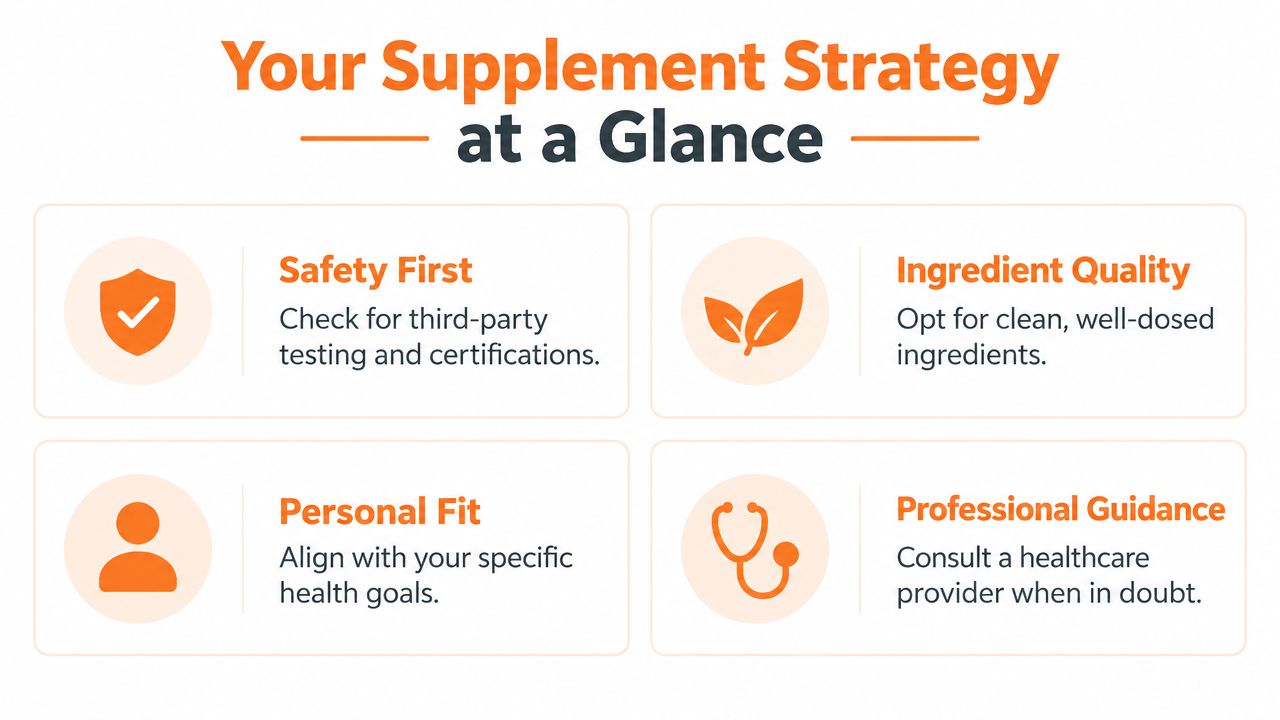
The decision can be reduced to four questions:
- Does the formula match the goal? A semen-focused product and an exercise stimulant aren't interchangeable. The ingredient list should make the intended support clear.
- Are the amounts visible? Clear doses are more useful than a proprietary blend that hides individual quantities.
- Can the quality claims be checked? Independent testing, cGMP manufacturing, and published thresholds offer stronger reassurance than vague purity language.
- Does the routine fit the person? Existing medications, allergies, dietary restrictions, and personal health history may affect whether a supplement is appropriate.
SEMEX is one example of a daily men's wellness supplement formulated around Zinc, L-Arginine, Sunflower Lecithin, Bromelain, Maca Root, Panax Ginseng, Ashwagandha, Tongkat Ali, Saw Palmetto, and Horny Goat Weed. Its stated quality features include a vegan, non-GMO formulation, production in the USA in a cGMP-registered facility, and third-party testing by Eurofins for microbials, heavy metals, and adulterants, with published testing thresholds. The product is generally taken as three capsules daily, with benefits positioned as building gradually over about 30 days, and it includes a 90-day money-back guarantee.
A careful buyer should compare those details with other products rather than treating any single formula as universally suitable. The strongest choice is the one with a clear purpose, transparent ingredients, credible quality controls, and claims that remain within the boundaries of normal wellness support.
These statements have not been evaluated by the Food and Drug Administration. This product is not intended to diagnose, treat, cure, or prevent any disease.
SEMEX offers a daily, ingredient-led supplement designed to support semen volume, taste, blood-flow physiology, and overall men's vitality through a transparent capsule formula. Men comparing men's performance supplements can review the full formula, quality information, and daily-use details at SEMEX.