

Men's Health Capsules That Fit Your Priorities
You're standing in front of two tabs, or two bottles, and both promise male vitality in polished language. Both list a dozen botanicals. Both look clean, natural, and serious. That sameness is the problem, and it's exactly why you should stop comparing front labels and start comparing outcomes, doses, and proof.
Table of Contents
- Why Capsule Labels Look Similar Before They Are
- Understand the Men's Health Capsule Format
- Compare Actives and Ingredient Blends
- Audit Every Supplement Label in Order
- Verify Manufacturing and Testing Claims
- Match Formula Profiles to Buyer Goals
- Make a Cautious Final Capsule Choice
Why Capsule Labels Look Similar Before They Are
A shopper comparing three bottles of men's health capsules will usually see the same pattern. One front panel says it supports vitality. Another supports male wellness. A third supports performance and reproductive health. The words differ slightly, but they don't tell you what amount of anything you're taking, whether that amount was studied for the outcome you want, or whether anyone tested the finished batch in your hand.
That sameness is easy to manufacture. A long ingredient list costs little to print. Disclosing the dose of every active, standardizing a botanical extract, and publishing batch testing cost more, so fewer labels do it. When you judge by ingredient count, you're rewarding the longest list, not the most coherent formula.
Familiarity doesn't fix this. CDC analysis of the 2017–2018 National Health and Nutrition Examination Survey found that 50.8% of U.S. men reported taking at least one dietary supplement in the previous 30 days, so this is a mainstream category, not a new one. Widespread use tells you men are comfortable buying capsules. It doesn't tell you a specific formula produces a specific result.
The four questions that separate labels
Ask these in order, and most lookalike products separate quickly.
- Which outcome matters to you: Semen volume, taste expectations, general vitality, a sperm parameter, and fertility are different endpoints, and evidence for one doesn't transfer to another.
- Are doses visible: You need an amount per serving for each active, not a blend total that hides how the total is split.
- What manufacturing controls apply: A facility claim describes process controls, not the contents of your specific bottle.
- What finished-product testing exists: Batch results with methods and limits give you something to verify.
If a label can't answer the first two questions clearly, its answers to the last two won't rescue it.
There's one boundary to hold throughout. A dietary supplement can use structure/function language such as supports or helps maintain normal function. It can't credibly promise to treat infertility, fix a low count, or guarantee a bedroom result. When a front panel blurs that line, treat the blur as information about the brand's standards, not as a stronger claim.
Understand the Men's Health Capsule Format
A capsule is a shell that carries a measured amount of one or more ingredients. That's the whole format, and understanding its parts prevents most buying mistakes.
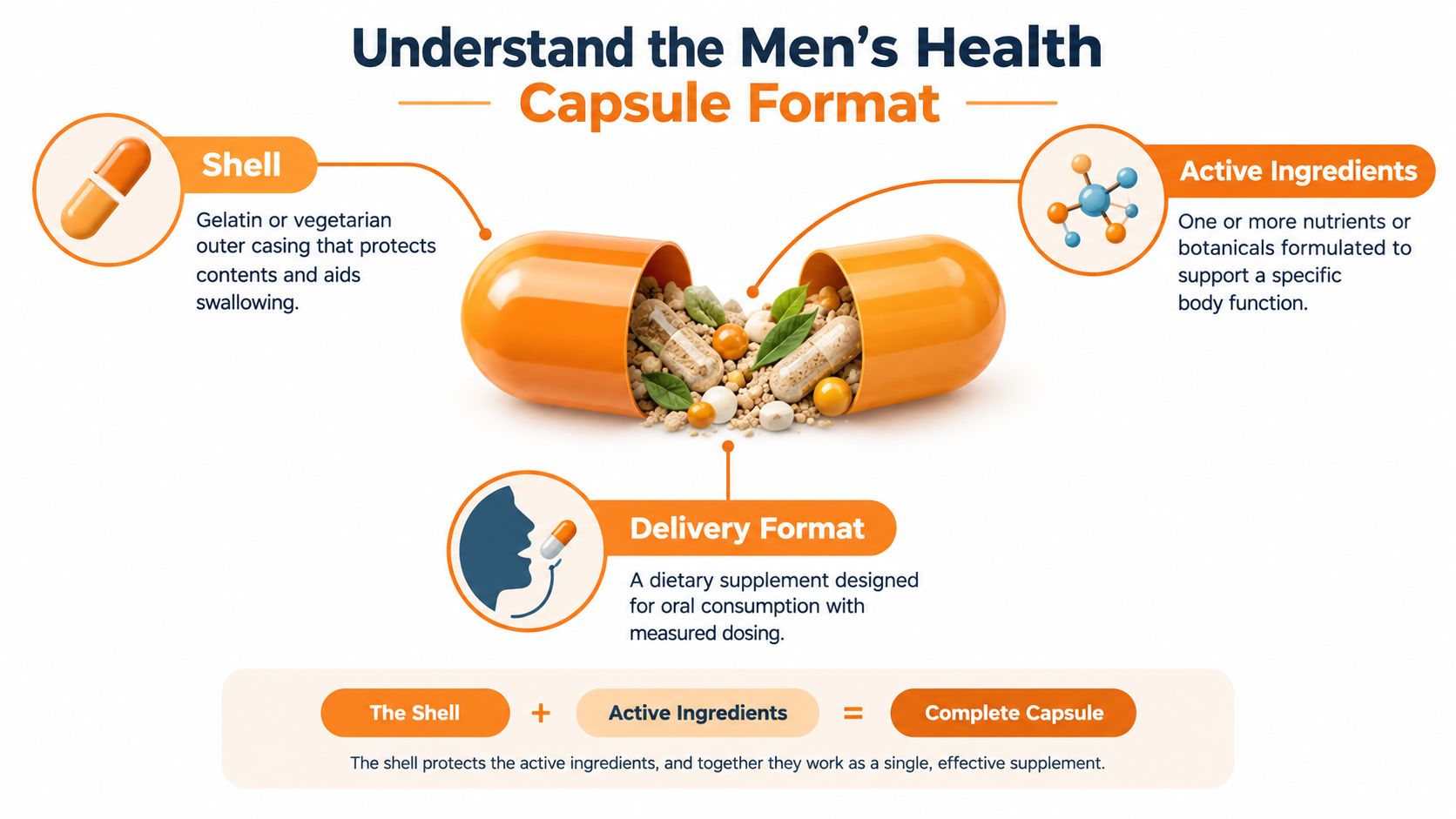
The shell is gelatin or a vegetarian casing. It protects contents and helps you swallow them, but it contributes no active effect. The active ingredients inside do the intended work and should be listed with amounts. The delivery format is oral dosing in set units, which is why serving size matters so much, since two products with identical bottles can define a serving as one capsule or three.
How formats change what you can verify
| Format | Dosing control | Ingredient capacity | Label readability |
|---|---|---|---|
| Capsule | Fixed per unit, easy to count | Moderate, limited by shell size | Clear when each active is listed |
| Tablet | Fixed per unit | Can be compressed tighter | Binders and coatings add other ingredients |
| Powder | You measure it, so it varies | Higher per serving | Amount depends on your scoop |
| Gummy | Fixed per piece | Lower, space goes to sweeteners | Actives often compete with flavoring |
Capsules sit in a useful middle. You get repeatable units without measuring, and brands can fit a meaningful amount of powder inside. The trade-off is capacity. A formula with many actives in a small daily capsule count has to divide that space, so some ingredients may end up present in name more than in amount. How a form is absorbed also differs by ingredient, which is why understanding supplement bioavailability matters before you assume equal label amounts behave equally.
Outcomes that aren't interchangeable
Don't let one word do five jobs. Semen volume is the amount of fluid. Sperm count is the number of sperm. Motility is how they move. Vitality is a broad wellness idea covering energy and libido. Fertility is whether conception and live birth occur.
More fluid doesn't mean healthier sperm, and a change in one lab parameter doesn't mean a baby is more likely. A 2025 systematic review found supplements may improve isolated sperm parameters in some studies, but it did not demonstrate improved pregnancy or live-birth outcomes, and overall certainty was limited by heterogeneity, bias, and study quality.
Practical rule: Name the single outcome you care about most before you read any panel, then judge every claim against that outcome only.
Compare Actives and Ingredient Blends
Compare formulas ingredient by ingredient. A blend with many names can be weaker, on the outcome you care about, than a shorter formula with disclosed amounts that match how those ingredients were studied.
Start with the simplest benchmark, which is dose transparency. For each active, you want the form, the amount per serving, and a defined daily serving. With minerals, compare the elemental amount, because the total weight of a zinc compound isn't the same as the zinc it delivers. With botanicals, look for the plant part and standardization, since extracts vary and studies use specific extracts, doses, and durations that don't automatically apply to a different extract on a label.
Three ingredients that show the method
Zinc is the clearest example of a nutrient with a real role and a real limit. It plays a role in normal reproductive function, which supports cautious structure/function wording. It doesn't support presenting a capsule as a fertility treatment. The limit matters for your total intake, because the adult tolerable upper intake level for zinc is 40 mg per day from all sources, including food and supplements. If your multivitamin, fortified foods, and a men's formula all add zinc, you tally all three, not just the new bottle.
L-arginine participates in nitric-oxide related vascular signaling. That's a mechanism, and mechanisms are where labels often overreach. A pathway's involvement in blood flow doesn't guarantee a sexual-performance outcome from an oral capsule at the dose in front of you. Ask what dose is present and whether human oral evidence matches your goal, rather than accepting pathway language as a result.
Bromelain requires the most restraint. It's an enzyme mixture derived from pineapple and it's included in some men's wellness formulas, but the available evidence doesn't establish that it changes semen taste in humans. A taste claim would need a controlled human study measuring that sensory outcome directly. Until then, describe bromelain as an ingredient in the formula, not as a proven way to improve flavor or volume.
Other common additions, such as sunflower lecithin, maca root, Panax ginseng, ashwagandha, tongkat ali, saw palmetto, and horny goat weed, deserve the same treatment. For each one, separate the traditional or mechanistic rationale from human evidence on your specific endpoint, and note that combining several botanicals raises tolerability and interaction questions that single-ingredient marketing ignores.
Why proprietary blends block comparison
A proprietary blend lists ingredients in descending order with one combined weight. You can't tell whether the headline ingredient makes up most of that weight or a trace of it, and you can't compare the dose with any studied amount. That's not a minor formatting choice. It removes the one piece of information you need to judge whether the formula is built around an active or around its name.
As a factual reference point, SEMEX is a capsule product in this category, and it should be assessed by the same ingredient-by-ingredient method as any unnamed alternative, with each active tied to its own evidence rather than to a product-level promise.
A formula earns confidence when you can state, for every active, what it's there to support, how much is present, and what evidence matches that amount and outcome.
Audit Every Supplement Label in Order
Read panels in a fixed order and you'll finish in a few minutes with a clearer answer than an hour of browsing reviews gives you.
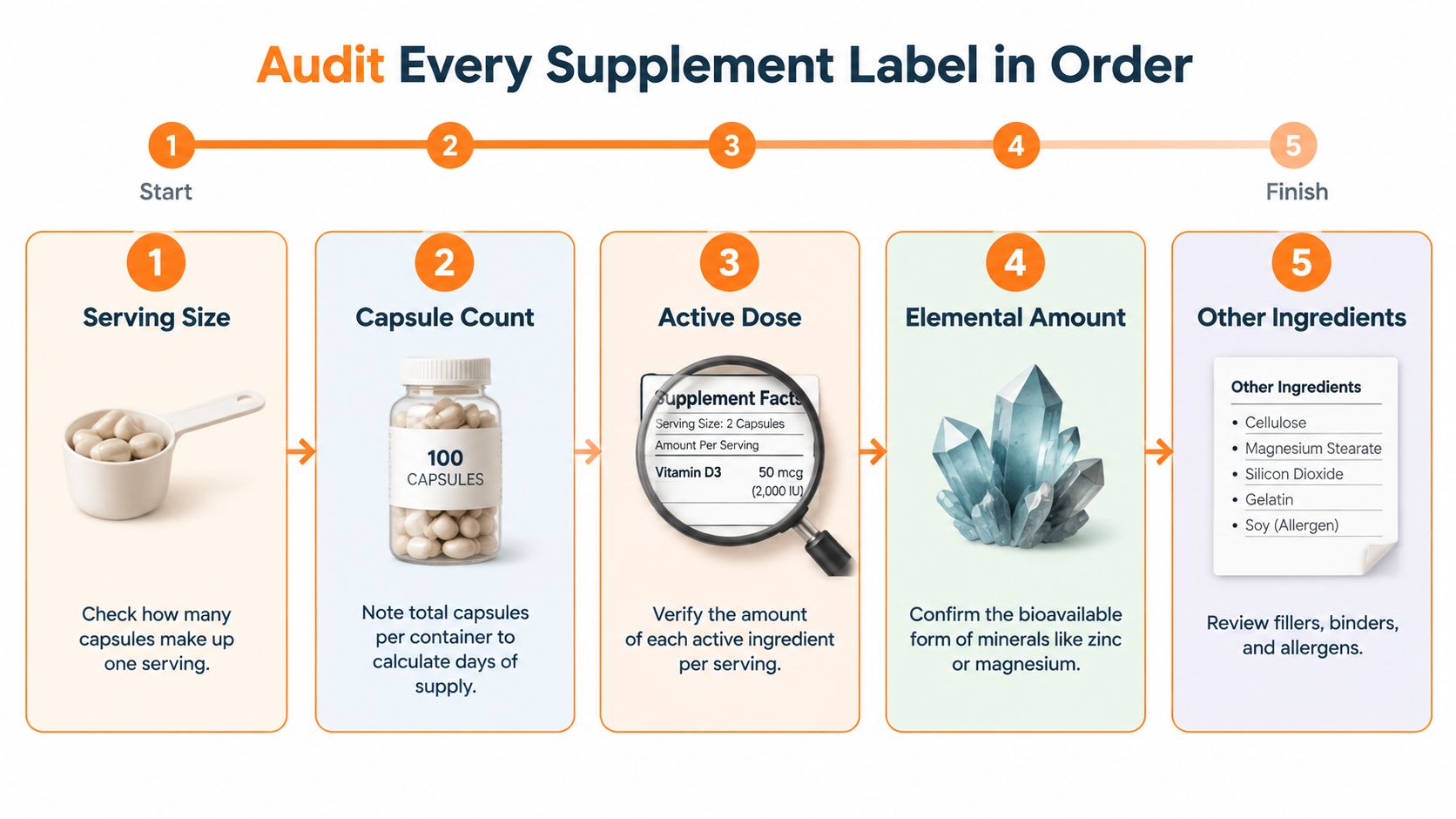
The audit sequence
- Serving size first: Count how many capsules make one serving, then check capsules per container to get days of supply and true daily cost in effort.
- Active dose second: Confirm the amount of each ingredient per serving, and flag any active hidden inside a blend total.
- Elemental amount third: For zinc and other minerals, use the elemental figure so you can tally intake across products.
- Other ingredients fourth: Review fillers, allergens, shell source, and any interaction or warning language.
- Claim wording last: Check whether directions and claims describe support for normal function or drift into treating a condition.
A fuller walkthrough of how to read supplement labels uses this same sequence, and it's worth following in order because an attractive claim read first will color everything after it.
Two miniature labels
A transparent panel reads like this in spirit. Serving size is defined, each active carries its own amount, minerals show elemental values, directions match the serving, and claims say supports normal function. You can disagree with the formula choices, but you can evaluate them.
A vague panel looks different. It announces a large proprietary blend, leans on supports male wellness, gives no elemental mineral amount, and implies outcomes the ingredient list can't substantiate. You aren't evaluating a formula there, since you're evaluating adjectives.
Now apply the audit to combined use, which is where men get into trouble without realizing it. Tally zinc from a multivitamin and fortified foods before adding another source. Check whether two products repeat the same botanicals under different blend names. Don't assume a long capsule list adds up to a coherent, well-dosed formula.
Evidence should also discipline your expectations during the audit. In a randomized trial of 2,370 couples, zinc plus folic acid did not improve live births or major sperm measures compared with placebo, with 34% versus 35% live births, while gastrointestinal symptoms were more frequent in the supplement group. Zinc belongs on a label as a nutrient that plays a role in normal function. A label implying it treats infertility has gone past that evidence.
Verify Manufacturing and Testing Claims
Manufacturing language sounds uniform, but different claims assure different things. Separate them and you stop paying for reassurance you aren't getting.
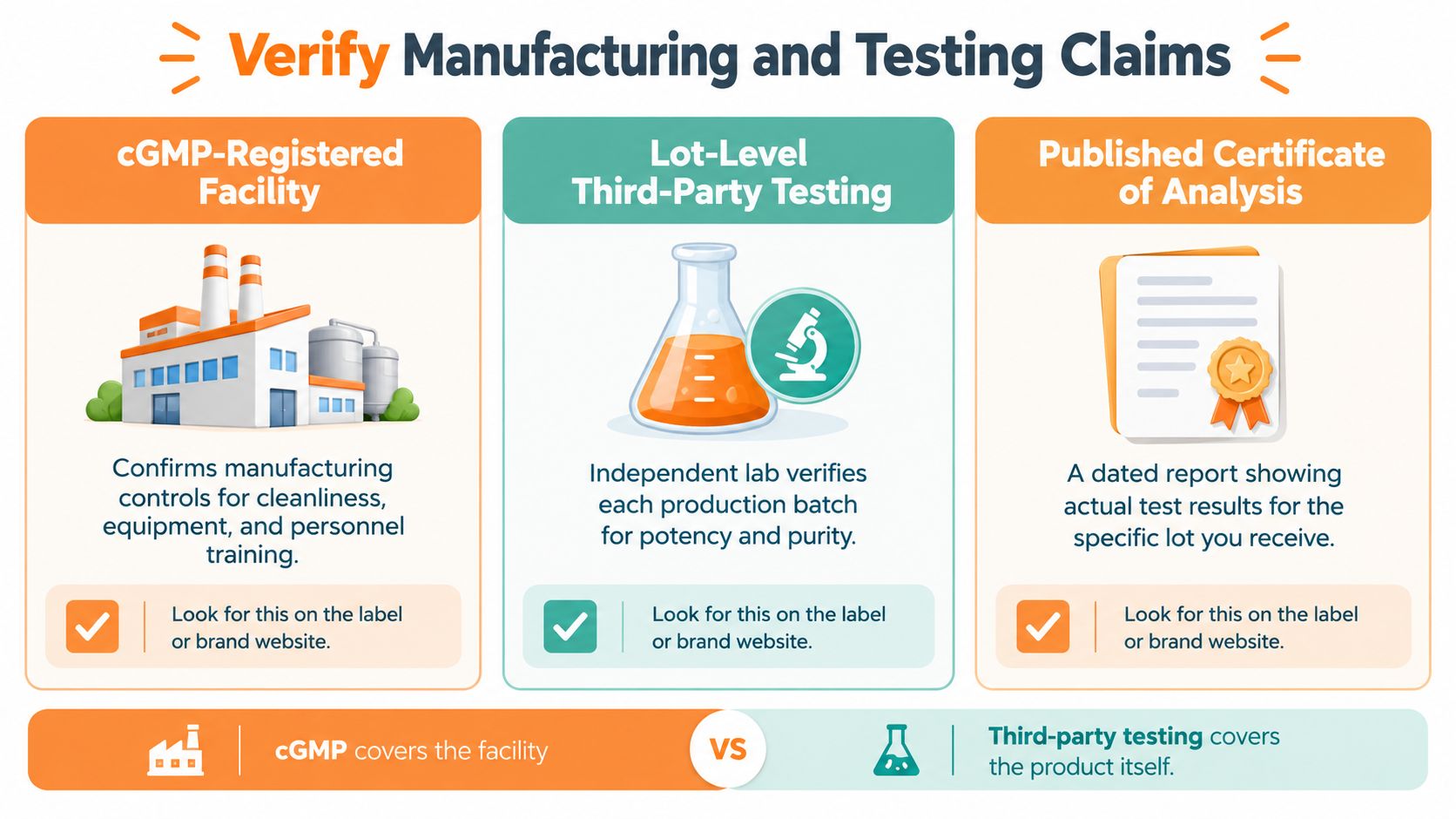
Three levels of assurance
A cGMP-registered facility claim concerns manufacturing controls. FDA dietary-supplement cGMP requirements call for specifications covering identity, purity, strength, composition, and contamination limits, with finished-batch testing or examination used to verify compliance. That framework matters, and FDA's overview names contaminants such as pesticides and heavy metals as quality concerns.
Lot-level third-party testing is different. An independent laboratory tests a specific production batch for things like microbials, heavy metals, and undeclared adulterants. This speaks to the finished product rather than the building it came from.
A published certificate of analysis is the strongest of the three because you can read it. Look for the batch number, test methods, reporting limits, and pass or fail criteria, plus confirmation that the tested sample matches the label serving. A general statement that a product is third-party tested, with no document behind it, sits well below this level. Reading about third-party verification helps you recognize what a usable report contains.
Applying the same standard to front-of-pack badges
Vegan and non-GMO positioning follows identical logic. A certification or a specific verification statement you can trace is worth more than an unsupported badge. Neither claim, on its own, establishes purity, potency, or effectiveness, so don't let a dietary preference claim substitute for contaminant and adulterant testing.
Consider one worked example in this category. It's positioned as vegan and non-GMO, made in the USA in a cGMP-registered facility, tested by Eurofins for microbials, heavy metals, and adulterants, with published testing thresholds and a 90-day money-back guarantee. Those are verifiable quality and purchase terms. They tell you how the product is made, checked, and backed commercially.
Quality credentials verify that a capsule contains what its label says, within tested limits. They don't verify that it changes semen volume, sperm count, libido, or fertility.
That distinction protects you twice. It keeps you from dismissing testing as marketing, since adulterant screening matters in sexual wellness products, where undeclared drug ingredients change the risk profile completely. It also keeps you from converting a clean certificate into a clinical promise nobody tested. Demand the batch document, then judge outcomes on outcome evidence.
Match Formula Profiles to Buyer Goals
Different priorities produce different reasonable choices. There's no universal winner here, only better and worse matches between a formula's verifiable features and what you're trying to support.
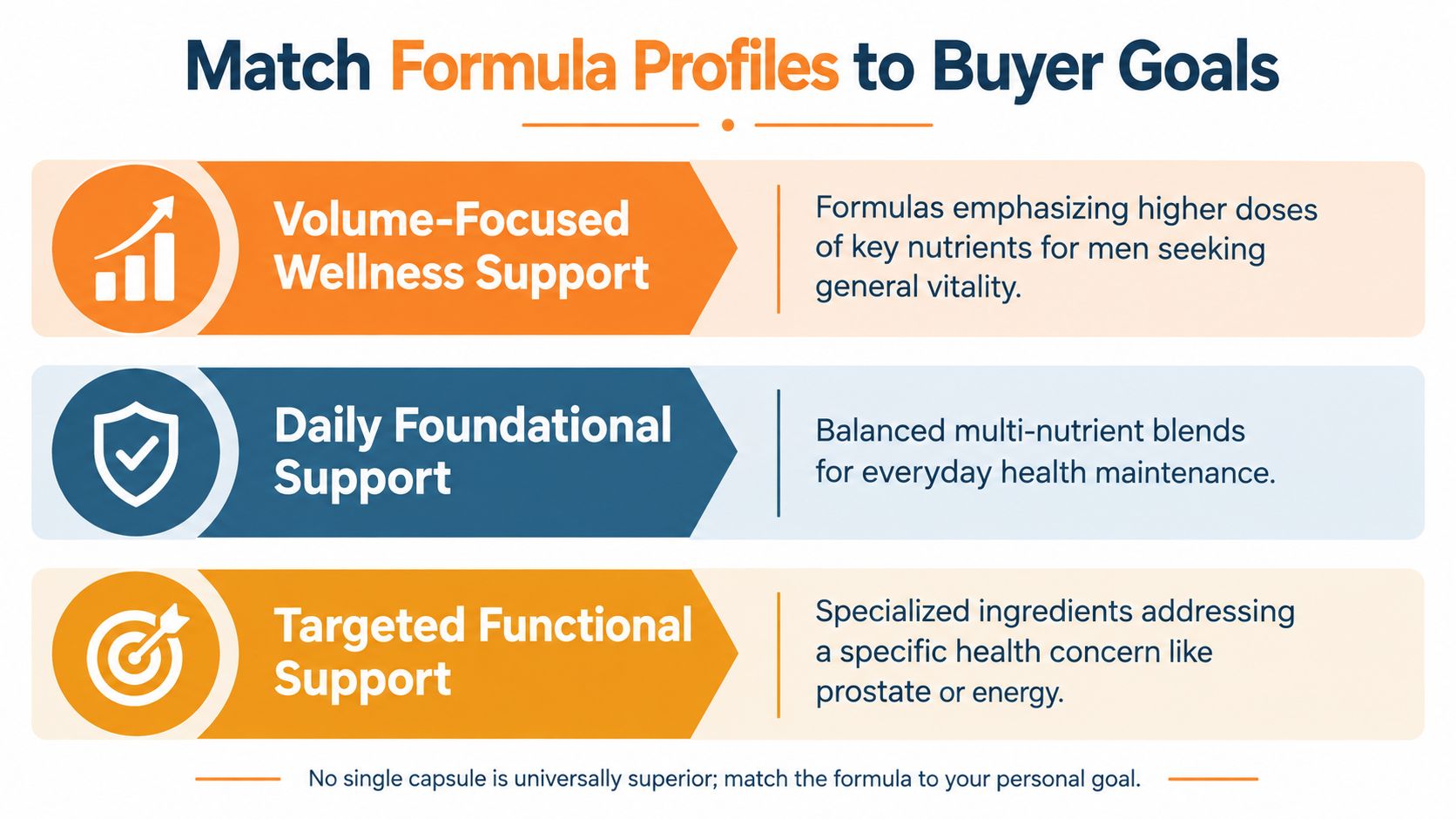
Volume-focused wellness support
If volume is your stated interest, prioritize clearly disclosed amounts for the ingredients the brand positions for that purpose, a serving you can take consistently, and expectations set in support language. Be skeptical of any claim that more fluid proves better sperm health, because those are separate measures. Your risk tolerance should be low for hidden doses, since you can't judge a volume-oriented formula whose relevant amounts are invisible.
Taste-related expectations
This goal demands the strictest evidence standard. An ingredient's association with pineapple or with enzymes isn't evidence about human semen taste. If a brand can't point to research on that exact sensory outcome, treat the expectation as unproven and decide whether you're comfortable buying on that basis. Many buyers aren't, once the gap is stated plainly.
Vitality-oriented botanical support
Buyers drawn to botanicals for general vitality should compare disclosed doses, extract standardization, and how many botanicals are stacked together. More botanicals mean more tolerability and interaction variables, especially alongside medication. A shorter, fully disclosed botanical profile can suit a cautious buyer better than a long blend, even if the blend reads as more thorough.
Manufacturing credentials as the priority
Some men care most about what's verifiable today. If that's you, rank batch-specific testing, published thresholds, adulterant screening, and traceable vegan or non-GMO verification above ingredient novelty. Building personalized supplement plans around your own medications, existing products, and risk tolerance is a better use of time than copying someone else's stack.
Whichever profile fits, hold one line. Persistent concerns about fertility, semen changes, pain, or sexual function belong with a qualified healthcare professional who can measure what's actually happening. A capsule can support normal function as part of a routine. It shouldn't become a reason to delay evaluation when something is persistently wrong, and escalating doses on your own is not a substitute for an answer.
Make a Cautious Final Capsule Choice
Buy, defer, or walk away based on whether the label survived your own audit, not on how confident the front panel sounds.
Buy only when these line up
- Outcome phrased accurately: The claim describes support for normal function and matches the endpoint you named at the start.
- Doses visible: Every active shows an amount per serving, minerals show elemental amounts, and no key ingredient hides in a blend.
- Serving practical: The daily capsule count and directions fit a routine you'll keep consistently.
- Quality verifiable: You can find batch-level testing with methods and limits, not only a facility claim or a badge.
- Safety information clear: Warnings, allergens, and interaction language are present and readable.
Walk away from these patterns
Decline all-in-one products that conceal doses, promise disease treatment or guaranteed bedroom outcomes, or lack credible contaminant and adulterant testing. Be equally wary when natural, vegan, or non-GMO positioning is offered as a substitute for evidence. A 2025 Philippine FDA warning identified undeclared sildenafil citrate in a men's herbal dietary supplement, illustrating why natural or herbal labeling does not by itself establish purity or safety, and undeclared drug ingredients can pose particular risks for people with cardiovascular, kidney, blood-pressure, or stroke-related concerns.
Before starting, review medications and health conditions with a qualified professional, and disclose every supplement you're taking. Avoid duplicating actives across products, watch total mineral intake from all sources, and stop and seek advice if adverse effects persist rather than increasing the dose. Fertility concerns that continue deserve medical evaluation, not a stronger stack.
These statements have not been evaluated by the Food and Drug Administration. This product is not intended to diagnose, treat, cure, or prevent any disease.
If you want a men's health capsule you can audit against the standards above, look at SEMEX and read its ingredient panel, serving directions, and published Eurofins testing thresholds for microbials, heavy metals, and adulterants before you decide. It's vegan, non-GMO, made in the USA in a cGMP-registered facility, and backed by a 90-day money-back guarantee, so you can verify the manufacturing and purchase terms yourself and judge the formula on disclosed ingredients rather than promises.