

Men Strip Poker: Rules, Consent Steps and Hosting Tips
Someone has suggested strip poker for card night, and the group chat is interested. Now you're trying to work out what that means: ordinary poker with a twist, a game of dares, or something nobody has actually agreed to yet.
Keep it ordinary poker. Choose the clothing rules before anyone sits down, offer a nonsexual alternative, and make leaving as easy as joining. A good host doesn't need to guess whether everyone looks comfortable. The host gives everyone clear choices they can change without an argument.
Table of Contents
- How to Play Men Strip Poker Step by Step
- Variations and Clothing Stake Formats Compared
- Consent Checklist to Settle Before the First Deal
- Handling Tilt, Pressure and Discomfort at the Table
- Hosting a Respectful Night for Mixed or Male-Only Groups
- Running Your First Night Without Surprises
How to Play Men Strip Poker Step by Step
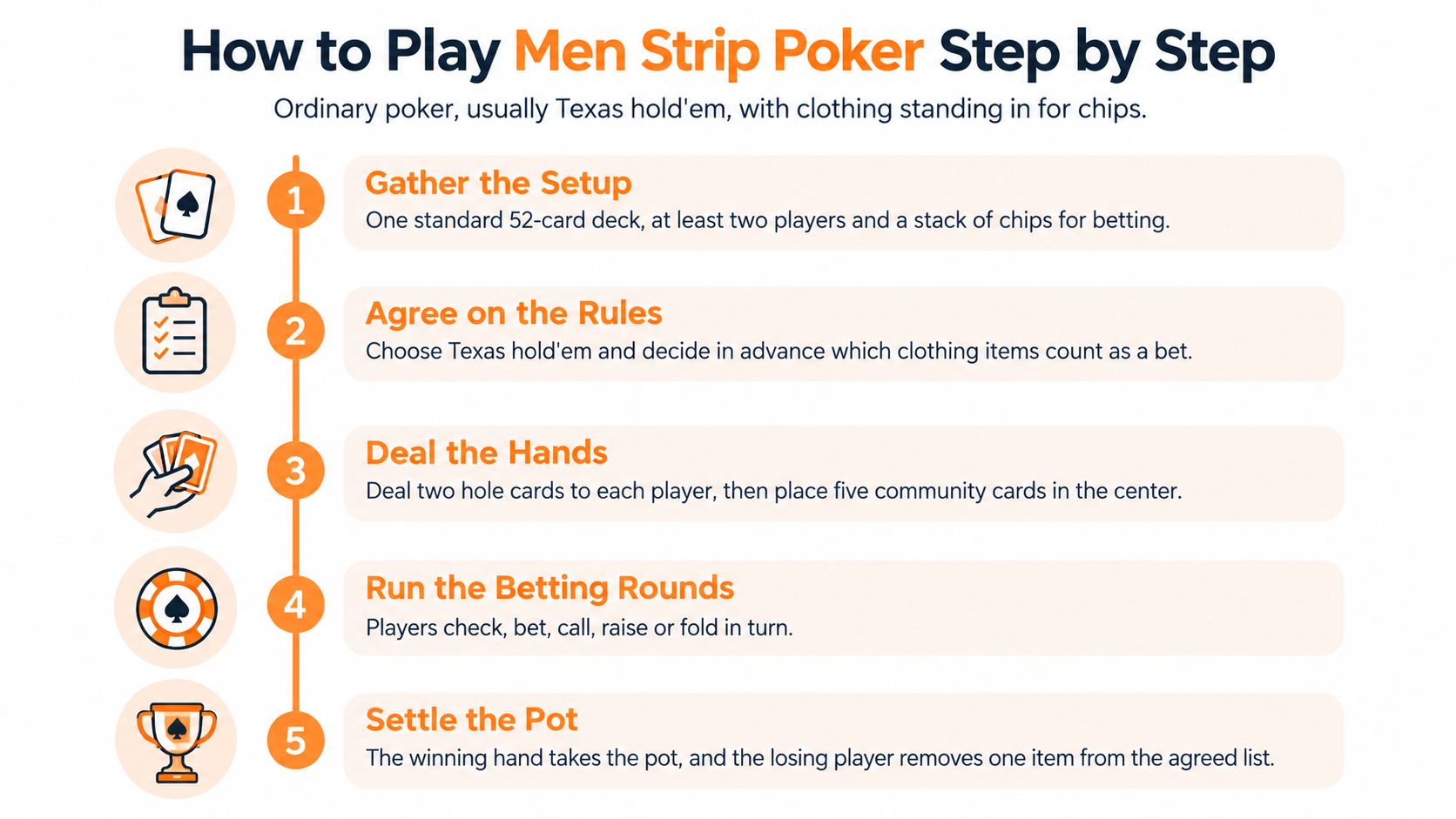
Men strip poker is ordinary poker, usually Texas hold'em, with clothing standing in for chips through a buy-in system. The PokerStrategy hold'em rules describe a format using a standard 52-card deck and at least two players, where removing clothing replenishes an empty chip stack and losing all clothing ends participation.
You'll also need chips for everyone, a dealer button, and a printed rule card. Chips have no cash value, and nobody should put money into the pot.
Set up before dealing
- Confirm the opt-in. Get a spoken agreement from each player after explaining the format, boundaries, and exit option. An invitation accepted in a group chat isn't a substitute for agreement at the table.
- Set equal starting clothing inventories. Count only items each person has volunteered to include, and define whether a pair of socks counts as an item or separate items. Equal inventories prevent someone's wardrobe from becoming an extra advantage.
- Distribute equal chip stacks. For example, you could give everyone 100 chips and use that same amount for each clothing buy-in. Write the amount down so nobody negotiates a better refill after losing.
- Post the blinds and deal the hole cards in normal hold'em order. Deal two private cards to each player, moving clockwise; for heads-up play, the dealer posts the small blind.
- Play the normal betting rounds. Deal the flop, turn, and river in sequence, with betting between them. Players check, bet, call, raise, or fold when permitted, and the best eligible hand wins at showdown.
- When a stack runs out, offer the agreed buy-in. The player may remove an eligible item, use the pre-agreed nonsexual alternative, or stop playing. Losing a pot alone doesn't trigger clothing removal in this format.
- Sit out at the clothing limit. If the agreed format ends participation when no eligible clothing remains, the player leaves the game then. Personal boundaries can end participation earlier; nobody has to reach nudity.
- Log the hand's result on a card. Record the winner, any buy-in, and any disputed ruling, without recording bodies or personal details. This makes it easier to resolve confusion before another hand starts.
Setup by group size
| Players | Deck and dealing | Clothing rule |
|---|---|---|
| 2 players | One 52-card deck; dealer button alternates | Equal items; out at zero clothing |
| 3–4 players | One deck; standard blinds | Equal items; one item per buy-in |
| 5–7 players | One deck; shorter rounds to keep pace | Equal items; player sits out at zero clothing |
Use the visual as an overview of the sequence. For chip buy-in play, follow the written rule above: an empty stack, not every lost hand, triggers the buy-in choice.
The most common hosting slip is changing the buy-in price mid-game. That turns a settled rule into a bargaining session, usually when someone has the least influence.
For a practice target, aim for routine decisions under a minute, while allowing beginners time to ask questions. The better test is whether every player can explain why the winner took the pot.
Variations and Clothing Stake Formats Compared
Clothing stake formats compared
| Format | How clothing is used | Elimination rule | Best for |
|---|---|---|---|
| Hold'em chip buy-in | Clothing buys chips when the stack hits zero | Out at zero clothing | Experienced players who want full poker |
| Equal-chip non-cash format | Chips are non-cash; clothing is the buy-in and penalty | Leaves once no clothing remains | Groups of five to seven wanting a fast game |
| Clothing-only forfeit | Lose one item per lost hand, no chips | Out at zero items | Two players and short sessions |
| Nonsexual penalty swap | Lost hands trade a forfeit card instead of clothing | Never forced to undress | Mixed-comfort groups and couples |
| Layered wardrobe | Several layers each, capped items per round | Out after a set number of items | Groups where pace matters most |
These are house-format choices, not interchangeable rules. Clothing is the stake, so the trigger for removal determines how quickly someone reaches their limit.
Racy Poker's rule summary describes play with two to seven participants, recommends approximately equal removable clothing inventories, and includes a non-cash chip format in which players normally leave once no clothing remains. Treat the group recommendations in the table as hosting choices rather than promises about game speed.
Match the format to the players
Hold'em chip buy-in suits people who want poker decisions to remain the main event. A bad hand costs chips first, giving players room to fold and recover without an immediate clothing consequence.
The equal-chip non-cash format suits a larger table that wants straightforward accounting. It only runs faster if the host also keeps dealing efficient and avoids prolonged arguments over bets.
Clothing-only forfeits suit a short, simple game between people who understand that each lost hand has an immediate consequence. Define what happens when someone folds, because otherwise players may discover different expectations after the cards are down.
The nonsexual penalty swap works when people want the same social activity without the same exposure. Use harmless, prewritten cards, such as taking the next dealing turn; don't replace clothing with humiliating dares, drinking, or physical contact.
Layered wardrobes suit groups that want a predictable pace. Set the removal cap and eligible inventory in advance rather than letting someone add accessories during play.
Consider a hypothetical group of four friends: one arrives in three removable layers while the others have one each. Don't make the less-covered players match that exposure. Agree on a smaller eligible inventory, arrange comparable optional layers, or choose the penalty swap before dealing.
Practical rule: Start with the mildest format your least comfortable player accepts. Consider a stronger format only when everyone independently asks for it, not when the most enthusiastic player campaigns for it.
Consent Checklist to Settle Before the First Deal
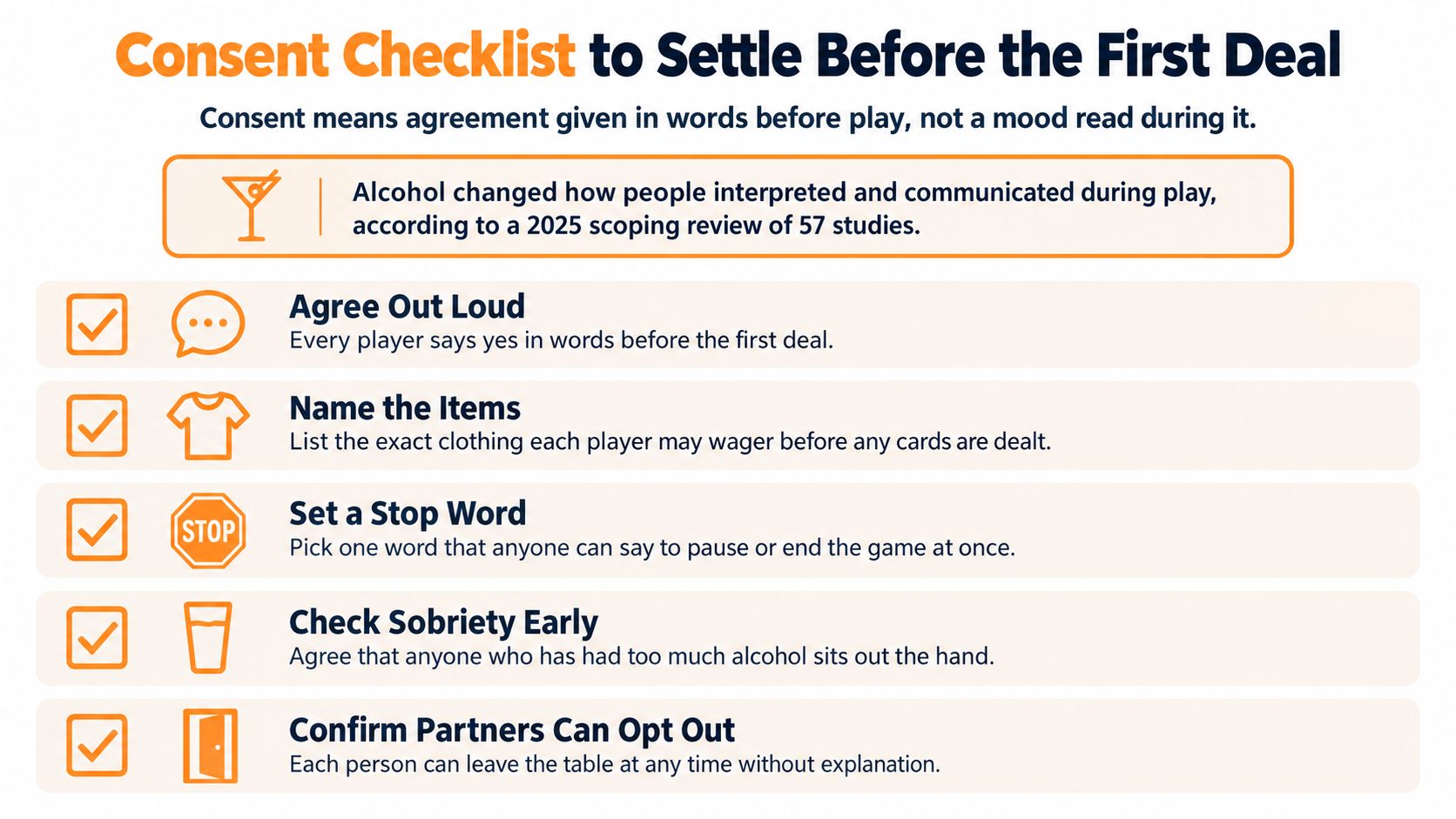
Consent means agreement given in words before play, not a mood read during it. Write the terms on the rule card so players don't have to remember a conversation while everyone watches their next decision.
A 2025 scoping review of 57 studies published in The Journal of Sex Research found that alcohol affects how people interpret and communicate sexual consent; intoxication could increase arousal without increasing comfort, safety, or wantedness. That's a reason to settle terms clearly and stop when anyone's ability to choose becomes uncertain, not a reason to interpret enthusiasm more generously.
Get an answer from each person
- Confirm adult, voluntary participation. Everyone must be an adult who chooses to join. Don't recruit someone into an empty seat through teasing, repeated invitations, or a partner's insistence.
- Let each player name their clothing limit. Shirt and socks only is a complete boundary, not an opening offer. Keep any clothing outside that limit out of the game.
- Separate play from sexual contact. Clothing removal doesn't authorize touching, kissing, or any other sexual activity. Any such agreement must be separate, explicit, and outside the game's reward or penalty system.
- Agree on a stop word or gesture. It ends play immediately, without requiring the person to explain what happened. Choose something easy to say or make while seated.
- Put phones away. No photos, video, or audio recording without explicit permission. Permission to attend isn't permission to create or share a record.
- Set an alcohol limit before serving drinks. Nobody drinks to catch up, and nobody continues participating when their capacity is uncertain. An agreed limit isn't proof that someone remains able to consent.
- Allow consequence-free withdrawal. Anyone may leave without comment, penalty, or a replacement forfeit. Don't turn the departure into a group discussion.
The checklist gives the table a shared reference, but each player's current answer still controls what happens.
Keep permission specific
Winning a hand, flirting, revealing clothing, or leaving the room does not count as yes to anything else. Neither does being someone's partner or having played before.
For couples discussing a new intimate experience, these first-time sex communication tips offer a separate starting point for talking about expectations. Don't use that conversation to make the card game an implied route toward sex.
Written terms protect the fun by removing the need to guess. Playful competition doesn't require erotic escalation.
Re-check agreement after any proposed change in stakes. A new clothing rule, penalty, or participant creates a new decision, and silence doesn't approve it.
Handling Tilt, Pressure and Discomfort at the Table
Set a stop condition before play: a fixed hand count, an agreed clothing threshold, or any consent concern ends the session. Don't extend the game so someone can recover losses or prove they can handle the pressure.
Keep a simple session log alongside it. Record hands played, disputed rulings, opt-outs, and breaks, but leave out explanations for personal boundaries. The point is to identify problems with the format, not build a record of who was uncomfortable.
Respond to behavior without diagnosing the player
The Bristol-hosted study of elite professional online poker players discusses emotionally driven loss-chasing and increased risk-taking after losses. At a social table, the useful response to tilt is to restore the agreed limits and take a break, not offer a larger gamble.
You don't need to decide whether someone is angry, embarrassed, or just tired before intervening. Respond to what they're doing: demanding higher stakes, arguing repeatedly, or struggling to make a voluntary choice.
Live problems, likely causes and first responses
| Problem at the table | Likely cause | First response |
|---|---|---|
| Player goes quiet or hesitates before bets | Discomfort or pressure | Pause the hand and ask a yes-or-no check-in |
| Someone wants to double the clothing stake | Tilt after losses | End the round and return to the agreed limits |
| A player seems drunk or slurring | Intoxication impairs agreement | Stop removing items and end play for that person |
| Argument over a ruling | Unclear rule | Read the rule card aloud, rule once, move on |
| Someone asks to film or photograph | Boundary breach | End the game for the night and treat it as a withdrawal |
| A player wants out for any reason | Changed comfort | Let them leave without comment and keep the others playing |
For the recording row, announce beforehand that a filming request ends this particular game. That conservative house rule prevents an on-the-spot vote in which someone might agree just to avoid disappointing friends. If someone records anyway, stop immediately and address the unauthorized recording rather than continuing to deal.
A disputed ruling needs a different response. Explain the decision neutrally, and if the rule card genuinely doesn't answer the question, cancel the disputed consequence rather than inventing a harsher rule after the loss.
Use the log after everyone has dressed and the game is over. If the same confusion keeps appearing, change the format next time instead of blaming the person who raised it.
The same distinction matters in conversations about relationship satisfaction: participation isn't an obligation to reassure a partner by continuing. Accept the answer without asking the person to demonstrate that they're still having fun.
A player who hesitates before every bet may be uncomfortable rather than strategic. Pause before the next deal and ask, “Do you want to continue with these rules?” Anything unclear means the game stays paused.
Hosting a Respectful Night for Mixed or Male-Only Groups
Say you're hosting a bachelor party at a friend's home. The groom likes the idea of strip poker, but the guests include close friends, newer acquaintances, and someone who only expected dinner. The invitation needs to explain the activity plainly and offer a genuine alternative, not reveal the plan after everyone arrives.
The groom shouldn't set the stakes. Choose a host who can enforce boundaries without treating participation as a tribute to the guest of honor.
Keep the host's job separate from winning
Give the host practical duties:
- Deal consistently. Keep the button moving and explain whose action comes next.
- Apply the written rules. Don't let a loud player negotiate exceptions.
- Watch the clock. Call breaks and finish at the announced time.
- Watch the room. Notice withdrawal, side conversations, or joking that targets a particular player.
Consider a hypothetical 40-minute round that stretches to 90 minutes because the host lets a joke become a dare. The mistake isn't slow poker; it's allowing the activity to change without a fresh agreement. At the break, cancel the dare, reset the original terms, and ask privately whether each person wants to resume.
A comfortable venue supports that reset. Use a private home with a closed door, not a public bar or a shared room where uninvited people wander through.
Adjust the invitation to the group
For a couples' night, decide whether partners will play against each other and make sure either person can sit out independently. For friends, invite people who can decline without risking their place in the group.
Male-only and mixed groups need the same clarity. Gender composition doesn't tell you anyone's orientation, boundaries, or interest in sexual play. A discussion of different sexual styles belongs in a private conversation, not in assumptions made around the table.
Spectators must accept the same privacy rules as players. They don't comment on bodies, pressure bets, or relay events to a group chat involving people who never agreed to attend.
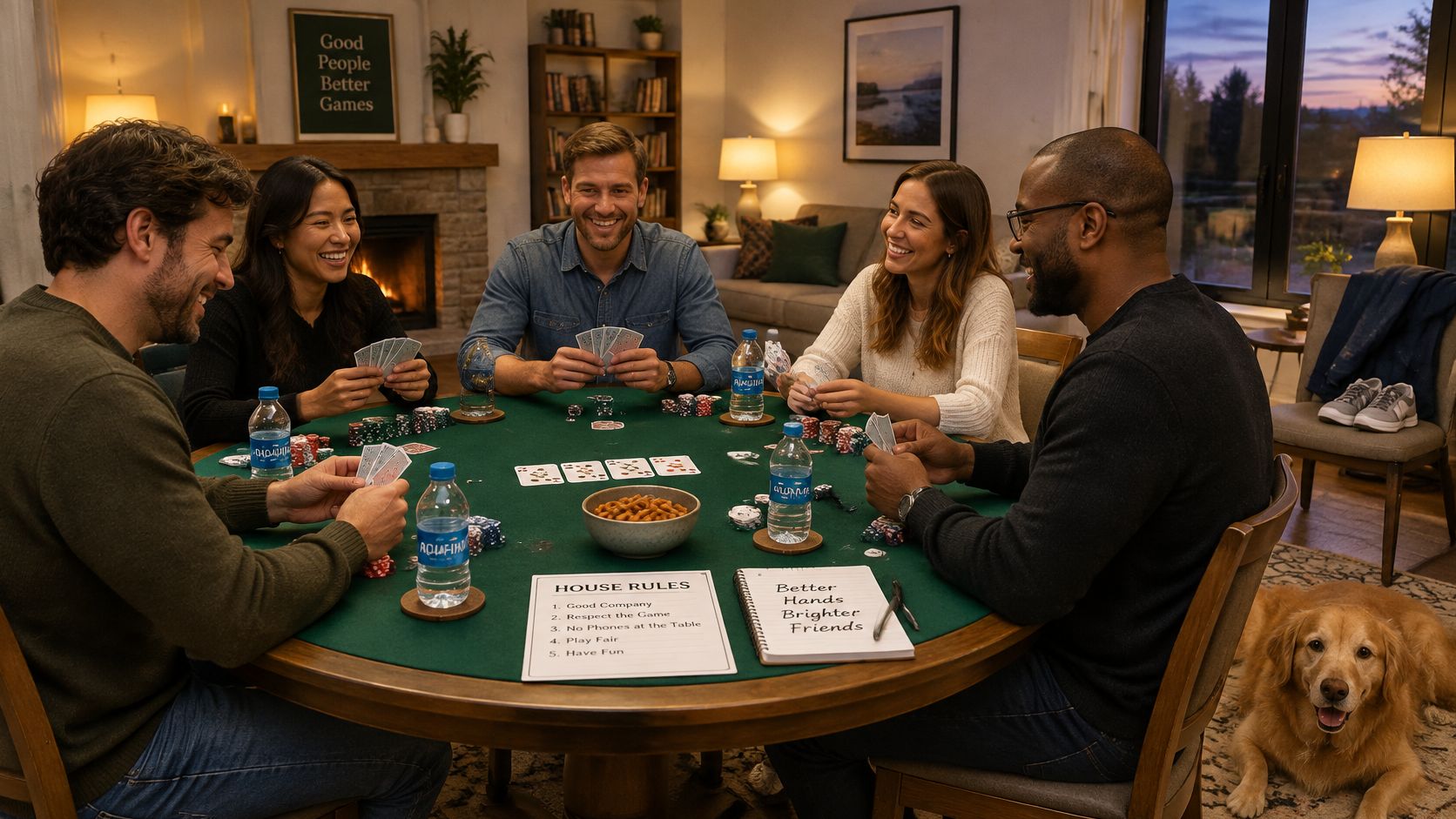
For a sample schedule, reserve a two-to-three-hour window including food, the rules discussion, breaks, and cleanup. Keep water available, put snacks away from the cards, and choose an end time before fatigue turns routine decisions into arguments.
Running Your First Night Without Surprises
Make the first event easy to understand and easy to stop. You're testing whether the group enjoys the format, not whether anyone can tolerate more exposure than expected.
A successful trial gives you useful answers even if the table switches to ordinary poker. Nobody needs to complete the clothing format for the evening to count.
Use a weekend trial plan
- Choose a format and print the rule card. Include the betting structure, eligible clothing inventory, refill rule, alternative penalty, and exit procedure. Read it aloud yourself before sending invitations; if you can't explain a consequence plainly, simplify it.
- Send a direct invitation. Say that participation is opt-in, spectators must follow privacy rules, and anyone can sit out. Offer ordinary cards or another activity without making the alternative sound like a consolation prize.
- Run a chip-only rehearsal. For example, use a 20-minute dry run to test the blinds, dealing order, and refill procedure. Explain clothing consequences verbally without applying them, so beginners can learn without exposure attached to mistakes.
- Hold the consent huddle before switching formats. Get individual answers, settle the stopping condition, and write the hand count on the rule card. Don't start while someone is still trying to understand what their agreement covers.
- Debrief after play. For example, reserve five minutes to ask what felt fun, what felt pushy, and what should change. Let people answer privately later if they prefer, and don't require them to justify a boundary in front of friends.
Judge the evening by the exits
The success test is whether everyone left on their own terms and would willingly choose to play again. Someone declining another session isn't a failure to overcome; it's useful information about what suits that person.
If partners want a different kind of novelty afterward, discuss bedroom role-play ideas separately. Don't turn a successful card night into permission for a new activity.
Keep the next invitation just as explicit as the first. Familiarity can make people skip the conversation, even when their comfort or circumstances have changed.
Terms set in advance are what keep the game playful. The host's job is to make those terms dependable, not to make the night more daring.
SEMEX offers a daily men's dietary supplement formulated to support semen volume and improve taste, alongside educational content about intimacy and communication. If you're exploring personal wellness alongside shared experiences, visit SEMEX to review the formula and decide whether it fits your routine; it has no role in anyone's consent or willingness to participate.
These statements have not been evaluated by the Food and Drug Administration. This product is not intended to diagnose, treat, cure, or prevent any disease.