

Man with a Boner
An erection is a hydraulic event driven by blood flow and nitric oxide, not just a sexual reaction. A commonly cited average erect penis measures about 5.1 inches, or roughly 13 centimeters, in length, with an average erect girth of about 4.6 inches, while occasional erections throughout the day can reflect healthy vascular and nervous-system function.
A man with a boner may be standing in a changing room, waking from sleep, sitting through a meeting, or feeling sexual excitement with a partner. The timing can feel awkward, but the event itself is usually ordinary biology rather than a sign that something is wrong. An erection can appear because of touch, thoughts, sleep-related nervous-system activity, or no obvious conscious trigger.
The useful question isn't whether every erection follows a sexual script. It's whether the body can regulate blood flow, respond to nerve signals, become firm when appropriate, and return to a relaxed state. That perspective replaces shame with observation and helps separate normal variation from a pattern worth discussing with a healthcare professional.
Table of Contents
- Understanding the Male Erection
- The Biology Behind the Boner
- The Role of Blood Flow and Nitric Oxide
- Why Erections Happen Spontaneously
- Erection Myths and Realities
- When to Seek Medical Advice
- Supporting Long-Term Vascular Health
Understanding the Male Erection
The phrase “man with a boner” sounds casual, but the physiology behind it is precise. An erection depends on the brain, nerves, blood vessels, smooth muscle, and connective tissue working together. Sexual arousal can start the process, yet conscious desire isn't required for every erection.
An ordinary body response
A spontaneous erection doesn't automatically reveal what a person wants, what they were thinking, or how they feel about someone nearby. Physical contact may trigger a reflex response. Emotional stimulation may activate brain-to-nerve signals. Sleep can also create erections without a dream or deliberate arousal.
That distinction matters because many men interpret an unexpected erection as evidence of abnormal behavior or hidden intent. In most cases, it's the body changing blood flow in erectile tissue. The event may be inconvenient, but embarrassment doesn't make it medically unusual.
The penis also belongs in the broader context of male anatomy. A clear overview of the male reproductive system and its functions can help place erections alongside the testes, prostate, glands, ducts, and other structures involved in reproduction and sexual function.
Practical rule: An erection is a physical response, not a statement of character, consent, attraction, or intention.
Why the response matters
Erectile function offers a limited but useful window into vascular and nervous-system performance. The penis needs an adequate blood supply and coordinated nerve signaling, so changes can sometimes accompany broader health concerns. Still, one weaker erection or one unexpected erection doesn't provide a diagnosis.
The more helpful approach is to notice patterns. A person can ask whether erections occur during sleep, whether they respond to stimulation, whether firmness changes with stress or fatigue, and whether any difficulty persists. Those observations give a clinician more useful information than comparisons with pornography, locker-room stories, or online claims.
The Biology Behind the Boner
The erect penis behaves like a dynamic hydraulic structure. Three erectile bodies fill with blood under pressure: the paired corpora cavernosa and the corpus spongiosum. A strong connective-tissue layer called the tunica albuginea surrounds the erectile chambers, helping contain pressure and support firmness.
A hydraulic process in plain language
The corpora cavernosa work like expandable chambers. Nerve signals and chemical messengers relax smooth muscle in their walls, allowing penile arteries to deliver blood into spaces within the erectile tissue. As those spaces fill and enlarge, internal pressure rises, lifting the penis into an erect position.
The corpus spongiosum surrounds the urethra and extends into the glans. It also becomes engorged, while its structure helps keep the urethral passage from closing completely. As the erectile tissue expands, the tunica albuginea compresses veins that would otherwise carry blood away. Blood therefore stays within the tissue long enough to maintain rigidity.
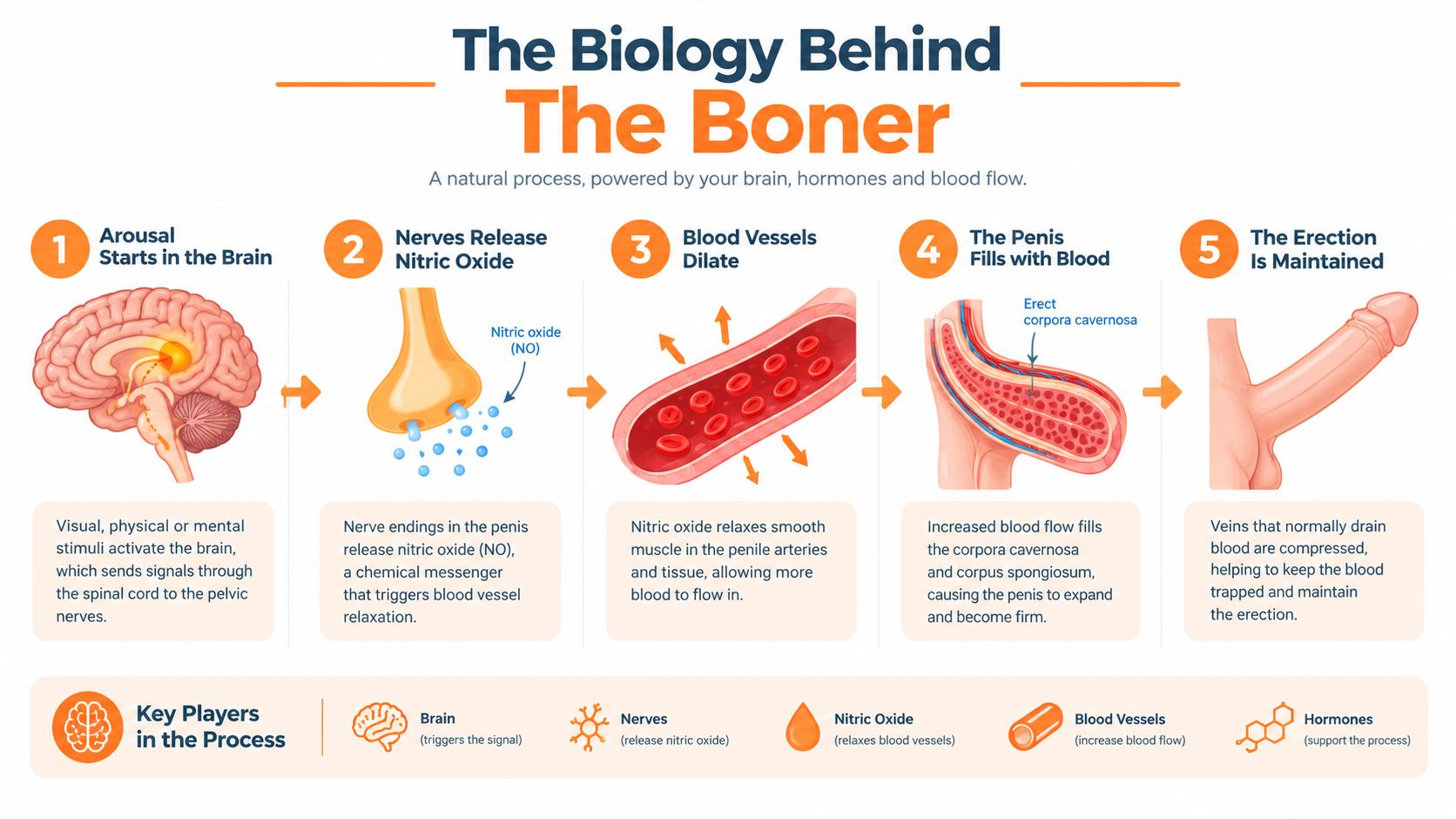
During an erection, blood flow raises intracavernous pressure to about 100 mm Hg, while oxygen tension reaches around 90 mm Hg. These figures come from StatPearls' clinical overview of penile erection physiology. Together, pressure and oxygen changes transform the penis from soft and flexible tissue into a firmer structure.
Why firmness can change
An erection changes continuously rather than following a simple on-off pattern. Blood inflow, venous drainage, nerve activity, attention, stress, temperature, and touch can all shift the balance. If smooth-muscle relaxation decreases or sympathetic stress signals become stronger, the chambers may retain less blood and firmness can fade.
Fluctuation alone does not establish disease. Partial and full erections can occur during ordinary daily life, while changes across sleep, stress, or stimulation may reflect normal physiology. The hydraulic model helps explain these shifts and also gives erections value as a limited barometer of vascular and nervous-system function. Persistent changes deserve attention, while an isolated variation usually does not indicate a medical problem.
The Role of Blood Flow and Nitric Oxide
Nitric oxide, usually shortened to NO, is one of the central chemical signals in erection physiology. Nerves and endothelial cells in the corpora cavernosa release NO, which activates soluble guanylyl cyclase inside smooth-muscle cells. That raises cGMP, lowers intracellular calcium, and relaxes the smooth muscle that controls arterial filling.
The sequence resembles opening a set of flexible valves. Relaxed smooth muscle allows more blood to enter the erectile tissue. At the same time, expanding tissue presses veins against the tunica albuginea, reducing outflow. Rigidity develops when inflow exceeds outflow, not because the penis contains a muscle that becomes stronger.
The L-arginine connection
The body uses the amino acid L-arginine as a substrate for nitric oxide synthesis through endothelial nitric oxide synthase, or eNOS. The review of nitric oxide and erectile physiology describes how this pathway supports cavernosal relaxation and how impaired signaling can shift the balance toward weaker arterial filling.
Human research has also examined L-arginine in vascular contexts. In a randomized, double-blind, placebo-controlled study of patients with heart failure, oral supplemental L-arginine increased forearm blood flow during exercise from 5.1±2.8 to 6.6±3.4 mL·min, while another human study found concentration-dependent vasodilation in healthy subjects, with the effect attributed to nitric oxide pathways, as reported in Circulation.
This evidence describes an ingredient and a biological pathway, not a guarantee about an individual erection. Supplements also aren't substitutes for evaluation when erectile changes persist.
Why circulation deserves attention
Because erections rely on vascular integrity, erectile changes can deserve the same calm attention as other circulation-related symptoms. High stress, smoking, medication effects, metabolic problems, and cardiovascular conditions can all influence the systems involved. A clinician can assess the whole context instead of treating the penis as an isolated organ.
More detail on the chemical pathway appears in this guide to nitric oxide and blood flow.
Why Erections Happen Spontaneously
A person may wake with an erection, experience one after incidental contact, or notice one while thinking about something unrelated to sex. These events can seem random because the conscious mind doesn't always receive the signal that initiated them.
Reflexes, thoughts, and sleep
A reflexogenic erection begins with physical stimulation. Touch activates sensory nerves, which send signals through spinal pathways and the autonomic nervous system. The response can happen quickly and may not match the person's conscious mood.
A psychogenic erection begins with thoughts, memories, emotions, or visual stimulation. The brain sends signals through autonomic nerves to influence penile blood vessels. Anxiety can interfere with that process, but ordinary excitement can support it.
Sleep-related erections belong to a different category. Clinical sources refer to them as nocturnal penile tumescence, and a morning erection is often the last sleep-related erection noticed after waking. The clinical explanation from Cleveland Clinic notes that erections can last from a few minutes to a few hours, depending on the circumstances.
A normal interruption
A commuter who notices an erection during a crowded train ride hasn't necessarily experienced sexual desire toward anyone nearby. A student who wakes with one hasn't necessarily had a sexual dream. A partner who loses firmness while distracted hasn't necessarily lost attraction.
Those examples show why context matters. The body responds to nerves, sleep, blood flow, and attention, while the mind tries to assign a story afterward. A practical guide to the different types of boners can help readers compare these patterns without treating every event as a psychological message.
Erection Myths and Realities
A person may compare erection size, duration, or frequency with online claims and conclude that something is wrong. Clinical physiology supports a calmer interpretation. Wide normal variation is expected, and one measurement or episode says little about sexual health on its own. Erections can also serve as a useful physiological barometer: a persistent change may reflect broader vascular health, while occasional variation is usually part of normal biology.
Size isn't a performance score
A commonly cited anatomical measurement places average erect length at about 5.1 inches, or roughly 13 centimeters, with average erect girth at about 4.6 inches, according to Cleveland Clinic's overview of erections. These population averages are reference points, not requirements. They do not predict a person's ability to experience pleasure, communicate with a partner, or have satisfying sexual activity.
Erect volume can increase roughly threefold from flaccid volume, with a reported range of 1.7 to 5 times. Flaccid appearance changes with temperature, stress, exercise, and muscle tone, so a soft measurement cannot reliably forecast erect size.
Duration has no single target
Erections may last from a few minutes to a few hours, depending on the circumstances. During intercourse, the average time before ejaculation is about seven minutes, but an average is not a target for every couple. Timing varies, and firmness may rise or fall during stimulation.
The WebMD explanation of how an erection occurs describes why casual comparisons can mislead. A normal range is broader than many online discussions suggest.
Frequency varies too
Morning erections, spontaneous erections, and erections during partnered sex do not follow a universal schedule. More frequent erections are not automatically healthier, and fewer erections are not automatically a disorder. A noticeable, persistent change matters more than counting isolated events, particularly because erection patterns can offer clues about circulation and overall vascular health.
When to Seek Medical Advice
An erection may be less reliable after a sleepless night, during stress, or when attention is divided by relationship tension. An isolated change usually reflects the circumstances. A repeated change deserves attention, particularly if it affects sexual activity or causes distress.
Three patterns to distinguish
Normal variation includes an erection that appears unexpectedly, shifts in firmness, or fades when stimulation stops. Occasional difficulty during a tiring or stressful period can also fall within normal variation.
Situational difficulty follows a recognizable setting. Someone may have erections during sleep or while alone but struggle with a new partner, performance pressure, or intense anxiety. The nervous system responds to emotional context much like a traffic signal responding to changing conditions. Support, not ridicule, is the appropriate response.
Persistent erectile dysfunction means a consistent difficulty getting or keeping an erection. Clinical guidance defines ED as a consistent problem lasting more than three months, as summarized in a clinical review or guidance source. A healthcare professional must assess the cause, which may involve circulation, nerves, hormones, medications, or emotional factors.
A prolonged erection is different
A prolonged, painful erection that does not resolve may be priapism, a medical emergency requiring urgent care. Do not wait indefinitely, search for home remedies, or take more sexual-enhancement products.
A healthcare visit is not an admission of failure. It checks the blood vessels, nerves, hormones, medications, and emotional factors that may be involved.
Arrange an evaluation when erectile changes persist, worsen, occur with pain or curvature, or appear alongside other health concerns. A clinician can review symptoms and medications, perform an examination, and decide whether testing is appropriate. An erection can act as a barometer of vascular health, so a lasting change deserves a clear explanation.
Supporting Long-Term Vascular Health
An erection begins with circulation, so long-term sexual function benefits from the same habits that support vascular health. Regular physical activity, balanced nutrition, adequate sleep, stress management, and avoiding tobacco can all help maintain the systems involved in blood-vessel function. These habits support the body broadly rather than promising a specific sexual result.
Food and ingredients have defined roles
L-arginine contributes to the nitric oxide pathway described earlier. That doesn't mean every product containing it will produce the same response, or that it should replace medical care. The relevant question is whether a person understands the ingredient, the evidence, possible interactions, and the limits of supplement claims.
Zinc has a separate reproductive-health role. A review in the medical literature on zinc and male reproduction reports that one study found zinc supplementation significantly increased semen volume, sperm motility, and the percentage of normal sperm morphology in infertile males. The same review describes positive effects on semen parameters including motility, morphology, and sperm count. These findings concern zinc research and shouldn't be presented as proof that a particular supplement treats infertility or any other condition.
SEMEX is a dietary supplement formulated with Zinc, L-Arginine, Sunflower Lecithin, Bromelain, Maca Root, Panax Ginseng, Ashwagandha, Tongkat Ali, Saw Palmetto, and Horny Goat Weed. It's described as supporting semen volume, taste, and overall male vitality, but it isn't a drug or a treatment for erectile dysfunction.
A practical health routine
A man monitoring erectile health can keep the process simple:
- Track patterns, not isolated moments: Note persistent changes in firmness, sleep-related erections, desire, medications, stress, and fatigue.
- Support circulation daily: Choose regular movement and a balanced eating pattern instead of relying on a last-minute product.
- Review supplements carefully: Check labels, avoid unsupported promises, and discuss possible interactions with a qualified healthcare professional.
- Act on lasting changes: Persistent erectile difficulty deserves assessment, even when embarrassment makes the conversation uncomfortable.
The strongest long-term strategy is not chasing a particular image of a man with a boner. It's maintaining the cardiovascular, nervous, hormonal, and emotional health that allows the body to respond naturally.
Supplement reminder: Structure/function language describes support for normal body functions. It doesn't establish that a product diagnoses, treats, cures, or prevents disease.
SEMEX offers a daily men's supplement focused on semen volume, taste, and ingredient-based support for male wellness, including Zinc and L-Arginine. Men interested in exploring its formula can visit SEMEX and review the product details before deciding whether it fits their routine.
These statements have not been evaluated by the Food and Drug Administration. This product is not intended to diagnose, treat, cure, or prevent any disease.