

Male Libido Supplement: What It Is and What to Know
The most popular advice about a male libido supplement is often the least useful: choose a formula that promises everything at once. Desire, erection quality, semen volume, and testosterone aren't interchangeable outcomes, so an ingredient associated with one shouldn't automatically be presented as evidence for all four.
A clearer approach starts with the endpoint. A man who wants more sexual interest needs a different evidence discussion from someone focused on blood flow, ejaculate volume, or a laboratory testosterone result. The product label, research, and safety questions should all be judged against that specific goal.
Table of Contents
- What a Male Libido Supplement Actually Is
- The Core Ingredients Most Formulas Share
- What the Research Actually Shows by Ingredient
- How to Read a Male Libido Supplement Label
- Dosing Patterns, Onset, and Safety Considerations
- Why These Products Support Rather Than Treat
- Putting It All Together Before You Buy
What a Male Libido Supplement Actually Is
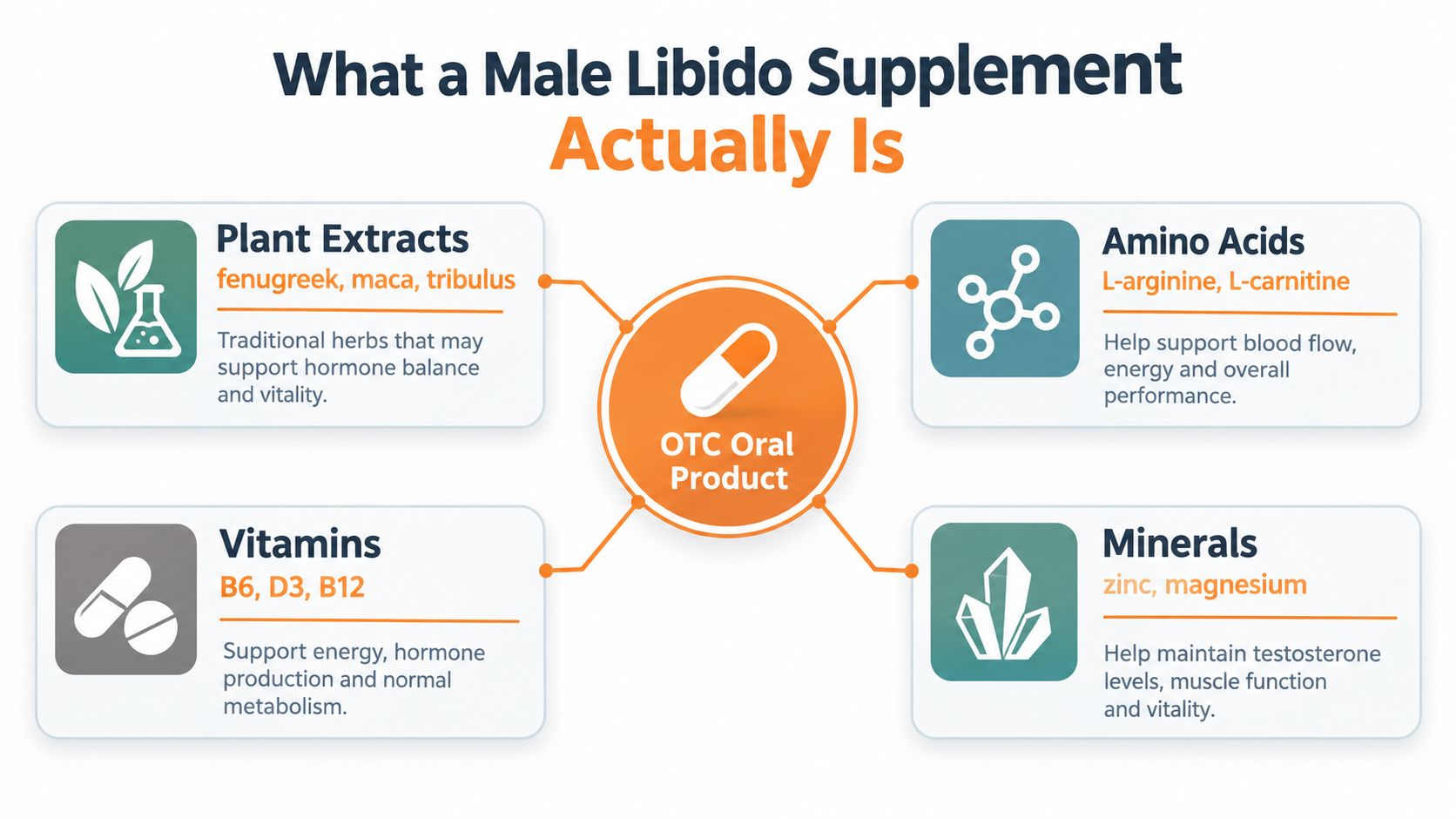
A male libido supplement is an over-the-counter oral product, commonly sold as capsules or powder blends. Its ingredients may include plant extracts, amino acids, vitamins, and minerals marketed to support aspects of sexual desire, performance, vitality, or reproductive wellness. It isn't a prescription drug, hormone replacement, or treatment for a diagnosed sexual or hormonal condition.
The phrase becomes confusing because many products target four different outcomes:
- Subjective desire means the mental or emotional interest in sexual activity. Stress, mood, sleep, relationships, and general health can all affect it.
- Erectile function concerns the vascular ability to get and maintain an erection. This is closely tied to blood flow and nitric oxide biology, not only to testosterone.
- Ejaculate or semen volume is a physical fluid measurement. It can be discussed alongside fertility, but it isn't a direct measurement of desire, virility, or erection quality.
- Serum testosterone is a hormone reading from a blood test. A supplement marketed for vitality can't establish a testosterone change without appropriate testing.
Why the distinction matters
A label may list zinc, L-arginine, maca, and several herbal extracts under one broad promise. That doesn't mean every ingredient has been studied for the same endpoint. Zinc is tied most clearly to nutrient sufficiency and reproductive functions, while L-arginine is tied to nitric oxide and blood-flow physiology. Those pathways shouldn't be converted into an automatic claim about desire or testosterone.
The same caution applies to visible results. More semen volume doesn't prove stronger libido, and an erection supported by improved circulation doesn't prove a hormone imbalance has changed. Readers can make better decisions by asking one question first: Which outcome is the product meant to support?
Practical rule: Match the ingredient to the endpoint before judging the promise.
This framework also helps separate support from treatment. A supplement may contribute to normal body functions, but persistent changes in desire, erections, or energy can deserve professional evaluation rather than a larger ingredient stack.
The Core Ingredients Most Formulas Share
Most formulas combine ingredients from several families instead of relying on one pathway. Maca root, or Lepidium meyenii, is generally positioned around subjective desire and sexual interest rather than a confirmed hormone increase. Panax ginseng, often called Asian red ginseng, is commonly included because ginsenosides are associated with nitric oxide biology and vascular function.
Tongkat ali, or Eurycoma longifolia, is usually marketed around stress, vitality, and testosterone-related support. Ashwagandha, or Withania somnifera, sits closer to stress regulation and recovery. These are proposed pathways, not permission to claim that a finished product changes hormones or treats a condition.
Horny goat weed, or Epimedium, contains icariin, a flavonoid studied for its influence on pathways related to PDE5. That mechanism is why it appears in performance formulas, although a plausible mechanism isn't the same as strong human evidence. Tribulus terrestris is also common, despite limited support for improving libido or testosterone in healthy men.
Nitric oxide precursors form another major group. L-arginine is the direct precursor to nitric oxide, while L-citrulline can contribute to arginine availability through the body's metabolic pathway. Their clearest proposed role is blood-flow support, so they map more naturally to erection quality than to subjective desire or semen volume.
Micronutrients fill a different role. Zinc is an essential mineral involved in sperm formation, and folate depends on zinc to help form sperm DNA, as described by the National Institutes of Health. Vitamin D and B vitamins may help address nutritional gaps, but a label shouldn't turn general nutritional support into a guaranteed testosterone or libido result.
| Ingredient | Primary pathway | Endpoint it targets |
|---|---|---|
| Maca | Central desire and sexual-interest pathways | Subjective desire |
| Panax ginseng | Nitric oxide and vascular support | Erection quality |
| Tongkat ali | Stress and testosterone-related support | Vitality and hormone-related drive |
| Ashwagandha | Stress, recovery, and cortisol-related pathways | Well-being, desire, and reproductive markers |
| Horny goat weed | Icariin and PDE5-related signaling | Proposed erection support |
| Tribulus terrestris | Traditional vitality positioning | Evidence for libido and testosterone is limited |
| L-arginine | Nitric oxide precursor | Blood-flow-dependent erection quality |
| L-citrulline | Supports arginine availability | Blood-flow-dependent erection quality |
| Zinc | Sperm formation and micronutrient sufficiency | Reproductive function and deficiency support |
| Vitamin D and B vitamins | General nutritional pathways | Nutrient status and vitality |
A product comparison should therefore begin with the male enhancement ingredients explained by endpoint, not with the longest ingredient list. More ingredients can mean more proposed pathways, but it can also make dosing, interactions, and attribution harder to understand.
What the Research Actually Shows by Ingredient
The evidence is more useful when each ingredient is judged against the outcome it measured. Independent reviews identify some randomized trial support for Panax ginseng, L-arginine, tongkat ali, and Tribulus terrestris, but the strength and consistency vary by ingredient and endpoint. Zinc is widely used, yet it has little evidence for improving sexual performance in men whose baseline zinc status is normal, as summarized in the Journal of Sexual Medicine review.
Maca has small human trials suggesting modest changes in self-reported desire that aren't necessarily explained by testosterone. That makes it more relevant to how a person feels than to a laboratory hormone result. Ginseng has human evidence related to erectile function, although study limitations mean it shouldn't be presented as equivalent to a prescription treatment.
Tongkat ali has shown promise in selected groups, particularly where stress and baseline well-being may influence sexual function. The results are heterogeneous, so a modest finding in a specific population shouldn't become a universal promise. Ashwagandha has stronger support around stress, recovery, and some sperm-related measures than around libido alone. The evidence on ashwagandha for men's health should therefore be read by endpoint rather than by marketing category.
Horny goat weed is a good example of the gap between mechanism and outcome. Icariin has promising preclinical activity, but human evidence at ordinary supplement doses remains limited. Tribulus appears frequently in formulas, yet human evidence for meaningful testosterone or libido changes in healthy men is weak.
L-arginine has a measurable physiological rationale, but that doesn't guarantee a consistent clinical result. In a healthy-human study, intravenous infusion of 30 g L-arginine reduced blood pressure by 4.4±1.4% and total peripheral resistance by 10.4±3.6%, while 6 g doses didn't produce significant changes in the cited review. A separate meta-analysis found no overall improvement in blood-flow markers among people with cardiovascular or metabolic disorders, with a standardized mean difference of 0.30, 95% CI −0.85 to 1.46, in the same source. This supports cautious blood-flow language, not a direct libido claim.
| Ingredient | Evidence strength | Best-supported endpoint | Key caveat |
|---|---|---|---|
| Maca | Limited to moderate | Self-reported desire | Small studies and subjective outcomes |
| Panax ginseng | Some randomized support | Erectile function | Blinding and sample-size limitations |
| Tongkat ali | Preliminary | Stress-related well-being and hormone-related markers | High heterogeneity |
| Ashwagandha | More support for stress and reproductive markers | Stress, recovery, and selected sperm measures | Libido evidence is less direct |
| Horny goat weed | Limited human evidence | Proposed erection pathway | Preclinical findings don't establish human benefit |
| Tribulus terrestris | Weak or inconsistent | No reliable healthy-men endpoint | Common marketing exceeds evidence |
| L-arginine | Mixed | Blood-flow physiology and selected erectile measures | Dose and population matter |
| Zinc | Stronger for deficiency-related reproductive roles | Sperm formation and nutrient sufficiency | Doesn't establish a universal performance effect |
The 2016 meta-analysis in Scientific Reports pooled 20 studies with 2,600 infertile cases and 867 controls. It found lower seminal zinc concentrations in infertile men than in controls, with a standardized mean difference of −0.64, 95% CI −1.01 to −0.28, and associated zinc supplementation with improvements in semen volume, sperm motility, and normal sperm morphology, with standardized mean differences of −0.99, −1.82, and −0.75, respectively according to the meta-analysis. The same source also describes a U.S. NIH-linked trial of 2,370 couples in which zinc plus folic acid produced 34% live births versus 35% with placebo, without significant improvement in live births, sperm counts, or sperm function. The lesson is precise ingredient wording, not a universal fertility promise.
How to Read a Male Libido Supplement Label
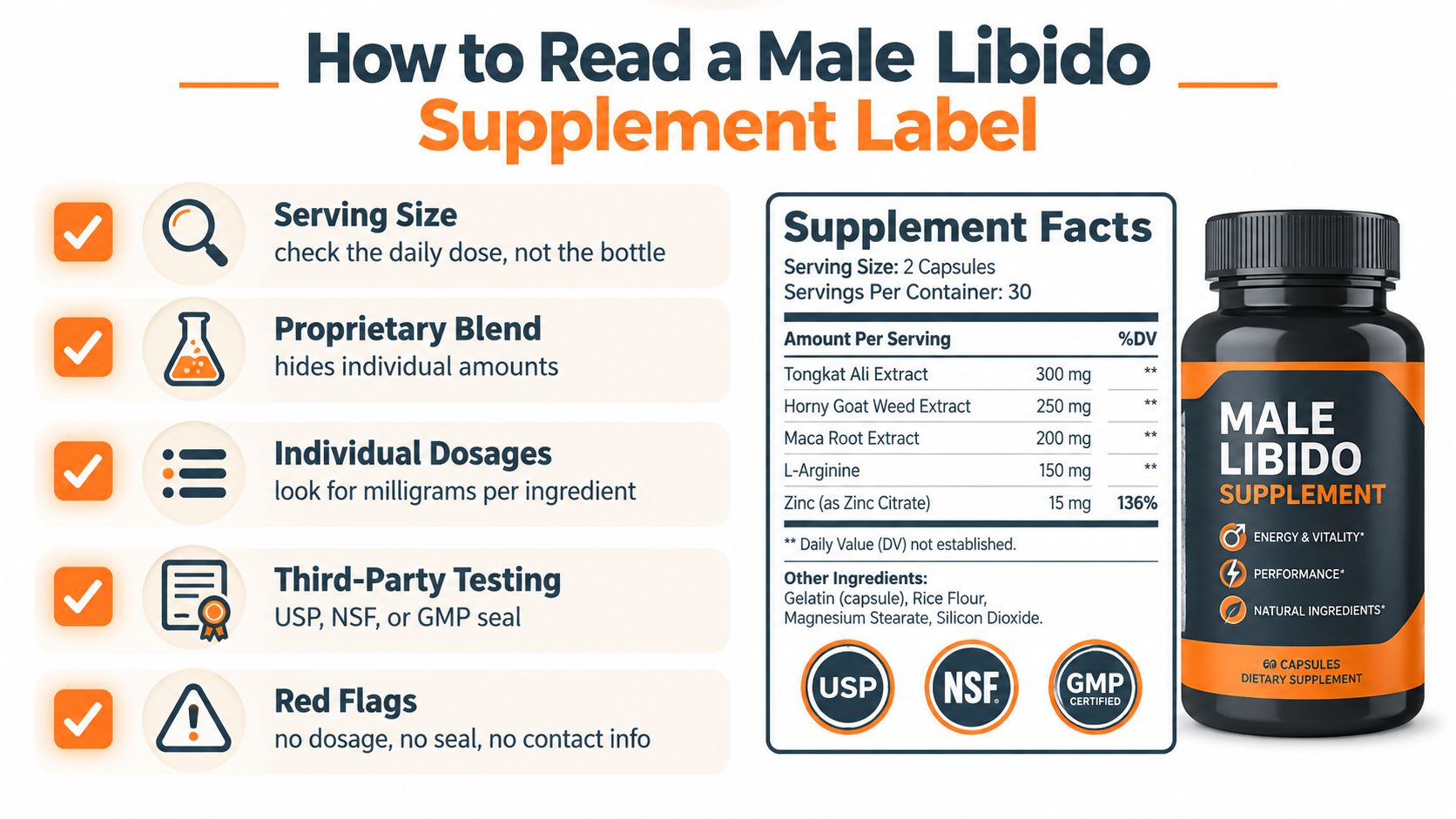
A credible label should answer basic questions before a buyer considers the product. Start with the serving size, then calculate how many capsules or scoops provide that serving. A bottle's capsule count doesn't reveal the actual daily intake.
The facts panel
A transparent Supplement Facts panel lists each ingredient and its amount per serving. A proprietary blend may disclose only the combined weight, leaving readers unable to tell whether a named herb appears in a meaningful amount or only a trace quantity.
Standardization adds another layer. An extract can list a total botanical weight while separately identifying active compounds, such as ginsenosides in ginseng or eurycomanone in tongkat ali. The standardized percentage helps readers compare extracts more intelligently, although it still doesn't prove that the formula will produce a particular result.
The supplement-label reading guide can help readers apply the same checklist across different products. The label should also identify the manufacturer or distributor, provide contact information, and show an expiration date or lot information.
Quality signals and warning signs
Third-party testing can add useful verification. USP, NSF, and Informed Sport seals indicate that a product has gone through a relevant external quality program, although the exact scope of testing depends on the certification. A cGMP manufacturing statement addresses production controls, not proof that the formula improves libido.
A careful review should also check:
- Allergen information: The label should identify relevant allergens and manufacturing disclosures.
- Dietary preferences: Vegan and non-GMO claims should be supported by clear certification or documentation.
- Stimulant disclosure: Caffeine or stimulant-like ingredients shouldn't be hidden inside an unnamed blend.
- Testing scope: A seal or certificate should clarify whether testing covers identity, microbes, heavy metals, or adulterants.
- Contact details: Missing manufacturer information makes questions and adverse-event reporting harder.
A polished bottle can't compensate for an opaque formula. Known amounts, traceable manufacturing, and realistic language are more useful than dramatic promises.
Dosing Patterns, Onset, and Safety Considerations
Most multi-ingredient formulas use a once- or twice-daily pattern because the product combines nutrients and extracts intended for regular intake. Standardized extracts may show a smaller milligram amount than whole-herb powder because the extract concentrates selected compounds. A smaller number on the label doesn't automatically mean a weaker ingredient, and a larger number doesn't automatically mean a better formula.
Immediate effects deserve skepticism. Some products are taken consistently over a gradual period, while the relevant studies for desire, stress, or reproductive markers may involve sustained use. A user shouldn't judge every ingredient by the experience of the first serving, but shouldn't keep increasing the dose because a quick sensation didn't occur.
| Ingredient | Typical daily dose range | Onset window | Key safety considerations |
|---|---|---|---|
| Maca | Product-specific | Gradual with consistent use | Review tolerance and existing medications |
| Panax ginseng | Product-specific | Gradual, with some acute stimulant sensitivity | May interact with anticoagulants and stimulants |
| Ashwagandha | Product-specific | Gradual | Discuss use with a clinician when taking sedatives or thyroid medication |
| Tongkat ali | Product-specific | Gradual | Caution with hypoglycemics and health conditions affecting hormones |
| Horny goat weed | Product-specific | Variable | Caution with nitrates and blood-pressure medicines |
| L-arginine | Product-specific | Variable | Review blood-pressure medicines and cardiovascular history |
| Zinc | Product-specific | Nutritional correction is gradual | Avoid duplicating zinc across products without professional guidance |
| Vitamin D and B vitamins | Product-specific | Nutritional status changes gradually | Check for duplicate ingredients and medication interactions |
The table uses qualitative dose guidance because a single “typical” dose can't safely represent different extracts, concentrations, and combinations. A clinician or pharmacist can assess the actual Supplement Facts panel rather than guessing from an ingredient name.
Safety check: Anyone taking prescriptions, managing cardiovascular or hormonal concerns, or using medication for mood or blood sugar should review a new formula before adding it.
Stacking creates a common problem. A separate zinc product, multivitamin, pre-workout, and libido blend can all contain overlapping ingredients. Ginseng may be relevant to anticoagulant use, ashwagandha to sedatives or thyroid medication, tongkat ali to hypoglycemics, and horny goat weed to nitrates or blood-pressure drugs. These aren't reasons to assume every formula is unsafe, but they are reasons to avoid treating “natural” as automatically risk-free.
Why These Products Support Rather Than Treat
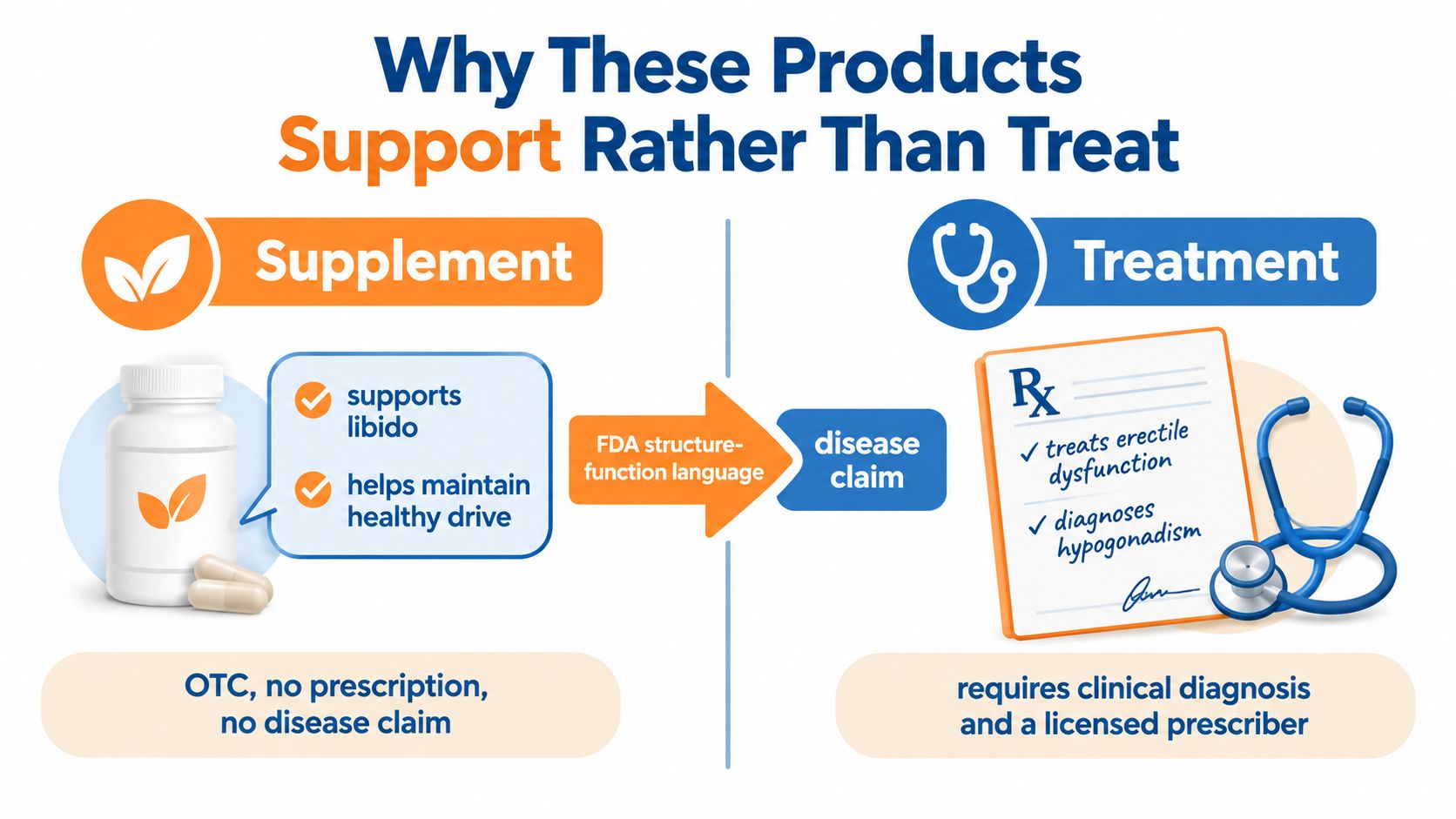
The difference between support and treatment isn't just a wording preference. FDA describes a structure/function claim as a statement about how a nutrient or dietary ingredient affects the body's structure or function, or about a documented mechanism that helps maintain it. Examples such as “supports healthy desire” or “helps maintain normal vitality” stay within that general category, while claims that a product treats erectile dysfunction or hypogonadism move toward disease claims.
What the FDA requires
FDA doesn't pre-approve structure/function claims for efficacy before a dietary supplement reaches the market. The manufacturer must have substantiation, keep the wording truthful and not misleading, and notify FDA within 30 days after first marketing a product with the claim under FDA's structure/function requirements.
The required disclaimer is exact:
These statements have not been evaluated by the Food and Drug Administration. This product is not intended to diagnose, treat, cure, or prevent any disease.
That sentence doesn't mean every product works, nor does it replace evidence. It signals that a dietary supplement occupies a different regulatory category from a diagnosed condition and its medical treatment.
What readers should infer
A support claim should be narrow enough to connect an ingredient with a normal function. L-arginine can be discussed in relation to nitric oxide and blood flow. Zinc can be discussed in relation to normal reproductive functions and sperm formation. Neither connection, by itself, establishes that a complete product will restore desire, resolve erection problems, or change a laboratory hormone result.
Persistent or sudden changes in sexual function can have many possible contributors, including medication effects, stress, sleep problems, relationship strain, or an underlying health issue. A supplement can be one part of a broader wellness routine, but it shouldn't replace an evaluation when symptoms continue or interfere with daily life.
Putting It All Together Before You Buy
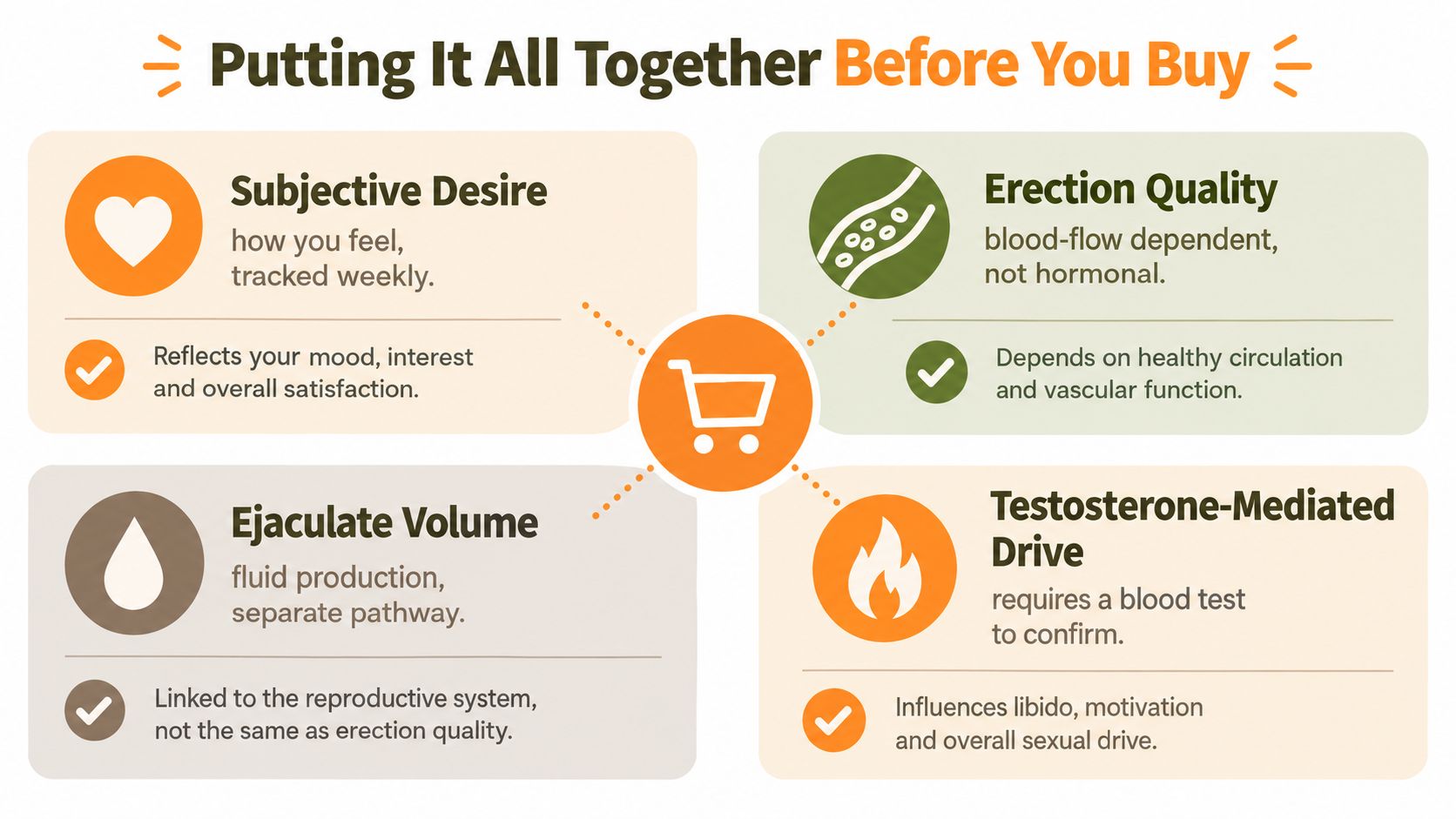
The four-outcome framework turns a crowded shelf into a more manageable decision. First, identify the result that matters most. A person seeking stronger sexual interest is evaluating subjective desire, while someone focused on erection quality is evaluating blood-flow support. Semen volume is a separate fluid-production endpoint, and testosterone-mediated drive requires a blood test to confirm a hormone result.
A practical buying path
- Name the endpoint. Choose desire, erection quality, semen volume, or a confirmed testosterone concern. Avoid judging a product by a promise that combines all four.
- Match the pathway. Maca and selected adaptogens are more naturally discussed around desire or well-being. L-arginine and L-citrulline fit blood-flow biology. Zinc has a clearer role in nutrient sufficiency and reproductive function.
- Inspect the formula. Prefer disclosed amounts over an unexplained proprietary blend. Look for extract standardization where relevant and check for duplicate nutrients.
- Verify production. Review cGMP information and meaningful third-party testing. A quality seal addresses manufacturing or testing, not guaranteed performance.
- Check the personal context. Medication use, cardiovascular concerns, hormonal questions, mood conditions, and blood-sugar treatment can all affect whether an ingredient is appropriate.
A focused formula may be easier to evaluate than a crowded stack that targets the same endpoint repeatedly. Cost should follow transparency and verification, not the number of ingredients printed on the front of the bottle.
SEMEX is one daily supplement option that combines zinc, L-arginine, sunflower lecithin, bromelain, maca root, Panax ginseng, ashwagandha, tongkat ali, saw palmetto, and horny goat weed for structure/function support related to semen volume, taste, libido, blood flow, and male reproductive wellness. Its published product information describes a vegan, non-GMO formula made in the USA in a cGMP-registered facility and third-party tested by Eurofins, so readers can review those details alongside other products rather than treating the formula as a medical intervention.
The most useful choice is the one that keeps the endpoint, evidence, label, and safety profile aligned. That approach replaces the broad promise of a “male libido supplement” with a more honest question: which ingredient supports which function, and what can the evidence justify?
Readers comparing formulas for libido, semen volume, taste, and ingredient transparency can review the daily approach offered by SEMEX. The product information provides its ingredient list and quality details, giving men a concrete option to evaluate against the endpoint-based checklist above.