

Male Libido Products: A Truthful Comparison
Sexual-enhancement products represented 45.5% of all dietary supplements containing unapproved pharmaceutical ingredients identified in U.S. enforcement data from 2007 to 2016. That figure means safety verification should come before comparing ingredients, formats, or promised effects.
The finding doesn't mean every male libido product is adulterated. It does show why a bottle's label, manufacturing controls, testing documentation, and claims deserve as much attention as its ingredient list. A supplement can look “natural” while still creating uncertainty about identity, purity, dosage, or interactions.
The most useful comparison therefore has two layers. First, a product should be checked for transparent formulation and quality controls. Only then should men compare herbal ingredients, nutrients, nitric-oxide support, lifestyle programs, or topical products according to the outcome they want to support.
Table of Contents
- Why Safety Must Come Before Comparison
- Comparing Main Categories of Libido Support
- Key Ingredients - What the Research Says
- How to Verify Product Quality and Safety
- Real-World Scenarios for Different Goals
- Making Your Final Decision with Confidence
Why Safety Must Come Before Comparison
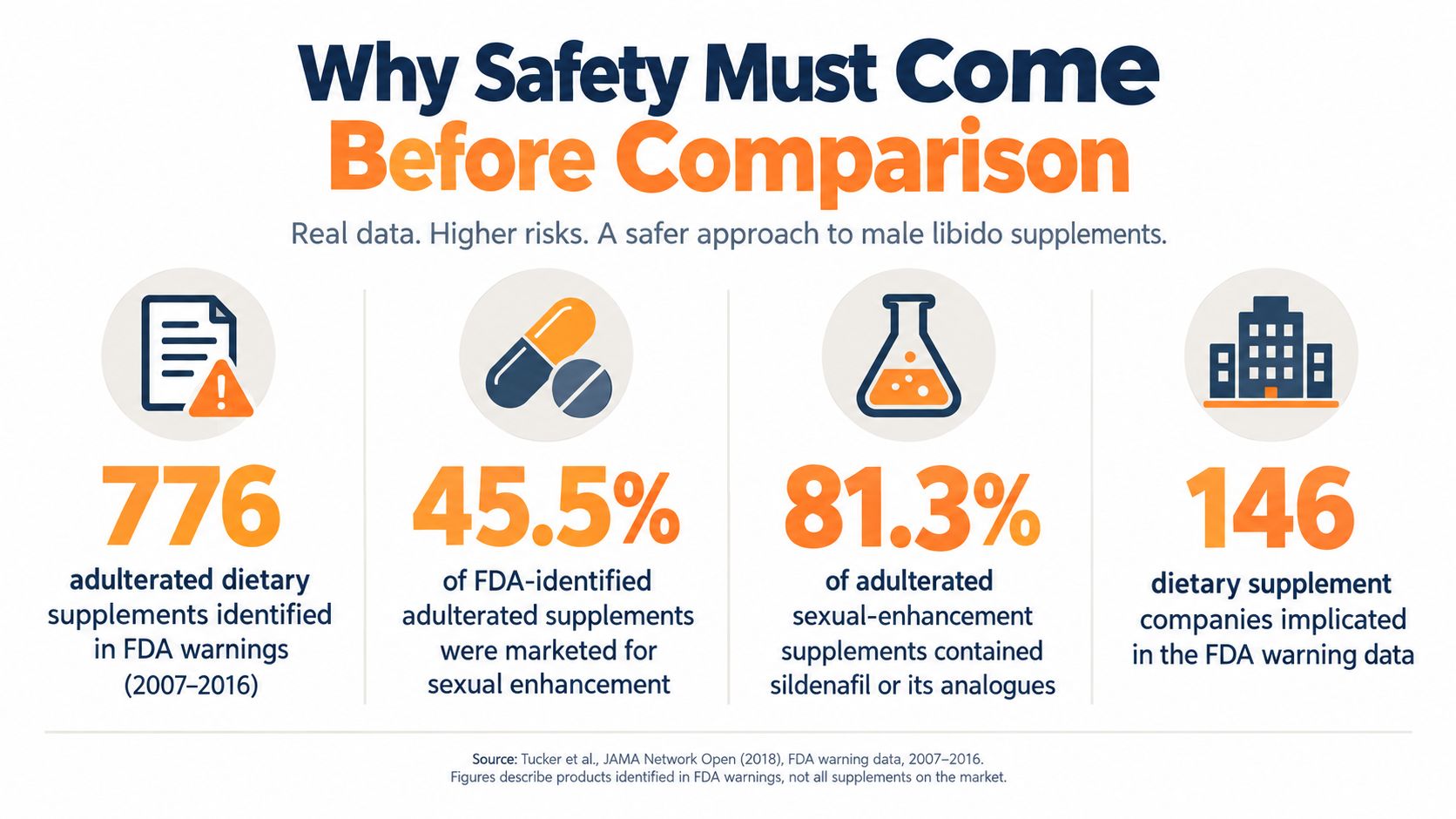
A review of U.S. Food and Drug Administration enforcement data identified 776 dietary supplements containing unapproved pharmaceutical ingredients between 2007 and 2016. Sexual-enhancement products made up 353 cases, or 45.5%, the largest category in the review, as reported in the Journal of the American Medical Association research article.
The same review linked those products to 146 companies. In 157 cases, or 20.2%, a supplement contained more than one undeclared pharmaceutical ingredient. Label transparency was weaker still. 757 of 776 products, or 97.6%, did not disclose the unapproved ingredients.
Why hidden ingredients change the buying decision
Within the 353 sexual-enhancement products in that dataset, 287, or 81.3%, contained sildenafil, a sildenafil analogue, or both. Sildenafil appeared in 166 products, or 47.0%, and at least one structural analogue appeared in 134, or 38.0%. That pattern matters because a buyer comparing products by claims, packaging, or immediate effect may be comparing undeclared drugs rather than the labeled formula.
This is the quality-assurance problem many ingredient guides miss. A category comparison only becomes meaningful after a product clears basic verification questions: what the manufacturer tests, whether testing applies to the finished batch, and whether the documentation addresses undeclared PDE5 drugs, identity, contaminants, and labeling accuracy.
Those historical findings do not justify treating every supplement as adulterated. They do justify skepticism toward weak signals. “Natural,” “herbal,” a long proprietary blend, or a strong fast-acting effect cannot confirm what a finished product actually contains.
A more recent example showed the same type of risk in a narrower market sample. In a geographically limited 2023 survey of 102 sexual-enhancement products sold in the Sacramento, California, area, researchers found that 68 products, or 67%, contained at least one PDE5 inhibitor. Among those positive products, 40% contained one PDE5 inhibitor and 60% contained two or more, as detailed in the 2023 laboratory survey.
Practical rule: A product should earn consideration through finished-batch testing and full disclosure, not through a dramatic promise or a “proprietary” label.
That standard applies especially to convenience-market products, including gas-station sexual-enhancement products, where perceived strength can distract from unanswered questions about identity, dosage, and undisclosed active compounds.
Comparing Main Categories of Libido Support
Male libido products sit in different evidence categories, and that difference matters before anyone compares benefits. Some products are built around desire or subjective vitality. Others aim to support normal nutritional status, daily habits linked to sexual wellbeing, or short-term local sensation. If those categories are treated as interchangeable, the comparison quickly becomes misleading.
A better framework is to ask two questions at the same time. What outcome is the product targeting, and what kind of proof would fit that outcome if the label is accurate?
| Category | Primary Function | Evidence Quality | Time to Result |
|---|---|---|---|
| Herbal supplements | Support desire, vitality, or selected physiological pathways | Ingredient-specific and often limited | Usually gradual, depending on ingredient and consistent use |
| Vitamin and mineral blends | Help maintain normal nutritional and reproductive functions | Strongest when correcting a deficiency, less persuasive as a universal enhancer | Gradual, with effects dependent on baseline status |
| Lifestyle and behavioral programs | Support circulation, energy, stress management, and relationship wellbeing | Broad rationale, but individual outcomes vary | Gradual and dependent on adherence |
| Topical enhancers | Influence local sensation or sexual experience | Product-specific and difficult to generalize | Often intended for short-term use, with tolerability requiring attention |
Herbal supplements
Herbal formulas are usually sold with the widest language and the narrowest specificity. That is exactly why they need careful reading. A plant ingredient may have some human data for desire, mood, or perceived vitality, while having no meaningful evidence for erection quality, fertility, or hormone correction.
Maca is a good example. In a 12-week double-blind, placebo-controlled pilot study, healthy men aged 21 to 56 received 1.5 g/day or 3.0 g/day of maca or placebo. Sexual desire improved relative to placebo, with separation emerging at approximately eight weeks, but the two maca doses did not clearly differ, and serum testosterone and estradiol did not change, according to the maca clinical research.
That pattern leads to a more disciplined interpretation. Maca can be described as a libido-support ingredient with limited human evidence tied to a specific endpoint and timeframe. It should not be treated as shorthand for stronger claims about erectile dysfunction, infertility, or hormonal deficiency. For buyers, the quality-assurance angle matters here too. If an herbal blend promises unusually strong or fast effects, the first question is still whether the finished product matches its label.
Vitamins and minerals
Vitamin and mineral blends often sound more concrete because nutrients have recognized biological roles. Yet that can blur an important distinction between supporting normal physiology and improving a specific sexual or fertility outcome in men who are not known to be deficient.
Zinc illustrates the point. Zinc contributes to normal reproductive biology, but that fact alone does not make every high-dose zinc formula a reliable strategy for libido, semen volume, or fertility. The FDA explains that structure/function claims describe support for normal body structure or function and do not establish that a product diagnoses, treats, or prevents disease, as outlined in the FDA structure/function claims resource.
So the practical comparison is narrower than marketing suggests. Does the label clearly disclose the zinc amount. Is the claim limited to normal nutritional support. Is there any reason to think the user actually needs more zinc. Without those answers, a mineral blend can look more evidence-based than it really is.
Lifestyle and behavioral programs
Lifestyle programs work on a different level. They do not isolate one ingredient, and they are harder to package into a simple before-and-after promise. Their relevance comes from the fact that sexual wellbeing can be affected by sleep, physical activity, alcohol use, stress, relationship context, and general energy status at the same time.
This category usually has the broadest rationale and the least product-like marketing. It also demands patience. Someone seeking an immediate effect may judge it harshly, while someone looking for durable support may see more value in a method that addresses several contributors at once. Persistent or distressing sexual changes still warrant medical evaluation, especially when other symptoms appear alongside them.
Topical products
Topical enhancers belong in their own category because they target local sensation rather than systemic nutritional support or longer-term changes in desire. That difference affects both expectations and safety review.
Any effect depends heavily on the formula, directions, skin tolerance, and the user's expectations. A topical product should therefore be checked for its full ingredient list, warnings, and whether it is intended only for external use. Comparing a topical enhancer directly with maca or a nutrient blend usually creates a category error. They are aimed at different outcomes, and they operate on different timelines.
Key Ingredients - What the Research Says
An ingredient panel is only useful when each substance is tied to a defined mechanism, a human outcome, a studied amount, and a plausible time horizon. That standard matters before any category comparison because many male libido products borrow credible language from nutrition or vascular biology while giving consumers no practical way to judge whether the formula matches the research.
L-arginine and nitric-oxide biology
L-arginine is involved in nitric-oxide production, which links it to vascular signaling and blood flow. A 2020 expert review described one randomized trial in which 31% of men receiving L-arginine reported improved erectile function compared with 12% receiving placebo, and it also discussed a meta-analysis of 10 randomized controlled trials that found significant improvement in subjective erectile-function ratings, while noting variation in dose and study quality, according to the clinical review of L-arginine and sexual function.
Those results support a narrower conclusion than marketing usually implies. They suggest that L-arginine may help some men under specific study conditions. They do not show that every product containing L-arginine will produce the same effect, and they do not justify disease-treatment language for supplements.
Dose and context also change the interpretation. One randomized trial used 6 g of L-arginine per day for three months to 51 men, compared with 47 placebo participants. Another used an amount equivalent to 1.7 g daily for three months in a combination product. Those are sexual-function studies, not proof about semen volume or a guarantee for any proprietary blend, which is consistent with the boundaries described in the FDA guidance on structure/function claims.
Maca and desire
Maca is a good example of why raw ingredient names are not enough. For this ingredient, the practical questions are whether the product identifies the preparation clearly, whether the amount is disclosed, and whether the label gives a realistic assessment window instead of hinting at an immediate effect.
Human research on maca has focused more on sexual desire than on instant performance. As noted earlier, the evidence base is limited. The point that matters here is quality control. If a label does not specify a standardized extract or at least a clear amount, the consumer cannot tell whether the product resembles the studied preparations summarized in the systematic review of maca.
That makes maca useful as a screening test for label credibility. A vague superlative such as “maximum strength” says less than a disclosed extract form and serving size.
Zinc and reproductive function
Zinc is better understood as a nutrient that plays a role in normal reproductive function than as a direct libido enhancer. That distinction is easy to miss in front-label marketing.
A nutrient can matter biologically without improving every outcome a buyer hopes for. For zinc, the more careful questions are whether the amount is stated, whether the formula duplicates zinc already taken from other supplements, and whether the product stays within a structure/function framing instead of implying a guaranteed reproductive result.
Other botanicals
Panax ginseng, ashwagandha, Tongkat Ali, saw palmetto, and horny goat weed are often bundled into one men's-health story, but they do not belong to one evidence category. Each has its own extract issues, dose range, safety profile, study population, and endpoint. A product that combines several of them can look stronger on a label while remaining harder to evaluate scientifically.
Readers who want a broader comparison can review male-enhancement ingredients across common formula types. The core rule remains simple. Evidence for one ingredient should not be used as proof for an entire multi-ingredient product unless the finished formula itself has been studied and clearly identified.
How to Verify Product Quality and Safety
A buyer cannot verify a male libido product by the front label alone. The useful evidence sits in the product record, lot details, and test documentation that show what was manufactured and whether the finished batch was screened for contaminants or hidden drugs.
That quality-assurance step matters because sexual-enhancement supplements have a documented history of undisclosed pharmaceutical adulteration, as noted earlier. The practical question is not only whether an ingredient sounds promising, but whether the bottle in hand matches its label and has been checked at the finished-product level.
A practical purchase checklist
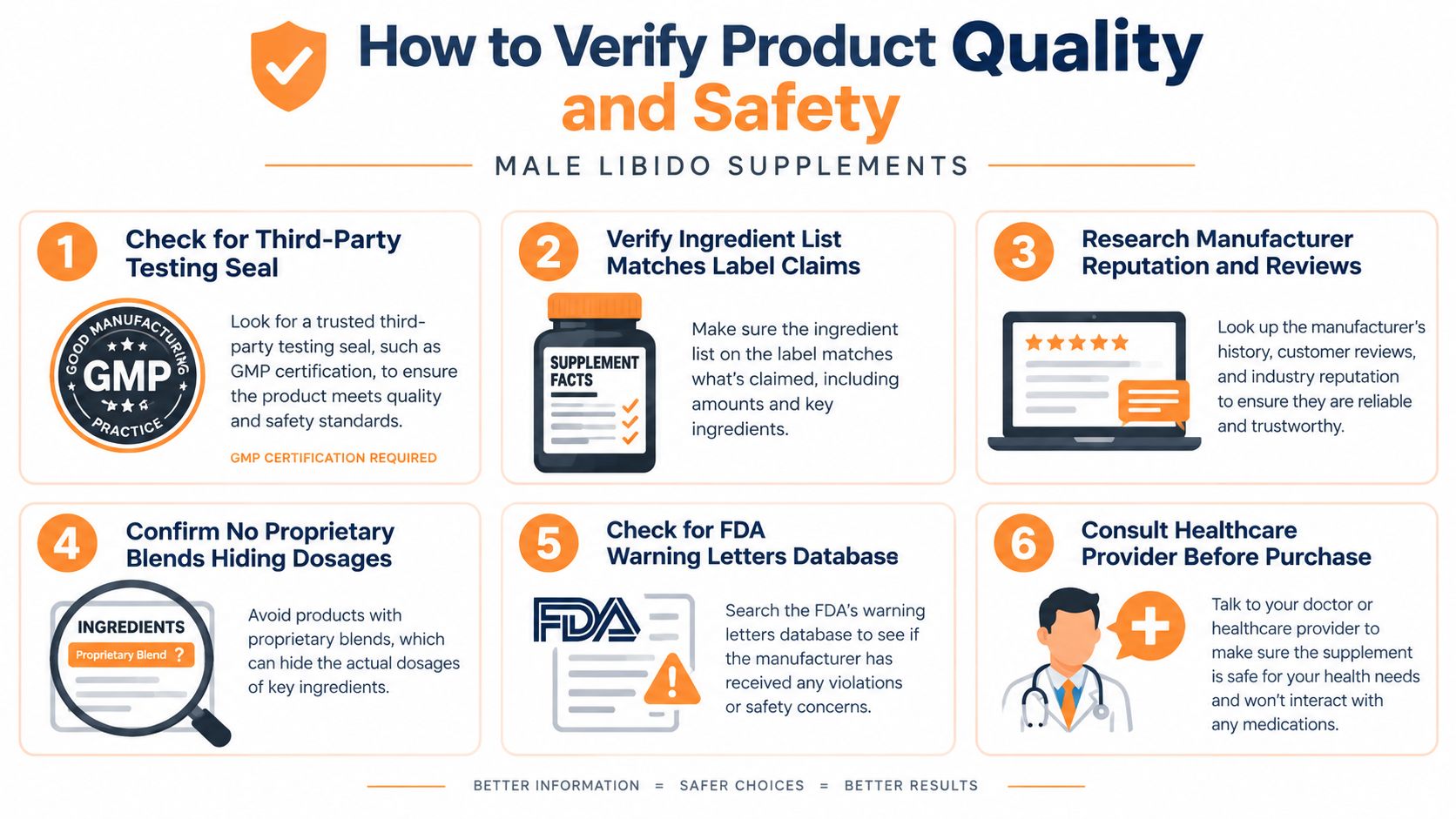
- Check finished-batch testing. Ask what the laboratory tested in the final product, not just in incoming raw materials. A useful report or summary should indicate identity and composition, and it should also address purity questions such as microbes, heavy metals, and undeclared pharmaceutical ingredients. A seal means little if the company does not explain the testing scope.
- Match the formula to the label. Each active ingredient should be named with its amount per serving. Proprietary blends make comparison harder and obscure overlap with other supplements a person may already be taking. If an extract is used, the label should identify the extract form rather than relying on marketing language.
- Review manufacturing controls. Current good manufacturing practices are meant to support identity, purity, quality, strength, and composition during production and labeling. They do not prove that a supplement will improve libido, erections, fertility, or any other outcome. The distinction is explained in FDA's questions and answers on dietary supplements.
- Research the manufacturer. A serious company should provide contact information, lot identification, adverse-event reporting details, and a clear explanation of how testing is handled. Certificates and lab summaries are more informative than star ratings because they show process rather than opinion.
- Check regulatory warnings. Search FDA recalls, warning letters, and safety alerts for both the brand and the product name. This step is especially relevant in a category where hidden PDE5-type ingredients have repeatedly appeared. The risk becomes more than theoretical when adulteration involves ingredients that can interact dangerously with nitrate medicines, a concern reflected in this FDA recall notice.
- Ask a healthcare professional. A clinician or pharmacist can review medication interactions, cardiovascular risk, persistent symptoms, and whether a change in sexual function should be medically evaluated before supplement use.
A strong label answers questions before the buyer has to ask them. If a company will not explain finished-batch testing, that gap is itself meaningful.
For men comparing daily formulas, independent supplement verification standards belong near the top of the checklist. They help separate products that only describe benefits from products that document what is in the bottle.
Real-World Scenarios for Different Goals
A man seeking general vitality may start with a transparent daily formula that lists every ingredient and amount, then assess how he feels over a consistent period. He shouldn't use a stronger immediate sensation as proof of quality, especially because pharmacologically active ingredients can be hidden in products marketed as natural.
When the goal is nutritional support
A man focused on reproductive nutrition may look for zinc and other nutrients, but he should distinguish supporting normal function from expecting a guaranteed change in semen volume, sperm concentration, or fertility outcomes. The appropriate product review includes dose, overlapping supplements, dietary intake, and professional advice when reproductive concerns persist.
Another man may be interested in circulation support and notice L-arginine on a label. The relevant question isn't just whether L-arginine appears. He should check the disclosed daily amount, the study population behind any cited evidence, the duration used in research, and whether the claim describes nitric-oxide biology rather than disease treatment.
When the goal is shared experience
A couple seeking more novelty or confidence may define success differently from a man focused on reproductive endpoints. Desire, erection quality, semen characteristics, taste, mood, and relationship satisfaction are separate outcomes, so a product that discusses one shouldn't imply support for all of them.
A gradual approach can be more informative than a one-night test. Men can track the specific outcome they care about, note tolerability, avoid combining multiple products at once, and stop when an unexpected reaction appears. A healthcare professional should be involved when prescription medicines, cardiovascular conditions, or persistent sexual changes are part of the picture.
These scenarios point to a broader principle: the product category should follow the goal, and the goal should follow a clearly defined outcome. Ingredient evidence can't compensate for an unclear objective.
Making Your Final Decision with Confidence
A confident decision follows a sequence:
- Define the outcome. Separate desire, circulation support, vitality, reproductive nutrition, semen characteristics, and shared sexual experience.
- Reject unclear products. Avoid labels that conceal amounts, omit testing details, or rely on drug-like promises.
- Match evidence to the ingredient. Consider the human endpoint, studied dose, preparation, duration, and population.
- Check interactions. Review medicines and health conditions with a qualified professional.
- Set a gradual assessment period. A supplement should be judged by transparent use, tolerability, and the outcome it claims to support.
SEMEX is one example of a daily supplement that lists zinc, L-arginine, sunflower lecithin, bromelain, maca root, Panax ginseng, ashwagandha, Tongkat Ali, saw palmetto, and horny goat weed, and is described as vegan, non-GMO, made in the USA in a cGMP-registered facility, and third-party tested by Eurofins for microbes, heavy metals, and adulterants. Men comparing it with other male libido products can review the formula and testing information against the same quality criteria rather than treating the ingredient count as proof of an outcome.
These statements have not been evaluated by the Food and Drug Administration. This product is not intended to diagnose, treat, cure, or prevent any disease.
SEMEX offers a transparent daily supplement option for men evaluating ingredient disclosure, manufacturing controls, and third-party testing alongside libido and reproductive-support goals. Visit SEMEX to review the formula and quality information before deciding whether it fits a personal wellness routine.