

Male Libido Increase: A Realistic Guide to What Works
A man can go from feeling interested in sex to barely thinking about it, then blame testosterone, age, or a busy week. The usual response is to search for a fast male libido increase and buy the first supplement promising more drive. That approach skips the most important question: what changed, and is the problem desire, erectile function, or both?
A better strategy starts with a clinical-style screen, separates sexual desire from performance, and gives lifestyle changes enough time to work. Supplements may support general vitality or normal function, but they aren't a guaranteed solution. Persistent or distressing changes deserve proper evaluation, not increasingly large doses.
Table of Contents
- What Male Libido Actually Reflects
- Why Testosterone Is Only Part of the Story
- Building Your 12-Week Self-Monitoring Protocol
- Lifestyle Levers That Actually Move the Needle
- Ingredients Men Ask About and What the Research Says
- How to Judge Any Libido Supplement Before You Buy
- Realistic Expectations and When to See a Clinician
What Male Libido Actually Reflects
Libido is sexual interest and motivation. Erectile function is the body's ability to produce and maintain an erection. They overlap, but they aren't interchangeable. A man can want sex and struggle with erections, or have adequate erections without feeling much desire. Measuring only performance can therefore miss the underlying issue.
Desire responds to several inputs at once: sleep, stress, mood, hormones, cardiovascular health, medications, body composition, and relationship context. A difficult work period, poor sleep, unresolved conflict, or a medication change can reduce interest even when testosterone hasn't changed meaningfully.
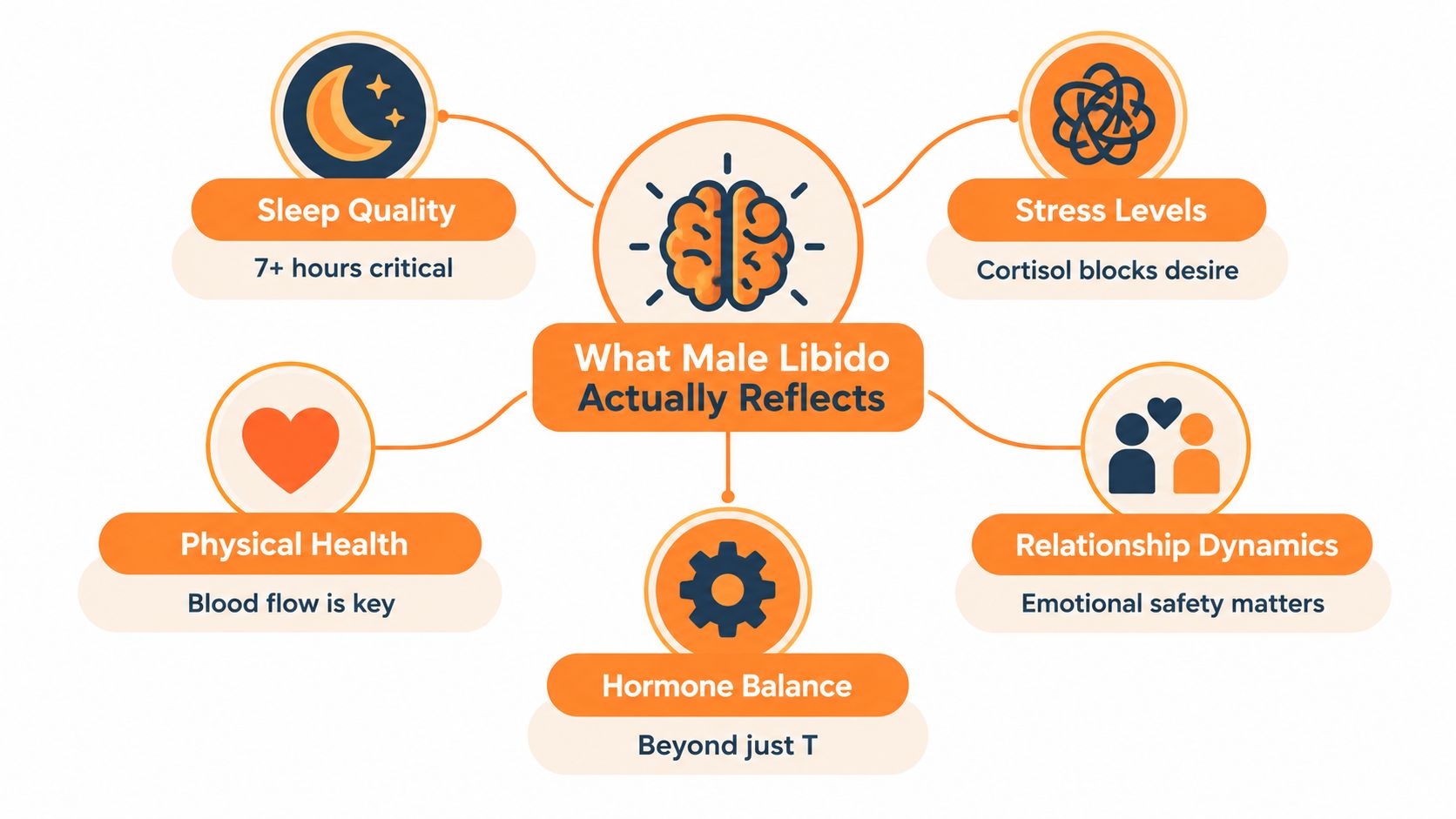
Start with four baseline pillars
A useful audit takes one evening. It doesn't require expensive testing or a complicated app.
- Desire: Rate current sexual desire on a consistent 0–10 scale. Record whether the concern involves spontaneous interest, initiation, erection quality, ejaculation, or relationship satisfaction.
- Sleep: Note the usual sleep window, interruptions, and whether mornings feel restorative. Sleep loss can affect energy, mood, and sexual interest together.
- Stress: Record the main sources of pressure and whether desire drops during stressful periods. Anxiety and emotional overload often show up as reduced sexual attention before a man identifies them as the cause.
- Health status: List current medications, alcohol use, smoking, exercise, body-weight trends, pain, mood symptoms, and recent health changes. Don't stop a prescribed medication without medical advice.
Age matters, but it doesn't create an automatic cliff. Historical sexual-function data summarized in a peer-reviewed review of male sexual function and aging found that more than 70% of men aged 40–49 reported wanting sex more than once per week, compared with approximately 15% of men aged 70 and older. Fewer than 5% of men aged 40–49 reported no interest in sex, while roughly 35% of men over 70 reported no desire for sexual activity.
Practical rule: A baseline is more useful than a guess. If desire isn't measured before a change, almost any later impression can feel like proof.
The audit gives a starting snapshot, not a diagnosis. It tells a man whether the first lever should be sleep, stress, movement, medication review, relationship support, or clinical testing. That is a stronger foundation for a male libido increase than a shopping list.
Why Testosterone Is Only Part of the Story
The assumption that more testosterone automatically means more libido is too simple. Testosterone supports sexual desire, but desire also depends on the brain, mood, energy, health, relationships, and the context in which sex occurs.
A 2024 naturalistic study followed 41 adult men for one month and collected 759 daily observations. It found no statistically significant relationship between day-to-day testosterone fluctuations and daily changes in sexual desire, and no significant association between each participant's average testosterone level and average desire, as reported in the published study.

When testosterone deserves attention
That finding doesn't mean testosterone is irrelevant. Clinical evidence shows that appropriately evaluated older men with clinically low testosterone can experience improved sexual desire when low levels and compatible symptoms are addressed. The distinction matters: correcting a medical deficiency is different from chasing normal daily variation with a consumer supplement.
European Association of Urology guidance describes testosterone as important for sexual desire, while also noting that circulating testosterone doesn't directly predict desire, particularly in older men. A medical and sexual history, along with appropriate laboratory assessment, helps distinguish hormone deficiency from other contributors.
A man looking for more background on the relationship between hormones and reproductive function can review male reproductive system hormones, but a web page shouldn't replace an evaluation when symptoms persist.
Other causes deserve equal attention
Low desire can reflect depression, anxiety, relationship conflict, chronic pain, medication effects, sleep problems, cardiovascular disease, or erectile difficulties. Some men fixate on testosterone because it offers a simple explanation, while the underlying problem is exhaustion, unresolved resentment, or a medication side effect.
A single low testosterone result also isn't enough to establish a diagnosis. Compatible symptoms and appropriately timed, repeat testing under medical supervision are generally needed. A testosterone-focused product may support general vitality, but it can't resolve every cause of low desire.
Building Your 12-Week Self-Monitoring Protocol
A 12-week protocol turns vague frustration into usable information. The aim isn't to obsess over sex every day. The aim is to make a few deliberate changes, track the relevant signals, and judge the pattern instead of reacting to one unusually good or bad week.
Week one creates the reference point
For the first week, change nothing deliberately. Record the desire score on a consistent 0–10 scale, average sleep quality, exercise sessions, alcohol intake, stress level, and any notable medication or mood changes. If erectile function is also a concern, track it separately rather than treating it as a substitute for desire.
Validated tools can add structure. The Derogatis Interview for Sexual Functioning in Men-II and the desire items of the IIEF-15 are examples of instruments that separate desire from other sexual endpoints.
Weeks two through eleven isolate the variables
Choose one primary lever first. A man might set a consistent sleep schedule, resume regular aerobic and resistance exercise, moderate alcohol, or create a protected recovery period. Keep the weekly log short:
- Desire: One score on the same day each week.
- Sleep: Typical sleep quality and interruptions.
- Training: Exercise sessions and whether recovery felt adequate.
- Stress: A brief rating plus the main source of pressure.
- Context: Medication changes, illness, relationship tension, or travel.
Changing everything at once is the fastest way to lose useful information. Adding multiple supplements, a new training plan, a strict diet, and a different sleep schedule makes improvement impossible to attribute. Overtraining while sleep-deprived can also move the plan in the wrong direction.
Week twelve is for pattern recognition
Compare the final audit with the first. Look for a sustained direction across several weeks, not a single high score. If sleep improved but desire didn't, the next step might be stress, medication review, relationship support, or clinical assessment rather than another product.
Meta-analytic evidence found that lifestyle interventions produced a modest but statistically significant improvement in erectile function, with a mean difference of 2.35 points, a 95% confidence interval of 1.68–3.01, and heterogeneity of I²=53%, as reported in the Journal of Sexual Medicine analysis. Significant effects were reported for diet-only, exercise-only, and combined approaches. The measured outcome was primarily erectile function, so it shouldn't be presented as proof of a matching change in spontaneous desire.
Lifestyle Levers That Actually Move the Needle
A supplement can't compensate for a body that is chronically exhausted, sedentary, stressed, or poorly recovered. The practical route to a male libido increase is to improve the conditions that support energy, mood, circulation, and sexual attention.
Exercise should build capacity, not drain it
Combine regular aerobic movement with resistance training. Brisk walking, cycling, swimming, and similar activities support cardiovascular fitness, while resistance work supports strength and body composition. The right plan is one a man can repeat without sacrificing sleep.
A busy man can begin with a short walk on several days and resistance sessions built around basic movements. The first week's target is consistency, not exhaustion. Training hard while sleep-deprived is a common mistake because fatigue can suppress interest even when the program looks impressive on paper.
Sleep is the foundation
A consistent seven-to-nine-hour sleep window is a practical target for many adults, but the schedule matters too. A fixed wake time, a darker bedroom, reduced late-night screen exposure, and a short wind-down routine create better conditions than trying to recover from repeated short nights on the weekend.
The one-week action is simple: choose a wake time and protect it. If loud snoring, repeated awakenings, or persistent daytime sleepiness are present, a clinician should assess the possibility of a sleep disorder rather than treating fatigue as a motivation problem.
Alcohol and body weight need a realistic approach
Excess alcohol can interfere with sleep, energy, mood, and sexual function. A useful first move is to identify which drinking occasions are habitual and reduce those occasions rather than attempting an unsustainable restriction.
Gradual weight reduction can be appropriate when body weight is affecting health, mobility, energy, or confidence. Aggressive dieting often creates fatigue and irritability, so meals should remain adequate and consistent. A practical starting action is to replace one recurring alcohol occasion or highly processed meal with a more supportive option.
Stress needs an appointment on the calendar
“Manage stress better” isn't an actionable plan. Short daily breathwork can create a transition out of work mode, while a protected weekly recovery window gives the nervous system time away from constant demands. Counseling or relationship support may be more appropriate when anxiety, depression, or conflict is driving the change.
A man can start with a few quiet minutes of slow breathing after work and a scheduled period without work messages. Further ideas appear in meditation and libido, but the key is repetition. Stress management works as a habit, not as a one-time emergency measure.
Ingredients Men Ask About and What the Research Says
Ingredient research should be read at the ingredient level, not transferred automatically to every multi-ingredient formula. A study of one extract, dose, population, and outcome doesn't prove that another blend will produce the same result.
| Ingredient | Studied Role | Evidence Strength |
|---|---|---|
| Zinc | Supports normal male reproductive function and contributes to normal physiological processes | Strongest when correcting inadequate intake, not a universal libido enhancer |
| L-arginine | Supports nitric-oxide pathways and blood-flow function | Limited, formulation-specific human evidence |
| Maca root | Commonly studied for sexual desire and general vitality | Evidence is limited and variable |
| Panax ginseng | Studied in relation to sexual function and energy | Results vary by preparation and outcome |
| Ashwagandha | Studied for stress resilience and aspects of male wellness | Promising but not definitive for libido |
| Tongkat Ali | Commonly marketed for vitality and hormone-related support | Human evidence remains limited and formulation-dependent |
| Saw palmetto | More commonly associated with prostate-related wellness | Not a direct, established libido ingredient |
| Horny goat weed | Traditionally associated with sexual vitality and blood-flow support | Evidence and safety depend heavily on preparation |
What the L-arginine study does and doesn't show
A published human study evaluated an oral regimen equivalent to 1.7 grams of L-arginine daily in 40 men aged 25–45 over three months. After the first month of L-arginine alone, 5% experienced a normal erection. After two additional months using L-arginine with Pycnogenol, the reported proportion rose to 80% and then 92.5%, according to the published human study.
The late-phase results involved a combination, not L-arginine alone. They support discussion of nitric-oxide-related sexual-function research, not a promise that L-arginine alone produces a particular result.
Zinc plays a role in normal male reproductive function, but more isn't automatically better. Maca, ginseng, ashwagandha, Tongkat Ali, saw palmetto, and horny goat weed should each be judged by the exact preparation, dose, outcome, and safety information available. Limited research calls for disciplined wording: supports, plays a role in, and may help maintain are defensible; “raises libido for every man” isn't.
How to Judge Any Libido Supplement Before You Buy
A serious evaluation begins with the label, not the front-of-bottle promise. Multi-ingredient products can contain different extract forms, undisclosed quantities, or combinations that haven't been studied together. Nutraceutical research commonly involves small trials, variable formulations, uncertain optimal doses, limited long-term data, and possible medication interactions.
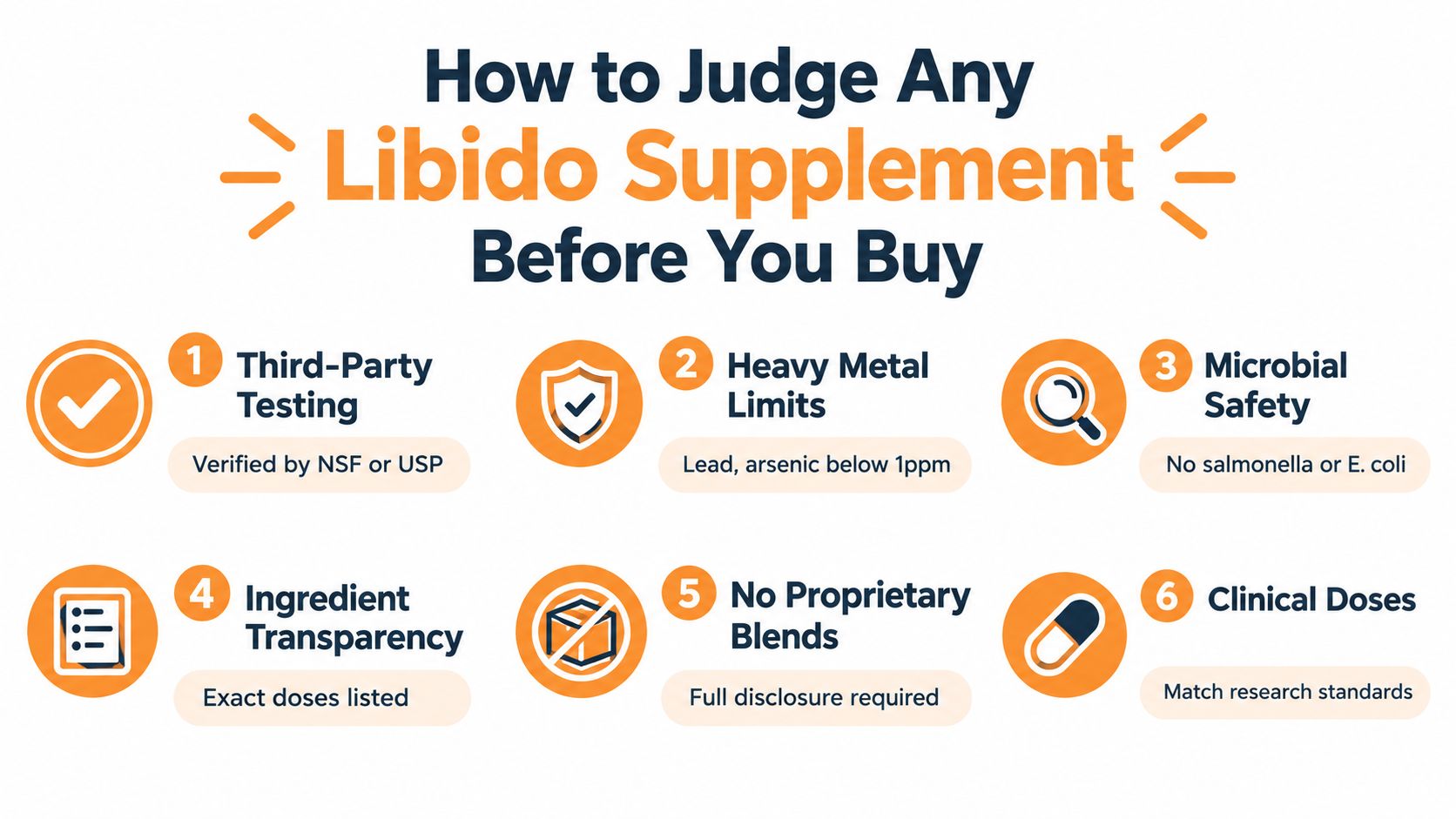
Five questions belong on every shopping list
- Are the individual doses disclosed? A proprietary blend prevents comparison with ingredient-level research and makes it difficult to identify excessive amounts.
- Is testing transparent? Look for third-party testing that addresses microbials, heavy metals, and adulterants, with published thresholds rather than a vague quality badge.
- Are extracts standardized? A named extract with a defined standard is easier to evaluate than an unidentified raw herb powder.
- Does the manufacturer disclose facility standards? A cGMP-registered facility, batch information, and a clear testing process provide more useful information than lifestyle branding alone.
- Does the formula fit the person taking it? Vegan and non-GMO status may matter to a buyer, but medications, cardiovascular conditions, hormonal concerns, and psychiatric treatment matter for safety.
Men comparing labels can also use this guide on how to read supplement labels. The same discipline applies whether the bottle contains zinc, L-arginine, maca, ginseng, or several herbs.
Understand what the FDA wording means
U.S. structure/function claims may describe how an ingredient supports a body structure or function when the claim is truthful, not misleading, and appropriately substantiated. That language doesn't turn a supplement into a treatment.
The FDA's structure/function labeling guidance specifies that the required disclaimer wording cannot be modified. A product using this framework should carry the following exact statement:
“These statements have not been evaluated by the Food and Drug Administration. This product is not intended to diagnose, treat, cure, or prevent any disease.”
The FDA's consumer guidance also supports checking claims, interactions, and product information rather than assuming “natural” means risk-free. NCCIH guidance warns that sexual-enhancement supplements may contain undisclosed drug ingredients, and combinations or excessive doses can be dangerous.
Realistic Expectations and When to See a Clinician
A sustainable male libido increase usually looks gradual. Sleep becomes more consistent, energy improves, stress becomes less dominant, and desire may return with fewer obstacles. An overnight transformation is a marketing story, not a reliable plan.
A supplement can support general vitality or normal function, but it can't guarantee a libido change. The responsible approach is to test one meaningful lifestyle lever, track the result, and investigate broader causes when the pattern persists.
Red flags shouldn't be handled with higher doses
A clinician should be involved when low desire is persistent or distressing, especially alongside:
- Fatigue or mood changes: These can point toward sleep, psychological, medication, or broader health factors.
- Erectile changes or pain: Desire and erection quality are separate endpoints, and pain needs assessment rather than self-treatment.
- Infertility concerns: Reproductive concerns require appropriate evaluation, not assumptions based on libido alone.
- A new medication: The prescribing clinician can review possible sexual side effects and alternatives.
- Symptoms of androgen deficiency: Diagnosis generally requires compatible symptoms plus appropriately timed, repeat laboratory assessment, not one isolated result.
Depression, anxiety, relationship conflict, chronic pain, cardiovascular disease, medication effects, and sleep problems can all reduce desire. A clinical screen should review those possibilities alongside hormone testing when indicated.
This week, a man can complete the baseline audit, choose one lifestyle lever, and schedule a check-in at week four. If the score remains low or the change feels troubling, the next step should be a primary-care or appropriate specialist appointment. Dietary supplements may support general wellness, but they aren't a replacement for medical assessment.
SEMEX is a daily men's wellness supplement containing zinc, L-arginine, sunflower lecithin, bromelain, maca root, Panax ginseng, ashwagandha, Tongkat Ali, saw palmetto, and horny goat weed, with vegan, non-GMO, cGMP-registered manufacturing and third-party testing described by the brand. Men evaluating supplement options for vitality and normal reproductive function can visit SEMEX and review the formula and product information before deciding whether it fits their routine.
These statements have not been evaluated by the Food and Drug Administration. This product is not intended to diagnose, treat, cure, or prevent any disease.