

Male Enhancement Supplement Buyer Guide for 2026
A man can spend ten minutes comparing bottles and still not know what he's buying. One label promises harder erections, another emphasizes testosterone, and a third highlights semen volume, while none makes it easy to verify the dose, purity, or testing behind the claims. The smartest purchase starts with label trust, not the loudest promise.
A male enhancement supplement should be judged by its intended structure and function, its disclosed ingredients, its manufacturing controls, and its contamination safeguards. Ingredients such as zinc and L-arginine have legitimate biological roles, but they aren't interchangeable, and they don't turn a supplement into a treatment. The guide below sorts products by practical goal, then shows how to reject weak or risky formulas before money changes hands.
Table of Contents
- What Most Guys Actually Want From a Male Enhancement Supplement
- The Main Categories on the Shelf and What They Target
- Common Ingredients and What the Research Actually Supports
- Quality Markers That Separate Serious Formulas From the Rest
- Safety, Interactions, and the Contamination Question Nobody Talks About
- Matching a Product to Your Real Situation
- A Simple Decision Framework You Can Use on Any Label
What Most Guys Actually Want From a Male Enhancement Supplement
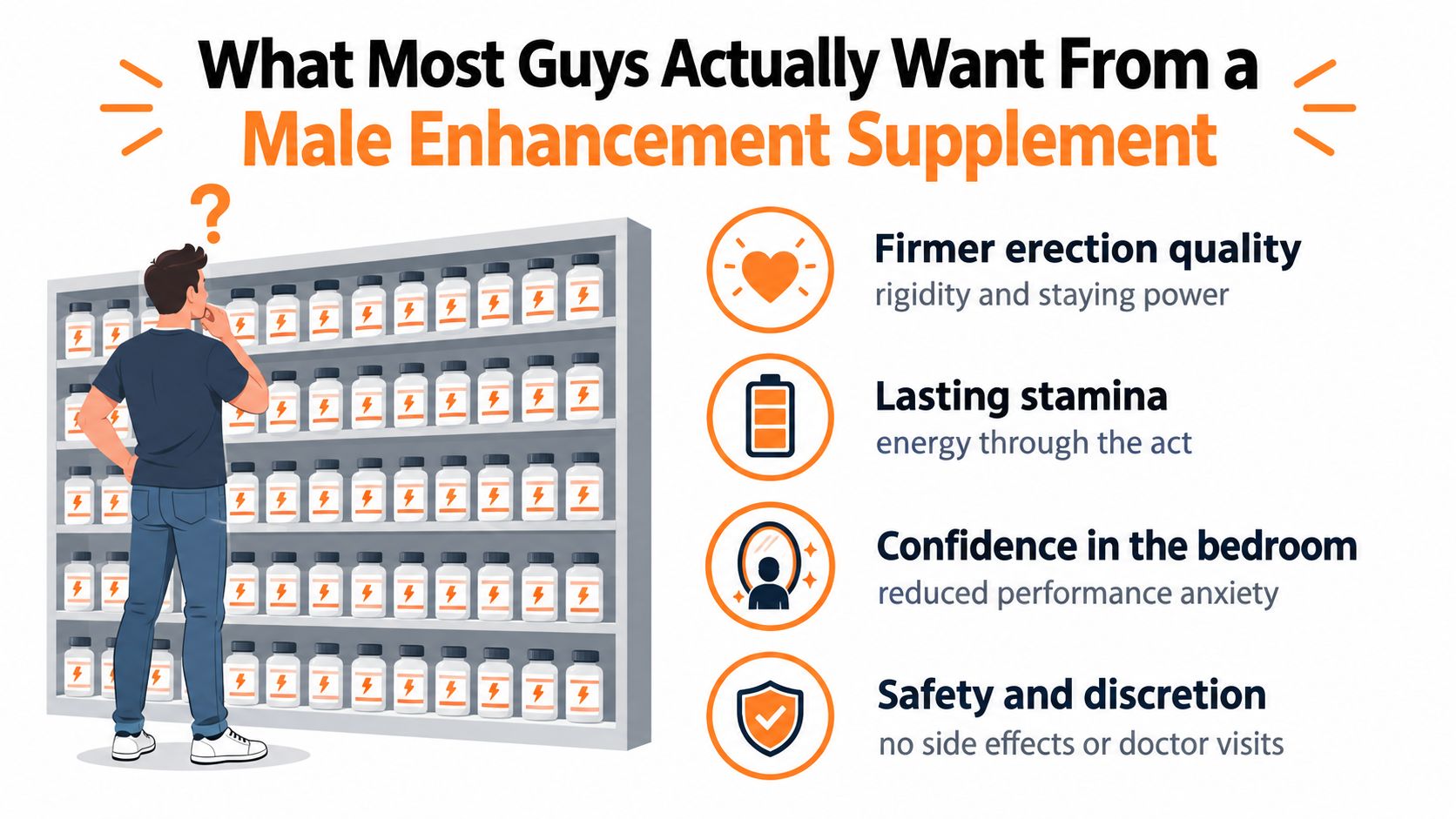
Most buyers aren't looking for a complicated ingredient lecture. They're standing in front of a shelf of nearly identical bottles, trying to decide which formula may support erection quality, semen volume, daily energy, or long-term men's wellness without creating another problem.
The first step is to identify the primary goal. A circulation-focused formula is built around a different mechanism than a semen-volume formula, and a daily vitality blend may use adaptogens rather than nitric-oxide ingredients. A product can support more than one area, but crossover formulas usually favor one main purpose.
Four practical buying goals
- Firmer erection quality: Circulation ingredients are generally included to support nitric oxide signaling and blood-flow pathways. That's structure/function language, not a promise to treat erectile dysfunction.
- Greater semen volume: Zinc, amino acids, lecithin, and other reproductive-health ingredients are commonly chosen to support normal seminal function. Volume alone doesn't establish sperm quality or fertility outcomes.
- Daily energy and drive: Adaptogens, botanical extracts, and selected vitamins may support normal energy, stress resilience, or libido-related function. Buyers should expect ingredient-specific evidence, not a guaranteed change in motivation.
- Long-term men's wellness: Mineral status, reproductive function, prostate comfort, and general vitality often matter more than a short-lived sensation. This category rewards transparent formulas over dramatic advertising.
The second step is to separate a support claim from a medical promise. FDA guidance defines structure/function claims as statements about how a nutrient or dietary ingredient affects the body's structure or function, or how it helps maintain that structure or function. Those claims must be truthful and not misleading, and they don't receive premarket FDA approval, as explained in the FDA's dietary supplement guidance.
Practical rule: A product that explains its ingredients, doses, testing, and intended function deserves more attention than one that relies on oversized words such as “extreme” or “instant.”
The third step is to ask a question most comparison pages skip: could the product contain something that isn't on the label? FDA enforcement pages and NCCIH consumer information describe repeated concerns involving sexual-enhancement supplements adulterated with undeclared drug ingredients. Buyers should therefore evaluate purity, interaction warnings, and batch documentation before comparing flavor, capsule count, or promotional language. A useful overview of the difference between libido support and related goals appears in this guide to libido support.
The Main Categories on the Shelf and What They Target
The shelf becomes easier to read once products are grouped by function. The categories overlap, but each usually has a dominant purpose.
| Category | Primary Support | Typical Ingredients | Best Fit |
|---|---|---|---|
| Nitric-oxide and circulation blends | Blood-flow signaling and erection firmness | L-arginine, L-citrulline, beet-derived nitrate sources | Men prioritizing circulation support |
| Testosterone-support formulas | Energy, libido, and normal hormone-related function | Tongkat ali, fenugreek, zinc, boron | Men focused on daily drive and vitality |
| Seminal-volume and prostate blends | Normal reproductive function and urinary comfort | Zinc, selenium, lecithin, saw palmetto, beta-sitosterol | Men prioritizing semen or prostate-related wellness |
| Adaptogenic vitality stacks | Stress resilience, stamina, and general energy | Ashwagandha, maca, Panax ginseng, rhodiola | Men seeking broader daily wellness support |
Circulation formulas
L-arginine and L-citrulline are usually the headline ingredients here. L-arginine serves as a substrate for nitric oxide synthase, while citrulline can contribute to arginine availability. These formulas are designed to support blood-flow signaling, not to replicate prescription medication.
The evidence is context-dependent. A controlled infusion study reported increased femoral arterial blood flow during L-arginine administration in patients with critical limb ischemia, but intravenous findings shouldn't be treated as proof that any oral capsule will produce the same response. Oral results can vary with dose, absorption, baseline nitric-oxide production, and the person's health profile.
Testosterone and vitality formulas
Tongkat ali, fenugreek, boron, and zinc often appear in formulas marketed around testosterone support. Their practical positioning is usually energy, libido, training drive, or normal hormone metabolism. That doesn't mean every formula changes testosterone meaningfully, and a label should disclose the extract type and amount rather than listing only a botanical name.
Volume and prostate blends
Zinc has a clear biological role in male reproductive function, including sperm development and normal testicular activity. Saw palmetto and beta-sitosterol are commonly positioned around prostate and urinary comfort, while lecithin is used in semen-volume formulas. These ingredients target different outcomes, so a product emphasizing volume shouldn't be judged by the same standard as one marketed around urinary support.
Adaptogenic stacks
Ashwagandha, maca, Panax ginseng, and similar botanicals are typically included for stress resilience, perceived energy, and general vitality. These products may suit men who want an everyday wellness formula rather than a narrowly targeted circulation blend. A crossover product can be convenient, but it also makes dose transparency more important because the formula may spread active ingredients across many goals.
Common Ingredients and What the Research Actually Supports
The ingredient panel deserves more scrutiny than the front label. A familiar name can still be underdosed, hidden inside a proprietary blend, or paired with an extract that isn't identified clearly enough to evaluate.
| Ingredient | Common Claim | Evidence Level | Key Caveat |
|---|---|---|---|
| L-arginine | Supports nitric oxide and circulation | Mechanistically established, clinically mixed | Infusion findings don't guarantee equivalent oral effects |
| L-citrulline | Supports arginine availability and blood flow | Plausible, formulation-dependent | Dose and absorption details matter |
| Zinc | Supports normal reproductive function and sperm development | Well-established biological role, mixed outcome evidence | Excess intake can create adverse changes |
| Ashwagandha | Supports stress resilience, vitality, and reproductive measures | Ingredient-specific and developing | Extract type and endpoint matter |
| Tongkat ali | Supports libido and hormone-related vitality | Preliminary to moderate, product-dependent | Standardization is often unclear |
| Fenugreek | Supports libido and selected hormone markers | Preliminary and formulation-specific | Marketing often outruns the evidence |
| Maca | Supports subjective drive and energy | Limited, outcome-specific | Effects are not the same as fertility outcomes |
| Saw palmetto | Supports prostate and urinary comfort | Mixed, goal-specific | It isn't a general performance ingredient |
| Selenium | Supports antioxidant and reproductive biology | Foundational nutrient role | More isn't automatically better |
| Boron | Supports mineral and hormone metabolism | Preliminary | Human evidence remains limited |
Ingredients with a clearer biological rationale
Zinc is one of the most studied mineral ingredients in male reproductive wellness. A 2016 meta-analysis of 20 studies involving 2,600 men with male fertility issues and 867 controls associated zinc supplementation with better semen metrics, including semen volume, sperm motility, and the proportion of normally shaped sperm, as reported in the published meta-analysis. The reported standardized mean differences were -0.99 for semen volume, -1.82 for motility, and -0.75 for normal morphology, but later clinical reviews have emphasized that newer research hasn't consistently shown improvements in pregnancy rates, sperm counts, or sperm function.
That distinction matters. Zinc supports the biology of reproductive function, but a supplement label shouldn't convert that role into a promise about fertility outcomes. Reviews also describe zinc involvement in testicular development, spermatogenesis, sperm maturation, capacitation, and fertilization, while warning that excessive zinc can contribute to oxidative stress and other adverse changes, as detailed in this review of zinc and male reproductive function.
L-arginine has a similarly legitimate but limited role. It's the obligate substrate for nitric oxide synthase, so it directly participates in nitric-oxide production and downstream blood-flow signaling. A review found that L-arginine doses of 1,500 to 5,000 mg improved erectile-function outcomes compared with placebo or no treatment, with additional gains reported for satisfaction and orgasmic function, although results vary by population and baseline nitric-oxide production, according to this review of L-arginine and sexual function.
Where marketing gets ahead of evidence
Ashwagandha, tongkat ali, fenugreek, and maca may fit a vitality formula, but each should be treated as its own ingredient rather than as proof of a finished product's effectiveness. Saw palmetto and beta-sitosterol belong more naturally in prostate and urinary-comfort discussions than in a generic performance blend. Selenium and boron can support nutrient adequacy and normal metabolism, but neither justifies a drug-like promise.
The L-arginine ingredient guide offers useful context for distinguishing nitric-oxide biology from broad performance advertising. Stimulants and hidden actives deserve special caution, especially when a label uses a proprietary blend that conceals individual amounts.
Quality Markers That Separate Serious Formulas From the Rest
A glossy bottle proves almost nothing. A serious male enhancement supplement should make it easy to verify what's inside, where it was made, and whether an independent party checked the finished product.
| Marker | What It Verifies | Trust Level | How to Confirm |
|---|---|---|---|
| Vegan certification | No animal-derived ingredients or processing inputs under the certifier's standard | High when certification is named and current | Check the certifier and certificate details |
| Non-GMO verification | Compliance with a defined non-GMO standard | Useful, but narrower than purity testing | Look for recognized verification, not just label text |
| Third-party testing | Independent checks for identity, contaminants, or adulterants | Highest priority for this category | Verify the testing organization and available documentation |
| cGMP manufacturing | Manufacturing controls for identity, quality, sanitation, and consistency | Essential baseline | Confirm the facility's compliance claims and records |
What each marker actually means
Vegan is stronger when a recognized certification backs it. “Plant-based” may describe one ingredient while leaving capsules, processing aids, or other components unspecified. Non-GMO can help buyers with dietary preferences, but it doesn't establish that a product is free from heavy metals, microbes, or undeclared pharmaceutical ingredients.
Third-party testing matters most for a category with a history of adulteration. NSF, USP, ConsumerLab, and Informed Choice are examples of recognized testing or certification names, but a logo without a verifiable program or certificate shouldn't receive automatic trust. The third-party verification guide explains why independent documentation is more useful than a marketing badge alone.
cGMP compliance addresses manufacturing controls. It doesn't prove that every ingredient delivers a promised outcome, but it indicates that the facility follows defined processes for production and quality management. That's more meaningful than a premium-looking bottle.
Budget priority: If only two markers can be prioritized, choose independent third-party testing and cGMP manufacturing controls. Vegan and non-GMO status matter to dietary fit, but they don't replace adulterant or process verification.
A quick label audit should confirm the lot or batch number, expiration date, manufacturer contact information, complete Supplement Facts panel, and access to a Certificate of Analysis when available. “Clinically dosed,” “premium,” and “advanced” are nearly worthless without actual amounts and supporting documentation.
Safety, Interactions, and the Contamination Question Nobody Talks About
The biggest risk in this category may not be an ingredient that fails to work. It may be an ingredient or drug that never appeared on the label.
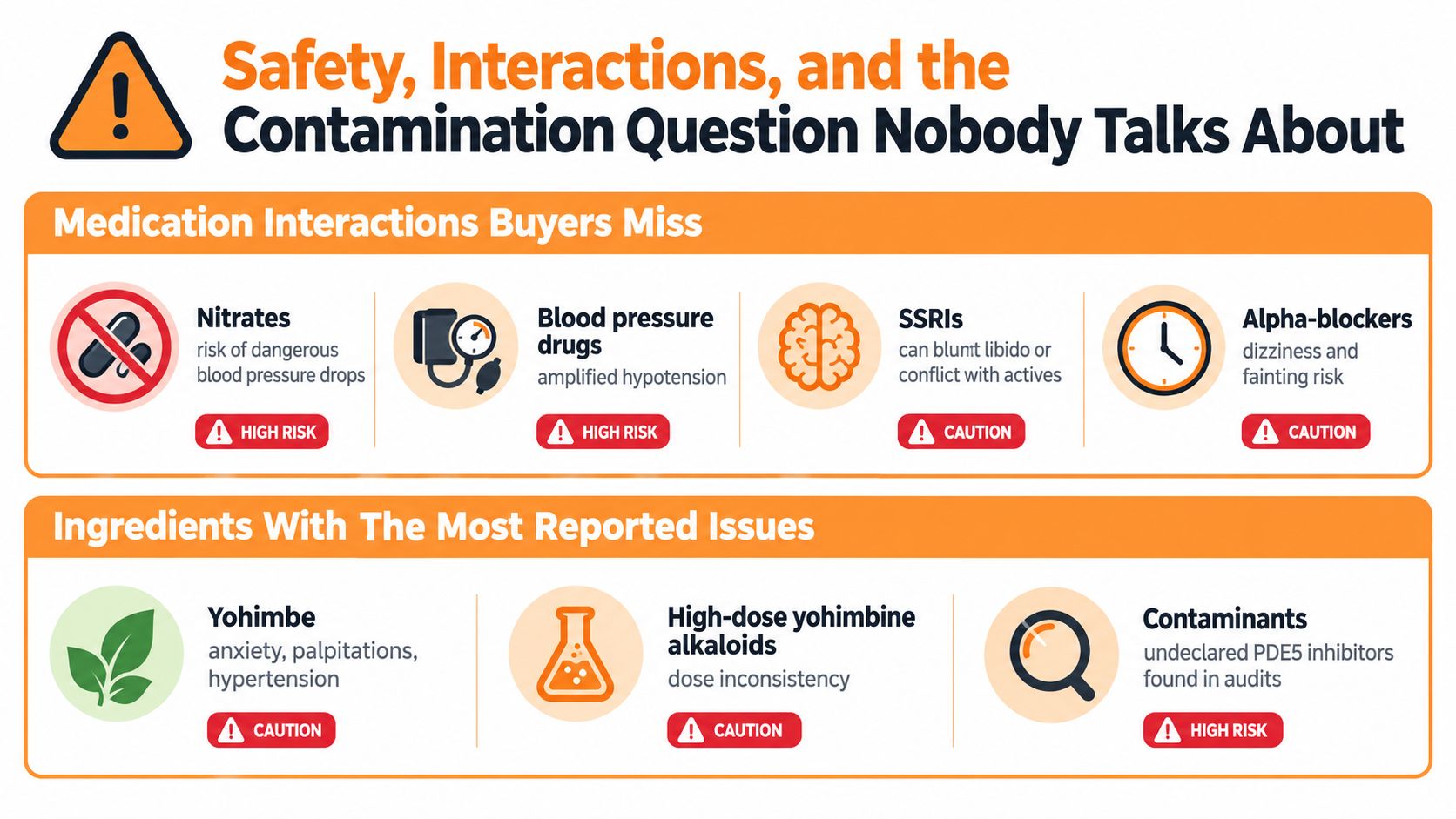
The FDA's sexual-enhancement notifications describe repeated warnings and recalls involving undeclared sildenafil, tadalafil, and sibutramine. NCCIH also notes that sexual-enhancement supplements have been found adulterated with drug ingredients that weren't listed on the label. That pattern makes purity testing and transparent sourcing central buying criteria, not optional extras.
Medication interactions require a real check
Men taking prescription medication shouldn't guess from a product page. Nitrates and undeclared PDE-5 drugs can create dangerous blood-pressure effects. Blood-pressure medication, alpha-blockers, and other circulation-active drugs can also create additive effects such as dizziness or fainting.
SSRIs raise a different concern. They can affect libido and sexual function, while a supplement containing stimulants or unverified actives may introduce an interaction that the label doesn't explain. Anyone taking prescriptions should show the full Supplement Facts panel to a pharmacist before starting a new formula.
Ingredients and labels that deserve suspicion
Yohimbe and concentrated yohimbine alkaloids have a reputation for anxiety, palpitations, hypertension, and inconsistent dosing. High-dose L-arginine may also be unsuitable for some people depending on medication and health status. Unregulated horny goat weed extracts create another problem because botanical identity, concentration, and adulteration controls can vary.
A risky label often includes several warning signs:
- Missing lot number: Without a lot identifier, a buyer has less ability to connect the product to testing or a recall.
- Proprietary blend: A total blend weight without individual doses prevents meaningful evaluation.
- Drug-like promises: Claims of instant or guaranteed performance suggest the product may be crossing the line from structure/function language.
- No interaction guidance: A serious formula should identify relevant cautions instead of leaving buyers to discover them after purchase.
- No testing documentation: A logo without a certificate, laboratory name, or batch connection is weak evidence.
Safety rule: Anyone using nitrates, blood-pressure drugs, SSRIs, alpha-blockers, or other prescriptions should consult a pharmacist before using a male enhancement supplement.
Matching a Product to Your Real Situation
The right formula depends on the outcome being prioritized. A man focused on semen volume shouldn't evaluate a product solely by its energy blend, while someone seeking daily vitality may not need a formula overloaded with prostate ingredients.
Volume support
Look for a transparent formula that identifies zinc, lecithin, and amino acids by amount. Zinc has a role in normal reproductive biology, but semen volume and fertility outcomes are separate questions. A product that makes both sound identical should be rejected.
Must-have markers: clear milligram dosing, cGMP manufacturing, and a batch or lot identifier.
Daily vitality
Adaptogens, B vitamins, maca, Panax ginseng, fenugreek, or similar ingredients may suit men interested in normal energy and stress resilience. The formula should disclose extract details and avoid hiding stimulating ingredients in a blend.
Must-have markers: independent testing and no proprietary blend.
Fertility-focused ingredients
A fertility-oriented buyer may look for zinc, selenium, folate, or coenzyme Q10, but the presence of those ingredients doesn't establish an improvement in pregnancy outcomes. The evidence is ingredient-specific and endpoint-specific, so a buyer should avoid formulas that treat semen volume as a substitute for fertility evaluation.
Must-have markers: purity documentation, allergen disclosure, and an honest distinction between reproductive support and medical treatment.
Workout confidence
Citrulline, L-arginine, and nitrate-precursor ingredients are more relevant to circulation and training-related blood-flow support. Stimulant disclosure matters because a product that combines circulation ingredients with hidden stimulants can be difficult to assess.
Must-have markers: full stimulant disclosure and batch testing.
General men's wellness
A broad formula may combine foundational minerals, antioxidants, and vitality botanicals. That can make sense for a buyer seeking an everyday routine, but a long ingredient list doesn't automatically make the product more useful.
Must-have markers: a complete label, transparent doses, and evidence that the manufacturer tests the finished product.
SEMEX is one example of a daily product positioned around semen volume and taste, using ingredients including zinc, L-arginine, sunflower lecithin, bromelain, maca root, Panax ginseng, ashwagandha, tongkat ali, saw palmetto, and horny goat weed. Its published product information describes vegan, non-GMO manufacturing in a cGMP-registered facility and third-party testing by Eurofins for microbes, heavy metals, and adulterants. Buyers should still match any formula to their own goal, medications, and quality requirements.
A Simple Decision Framework You Can Use on Any Label
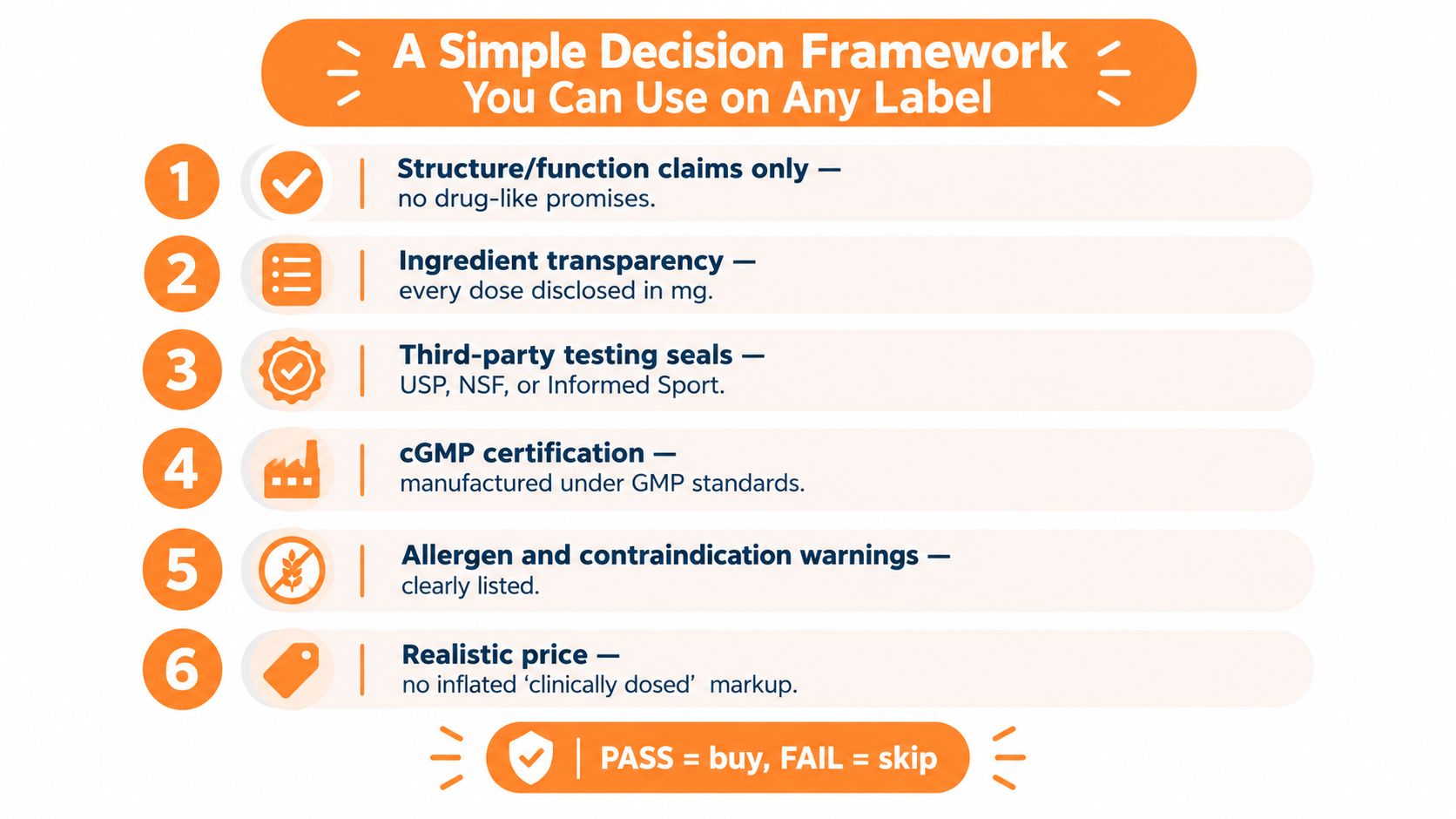
A good label review doesn't need to become a research project. Six checks can eliminate most weak options quickly.
- Read the claim language. Look for support, maintenance, and ingredient-function wording. Drug-like promises, instant results, and guaranteed outcomes are immediate warning signs.
- Demand ingredient transparency. Every active should show its amount in milligrams or another usable unit. A proprietary blend that hides doses fails this test.
- Verify independent testing. Look for a meaningful seal from organizations such as USP, NSF, ConsumerLab, or Informed Choice, then confirm that the program or certificate exists.
- Check cGMP controls. The manufacturer should identify its quality standards and provide a credible way to verify manufacturing compliance.
- Review dietary and safety fit. Vegan status, non-GMO verification, allergen information, stimulant disclosure, contraindications, and interaction warnings all belong in the decision.
- Compare the active dose, not the bottle price. A lower-priced bottle may provide less of the relevant ingredient, while a high-priced bottle might inflate its marketing. Compare the disclosed active amounts and testing support across products.
Run the shortlist head-to-head
Choose three finalists and place their labels side by side. Mark whether each one discloses individual doses, identifies botanical extracts, provides batch testing, explains cGMP manufacturing, lists allergens, and avoids hidden stimulants. The formula that survives the checks with fewer assumptions deserves consideration, even if it makes less dramatic promises.
A product should be skipped when it has missing batch information, unexplained proprietary blends, no credible testing evidence, or claims that sound more like a prescription advertisement than a supplement label. The objective isn't perfection. It's a defensible shortlist built around transparent ingredients, appropriate structure/function claims, and verifiable quality controls.
Men comparing a male enhancement supplement can review SEMEX's ingredient profile, manufacturing information, and testing details at SEMEX. The product is designed as a daily men's wellness formula with volume- and taste-focused ingredients, so it can be evaluated against the label standards outlined above.
These statements have not been evaluated by the Food and Drug Administration. This product is not intended to diagnose, treat, cure, or prevent any disease.