

Maca Root Capsules: A Clear Guide to Benefits and Use
Research on maca root capsules most often uses 1.5 to 3 grams per day, and the clearest recurring human signal is improved self-reported sexual desire in short trials, not a proven fertility benefit. That distinction matters because libido, testosterone, sperm quality, and pregnancy outcomes are separate questions.
Maca is an ancient Andean food in a modern delivery format. Its history reaches back to cultivation in the Peruvian Andes as far as 1600 BC, while its transition into an internationally marketed dietary supplement accelerated by the early 2000s (review of maca's history and research). Capsules make the root portable and easier to measure, but they don't turn limited evidence into a guarantee.
The most useful way to evaluate maca root capsules is to separate three issues: what maca is, what human studies measure, and whether a product's label supports a meaningful dose and consistent quality. The following guide keeps sexual desire, exercise-related outcomes, testosterone claims, and fertility evidence in their proper categories.
Table of Contents
- What Maca Root Capsules Are and Where They Come From
- How Maca Works Inside the Body
- What the Research Actually Shows About Benefits
- Capsule vs Powder and How to Choose a Format
- Practical Dosing, Timing, and Safety Basics
- Quality Markers Worth Checking Before You Buy
- Common Claims Worth Questioning
- Bringing It All Together and Using Maca Responsibly
What Maca Root Capsules Are and Where They Come From
Maca is a high-Andean root, Lepidium meyenii, used in Peru as both food and traditional medicine. Its history matters because capsules contain the same plant material in a newer delivery format, not a newly discovered ingredient. Maca later entered supplement markets in Japan, America, and Europe (historical and contemporary review).
Manufacturing determines what reaches the capsule. Producers typically dry the harvested root, mill it into powder, and fill a measured amount into a gelatin or plant-based shell. Some products use gelatinized maca, a heat-and-water process that removes part of the starch before drying. The final material may be easier to digest for some people, but it is not interchangeable with ordinary milled root.
Processing conditions also matter. Drying temperature, milling fineness, moisture control, and storage can affect powder consistency and stability. A label that lists only “maca root” leaves those details unclear, so capsule quality cannot be judged by the front label alone.

Why color appears on maca labels
Commercial products commonly identify three maca color phenotypes, yellow, red, and black. These labels describe differences in the root, but color alone does not show that one variety produces a particular libido or fertility outcome in humans. Those are separate questions, and neither should be answered by color marketing.
A named phenotype can still improve traceability. Compare it with the botanical identity, country or region of origin, processing method, serving amount, and whether the product contains plain powder or an extract. These details provide a more useful buying checklist than a color claim by itself.
Ancient ingredient, modern questions
Raw root, gelatinized root, and concentrated extract represent different materials. Treat the capsule as a delivery system, then check the ingredient form and dose independently. That distinction helps buyers assess whether a study's maca preparation resembles the product they are considering.
How Maca Works Inside the Body
Maca belongs to the cruciferous plant family and provides carbohydrates, protein, fiber, and smaller bioactive compounds. Its chemical profile includes ** macamides, macaenes, glucosinolates, alkaloids, and polyphenols**, which may help explain some observed functional effects (clinical safety and composition review).
The root works more like a multi-instrument musician than a soloist. Researchers have not established one compound as the complete explanation for every reported effect. Instead, the combined profile may matter, with phenotype and processing influencing which compounds remain and in what amounts.
Macamides are distinctive fatty-acid amides found in maca. They are often discussed because they may reflect maca's characteristic chemistry, but their presence does not prove a specific libido or fertility outcome in people. Macaenes are related unsaturated fatty acids. They contribute to the root's chemical profile, yet they should be treated as research markers rather than guaranteed active ingredients.
Why standardization matters
Two capsules can each list 500 milligrams while containing different materials. One may hold plain powdered root, while another uses a concentrated or gelatinized extract. Drying temperature, plant material, phenotype, and extraction method can change the final chemical profile.
A marker such as macamides may make products easier to compare, but it cannot substitute for human evidence. A measured marker is a description of composition, not proof of a particular clinical result.
Label details are covered in the buying checklist below. Maca is not generally treated as a direct hormone replacement, and human research has not established a reliable testosterone-raising effect at typical studied doses. “Hormone support” therefore should not be read as hormone replacement or a promise of a laboratory change.
What the Research Actually Shows About Benefits
The clearest human signal concerns sexual desire, especially self-reported desire rather than a direct reproductive outcome. A controlled study gave 3 grams per day of black or red maca extract for 12 weeks to 175 participants, showing that maca has been studied beyond very small pilot experiments (maca clinical research review).
A separate controlled crossover study followed 8 trained male cyclists for 14 days. Participants reported greater sexual desire than at baseline and with placebo. The study also recorded better 40-kilometer time-trial performance compared with baseline. Its small sample and short duration make the findings difficult to generalize.
What dose-finding adds
A pilot study compared 1.5 grams per day with 3 grams per day. The higher regimen produced the more pronounced improvement in sexual function (dose-finding study). This helps define the doses examined in research. It does not show that everyone needs the higher amount, or that benefits will continue rising as the dose increases.
The evidence base remains uneven. One review reported that 55 of 57 studies found some effect, while also identifying differences in maca phenotype, preparation, participant groups, and outcome measurement (maca research review). Those differences make results harder to compare across products and studies.
| Claim | Evidence strength | Typical dose | Key limitation |
|---|---|---|---|
| Sexual desire | More consistent short-trial signal | 1.5 to 3 g/day | Often self-reported, with limited long-term evidence |
| Exercise performance | Preliminary | Studied extract doses | Small studies and varied protocols |
| Testosterone | Not established | 1.5 to 3 g/day in typical trials | Direct hormone changes are not consistently demonstrated |
| Fertility | Inconclusive | Studied doses vary | Libido findings do not prove pregnancy or live-birth outcomes |
| Semen quality | Unclear overall | Studied doses vary | Meta-analysis did not show a statistically significant sperm-concentration improvement |
Libido and fertility require separate questions. A 2022 meta-analysis of five randomized controlled trials found maca's overall effect on semen quality unclear, with no statistically significant improvement in sperm concentration versus placebo. Its pooled weighted mean difference was 2.22, with a 95% confidence interval from -2.94 to 7.37 and p = 0.4 (2022 semen-quality meta-analysis).
For fertility concerns, ask a clinician which outcome should be evaluated, such as semen testing or another fertility assessment, rather than treating a change in sexual desire as evidence of improved reproductive outcomes.
Capsule vs Powder and How to Choose a Format
Capsules and powder contain the same root only when the labels describe comparable material. The practical choice usually comes down to dose control, taste, portability, and tolerance.
A capsule provides a pre-measured serving and avoids maca's earthy, bitter flavor. Powder works well in smoothies, oatmeal, and recipes, but accurate dosing requires a reliable milligram scale rather than a household spoon. Loose powder also gives cooks more flexibility, while capsules suit people who want a repeatable routine.
Capsules may use finely processed material, which can change how quickly the contents disperse during digestion. Encapsulation also adds processing and packaging costs, but convenience can make consistent use easier.
| Factor | Capsule | Powder |
|---|---|---|
| Dose control | Pre-measured by the label | Flexible, but weighing is preferable |
| Shelf storage | Convenient and portable | Requires a dry, sealed container |
| Taste | Largely concealed | Strong earthy flavor |
| Routine use | Simple for travel and daily habits | Better for recipes and shakes |
| High-dose flexibility | Requires several capsules | Easier to adjust, preferably with guidance |
A reader comparing products can also review maca root extract benefits to understand how extract language differs from plain root powder.
Capsules make the most sense for a label-driven routine, especially when the product identifies the amount of maca per serving. Powder may suit cooks or people who need flexible quantities, but high-dose protocols should be discussed with a qualified clinician.
Practical Dosing, Timing, and Safety Basics
Human studies commonly assess maca root capsules or comparable preparations at 1.5 to 3 grams per day. If one capsule contains 500 milligrams, that equals three to six capsules daily, not two to four. The label's milligram amount is the starting point for calculation because capsule strengths vary.
Begin at the lower end and take maca with food if it causes stomach discomfort. Splitting the daily amount between morning and later in the day may also make the routine easier to tolerate. A capsule schedule should be judged by the amount of maca delivered, not by the number of capsules alone.
A measured trial
Research has generally followed maca use over several weeks rather than assessing one serving. A personal trial can therefore run for four to twelve weeks, followed by a review of changes and side effects. The evidence includes a 12-week controlled trial and a dose-finding study that examined consistent use over time (clinical trial evidence; dose-finding evidence).
Timing is flexible:
- Morning: Useful for observing daytime energy or possible stimulation.
- Split dosing: May feel gentler than taking the full amount at once.
- Before exercise: Some users prefer this timing, but research has not established a universal performance schedule.
Gelatinized maca has been heat-treated and may be easier for some people to digest than raw maca. Study form matters, so raw powder, gelatinized maca, and extracts should not be treated as interchangeable. A product's format can affect how closely its use matches the preparation examined in research.
Who should ask a clinician first
Reported concerns include gastrointestinal upset, headache, insomnia, sweating, and other mild symptoms. The NCBI safety review describes reported side effects as uncommon and mild, and says maca has not been convincingly linked to liver injury.
People with hormone-sensitive conditions or thyroid disease should seek medical advice before use. The same applies to anyone taking hormone therapy, SSRIs, anticoagulants, or thyroid medication. Pregnant or breastfeeding individuals should avoid maca because human safety data remain inadequate.
A clinician can also check whether low libido, low energy, or fertility concerns need a broader evaluation. Those goals overlap in marketing, but they are not the same question, and a dosing routine cannot replace assessment of an underlying problem. For practical comparison of serving amounts, readers can review maca root dosage for men and match any routine to the product's actual label.
Quality Markers Worth Checking Before You Buy
A maca capsule should make comparison easy. The label needs to show the amount per serving, rather than hiding maca inside a proprietary blend or a vague “men's wellness complex.” Without that information, matching the product to human dosing research becomes difficult.
Purchasing signals that matter
Earlier sections covered botanical identity and preparation. For buying decisions, focus on whether the manufacturer can document what happened to the finished batch.
Look for a certificate of analysis (CoA) connected to the product's lot number. A useful CoA should identify the tested material, report results, name the laboratory, and state whether testing covered identity, potency, heavy metals, microbes, or adulterants. A downloadable document with no lot connection offers less practical evidence.
The laboratory's qualifications also matter. ISO-17025 accreditation indicates a testing laboratory operates under recognized competence requirements for specific tests. USP or NSF marks may provide useful context when the organization and certification scope are clear. An unexplained quality badge does not show what was examined.
Manufacturing information adds another layer. cGMP controls address how supplements are produced, handled, documented, and checked for consistency. They do not prove that maca will improve libido or fertility, and they do not replace batch-specific testing. Treat them as manufacturing safeguards, not outcome evidence.
Details that make a label easier to assess
The label should state maca's quantity in milligrams or grams per serving and identify the product's form in a concise way. Raw maca, gelatinized maca, and extracts may differ in preparation and concentration, so the form helps you judge whether the capsule resembles the material studied.
Check the expiration date, allergen statement, capsule-shell material, and testing scope. A vegan shell may matter for dietary reasons, but it says nothing about maca potency. Buyers who want a practical explanation of verification can review supplement purity testing.
Buying principle: A transparent label cannot guarantee a benefit. It can show whether the product is identifiable, traceable, and reasonably comparable before purchase.
Common Claims Worth Questioning
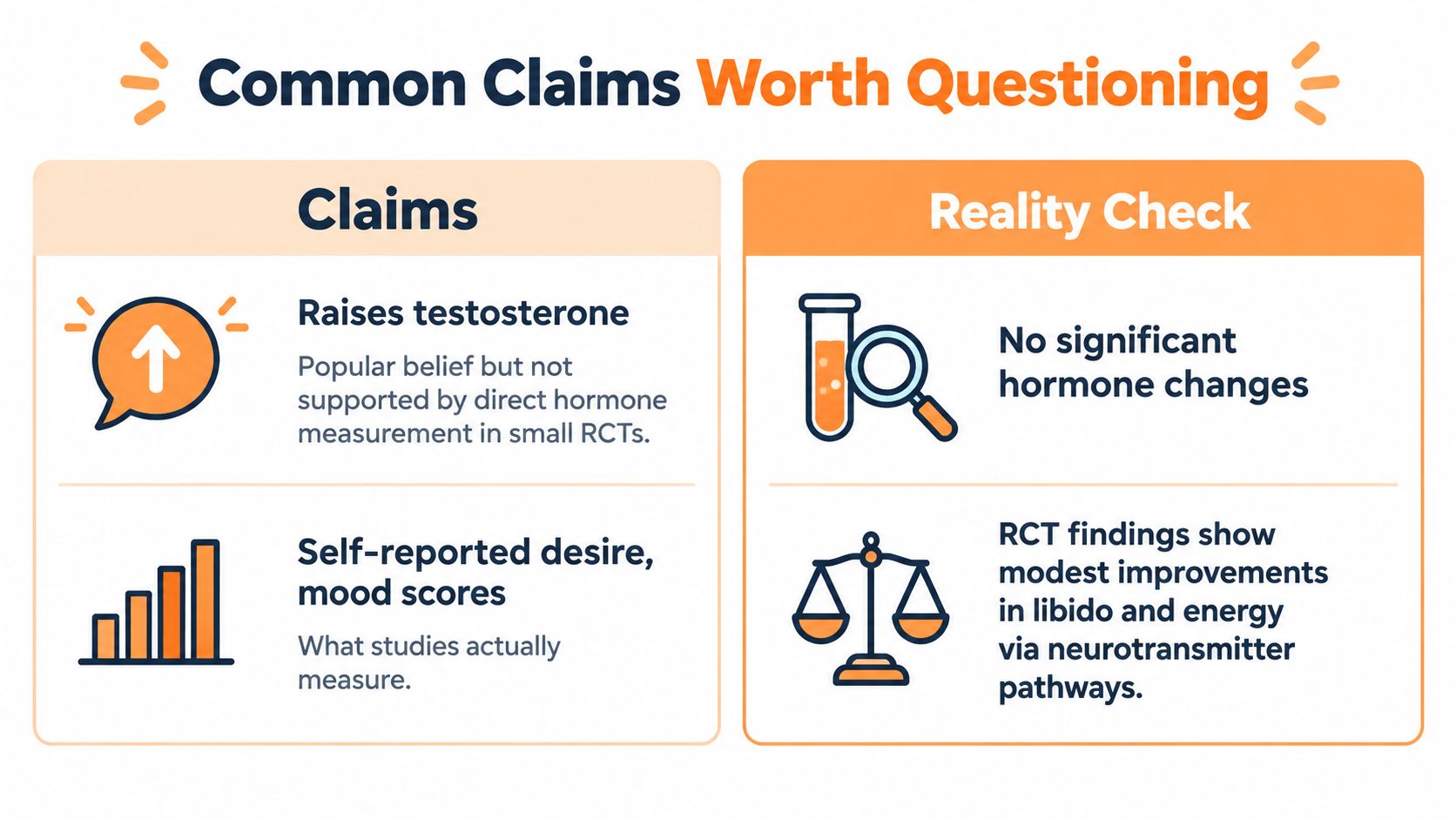
A capsule label can turn a modest research signal into a promise about hormones or fertility. Separating sexual desire from reproductive outcomes makes the claims easier to judge.

“Maca raises testosterone”
That wording exceeds what human research can support. Studies may report changes in self-reported desire, mood, or perceived energy, while direct measures of testosterone and other reproductive hormones do not provide a consistent basis for a testosterone-boosting claim.
Libido is more like a dashboard with several inputs than a single hormone switch. Sleep, stress, mood, relationship context, and nervous-system signaling can all affect sexual interest. Someone may notice greater desire without a measurable testosterone change.
Persistent changes in sexual function, energy, or mood warrant medical evaluation. A maca capsule should not replace assessment for a possible hormone disorder.
“Maca fixes fertility”
Fertility claims often combine separate endpoints under one reassuring phrase. Labels may say maca “supports male fertility,” “promotes reproductive health,” or “supports sperm quality.” Those phrases should not be read as proof of higher sperm concentration, better motility, conception, or pregnancy rates.
The meta-analysis covered earlier leaves the semen-quality picture uncertain. Encouraging preliminary findings, where present, still do not establish a fertility treatment or replace semen analysis and appropriate care.
A more precise description is that maca may support subjective sexual wellbeing, with possible but unconfirmed relevance to broader reproductive health. Capsule buyers should reject wording that turns desire into fertility, or a research signal into a guaranteed outcome. That distinction keeps the product's potential in proportion to the evidence.
Bringing It All Together and Using Maca Responsibly
A responsible maca routine starts with the label and a defined goal, not a marketing promise. Libido and fertility are separate questions, so track them separately and judge the capsule by its preparation, dose, and testing details.
- Choose a clearly identified preparation. Look for raw or gelatinized maca with Lepidium meyenii, the phenotype, country of cultivation, and any stated marker compounds, such as macamides.
- Start at the lower research range. About 1.5 grams daily, divided into two servings with food, offers a cautious starting point. With 500-milligram capsules, that equals three capsules per day.
- Adjust only if tolerated. If the lower amount causes no digestive, sleep, mood, or headache concerns, a person may move toward 2 to 3 grams daily. More is not automatically better. Staying within amounts studied in humans makes dose changes easier to evaluate.
- Reassess rather than assume. Review the routine after eight to twelve weeks, focusing on the original goal. Increased desire does not demonstrate improved fertility, and worsening sleep, mood, sweating, or digestion is a reason to stop and seek advice.
Maca root capsules are intended for adults. People taking thyroid medication or hormone therapy, or those with hormone-sensitive conditions, should consult a clinician before use. Pregnant or breastfeeding individuals should avoid maca because safety evidence is lacking.
SEMEX is one men's wellness option containing maca root extract alongside zinc, L-arginine, sunflower lecithin, bromelain, and other botanical ingredients. It is vegan, non-GMO, made in the USA in a cGMP-registered facility, and third-party tested by Eurofins. These details let buyers compare its formulation and testing with other products, rather than treating maca as a fertility solution.
These statements have not been evaluated by the Food and Drug Administration. This product is not intended to diagnose, treat, cure, or prevent any disease.
Readers comparing capsules with broader men's wellness formulas can review the ingredient and testing information from SEMEX. Use the product page to check whether its maca-containing formula matches your goals, dietary preferences, and quality checklist.