

Libido Booster Pills: How to Compare Ingredients and Choose
You're standing in front of a wall of libido booster pills. Every bottle promises confidence, stamina, testosterone support, or a stronger sex drive. The labels look different, but the formulas often circle the same handful of herbs, minerals, and amino acids, presented in different combinations and with very different levels of transparency.
The smart buyer doesn't choose by bottle design or the boldest promise. He reads the Supplement Facts panel, checks the dose, identifies the evidence behind each ingredient, and screens for interactions and adulteration risks. The aim isn't to find a magic capsule. It's to find the smallest, clearest formula that matches the actual problem.
Table of Contents
- Why Comparing Libido Booster Pills Starts With Ingredients
- The Libido Supplement Category at a Glance
- What the Research Says About Each Core Ingredient
- Matching Ingredients to the Real Problem You're Solving
- The Buyer's Safety and Quality Checklist
- Choosing the Right Pill for Your Situation
- A Simple Decision Rule Before You Buy
Why Comparing Libido Booster Pills Starts With Ingredients
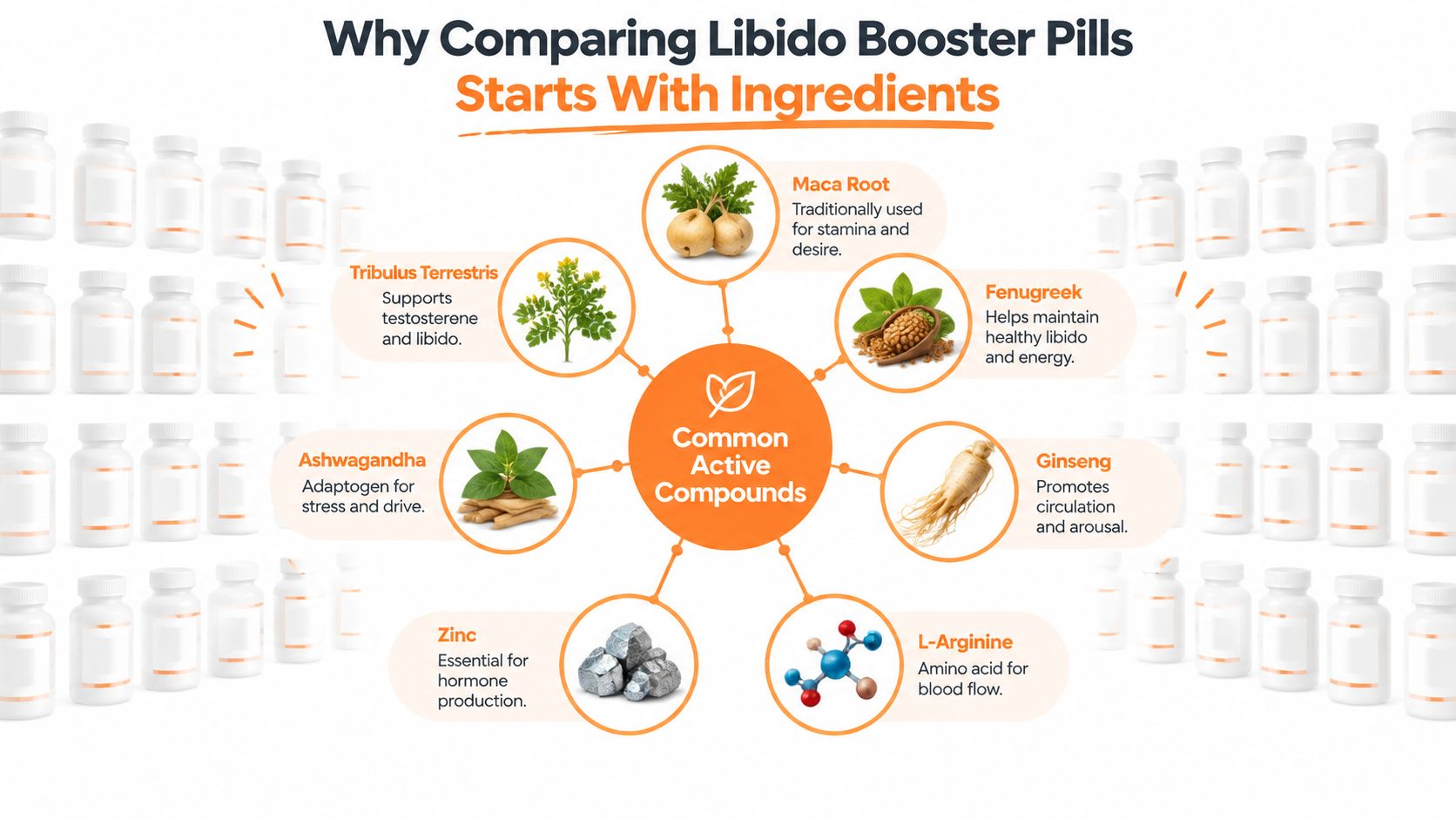
You are comparing two libido booster pills. One lists maca, ginseng, zinc, fenugreek, tongkat ali, horny goat weed, L-arginine, and ashwagandha with exact amounts. The other uses a proprietary blend and promises broader results. The first label gives you something to evaluate. The second asks you to trust marketing.
These formulas repeatedly use the same herbs, minerals, and amino acids, but their extracts, doses, and evidence can differ sharply. Ingredient-level comparison beats brand-level marketing because a polished bottle cannot fix an undisclosed dose, a weak extract, or a crowded formula built on limited human research. Start with the Supplement Facts panel, then judge each ingredient by its evidence grade, typical research dose, and safety flags.
Read the panel like an auditor
Use this four-step check:
- List every active ingredient. Set aside the front-label promise until you can see the complete formula.
- Find the amount per serving. Treat “proprietary blend” as a warning because it hides each component's dose.
- Match the dose to human research. Plausible biology does not make a low-dose ingredient effective.
- Check the safety context. Review blood-pressure effects, bleeding risk, medication interactions, and the possibility of hidden drug ingredients.
Then identify the pill's intended job. A nitric-oxide formula addresses a different target from one focused on stress regulation or nutritional repletion. A single “libido” label can conceal very different approaches, so avoid buying a kitchen-sink formula without knowing which problem its ingredients are meant to address.
Practical rule: Explain what each major ingredient is meant to do, how much the pill supplies, and which conditions or medicines could make it unsuitable.
Evidence grades make comparisons quicker. An A-grade ingredient has reasonably consistent human evidence for a relevant outcome. A B-grade ingredient has promising but limited or conditional support. C and D grades signal contradictory, insufficient, or negative evidence. In one review of ingredients used in testosterone and erectile-dysfunction supplements, only 19% of reviewed ingredients received an A grade, while 68% fell into C or D categories, as reported in the ingredient evidence review. Use those grades as a filter, not as a substitute for checking dose and safety.
The Libido Supplement Category at a Glance
You are comparing libido pills in a crowded market, with labels promising testosterone support, stronger erections, more energy, better stamina, or improved sexual desire. One independent industry report valued global men's sexual wellness products at $14.8 billion in 2025 and projected $28.6 billion by 2034. Supplements represented 14.6% of the market in 2025, with projected growth at an 8.4% CAGR from 2026 to 2034, according to global men's sexual wellness market data.
Libido-focused products are a major part of that market. Libido-enhancement products held 17.8% of men's vitality supplements in 2025, showing that desire-focused formulas are sold as a core category rather than a minor add-on. That commercial demand gives manufacturers room to use broad promises. It does not confirm that a particular capsule works.
| Data Point | What It Means for Buyers |
|---|---|
| Global men's sexual wellness products were valued at $14.8 billion in 2025 | Buyers face a mature, crowded category rather than a small niche |
| The market is projected to reach $28.6 billion by 2034 | More products and stronger marketing pressure are likely |
| Supplements held 14.6% share in 2025 | Supplement formulas are a meaningful part of men's sexual wellness purchasing |
| Libido products held 17.8% of men's vitality supplements in 2025 | Libido support is a central category, not a minor add-on |
| Supplements are projected to grow at an 8.4% CAGR from 2026 to 2034 | Label literacy will become more important as product choice expands |
Safety requires separate scrutiny. The FDA reports that products marketed for sexual enhancement, male enhancement, erectile dysfunction, stamina, or sexual dysfunction have contained dangerous hidden ingredients. A 2013 FDA warning identified undeclared sulfoaildenafil and dimethylsildenafil in CONTROL All Natural Sexual Enhancement. These compounds are structurally similar to sildenafil and can interact with nitrates, causing a dangerous drop in blood pressure. Later FDA actions identified sildenafil in JACK'D Sexual Enhancement Liquid in 2022, announced recalls involving sildenafil and tadalafil in 2024, and warned about products containing sildenafil, tadalafil, or high levels of yohimbine in 2026, as detailed in the FDA sexual enhancement product notifications.
Treat “natural” as a marketing description, not a safety certificate. Here, a libido booster pill means an orally consumed dietary supplement marketed to support sexual desire, arousal, erection quality, vitality, or related male wellness goals. It has not been evaluated like a prescription medicine.
For broader context, what libido support means can include desire, arousal, erection-related concerns, and general sexual wellbeing. Use that distinction when judging whether a product's ingredients match the result you want.
What the Research Says About Each Core Ingredient
The ingredient list deserves a harder look than the front label. Human evidence varies sharply, and a formula containing many compounds isn't automatically stronger. One review of online erectile-dysfunction supplements found an average of 8.2 ± 4.3 active ingredients, a pattern that illustrates how multi-ingredient formulas can combine a few plausible components with several poorly supported additions, according to the review of male sexual-health ingredients.
| Ingredient | Primary Mechanism | Typical Dose | Evidence Grade | Key Safety Note |
|---|---|---|---|---|
| Zinc | Reproductive function and nutritional support | 15 to 30 mg | B, conditional | Excess intake can create problems; consider total daily intake |
| Maca | Desire and subjective sexual wellbeing | 1,500 to 3,000 mg | B | Evidence is more consistent for self-reported desire than a defined mechanism |
| Panax ginseng | Circulation and sexual function | 900 to 1,000 mg | B | May increase bleeding risk with anticoagulants |
| Tongkat ali | Stress and testosterone-related support | 200 to 400 mg | B to C | Extract quality and standardization matter |
| Horny goat weed | Icariin and PDE5-related activity | Label-dependent | C | Human evidence is thin; cardiovascular interactions are possible |
| Fenugreek | Libido and energy support | Label-dependent | C | Extract strength varies widely |
| Tribulus terrestris | Libido and testosterone-related signaling | Label-dependent | C | Testosterone claims are stronger than the human evidence |
| Ashwagandha | Stress regulation and adaptive support | Label-dependent | B, conditional | Use caution with medicines and thyroid-related concerns |
| L-citrulline | Nitric-oxide and blood-flow support | Label-dependent | B, outcome-specific | May affect blood pressure |
Ingredients with the clearest practical case
Zinc earns a place when intake is inadequate or deficiency is plausible. It plays important roles in spermatogenesis, sperm development and maturation, ejaculation, liquefaction, sperm binding, capacitation, and fertilization, while low seminal zinc is associated with low sperm count and poorer sperm quality, according to the peer-reviewed review of zinc and male reproductive function. That doesn't make zinc a universal libido enhancer, and a NIH-reviewed study found that zinc plus folic acid marketed for male infertility didn't improve pregnancy rates, sperm counts, or sperm function, as reported by NICHD.
Maca has a reasonable B-grade case for subjective desire, particularly at 1,500 to 3,000 mg daily, but the evidence is better for reported interest and sexual wellbeing than for a clear hormone effect. Buyers should treat it as a desire-support ingredient, not a guaranteed testosterone booster.
Panax ginseng has some of the stronger male sexual-function support among the common botanicals. Typical labels use 900 to 1,000 mg, but extract preparation matters. It can be a poor choice for anyone taking anticoagulants because of possible bleeding concerns.
Ingredients that require more skepticism
Tongkat ali is usually positioned around cortisol-mediated testosterone support, with commonly cited doses of 200 to 400 mg. The label should identify a standardized extract and provide testing information. A generic “tongkat ali blend” tells the buyer too little.
Horny goat weed contains icariin, a compound discussed for PDE5-related activity. The mechanism is interesting, but human evidence remains thin, and products may create cardiovascular concerns, especially when combined with medications that affect blood pressure or erectile function.
Fenugreek may support libido and energy in some formulations, but extract concentration and study quality vary. Tribulus terrestris has a familiar testosterone reputation, yet its marketing is more confident than its human evidence. Both belong in the C-grade category unless a product provides a compelling, transparent rationale.
Ashwagandha is more persuasive when stress, poor recovery, or mental overload sits behind reduced desire. It shouldn't be sold as a universal sexual-performance ingredient, and medication use or thyroid concerns warrant professional review.
L-citrulline supports nitric-oxide production and belongs in the blood-flow category rather than the direct-desire category. L-arginine, a related nitric-oxide precursor, has more specific evidence: a 2019 systematic review and meta-analysis found that 1,500 to 5,000 mg improved erectile-dysfunction outcomes versus placebo or no treatment, with a pooled odds ratio of 3.37, a 95% confidence interval of 1.29 to 8.77, and P = .01, as reported in the systematic review of arginine supplementation. The same analysis found improvements in several erectile-function domains, but sexual desire didn't change, which is the critical distinction.
Readers comparing formulas can also use this male enhancement ingredient guide. A product such as SEMEX includes several ingredients discussed above, but its presence on a label doesn't replace the need to evaluate dose, evidence, testing, and personal suitability.
Matching Ingredients to the Real Problem You're Solving
A libido pill should be selected by the job it's expected to perform. Desire, erection quality, stress, and nutrient status overlap, but they aren't interchangeable targets.
| Symptom or Goal | Best-Fit Ingredient Class | Lead Ingredients | Typical Dose Range | Time to Notice Effect |
|---|---|---|---|---|
| Desire feels muted, with no obvious mechanical issue | Desire and arousal support | Maca, fenugreek, tribulus | Maca, 1,500 to 3,000 mg daily | Several weeks of consistent use |
| Arousal is present, but erection quality is inconsistent | Nitric-oxide and blood-flow support | L-citrulline, L-arginine, horny goat weed | L-arginine, 1,500 to 5,000 mg in the reviewed evidence | Can be gradual; judge by consistent use |
| Stress, poor recovery, or mental overload is suppressing interest | Adaptogenic support | Ashwagandha, rhodiola, Panax ginseng | Product-specific and extract-dependent | Several weeks |
| Bloodwork or diet suggests a nutrient gap | Deficiency support | Zinc, vitamin D | Zinc commonly 15 to 30 mg | Depends on correcting the underlying gap |
| Concern centers on testosterone | Hormone-related support | Zinc, vitamin D, D-aspartic acid, tongkat ali | Product-specific | Reassess rather than assuming a quick effect |
If morning desire has faded while stress and poor sleep dominate, an adaptogen-led formula is more logical than a stimulant-heavy blend. If desire is intact but erection mechanics are unreliable, nitric-oxide support deserves greater attention than a pill marketed only around testosterone.
Deficiency changes the decision again. Zinc makes sense as nutritional support when intake is low, but it shouldn't be presented as a proven fertility treatment. Vitamin D belongs in the same conditional category. The buyer with abnormal bloodwork needs to address the documented issue rather than stack every popular ingredient.
The most useful question isn't “Which pill boosts libido?” It's “Which part of sexual function is actually underperforming?”
Time horizon matters because supplements rarely behave like on-demand medication. A buyer assessing a botanical or nutrient formula should use consistent daily habits and realistic expectations, while persistent or sudden changes deserve clinical evaluation. A supplement can support nutritional and lifestyle gaps, but it can't explain an unexplored hormonal, vascular, psychological, or medication-related issue.
The Buyer's Safety and Quality Checklist
A serious product makes verification easy. A risky product asks the buyer to trust a dramatic promise, a proprietary blend, and a vague “natural” claim.
Start with independent testing
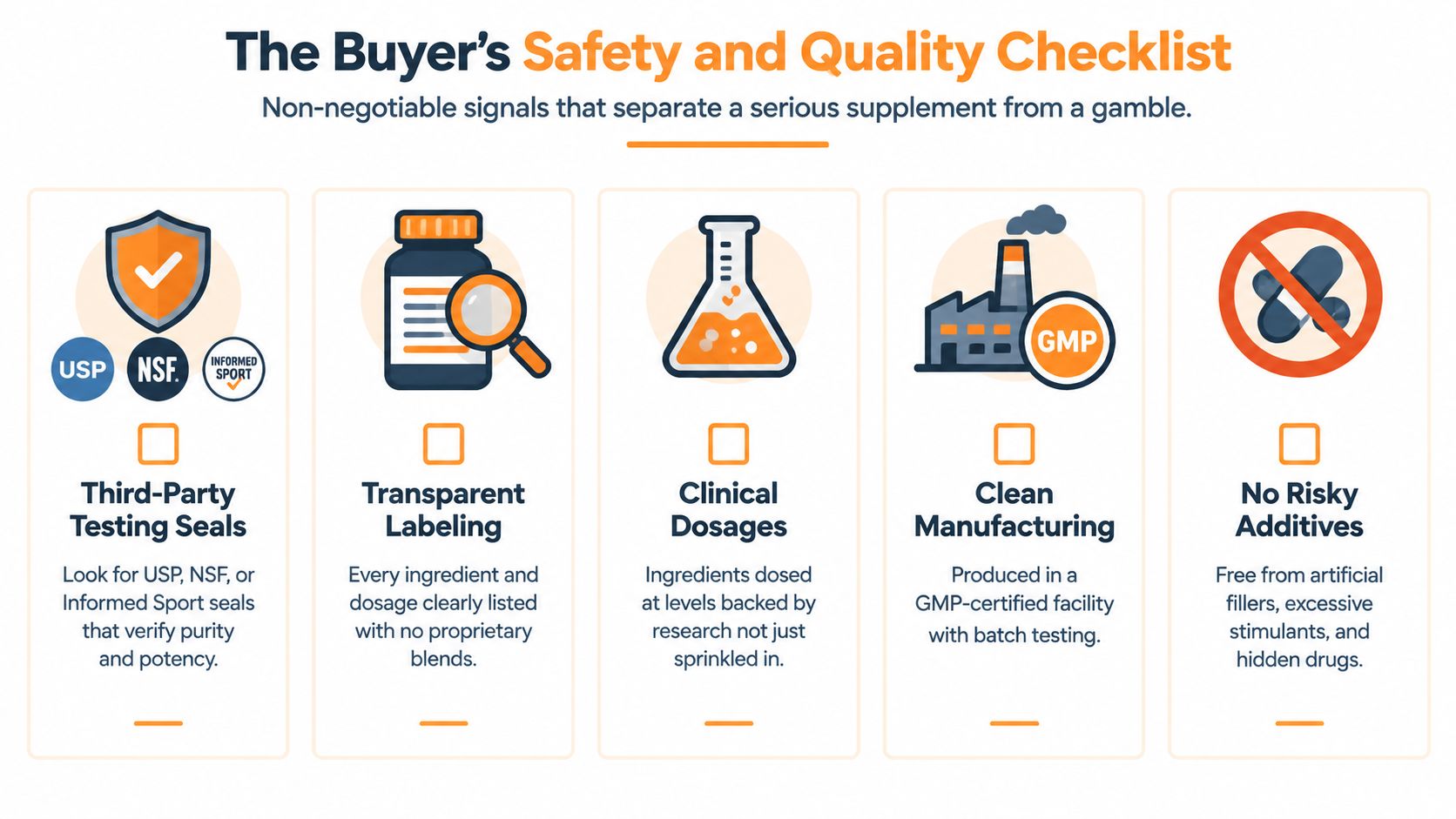
Look for recognized third-party testing marks such as USP, NSF, or Informed Sport. These programs can verify aspects of identity, purity, potency, and manufacturing controls, depending on the specific certification. A logo printed on a bottle isn't enough. Buyers should confirm that the certification applies to the product and not merely to an ingredient supplier or manufacturing facility.
A transparent label lists every active ingredient and its amount. Proprietary blends fail that test because the total blend weight may be shown while individual doses remain hidden. Recognizable standardized extracts, such as KSM-66 or LJ100 when used, offer more useful information than a generic herb name, although standardization alone doesn't prove that an ingredient will deliver the advertised outcome.
Inspect manufacturing and formulation
cGMP manufacturing indicates that the facility follows current good manufacturing practices. An FDA-registered facility is a manufacturing-status detail, not an FDA endorsement of a product's efficacy or safety. Buyers should also separate meaningful quality claims from lifestyle preferences. Vegan, gluten-free, and allergen statements may matter personally, but they don't substitute for batch testing.
Sexual enhancement supplements deserve extra scrutiny because FDA enforcement has repeatedly involved hidden sildenafil, tadalafil, and related compounds. The FDA's enforcement history makes one point unavoidable: a product marketed as a supplement may still carry undisclosed pharmacological risk.
Skip the gamble: If a bottle hides doses, promises an instant transformation, or avoids independent testing, the correct buying decision is to leave it on the shelf.
A printable buyer checklist
- Confirm certification: Look for a verifiable USP, NSF, or Informed Sport mark.
- Demand full dosing: Every active ingredient should have an exact amount.
- Reject mystery blends: Proprietary blends prevent meaningful comparison.
- Check extract identity: Standardized forms are easier to evaluate than vague botanical names.
- Review interactions: Pay special attention to blood pressure, nitrates, anticoagulants, and erectile-function medicines.
- Inspect batch information: The company should make lot-level quality information accessible.
- Question extreme claims: “Instant,” “prescription strength,” and “no side effects” are poor substitutes for evidence.
- Check the facility: cGMP manufacturing is a baseline quality signal, not a performance guarantee.
- Keep the formula focused: More ingredients create more opportunities for weak evidence and interactions.
- Ask a clinician when symptoms persist: A recurring sexual-health change may need evaluation beyond supplementation.
For a closer look at verification standards and testing practices, readers can review third-party supplement verification.
Choosing the Right Pill for Your Situation
The stressed professional in his 30s or 40s usually doesn't need a label packed with exotic stimulants. If poor sleep, heavy workload, and mental fatigue have flattened sexual interest, an ashwagandha-centered formula with sensible nutritional support may be more rational than a product shouting about testosterone. The useful test is whether the formula addresses stress and recovery without hiding its doses.
The over-40 trainee has a different decision. He may still want desire, but erection quality and workout-related circulation may matter just as much. A citrulline-led formula, possibly paired with pine bark or horny goat weed, fits that objective more directly than a broad testosterone stack that may not address blood flow. Horny goat weed requires more caution because its PDE5-related discussion doesn't eliminate interaction risk.
The man over 50 who takes blood-pressure or cholesterol medication should put safety ahead of novelty. A low-complexity, well-tested formula deserves consideration only after medication interactions are reviewed. Panax ginseng, nitric-oxide precursors, horny goat weed, and other circulation-oriented ingredients may not be suitable for every medication profile.
The right formula is usually the smallest one that matches the actual problem.
That principle prevents unnecessary stacking. A man with a documented nutrient gap shouldn't chase a dozen botanicals, and a man with stress-related low desire shouldn't assume that more testosterone language will solve it. Persistent changes, pain, medication side effects, or major shifts in sexual function call for a healthcare conversation rather than endless product trials.
A Simple Decision Rule Before You Buy
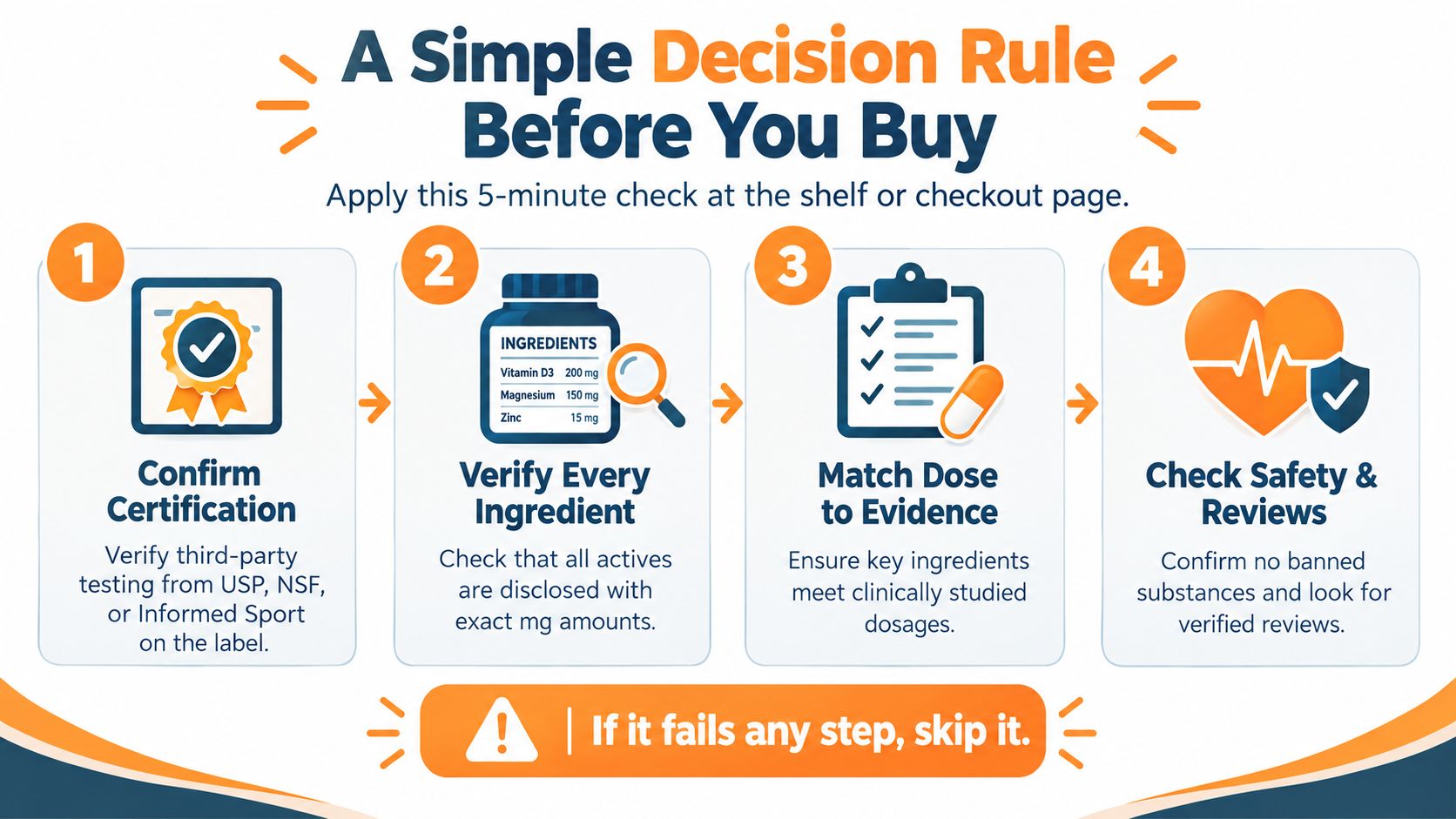
A five-minute screen can eliminate most poor choices. First, confirm a real third-party certification. Next, verify that every important active ingredient has an exact amount and a dose that resembles the human research. Then scan for proprietary blends, extravagant promises, and ingredients that could conflict with current medication.
The final check is personal suitability. A product may look transparent yet still be inappropriate for someone using nitrates, anticoagulants, blood-pressure medicines, or other treatments that affect circulation. If the formula fails any part of that review, it should be skipped.
No libido booster pill is a magic switch. Consistent daily use may be needed for four to eight weeks, but expectations must match the likely cause, whether nutritional, stress-related, hormonal, or vascular. Persistent low libido, sudden changes, erectile difficulties, pain, or other concerning symptoms warrant clinical evaluation because supplements don't replace assessment of an undiagnosed health issue.
Readers who want to compare a men's wellness supplement against the ingredient and testing standards discussed here can visit SEMEX. The product combines ingredients including zinc, L-arginine, maca root, Panax ginseng, ashwagandha, tongkat ali, and horny goat weed, so the same label-auditing approach should be applied before purchase.
These statements have not been evaluated by the Food and Drug Administration. This product is not intended to diagnose, treat, cure, or prevent any disease.