

L Arginine Supplement Side Effects
A man can stand in front of a supplement shelf, read “L-arginine,” and still have no clear idea whether the product is appropriate for him. The label may mention blood flow, exercise, or nitric oxide, while the warnings mention nausea, dizziness, and interactions with medication. The important question isn't only which symptoms can occur. It's whether L-arginine fits with a person's current medicines, health conditions, and total daily intake.
Most reported problems are mild and dose-related, but that doesn't make every situation interchangeable. Short-term moderate use is commonly tolerated, while higher amounts, cardiovascular medicines, blood-pressure effects, and certain medical histories require a more careful review. The following guide focuses on how to read the product, understand the mechanism, and identify when a pharmacist or clinician should be involved.
Table of Contents
- Reading the Label the Smart Way
- How L-Arginine Works in the Body
- Dose Ranges and What Changes With Them
- Common Side Effects to Watch For
- Medication and Health Condition Interactions
- Special Cases Worth a Second Look
- A Simple Safety Checklist Before You Start
Reading the Label the Smart Way
A reader comparing two bottles may notice that one says L-arginine, another says L-arginine HCl, and a third lists arginine alpha-ketoglutarate. Those names can make the side-effect information look more complicated than it is. The first task is to find the actual amount of arginine supplied per serving, rather than focusing on the size of the capsule, powder scoop, or proprietary blend.
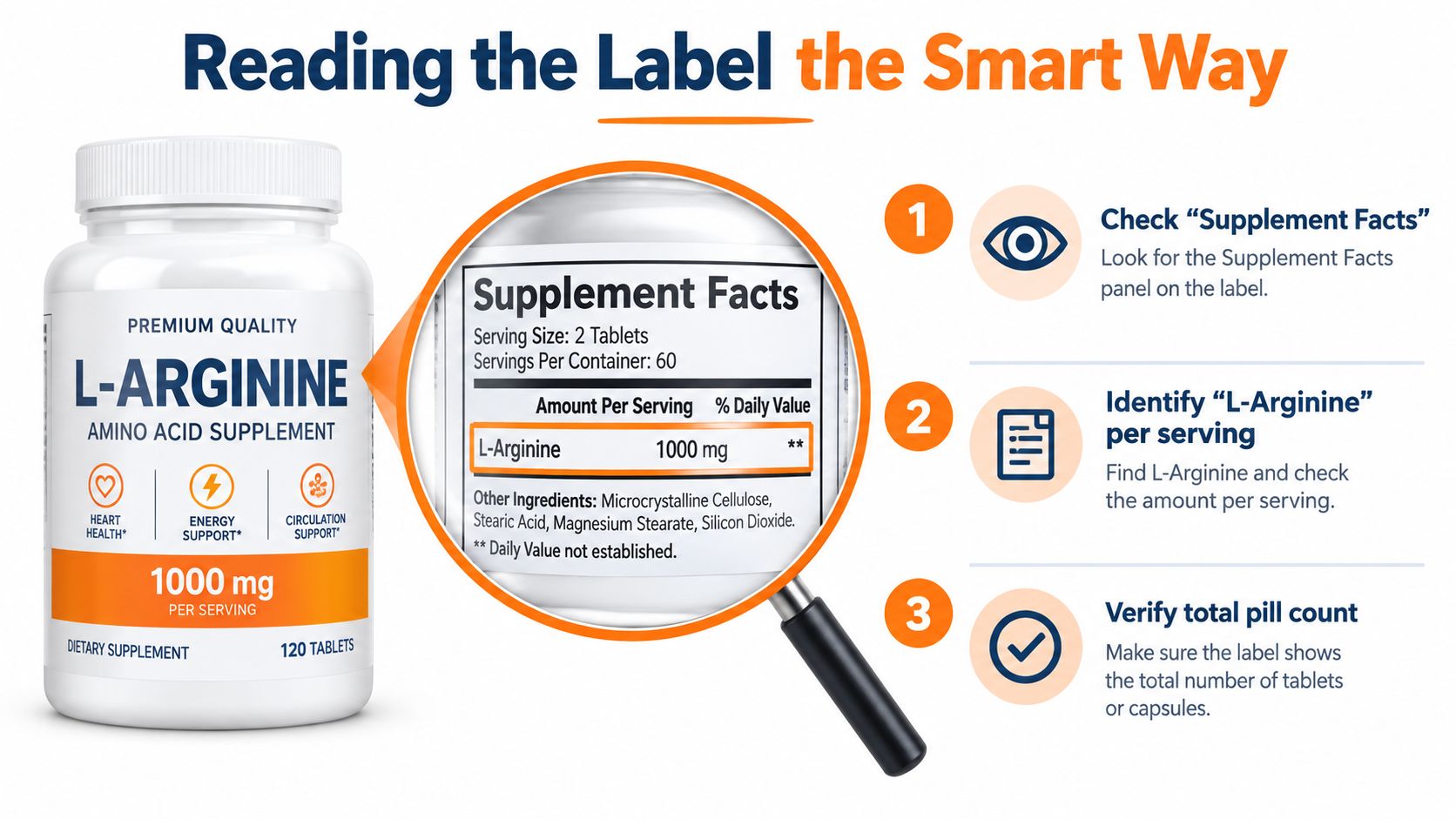
The Supplement Facts panel should show the serving size and the amount of the active ingredient. A serving of several capsules can contain a substantially different total amount from a single-capsule serving, so the capsule count matters. If a product uses a blend, the panel may not make the individual amount of L-arginine clear, which makes it harder to compare the product with research using gram-level doses.
Separate arginine from the extras
The form of arginine can affect how the product is labeled, but the practical safety check remains the same. A person should identify the form, the amount per serving, and the number of servings used each day. Total intake can rise when someone combines a standalone arginine product with a pre-workout, performance formula, or men's wellness blend.
The rest of the ingredient list deserves equal attention. Caffeine blends, sweeteners, flavoring agents, herbal stimulants, and fillers may cause symptoms that get mistakenly blamed on L-arginine. For example, insomnia or jitteriness may point toward a stimulant in the formula rather than the amino acid itself.
Label rule: The active dose is only one part of the safety review. The full ingredient panel shows what else may affect digestion, sleep, heart rate, or blood pressure.
A supplement label is a starting point, not a medical clearance. Products can also vary in manufacturing quality, so independent testing seals such as USP, NSF, or ConsumerLab can provide additional information about identity and purity. A practical explanation of serving sizes and ingredient panels appears in this guide to reading supplement labels. The label should be checked before a person considers whether the warnings apply to him.
How L-Arginine Works in the Body
A person may add L-arginine for exercise, circulation, or sexual health support while already taking other products or medicines. Understanding its biological pathway helps explain why the safety question depends on more than a symptom list.
L-arginine participates in the body's nitric-oxide pathway. L-arginine is the raw material, nitric oxide synthase is the processing system, and nitric oxide is the signal that tells blood-vessel walls to relax. The process resembles a production line: one substance supplies the material, another helps process it, and the final signal affects circulation.
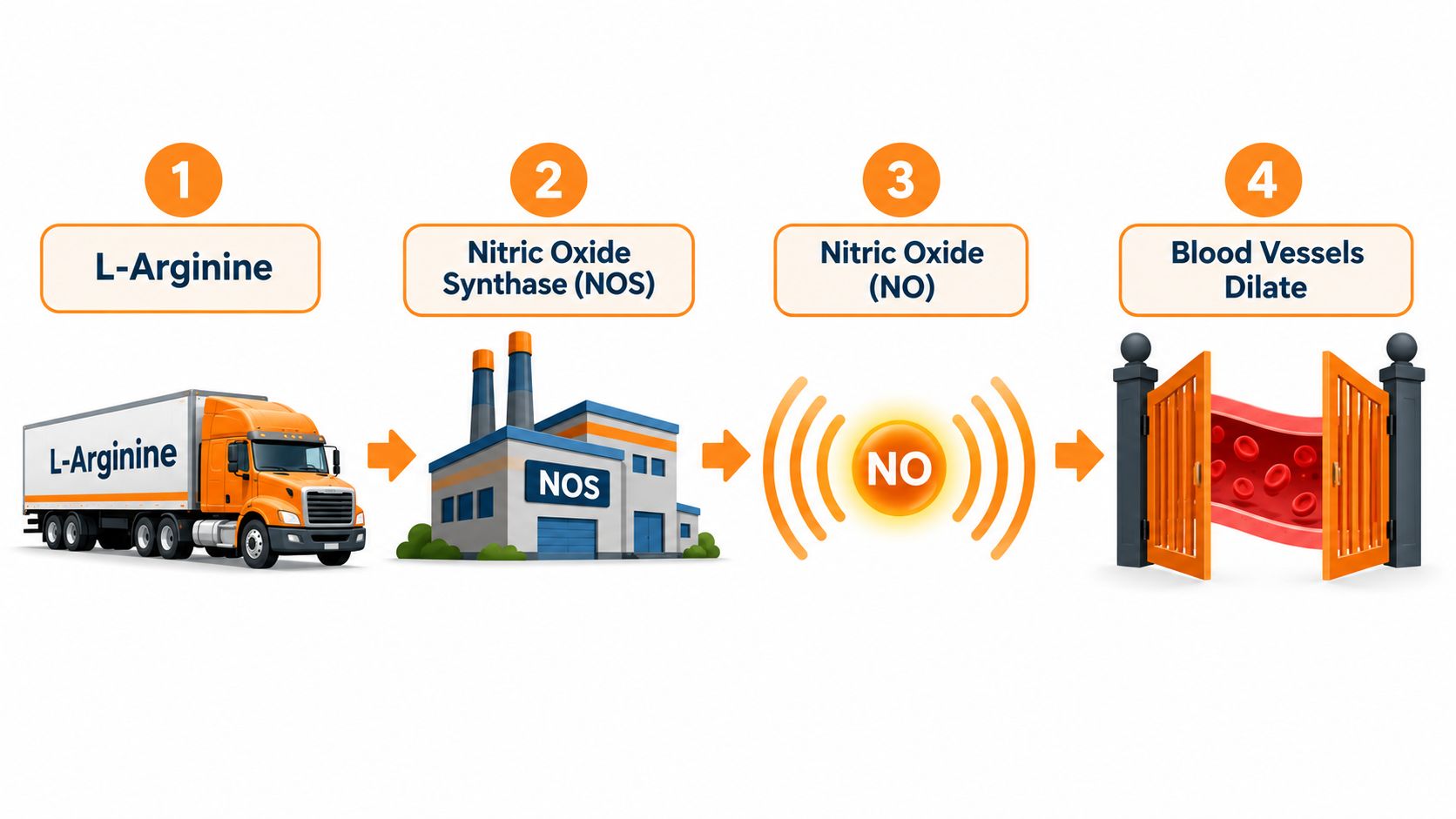
Vessel relaxation can influence blood flow and blood pressure. It also explains why L-arginine appears in products promoted for exercise blood flow, cardiovascular support, and erectile function. The same effect may become a concern if someone already uses medicine that lowers blood pressure. Adding L-arginine can increase vascular relaxation and make light-headedness or weakness more likely.
Why digestion can react
The body does not absorb every part of a consumed dose in the same way. Some arginine remains in the digestive tract and may contribute to bloating, abdominal discomfort, nausea, and diarrhea. The NIH Office of Dietary Supplements reports that doses up to 9 grams per day were generally safe and well tolerated in short-term studies. Amounts from 9 to 30 grams per day more often caused gastrointestinal problems and a small reduction in blood pressure. NIH guidance on L-arginine and exercise supplements
This pathway also helps explain headaches and dizziness. If vessels relax more than expected, blood pressure can fall, leaving someone light-headed, weak, or unsteady. The concern increases with nitrates, antihypertensive medicines, erectile-dysfunction medicines, or other vasodilators.
L-arginine is not automatically dangerous, and a side effect does not mean it harms everyone. The practical question is whether the dose, product, medicines, and health conditions together create more vascular or digestive stress than expected.
Dose Ranges and What Changes With Them
Dose often separates mild, occasional discomfort from clearer intolerance. A larger serving does not automatically produce a better result. As the amount rises, the digestive system has more to process, and taking the entire daily amount at once can make symptoms more likely.
These ranges describe patterns seen in research, not fixed personal limits. Sensitivity varies. A label may also understate total intake if several products contain L-arginine, such as a standalone supplement, a pre-workout formula, and a product marketed for sexual health.
L-Arginine Dose Bands and Reported Effects
| Dose Range | Typical Use | Most Common Side Effects |
|---|---|---|
| Up to 3 grams daily | Lower supplemental intake | Often tolerated, although sensitive users may notice digestive discomfort |
| 3 to 6 grams daily | Common range in clinical and performance research | Nausea, bloating, abdominal discomfort, or loose stools may occur |
| 6 to 9 grams daily | Higher supplemental intake | Gastrointestinal symptoms and blood-pressure effects become more relevant |
| 9 to 30 grams daily | Gram-level research dosing | Diarrhea, nausea, abdominal discomfort, appetite reduction, and modest blood-pressure reduction are reported more often |
The NIH information on dose and tolerability describes amounts up to 9 grams per day as generally well tolerated for several days or weeks. Safety at high doses beyond three months has not been established. Research using 9 to 30 grams per day has reported bloating, reduced appetite, diarrhea, and, in some cases, hyperchloremic acidosis. These findings should not be applied automatically to a typical product serving, because research doses can be much larger.
A dose that seems reasonable on paper may still be a poor fit for someone taking blood-pressure medicine, nitrates, or another product that affects circulation. The same amount can therefore have a different safety margin from one person to another. The label is a starting point, not permission to ignore existing treatment or a diagnosed condition.
Why divided doses may help
A single large serving sends more L-arginine through the digestive tract at once. Dividing the same daily amount can spread that load out, much like pouring water through a filter gradually instead of all at once. A review found that single doses of 3 to 6 grams rarely caused symptoms, while gastrointestinal reactions became more common above approximately 9 grams per dose, particularly in some athletic populations.
Check the serving size, suggested frequency, and overlapping ingredients before deciding how much to take. This L-arginine dosage guide can help with label comparison, but a pharmacist or clinician should assess the choice when medication or a health condition is involved.
Common Side Effects to Watch For
The most recognizable L-arginine supplement side effects involve the digestive system and blood vessels. A person may notice symptoms after taking a serving, after increasing the daily amount, or after combining products that contain the same ingredient. The symptoms can be uncomfortable without being medically dangerous, but persistent or severe reactions deserve attention.

Digestive reactions
The common complaints include:
- Nausea: More likely when a serving is large or the product is taken without considering total daily intake.
- Abdominal pain or cramping: A sign that the digestive tract isn't tolerating the amount well.
- Bloating and gas: These may occur when part of the dose remains in the gut.
- Diarrhea or loose stools: This becomes more relevant at higher gram-level doses.
A 2019 systematic review of arginine supplementation for erectile dysfunction included 216 patients. In that review, 16 patients, or 8.3%, reported mild adverse effects, compared with 2.4% in placebo groups. Reported symptoms included headache, itching, and insomnia, and no severe adverse effects were observed. When arginine-only treatment was examined separately, 2 of 99 participants, or 2%, reported adverse effects. These figures come from the Mayo Clinic review of L-arginine, and they describe specific clinical studies rather than every supplement user.
Vascular symptoms
Headache, dizziness, warmth, or flushing can reflect the blood-vessel relaxation described earlier. A mild symptom after a serving may improve when the dose is reduced, but dizziness while standing, fainting, unusual weakness, or impaired exercise tolerance calls for more caution.
A person shouldn't force through recurring symptoms to reach a target serving. Persistent diarrhea, repeated cramping, severe headache, or continuing light-headedness is a reason to stop the supplement and contact a healthcare professional. Chest discomfort, fainting, severe shortness of breath, or confusion requires urgent medical attention rather than dose experimentation.
A broader overview of supplement side effects can help distinguish ingredient-specific concerns from reactions caused by a multi-ingredient formula.
Medication and Health Condition Interactions
The most consequential safety question often isn't whether L-arginine can cause an upset stomach. It's whether the ingredient adds to the effect of a medicine already affecting blood pressure, blood vessels, blood sugar, bleeding, or potassium.
L-arginine can increase nitric-oxide availability and promote vasodilation. Combined with nitrates, antihypertensive medicines, certain diuretics, or erectile-dysfunction medicines, that effect may become additive. A person may experience light-headedness, fainting, low blood pressure, or reduced exercise tolerance. Pooled trial results described in clinical summaries showed average reductions of roughly 5 to 6 mm Hg systolic and 2 to 3 mm Hg diastolic, although individual responses vary. Drug interaction information for L-arginine explains why medication review matters.
Medication and condition comparison
| Medication or Condition | Interaction Risk | Recommended Action |
|---|---|---|
| Nitrates such as nitroglycerin or isosorbide | Additive nitric-oxide-related vasodilation and hypotension | Avoid combining without specific medical clearance |
| Antihypertensive medicines | Blood pressure may fall more than intended | Ask a prescriber or pharmacist before use and monitor for dizziness |
| Erectile-dysfunction medicines such as sildenafil | Combined vascular effects may cause excessive hypotension | Obtain professional guidance before combining |
| Blood thinners or antiplatelet medicines | Bleeding risk may increase | Review the ingredient with a clinician or pharmacist |
| Diabetes medicines | Blood sugar may shift when arginine affects glucose handling | Seek medical advice and monitor glucose as directed |
| Potassium-sparing diuretics such as amiloride, spironolactone, or triamterene | Potassium levels may rise | Avoid self-starting and request a medication review |
| Kidney or liver disease | Altered metabolism or clearance may increase risk | Use only with healthcare supervision |
The concern extends beyond prescriptions. Kidney disease may involve electrolyte disturbances or changes in waste-product handling, while liver disease can make altered metabolism more significant. People with cardiovascular disease, kidney disease, liver disease, or acute severe illness shouldn't treat a supplement label as a substitute for individualized advice.
The safest approach is to bring the full product label to a pharmacist. That review should include every blood-pressure medicine, nitrate, erectile-dysfunction medicine, blood thinner, diabetes treatment, and potassium-sparing diuretic.
Special Cases Worth a Second Look
Some health histories change the decision more than a dose adjustment. A person with recurrent cold sores, asthma, a recent heart event, or an upcoming operation may need to pause or avoid L-arginine rather than take less.

Herpes history
Mayo Clinic cautions that people with a history of cold sores or genital herpes should avoid L-arginine because it may reactivate the virus. The concern is easy to miss because the product may be marketed as a general amino-acid supplement rather than as an ingredient with relevance to viral history. A person with this history should discuss the product with a clinician before starting and should stop if unusual outbreak symptoms appear.
Asthma and low blood pressure
Mayo Clinic also cautions that L-arginine may worsen asthma or allergies. A person with asthma should seek professional advice rather than assuming that a blood-flow supplement is harmless because it is sold without a prescription.
Existing low blood pressure creates a separate concern. Adding a vasodilating ingredient to an already low baseline, or combining it with blood-pressure medication, may increase dizziness or fainting risk. A clinician can decide whether the ingredient is appropriate and whether blood-pressure monitoring is needed.
Recent heart events and surgery
L-arginine isn't recommended after a recent heart attack because of safety concerns. Health Canada's monograph also advises professional consultation for people taking cardiovascular, erectile-dysfunction, or blood-thinning medicines and says not to use L-arginine after myocardial infarction. The relevant health-product safety monograph also reflects the need for caution around cardiovascular and surgical situations.
MedlinePlus advises stopping L-arginine at least two weeks before scheduled surgery because of possible effects on blood-pressure control. People who are pregnant, breastfeeding, or considering the ingredient for a child should also seek medical direction first, because routine self-directed use isn't supported by the same safety assumptions used for healthy adults.
A Simple Safety Checklist Before You Start
A practical decision process can prevent most avoidable mistakes. The first step isn't opening the bottle. It's checking whether the person's existing treatment makes L-arginine a poor fit.
Before the first serving
- Review prescriptions: A pharmacist or prescriber should check any nitrate, blood-pressure medicine, erectile-dysfunction medicine, blood thinner, diabetes medicine, or potassium-sparing diuretic.
- Check medical history: Herpes, asthma, low blood pressure, cardiovascular disease, kidney disease, and liver disease all deserve specific discussion.
- Confirm surgical timing: A person with scheduled surgery should disclose L-arginine to the surgical team and follow the instruction to stop it at least two weeks beforehand.
- Exclude higher-risk situations: Pregnancy, breastfeeding, childhood use, and recovery after a recent heart attack call for medical direction rather than self-starting.
- Inspect the formula: The label should state the active arginine amount clearly and disclose caffeine, stimulants, sweeteners, and other additions.
During cautious use
A person cleared to use the ingredient can begin at the lower end of the available serving range rather than immediately choosing a large amount. A modest serving, often 1 to 2 grams, can be assessed for tolerance before any increase, but the appropriate amount depends on the product and the individual's health profile.
Dividing the daily intake may reduce digestive discomfort. A person can also keep a simple record of blood pressure, heart rate, nausea, bowel changes, dizziness, headache, and any unusual weakness during the first two weeks. That record gives a clinician useful information and helps identify whether symptoms follow a particular serving.
Stop-and-check rule: Warning signs, swelling, chest discomfort, fainting, severe dizziness, confusion, or persistent gastrointestinal symptoms should end the experiment and prompt medical contact.
Third-party testing from USP, NSF, or ConsumerLab can help with product-quality decisions, while a formula with undisclosed stimulants creates unnecessary uncertainty. The safest choice isn't necessarily the product with the largest serving. It's the product and dose that fit the person's medication review, medical history, and tolerance.
These statements have not been evaluated by the Food and Drug Administration. This product is not intended to diagnose, treat, cure, or prevent any disease.
Men comparing ingredients for a daily wellness routine can review how SEMEX combines L-arginine with other men's wellness ingredients and assess the formula against their own medication checklist. Visit SEMEX to review the product details and make a more informed supplement decision.