

L Arginine Capsules Benefits: Real Science & How to Use Them
A man comparing L-arginine capsules may see the same promises everywhere: better circulation, more energy, improved sexual performance, and stronger reproductive support. The difficult part isn't finding a list of possible benefits. It's understanding why the ingredient may matter more for someone with impaired vascular function than for a healthy man whose blood vessels already respond normally.
L-arginine is best understood as biological support, not a guaranteed “pump.” It supplies raw material for nitric oxide, a signaling molecule involved in blood-vessel relaxation. That mechanism helps explain the interest in circulation, exercise recovery, erectile function, and sperm health, while the mixed evidence explains why results vary from person to person.
Table of Contents
- Why L Arginine Is the Foundation of Circulation Support
- How L Arginine Powers Blood Flow and Vessel Health
- Supporting Semen Volume and Sperm Quality Naturally
- Finding the Right Dosage for Your Goals
- Safety Considerations and Who Should Be Cautious
- How to Choose a High-Quality L Arginine Supplement
- Putting It All Together for Lasting Results
Why L Arginine Is the Foundation of Circulation Support
A man comparing circulation supplements may see labels built around herbs, minerals, or several amino acids. L-arginine has a more specific role. It is a direct precursor to nitric oxide, giving the body one of the raw materials needed to produce this vascular signal. That connection explains why researchers study L-arginine capsules for circulation support, although a biological role does not guarantee a noticeable result.
Nitric oxide helps blood vessels relax. Relaxed vessels can make more room for blood to move, which supports the delivery of oxygen and nutrients to tissues. The same pathway helps explain L-arginine's presence in products marketed for men's vitality and intimate wellness. It works more like supplying material to a communication system than like taking a direct stimulant, and it cannot replace medical care.

Why context changes the outcome
The phrase l arginine capsules benefits can suggest that everyone should expect the same effect. Research points to a more specific pattern. Someone with endothelial dysfunction may have more opportunity for improvement than a healthy, active man whose blood vessels already respond normally.
Evidence from a separate review of L-arginine in healthy populations found no clear improvement in measures such as plasma L-arginine, forearm blood flow, or endothelial-dependent vasodilation in the available review evidence. This does not make the ingredient irrelevant. It shows that the starting condition of the vascular system can influence the outcome.
That distinction makes supplement decisions more practical. Consider the goal first, then whether the relevant pathway may be under strain. A person should also review medications and health conditions with a qualified clinician, since they can change both suitability and risk.
Practical rule: L-arginine supports a biological pathway. It is not a universal performance switch.
How L Arginine Powers Blood Flow and Vessel Health
The endothelium acts as a signaling layer inside each blood vessel. It detects chemical cues and instructs the surrounding smooth muscle to relax or contract. Endothelial cells can use L-arginine to produce nitric oxide, or NO. NO then signals the smooth muscle to relax, creating more room for blood to move.
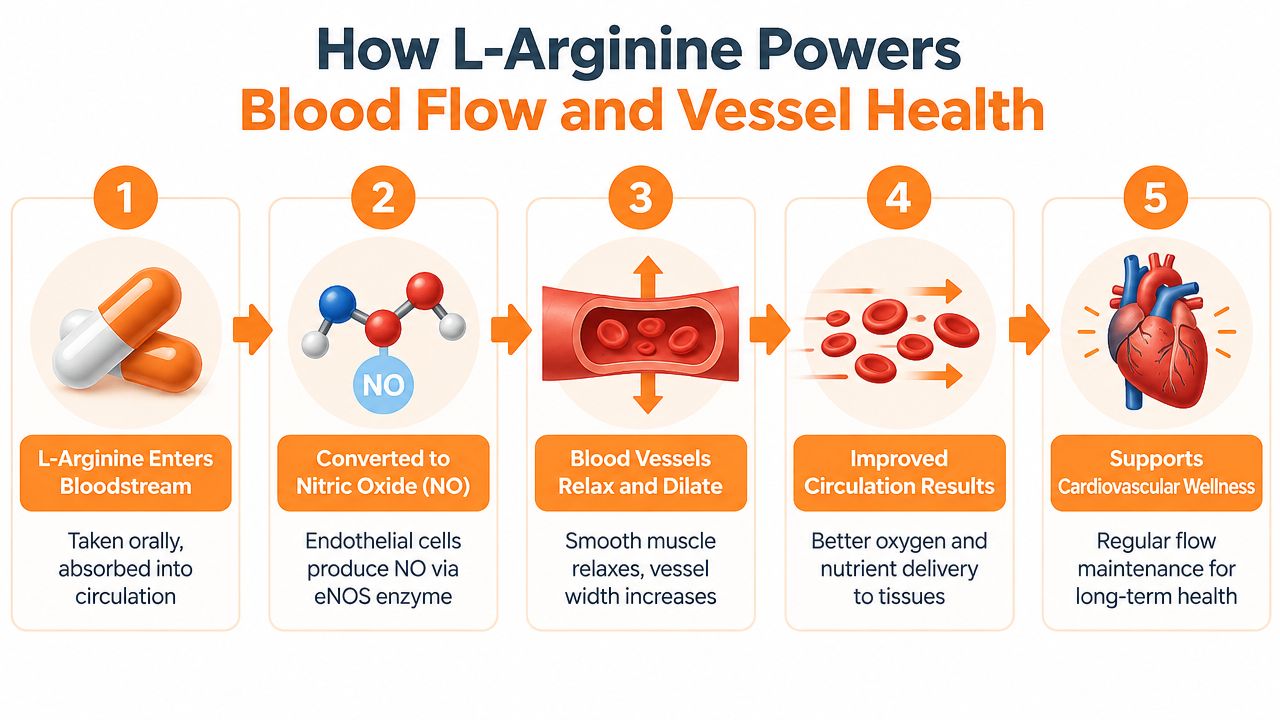
Human research has measured vascular changes through this pathway, particularly among people with impaired circulation. One randomized trial found that an intravenous dose of 30 g administered over 30 minutes increased limb blood flow about 2-fold. Another reported that 6 months of oral L-arginine produced a coronary blood-flow response of 149±20% compared with 6±9% with placebo. These findings appear in the Circulation study on L-arginine and vascular response.
Those results do not mean a capsule will reproduce an intravenous research protocol. Route, dose, health status, and study design can all change the response. The findings instead clarify the mechanism: L-arginine supplies material for a signaling pathway that may work differently in a healthy vascular system than in one under strain.
What the vascular studies actually suggest
Additional human research found that femoral arterial blood flow rose 42.3% ± 7.9% during intravenous L-arginine infusion, while placebo changed by 4.3% ± 13.0% in patients with critical limb ischemia. Earlier research also reported dose-dependent forearm blood-flow increases at intra-arterial doses from 10 to 60 mg per minute, with flow changing from 4.7 ± 0.6 to 8.2 ± 0.9 mL·min⁻¹·100 mL⁻¹. These figures come from the Circulation research on L-arginine and vascular tone.
For broader context, this guide to nitric oxide and blood flow explains how NO relates to circulation. The practical conclusion is specific: L-arginine may have more noticeable relevance when the NO pathway is responsive but limited, while healthy populations may see little measurable change. That context matters when deciding whether capsules match a person's actual goal and vascular status.
Supporting Semen Volume and Sperm Quality Naturally
A man may notice stronger sexual function and assume his reproductive health will improve in the same way. Sperm development follows a different set of factors. L-arginine has been studied as a nutrient linked with sperm quality and motility, rather than as a treatment that directly changes fertility outcomes. Its proposed role again involves nitric oxide, or NO, a signaling molecule that may influence the environment where sperm develop and move.
Some reviews describe favorable findings in specific fertility disorders, including reported improvements in sperm count and motility among people with oligospermia and asthenospermia. A systematic review of dietary supplements connected L-arginine trials with improved progressive motility at 1.4 g in studies enrolling 50 participants, according to the review of male fertility and nitric oxide. This research supports interest in L-arginine, but the response may differ between a person with impaired sperm parameters and someone whose baseline fertility is already normal.
Why motility findings do not equal fertility outcomes
Sperm motility is one laboratory measure, like checking how well one part of an engine moves. It can provide useful information without proving that the entire reproductive system will produce a desired outcome. The studies were often modest in size, and results can vary with nutrition, illness, heat exposure, sleep, alcohol use, medication, and the time between assessments.
L-arginine may support conditions related to sperm motility and quality. No supplement should be presented as treating infertility or guaranteeing conception. Men concerned about reproductive health should consider a clinician-led evaluation, which can examine several possible factors instead of relying on a capsule alone.
Zinc sometimes appears alongside L-arginine in men's reproductive formulas. A WHO-indexed review reports that dietary zinc deficiency below 5 ppm impairs reproduction in both males and females, supporting zinc's relevance to normal reproductive function through its documented review. That evidence concerns zinc deficiency, not a guarantee that adding more zinc or combining it with L-arginine will produce a specific result.
Useful distinction: L-arginine's reproductive research concerns support for sperm-related parameters, not a promise to fix a fertility diagnosis.
Finding the Right Dosage for Your Goals
A reader may see 500 mg, 750 mg, or 1 g on a capsule label and assume the largest option must work best. The label shows strength, not suitability. L-arginine response depends on the goal, starting health, tolerance, and how consistently it is used.
Capsule math makes serving sizes easier to understand. A 500 mg capsule provides 1 g in two capsules, while a 750 mg capsule requires four capsules to provide 3 g. A 1 g capsule reaches 2 g in two capsules. These examples do not prescribe an amount, but they help prevent accidental over- or under-counting when comparing products.
Comparing lower and higher research protocols
Research on higher-risk patients examined daily oral doses from 2.8 to 8 g, used for 2 weeks to 6 months, and associated them with improvements in mild-to-moderate erectile dysfunction scores in the relevant meta-analysis. The comparison highlights a context-specific response. A person with compromised vascular function may respond differently from a healthy user, so a research range should not become an automatic target.
Use four questions to match the amount to the purpose:
- Purpose: A product studied for vascular function is not automatically interchangeable with one marketed for sperm-related parameters.
- Tolerance: Digestive discomfort can make a routine difficult to maintain, even if the label suggests a larger serving.
- Duration: Some outcomes depend on consistent use over time, so one serving cannot settle whether the approach fits.
- Medical context: People with relevant health conditions or medication use should obtain professional guidance before approaching research amounts.
The practical rule is simple: more is not always better. Compare the label with the intended goal, follow the manufacturer's directions, and use a L-arginine dosage guide to distinguish capsule strength from total daily intake. Individual advice still matters, especially when the planned amount resembles a research protocol.
Safety Considerations and Who Should Be Cautious
“Natural” doesn't mean physiologically inactive. Because L-arginine can support NO production and vessel relaxation, it may also lower blood pressure. That effect can be relevant for someone taking medication, managing low blood pressure, or combining several products that influence circulation.
Commonly reported oral side effects include nausea, diarrhea, bloating, headache, palpitations, and possible hypotension, as summarized by medical information on L-arginine safety. These reactions may be especially frustrating for people who increase intake quickly or assume that discomfort signals effectiveness.
Medication interactions deserve priority
People taking nitrates, including nitroglycerin or similar medicines, should be particularly cautious because the combination may lower blood pressure too far. Other blood-pressure-lowering medicines can create a similar concern. Anyone using medication for cardiovascular health should discuss L-arginine with a qualified healthcare professional before adding it.
A pharmacist can also review the full supplement stack. That matters because a person may take a pre-workout, a sexual wellness product, and a blood-pressure medicine without realizing that several ingredients can affect vascular tone at the same time.
Why healthy users may notice less
The evidence also challenges the assumption that every user should experience a strong benefit. A review in healthy men found no meaningful improvement in several blood-flow measures, while broader oral L-arginine analyses reported no overall improvement in post-ischemic hyperemia. The response appears more likely to depend on vascular status, dose, duration, and study population than on the ingredient name alone.
A safe decision includes more than checking the front label:
- Review medications first, especially nitrates and blood-pressure treatments.
- Start only within labeled directions, rather than copying an intensive research protocol.
- Monitor tolerance, including digestive symptoms, headache, palpitations, or light-headedness.
- Stop and seek medical guidance if troubling symptoms appear.
How to Choose a High-Quality L Arginine Supplement
A transparent label is more useful than an aggressive promise. The first checkpoint is the ingredient panel. It should identify L-arginine clearly, show the amount per serving, list other active ingredients, and avoid hiding a proprietary blend that prevents meaningful comparison.

A practical quality checklist
Third-party verification adds another layer of confidence because an independent laboratory can assess whether a product meets stated standards. Readers evaluating this point can review what third-party verification means for supplements, then look for accessible testing information rather than relying only on marketing language.
Other useful checks include:
- Ingredient identity: The label should name L-arginine instead of using only a broad category such as “nitric oxide complex.”
- Serving clarity: The daily serving should be easy to understand, including the number of capsules and total amount.
- Manufacturing information: A responsible brand should provide clear manufacturing and contact details.
- Testing scope: Testing for microbials, heavy metals, and adulterants can help readers compare transparency, when the brand publishes what it tests and the relevant thresholds.
- Formula fit: Extra ingredients may be useful, but they also increase the number of substances that need review for tolerance and interactions.
SEMEX is one example of a men's daily supplement that includes L-arginine, zinc, sunflower lecithin, and bromelain, along with additional wellness ingredients. Its published product information lists 3 capsules daily, vegan and non-GMO positioning, USA manufacturing in a cGMP-registered facility, and third-party testing by Eurofins for microbials, heavy metals, and adulterants. Those details describe the product and its quality approach, not a guarantee that L-arginine will produce a particular outcome.
Putting It All Together for Lasting Results
The most realistic view of L-arginine capsules benefits is also the most useful. L-arginine supplies material for nitric oxide production, and that pathway may matter more when vascular function is already impaired than when a healthy person has strong endothelial responsiveness. Research also connects the ingredient with sperm-related parameters, but the findings don't justify promises about fertility, sexual performance, or athletic results for every user.
A sensible routine starts with a specific goal, a transparent label, and attention to safety. The person should compare the serving size with the intended use, avoid copying high-dose research protocols without guidance, and give consistency more weight than a single day's sensation. Tolerance and medication compatibility come before expectations.
Results, when they occur, may build gradually rather than appearing as an immediate stimulant effect. Anyone taking nitrates, blood-pressure medicine, or other products that affect circulation should consult a healthcare professional before using L-arginine.
These statements have not been evaluated by the Food and Drug Administration. This product is not intended to diagnose, treat, cure, or prevent any disease.
Men comparing daily formulas can visit SEMEX to review a capsule blend that includes L-arginine and other ingredients selected for men's wellness, semen volume, and taste support. The product page provides its serving directions, ingredient list, testing information, and purchase terms so readers can make a more informed comparison.